

The audacity of the Apollo Gallery heist at the Louvre — a daylight smash-and-grab that removed Napoleonic-era crown jewels in under seven minutes — has been followed by an equally shocking discovery: internal audits and cybersecurity checks show the museum’s core security systems were protected by trivially simple passwords and were running on legacy, unsupported Microsoft operating systems.
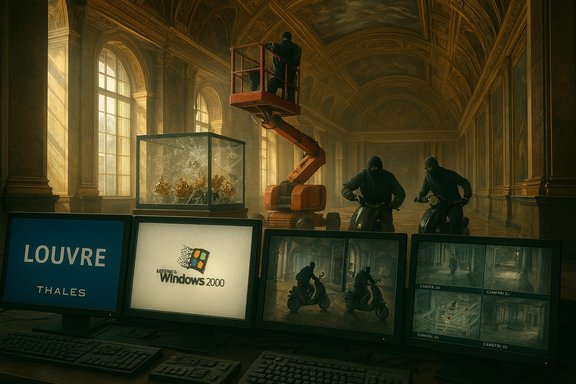
The theft unfolded in October when a team of masked raiders arrived with a cherry-picker truck, ascended to a first-floor balcony, forced entry into the Galerie d’Apollon, smashed display cases and fled on scooters with eight pieces of priceless royal and imperial jewellery. The haul included diadems, necklaces and brooches associated with Empress Eugénie and Empress Marie-Louise; one crown dropped during the escape was later recovered damaged. Four suspects were initially detained and additional arrests followed as investigators pursued leads. Beneath the cinematic details of the breakout, however, lurks a far more mundane but consequential failure: a 2014 cybersecurity audit by France’s National Cybersecurity Agency (ANSSI) and subsequent internal and external inspections flagged a laundry list of vulnerabilities that — on paper — should have been remediated long before the thieves arrived. Those warnings included passwords so obvious they were the institution’s name and vendor name, and security appliances still dependent on Windows 2000 and Windows Server 2003. Multiple post-heist reports and investigative pieces have independently confirmed these findings.
Fixing the problems will require more than new cameras or a few resignations. It will demand institutional change: a sustained lifecycle funding model, stronger procurement discipline, a security-first culture, and the technical hardening that modern museums — as custodians of national heritage — can no longer defer. The immediate arrests and police work may yet recover the missing jewels; the deeper task is ensuring that no future audacious raid succeeds because simple, preventable flaws remain unaddressed.
Source: 매일경제 It has been confirmed that the security password of the Louvre Museum in France, which robbed an ama.. - MK
 Background
The theft unfolded in October when a team of masked raiders arrived with a cherry-picker truck, ascended to a first-floor balcony, forced entry into the Galerie d’Apollon, smashed display cases and fled on scooters with eight pieces of priceless royal and imperial jewellery. The haul included diadems, necklaces and brooches associated with Empress Eugénie and Empress Marie-Louise; one crown dropped during the escape was later recovered damaged. Four suspects were initially detained and additional arrests followed as investigators pursued leads. Beneath the cinematic details of the breakout, however, lurks a far more mundane but consequential failure: a 2014 cybersecurity audit by France’s National Cybersecurity Agency (ANSSI) and subsequent internal and external inspections flagged a laundry list of vulnerabilities that — on paper — should have been remediated long before the thieves arrived. Those warnings included passwords so obvious they were the institution’s name and vendor name, and security appliances still dependent on Windows 2000 and Windows Server 2003. Multiple post-heist reports and investigative pieces have independently confirmed these findings. What the audits found
The 2014 ANSSI assessment: trivial credentials and obsolete endpoints
The ANSSI audit conducted in 2014 examined the Louvre’s security network — the backbone that connects access control, alarms, and video surveillance. Auditors reported that they could gain privileged access using weak credentials: the main video surveillance server accepted “LOUVRE” as a password and a Thales-supplied application used “THALES” as its login. ANSSI warned these weaknesses left the museum’s detection and protection systems open to compromise, and explicitly recommended stronger password policies and migration away from obsolete platforms. It is important to note that ANSSI’s report was framed as an expert penetration-style assessment: it demonstrated not only theoretical exposure but practical routes by which an attacker could influence badge databases, camera feeds, and alarm logic — exactly the sorts of controls that would permit or conceal an intrusion. ANSSI concluded that an attacker with such access “would be able to facilitate damage or even theft of artworks.”Later inspections and procurement reviews: aging systems persisted
Follow-up inspections and procurement records show the problem was not isolated to a single server or application. A 2017 review by the National Institute of Advanced Studies in Security and Justice (INHESJ) and later administrative audits noted workstations and specific security appliances running Windows 2000 and Windows XP, systems whose vendor support and security updates had long since ended. Public procurement documents reviewed by journalists indicate several alarm, CCTV and access-control applications had not received updates or replacement plans for years. These findings paint a picture of incremental decay rather than a single oversight.Budget choices and coverage shortfalls
An administrative audit covering operations between 2018 and 2024 documented the Louvre’s spending priorities: large sums allocated to acquisitions and exhibition renovations, while maintenance and safety budgets lagged. The audit highlighted that only a minority of exhibition rooms were equipped with cameras — figures in contemporary reporting cite surveillance coverage at roughly 39% — and that projects to modernize fire-response plans and surveillance installations had been repeatedly delayed or underfunded.Technical realities: why the vulnerabilities matter
Weak passwords are not "old-fashioned" problems
Using easily guessable credentials such as the institution’s name or the vendor name is a textbook misconfiguration. This error matters for three technical reasons:- Credential predictability makes brute-force and targeted guessing trivial. Automated tools and simple scripts can enumerate and test such passwords in seconds.
- Privilege chaining: the compromised credential was associated with systems that mediate alarms and camera controls — once compromised, attackers can obscure their presence or manipulate logs.
- Lack of defense-in-depth: weak passwords coupled with legacy systems and absent segmentation multiply risk; one compromised node can expose broader networks.
Legacy operating systems are active attack surfaces
Windows 2000 and Windows Server 2003 reached end of support many years ago, leaving them without security patches for critical vulnerabilities. Running such systems in any networked capacity — let alone on a security VLAN connected to sensitive appliances — creates persistent, unpatchable entry points. In real-world terms, this means:- Known exploits with public proof-of-concept code exist and can be weaponized.
- Modern endpoint protection and management tools often do not support ancient OSes.
- Vendors may have ceased developing or supporting interfacing software, leaving integration code brittle and unpatched.
Operational detection gaps
Even if perimeter controls function nominally, CCTV coverage blind spots and misconfigured camera orientations can nullify their deterrent and forensic value. Testimony from the museum’s director and subsequent investigations described cameras that did not cover the balcony used by the thieves, and an exterior camera near the entry point that was pointed away from the vulnerable window. When coupled with limited staffing and crowded galleries, this results in delayed detection and a reduced ability to intervene in real time.Organizational and budgetary causes
Prioritization of acquisitions over infrastructure
The administrative audit noted that the Louvre devoted substantial resources to acquiring works and refurbishing exhibition spaces while comparatively little was spent on maintenance and safety upgrade projects. Public figures cited in reporting show tens of millions of euros going to acquisitions and remodels, with a much smaller share for maintenance and security upgrades — a gap that, in hindsight, translated into deferred modernization of critical systems. Those financial decisions, whether born of prestige, political promises, or procurement bottlenecks, had a measurable operational cost.Procurement complexity and vendor lock-in
Large cultural institutions often operate on procurement cycles, long vendor relationships and bespoke systems. When a supplier’s product (for example, a legacy Thales application) becomes an integral part of the security ecosystem, replacing or upgrading it requires time, budget, and operational planning. The public record suggests at least one core application had ceased active development by its vendor, complicating migration plans and creating a maintenance dependency that was not resolved in time.Human factors and culture
Staffing levels, turnover, and the distribution of responsibilities contribute to security posture. Reports cited understaffing and overcrowding at the Louvre, and testimony from the director noted staff walkouts and complaints earlier in the year. When vigilance is spread thin across tens of thousands of visitors daily, mechanical and technical safeguards must compensate — which they did not. Organizational attention drift — where attention is directed toward headline projects and away from mundane but vital maintenance — is a recurring theme in the institutional record.The immediate aftermath: leadership and legal responses
Culture Minister Rachida Dati ordered an extraordinary board meeting and asked the museum’s director to convene discussions on establishing a new security department and accelerating installation of intrusion-prevention devices. The director offered her resignation, which the minister declined; investigators meanwhile pursued arrests and sought to recover the stolen pieces. Law enforcement emphasized that the items are effectively unsellable in legitimate markets and urged recovery through investigative pressure and international cooperation. Prosecutors reported DNA matches and identified suspects with prior theft histories; several arrests were made in the days following the heist. Despite these developments, the physical jewels remained unrecovered in initial reporting. The legal framing for the suspects included organized theft and criminal conspiracy, and investigators continue to evaluate whether inside knowledge or collusion eased the operation.What this means for museum cybersecurity and physical security — a practical analysis
The Louvre is not unique in facing the tension between visible investment (acquisitions, galleries) and latent investment (maintenance, IT hygiene). The lessons for cultural institutions and facility operators are immediate and applicable.Short-term remediation checklist (first 90 days)
- Enforce strong password policies and rotate all administrative credentials immediately. Replace default or trivial passwords with multi-factor authentication (MFA) on all privileged accounts.
- Isolate and segment security networks so CCTV, alarms and access control systems are physically and logically separated from general-purpose IT networks.
- Replace exposed legacy endpoints or remove them from network access while interim compensations (e.g., virtual patching, network filtering) are applied.
- Complete a full CCTV coverage audit and reorient or add cameras to eliminate blind spots in galleries and external façades used for loading or servicing.
- Conduct an immediate internal communications and staffing review to ensure physical guards and on-site law enforcement liaisons are adequately resourced for high-value galleries.
Mid-term steps (3–12 months)
- Implement centralized logging with tamper-resistant storage for CCTV and access-control logs.
- Run a full red-team assessment that includes physical breach simulations and evaluates the end-to-end detection and response chain.
- Migrate or modernize vendor-supplied security applications; where replacement is infeasible, Institute compensating controls such as network segmentation and hardened gateways.
Long-term institutional reforms (12–36 months)
- Rebalance capital planning to include mandatory lifecycle budgets for security and IT maintenance.
- Establish a dedicated Security Operations Center (SOC) for 24/7 monitoring, paired with law enforcement liaison officers.
- Create a governance board-level security committee with explicit authority and regular reporting to prevent deferred maintenance from persisting.
Risks and potential blind spots
Insider threat vs. opportunistic exploitation
Public reporting has, to date, not confirmed insider complicity, and authorities have emphasized arrests based on DNA and surveillance chain evidence. Nevertheless, the presence of trivial administrative credentials and poorly segmented networks materially increases the risk that an opportunistic actor — whether external or internal — could exploit technical weaknesses to assist a theft. That risk remains non-trivial until the museum proves systemic changes. Claims that insiders were involved should be treated carefully until judicial processes provide confirmation.The limits of technology without process
Camera upgrades and software patches are necessary but insufficient on their own. Security is a socio-technical system: technical controls must be backed by processes (change management, procurement timelines, patch cadences), people (adequate guards, trained IT staff), and governance (budget authority, board oversight). Institutions that focus narrowly on one axis — for example, buying new cameras without ensuring monitoring and response — will remain vulnerable.Public trust and reputational capital
Museums trade in public trust and cultural stewardship. High-profile breaches shake donor confidence, visitor perception, and political support. The Louvre faces reputational consequences that extend beyond the financial value of the stolen pieces, including scrutiny of how public funds are allocated for heritage protection. Restoring that trust requires a clear, demonstrable, and sustained remediation plan.Lessons for IT and security leaders in cultural institutions
- Assume attackers begin with credentials. Default or trivial credentials remain one of the most common root causes of compromise. Enforce MFA and ephemeral credentials for administrative tasks.
- Treat the security network as a critical asset. CCTV, access control and alarm systems are not peripheral; they are core infrastructure and must be funded and refreshed accordingly.
- Plan lifecycle spending, not headline spending. Acquisitions and exhibitions attract attention; maintenance does not. Budget models must reserve a fixed portion of capital for lifecycle and cyber-physical security upkeep.
- Invest in cross-disciplinary testing. Physical security teams, IT security teams and procurement should run integrated tabletop exercises and full-scope red-team operations to identify combined attack vectors.
- Document and de-risk legacy vendors. If a vendor product cannot be modernized, institutions must plan compensating controls and schedule end-of-life migrations well in advance.
What remains unclear and should be treated with caution
Several elements in the reporting chain require caution: whether the specific credentials “LOUVRE” and “THALES” were still valid at the time of the theft cannot be confirmed publicly beyond the documents cited in press investigations and the ANSSI assessment. The timeline of remediation steps taken since the 2014 audit is also partially opaque in public records; museum management and government entities claim ongoing modernization efforts, but external reporting suggests those efforts were incomplete in critical areas. These gaps in the public record underline why transparency and independent verification are essential in the wake of an incident of this scale. Where assertions are not corroborated by multiple, independent primary documents they should be treated as provisional.A practical roadmap: 10 priority actions for museums today
- Rotate and strengthen all privileged credentials; require MFA everywhere administrative access exists.
- Isolate CCTV and alarm networks on physically separated VLANs and enforce strict firewall rules.
- Replace or decommission unsupported operating systems; where that is not immediately possible, apply compensating controls (virtual patching, restricted access).
- Increase CCTV coverage to remove blind spots in high-value galleries and external façades used for maintenance access.
- Create or expand a staffed Security Operations Center with 24/7 monitoring and rapid-response protocols.
- Perform quarterly red-team exercises that combine physical breach and cyber intrusion scenarios.
- Adopt vendor lifecycle policies that prevent prolonged dependency on unsupported appliances.
- Allocate a fixed percentage of annual capital to maintenance and security lifecycle expenses.
- Implement tamper-evident logging and offsite log storage for video and access-control data.
- Publish an annual security posture summary to build public trust and demonstrate continuous improvement.
Conclusion
The Louvre heist is a rare, dramatic headline event with ordinary technical roots: weak credentials, aging systems, budgetary choices, and operational coverage gaps. Those converging failures turned a daylight smash-and-grab into a global story about how digital neglect and deferred infrastructure upkeep can translate into dramatic real-world loss.Fixing the problems will require more than new cameras or a few resignations. It will demand institutional change: a sustained lifecycle funding model, stronger procurement discipline, a security-first culture, and the technical hardening that modern museums — as custodians of national heritage — can no longer defer. The immediate arrests and police work may yet recover the missing jewels; the deeper task is ensuring that no future audacious raid succeeds because simple, preventable flaws remain unaddressed.
Source: 매일경제 It has been confirmed that the security password of the Louvre Museum in France, which robbed an ama.. - MK
