LSEG MaaS Launch: A Practical Model Marketplace for Banks and Vendors

  • Thread Author
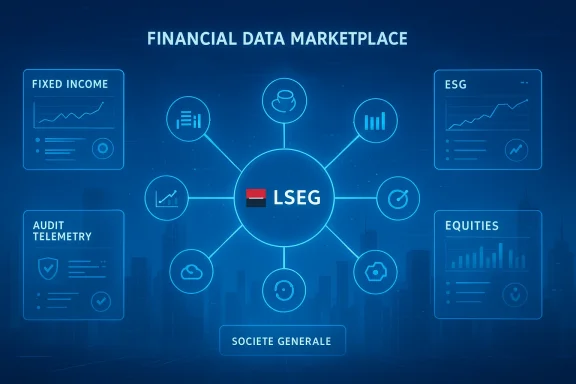
Central LSEG hub linking Fixed Income, ESG, Equities and other data panels in a financial data marketplace.
LSEG’s launch of Model‑as‑a‑Service (MaaS) marks a pragmatic and strategically timed extension of its data‑and‑infrastructure play: the platform promises a governed, monetisable marketplace where banks, buy‑side firms and analytics vendors can host, distribute and run financial models — and Societe Generale has been named as the first major partner to publish seven flagship datasets and analytics on the marketplace.

Background​

LSEG’s announcement on February 19, 2026, described MaaS as a secure, governed marketplace that lets institutions expose models and analytics to clients without the heavy integration and compliance burden traditionally associated with commercialising proprietary models. The initial content bundle from Societe Generale spans Fixed Income, FX, ESG and Equities analytics, and LSEG positions the service as a route to both distribution and operationalisation of third‑party models alongside its own analytics.
This launch is not an isolated product release: it sits on top of an expanding set of LSEG cloud and partner initiatives that include easier distribution of LSEG data to cloud platforms and AI development environments. LSEG has already been threading its datasets into major cloud ecosystems (notably Microsoft Azure and Databricks) and building MCP‑based connectivity that surfaces licensed, AI‑ready data into agent runtimes. Those prior moves provide the practical plumbing MaaS needs to deliver models into enterprise AI stacks.
Industry coverage and commentary from financial media quickly followed the press release, echoing LSEG’s framing of MaaS as a way to reduce infrastructure and go‑to‑market overhead for model providers while giving consumers a single, governed access point to multiple providers’ analytics. Independent press outlets reiterated the categories of analytics being made available and the role of Microsoft partnership and Model Context Protocol connectors in enabling distribution and deployment.

What is Model‑as‑a‑Service (MaaS)?​

A quick definition​

Model‑as‑a‑Service, as positioned by LSEG, is a managed marketplace and runtime that allows institutions to:
  • Host analytic models and packaged analytics in an LSEG‑governed environment.
  • Distribute model functionality (not raw code or raw data) to authorised clients.
  • Execute or probe models in a controlled, auditable runtime which enforces licensing and compliance rules.
The offering is explicitly about turning proprietary intellectual property — quant models, scoring algorithms, analytics bundles — into scalable, revenue‑bearing services without exposing raw model internals or requiring customers to build bespoke connectivity stacks.

Core capabilities LSEG highlights​

  • Secure hosting and run‑time: models run inside a governed environment with rights and usage controls.
  • Discovery and distribution: centralised marketplace for discovery, with LSEG providing the commercial surface.
  • MCP‑based connectors: Model Context Protocol (MCP) connectors enable models to be surfaced into partner AI ecosystems and agent runtimes, simplifying integration.
These components form the triangle most modern model marketplaces attempt to solve: trust (who can run/see what), utility (how models are packaged and discovered) and plumbing (how models connect into customer workflows).

Why LSEG’s timing and angle matters​

Market maturity meets regulatory and operational demand​

Over the last 18–24 months, buy‑side and sell‑side firms have moved from experimentation with models and LLMs to operationalisation concerns: model governance, data licensing, reproducibility, audit trails and secure deployment. LSEG is exploiting an opening where firms want to monetise analytics while keeping control over IP and compliance posture. A marketplace that handles both the commercial contracting and the technical guardrails reduces friction for both sellers and buyers.

Strategic leverage of cloud partnerships​

LSEG’s MaaS does not live in isolation — the company has amplified its cloud alignments (significant work with Microsoft and integrations with Databricks and AWS across 2025–2026). Those partnerships provide two advantages:
  1. Distribution reach: embedding models into partner ecosystems like Microsoft Copilot Studio gives instant access to enterprise agent builders and workflows.
  2. Operational scale: cloud partners offer compute, identity, and data governance primitives necessary for productionising model execution and connectors at scale.
That combination — a trusted data provider + a cloud platform’s agent runtime — is compelling for financial customers who must meet strict audit, risk and data access requirements.

The technical underpinning: Model Context Protocol (MCP) and Copilot Studio​

What MCP brings to the table​

The Model Context Protocol (MCP) is emerging as a pragmatic standard for exposing model capabilities, tools and knowledge servers to agent frameworks. MCP abstracts the contract between an external knowledge/action server and an LLM‑led agent so that connectors can be built once and consumed broadly.
LSEG’s MaaS relies on MCP connectors to publish model metadata, inputs, outputs and operational bindings so downstream agent , Microsoft Copilot Studio) can discover and call model functions with appropriate governance and telemetry. This approach reduces brittle point‑to‑point integrations and enables live synchronization of model interfaces.

Integration with Copilot Studio — practical consequences​

Microsoft added MCP support to Copilot Studio, enabling makers to wire external data and tools into agents via MCP connectors. LSEG’s managed MCP server is designed to expose licensed datasets and deterministic analytics directly into Copilot Studio agents and the Microsoft 365 Copilot runtime — meaning agents can call LSEG‑published model endpoints as part of everyday workflows like research briefs, risk reports or portfolio notes. This is a concrete example of the model marketplace feeding directly into agentic productivity scenarios used on trading desks and by risk teams.
An internal forum analysis of the LSEG‑Microsoft workstream previously described how MCP servers bridge LSEG APIs and customer AI stacks, and highlighted the availability of MCP connectors for key partner runtimes. That industry discussion matches the public technical framing LSEG and Microsoft have used in recent months.

Societe Generale’s role: content, credibility and the first mover effect​

Societe Generale has been announced as the first partner to place analytics on MaaS, contributing seven datasets and analytics across Fixed Income, FX, ESG and Equities. For SocGen, the marketplace is a channel to monetise proprietary analytics and to place its products within client workflows built on LSEG and Microsoft platforms. For LSEG, onboarding a large universal bank of SocGen’s scale provides credibility for other potential sellers and buyers.
Why Societe Generale matters:
  • Domain depth: SocGen’s analytics bring institutional‑grade models that can be productised for asset managers and corporate clients.
  • Regulatory familiarity: large banks already operate under stringent governance, easing concerns about a partner contributing regulated analytics to a marketplace.
  • Network signal: a respected bank as first partner reduces perceived seller risk for other firms considering publication.
SocGen’s commercial rationale is simple: reach more clients without reinventing distribution mechanics, and monetize IP while keeping control over model execution and licensing.

Concrete use cases and early adopters​

The MaaS architecture supports a set of timely, high value use cases for institutions:
  • Portfolio managers accessing third‑party scoring models inside their portfolio construction workflows, without extracting raw data or deploying vendor code.
  • Risk teams running stress and scenario analytics supplied by specialist vendors while preserving audit trails and entitlements.
  • Quant teams subscribing to vendor signals (e.g., FX microstructure or ESG scoring) and embedding them into backtesting pipelines via secure API‑style calls mediated by MCP.
  • Compliance and model governance teams auditing model calls and entitlements centrally, rather than chasing logs across distributed deployments.
Practically, the value is delivered when buyers can call a model and receive deterministic outputs that are traceable, priced and under contract — all without lengthy IT integrations.

Commercial and operational benefits (LSEG’s pitch)​

LSEG and early press coverage emphasise the following advantages for institutions:
  • Faster time to market: models can be published onto the marketplace, discovered, and consumed without bespoke API projects.
  • Lower infrastructure and compliance overhead: sellers avoid building and running customer‑grade infrastructure and governance tooling themselves.
  • Monetisation and discoverability: the marketplace creates a central commercial surface and billing/entitlement mechanisms.
  • Seamless integration with AI ecosystems: MCP connectors enable models to be used inside agent authoring tools and productivity layers such as Copilot Studio.
These benefits are real if the marketplace enforces consistent SLOs, latency guarantees and licensing terms — but that is also where the critical operational work must happen.

Critical analysis: strengths and likely challenges​

Strengths​

  • Operational pragmatism: LSEG is leveraging existing relationships in markets and cloud partnerships to deliver a service that matches current enterprise needs for governance and traceability. The combination of a trusted data vendor and widely used cloud agent tooling is a practical route to real world adoption.
  • Immediate demand signal: banks and asset managers have repeatedly flagged the need for secure model sharing and monetisation; LSEG’s marketplace answers a clear client pain point.
  • Standards‑led integration: adopting MCP reduces bespoke integration costs and helps create an ecosystem of reusable connectors that benefit buyers and sellers alike.

Risks and operational friction points​

  • Model risk and interpretability: exposing black‑box models as services does not remove the need for rigorous model validation, bias testing and regulatory scrutiny. Institutions consuming outputs must retain model governance responsibilities; a marketplace does not absolve them of that duty.
  • Data and IP leakage concerns: while MaaS is framed as returning outputs rather than raw data or model internals, sophisticated reverse‑engineering and inference attacks remain a concern in any hosted execution environment. Clear contractual, telemetry and technical controls are essential.
  • Commercial frictions: revenue sharing, liability, service levels and dispute resolution across multiple jurisdictions can complicate marketplace economics — particularly for models used in regulated decisioning. LSEG will need transparent contracts and clear SLAs to scale adoption.
  • Vendor lock‑in and platform dependence: close integration with Microsoft’s Copilot Studio and the use of MCP connectors catalyse adoption, but they can also create an operational dependence on a small set of platform suppliers. Firms will weigh portability and multi‑cloud strategy carefully.

Governance and regulatory scrutiny​

Financial regulators have heightened scrutiny of algorithmic decisioning and model governance. Any marketplace that enables cross‑institutional model consumption should anticipate:
  • Audit and explainability requirements when models produce trading, credit or regulatory outputs.
  • Data residency and licensing constraints when models use licensed or proprietary datasets.
  • Cross‑border compliance and tax/tariff considerations for monetised analytics.
LSEG’s marketplace will need to demonstrate auditability, secure telemetry and legal clarity for institutional buyers and supervisors.

Competitive landscape: who else is in this space?​

LSEG’s MaaS is not alone in the broader trend of marketplace and model‑serving platforms. Key movements to watch:
  • Cloud vendors and platform providers (Microsoft, AWS, Databricks) are building connectors and marketplaces that make data and models available inside their analytic and agent runtimes; LSEG’s approach is to be the domain‑specific provider that sits between intellectual property owners and these platforms.
  • Specialist vendors and exchanges are experimenting with similar model distribution concepts focused on specific workflows (pricing, reference data, risk). The differentiation for LSEG is breadth of data, existing enterprise trust, and regulatory footprint.
  • Open‑source and neutral standard players working on MCP and similar protocols aim to reduce lock‑in by making connectors portable between agent backends. That movement supports LSEG’s decision to rely on MCP but also increases the chance that a multi‑vendor ecosystem emerges quickly.

Practical implications for WindowsForum readers — what IT and data teams should evaluate​

If your firm is considering consuming or selling models through MaaS, consider these action items:
  1. Inventory model governance: map which models are suitable for third‑party consumption and what validation and explainability artifacts are required.
  2. Assess integration points: identify whether your workflows use Microsoft Copilot Studio, Databricks or other agent authoring tools; confirm MCP connector capabilities and any latency or throughput requirements.
  3. Define contractual guardrails: work with procurement and legal teams to understand entitlements, indemnities and service levels before subscribing to model outputs.
  4. Plan telemetry and audit logging: ensure logs and call records are ingested into your governance tooling so model calls are reconstructible during investigations or audits.
  5. Pilot with non‑critical models: begin with research or advisory‑only models before exposing production systems to outsourced model outputs.
These steps help avoid the classic trap: rushing to use “convenient” model outputs without sufficient validation and governance.

What to watch next — short term signals and milestones​

  • **Marketplace onbyond Societe Generale, the pace and calibre of additional model vendors will indicate whether MaaS becomes a broad ecosystem or remains a niche distribution channel. Early adoption by other tier‑1 banks, sell‑side research houses or specialist data vendors will be a strong signal.
  • MCP connector maturity: monitor Microsoft Copilot Studio and other agent runtime updates for MCP feature expansion, stability and security controls. The richer the MCP toolset (schema validation, identity binding, RBAC), the more production‑ready MaaS integrations will appear.
  • Pricing and commercial model transparency: LSEG will need to publish or make available clear licensing and pricing options for MaaS usage; opaque commercial models hinder enterprise procurement. Watch for announcements or customer case studies that provide financial and operational detail.
  • Regulatory feedback: any public supervisory commentary or thematic reviews touching outsourced model consumption or marketplace‑based analytics will reshape contractual and tech controls required. Expect prudential supervisors to focus on auditability and vendor management.

Final appraisal: an incremental but meaningful step​

LSEG’s Model‑as‑a‑Service is an important, pragmatic step in the ongoing evolution of how financial models are commercialised and consumed. By combining LSEG’s domain trust and datasets with cloud partner runtimes and MCP connectivity, MaaS reduces integration overhead and creates a cleaner path to embed external analytics into enterprise workflows. The Societe Generale onboarding provides an immediate content baseline and a credibility boost for the marketplace.
That said, the novelty is less in the idea than in the execution. Real value will depend on hard engineering (latency, reliability, observability), clear commercial contracts, and robust governance tools that satisfy regulated institutions. Buyers must continue to treat model outputs as one input in decision making — with appropriate validation and oversight — not a black‑box replacement for internal controls. LSEG’s MaaS reduces friction; it does not eliminate regulatory or model risk.
For organisations building or buying models, MaaS is worth a close look: it offers a new distribution channel, smoother integration with agent tooling like Copilot Studio, and a commercial framework to turn IP into revenue. But prudent firms will pilot cautiously, insisting on telemetry, contractual clarity and the ability to test and validate model outputs under their own governance frameworks before they roll MaaS‑sourced analytics into production decisioning.

In short: LSEG’s MaaS brings a sensible, standards‑aware approach to a pressing enterprise need — packaging model distribution, governance and cloud integration into a single proposition. The platform’s success will hinge on how well LSEG operationalises governance, scales its MCP connectors across major agent runtimes, and attracts a diverse ecosystem of high‑quality model publishers beyond the early Societe Generale partnership.

Source: Fresno Bee https://www.fresnobee.com/press-releases/article314755646.html
 

LSEG’s new Model‑as‑a‑Service (MaaS) platform went live on February 19, 2026, creating a governed marketplace where banks and buy‑side firms can host, distribute and run analytical models — and Societe Generale is the first major partner to publish seven of its flagship datasets and analytics covering Fixed Income, FX, ESG and Equities onto that marketplace.

A glowing holographic padlock floats at the center of a data-security hub with charts and graphs.Background: why this matters now​

The launch of Model‑as‑a‑Service (MaaS) lands at an inflection point for financial markets: firms are under intense pressure to scale analytics and AI-driven workflows while keeping a tight grip on governance, entitlements and auditability. LSEG has spent the last several years turning itself into a data‑and‑workflow platform as much as a market infrastructure owner, deepening a multi‑year strategic relationship with Microsoft that already covers cloud migration, product integration and a series of co‑developed services. The MaaS announcement builds on that strategic thread by promising a secure, commercial route for vendors and banks to turn proprietary models into consumable products inside institutional workflows.
This is not just another vendor portal: LSEG is positioning MaaS as a secure run‑time and distribution layer — a place to execute models, not just list them — and to surface them into enterprise AI ecosystems using the emerging Model Context Protocol (MCP) standard. That combination of marketplace + execution surface is what makes this development potentially important for desks and risk teams.

What LSEG is offering: the product in plain terms​

Core proposition​

At its core, MaaS is a marketplace and managed execution environment with three linked capabilities:
  • A secure marketplace where sellers (banks, analytics vendors) can publish models and datasets that institutional clients can discover and license.
  • A governed hosting and runtime that allows licensed models to be executed without customers having to build bespoke integration plumbing or accept raw data exports.
  • Native connectors based on the Model Context Protocol (MCP) so models and datasets can be consumed inside AI tooling and agent platforms such as Microsoft Copilot Studio.
LSEG’s announcement frames this as reducing the usual costs and friction around model commercialisation: lower infrastructure overhead, simpler compliance and a single integration point to access models from multiple providers. Those are plausible operational benefits for many institutions, although they are vendor claims that will require proof in production.

The Societe Generale deal — content and coverage​

Societe Generale is the marquee launch partner. LSEG says seven Societe Generale datasets and analytics will be available at launch, spanning FX, Fixed Income, ESG and Equities, enabling clients to access SG’s proprietary analytics alongside LSEG’s own analytics in a single interface. SocGen’s team described the collaboration as an opportunity to commercialise their analytics at scale and reach shared clients through LSEG’s distribution.
Independent press outlets that re‑published the news corroborate the same basic facts from the LSEG release, confirming the scope and positioning of the partnership. That external corroboration reduces the risk that this is a narrowly scoped pilot dressed up as a product launch.

The technical plumbing: Model Context Protocol (MCP) and Copilot Studio​

What is MCP, and why it matters for MaaS​

Model Context Protocol (MCP) is an open protocol designed to let language models and agent frameworks discover and call external tools, datasets and prompts in a standard way. It has been pushed into the mainstream by major cloud and AI vendors, and Copilot Studio supports MCP connectors that expose resources and callable tools to agents. LSEG’s MaaS is explicitly built to publish models via MCP connectors so that downstream AI ecosystems can use them without heavy custom integration.
That matters because the whole promise of model marketplaces — rapid discovery, low‑friction adoption, and secure consumption — breaks down if each purchaser must perform expensive data engineering to integrate models into their stacks. MCP aims to reduce that friction by defining a common contract so that agent builders can browse and call tools and datasets in a uniform way.

Microsoft Copilot Studio integration​

LSEG specifically calls out the availability of its MCP connector in Microsoft Copilot Studio, enabling models hosted in MaaS to be surfaced directly within Copilot agents. Copilot Studio’s MCP support includes authentication, enterprise networking and data loss prevention controls, which are essential for regulated financial use cases. Microsoft’s own documentation describes how an MCP server exposes three classes of artefacts — resources, tools and prompts — to agents, which is exactly the integration pattern LSEG is adopting.
This isn’t theoretical: Microsoft and LSEG have already been working together on multiple initiatives since their strategic deal, including cloud hosting of LSEG services and pilot deployments that put licensed LSEG data into Microsoft workflows. The MaaS + MCP pattern is an extension of that collaboration, focused on model commerce and agentic AI.

What this changes for institutions and vendors​

For banks and analytics vendors​

  • Commercialisation path: Proprietary models can be monetised without building full SaaS stacks and complicated billing and entitlement systems — LSEG offers an off‑the‑shelf path to package and distribute models to institutional clients. This lowers the barrier to entry for smaller quant teams who want to monetise IP.
  • Discovery and reach: Being on LSEG’s marketplace can materially increase distribution reach because customers who already consume LSEG data will see partner models in the same workflow. That reduces sales friction at the initial discovery stage.
  • Operational overhead: Vendors avoid building and maintaining integrations to lots of different client environments; instead they publish once and LSEG (plus MCP connections) does the heavy lifting. That’s the vendor pitch; whether it holds depends on contract terms, revenue share and how well LSEG handles versioning and upgrades.

For buy‑side and sell‑side firms​

  • Faster prototyping and deployment: Risk teams and portfolio managers can discover third‑party analytics and run models inside a controlled runtime without waiting months for bespoke integration.
  • Centralised governance and entitlements: If implemented well, MaaS could centralise audit trails, entitlements and usage logging — a major plus for regulated institutions that struggle with shadow analytic pipelines.
  • Common risks remain: Using externally‑hosted models raises the usual concerns about model risk, reproducibility, data residency and the legal basis for decisions driven by black‑box outputs. LSEG’s environment and the MCP connectors provide controls, but these do not eliminate the need for institutional model governance and in‑house validation.

Strengths: what LSEG gets right​

  • Timing and positioning. LSEG is leveraging existing work on cloud migration, Microsoft integration and licensing to offer a product that fits current market needs: controlled model sharing combined with execution. The strategic alliance with Microsoft amplifies that capability into mainstream enterprise tooling.
  • Standards‑first approach. Building on MCP — which has rapidly gained industry traction as a de‑facto way to expose tools to agents — makes MaaS more interoperable and future‑proof than proprietary connector strategies. That lowers switching friction for clients who want to use LSEG data inside multiple agent runtimes.
  • Marketplace + runtime model. Combining discovery with a managed execution layer creates utility beyond a simple app‑store model: customers can access models without copying underlying data, which simplifies licensing and reduces data sprawl.
  • Anchor partner credibility. Societe Generale’s decision to publish seven analytics at launch gives the marketplace initial depth and demonstrates that large banks see value in distributing analytics that way. Independent coverage of the deal corroborates LSEG’s claims.

Risks and open questions​

No announcement eliminates trade‑offs. Below are the most material risks institutions should weigh before committing models or workflows to MaaS.

1. Model risk and regulatory scrutiny​

Publishing models into a third‑party marketplace does not absolve the deploying firm from model governance obligations. Regulators expect firms to be able to validate, back‑test and explain risk models used for capital, provisioning or trading decisions. How LSEG supports model provenance, lineage, deterministic audit trails, and the ability to run offline validation copies of models will determine regulatory acceptability. Those details are not fully public in the launch materials and will be critical for adoption.

2. Data residency and contractual entitlements​

Financial institutions operate under stringent data residency, client confidentiality and licensing rules. The value proposition of MaaS depends on LSEG’s ability to implement robust entitlements so that licensed data (and derived analytics) are available only to approved users and cannot be exfiltrated. Microsoft’s Copilot Studio MCP connectors include enterprise controls, but institutions must validate these controls against their legal and compliance frameworks before relying on the platform for sensitive models.

3. Vendor lock‑in and commercial terms​

Marketplaces inevitably introduce a commercial relationship and fee structure that affects margins and distribution. Firms should scrutinise revenue share, portability of models and IP protections, and the ability to de‑list or revoke models. The practical operational costs of versioning, model updates and support SLAs should be negotiated up front. LSEG’s pitch is operational simplicity; the fine print on commercial terms will determine whether that simplicity translates into better economics.

4. Security of model execution​

Executing models inside a hosted runtime raises risks around multi‑tenant isolation, secrets management (API keys, credentials used by models), and supply‑chain integrity for dependencies a model may use. LSEG and Microsoft emphasise enterprise security controls in Copilot Studio and MCP, but firms should run penetration tests, ask for SOC2/ISO attestations, and verify that the execution environment supports secure enclaves or network isolation where needed.

5. Reproducibility and explainability​

Black‑box models are useful but problematic in regulated contexts. Customers will demand explainability tools, the ability to replay inputs and outputs for audits, and deterministic modes for model execution when regulators or internal committees require exact replication of results. Vendors and LSEG must provide those capabilities to move MaaS from a novelty into a trusted production tool. LSEG’s launch statements promise governance but do not yet publish detailed model lifecycle controls.

Practical guidance for CIOs, heads of quant, and risk officers​

If you run or commission models, here’s a practical checklist to evaluate MaaS for pilots or production use:
  • Confirm the exact models and datasets on offer and whether they include sample runs or shadow‑mode access for in‑house validation. Ask for the seven SocGen datasets to be demoed in a safe, read‑only environment before licensing.
  • Evaluate entitlements and how LSEG enforces data licences across MCP connectors. Ensure role‑based access, logging, DLP integration and contract terms satisfy your legal and compliance teams.
  • Demand auditability: model versioning, input/output logs, and the ability to run deterministic, reproducible executions for oversight and regulatory reporting.
  • Run security and penetration testing on any MCP connector you plan to use. Insist on vendor attestations (SOC2/ISO) and get SLA commitments for uptime and incident response.
  • Define governance steps for vendor models: what constitutes an acceptable model provider, how to de‑list a model, and who is accountable for model failures or mispricings.
  • Negotiate commercial portability: insist on exportable model artifacts or a clearly defined migration pathway in contract language so you’re not locked into a single marketplace.
These are pragmatic steps you can start now if you plan to trial MaaS with either LSEG models or third‑party analytics.

Strategic implications for the market​

For LSEG​

MaaS is an obvious extension of LSEG’s pivot from exchange operator to data and workflow platform. It deepens LSEG’s role as a central plane for institutional market data and analytics — not just a data feed vendor but a distribution and execution hub. If LSEG can deliver reliable governance, it gains a sticky monetisable service that sits naturally on top of its existing licensing business. The Microsoft relationship is a strategic accelerant, giving LSEG ready access to enterprise AI tooling and a massive potential customer base.

For Microsoft​

Microsoft benefits from an industry partner that supplies high‑quality financial data that can be embedded into Copilot agents and Microsoft 365 workflows. That makes Microsoft’s Copilot and Copilot Studio more compelling for financial institutions that want agentic AI with licensed, authoritative data — a differentiator against generic LLM vendors. The MCP standard and LSEG’s connector lower the integration barrier for enterprise customers to combine Copilot with licensed data sources.

For banks and analytics vendors​

The marketplace creates commercial optionality. Banks that were previously reluctant to productise analytics because of infrastructure and commercial friction now have an outlet; analytics vendors gain a distribution channel into LSEG’s customer base. Over time, a healthy supply side could mean more specialised models are accessible to smaller investment teams without the upfront engineering costs. However, the winners will be those who pair unique data or demonstrably superior models with strong commercial terms and support.

How to judge success: 6 measurable metrics​

To tell whether MaaS is succeeding, watch for these signals over the next 6–12 months:
  • Number of published models and diversity of providers (banks, boutiques, data vendors).
  • Active institutional users and seats using published models in production workflows.
  • Number of MCP connector downloads/installs and active Copilot Studio integrations.
  • Volume of model executions and revenue share flows to publishing partners.
  • Audit and compliance outcomes: how many institutions accept MaaS models for regulatory reporting or trading decisions.
  • Time‑to‑integration: average days from discovery to deployment for a model published on MaaS.
Those metrics separate marketing from traction. LSEG and partners will likely publish commercial milestones if MaaS gains meaningful adoption.

Final assessment: pragmatic innovation with real caveats​

LSEG’s MaaS launch is a pragmatic, standards‑aware bet that addresses real pain points in model distribution, integration and governance. By coupling a marketplace with MCP connectivity into Microsoft Copilot Studio, LSEG has built a technically credible path for models to be discovered and used inside modern AI workflows. The Societe Generale anchor partner gives the marketplace instant credibility and content depth at launch.
That said, the real test will be operational: how LSEG implements entitlements, auditability, model lifecycle controls and remediation pathways. Vendor promises about reduced overhead and simpler commercialisation are compelling but must be validated against contract terms, security attestations and regulator expectations. For institutions, MaaS can be an accelerator — but it is not a substitute for disciplined internal model governance, validation and legal review.
If LSEG delivers the governance plumbing it promises, MaaS could alter how the industry packages and consumes analytics — moving some model economics from bespoke integration projects into a more fungible, discoverable marketplace. If it fails to provide robust controls, it risks becoming another vendor platform that never crosses the finish line into regulated production workflows. The next 12 months of partner onboarding, audit outcomes and early customer deployments will determine which of those two paths MaaS follows.

Quick checklist for teams who want to pilot MaaS now​

  • Request a demo of the seven Societe Generale datasets and run shadow tests against your reference models.
  • Get written data residency and entitlements documentation from LSEG and validate MCP connector network requirements with your security team.
  • Insist on an audit package (logs, versioning, input/output capture) before allowing any model outputs to affect live trading or regulatory calculations.
  • Negotiate termination and portability clauses so you can migrate models if commercial or performance terms change.
These practical steps will help you separate a promising sandbox from a production‑worthy service.
In short: LSEG’s MaaS is a meaningful, standards‑aware attempt to make the commercialisation of financial models practical at scale. It is worth piloting — but do so with eyes wide open about governance, auditability and contractual protections.

Source: The Full FX LSEG Launches Model-as-a-Service Capability - The Full FX
 

Back
Top