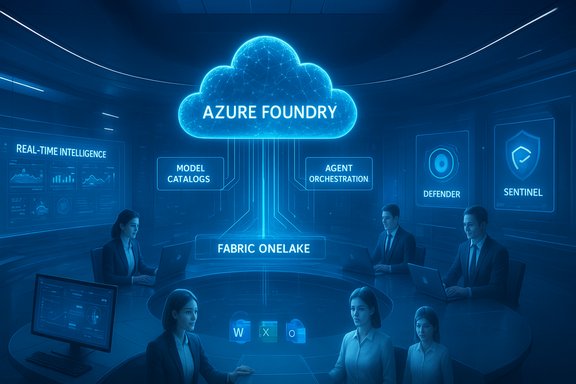
LTIMindtree’s newly announced expansion of its strategic alliance with Microsoft is a clear, pragmatic effort to turn years of Azure experimentation into large-scale, production-ready outcomes — bundling Azure OpenAI (via Microsoft Foundry), Microsoft 365 Copilot, Microsoft Fabric, and a full Microsoft security stack behind prescriptive migration and consumption programs designed to accelerate enterprise Azure adoption.
Background / Overview
LTIMindtree, the combined entity formed from L&T Infotech (LTI) and Mindtree, has publicly repositioned itself as a Microsoft-centric Global System Integrator (GSI) and is now formalizing that posture through a dedicated Microsoft business unit, a Microsoft Cloud Generative AI Center of Excellence (GenAI CoE), and a set of productized, transactable offerings that lean on Microsoft’s AI and data platform. The company’s messaging highlights three linked priorities: accelerate Azure migration and consumption, industrialize enterprise AI through Azure OpenAI and Foundry, and secure production deployments with Microsoft’s security portfolio.Microsoft’s own product architecture — centered on the Foundry control plane for model governance, Microsoft Fabric for unified data and OneLake, and Copilot for productivity — gives integrators a tightly integrated stack to package into industry accelerators and managed services. Microsoft documentation describes Foundry as a unified AI app-and-agent platform offering model catalogs, model routing, observability and governance controls intended to move AI from PoC to production. LTIMindtree frames the alliance as a way to help customers “move from pilots to productivity,” using commercial levers such as Microsoft Azure Consumption Commitment (variously abbreviated MAAC or MACC in marketplace and partner materials) plus co-sell and marketplace listings to underwrite migrations and early deployments. Several independent news outlets and the company’s press release summarize the engagement and quote LTIMindtree and Microsoft executives reiterating the joint GTM focus.
What the expanded alliance actually includes
This is the practical technology and commercial stack LTIMindtree is packaging with Microsoft:- Azure OpenAI integrated via Microsoft Foundry to power domain copilots, retrieval‑augmented generation (RAG) patterns, and agentic automation. Foundry surfaces model choice, real‑time model routing and agent orchestration for enterprise workloads.
- Microsoft 365 Copilot acceleration packages — governance‑first rollouts that embed Copilot across Word, Excel, Outlook, PowerPoint and Teams and extend Copilot into business workflows via Copilot Studio and declarative agents. LTIMindtree reports internal adoption to inform customer rollouts.
- Microsoft Fabric as the unified data plane (OneLake) and Fabric Real‑Time Intelligence for streaming and operational analytics — used to create the governed data spine for copilots and analytics. Microsoft documents show Fabric’s Real‑Time Intelligence and OneLake as core primitives for event-driven, low-latency analytics.
- Full Microsoft security stack deployments — Microsoft Defender XDR (Defender for Endpoint/XDR family), Microsoft Sentinel (cloud-native SIEM/SOAR), Microsoft Intune, Windows Autopatch, and Microsoft Entra ID for identity and access governance — used both internally by LTIMindtree and offered to customers as a secured hybrid/multi-cloud foundation. Microsoft Sentinel and Defender product docs emphasize integration for telemetry, automated playbooks and SOC modernization.
- Commercial and operational levers: Azure Consumption Commitment programs (MAAC/MACC), Cloud Accelerate Factory migration accelerators, marketplace listings and co‑sell engagement to reduce procurement friction and subsidize migration work. Partner and marketplace materials reference MAAC as a contractual consumption commitment used to finance transactable offers on Azure Marketplace.
- Industry accelerators and IP: LTIMindtree’s BlueVerse, Canvas.AI and other delivery artifacts that map to Microsoft stacks, intended to shorten the path from PoC to repeatable deployments across verticals such as manufacturing, banking, healthcare and retail.
Technical orientation: how the pieces fit
Retrieval‑augmented generation and Foundry as the control plane
At scale, enterprise LLM solutions follow the RAG pattern: ingest and normalize data into a governed store, build semantic/vector indexes, and route inference requests through enterprise-grade model hosts. Microsoft Foundry is positioned as an interoperable platform that lets organizations choose models, fine‑tune, route requests to the most cost-effective model, and govern agent behavior from a centralized control plane — including observability and policy enforcement. Microsoft’s Foundry product pages explicitly describe model routing, hosted agents and tooling for multi‑model deployments. This matters because it keeps sensitive data within the customer’s Azure tenancy while offering partners like LTIMindtree the orchestration layer to embed vector retrieval, prompt engineering, and business logic into domain copilots.Fabric, OneLake and Real‑Time Intelligence — the data spine
Fabric is Microsoft’s unified analytics platform; OneLake acts as the single data plane to reduce duplication and simplify governance across analytics and AI workloads. Fabric’s Real‑Time Intelligence workload adds eventstreams and an event-driven hub for streaming and operational analytics. Using Fabric to unify data into a governed lake makes it easier to ground LLM responses in authoritative datasets and to operationalize event-driven use cases (fraud detection, telemetry-driven automation, IoT).Security and governance: Defender XDR, Sentinel, Entra ID and Intune
For enterprise adoption of production AI, security and identity controls are preconditions. Microsoft Sentinel provides a cloud-native SIEM and orchestration environment for telemetry ingestion and automated playbooks. Defender XDR (Defender for Endpoint and related services) supplies EDR/XDR capabilities; Entra ID is the identity backbone, and Intune/Windows Autopatch cover endpoint management and automated patching. Microsoft’s security docs describe how these technologies interoperate to enable SOC modernization and automated incident response. LTIMindtree says it has deployed the full stack internally — a demonstrable reference it offers to customers.What LTIMindtree is promising customers — plain terms
- Faster cloud migration and time to value via migration factories, accelerators and Azure consumption commitments.
- Turnkey enterprise copilots and agents powered by Azure OpenAI and Foundry to automate knowledge work, customer interactions and domain workflows.
- Fabric-led data modernization to provide the single, governed source of truth for LLM grounding and analytics.
- Managed security and SOC modernization built on Microsoft Defender, Sentinel, Entra, Intune and Windows Autopatch to reduce operational risk.
- Packaged Copilot adoption services (governance-first) to maximize productivity gains with staged rollouts and controls.
Strengths and immediate upside for enterprise buyers
- Platform‑aligned delivery reduces integration risk. Using Azure‑native services for data, identity and model hosting cuts custom glue-code and simplifies compliance validation for auditors. Microsoft Foundry, Fabric and Sentinel are designed to interoperate, which helps reduce handoffs between vendor teams.
- Productization shortens time to measurable outcomes. LTIMindtree’s accelerators — BlueVerse, Canvas.AI and Cloud Accelerate Factory — are explicitly intended to convert pilots into repeatable services that are easier to budget and scale.
- Security‑first operational references. LTIMindtree points to large-scale endpoint modernization work (Intune, Windows Autopatch and Autopilot) and internal Copilot adoption as operational proof-points, which are credible signals for regulated customers looking for hands-on experience.
- Commercial levers to fund migrations. MAAC/MACC-style consumption commitments and co-sell incentives can reduce upfront migration costs and provide predictable commercial models for multi-year transformation programs. Documentation and marketplace examples show MAAC being used to support marketplace purchases and transactable offers.
Risks, trade‑offs and open questions
1) Vendor concentration and lock‑in risk
The attraction of an end‑to‑end, tightly integrated Azure stack is the same force that creates lock‑in risk. When data, models, orchestration and security are deeply bound to a single cloud ecosystem, future portability — switching models, moving to another cloud, or running critical workloads on specialized GPU providers — becomes harder and more expensive. Microsoft Foundry offers model choice and integrations with multiple providers, but operational portability and exit terms must be contractually negotiated. Microsoft product materials emphasize interoperability, but the commercial realities of long-term committed consumption (MAAC/MACC) can entrench a single-cloud dependency if procurement contracts lack re‑baseline and exit clauses.2) Consumption economics and MAAC-style commitments
MAAC/MACC can accelerate deployment via joint funding and discounts, but consumption commitments shift forecasting risk to the buyer. If workloads don’t scale as projected, customers may face surprise costs or protracted re-baselining negotiations. Marketplace and partner documentation shows MAAC being used widely, but organizations should insist on transparent cost modelling, runway re-baselines, and measurable outcome-linked payments before locking into multi-year consumption commitments.3) Governance complexity at scale
Enterprise LLM deployments amplify governance needs: model provenance, prompt redaction, DLP, human-in-loop approvals, explainability and audit trails. LTIMindtree emphasizes a governance-first Copilot rollout, but the actual enforcement of fine‑grained controls (data grounding, redaction and monitoring) is an engineering and operational challenge. Microsoft Foundry and Fabric include governance primitives, yet many governance outcomes depend on partner implementation discipline, and GTM narratives should be validated with technical runbooks and auditable SLAs.4) Unverifiable or company-declared scale claims
LTIMindtree’s announcement references high-volume telemetry ingestion and broad internal adoption of Microsoft 365 Copilot and the security stack. Those operational metrics — telemetry volumes, automated playbooks run per month, exact number of endpoints secured — are company-declared and not independently verifiable from public documents. Buyers should require measurable KPIs and third-party attestation (SOC reports, independent security audits) where security posture is a baseline requirement.Practical guidance for CIOs and procurement teams
- Start with a short, instrumented pilot that targets a real business KPI (time‑saved per role, case-resolution rate, FCR improvement) and ties partner fees to outcomes. This reduces speculative spend and validates MAAC assumptions.
- Require transparent cost models and MAAC re-baseline clauses. Insist on contractual exit provisions and portability commitments for data, models and vector indexes.
- Insist on auditable governance controls: data lineage, redaction policies, prompt inventories, and periodic red‑teaming results for LLM behaviour.
- Validate security posture with third‑party attestations. Ask for SOC reports, penetration testing results, and sample Sentinel dashboards or playbooks that demonstrate end‑to‑end telemetry ingestion and automated response.
- Preserve model and deployment flexibility. Demand documentation of model routing logic, failover policies, and ability to host inference on customer‑controlled infrastructure when required.
Market context and why the timing matters
Hyperscalers and global systems integrators are converging around “data + AI + governance” stacks. Microsoft’s strategy — binding Fabric (data), Foundry (models & agents) and Copilot (end‑user productivity) — creates a clear platform that integrators can productize. For LTIMindtree, the alliance is a strategic play to capture enterprise transformation spend by combining industry domain IP with Microsoft’s platform economics and co-sell engine. The market reaction to the announcement (share price upticks reported by market outlets) reflects investor appetite for AI-aligned growth bets by integrators. At the same time, Microsoft’s ecosystem is evolving fast: the company has broadened model choice (including third-party models like Anthropic) and is actively positioning Foundry as a multi‑model control plane — moves that both reduce single-vendor model risk and complicate governance. Enterprises need to ensure that the integration path chosen today does not become a brittle dependency as model sourcing and compute economics evolve.Verification notes and factual cross‑checks
- LTIMindtree’s expanded collaboration was announced via partner press feeds and widely covered in business outlets; the core claims (Foundry/Azure OpenAI, Copilot acceleration, Fabric integration, and security stack adoption) are repeatedly stated across LTIMindtree’s press materials and independent news coverage.
- Microsoft Foundry’s public product pages confirm Foundry’s model catalog, model routing, agent services and control plane features referenced by LTIMindtree. Foundry documentation is current and explicitly positions Foundry as a governance-enabled, multi‑model platform.
- Microsoft Fabric documentation details Real‑Time Intelligence and OneLake as Fabric primitives for streaming, event-driven analytics and unified data management — capabilities LTIMindtree says it will leverage in customer engagements.
- Microsoft Sentinel, Defender XDR and the Intune/Windows Autopatch/Entra family are documented security primitives suitable for the SOC-modernization claims; LTIMindtree’s public statements that it has deployed this stack internally are company-declared and corroborated in partner case narratives, but the exact telemetry volumes and automation metrics should be treated as self-reported until independently attested.
- On commercial mechanics, MAAC (often abbreviated MAAC or MACC) is referenced in Microsoft marketplace and partner materials as “Microsoft Azure Consumption Commitment,” and marketplace examples show how consumption commitments are used to support marketplace purchases, but customers should verify precise contractual naming and terms with Microsoft and partners. The marketplace naming is inconsistent across vendor communications, so procurement teams should confirm the exact legal instrument in each deal.
Bottom line
LTIMindtree’s expanded alliance with Microsoft is a timely, well‑aligned bet for enterprises that want a single‑partner path to scale Azure‑hosted copilots, RAG-based LLM applications and data-driven automation. The strengths are immediate: a platform‑native approach, productized delivery assets, and a security‑forward operational reference. The trade‑offs are equally tangible: vendor concentration, consumption forecasting risk under MAAC/MACC deals, and the non-trivial governance and operational effort required to run LLMs safely at scale.For enterprises seriously pursuing generative AI at production scale, this partnership is a credible route — provided buyers insist on rigorous pilots, transparent cost modelling, contractual portability and auditable security and governance evidence before committing to multi-year consumption or managed‑services arrangements.
Source: Machine Maker LTIMindtree Expands Strategic Alliance with Microsoft to Advance Azure Adoption | Machine Maker - Latest Manufacturing News | Indian Manufacturing News - Latest Manufacturing News | Indian Manufacturing News - Machine Maker