

LTIMindtree’s expanded collaboration with Microsoft aims to move enterprises from AI experimentation to scaled, cloud-native productivity by accelerating Microsoft Azure adoption, embedding Azure OpenAI models via Microsoft Foundry, and fast-tracking enterprise rollout of Microsoft 365 Copilot and Microsoft Fabric—a strategy that blends GTM muscle, security hardening, and SAP-led modernization capabilities to create a full-stack pathway for AI-driven business transformation.
LTIMindtree, a global technology consulting and digital solutions company, has deepened its relationship with Microsoft as a Global System Integrator (GSI) to help customers maximize cloud investments and accelerate Azure consumption and AI adoption. The partnership announcement highlights joint capabilities across Azure migration programs, Foundry-based Azure OpenAI integration, Copilot adoption programs, and Fabric-enabled data modernization. This is an extension of a multi-year trend where system integrators partner closely with hyperscalers to provide end-to-end services that couple technology with industry domain knowledge. LTIMindtree is positioning itself not just as an implementation vendor but as a co-innovation partner—bringing proprietary IP (such as BlueVerse marketplace and the Canvas.AI suite referenced in earlier LTIMindtree communications), center-of-excellence capabilities, and Microsoft-recognized specializations to accelerate customer time-to-value on Azure and Microsoft AI services. The company also recently won a notable SAP S/4HANA engagement with Convatec, which underscores the firm’s dual focus on cloud-native AI services and core enterprise system modernization.
For example:
Strengths of the move include LTIMindtree’s Microsoft credentials, a multi-pronged approach that aligns data, models, and security, and concrete go-to-market assets like CoEs and migration factories. Risks remain real: vendor concentration, data governance complexity, cost unpredictability, and the thorny operational challenge of turning pilot Copilots into trusted, explainable assistants for knowledge workers.
Enterprises that approach this partnership pragmatically—starting with risk-driven governance, measured pilots with clear KPIs, robust security instrumentation, and a FinOps framework—can materially reduce the time from experimentation to durable, measurable value. For organizations that hurry into large-scale Copilot deployments without that discipline, the likely outcomes are higher costs, regulatory friction, and suboptimal user trust.
In short, LTIMindtree and Microsoft are building a full-stack route to enterprise AI on Azure; the technical building blocks are credible and well-documented, but the ultimate success of any large-scale deployment will rest on governance, data quality, cost control, and the organization’s willingness to invest in operational maturity rather than treating AI as another project to be outsourced.
This partnership represents a significant evolution in how enterprise cloud and AI transformations will be packaged and delivered—with clear opportunities for accelerated value and equally clear responsibilities for risk management and operational readiness.
Source: Techcircle LTIMindtree expands partnership with Microsoft to accelerate Azure adoption among enterprises
 Background
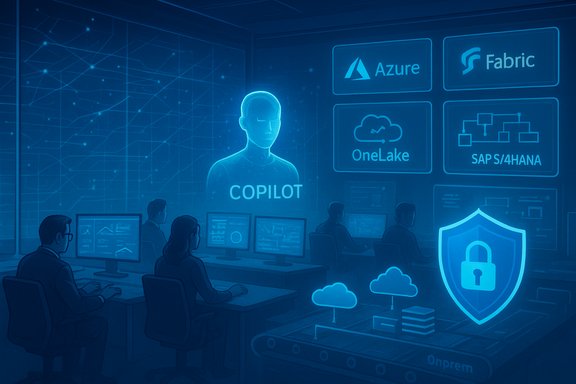
LTIMindtree, a global technology consulting and digital solutions company, has deepened its relationship with Microsoft as a Global System Integrator (GSI) to help customers maximize cloud investments and accelerate Azure consumption and AI adoption. The partnership announcement highlights joint capabilities across Azure migration programs, Foundry-based Azure OpenAI integration, Copilot adoption programs, and Fabric-enabled data modernization. This is an extension of a multi-year trend where system integrators partner closely with hyperscalers to provide end-to-end services that couple technology with industry domain knowledge. LTIMindtree is positioning itself not just as an implementation vendor but as a co-innovation partner—bringing proprietary IP (such as BlueVerse marketplace and the Canvas.AI suite referenced in earlier LTIMindtree communications), center-of-excellence capabilities, and Microsoft-recognized specializations to accelerate customer time-to-value on Azure and Microsoft AI services. The company also recently won a notable SAP S/4HANA engagement with Convatec, which underscores the firm’s dual focus on cloud-native AI services and core enterprise system modernization. What the expanded partnership includes
Core technology building blocks
- Azure OpenAI via Microsoft Foundry — Deploying generative AI models and agentic workflows through the Foundry platform to build enterprise-grade Copilots and AI agents that connect to an organization’s knowledge sources. Microsoft Foundry provides model choice, model routing, and agent orchestration across cloud and on-premises data.
- Microsoft 365 Copilot acceleration — Programs and jumpstarts designed to move customers from pilots to firm-wide Copilot adoption, embedding generative assistance into Word, Excel, Outlook, PowerPoint, Teams and business processes to improve productivity and knowledge work.
- Microsoft Fabric — Using Fabric’s unified analytics stack and OneLake foundation to organize enterprise data, enable analytics-to-AI workflows, and supply the governed datasets required to ground generative models and Copilots. Fabric’s built-in Copilot features and OneLake unify data engineering, transformation, and reporting under a SaaS experience.
- Azure migration and modernization factories — Cloud Accelerate Factory and Azure Consumption Commitment acceleration to help customers migrate workloads, optimize cloud spend, and operationalize Azure commitments. These services are designed to reduce lift-and-shift friction and accelerate modernization with prescriptive migration playbooks.
Security and governance stack
LTIMindtree reports deployment of the full Microsoft security stack across its environment and in customer engagements: Defender XDR, Microsoft Sentinel, Intune, Windows Autopatch, and Entra ID (formerly Azure AD). The company says it ingests comprehensive telemetry monthly to enable automated threat response and uses Microsoft Security Copilot for SOC augmentation. These are not only operational controls but also hygiene prerequisites for enterprise-scale AI deployments where data governance and secure model access are essential. The capabilities themselves are well-documented Microsoft offerings, but the scale and specifics of LTIMindtree’s data ingestion and automation pipeline are company-declared.Why this matters to enterprises
Faster time-to-value for cloud and AI investments
Enterprises face a recurring challenge: pilot fatigue. Many organizations have tested generative AI and cloud services at small scale but struggle to deliver measurable business outcomes broadly. By combining migration factories, consumption acceleration programs, and Copilot adoption tracks, LTIMindtree aims to shorten the path from prototype to production and from production to measurable ROI. The combined approach—data modernization with Fabric, model/agent orchestration with Foundry, and productivity tooling with Copilot—creates a coherent stack for operationalizing GenAI.Security-first AI and compliance posture
Bringing AI into core workflows changes risk profiles. Enterprises need unified visibility and incident response across identity, endpoints, email, and cloud workloads. Microsoft’s security portfolio—now positioned under Defender XDR and complemented by Sentinel for SIEM/SOAR—offers extended detection and response across the attack chain; LTIMindtree’s stated approach is to implement these controls alongside Security Copilot to accelerate threat investigations and automated remediation. This combination addresses a critical barrier to enterprise AI adoption: trust and governance.Data foundation and analytics: the Fabric advantage
Generative models are only as useful as the data they are grounded on. Microsoft Fabric centralizes data into OneLake and unifies analytics workloads, which can reduce data silos and simplify governance. For enterprises wrestling with data fragmentation, Fabric promises a single store and a consistent security model to support analytics, reporting, and AI—helping to ensure Copilot responses and agent behaviors are traceable and defensible.Technical verification and cross-referenced claims
- Microsoft Foundry (formerly Azure AI Studio) is a platform for building, optimizing, and governing AI apps and agents; it supports Azure OpenAI models and multi-model routing. This capability is documented on Microsoft’s Foundry product pages and technical docs.
- Microsoft Fabric is an end-to-end analytics platform built around OneLake and integrates workloads such as Data Engineering, Data Warehouse, and Power BI. Fabric includes Copilot support and OneLake security features for governing data access across analytics workloads. These features are documented in Microsoft Fabric documentation and Microsoft blog updates.
- Microsoft’s security portfolio includes Microsoft Defender XDR as an XDR platform and Microsoft Sentinel as a cloud-native SIEM and SOAR solution; Microsoft has published product pages and whitepapers describing their combined role in unified SOC operations. Microsoft Security Copilot is explicitly positioned as an AI assistant for security operations. LTIMindtree’s public statements about integrating these products correspond with Microsoft’s documented capabilities.
- LTIMindtree’s selection by Convatec to implement SAP S/4HANA across global operations is verified by LTIMindtree and BusinessWire press releases and has been reported by independent industry outlets—underlining the company’s presence in both strategic cloud + AI activities and core ERP modernization.
What LTIMindtree brings — strengths in the deal
- Deep Microsoft partnership credentials: Azure Expert MSP, multiple solution partner designations, and Microsoft recognitions (e.g., partner awards and Foundry/Fabric partner references). These credentials signal sustained investments in Microsoft skills, tooling, and GTM alignment—important for enterprise risk mitigation.
- End-to-end implementation capabilities: from cloud migration and cost optimization (Azure Consumption Commitment programs) to data platform modernization and SAP S/4HANA rollouts. This helps customers avoid fragmented vendor stacks and speeds integration between core systems and AI layers.
- Security-first posture: integrating Microsoft security tooling and Microsoft Security Copilot into operations can materially reduce detection-to-remediation time and supports governance-required audit trails for AI systems. LTIMindtree’s published case studies show internal integration of Copilot for Security and Sentinel-based workflows.
- Proprietary IP and industry agents: LTIMindtree highlights industry-specific agents, marketplaces, and blueprints (e.g., BlueVerse and Canvas.AI) that can accelerate vertical use cases—reducing time-to-solution for industries with strict domain requirements such as healthcare, manufacturing, and financial services.
Risks, trade-offs, and red flags
Vendor concentration and lock-in
Relying on a single hyperscaler and one system integrator for migration, security, data, and AI increases vendor concentration risk. While Microsoft Foundry supports multi-model integrations, most managed services and operational optimizations will be tightly coupled to Azure, Microsoft Fabric, and Microsoft identity/security primitives. Organizations should weigh the operational and commercial implications of deep Azure and Microsoft-stack dependence.Data sovereignty and regulatory exposure
Embedding Copilots and Foundry agents into workflows requires careful attention to data residency, data access controls, and regulatory compliance (HIPAA, GDPR, PCI-DSS, etc.. While Microsoft provides governance and Purview-based controls for Fabric/OneLake, customers must validate how sensitive data is ingested, how it’s used to fine-tune or prompt models, and whether audit logs meet regulatory retention requirements. Public statements by LTIMindtree and Microsoft affirm governance is part of the workstream, but implementation specifics remain customer-specific.Model reliability, hallucinations, and explainability
Enterprise Copilots and agents need deterministic behavior for high-stakes use cases. Generative models can hallucinate or produce plausible but incorrect outputs. Building production-grade Copilots requires grounding, retrieval augmentation, guardrails, and evaluation frameworks. Microsoft Foundry and Fabric provide tooling for grounding models with enterprise knowledge, but the burden remains on the integrator and customer to build robust evaluation, feedback, and retraining loops.Cost management and billing complexity
Azure Consumption Commitment models and Foundry pricing introduce new commercial levers that can be hard to manage if governance and tagging are incomplete. Enterprises need robust FinOps practices to avoid surprise spend from model inference, data egress, or Fabric compute. LTIMindtree’s migration and MACC acceleration programs aim to alleviate this but customers should demand transparent cost modeling and observability.Skills and operational maturity
Moving from pilot to scale requires platform engineering teams, prompt engineering, model ops, data ops, and security ops. System integrators can onboard and operate these capabilities, but sustainable transformation also requires internal capabilities transfer. The historical failure mode is short-term vendor-led operations without long-term knowledge transfer or change management. LTIMindtree emphasizes CoEs and skill programs; customers should insist on measurable enablement outcomes.Practical roadmap and checklist for enterprise adoption
Below is a prescriptive, sequential approach enterprises can use when evaluating and adopting the LTIMindtree–Microsoft stack.- Establish governance and risk baseline
- Map regulatory obligations (data residency, regulated PII/PHI), establish policy thresholds, and define success metrics for AI adoption.
- Data readiness assessment
- Inventory data sources, assess data quality, and identify candidate datasets for OneLake ingestion and Copilot grounding.
- Pilot a Foundry-based Copilot with clear KPIs
- Build a limited-scope Copilot using Foundry Models and a Fabric-backed knowledge layer. Define acceptance criteria (accuracy, latency, auditability).
- Harden security posture before scale
- Deploy Defender XDR, Sentinel ingestion, Intune device controls, Windows Autopatch, and Entra ID conditional access for pilot users.
- FinOps and cost guardrails
- Implement consumption monitoring for Foundry, Fabric compute, and Azure infrastructure. Define budget alerts and model inference caps.
- Operationalize with MLOps and platform engineering
- Create CI/CD pipelines for agent updates, model reviews, and red-teaming. Establish runbooks for model rollback and incident response.
- Skills transfer and CoE build
- Design LTIMindtree-assisted CoE handoffs with measurable training completion and internal runbook adoption metrics.
- Scale with phased rollout and continuous evaluation
- Expand use cases after meeting security, governance, and cost KPIs. Incorporate user feedback and continuous retraining schedules.
- Benefits of this approach:
- Reduces pilot-to-production risk.
- Ensures alignment with regulatory and security requirements.
- Preserves enterprise control over AI behavior and cost.
Why Convatec’s SAP S/4HANA win matters in this context
LTIMindtree’s simultaneous wins in both cloud/AI and SAP modernization create a strategic advantage: integrating S/4HANA modernization with a Fabric-powered analytics foundation and Foundry-enabled Copilots enables end-to-end digital operations where ERP master data, operational events, and analytics can directly inform AI agents and Copilot workflows.For example:
- A manufacturing order in SAP S/4HANA can feed real-time telemetry into Fabric, enabling AI agents to recommend inventory actions or trigger workflows in downstream systems.
- Copilot workflows integrated with SAP content and Fabric datasets can accelerate financial close, procurement decisions, or service operations—all while anchored to governed data sources.
Recommendations for procurement and CIOs
- Require transparency on data lineage and logging. Contracts should specify auditability, model provenance, and log retention to meet compliance demands.
- Insist on pilot KPIs tied to business outcomes, not just technical metrics (e.g., reduced time-to-decision, lower operational cost, fewer manual tickets).
- Negotiate clear FinOps SLAs and visibility into Azure Consumption Commitment usage to avoid billing surprises.
- Validate incident response runbooks that cover AI-specific incidents (model drift, malicious prompt injection, hallucination handling).
- Demand a knowledge-transfer plan with measurable milestones for internal capability building, not just a long-term managed services lock-in.
Final analysis and outlook
LTIMindtree’s expanded Microsoft partnership is a logical next step in the current enterprise IT landscape: hyperscalers provide the AI platforms and system integrators provide the industry, process, and delivery capabilities required to operationalize those platforms. The combined offering—Azure migrations, Foundry-based agent engineering, Fabric data modernization, Copilot adoption, and a Microsoft-native security stack—presents a credible path for enterprises that want to accelerate Azure adoption while embedding AI across business processes.Strengths of the move include LTIMindtree’s Microsoft credentials, a multi-pronged approach that aligns data, models, and security, and concrete go-to-market assets like CoEs and migration factories. Risks remain real: vendor concentration, data governance complexity, cost unpredictability, and the thorny operational challenge of turning pilot Copilots into trusted, explainable assistants for knowledge workers.
Enterprises that approach this partnership pragmatically—starting with risk-driven governance, measured pilots with clear KPIs, robust security instrumentation, and a FinOps framework—can materially reduce the time from experimentation to durable, measurable value. For organizations that hurry into large-scale Copilot deployments without that discipline, the likely outcomes are higher costs, regulatory friction, and suboptimal user trust.
In short, LTIMindtree and Microsoft are building a full-stack route to enterprise AI on Azure; the technical building blocks are credible and well-documented, but the ultimate success of any large-scale deployment will rest on governance, data quality, cost control, and the organization’s willingness to invest in operational maturity rather than treating AI as another project to be outsourced.
This partnership represents a significant evolution in how enterprise cloud and AI transformations will be packaged and delivered—with clear opportunities for accelerated value and equally clear responsibilities for risk management and operational readiness.
Source: Techcircle LTIMindtree expands partnership with Microsoft to accelerate Azure adoption among enterprises
