

MotorTrend’s 2026 American performance drag race at March Air Reserve Base put the Lucid Air Sapphire ahead of the Chevrolet Corvette ZR1X, Czinger 21C VMax, Mustang GTD, Rivian R1T Quad, Tesla Cybertruck, Tesla Model 3 Performance, and Cadillac CT5-V Blackwing in the quarter mile. The result was not just another electric-car party trick. It was a clean snapshot of where American speed has gone: away from the romantic idea of the perfect engine launch and toward software-managed torque, all-wheel-drive traction, and power electronics that make absurd acceleration repeatable. As detailed by MotorTrend and amplified by Autoevolution, the Sapphire did not merely embarrass a few muscle cars; it complicated the entire hierarchy of modern American performance.
For decades, an American drag race was supposed to sound a certain way. It was supposed to begin with a V8 clearing its throat, proceed through tire smoke and gear changes, and end with a trap-speed argument in the pits. MotorTrend’s latest “Greatest American Drag Race” still had plenty of internal-combustion theater, but the timing lights told a colder story.
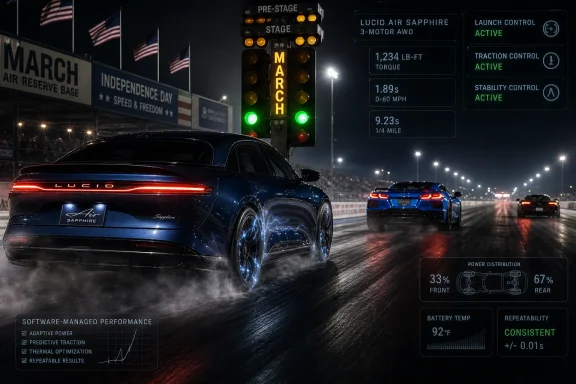
The Lucid Air Sapphire, a luxury sedan with mass closer to a large crossover than a traditional supercar, ran the quarter mile in 9.14 seconds at 153.2 mph. That was enough to edge out the Czinger 21C VMax and the Chevrolet Corvette ZR1X, both of which fit more comfortably into the mental category of “things that should win drag races.” The Lucid’s victory was not poetic. It was technical.
The important detail is not simply that an EV won. That has been happening often enough that the shock has worn thin. The important detail is that the Sapphire won against a field designed to prevent easy excuses: hybrid hypercar, hybrid Corvette, exotic track weapon, electric trucks, and traditional supercharged V8 sedan. This was not a Tesla picking on commuter cars at a stoplight. It was a 1,234-hp American electric sedan beating America’s newest hybrid supercar generation on a runway long enough to remove most of the usual caveats.
MotorTrend’s own framing gave the race a bicentennial-plus flourish: American performance, American machinery, American runway, absurd combined horsepower. Yet the result felt less like a celebration of one car than a referendum on an era. The launch is now a systems-engineering problem, and the computer is winning.
That is what makes the result so devastating. The Sapphire’s three-motor all-wheel-drive system gives it 1,234 hp and 1,430 lb-ft of torque, but those numbers matter less than how the car deploys them. Electric motors do not wait for boost, do not need a clutch dump, and do not ask the driver to balance wheelspin against bog. They just arrive.
The Sapphire’s 1.89-second 0–60 mph figure is the stat that sells posters, but the quarter-mile number is more revealing. A 9.14-second run from a 5,336-pound sedan means Lucid is not simply overpowering physics; it is managing it with extraordinary precision. The car is heavy, but its weight is low and its traction strategy is relentless. The launch becomes less an act of bravery than an execution of code.
That distinction matters because it changes the social meaning of speed. A traditional fast car made the driver visible: the clutch foot, the shift, the launch technique, the willingness to keep the throttle pinned. A Sapphire makes the engineers visible. The driver still participates, but the decisive work happened long before the runway, in calibration rooms and battery labs.
But the Lucid result exposes the limits of hybrid theater in a straight-line launch. The Corvette still has to reconcile a combustion engine’s power curve with electric assist, tire contact, driveline behavior, thermal reality, and a supercar layout that is meant to do more than humiliate a Christmas tree. Chevrolet has built a broader performance tool. Lucid built a sedan that happens to be nearly unbeatable in the first 1,320 feet.
That is not a small difference. The ZR1X is likely the more emotionally complex machine, and on a road course or mountain road the comparison becomes less obvious. But the quarter mile is brutally narrow. It rewards launch control, traction, torque delivery, and the ability to keep accelerating without interruption. In that narrow court, the Sapphire’s simplicity becomes ruthless.
The Corvette’s value story also remains formidable. MotorTrend and Autoevolution both noted the Corvette’s pricing as disruptive when compared with the $2.4 million Czinger. A roughly quarter-million-dollar Corvette that can trade numbers with seven-figure exotica is an American performance miracle of its own. The problem is that Lucid showed up with roughly the same price tag and a different definition of miracle.
The Czinger is fascinating because it sits between old and new worlds. Its 2.88-liter twin-turbo V8 and electric motors produce 1,250 hp, but the real story is the car’s purpose-built body and low-drag VMax configuration. It is not trying to be a sedan. It is not trying to be practical. It is a highly specialized answer to the question of how fast a tiny, expensive, hybridized American projectile can go.
That specialization paid off as the runway stretched. The Sapphire’s immediate torque gave it the opening move, but the Czinger’s shape and top-end ambition gave it the closing argument. The half-mile result was a useful corrective to lazy EV triumphalism. Electric powertrains are dominant at launch, but the faster the race gets, the more the body and sustained output matter.
This is why the event produced “two winners,” as MotorTrend put it. The Lucid was the quarter-mile king. The Czinger was the half-mile ruler. That split result is more honest than a single trophy because modern performance is no longer a single discipline. The car that demolishes 0–60 mph is not necessarily the car that owns 180 mph and beyond.
The GTD is a track weapon wearing the Mustang name. Its supercharged 5.2-liter V8, rear-drive layout, aero hardware, and chassis complexity are aimed at circuit performance, not necessarily at achieving the cleanest possible launch on a runway. Downforce that helps a car stay planted in a corner can become a tax in a straight-line speed contest. Rear-wheel drive remains glorious, but all-wheel-drive electrified torque is a cheat code from a dig.
The trap speed tells part of the story. The Mustang was still moving hard through the quarter, with a 156-mph trap that nearly matched or exceeded some quicker elapsed-time rivals. But elapsed time punishes a slow start more than it rewards a strong finish. The Ford’s aero and layout put it at a disadvantage before the first second had finished ticking away.
This is the broader lesson for enthusiasts who still use drag-race rankings as a universal performance ladder. The GTD’s mission is not invalidated by a Lucid sedan getting to the quarter-mile marker first. It simply belongs to a different church. The straight line is a measurement, not a full confession.
The Rivian’s result was arguably one of the most impressive practical demonstrations of the day. It produced 1,025 hp from a quad-motor electric setup and put that power down well enough to outrun the Mustang GTD to the quarter-mile stripe. That sentence should still feel ridiculous. A utility truck beating a $430,000 track-focused Mustang in elapsed time is the kind of fact that tells you the old categories have collapsed.
The Cybertruck’s 10.97-second quarter-mile run at 113.7 mph was less dramatic but still objectively quick. Its low trap speed relative to its elapsed time shows the familiar EV pattern: brutal launch, then a less heroic high-speed continuation. It is a stainless-steel reminder that acceleration has been democratized in bizarre ways. Vehicles shaped like appliances and weighing as much as old commercial trucks now run times that once belonged to modified drag machinery.
The drawback is that these trucks also reveal the artificial boundaries built into modern EV performance. Speed limiters, thermal constraints, tire ratings, and software decisions matter as much as horsepower. The Rivian’s half-mile run was checked by its limiter, turning a spectacular launch into a managed outcome. In the EV age, the spec sheet is only the beginning; the permission structure is the real performance envelope.
The Hennessey Venom F5’s absence also matters, though for a different reason. Hennessey represents the boutique American top-speed tradition: huge power, limited production, maximal swagger. The Czinger filled part of that exotic-American role, but not all of it. A full-mile format with a Venom F5 would have made the event less tidy and possibly more revealing.
Ford’s representation invites its own debate. The Mustang GTD is the right car if the story is American track engineering, but not necessarily if the story is straight-line American speed. A Ford GT, depending on configuration and availability, would have carried a different symbolic weight. Still, the GTD’s presence sharpened the lesson: the most exotic-looking or track-credentialed car is not automatically the drag-race answer.
No comparison test can include everything, and MotorTrend’s logistics were clearly formidable. But omissions shape narratives. When an event claims a national-performance frame, the missing brands become ghost competitors. Their absence does not invalidate the result, but it narrows the claim.
Launch control used to be a convenience. Now it is the event. The car decides torque distribution, slip targets, battery output, motor behavior, thermal limits, and stability intervention at a speed no human can match. The driver initiates the run, but the machine conducts it.
That is why the Lucid’s win feels so culturally significant. The Sapphire is not merely a powerful car; it is a calibrated system that happens to contain seats and a trunk. Its triumph says less about the death of combustion than about the rise of the invisible performance stack. In the quickest cars, code is now as important as camshafts.
This does not make enthusiast driving irrelevant. If anything, it makes the distinction between acceleration and driving more important. The Sapphire may own the quarter mile, but the joy of a manual CT5-V Blackwing or the cornering violence of a Mustang GTD lives elsewhere. The old mistake was assuming one number could settle every argument. The new mistake would be assuming electric dominance in one metric settles the rest.
But the Blackwing’s presence mattered because it carried the most analog brief. A supercharged 6.2-liter V8, rear-wheel drive, and a manual transmission made it the human-scale entry in a field increasingly defined by automated launches and electrified torque fill. It was not there to win the numbers war. It was there to remind everyone what is being traded away.
The manual gearbox is inefficient in this context. Human shifting costs time. Rear-drive traction costs time. Combustion torque delivery costs time. Yet those costs are also where much of the emotional texture lives. The Cadillac’s loss was predictable, but it was also clarifying.
Performance culture is splitting. One branch pursues measurable dominance with software, motors, and hybrid systems. The other preserves involvement, noise, and mechanical ritual, even as the stopwatch becomes crueler. The Blackwing did not win, but it defended the idea that being slower can still be meaningful.
Chevrolet can point to the ZR1X as a triumph of hybrid engineering, and rightly so. Ford can point to the GTD as a serious track car, and rightly so. Cadillac can point to the Blackwing as a farewell hymn to driver involvement, and rightly so. But Lucid can point to the timing board.
That timing board says the quickest American quarter-mile machine in this group was not the one with the most dramatic engine note, the lowest roofline, or the most race-car cosplay. It was a luxury EV sedan whose core advantage is the disciplined conversion of stored electrical energy into immediate, controlled thrust. That is a very different kind of American performance story.
The stakes go beyond bragging rights. As batteries improve, inverters mature, and torque-vectoring systems grow more sophisticated, acceleration numbers that once defined exotic cars will spread into more vehicle classes. The challenge for legacy performance brands will be to make their machines feel special when raw speed is no longer scarce.
That is why the event is useful. It punctures the fantasy that one spec can explain a car. The Sapphire’s mass should have hurt it, but traction and torque delivery overwhelmed that disadvantage in the quarter mile. The Czinger’s shape mattered more as distance increased. The Rivian’s power was spectacular until its limiter became the story.
The best way to read the race is not as a single ranking but as a map of performance domains. The first 60 feet belong to traction and torque control. The quarter mile rewards launch plus sustained shove. The half mile begins to favor aero and high-speed power. A full mile would likely reshuffle the deck again.
That is also why enthusiasts should be careful with absolutes. “Fastest” now requires a footnote, even when nobody prints one. Fastest to 60? Fastest through the quarter? Fastest across a half mile? Fastest around a circuit? Fastest while making the driver laugh? The answer changes with the question.
That does not make the Sapphire soulless. It makes it new. American performance has always been about excess, and the Sapphire is excess translated into the language of voltage, thermal control, and motor response. It is not less American because it is quiet. It may be painfully American precisely because it turns abundance into acceleration with almost comic bluntness.
The Czinger’s half-mile win adds another layer to that identity. Here, too, is an American company building something extreme, low-volume, technically audacious, and globally competitive. Its victory beyond the quarter mile suggests that the future is not simply EV sedans crushing everything. It is a more varied landscape of hybrids, electric platforms, aero specials, and software-defined monsters fighting over increasingly specific records.
The “Greatest American Drag Race” label may be debatable, especially with major absences. But the event did capture a real transition. The American performance car is no longer one thing. It is a Corvette with a hybrid front axle, a Lucid with three motors, a Czinger with tandem seating, a Rivian pickup running supercar-adjacent numbers, and a Cadillac manual hanging on because someone still cares.
 The Quarter Mile No Longer Belongs to the Loudest Car on the Runway
For decades, an American drag race was supposed to sound a certain way. It was supposed to begin with a V8 clearing its throat, proceed through tire smoke and gear changes, and end with a trap-speed argument in the pits. MotorTrend’s latest “Greatest American Drag Race” still had plenty of internal-combustion theater, but the timing lights told a colder story.The Lucid Air Sapphire, a luxury sedan with mass closer to a large crossover than a traditional supercar, ran the quarter mile in 9.14 seconds at 153.2 mph. That was enough to edge out the Czinger 21C VMax and the Chevrolet Corvette ZR1X, both of which fit more comfortably into the mental category of “things that should win drag races.” The Lucid’s victory was not poetic. It was technical.
The important detail is not simply that an EV won. That has been happening often enough that the shock has worn thin. The important detail is that the Sapphire won against a field designed to prevent easy excuses: hybrid hypercar, hybrid Corvette, exotic track weapon, electric trucks, and traditional supercharged V8 sedan. This was not a Tesla picking on commuter cars at a stoplight. It was a 1,234-hp American electric sedan beating America’s newest hybrid supercar generation on a runway long enough to remove most of the usual caveats.
MotorTrend’s own framing gave the race a bicentennial-plus flourish: American performance, American machinery, American runway, absurd combined horsepower. Yet the result felt less like a celebration of one car than a referendum on an era. The launch is now a systems-engineering problem, and the computer is winning.
Lucid Built a Sedan That Behaves Like a Drag-Strip Appliance
The Lucid Air Sapphire is a strange champion because it does not look like one. It is not a wedge-shaped exotic. It does not wear a wing large enough to double as patio furniture. It does not demand a helmet just to understand the seating position. It is, on paper, a luxury electric sedan with four doors, a finished cabin, and the polished calm of something meant to commute through Orange County without drama.That is what makes the result so devastating. The Sapphire’s three-motor all-wheel-drive system gives it 1,234 hp and 1,430 lb-ft of torque, but those numbers matter less than how the car deploys them. Electric motors do not wait for boost, do not need a clutch dump, and do not ask the driver to balance wheelspin against bog. They just arrive.
The Sapphire’s 1.89-second 0–60 mph figure is the stat that sells posters, but the quarter-mile number is more revealing. A 9.14-second run from a 5,336-pound sedan means Lucid is not simply overpowering physics; it is managing it with extraordinary precision. The car is heavy, but its weight is low and its traction strategy is relentless. The launch becomes less an act of bravery than an execution of code.
That distinction matters because it changes the social meaning of speed. A traditional fast car made the driver visible: the clutch foot, the shift, the launch technique, the willingness to keep the throttle pinned. A Sapphire makes the engineers visible. The driver still participates, but the decisive work happened long before the runway, in calibration rooms and battery labs.
The Corvette ZR1X Is Still a Monster, Just Not This Monster
The Chevrolet Corvette ZR1X’s third-place quarter-mile finish should not be mistaken for failure. A 9.36-second run at 153.4 mph is absurdly quick, and the car’s hybridized 5.5-liter twin-turbo LT7 V8 gives Chevrolet a machine that would have sounded fictional a generation ago. The ZR1X is the kind of Corvette that proves Detroit did not surrender to electrification; it weaponized it.But the Lucid result exposes the limits of hybrid theater in a straight-line launch. The Corvette still has to reconcile a combustion engine’s power curve with electric assist, tire contact, driveline behavior, thermal reality, and a supercar layout that is meant to do more than humiliate a Christmas tree. Chevrolet has built a broader performance tool. Lucid built a sedan that happens to be nearly unbeatable in the first 1,320 feet.
That is not a small difference. The ZR1X is likely the more emotionally complex machine, and on a road course or mountain road the comparison becomes less obvious. But the quarter mile is brutally narrow. It rewards launch control, traction, torque delivery, and the ability to keep accelerating without interruption. In that narrow court, the Sapphire’s simplicity becomes ruthless.
The Corvette’s value story also remains formidable. MotorTrend and Autoevolution both noted the Corvette’s pricing as disruptive when compared with the $2.4 million Czinger. A roughly quarter-million-dollar Corvette that can trade numbers with seven-figure exotica is an American performance miracle of its own. The problem is that Lucid showed up with roughly the same price tag and a different definition of miracle.
Czinger Won the Half Mile Because Air Still Gets a Vote
If the quarter mile belonged to Lucid, the half mile restored some dignity to the exotic class. The Czinger 21C VMax ran 14.40 seconds at 187.9 mph, passing the Sapphire’s 14.50-second, 181.9-mph effort and reminding everyone that battery torque is not the whole story once speed climbs. At that point, drag coefficient, frontal area, gearing, power sustain, and thermal management become the race.The Czinger is fascinating because it sits between old and new worlds. Its 2.88-liter twin-turbo V8 and electric motors produce 1,250 hp, but the real story is the car’s purpose-built body and low-drag VMax configuration. It is not trying to be a sedan. It is not trying to be practical. It is a highly specialized answer to the question of how fast a tiny, expensive, hybridized American projectile can go.
That specialization paid off as the runway stretched. The Sapphire’s immediate torque gave it the opening move, but the Czinger’s shape and top-end ambition gave it the closing argument. The half-mile result was a useful corrective to lazy EV triumphalism. Electric powertrains are dominant at launch, but the faster the race gets, the more the body and sustained output matter.
This is why the event produced “two winners,” as MotorTrend put it. The Lucid was the quarter-mile king. The Czinger was the half-mile ruler. That split result is more honest than a single trophy because modern performance is no longer a single discipline. The car that demolishes 0–60 mph is not necessarily the car that owns 180 mph and beyond.
Mustang GTD Proved Track Cars Are Not Drag Cars
The Ford Mustang GTD’s showing was the easiest to misread. It ran 10.47 seconds in the quarter mile at 156 mph, then 16.50 seconds at 161.7 mph in the half mile. Those numbers are ferocious in isolation, but they put the GTD behind machines with very different priorities. That does not make Ford’s halo Mustang a disappointment. It makes the drag strip an incomplete courtroom.The GTD is a track weapon wearing the Mustang name. Its supercharged 5.2-liter V8, rear-drive layout, aero hardware, and chassis complexity are aimed at circuit performance, not necessarily at achieving the cleanest possible launch on a runway. Downforce that helps a car stay planted in a corner can become a tax in a straight-line speed contest. Rear-wheel drive remains glorious, but all-wheel-drive electrified torque is a cheat code from a dig.
The trap speed tells part of the story. The Mustang was still moving hard through the quarter, with a 156-mph trap that nearly matched or exceeded some quicker elapsed-time rivals. But elapsed time punishes a slow start more than it rewards a strong finish. The Ford’s aero and layout put it at a disadvantage before the first second had finished ticking away.
This is the broader lesson for enthusiasts who still use drag-race rankings as a universal performance ladder. The GTD’s mission is not invalidated by a Lucid sedan getting to the quarter-mile marker first. It simply belongs to a different church. The straight line is a measurement, not a full confession.
The Trucks Made the Absurd Feel Normal
The Rivian R1T Quad and Tesla Cybertruck Cyberbeast should have been comic relief in a field with hypercars and track specials. Instead, they were evidence that the performance baseline has moved into deeply strange territory. A nearly 7,000-pound pickup running 10.45 seconds in the quarter mile would have sounded like paddock fiction not long ago. In MotorTrend’s race, it was merely fourth place.The Rivian’s result was arguably one of the most impressive practical demonstrations of the day. It produced 1,025 hp from a quad-motor electric setup and put that power down well enough to outrun the Mustang GTD to the quarter-mile stripe. That sentence should still feel ridiculous. A utility truck beating a $430,000 track-focused Mustang in elapsed time is the kind of fact that tells you the old categories have collapsed.
The Cybertruck’s 10.97-second quarter-mile run at 113.7 mph was less dramatic but still objectively quick. Its low trap speed relative to its elapsed time shows the familiar EV pattern: brutal launch, then a less heroic high-speed continuation. It is a stainless-steel reminder that acceleration has been democratized in bizarre ways. Vehicles shaped like appliances and weighing as much as old commercial trucks now run times that once belonged to modified drag machinery.
The drawback is that these trucks also reveal the artificial boundaries built into modern EV performance. Speed limiters, thermal constraints, tire ratings, and software decisions matter as much as horsepower. The Rivian’s half-mile run was checked by its limiter, turning a spectacular launch into a managed outcome. In the EV age, the spec sheet is only the beginning; the permission structure is the real performance envelope.
The Missing Cars Are Part of the Story
Autoevolution’s complaint about absent Mopar machinery was not just fan grumbling. A “Greatest American Drag Race” without Dodge’s modern drag-strip legacy feels incomplete, especially when the brand spent years making the Hellcat, Demon, and Demon 170 into cultural objects as much as performance cars. If the point was to stage the American acceleration argument, Mother Mopar’s empty chair was conspicuous.The Hennessey Venom F5’s absence also matters, though for a different reason. Hennessey represents the boutique American top-speed tradition: huge power, limited production, maximal swagger. The Czinger filled part of that exotic-American role, but not all of it. A full-mile format with a Venom F5 would have made the event less tidy and possibly more revealing.
Ford’s representation invites its own debate. The Mustang GTD is the right car if the story is American track engineering, but not necessarily if the story is straight-line American speed. A Ford GT, depending on configuration and availability, would have carried a different symbolic weight. Still, the GTD’s presence sharpened the lesson: the most exotic-looking or track-credentialed car is not automatically the drag-race answer.
No comparison test can include everything, and MotorTrend’s logistics were clearly formidable. But omissions shape narratives. When an event claims a national-performance frame, the missing brands become ghost competitors. Their absence does not invalidate the result, but it narrows the claim.
The Real Winner Was the Software Layer
The easy headline is that Lucid beat Chevrolet. The better headline is that software beat sentiment. Every vehicle in this field was deeply engineered, but the EVs made especially clear that modern acceleration is governed by control systems rather than by raw mechanical intimidation.Launch control used to be a convenience. Now it is the event. The car decides torque distribution, slip targets, battery output, motor behavior, thermal limits, and stability intervention at a speed no human can match. The driver initiates the run, but the machine conducts it.
That is why the Lucid’s win feels so culturally significant. The Sapphire is not merely a powerful car; it is a calibrated system that happens to contain seats and a trunk. Its triumph says less about the death of combustion than about the rise of the invisible performance stack. In the quickest cars, code is now as important as camshafts.
This does not make enthusiast driving irrelevant. If anything, it makes the distinction between acceleration and driving more important. The Sapphire may own the quarter mile, but the joy of a manual CT5-V Blackwing or the cornering violence of a Mustang GTD lives elsewhere. The old mistake was assuming one number could settle every argument. The new mistake would be assuming electric dominance in one metric settles the rest.
Cadillac’s Last-Place Run Was the Most Human Result
The Cadillac CT5-V Blackwing finished at the back of the field with an 11.66-second quarter mile at 124.7 mph. In a sane world, that would be considered wildly fast. In this company, it looked almost quaint.But the Blackwing’s presence mattered because it carried the most analog brief. A supercharged 6.2-liter V8, rear-wheel drive, and a manual transmission made it the human-scale entry in a field increasingly defined by automated launches and electrified torque fill. It was not there to win the numbers war. It was there to remind everyone what is being traded away.
The manual gearbox is inefficient in this context. Human shifting costs time. Rear-drive traction costs time. Combustion torque delivery costs time. Yet those costs are also where much of the emotional texture lives. The Cadillac’s loss was predictable, but it was also clarifying.
Performance culture is splitting. One branch pursues measurable dominance with software, motors, and hybrid systems. The other preserves involvement, noise, and mechanical ritual, even as the stopwatch becomes crueler. The Blackwing did not win, but it defended the idea that being slower can still be meaningful.
The Runway Verdict Leaves Detroit With a Harder Assignment
The Lucid Air Sapphire’s victory should make Detroit both proud and uncomfortable. Proud, because Lucid is an American company building an American electric sedan capable of beating some of the fastest domestic performance cars ever assembled. Uncomfortable, because the result challenges the mythology that still powers much of the performance-car business.Chevrolet can point to the ZR1X as a triumph of hybrid engineering, and rightly so. Ford can point to the GTD as a serious track car, and rightly so. Cadillac can point to the Blackwing as a farewell hymn to driver involvement, and rightly so. But Lucid can point to the timing board.
That timing board says the quickest American quarter-mile machine in this group was not the one with the most dramatic engine note, the lowest roofline, or the most race-car cosplay. It was a luxury EV sedan whose core advantage is the disciplined conversion of stored electrical energy into immediate, controlled thrust. That is a very different kind of American performance story.
The stakes go beyond bragging rights. As batteries improve, inverters mature, and torque-vectoring systems grow more sophisticated, acceleration numbers that once defined exotic cars will spread into more vehicle classes. The challenge for legacy performance brands will be to make their machines feel special when raw speed is no longer scarce.
The Timing Slips Say More Than the Horsepower Claims
MotorTrend’s runway race produced a clean hierarchy, but the larger lesson is that horsepower has become a less useful shorthand. The Czinger and Corvette both claimed 1,250 hp. The Lucid claimed 1,234 hp. The results did not follow the power figures in a simple line. Weight, traction, aero, gearing, software, and power sustain all had their say.That is why the event is useful. It punctures the fantasy that one spec can explain a car. The Sapphire’s mass should have hurt it, but traction and torque delivery overwhelmed that disadvantage in the quarter mile. The Czinger’s shape mattered more as distance increased. The Rivian’s power was spectacular until its limiter became the story.
The best way to read the race is not as a single ranking but as a map of performance domains. The first 60 feet belong to traction and torque control. The quarter mile rewards launch plus sustained shove. The half mile begins to favor aero and high-speed power. A full mile would likely reshuffle the deck again.
That is also why enthusiasts should be careful with absolutes. “Fastest” now requires a footnote, even when nobody prints one. Fastest to 60? Fastest through the quarter? Fastest across a half mile? Fastest around a circuit? Fastest while making the driver laugh? The answer changes with the question.
America’s Birthday Race Belonged to the Car That Least Looked Like a Flag-Waver
The irony of this Independence Day-adjacent spectacle is that the most symbolically old-school American machines were not the ones that defined it. The V8s made the noise, the Corvette carried the flag, the Mustang wore the attitude, and the Cadillac brought the manual-transmission romance. The Lucid brought the receipt.That does not make the Sapphire soulless. It makes it new. American performance has always been about excess, and the Sapphire is excess translated into the language of voltage, thermal control, and motor response. It is not less American because it is quiet. It may be painfully American precisely because it turns abundance into acceleration with almost comic bluntness.
The Czinger’s half-mile win adds another layer to that identity. Here, too, is an American company building something extreme, low-volume, technically audacious, and globally competitive. Its victory beyond the quarter mile suggests that the future is not simply EV sedans crushing everything. It is a more varied landscape of hybrids, electric platforms, aero specials, and software-defined monsters fighting over increasingly specific records.
The “Greatest American Drag Race” label may be debatable, especially with major absences. But the event did capture a real transition. The American performance car is no longer one thing. It is a Corvette with a hybrid front axle, a Lucid with three motors, a Czinger with tandem seating, a Rivian pickup running supercar-adjacent numbers, and a Cadillac manual hanging on because someone still cares.
The Stopwatch Has Rewritten the Bragging Rights
MotorTrend’s test leaves a few concrete lessons for anyone trying to make sense of the new American speed order. The headline is simple, but the implications are not.- The Lucid Air Sapphire was the quickest car in the quarter mile at this event, running 9.14 seconds at 153.2 mph.
- The Czinger 21C VMax was the strongest half-mile performer, running 14.40 seconds at 187.9 mph.
- The Corvette ZR1X remains an extraordinary performance value, but it did not beat the Lucid or the Czinger in this runway comparison.
- The Rivian R1T Quad showed that electric trucks can now intrude on supercar-style acceleration conversations, even when weight and speed limiters eventually catch up.
- The Mustang GTD and Cadillac CT5-V Blackwing proved that track focus and driver engagement do not automatically translate into drag-race dominance.
- The missing Dodge and Hennessey entries mean the result is authoritative for this field, not for every American performance machine that might have changed the conversation.
References
- Primary source: autoevolution
Published: 2026-07-03T21:20:19.259592
Happy 250, America, Here's Your True Quarter-Mile King: Not the ZR1X, but the Lucid Air Sapphire - autoevolution
Tesla, Rivian, Chevrolet, Czinger, Ford, Cadillac, and Lucid sent their quarter-milers to an epic showdown over an Air Force runway, the winner did it in 9.14 www.autoevolution.com
- Related coverage: motortrend.com
The State of American Performance Cars: Corvette ZR1X, Mustang GTD, Lucid Air Sapphire, and Czinger 21C
As America celebrates its 250th Anniversary, MotorTrend tests the Corvette ZR1X, Mustang GTD, Lucid Air Sapphire, and Czinger 21C on road and track to see what defines American performance in 2026.www.motortrend.com - Related coverage: gmauthority.com
Corvette ZR1X, CT5-V Blackwing Compete In American Drag Race
We're watching as the Corvette ZR1X and CT5-V Blackwing line up to take part in a drag race against an impressive field of American-built cars and trucks.gmauthority.com - Related coverage: autoblog.com
- Related coverage: lucidmotors.com
