

Lucidea announced LucideaCore v4.5.0 for ArchivEra, Argus, and SydneyDigital in Vancouver, British Columbia, with general availability planned for later this summer and headline changes including a refreshed menu design, interface improvements, and support for Windows Server 2025 and SQL Server 2025. The announcement is not a consumer Windows story, but it is exactly the kind of enterprise software update that tells us where the Windows server ecosystem is moving. In libraries, museums, archives, and knowledge centers, platform support is rarely glamorous; it is the difference between a managed upgrade path and another year of infrastructure drift. Lucidea’s message is simple: the collections database may be specialized, but the stack beneath it is joining Microsoft’s newest server generation.
LucideaCore v4.5.0 lands in a corner of the software market that most people never think about until something breaks. ArchivEra, Argus, and SydneyDigital are not mass-market productivity apps; they are systems of record for institutions that care about provenance, cataloging, access, preservation, and the slow accumulation of trusted metadata. That makes the underlying platform decision more consequential than the average version bump.
The most important line in the announcement is not the refreshed menu design, even if that is what daily users will see first. It is the addition of support for Windows Server 2025 and SQL Server 2025. For IT administrators, that is the sentence that determines whether an application belongs in the next infrastructure planning cycle or remains an exception that must be protected, isolated, and explained.
This is the quiet bargain of enterprise Windows: vendors do not merely add features, they validate environments. When a line-of-business platform says it supports a new server OS and database version, it gives administrators permission to include that workload in modernization plans. Without that permission, even a technically capable server upgrade can be politically and operationally blocked.
Lucidea is also aiming this release at end users, promising fewer clicks, more intuitive navigation, and a smoother experience across its ILS and CMS products. That matters because institutions running archival, museum, or library systems tend to have a mixed population of users: professional catalogers, researchers, public-service staff, occasional contributors, and administrators. In such environments, navigation is not cosmetic. It is training cost, data quality, and staff patience translated into interface design.
For archives and museums, the path from question to record can be unusually complex. A user may need to move between accession records, object descriptions, donor information, rights metadata, digital assets, locations, conservation notes, and public-facing discovery fields. A poor menu structure turns that work into institutional archaeology: the user is not just managing a collection, but excavating the software itself.
Lucidea’s announcement does not provide screenshots or a detailed changelog, so it would be a mistake to overstate the design transformation. The company is claiming interface enhancements and smoother navigation, not a ground-up reinvention. Still, the framing is revealing. Lucidea is selling v4.5.0 as a usability release that also carries platform modernization.
That pairing is smart because it speaks to two audiences at once. End users want the application to get out of the way. IT teams want the application to stop anchoring them to aging infrastructure. The best enterprise upgrades satisfy both groups, because a server migration that makes the user experience worse will be resisted, and a prettier interface that leaves unsupported infrastructure untouched will be dismissed as decorative.
Lucidea’s support for Windows Server 2025 therefore functions as a small but meaningful signal. It says that at least this piece of the cultural-heritage and knowledge-management stack is being prepared for the current Microsoft server generation. That matters for organizations trying to avoid the familiar trap of running one or two specialized applications on older servers long after the rest of the estate has moved on.
The Windows Server 2025 angle is also practical because many institutions running collections systems are not hyperscale enterprises with endless engineering capacity. A museum, university archive, law library, government records office, or corporate knowledge center may have a small IT team supporting a highly specialized staff. When a vendor certifies support for the newer platform, it reduces the amount of bespoke testing that customer must perform alone.
But support is not the same thing as urgency. Administrators should read the announcement as an enabler, not an instruction to rush. Windows Server migrations still require compatibility testing, backup validation, restore drills, authentication checks, integration reviews, and a rollback plan. The value of v4.5.0 is that Lucidea customers can begin that conversation with the vendor’s roadmap aligned to Microsoft’s.
Microsoft’s SQL Server 2025 release is part of a broader push to make the database layer more integrated with modern analytics, cloud-adjacent workflows, and AI-era data patterns. Whether Lucidea customers care about those headline capabilities on day one is another matter. Many will care more about lifecycle, security, supportability, and the ability to remain on a current Microsoft database platform.
That is where the LucideaCore announcement becomes important. Specialized applications often lag behind database releases because vendors must test schemas, stored procedures, indexing behavior, reporting components, drivers, and deployment tooling. SQL Server compatibility is not a checkbox that should be assumed. A collections system with decades of customer data cannot treat the database as interchangeable plumbing.
For WindowsForum readers, this is the database-administration lesson hiding inside a vendor press release. The meaningful question is not “does the software install?” It is whether upgrades preserve performance, reporting behavior, backup and restore expectations, collation assumptions, security models, and integration points. Lucidea’s statement of support begins that process, but customers should still demand version-specific technical documentation before touching production.
The budget reality is usually harsher than the mission. A collections system may be operated by a small team, supported by shared IT, and expected to serve internal staff, researchers, public users, and external partners. That means software usability and platform support have outsized consequences. Every extra click, ambiguous menu item, or unsupported server dependency becomes another tax on people who are already stretched.
Lucidea’s customer language — “client-driven improvements” and “developed with end users in mind” — is standard vendor phrasing, but in this market it has a sharper edge. Archives and museums do not want generic enterprise software with a collections veneer. They want systems that reflect how cataloging, accessioning, discovery, rights management, and public access actually work.
The strongest version of LucideaCore v4.5.0 would be one that narrows the gap between institutional practice and software structure. The announcement suggests that Lucidea is at least aiming in that direction. It does not give enough detail to judge whether the new navigation will materially reduce training time or errors, but the emphasis on fewer clicks is the right battlefield.
There are advantages to that model. Vendor-guided upgrades can account for customer-specific configurations, hosted versus on-premises deployments, data migrations, custom reports, integrations, and permission models. For systems that hold institutional memory, a cautious upgrade process is preferable to a reckless one.
The downside is scheduling friction. If general availability arrives later this summer, customers will still need to know when their own upgrade window opens, what prerequisites apply, whether the upgrade is mandatory for new platform support, and how long older versions remain supported. “You will be contacted” is fine as a first announcement. It is not a lifecycle policy.
IT administrators should press for the usual specifics: supported operating systems, supported SQL Server editions, browser requirements, .NET dependencies, migration sequencing, downtime expectations, rollback options, and known issues. A modernized menu is nice. A predictable upgrade runbook is better.
That is how Microsoft’s enterprise platform becomes real. A server OS can be generally available, documented, and licensed, but many customers will wait until their application vendors bless it. The operating system is only one layer in a stack of support contracts and institutional risk decisions.
The same applies to SQL Server. Database administrators may be ready to evaluate the new release, but application owners will ask whether their systems are certified. If the answer is no, the upgrade stalls. If the answer is yes, the project becomes possible, though not automatic.
Lucidea’s announcement is therefore less about splashy Windows features than about ecosystem gravity. Microsoft moves the platform. Vendors update their products. Customers slowly gain the confidence to modernize. That rhythm is boring only until you are the administrator responsible for keeping unsupported workloads alive.
That split is increasingly important. In many sectors, SaaS has turned platform support into the vendor’s problem. In cultural institutions, however, the move is uneven. Data sovereignty, budget cycles, integration needs, local policy, and comfort with vendor-hosted systems all influence deployment decisions.
For on-premises customers, Windows Server 2025 and SQL Server 2025 support is a planning tool. It allows them to align Lucidea workloads with broader server refreshes, virtualization strategies, backup modernization, and security baselines. It may also help justify hardware or licensing changes that would otherwise be difficult to prioritize.
For hosted customers, the support statement still matters, but more indirectly. A vendor operating on current server and database platforms is generally better positioned to maintain security, performance, and lifecycle compliance. Customers may not see the infrastructure, but they inherit the consequences of whether it is modern or neglected.
Archivists and collections managers are not casual data-entry clerks. They work with standards, exceptions, uncertain information, evolving descriptions, and long-lived records. The interface must accommodate both routine tasks and edge cases. Simplification that removes friction is good; simplification that flattens expertise is not.
The announcement’s language suggests a navigation refresh rather than a radical redesign, which may be the safer approach. In mature vertical software, evolutionary interface changes often work better than dramatic ones. Users want relief from clutter, not a forced relearning of every path through the system.
Still, Lucidea should expect customers to ask for training materials, side-by-side documentation, and clear guidance on what changed. A smoother experience is measured not only by how the product looks in a demo, but by how quickly real staff regain confidence after the upgrade.
The danger is that client-driven development can also produce accumulation. One institution’s necessary field, report, menu option, or workflow exception becomes another institution’s clutter. Over time, vertical software can become a museum of customer requests in its own right.
LucideaCore’s shared platform role is important here. If Lucidea can implement improvements at the core layer while preserving product-specific workflows, it can spread usability and platform benefits across multiple applications. That is the promise of a common foundation: a navigation enhancement or platform certification does not have to be rebuilt separately for each product.
But shared platforms also impose discipline. A change made for one product family must not distort another. Library automation, archival management, and museum collections management overlap, but they are not the same business. The success of v4.5.0 will depend on whether LucideaCore improves the common experience without sanding off the differences that make each application useful.
The announcement does not specify an exact release date, which means administrators should treat this as a planning notice rather than a deployment trigger. The right move now is to inventory current Lucidea versions, identify hosting models, confirm server and SQL Server versions, and determine whether any integrations could be affected. Waiting until the vendor’s upgrade email arrives is a common way to turn a manageable project into a rushed one.
Customers upgrading from earlier releases will receive applicable intervening updates, according to Lucidea. That is useful, but it also raises the importance of reading accumulated release notes. A customer moving from a much older version may experience more than the v4.5.0 menu refresh. They may inherit years of smaller changes in behavior, security, configuration, and reporting.
For IT teams, the safest assumption is that version distance matters. The further behind a system is, the more the upgrade should be treated as a project rather than a patch. That includes stakeholder testing, database backups, user acceptance, and a communication plan for staff who will notice the interface changes first.
Windows Server 2025 and SQL Server 2025 support does not automatically make a Lucidea deployment secure. Security depends on configuration, patching, identity practices, network exposure, backups, monitoring, and vendor maintenance. But support for current platforms gives administrators more room to apply modern baselines.
That is especially relevant for collections systems that expose public discovery portals or integrate with external services. A system that bridges internal records and public access needs careful separation of permissions, auditability, and update discipline. The more public-facing the deployment, the less tolerable it is to keep infrastructure frozen because an application cannot move forward.
The security-minded reading of LucideaCore v4.5.0 is therefore straightforward. If you are a customer, this release may become part of your argument for retiring older Windows Server and SQL Server dependencies. If you are the vendor, the next thing customers will want is clear documentation that turns support into deployable confidence.
That continuity is not backwardness. For many organizations, the Microsoft stack remains attractive because staff know it, auditors understand it, vendors support it, and the operational model is predictable. The cost of novelty is not just license price; it is retraining, integration risk, procurement friction, and the possibility that a niche vendor cannot support the new architecture.
At the same time, continuity can become complacency. Supporting the latest Windows Server and SQL Server versions is valuable precisely because it prevents mature applications from becoming museum pieces themselves. The goal is not to preserve old infrastructure for its own sake, but to preserve institutional data while allowing the underlying platform to evolve.
Lucidea’s announcement fits that pattern. It does not promise a revolution in collections management. It promises that the platform beneath those collections is moving forward, while the interface above it becomes easier to use. In enterprise software, that is often the more credible kind of progress.
Administrators should not wait passively. They should ask Lucidea for the technical specification tied to v4.5.0, including exact supported Windows Server and SQL Server configurations. They should also ask whether SQL Server 2025 support includes all editions relevant to their licensing and whether any compatibility level settings are recommended.
Application owners should prepare a different set of questions. What changed in the menu structure? Are existing workflows preserved? Will saved searches, reports, dashboards, portals, or role-specific permissions behave differently? How much training will staff need, and can users preview the new interface before production cutover?
The best upgrade conversations happen when IT and users compare notes before the maintenance window. Lucidea’s release touches both sides of the house. Treating it as only a server project or only an interface project would miss the point.
LucideaCore v4.5.0 is one of those ecosystem steps. It will not dominate Microsoft Ignite, and it will not change the trajectory of Windows by itself. But for the organizations that depend on ArchivEra, Argus, or SydneyDigital, it may determine when Windows Server 2025 and SQL Server 2025 become viable production options.
That is why this release deserves more attention than a routine vendor note. It sits at the intersection of usability, infrastructure lifecycle, and institutional stewardship. Museums, archives, and libraries are not just buying software features; they are entrusting vendors with the systems that describe and expose their collections.
The announcement also underscores a lesson Microsoft knows well: platform adoption is cumulative. Every supported application removes one objection from the migration plan. Every unsupported application preserves one island of legacy infrastructure. Lucidea has now signaled which side of that ledger its core platform is moving toward.
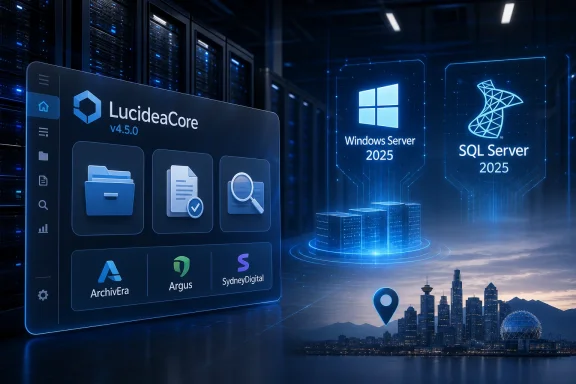 A Niche Release Exposes a Mainstream Windows Reality
LucideaCore v4.5.0 lands in a corner of the software market that most people never think about until something breaks. ArchivEra, Argus, and SydneyDigital are not mass-market productivity apps; they are systems of record for institutions that care about provenance, cataloging, access, preservation, and the slow accumulation of trusted metadata. That makes the underlying platform decision more consequential than the average version bump.The most important line in the announcement is not the refreshed menu design, even if that is what daily users will see first. It is the addition of support for Windows Server 2025 and SQL Server 2025. For IT administrators, that is the sentence that determines whether an application belongs in the next infrastructure planning cycle or remains an exception that must be protected, isolated, and explained.
This is the quiet bargain of enterprise Windows: vendors do not merely add features, they validate environments. When a line-of-business platform says it supports a new server OS and database version, it gives administrators permission to include that workload in modernization plans. Without that permission, even a technically capable server upgrade can be politically and operationally blocked.
Lucidea is also aiming this release at end users, promising fewer clicks, more intuitive navigation, and a smoother experience across its ILS and CMS products. That matters because institutions running archival, museum, or library systems tend to have a mixed population of users: professional catalogers, researchers, public-service staff, occasional contributors, and administrators. In such environments, navigation is not cosmetic. It is training cost, data quality, and staff patience translated into interface design.
The Menu Refresh Is Really a Workflow Argument
A “refreshed menu design” sounds modest, but menus are where enterprise applications reveal their age. In mature systems, years of customer requests, compliance needs, module additions, and configuration options often pile up into dense navigation structures that make sense only to veteran users. If LucideaCore v4.5.0 genuinely reduces the number of clicks between users and their information, that is more than a polish pass.For archives and museums, the path from question to record can be unusually complex. A user may need to move between accession records, object descriptions, donor information, rights metadata, digital assets, locations, conservation notes, and public-facing discovery fields. A poor menu structure turns that work into institutional archaeology: the user is not just managing a collection, but excavating the software itself.
Lucidea’s announcement does not provide screenshots or a detailed changelog, so it would be a mistake to overstate the design transformation. The company is claiming interface enhancements and smoother navigation, not a ground-up reinvention. Still, the framing is revealing. Lucidea is selling v4.5.0 as a usability release that also carries platform modernization.
That pairing is smart because it speaks to two audiences at once. End users want the application to get out of the way. IT teams want the application to stop anchoring them to aging infrastructure. The best enterprise upgrades satisfy both groups, because a server migration that makes the user experience worse will be resisted, and a prettier interface that leaves unsupported infrastructure untouched will be dismissed as decorative.
Windows Server 2025 Support Moves the Upgrade Conversation Out of Theory
Windows Server 2025 has been generally available since late 2024, but enterprise adoption is never just a matter of downloading the latest ISO. Workloads move when the vendors around them move. Backup agents, database platforms, identity integrations, monitoring tools, endpoint security, and line-of-business applications all need to fit the new environment before risk-averse administrators sign off.Lucidea’s support for Windows Server 2025 therefore functions as a small but meaningful signal. It says that at least this piece of the cultural-heritage and knowledge-management stack is being prepared for the current Microsoft server generation. That matters for organizations trying to avoid the familiar trap of running one or two specialized applications on older servers long after the rest of the estate has moved on.
The Windows Server 2025 angle is also practical because many institutions running collections systems are not hyperscale enterprises with endless engineering capacity. A museum, university archive, law library, government records office, or corporate knowledge center may have a small IT team supporting a highly specialized staff. When a vendor certifies support for the newer platform, it reduces the amount of bespoke testing that customer must perform alone.
But support is not the same thing as urgency. Administrators should read the announcement as an enabler, not an instruction to rush. Windows Server migrations still require compatibility testing, backup validation, restore drills, authentication checks, integration reviews, and a rollback plan. The value of v4.5.0 is that Lucidea customers can begin that conversation with the vendor’s roadmap aligned to Microsoft’s.
SQL Server 2025 Is the More Interesting Dependency
If Windows Server 2025 is the visible platform milestone, SQL Server 2025 may be the deeper one. Collections-management and library systems live or die by database integrity. Their value is not the interface alone, but the structured body of records behind it: descriptions, relationships, authority data, permissions, digital object links, audit trails, and institutional history.Microsoft’s SQL Server 2025 release is part of a broader push to make the database layer more integrated with modern analytics, cloud-adjacent workflows, and AI-era data patterns. Whether Lucidea customers care about those headline capabilities on day one is another matter. Many will care more about lifecycle, security, supportability, and the ability to remain on a current Microsoft database platform.
That is where the LucideaCore announcement becomes important. Specialized applications often lag behind database releases because vendors must test schemas, stored procedures, indexing behavior, reporting components, drivers, and deployment tooling. SQL Server compatibility is not a checkbox that should be assumed. A collections system with decades of customer data cannot treat the database as interchangeable plumbing.
For WindowsForum readers, this is the database-administration lesson hiding inside a vendor press release. The meaningful question is not “does the software install?” It is whether upgrades preserve performance, reporting behavior, backup and restore expectations, collation assumptions, security models, and integration points. Lucidea’s statement of support begins that process, but customers should still demand version-specific technical documentation before touching production.
Cultural Institutions Have Enterprise Problems Without Enterprise Budgets
It is tempting to treat library, archive, and museum software as a quaint side channel of enterprise IT. That would be a mistake. These organizations often manage sensitive records, public discovery portals, copyrighted works, donor information, internal research notes, and digital assets whose value is historical rather than transactional. Losing data or breaking access can be reputationally disastrous.The budget reality is usually harsher than the mission. A collections system may be operated by a small team, supported by shared IT, and expected to serve internal staff, researchers, public users, and external partners. That means software usability and platform support have outsized consequences. Every extra click, ambiguous menu item, or unsupported server dependency becomes another tax on people who are already stretched.
Lucidea’s customer language — “client-driven improvements” and “developed with end users in mind” — is standard vendor phrasing, but in this market it has a sharper edge. Archives and museums do not want generic enterprise software with a collections veneer. They want systems that reflect how cataloging, accessioning, discovery, rights management, and public access actually work.
The strongest version of LucideaCore v4.5.0 would be one that narrows the gap between institutional practice and software structure. The announcement suggests that Lucidea is at least aiming in that direction. It does not give enough detail to judge whether the new navigation will materially reduce training time or errors, but the emphasis on fewer clicks is the right battlefield.
Vendor-Controlled Upgrades Are a Blessing Until They Become a Bottleneck
Lucidea says existing clients will be contacted directly with upgrade details, and customers moving from earlier versions will receive applicable updates introduced between their current release and v4.5.0. That is reassuring, especially for organizations that do not upgrade every minor version. It also hints at a familiar reality in specialized enterprise software: upgrades are often mediated by the vendor rather than self-served from a download page.There are advantages to that model. Vendor-guided upgrades can account for customer-specific configurations, hosted versus on-premises deployments, data migrations, custom reports, integrations, and permission models. For systems that hold institutional memory, a cautious upgrade process is preferable to a reckless one.
The downside is scheduling friction. If general availability arrives later this summer, customers will still need to know when their own upgrade window opens, what prerequisites apply, whether the upgrade is mandatory for new platform support, and how long older versions remain supported. “You will be contacted” is fine as a first announcement. It is not a lifecycle policy.
IT administrators should press for the usual specifics: supported operating systems, supported SQL Server editions, browser requirements, .NET dependencies, migration sequencing, downtime expectations, rollback options, and known issues. A modernized menu is nice. A predictable upgrade runbook is better.
The Windows Angle Is Lifecycle Discipline, Not Desktop Excitement
For a Windows enthusiast site, the obvious trap is to ask whether this release changes anything for ordinary PC users. It does not, at least not directly. LucideaCore v4.5.0 is relevant because it shows how Windows Server 2025 and SQL Server 2025 adoption happens in the real world: not through a dramatic cutover, but through thousands of vendor certifications across specialized software categories.That is how Microsoft’s enterprise platform becomes real. A server OS can be generally available, documented, and licensed, but many customers will wait until their application vendors bless it. The operating system is only one layer in a stack of support contracts and institutional risk decisions.
The same applies to SQL Server. Database administrators may be ready to evaluate the new release, but application owners will ask whether their systems are certified. If the answer is no, the upgrade stalls. If the answer is yes, the project becomes possible, though not automatic.
Lucidea’s announcement is therefore less about splashy Windows features than about ecosystem gravity. Microsoft moves the platform. Vendors update their products. Customers slowly gain the confidence to modernize. That rhythm is boring only until you are the administrator responsible for keeping unsupported workloads alive.
The SaaS Versus On-Premises Tension Sits Just Beneath the Announcement
Lucidea’s product family spans organizations with different deployment preferences, and the announcement’s platform-support language will matter most to customers managing Windows and SQL Server directly. Hosted or SaaS customers may experience v4.5.0 primarily as an application upgrade, while on-premises customers will view it through the lens of infrastructure compatibility.That split is increasingly important. In many sectors, SaaS has turned platform support into the vendor’s problem. In cultural institutions, however, the move is uneven. Data sovereignty, budget cycles, integration needs, local policy, and comfort with vendor-hosted systems all influence deployment decisions.
For on-premises customers, Windows Server 2025 and SQL Server 2025 support is a planning tool. It allows them to align Lucidea workloads with broader server refreshes, virtualization strategies, backup modernization, and security baselines. It may also help justify hardware or licensing changes that would otherwise be difficult to prioritize.
For hosted customers, the support statement still matters, but more indirectly. A vendor operating on current server and database platforms is generally better positioned to maintain security, performance, and lifecycle compliance. Customers may not see the infrastructure, but they inherit the consequences of whether it is modern or neglected.
Interface Modernization Has to Respect Expert Users
Enterprise software redesigns often stumble when they underestimate expert habits. A menu structure that feels cleaner to a new user can frustrate a cataloger who has built years of muscle memory around the old navigation. Lucidea’s challenge is not simply to reduce clicks; it is to reduce clicks without hiding the depth that professional users need.Archivists and collections managers are not casual data-entry clerks. They work with standards, exceptions, uncertain information, evolving descriptions, and long-lived records. The interface must accommodate both routine tasks and edge cases. Simplification that removes friction is good; simplification that flattens expertise is not.
The announcement’s language suggests a navigation refresh rather than a radical redesign, which may be the safer approach. In mature vertical software, evolutionary interface changes often work better than dramatic ones. Users want relief from clutter, not a forced relearning of every path through the system.
Still, Lucidea should expect customers to ask for training materials, side-by-side documentation, and clear guidance on what changed. A smoother experience is measured not only by how the product looks in a demo, but by how quickly real staff regain confidence after the upgrade.
“Client-Driven Improvements” Is the Phrase to Watch
Every vendor says it listens to customers. The interesting question is which customers shape the roadmap and what kind of requests make it into the product. In specialized systems like ArchivEra, Argus, and SydneyDigital, client-driven improvements can be genuinely valuable because workflows are domain-specific and difficult to invent from the outside.The danger is that client-driven development can also produce accumulation. One institution’s necessary field, report, menu option, or workflow exception becomes another institution’s clutter. Over time, vertical software can become a museum of customer requests in its own right.
LucideaCore’s shared platform role is important here. If Lucidea can implement improvements at the core layer while preserving product-specific workflows, it can spread usability and platform benefits across multiple applications. That is the promise of a common foundation: a navigation enhancement or platform certification does not have to be rebuilt separately for each product.
But shared platforms also impose discipline. A change made for one product family must not distort another. Library automation, archival management, and museum collections management overlap, but they are not the same business. The success of v4.5.0 will depend on whether LucideaCore improves the common experience without sanding off the differences that make each application useful.
The Release Timing Gives IT Teams a Summer Planning Window
Lucidea says v4.5.0 will be generally available later this summer. That timing is convenient for some institutions and awkward for others. Universities and schools often use summer windows for maintenance, while museums and public-facing cultural organizations may have seasonal visitor patterns that complicate downtime.The announcement does not specify an exact release date, which means administrators should treat this as a planning notice rather than a deployment trigger. The right move now is to inventory current Lucidea versions, identify hosting models, confirm server and SQL Server versions, and determine whether any integrations could be affected. Waiting until the vendor’s upgrade email arrives is a common way to turn a manageable project into a rushed one.
Customers upgrading from earlier releases will receive applicable intervening updates, according to Lucidea. That is useful, but it also raises the importance of reading accumulated release notes. A customer moving from a much older version may experience more than the v4.5.0 menu refresh. They may inherit years of smaller changes in behavior, security, configuration, and reporting.
For IT teams, the safest assumption is that version distance matters. The further behind a system is, the more the upgrade should be treated as a project rather than a patch. That includes stakeholder testing, database backups, user acceptance, and a communication plan for staff who will notice the interface changes first.
Security Is the Unspoken Reason Platform Support Matters
The announcement emphasizes usability and platform support, but security sits behind both. Unsupported or aging server platforms create risk even when the application itself is stable. Attackers do not care that a workload is culturally important or budget-constrained; they care whether it exposes a vulnerable service, outdated runtime, weak authentication path, or neglected database.Windows Server 2025 and SQL Server 2025 support does not automatically make a Lucidea deployment secure. Security depends on configuration, patching, identity practices, network exposure, backups, monitoring, and vendor maintenance. But support for current platforms gives administrators more room to apply modern baselines.
That is especially relevant for collections systems that expose public discovery portals or integrate with external services. A system that bridges internal records and public access needs careful separation of permissions, auditability, and update discipline. The more public-facing the deployment, the less tolerable it is to keep infrastructure frozen because an application cannot move forward.
The security-minded reading of LucideaCore v4.5.0 is therefore straightforward. If you are a customer, this release may become part of your argument for retiring older Windows Server and SQL Server dependencies. If you are the vendor, the next thing customers will want is clear documentation that turns support into deployable confidence.
Microsoft’s Stack Still Owns the Back Office of Specialized Knowledge
There is a broader industry story here about Microsoft’s persistence in the back office. Cloud-native platforms get the attention, but a huge amount of institutional knowledge still lives in applications backed by Windows Server, SQL Server, IIS, .NET, Active Directory or Entra-connected identity, and familiar administrative tooling. LucideaCore v4.5.0 appears to be another example of that continuity.That continuity is not backwardness. For many organizations, the Microsoft stack remains attractive because staff know it, auditors understand it, vendors support it, and the operational model is predictable. The cost of novelty is not just license price; it is retraining, integration risk, procurement friction, and the possibility that a niche vendor cannot support the new architecture.
At the same time, continuity can become complacency. Supporting the latest Windows Server and SQL Server versions is valuable precisely because it prevents mature applications from becoming museum pieces themselves. The goal is not to preserve old infrastructure for its own sake, but to preserve institutional data while allowing the underlying platform to evolve.
Lucidea’s announcement fits that pattern. It does not promise a revolution in collections management. It promises that the platform beneath those collections is moving forward, while the interface above it becomes easier to use. In enterprise software, that is often the more credible kind of progress.
The Real Test Will Come After the Upgrade Emails
The immediate news is simple: LucideaCore v4.5.0 is coming, and existing clients will receive upgrade details directly. The harder part begins when customers compare the announcement to their own environments. A small archive running a hosted deployment and a large museum with complex integrations may both be “Lucidea customers,” but their upgrade realities will differ dramatically.Administrators should not wait passively. They should ask Lucidea for the technical specification tied to v4.5.0, including exact supported Windows Server and SQL Server configurations. They should also ask whether SQL Server 2025 support includes all editions relevant to their licensing and whether any compatibility level settings are recommended.
Application owners should prepare a different set of questions. What changed in the menu structure? Are existing workflows preserved? Will saved searches, reports, dashboards, portals, or role-specific permissions behave differently? How much training will staff need, and can users preview the new interface before production cutover?
The best upgrade conversations happen when IT and users compare notes before the maintenance window. Lucidea’s release touches both sides of the house. Treating it as only a server project or only an interface project would miss the point.
A Smaller Vendor Announcement Shows How Windows Modernization Actually Happens
The Windows ecosystem is too often discussed through Microsoft’s announcements alone. That perspective is incomplete. The practical life of a Windows Server release depends on independent software vendors deciding when to certify, support, and optimize for it.LucideaCore v4.5.0 is one of those ecosystem steps. It will not dominate Microsoft Ignite, and it will not change the trajectory of Windows by itself. But for the organizations that depend on ArchivEra, Argus, or SydneyDigital, it may determine when Windows Server 2025 and SQL Server 2025 become viable production options.
That is why this release deserves more attention than a routine vendor note. It sits at the intersection of usability, infrastructure lifecycle, and institutional stewardship. Museums, archives, and libraries are not just buying software features; they are entrusting vendors with the systems that describe and expose their collections.
The announcement also underscores a lesson Microsoft knows well: platform adoption is cumulative. Every supported application removes one objection from the migration plan. Every unsupported application preserves one island of legacy infrastructure. Lucidea has now signaled which side of that ledger its core platform is moving toward.
The Upgrade Checklist Lucidea Customers Should Start Before Summer Ends
The smartest response to LucideaCore v4.5.0 is neither excitement nor skepticism, but preparation. This is a release that appears to combine user-visible changes with infrastructure implications, which means the upgrade should be discussed by both collections leadership and IT before the vendor’s scheduling process begins.- Customers should confirm which LucideaCore version they currently run and how many intervening updates will be included in the move to v4.5.0.
- IT teams should ask Lucidea for exact Windows Server 2025 and SQL Server 2025 support details, including prerequisites, supported editions, and any known limitations.
- Application owners should plan user testing around the refreshed menu design, because navigation changes can affect productivity even when data and features remain intact.
- Organizations with integrations, public portals, custom reports, or authentication dependencies should treat the upgrade as a coordinated change rather than a routine maintenance task.
- Security teams should use the release as an opportunity to revisit server lifecycle, database patching, backups, permissions, and exposure of any public-facing discovery components.
- Hosted customers should still ask what the new platform support means for vendor-operated environments, upgrade timing, downtime, and rollback expectations.
References
- Primary source: The AI Journal
Published: 2026-06-18T20:48:07.980186
Lucidea Announces LucideaCore v4.5.0 for ArchivEra, Argus, and SydneyDigital | The AI Journal
VANCOUVER, British Columbia--(BUSINESS WIRE)--Lucidea, a global provider of market-leading knowledge management, library automation, and museum and archives aijourn.com
- Related coverage: lucidea.com
Argus and Museum Collections Management Resources | Lucidea
Access museum collections management resources, including white papers, case studies, and learn about using Argus for your museum’s collections management.lucidea.com - Related coverage: slashdot.org
Compare ArchivEra vs. Argus in 2026
What’s the difference between ArchivEra and Argus? Compare ArchivEra vs. Argus in 2026 by cost, reviews, features, integrations, and moreslashdot.org
- Related coverage: platform.softwareone.com

Argus by Lucidea | SoftwareOne Marketplace
Discover Argus by Lucidea on the SoftwareOne Marketplace. Learn about key features, benefits, and licensing options to optimize your business workflow.
platform.softwareone.com
- Related coverage: sourceforge.net
ArchivEra vs. Argus Comparison
Compare ArchivEra vs. Argus using this comparison chart. Compare price, features, and reviews of the software side-by-side to make the best choice for your business. sourceforge.net
- Related coverage: lucidity.cloud
- Related coverage: mcpservers.org
Argus MCP Server | Awesome MCP Servers
專為AI代理設計的多供應商搜尋中介,可路由至SearXNG、Brave、Serper、Tavily及Exa,具備自動備援、RRF排序、內容提取與預算強制功能。mcpservers.org
