

Amdocs said on May 13, 2026, that it will migrate one of Lumen Technologies’ enterprise billing platforms to Microsoft Azure, extending an existing cloud-modernization relationship that has already moved some Lumen systems onto Google Cloud. The announcement is easy to file under the familiar heading of telecom IT outsourcing, but that understates what is happening. Lumen is not merely changing hosting providers for a back-office workload; it is moving one of the systems that turns network service into revenue onto the same public-cloud substrate now absorbing telecom operations, AI tooling, and enterprise connectivity. The wager is that billing, long treated as the cautious core of carrier IT, can become part of the cloud operating model without becoming another expensive migration cautionary tale.
Telecom cloud stories usually begin with radio networks, edge computing, private 5G, or AI operations centers. Billing sounds dull by comparison, which is precisely why it matters. A carrier can experiment around the edges of its network, but the billing platform is where product catalogs, contracts, usage records, disputes, credits, tax logic, revenue recognition, and customer trust collide.
That makes Lumen’s move more consequential than a generic “workload migration” press release. Enterprise billing is not a stateless web app that can be containerized over a long weekend. It is a dense operational system tied to sales motions, service inventory, provisioning, customer care, partner settlements, compliance obligations, and the financial rhythm of the business.
The Amdocs announcement frames the Azure move around resiliency, scalability, operational agility, and efficiency. Those are the expected words, but they are not empty ones in this context. For a communications provider serving business customers, billing platform fragility quickly becomes customer-experience fragility. Late invoices, incorrect rating, broken product bundles, or sluggish change processes can undermine the very enterprise services that operators are trying to modernize and sell.
Lumen, formerly CenturyLink, has spent years trying to reposition itself around enterprise networking, cloud connectivity, security, and digital services rather than merely legacy telecom access. That strategic pivot only works if its internal systems can move at something closer to software speed. The billing migration is therefore less about Azure winning another logo than about Lumen trying to align its revenue engine with the cloud-first operating model it sells to customers.
That distinction matters for WindowsForum readers because enterprise Azure adoption has matured beyond lift-and-shift. The early cloud era promised reduced capital expenditure, elastic capacity, and global infrastructure. The current wave is more ambitious: cloud providers and their partners now sell modernization as a managed, AI-assisted engineering process in which discovery, dependency mapping, code transformation, testing, migration sequencing, and optimization become partly automated.
Microsoft has been leaning hard into that story across Azure, GitHub Copilot, Azure OpenAI, Microsoft Foundry, and its broader agent strategy. Amdocs, for its part, has positioned aOS as an agentic operating layer for telecommunications, where AI agents can help manage the complexity of telco-specific systems. Lumen’s billing migration gives that narrative a concrete venue: a real carrier, a real revenue platform, and a workload where failure would be visible.
Still, the public announcement does not say exactly what architecture will emerge on Azure. It does not specify whether the platform will be rehosted, refactored, decomposed into cloud-native services, integrated with managed databases, or gradually surrounded by newer APIs. That silence is normal for customer announcements, but it is also important. “Migrating to Azure” can mean many different things, from virtual machines running familiar software to a deeper redesign around cloud-native services, observability, automation, and DevSecOps.
For IT leaders, that ambiguity is the lesson. The cloud headline is the least interesting part of any enterprise migration. The hard questions live underneath: which components are modernized, which are merely relocated, which dependencies remain on-premises, how data consistency is handled during transition, how rollback works, and whether the new environment is operationally simpler or merely different.
Large carriers rarely standardize on a single hyperscaler for every workload. They inherit acquisitions, regulatory constraints, vendor partnerships, regional preferences, commercial terms, data requirements, and application architectures that point in different directions. A billing platform may land on Azure because the surrounding Microsoft stack, partner ecosystem, operational tooling, commercial agreement, or technical roadmap makes sense. Another platform may land on Google Cloud because of data analytics, AI tooling, or an existing migration award. AWS may remain present because it already supports other operational or customer-facing workloads.
The marketing version of multi-cloud implies portability: workloads gliding between clouds as business needs change. The operational version is messier. Each cloud has its own identity model, networking primitives, monitoring stack, managed database assumptions, cost controls, security posture, and failure modes. Even when Kubernetes, Terraform, OpenTelemetry, and common CI/CD practices soften the differences, they do not erase them.
That is especially true in telecom, where public cloud often intersects with private networks, edge locations, regulated data, and long-lived support systems. A carrier’s cloud estate is not a greenfield SaaS startup. It is a layered map of mainframes, commercial off-the-shelf platforms, proprietary integration code, APIs, batch jobs, message buses, customer portals, and operational scripts that have accreted over decades.
Lumen’s Azure billing project should therefore be read as a pragmatic multi-cloud move, not a theological statement about cloud neutrality. The company is placing a specific enterprise billing workload on Azure while continuing a broader transformation across clouds. The outcome will depend less on the number of hyperscalers in the press release than on whether Lumen can impose common governance, cost discipline, security controls, and operational visibility across them.
There is a real idea behind the buzzword. Large migrations involve repetitive but high-stakes tasks: inventorying applications, identifying dependencies, classifying code patterns, analyzing database calls, generating test cases, producing infrastructure templates, comparing performance baselines, and flagging anomalies. AI agents, if governed properly, can help teams move faster through this sludge. They can also create a more consistent audit trail than ad hoc human-only efforts, provided the tooling is designed for traceability rather than theatrical autonomy.
But “agentic” should not be confused with magic. Billing systems are full of business rules that are not always documented, and some of those rules exist because a customer contract, regulatory requirement, or operational exception demanded them years ago. An AI tool may discover code paths and dependencies, but it cannot independently decide whether a strange billing adjustment is obsolete cruft or a legally important accommodation for a major enterprise account.
This is where Amdocs has an advantage and a burden. The company’s long history in business support systems gives it domain context that a generic migration shop may lack. At the same time, the more it leans into AI-assisted migration, the more customers will expect faster delivery without accepting greater risk. In enterprise billing, speed is welcome only when it does not compromise correctness.
The credible version of agentic migration is not autonomous robots rewriting the carrier’s revenue platform in the dark. It is a tightly bounded engineering workflow in which AI accelerates discovery, transformation, testing, and optimization while human experts remain accountable for architecture, exceptions, compliance, and production readiness. If that is what Amdocs means by aOS in this engagement, the claim deserves attention. If it becomes another broad AI wrapper around conventional services work, customers will notice.
That is why a billing migration matters. It sits above the network but below customer experience, joining operational infrastructure to monetization. If Azure becomes trusted for these systems, Microsoft gains more than compute consumption. It gains relevance in the carrier’s operating model.
This also helps explain why Microsoft’s broader AI platform push matters in telecom. Carriers want to automate service assurance, customer care, network planning, field operations, security response, product configuration, and sales support. But those AI use cases depend on clean access to operational and commercial data. Billing is not merely a finance application; it is a structured record of what customers bought, used, changed, disputed, renewed, or abandoned.
A modernized billing platform on Azure could eventually feed analytics, customer intelligence, product experimentation, and automation workflows more naturally than a legacy environment designed for slower release cycles. That does not happen automatically. Data governance, privacy controls, integration architecture, and cost management must be engineered deliberately. But the strategic direction is obvious: Microsoft wants Azure to host not just carrier workloads, but carrier intelligence.
The competitive backdrop is equally obvious. Google Cloud has made a strong telco and data analytics pitch. AWS has its own carrier relationships and cloud infrastructure story. Lumen’s known use of multiple clouds reflects the market reality that no hyperscaler owns telecom transformation outright. Microsoft’s win here is meaningful precisely because the field is contested.
That can happen when migration is treated as a destination rather than an operating change. A workload can be on Azure and still be slow to modify. It can be cloud-hosted and still tightly coupled. It can be more resilient at the infrastructure layer while remaining brittle at the application or data layer. It can have autoscaling capacity and still suffer from manual release gates, opaque dependencies, or unresolved process bottlenecks.
For Lumen, the meaningful test will be whether the Azure move improves the pace and reliability with which enterprise products can be launched, changed, bundled, billed, and supported. That is where telecom modernization gets real. Network-as-a-service, dynamic bandwidth, cloud connectivity, security bundles, edge services, and partner marketplaces all require commercial systems that can represent flexible products without creating months of back-office work.
Amdocs knows this market because business support systems have long been the bottleneck between telecom ambition and telecom execution. The industry has repeatedly promised new monetization models around 3G, 4G, 5G, IoT, edge computing, and private networks. The network capabilities often arrive before the billing, ordering, catalog, and care systems are ready to monetize them cleanly.
That history should temper expectations. Moving one enterprise billing platform to Azure will not by itself transform Lumen into a hyperscale software company. But it can remove one piece of accumulated drag, especially if the migration is paired with modernization of interfaces, deployment practices, testing, observability, and product configuration.
Administrators and architects looking at similar migrations should pay attention to the operational questions behind the announcement. Identity and access management will be central, especially if legacy billing operators, service accounts, automation tools, partner integrations, and reporting systems need controlled access across hybrid or multi-cloud environments. Microsoft Entra, privileged access workflows, conditional access policies, key management, and audit logging are not decorative pieces; they are migration prerequisites.
Observability is another pressure point. Billing platforms generate business-critical signals, but legacy monitoring often focuses on infrastructure health rather than end-to-end process correctness. On Azure, the organization needs to know not only whether compute, storage, and databases are healthy, but whether rating jobs completed, invoice batches reconciled, downstream feeds arrived, and customer-facing portals reflect the correct state.
Backup and disaster recovery also become more nuanced. A resilient cloud architecture is not just one that spans availability zones. It must account for data recovery points, transaction consistency, failover sequencing, reconciliation after outages, and the operational authority to declare a rollback or cutover. In billing, partial recovery can be worse than downtime if it produces inconsistent financial records.
Then there is cost. Cloud migration advocates love elasticity, but billing platforms can be heavy consumers of compute, storage, database throughput, logging, and data movement. AI-assisted migration may reduce engineering time, but it does not remove the need for FinOps discipline. If Lumen’s move delivers operational agility at the price of opaque cloud spend, the project will have solved one class of problems while creating another.
For all the attention given to generative AI front ends, many large companies are stuck with application estates that were not built for rapid change. They have fragile integrations, undocumented dependencies, aging codebases, brittle test suites, and institutional knowledge trapped in a shrinking group of experts. AI agents aimed at modernization attack that problem more directly than another conversational assistant bolted onto a portal.
Telecom is fertile ground for this because the industry combines massive scale with legacy complexity. Carriers have enormous incentive to automate, but they also operate systems where errors can affect millions of customers or major enterprise accounts. That forces a more disciplined form of AI adoption than the casual “let the model do it” rhetoric common elsewhere.
If Amdocs can use AI agents to accelerate migration while preserving traceability, testability, and governance, the approach could become a template for other communications providers. If the tooling mainly produces faster assessments and nicer dashboards, it will still have value, but it will not justify the more ambitious language now attached to agentic transformation.
The difference will show up in delivery outcomes. Did the AI-enabled framework shorten dependency discovery? Did it reduce defects? Did it improve test coverage? Did it produce infrastructure and deployment patterns that operations teams can maintain? Did it make optimization continuous rather than a post-migration cleanup exercise? These are the measures that matter after the announcement fades.
If the move helps Lumen launch enterprise service bundles faster, support more dynamic pricing, integrate partner products more cleanly, improve billing transparency, or reduce operational friction for business customers, then the migration becomes part of a larger competitive strategy. If it mostly reduces infrastructure headaches while leaving product and process agility unchanged, then it will be a useful modernization project but not a strategic inflection point.
The carrier market badly needs the former. Enterprise customers increasingly expect networking to behave more like cloud services: configurable, observable, elastic, API-friendly, and tied to business outcomes rather than long provisioning cycles. Operators can build slick portals and programmable network services, but if the commercial systems behind them cannot keep up, the experience breaks.
That is why billing modernization belongs in the same conversation as network automation and AI operations. The customer does not experience these as separate systems. A business customer ordering connectivity, security, cloud access, or managed services experiences a chain: quote, order, provision, monitor, support, invoice, renew. Weakness anywhere in that chain becomes the provider’s brand.
Lumen’s Azure migration will not single-handedly determine its enterprise future. But it is the kind of plumbing project that either enables or constrains the visible strategy. In telecom, the back office is often where the front office’s promises go to wait.
Lumen is not alone in facing that transition. Banks, insurers, airlines, manufacturers, healthcare organizations, and governments are all trying to modernize core systems without breaking the processes those systems encode. The cloud providers know this, which is why they increasingly sell migration factories, modernization agents, industry clouds, governance frameworks, and partner ecosystems rather than raw infrastructure alone.
The Amdocs-Lumen-Azure project is therefore both specific and representative. It is specific because telecom billing has its own complexity and Lumen has its own transformation agenda. It is representative because it shows how the next phase of cloud adoption will be fought: workload by workload, control plane by control plane, with AI used less as a novelty than as a lever against modernization debt.
The announcement gives Microsoft another proof point in telco, gives Amdocs another stage for its AI-enabled migration story, and gives Lumen a chance to make its internal systems better match its cloud-first ambitions. The real story, however, will be written in operations. If invoices keep flowing, changes ship faster, resilience improves, and enterprise products become easier to monetize, the migration will matter. If not, it will join the long archive of cloud projects that moved the machinery without changing the machine.
For administrators, architects, and security teams, the concrete implications are sharper than the press-release language suggests.
Source: Telecompaper Amdocs migrates Lumen enterprise billing to Azure
 Billing Is Where Telecom Modernization Stops Being Abstract
Telecom cloud stories usually begin with radio networks, edge computing, private 5G, or AI operations centers. Billing sounds dull by comparison, which is precisely why it matters. A carrier can experiment around the edges of its network, but the billing platform is where product catalogs, contracts, usage records, disputes, credits, tax logic, revenue recognition, and customer trust collide.That makes Lumen’s move more consequential than a generic “workload migration” press release. Enterprise billing is not a stateless web app that can be containerized over a long weekend. It is a dense operational system tied to sales motions, service inventory, provisioning, customer care, partner settlements, compliance obligations, and the financial rhythm of the business.
The Amdocs announcement frames the Azure move around resiliency, scalability, operational agility, and efficiency. Those are the expected words, but they are not empty ones in this context. For a communications provider serving business customers, billing platform fragility quickly becomes customer-experience fragility. Late invoices, incorrect rating, broken product bundles, or sluggish change processes can undermine the very enterprise services that operators are trying to modernize and sell.
Lumen, formerly CenturyLink, has spent years trying to reposition itself around enterprise networking, cloud connectivity, security, and digital services rather than merely legacy telecom access. That strategic pivot only works if its internal systems can move at something closer to software speed. The billing migration is therefore less about Azure winning another logo than about Lumen trying to align its revenue engine with the cloud-first operating model it sells to customers.
Azure Gets the Revenue Engine, Not Just Another Workload
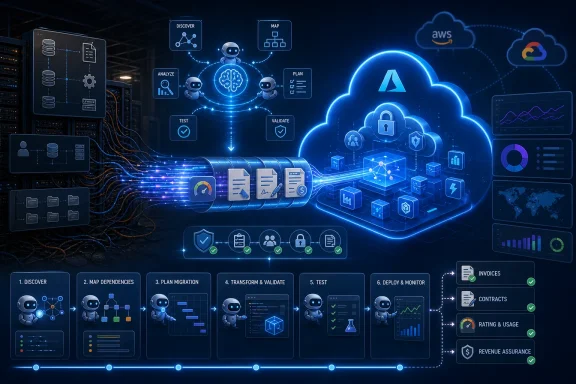
Microsoft Azure’s role here is significant because the platform is not being used only as cheaper infrastructure. The announcement says Amdocs will apply agentic, AI-enabled migration capabilities through its Amdocs Operating System framework, or aOS, to accelerate the cloud journey and reduce transformation risk. In other words, the pitch is not simply “move the billing platform to Azure,” but “use AI-assisted tooling and a controlled operating framework to migrate something too complex to modernize by brute force.”That distinction matters for WindowsForum readers because enterprise Azure adoption has matured beyond lift-and-shift. The early cloud era promised reduced capital expenditure, elastic capacity, and global infrastructure. The current wave is more ambitious: cloud providers and their partners now sell modernization as a managed, AI-assisted engineering process in which discovery, dependency mapping, code transformation, testing, migration sequencing, and optimization become partly automated.
Microsoft has been leaning hard into that story across Azure, GitHub Copilot, Azure OpenAI, Microsoft Foundry, and its broader agent strategy. Amdocs, for its part, has positioned aOS as an agentic operating layer for telecommunications, where AI agents can help manage the complexity of telco-specific systems. Lumen’s billing migration gives that narrative a concrete venue: a real carrier, a real revenue platform, and a workload where failure would be visible.
Still, the public announcement does not say exactly what architecture will emerge on Azure. It does not specify whether the platform will be rehosted, refactored, decomposed into cloud-native services, integrated with managed databases, or gradually surrounded by newer APIs. That silence is normal for customer announcements, but it is also important. “Migrating to Azure” can mean many different things, from virtual machines running familiar software to a deeper redesign around cloud-native services, observability, automation, and DevSecOps.
For IT leaders, that ambiguity is the lesson. The cloud headline is the least interesting part of any enterprise migration. The hard questions live underneath: which components are modernized, which are merely relocated, which dependencies remain on-premises, how data consistency is handled during transition, how rollback works, and whether the new environment is operationally simpler or merely different.
The Multi-Cloud Story Is Less Romantic Than It Sounds
The announcement also notes that Lumen’s existing relationship with Amdocs has already involved moving part of Lumen’s systems to Google Cloud, while this new project targets Microsoft Azure. Separately, Lumen executives have described the company as pursuing a multi-cloud transformation involving Azure, Google Cloud, and Amazon Web Services. That sounds like flexibility, and in some ways it is. In practice, multi-cloud is usually less a grand abstraction than a series of negotiated realities.Large carriers rarely standardize on a single hyperscaler for every workload. They inherit acquisitions, regulatory constraints, vendor partnerships, regional preferences, commercial terms, data requirements, and application architectures that point in different directions. A billing platform may land on Azure because the surrounding Microsoft stack, partner ecosystem, operational tooling, commercial agreement, or technical roadmap makes sense. Another platform may land on Google Cloud because of data analytics, AI tooling, or an existing migration award. AWS may remain present because it already supports other operational or customer-facing workloads.
The marketing version of multi-cloud implies portability: workloads gliding between clouds as business needs change. The operational version is messier. Each cloud has its own identity model, networking primitives, monitoring stack, managed database assumptions, cost controls, security posture, and failure modes. Even when Kubernetes, Terraform, OpenTelemetry, and common CI/CD practices soften the differences, they do not erase them.
That is especially true in telecom, where public cloud often intersects with private networks, edge locations, regulated data, and long-lived support systems. A carrier’s cloud estate is not a greenfield SaaS startup. It is a layered map of mainframes, commercial off-the-shelf platforms, proprietary integration code, APIs, batch jobs, message buses, customer portals, and operational scripts that have accreted over decades.
Lumen’s Azure billing project should therefore be read as a pragmatic multi-cloud move, not a theological statement about cloud neutrality. The company is placing a specific enterprise billing workload on Azure while continuing a broader transformation across clouds. The outcome will depend less on the number of hyperscalers in the press release than on whether Lumen can impose common governance, cost discipline, security controls, and operational visibility across them.
Agentic Migration Is the New Sales Pitch for Old Complexity
The most fashionable phrase in the announcement is “agentic, AI-enabled migration.” A few years ago, the same project might have been described as automated migration, cloud modernization, or DevOps transformation. In 2026, the industry has settled on agentic as the word that promises software can do more than recommend; it can plan, act, check, and iterate within guardrails.There is a real idea behind the buzzword. Large migrations involve repetitive but high-stakes tasks: inventorying applications, identifying dependencies, classifying code patterns, analyzing database calls, generating test cases, producing infrastructure templates, comparing performance baselines, and flagging anomalies. AI agents, if governed properly, can help teams move faster through this sludge. They can also create a more consistent audit trail than ad hoc human-only efforts, provided the tooling is designed for traceability rather than theatrical autonomy.
But “agentic” should not be confused with magic. Billing systems are full of business rules that are not always documented, and some of those rules exist because a customer contract, regulatory requirement, or operational exception demanded them years ago. An AI tool may discover code paths and dependencies, but it cannot independently decide whether a strange billing adjustment is obsolete cruft or a legally important accommodation for a major enterprise account.
This is where Amdocs has an advantage and a burden. The company’s long history in business support systems gives it domain context that a generic migration shop may lack. At the same time, the more it leans into AI-assisted migration, the more customers will expect faster delivery without accepting greater risk. In enterprise billing, speed is welcome only when it does not compromise correctness.
The credible version of agentic migration is not autonomous robots rewriting the carrier’s revenue platform in the dark. It is a tightly bounded engineering workflow in which AI accelerates discovery, transformation, testing, and optimization while human experts remain accountable for architecture, exceptions, compliance, and production readiness. If that is what Amdocs means by aOS in this engagement, the claim deserves attention. If it becomes another broad AI wrapper around conventional services work, customers will notice.
Microsoft’s Telco Cloud Ambition Keeps Moving Up the Stack
For Microsoft, this project fits a longer campaign to make Azure a serious platform for communications providers. The company has spent years courting telcos through Azure for Operators, private MEC, network automation partnerships, 5G core efforts, and industry-specific collaborations. Yet the telco cloud opportunity has always been broader than network functions. Operators also run some of the most intricate enterprise IT estates on the planet.That is why a billing migration matters. It sits above the network but below customer experience, joining operational infrastructure to monetization. If Azure becomes trusted for these systems, Microsoft gains more than compute consumption. It gains relevance in the carrier’s operating model.
This also helps explain why Microsoft’s broader AI platform push matters in telecom. Carriers want to automate service assurance, customer care, network planning, field operations, security response, product configuration, and sales support. But those AI use cases depend on clean access to operational and commercial data. Billing is not merely a finance application; it is a structured record of what customers bought, used, changed, disputed, renewed, or abandoned.
A modernized billing platform on Azure could eventually feed analytics, customer intelligence, product experimentation, and automation workflows more naturally than a legacy environment designed for slower release cycles. That does not happen automatically. Data governance, privacy controls, integration architecture, and cost management must be engineered deliberately. But the strategic direction is obvious: Microsoft wants Azure to host not just carrier workloads, but carrier intelligence.
The competitive backdrop is equally obvious. Google Cloud has made a strong telco and data analytics pitch. AWS has its own carrier relationships and cloud infrastructure story. Lumen’s known use of multiple clouds reflects the market reality that no hyperscaler owns telecom transformation outright. Microsoft’s win here is meaningful precisely because the field is contested.
The Risk Is Not Migration Failure; It Is Migration Disappointment
The nightmare version of a project like this is a botched cutover that disrupts billing. But the more common failure mode in enterprise cloud migration is subtler: the system moves, the invoices still run, the press release ages, and the organization discovers that it has not become meaningfully more agile.That can happen when migration is treated as a destination rather than an operating change. A workload can be on Azure and still be slow to modify. It can be cloud-hosted and still tightly coupled. It can be more resilient at the infrastructure layer while remaining brittle at the application or data layer. It can have autoscaling capacity and still suffer from manual release gates, opaque dependencies, or unresolved process bottlenecks.
For Lumen, the meaningful test will be whether the Azure move improves the pace and reliability with which enterprise products can be launched, changed, bundled, billed, and supported. That is where telecom modernization gets real. Network-as-a-service, dynamic bandwidth, cloud connectivity, security bundles, edge services, and partner marketplaces all require commercial systems that can represent flexible products without creating months of back-office work.
Amdocs knows this market because business support systems have long been the bottleneck between telecom ambition and telecom execution. The industry has repeatedly promised new monetization models around 3G, 4G, 5G, IoT, edge computing, and private networks. The network capabilities often arrive before the billing, ordering, catalog, and care systems are ready to monetize them cleanly.
That history should temper expectations. Moving one enterprise billing platform to Azure will not by itself transform Lumen into a hyperscale software company. But it can remove one piece of accumulated drag, especially if the migration is paired with modernization of interfaces, deployment practices, testing, observability, and product configuration.
Windows and Azure Admins Should Read This as an Operations Story
For WindowsForum’s core audience, the announcement is a useful reminder that Azure’s most consequential enterprise wins are not always flashy AI demos or greenfield cloud-native apps. They are often ugly, necessary migrations of systems that organizations depend on but would rather not touch. Those are the systems that define whether a cloud program is credible.Administrators and architects looking at similar migrations should pay attention to the operational questions behind the announcement. Identity and access management will be central, especially if legacy billing operators, service accounts, automation tools, partner integrations, and reporting systems need controlled access across hybrid or multi-cloud environments. Microsoft Entra, privileged access workflows, conditional access policies, key management, and audit logging are not decorative pieces; they are migration prerequisites.
Observability is another pressure point. Billing platforms generate business-critical signals, but legacy monitoring often focuses on infrastructure health rather than end-to-end process correctness. On Azure, the organization needs to know not only whether compute, storage, and databases are healthy, but whether rating jobs completed, invoice batches reconciled, downstream feeds arrived, and customer-facing portals reflect the correct state.
Backup and disaster recovery also become more nuanced. A resilient cloud architecture is not just one that spans availability zones. It must account for data recovery points, transaction consistency, failover sequencing, reconciliation after outages, and the operational authority to declare a rollback or cutover. In billing, partial recovery can be worse than downtime if it produces inconsistent financial records.
Then there is cost. Cloud migration advocates love elasticity, but billing platforms can be heavy consumers of compute, storage, database throughput, logging, and data movement. AI-assisted migration may reduce engineering time, but it does not remove the need for FinOps discipline. If Lumen’s move delivers operational agility at the price of opaque cloud spend, the project will have solved one class of problems while creating another.
The Amdocs-Lumen Deal Shows Where Enterprise AI Is Quietly Going
The most interesting AI deployments in enterprise IT may not be chatbots. They may be the invisible engineering systems that help organizations change the software they already have. That is the deeper signal in Amdocs’ language around aOS and AI-enabled migration.For all the attention given to generative AI front ends, many large companies are stuck with application estates that were not built for rapid change. They have fragile integrations, undocumented dependencies, aging codebases, brittle test suites, and institutional knowledge trapped in a shrinking group of experts. AI agents aimed at modernization attack that problem more directly than another conversational assistant bolted onto a portal.
Telecom is fertile ground for this because the industry combines massive scale with legacy complexity. Carriers have enormous incentive to automate, but they also operate systems where errors can affect millions of customers or major enterprise accounts. That forces a more disciplined form of AI adoption than the casual “let the model do it” rhetoric common elsewhere.
If Amdocs can use AI agents to accelerate migration while preserving traceability, testability, and governance, the approach could become a template for other communications providers. If the tooling mainly produces faster assessments and nicer dashboards, it will still have value, but it will not justify the more ambitious language now attached to agentic transformation.
The difference will show up in delivery outcomes. Did the AI-enabled framework shorten dependency discovery? Did it reduce defects? Did it improve test coverage? Did it produce infrastructure and deployment patterns that operations teams can maintain? Did it make optimization continuous rather than a post-migration cleanup exercise? These are the measures that matter after the announcement fades.
The Real Benchmark Will Be Lumen’s Next Product Cycle
Cloud migrations are often judged at cutover, but the better benchmark comes later. The question is what Lumen can do after the billing platform is on Azure that it could not do before, or could only do slowly and expensively.If the move helps Lumen launch enterprise service bundles faster, support more dynamic pricing, integrate partner products more cleanly, improve billing transparency, or reduce operational friction for business customers, then the migration becomes part of a larger competitive strategy. If it mostly reduces infrastructure headaches while leaving product and process agility unchanged, then it will be a useful modernization project but not a strategic inflection point.
The carrier market badly needs the former. Enterprise customers increasingly expect networking to behave more like cloud services: configurable, observable, elastic, API-friendly, and tied to business outcomes rather than long provisioning cycles. Operators can build slick portals and programmable network services, but if the commercial systems behind them cannot keep up, the experience breaks.
That is why billing modernization belongs in the same conversation as network automation and AI operations. The customer does not experience these as separate systems. A business customer ordering connectivity, security, cloud access, or managed services experiences a chain: quote, order, provision, monitor, support, invoice, renew. Weakness anywhere in that chain becomes the provider’s brand.
Lumen’s Azure migration will not single-handedly determine its enterprise future. But it is the kind of plumbing project that either enables or constrains the visible strategy. In telecom, the back office is often where the front office’s promises go to wait.
The Cloud-First Bet Now Runs Through the Ledger
This deal is a small window into a broader shift in enterprise infrastructure, where public cloud is no longer a place for peripheral workloads but the target environment for systems of record. That shift is uncomfortable because systems of record are where architectural purity meets regulatory duty, customer contracts, operational habits, and financial accountability.Lumen is not alone in facing that transition. Banks, insurers, airlines, manufacturers, healthcare organizations, and governments are all trying to modernize core systems without breaking the processes those systems encode. The cloud providers know this, which is why they increasingly sell migration factories, modernization agents, industry clouds, governance frameworks, and partner ecosystems rather than raw infrastructure alone.
The Amdocs-Lumen-Azure project is therefore both specific and representative. It is specific because telecom billing has its own complexity and Lumen has its own transformation agenda. It is representative because it shows how the next phase of cloud adoption will be fought: workload by workload, control plane by control plane, with AI used less as a novelty than as a lever against modernization debt.
The announcement gives Microsoft another proof point in telco, gives Amdocs another stage for its AI-enabled migration story, and gives Lumen a chance to make its internal systems better match its cloud-first ambitions. The real story, however, will be written in operations. If invoices keep flowing, changes ship faster, resilience improves, and enterprise products become easier to monetize, the migration will matter. If not, it will join the long archive of cloud projects that moved the machinery without changing the machine.
The Practical Read for Admins Watching From the Server Room
The lesson for IT teams is not that every billing platform belongs on Azure, or that agentic migration has suddenly made legacy complexity disappear. The lesson is that the center of gravity has moved. Even conservative, revenue-critical systems are now candidates for public-cloud modernization when the business case, controls, and migration discipline are strong enough.For administrators, architects, and security teams, the concrete implications are sharper than the press-release language suggests.
- Mission-critical cloud migration should be judged by post-migration operating speed, not merely by a successful cutover.
- AI-assisted modernization is most credible when it improves discovery, testing, governance, and optimization rather than pretending to replace expert accountability.
- Multi-cloud strategy adds resilience and bargaining power only if identity, observability, cost management, and security controls remain coherent across platforms.
- Billing and other revenue systems need cloud architectures designed around data consistency, reconciliation, rollback, and auditability from the beginning.
- Azure’s telco opportunity is expanding beyond network functions into the commercial and operational systems that decide whether new services can be monetized quickly.
Source: Telecompaper Amdocs migrates Lumen enterprise billing to Azure
