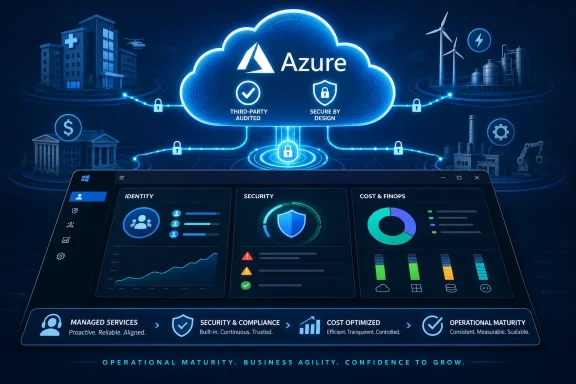
Lunavi announced on June 3, 2026, from Cheyenne, Wyoming, that it has achieved Microsoft’s Azure Expert Managed Services Provider designation, a partner credential awarded after Microsoft qualification checks and an independent audit of Azure managed-services capabilities. The news is easy to dismiss as another badge in the Microsoft partner economy. It is more useful to read it as a signal about where enterprise cloud buying has moved: away from raw migration help and toward audited operating models for AI-era infrastructure. For WindowsForum readers, the interesting part is not the trophy case; it is what Microsoft is asking customers to trust when Azure becomes the substrate for applications, data, security, and artificial intelligence.
The Azure Expert MSP designation is not simply a marketing label for companies that sell Azure services. Microsoft describes the program as an expert-tier partner track requiring qualification requirements, an application process, and an audit before a partner can receive or renew the badge. That matters because the cloud-services market is full of firms that can run a migration workshop, but far fewer that can prove repeatable practices for operating production Azure estates over time.
Lunavi’s announcement says the audit evaluated technical capabilities, people, and processes. That triad is the real story. In the old infrastructure world, a service provider could differentiate on hardware availability, help-desk responsiveness, or VMware operational discipline. In the Azure era, the differentiator is whether the provider can turn Microsoft’s rapidly changing platform into something a CIO, CISO, and finance chief can all live with.
The timing is also telling. Lunavi is positioning the designation around AI readiness, modernization, and regulated verticals such as healthcare, energy, finance, and manufacturing. Those are not casual cloud adopters. They are the customers most likely to discover that cloud migration is the easy part and cloud operations are the expensive, risky, politically fraught part.
Microsoft’s own partner structure reinforces that shift. Azure Expert MSP sits above ordinary partner participation and depends on aligned solution-area designations, performance expectations, skilling, support participation, and CSP-related requirements. In plain English, Microsoft is not merely asking whether a partner can talk about Azure. It is asking whether the partner has customers, trained staff, support motion, and operational evidence.
That distinction matters because enterprises have become more skeptical about cloud promises. Many organizations already moved workloads to Azure, AWS, or Google Cloud only to find that elasticity did not automatically lower costs, DevOps did not automatically improve governance, and security controls did not automatically configure themselves. A managed-service provider now has to answer harder questions about identity, backup, compliance, cost allocation, incident response, and application resilience.
Lunavi’s announcement emphasizes complex migrations, cloud-native application development, operational excellence, security, reliability, and FinOps. Those are the right words because they map to the problems IT teams are actually wrestling with. The phrase FinOps in particular has moved from conference jargon to boardroom necessity as cloud bills become a recurring operational exposure rather than a capital expense with a depreciation schedule.
There is a subtle but important vendor dynamic here. Microsoft benefits when more credible partners can help customers consume Azure services confidently. Lunavi benefits when Microsoft’s audit process lends third-party weight to its sales claims. Customers benefit only if the badge translates into better architecture, faster remediation, more transparent operations, and fewer expensive surprises.
Azure is a natural home for many Microsoft-centric organizations pursuing that path. Windows Server estates, Active Directory histories, SQL Server investments, Microsoft 365 data, Power Platform experiments, GitHub pipelines, and Azure AI services all pull enterprises deeper into the Microsoft cloud orbit. But connecting those pieces safely is not a weekend project.
This is where an Azure Expert MSP credential becomes commercially useful. It tells a buyer that the partner has passed a process meant to validate its ability to run Azure environments end to end. That does not guarantee brilliance on every project, but it raises the floor. In AI projects, the floor matters because bad foundations create visible failures: overshared data, runaway spend, brittle pipelines, poorly isolated workloads, and compliance gaps that surface after the prototype becomes politically impossible to kill.
The most credible AI service providers in the next few years will not be the ones that talk only about models. They will be the ones that can explain how data is classified, how access is governed, how workloads are monitored, how costs are forecast, how failures are handled, and how the organization avoids turning every proof of concept into a permanent exception. Lunavi is trying to place itself in that category.
Badges, specializations, and expert designations are Microsoft’s way of imposing order on that market. They help Microsoft route customers toward partners that have cleared specific bars, and they help buyers narrow a field that might otherwise be indistinguishable. The Azure Expert MSP badge is especially useful because managed services are ongoing by nature. A poor migration can be painful; a poor managed-services relationship can become a long-term operational drag.
There is also a strategic reason Microsoft wants strong Azure MSPs. Cloud adoption increasingly depends on complex hybrid realities. Enterprises still run Windows Server, SQL Server, domain controllers, legacy line-of-business applications, VDI estates, compliance systems, and third-party security tools. Microsoft can build the platform, but partners often do the messy translation work between platform capability and customer reality.
That translation work is where the value is. It is also where customers get hurt when they choose badly. A partner that lacks operational maturity can overprovision resources, mishandle privileged access, ignore tagging and cost governance, or treat security baselines as optional. An audited MSP program cannot eliminate those risks, but it gives customers a better starting point for due diligence.
Scarcity is central to the value of these programs. If every Microsoft partner could obtain the designation, it would become ornamental. By keeping the bar high through prerequisites and audit requirements, Microsoft preserves the credential’s signaling value. Customers may not know every detail of the audit checklist, but they understand that a smaller field implies a more selective process.
There is a second implication: the market for Azure managed services is maturing, but it is not commoditized at the high end. Plenty of firms can sell Azure subscriptions, deploy workloads, or manage a handful of tenants. Fewer can credibly present themselves as enterprise-grade operators across migration, modernization, security, reliability, and financial governance.
For Lunavi, the designation becomes a competitive weapon against both larger global integrators and smaller regional MSPs. Against the giants, Lunavi can argue that it has the same Microsoft expert-tier validation with potentially more focus. Against smaller providers, it can argue that its processes have been tested at a level those firms may not have reached.
That interlocking nature raises the stakes. A Windows administrator who once managed servers, group policies, patch windows, and backup jobs may now be part of a broader operating model involving Azure Policy, role-based access control, conditional access, Defender signals, Log Analytics, Sentinel, GitHub workflows, and cost-management dashboards. The complexity is not fake. It is the natural consequence of moving from a server estate to a distributed services platform.
An MSP can help, but only if it respects the existing IT organization rather than trying to replace institutional knowledge with generic cloud templates. The best Azure partners know when a workload should be modernized, when it should be lifted and shifted temporarily, when it should stay on-premises, and when the real problem is identity or process rather than compute. The worst treat every project as a consumption opportunity.
Lunavi’s vertical emphasis suggests it is aiming for customers that cannot afford naïve modernization. Healthcare workloads bring privacy and availability requirements. Energy and manufacturing environments often involve operational technology constraints. Finance brings auditability and risk management. In these sectors, the MSP is not just a helper; it can become part of the control environment.
The most important question is whether the MSP’s operating model matches the customer’s risk profile. A fast-growing software company may prize automation and deployment velocity. A hospital network may care more about uptime, access controls, and compliance reporting. A manufacturer may need careful integration between cloud systems and plant-floor realities. The same Azure badge can sit atop very different service experiences.
There is also a danger in overreading Microsoft’s incentives. Microsoft wants partners to drive Azure adoption and consumption. That does not make the program cynical, but it does mean customers should distinguish between Microsoft-validated capability and independent advice about whether Azure is always the right destination. A good partner can say “not yet,” “not this workload,” or “not in this architecture.” Buyers should listen for that kind of restraint.
The strongest MSP relationships are transparent about tradeoffs. Cloud-native redesign may improve scalability but raise short-term cost and complexity. A lift-and-shift migration may reduce data-center pressure but preserve technical debt. AI enablement may create business value but require uncomfortable data-governance work first. A badge can indicate competence; candor indicates trustworthiness.
FinOps is not just a dashboarding exercise. It is a discipline that connects engineering decisions to financial accountability. Reserved instances, savings plans, right-sizing, storage-tier choices, egress patterns, idle resources, tagging hygiene, and chargeback models all determine whether cloud becomes a strategic platform or an uncontrolled budget leak.
Managed-service providers have a mixed record here. Some help customers reduce waste because long-term trust is more valuable than short-term consumption. Others have weak incentives to challenge unnecessary spend, especially when their commercial model is tied to cloud volume or project expansion. Customers should examine how any MSP, including an Azure Expert MSP, is compensated and measured.
The AI wave intensifies the issue. Model hosting, vector storage, data pipelines, GPU-backed workloads, and experimentation environments can create unfamiliar consumption patterns. A company that struggled to manage ordinary Azure VM sprawl may find AI infrastructure even harder to control. Operational excellence without cost governance is no longer operational excellence.
Microsoft has spent years tightening expectations around partner security, including multifactor authentication and secure application practices for partners working with Microsoft cloud services. That context matters for any Azure MSP conversation. Customers are not only buying skills; they are extending trust into another organization’s identity systems, support workflows, and operational habits.
For regulated industries, the MSP’s documentation discipline can be as important as its technical talent. Incident timelines, change records, access reviews, backup evidence, vulnerability remediation, and compliance mappings are the artifacts that turn security from an aspiration into a defensible practice. If those artifacts are missing, the customer may discover the gap only during an audit or incident.
Lunavi’s designation does not tell us the details of every control it operates for every client. It does, however, indicate that Microsoft and a third-party audit process have examined the company against the Azure Expert MSP program’s expectations. That is meaningful, but customers should still validate scope, responsibilities, and evidence before assuming the badge covers their specific risk.
That is why the MSP story has matured. Early cloud migration was often framed as an escape from data centers. Today’s modernization programs are more likely to involve application refactoring, data-platform consolidation, security posture management, endpoint integration, automation, and AI experimentation. The service provider’s job is not simply to move workloads; it is to keep the resulting estate understandable.
For Microsoft, that means the Azure partner channel is part of the product experience. If a customer’s Azure implementation is messy, expensive, or insecure, the customer rarely blames only the partner. The platform’s reputation suffers too. Expert MSP programs are one way Microsoft tries to reduce that downstream risk.
For Lunavi, the badge gives it permission to compete in higher-stakes conversations. It can walk into accounts where cloud strategy is tied to board-level transformation, not just infrastructure refresh. The challenge will be proving that the audit-backed promise holds up in the everyday work of tickets, migrations, architectural reviews, and budget meetings.
That middle path can be attractive. Some customers do not want to be a small account inside a massive systems integrator. Others have outgrown local MSPs that are excellent with endpoints and Microsoft 365 but thin on Azure architecture, data engineering, or AI development. A firm like Lunavi is trying to occupy the space between those worlds.
The difficulty is that this space is crowded and demanding. Customers expect strategic advice, 24/7 operational competence, security maturity, cost discipline, and application-development ability. They also expect industry fluency. A generic Azure pitch is not enough when healthcare, finance, energy, and manufacturing each bring different constraints.
The Azure Expert MSP designation helps Lunavi clear the first credibility hurdle. It does not finish the race. The next test is whether customers see measurable improvements in migration outcomes, modernization velocity, cost control, reliability, and AI readiness. In the enterprise market, the badge opens the door; delivery keeps it open.
Azure Expert MSP remains more interesting because it is tied to managed operations and audit-backed validation. That gives it more substance than a simple membership tier. Still, buyers should translate the designation into practical procurement questions rather than treating it as a magic stamp.
Ask how the MSP handles tenant segmentation, escalation, incident communications, identity governance, and cost anomalies. Ask for examples of modernization projects that went beyond lift-and-shift. Ask how AI projects are governed once they move from demonstration to production. Ask what happens when Microsoft changes a service, retires a feature, or introduces a new capability that affects the customer’s architecture.
The right partner should welcome those questions. An expert designation should make a provider more accountable, not less. If the badge is real evidence of operational maturity, the provider should be able to show how that maturity appears in contracts, runbooks, reports, tooling, and customer outcomes.
 Microsoft’s Cloud Partner Badge Is Really a Governance Test
The Azure Expert MSP designation is not simply a marketing label for companies that sell Azure services. Microsoft describes the program as an expert-tier partner track requiring qualification requirements, an application process, and an audit before a partner can receive or renew the badge. That matters because the cloud-services market is full of firms that can run a migration workshop, but far fewer that can prove repeatable practices for operating production Azure estates over time.Lunavi’s announcement says the audit evaluated technical capabilities, people, and processes. That triad is the real story. In the old infrastructure world, a service provider could differentiate on hardware availability, help-desk responsiveness, or VMware operational discipline. In the Azure era, the differentiator is whether the provider can turn Microsoft’s rapidly changing platform into something a CIO, CISO, and finance chief can all live with.
The timing is also telling. Lunavi is positioning the designation around AI readiness, modernization, and regulated verticals such as healthcare, energy, finance, and manufacturing. Those are not casual cloud adopters. They are the customers most likely to discover that cloud migration is the easy part and cloud operations are the expensive, risky, politically fraught part.
Microsoft’s own partner structure reinforces that shift. Azure Expert MSP sits above ordinary partner participation and depends on aligned solution-area designations, performance expectations, skilling, support participation, and CSP-related requirements. In plain English, Microsoft is not merely asking whether a partner can talk about Azure. It is asking whether the partner has customers, trained staff, support motion, and operational evidence.
Lunavi Is Selling Assurance, Not Just Azure Labor
Lunavi’s pitch is built around digital transformation, managed services, AI development, cloud migration, and application modernization. That is a broad portfolio, but the Azure Expert MSP designation gives the company a tighter enterprise story: it can claim that its Azure practice has been tested against Microsoft’s expectations rather than only described in a sales deck.That distinction matters because enterprises have become more skeptical about cloud promises. Many organizations already moved workloads to Azure, AWS, or Google Cloud only to find that elasticity did not automatically lower costs, DevOps did not automatically improve governance, and security controls did not automatically configure themselves. A managed-service provider now has to answer harder questions about identity, backup, compliance, cost allocation, incident response, and application resilience.
Lunavi’s announcement emphasizes complex migrations, cloud-native application development, operational excellence, security, reliability, and FinOps. Those are the right words because they map to the problems IT teams are actually wrestling with. The phrase FinOps in particular has moved from conference jargon to boardroom necessity as cloud bills become a recurring operational exposure rather than a capital expense with a depreciation schedule.
There is a subtle but important vendor dynamic here. Microsoft benefits when more credible partners can help customers consume Azure services confidently. Lunavi benefits when Microsoft’s audit process lends third-party weight to its sales claims. Customers benefit only if the badge translates into better architecture, faster remediation, more transparent operations, and fewer expensive surprises.
The AI Boom Makes Managed Services Less Optional
The press release frames the designation partly around AI readiness, and that is not accidental. Generative AI has turned cloud modernization from a gradual IT-roadmap item into a competitive panic in many executive suites. Companies want copilots, agents, private data retrieval, automated workflows, and AI-assisted software development, but those projects quickly expose weaknesses in identity, data governance, observability, and cloud architecture.Azure is a natural home for many Microsoft-centric organizations pursuing that path. Windows Server estates, Active Directory histories, SQL Server investments, Microsoft 365 data, Power Platform experiments, GitHub pipelines, and Azure AI services all pull enterprises deeper into the Microsoft cloud orbit. But connecting those pieces safely is not a weekend project.
This is where an Azure Expert MSP credential becomes commercially useful. It tells a buyer that the partner has passed a process meant to validate its ability to run Azure environments end to end. That does not guarantee brilliance on every project, but it raises the floor. In AI projects, the floor matters because bad foundations create visible failures: overshared data, runaway spend, brittle pipelines, poorly isolated workloads, and compliance gaps that surface after the prototype becomes politically impossible to kill.
The most credible AI service providers in the next few years will not be the ones that talk only about models. They will be the ones that can explain how data is classified, how access is governed, how workloads are monitored, how costs are forecast, how failures are handled, and how the organization avoids turning every proof of concept into a permanent exception. Lunavi is trying to place itself in that category.
Microsoft’s Partner Economy Has Become a Trust Filter
Microsoft’s cloud partner ecosystem is sprawling, and that is both a strength and a problem. Customers can find specialists for migration, security, analytics, app modernization, desktop virtualization, networking, and industry-specific compliance. But abundance creates noise. Every partner says it has cloud expertise; every slide deck says it can modernize the enterprise.Badges, specializations, and expert designations are Microsoft’s way of imposing order on that market. They help Microsoft route customers toward partners that have cleared specific bars, and they help buyers narrow a field that might otherwise be indistinguishable. The Azure Expert MSP badge is especially useful because managed services are ongoing by nature. A poor migration can be painful; a poor managed-services relationship can become a long-term operational drag.
There is also a strategic reason Microsoft wants strong Azure MSPs. Cloud adoption increasingly depends on complex hybrid realities. Enterprises still run Windows Server, SQL Server, domain controllers, legacy line-of-business applications, VDI estates, compliance systems, and third-party security tools. Microsoft can build the platform, but partners often do the messy translation work between platform capability and customer reality.
That translation work is where the value is. It is also where customers get hurt when they choose badly. A partner that lacks operational maturity can overprovision resources, mishandle privileged access, ignore tagging and cost governance, or treat security baselines as optional. An audited MSP program cannot eliminate those risks, but it gives customers a better starting point for due diligence.
The “Under 70” Claim Shows How Narrow the Club Still Is
Lunavi says it is now part of a select group of fewer than 70 organizations in the United States with the Azure Expert MSP designation. That number should be read carefully. It is a marketing claim in a company announcement, not a complete map of the entire Microsoft partner universe. Still, it underscores the intended scarcity of the badge.Scarcity is central to the value of these programs. If every Microsoft partner could obtain the designation, it would become ornamental. By keeping the bar high through prerequisites and audit requirements, Microsoft preserves the credential’s signaling value. Customers may not know every detail of the audit checklist, but they understand that a smaller field implies a more selective process.
There is a second implication: the market for Azure managed services is maturing, but it is not commoditized at the high end. Plenty of firms can sell Azure subscriptions, deploy workloads, or manage a handful of tenants. Fewer can credibly present themselves as enterprise-grade operators across migration, modernization, security, reliability, and financial governance.
For Lunavi, the designation becomes a competitive weapon against both larger global integrators and smaller regional MSPs. Against the giants, Lunavi can argue that it has the same Microsoft expert-tier validation with potentially more focus. Against smaller providers, it can argue that its processes have been tested at a level those firms may not have reached.
Windows Shops Should Read This as a Cloud Operations Story
For many WindowsForum readers, Azure is not an abstract hyperscale platform. It is where familiar Microsoft infrastructure has been migrating for years: virtual machines, Azure Virtual Desktop, Entra ID, Intune, Defender, SQL workloads, backup, disaster recovery, and hybrid management. A designation like Azure Expert MSP matters because the Microsoft stack has become less about products and more about interlocking control planes.That interlocking nature raises the stakes. A Windows administrator who once managed servers, group policies, patch windows, and backup jobs may now be part of a broader operating model involving Azure Policy, role-based access control, conditional access, Defender signals, Log Analytics, Sentinel, GitHub workflows, and cost-management dashboards. The complexity is not fake. It is the natural consequence of moving from a server estate to a distributed services platform.
An MSP can help, but only if it respects the existing IT organization rather than trying to replace institutional knowledge with generic cloud templates. The best Azure partners know when a workload should be modernized, when it should be lifted and shifted temporarily, when it should stay on-premises, and when the real problem is identity or process rather than compute. The worst treat every project as a consumption opportunity.
Lunavi’s vertical emphasis suggests it is aiming for customers that cannot afford naïve modernization. Healthcare workloads bring privacy and availability requirements. Energy and manufacturing environments often involve operational technology constraints. Finance brings auditability and risk management. In these sectors, the MSP is not just a helper; it can become part of the control environment.
The Badge Does Not Replace Customer Due Diligence
An Azure Expert MSP designation is a strong signal, but it is not a substitute for procurement discipline. Customers should still ask uncomfortable questions before handing over operational responsibility. Which services are included? Who owns incident response? How are privileged accounts managed? What happens if monthly cloud spend deviates from forecast? How often are architecture reviews conducted? How portable are the customer’s runbooks and documentation if the relationship ends?The most important question is whether the MSP’s operating model matches the customer’s risk profile. A fast-growing software company may prize automation and deployment velocity. A hospital network may care more about uptime, access controls, and compliance reporting. A manufacturer may need careful integration between cloud systems and plant-floor realities. The same Azure badge can sit atop very different service experiences.
There is also a danger in overreading Microsoft’s incentives. Microsoft wants partners to drive Azure adoption and consumption. That does not make the program cynical, but it does mean customers should distinguish between Microsoft-validated capability and independent advice about whether Azure is always the right destination. A good partner can say “not yet,” “not this workload,” or “not in this architecture.” Buyers should listen for that kind of restraint.
The strongest MSP relationships are transparent about tradeoffs. Cloud-native redesign may improve scalability but raise short-term cost and complexity. A lift-and-shift migration may reduce data-center pressure but preserve technical debt. AI enablement may create business value but require uncomfortable data-governance work first. A badge can indicate competence; candor indicates trustworthiness.
FinOps Is Where Cloud Optimism Meets the Invoice
Lunavi’s announcement includes FinOps in its list of customer advantages, and that deserves attention. In the first phase of cloud adoption, the industry talked mostly about agility. In the current phase, customers talk more bluntly about bills. Azure can be efficient, but it can also make waste wonderfully easy to automate.FinOps is not just a dashboarding exercise. It is a discipline that connects engineering decisions to financial accountability. Reserved instances, savings plans, right-sizing, storage-tier choices, egress patterns, idle resources, tagging hygiene, and chargeback models all determine whether cloud becomes a strategic platform or an uncontrolled budget leak.
Managed-service providers have a mixed record here. Some help customers reduce waste because long-term trust is more valuable than short-term consumption. Others have weak incentives to challenge unnecessary spend, especially when their commercial model is tied to cloud volume or project expansion. Customers should examine how any MSP, including an Azure Expert MSP, is compensated and measured.
The AI wave intensifies the issue. Model hosting, vector storage, data pipelines, GPU-backed workloads, and experimentation environments can create unfamiliar consumption patterns. A company that struggled to manage ordinary Azure VM sprawl may find AI infrastructure even harder to control. Operational excellence without cost governance is no longer operational excellence.
Security Is the Unforgiving Part of the MSP Promise
The managed-services model creates a security paradox. A capable MSP can improve security by bringing specialized expertise, tooling, monitoring, and disciplined processes. But an MSP also becomes a privileged actor inside customer environments. If its own access practices, automation, or tenant boundaries are weak, it can become a concentration of risk.Microsoft has spent years tightening expectations around partner security, including multifactor authentication and secure application practices for partners working with Microsoft cloud services. That context matters for any Azure MSP conversation. Customers are not only buying skills; they are extending trust into another organization’s identity systems, support workflows, and operational habits.
For regulated industries, the MSP’s documentation discipline can be as important as its technical talent. Incident timelines, change records, access reviews, backup evidence, vulnerability remediation, and compliance mappings are the artifacts that turn security from an aspiration into a defensible practice. If those artifacts are missing, the customer may discover the gap only during an audit or incident.
Lunavi’s designation does not tell us the details of every control it operates for every client. It does, however, indicate that Microsoft and a third-party audit process have examined the company against the Azure Expert MSP program’s expectations. That is meaningful, but customers should still validate scope, responsibilities, and evidence before assuming the badge covers their specific risk.
The Real Competition Is No Longer “Cloud or Not Cloud”
Lunavi’s announcement arrives in a market where the basic cloud debate is mostly over. Enterprises may still argue about placement, cost, sovereignty, and architecture, but few serious IT organizations are deciding whether cloud matters at all. The more relevant competition is between disciplined cloud operations and chaotic cloud accumulation.That is why the MSP story has matured. Early cloud migration was often framed as an escape from data centers. Today’s modernization programs are more likely to involve application refactoring, data-platform consolidation, security posture management, endpoint integration, automation, and AI experimentation. The service provider’s job is not simply to move workloads; it is to keep the resulting estate understandable.
For Microsoft, that means the Azure partner channel is part of the product experience. If a customer’s Azure implementation is messy, expensive, or insecure, the customer rarely blames only the partner. The platform’s reputation suffers too. Expert MSP programs are one way Microsoft tries to reduce that downstream risk.
For Lunavi, the badge gives it permission to compete in higher-stakes conversations. It can walk into accounts where cloud strategy is tied to board-level transformation, not just infrastructure refresh. The challenge will be proving that the audit-backed promise holds up in the everyday work of tickets, migrations, architectural reviews, and budget meetings.
The Cheyenne Cloud Firm Is Pitching a North American Middle Path
Lunavi’s headquarters in Cheyenne, Wyoming, gives the story a slightly different flavor from the usual cloud-services announcement out of Seattle, Silicon Valley, New York, or a global consulting hub. The company is not presenting itself as a hyperscale consultancy. It is positioning as a North American partner with full-stack expertise and enough Microsoft validation to serve serious enterprise accounts.That middle path can be attractive. Some customers do not want to be a small account inside a massive systems integrator. Others have outgrown local MSPs that are excellent with endpoints and Microsoft 365 but thin on Azure architecture, data engineering, or AI development. A firm like Lunavi is trying to occupy the space between those worlds.
The difficulty is that this space is crowded and demanding. Customers expect strategic advice, 24/7 operational competence, security maturity, cost discipline, and application-development ability. They also expect industry fluency. A generic Azure pitch is not enough when healthcare, finance, energy, and manufacturing each bring different constraints.
The Azure Expert MSP designation helps Lunavi clear the first credibility hurdle. It does not finish the race. The next test is whether customers see measurable improvements in migration outcomes, modernization velocity, cost control, reliability, and AI readiness. In the enterprise market, the badge opens the door; delivery keeps it open.
A Microsoft Badge Becomes Useful Only When It Changes Buyer Behavior
The obvious risk with partner designations is badge fatigue. Microsoft has many partner labels, specializations, solution areas, and program names, and customers can reasonably struggle to distinguish one from another. If every announcement sounds “prestigious,” the word loses force.Azure Expert MSP remains more interesting because it is tied to managed operations and audit-backed validation. That gives it more substance than a simple membership tier. Still, buyers should translate the designation into practical procurement questions rather than treating it as a magic stamp.
Ask how the MSP handles tenant segmentation, escalation, incident communications, identity governance, and cost anomalies. Ask for examples of modernization projects that went beyond lift-and-shift. Ask how AI projects are governed once they move from demonstration to production. Ask what happens when Microsoft changes a service, retires a feature, or introduces a new capability that affects the customer’s architecture.
The right partner should welcome those questions. An expert designation should make a provider more accountable, not less. If the badge is real evidence of operational maturity, the provider should be able to show how that maturity appears in contracts, runbooks, reports, tooling, and customer outcomes.
The Fine Print Behind Lunavi’s Azure Win Is Where IT Should Focus
Lunavi’s announcement is less about a single company collecting another Microsoft credential and more about the standards now required to manage enterprise Azure environments credibly. For IT leaders and Windows professionals, the practical lessons are concrete.- Lunavi announced on June 3, 2026, that it achieved Microsoft’s Azure Expert MSP designation after an evaluation that included technical, staffing, and process scrutiny.
- Microsoft’s Azure Expert MSP program requires partners to meet qualification requirements, submit an application, and pass an audit before earning or renewing the designation.
- The designation is most relevant to customers that need ongoing Azure operations, not just one-time migration assistance.
- AI readiness increases the value of disciplined cloud management because data governance, identity, cost control, and monitoring become prerequisites for safe deployment.
- Customers should treat the badge as a strong due-diligence signal while still validating service scope, security practices, escalation models, and FinOps incentives.
- The real measure of Lunavi’s achievement will be whether customers see better reliability, faster modernization, stronger security posture, and more predictable Azure spending.
References
- Primary source: The AI Journal
Published: Wed, 03 Jun 2026 13:38:34 GMT
Lunavi Receives Prestigious Microsoft Azure Expert Managed Services Provider (MSP) Designation | The AI Journal
CHEYENNE, Wyo., June 3, 2026 /PRNewswire/ -- Lunavi, a leading provider of digital transformation, managed services, and AI development, announced today that aijourn.com
- Official source: partner.microsoft.com
Azure Expert Managed Services Provider
This program gives our most capable Azure MSPs full support to help drive revenue for themselves—and their customers.partner.microsoft.com
- Official source: learn.microsoft.com
Networking Partners: Azure Networking | Microsoft Learn
Learn about Azure Networking Managed Service Provider Partner Program and find a list of partners that offer cloud and hybrid networking services.learn.microsoft.com - Official source: azure-int.microsoft.com
- Related coverage: lunavi.com
Lunavi Earns Distinguished Microsoft Azure Expert MSP Certification For Fourth Consecutive Year
November 01, 2023 – Lunavi, a leading provider of digital transformation consulting and managed services, has been awarded Microsoft’s Azure Expert Managed Services Provider (MSP) status for the fourth consecutive year. www.lunavi.com
- Related coverage: techtarget.com
What is Microsoft Azure and How Does It Work? | Definition from TechTarget
Azure offers a range of cloud computing services. Explore its services, features and pricing options and look into its history and competitive landscape.www.techtarget.com
- Official source: azure.microsoft.com
Azure Partners – Find an Azure Expert Partner | Microsoft Azure
Get technical advice and support from expert Microsoft Azure partners to deliver solutions that help your business grow. Find a partner that meets your needs.azure.microsoft.com
- Official source: techcommunity.microsoft.com

Designations for Azure Expert MSP | Microsoft Community Hub
Hello community!Could you please inform me, if you know, since when the partner designations Data & AI, Digital & App Innovation, Infrastructure have...
techcommunity.microsoft.com
- Related coverage: comparethecloud.net
ANS renews Azure Expert MSP status as cloud complexity grows with AI workloads
ANS has passed the independent audit required to retain Microsoft's Azure Expert MSP designation, covering 267 customers and more than 236,000 Azure… www.comparethecloud.net
- Official source: azuremarketplace.microsoft.com
Azure Virtual Desktop: Managed Services
<p>Backed by our 24/7 customer support and Azure Expert MSP staff, we ensure your desktop environment is optimized, secure, and up-to-date.</p>azuremarketplace.microsoft.com
- Related coverage: go.lunavi.com
Aerial view of Smart transportation with Expressway, Road and Roundabout, busy highway traffic night time. Important infrastructure.
Aerial view of Smart transportation with Expressway, Road and Roundabout, busy highway traffic night time. Important infrastructure.go.lunavi.com
- Related coverage: insight.com
- Related coverage: cloud9infosystems.com
- Related coverage: vmware.com
1496175783935
VMware Aria Cost fosters the growth and evolution that will help MSPs become prominent members of Microsoft’s partner communitywww.vmware.com