

M-Files is pitching its Microsoft 365 Copilot integration, highlighted by FinTech Global on May 4, 2026, as a way to make enterprise AI more trustworthy by grounding Copilot in governed, metadata-rich documents stored and controlled through Microsoft 365. The claim is not that M-Files makes generative AI infallible. It is that most Copilot failures begin before the prompt is typed, in the sprawl of drafts, permissions, folders, duplicate files, and half-governed repositories that define modern office work. If that diagnosis is right, the next phase of enterprise AI will be won less by clever chat windows than by the unglamorous discipline of document control.
The enterprise AI story has been sold as a model story: better language models, larger context windows, smarter agents, and deeper app integrations. That is only partly true. In most organizations, the model is not the first bottleneck; the source material is.
Microsoft 365 Copilot works best when it can retrieve the right information from the Microsoft Graph, reason over it, and return an answer that reflects the user’s permissions and work context. But “permission-aware” is not the same as “business-aware.” A user may technically have access to a 2021 contract draft, a superseded policy, a stale pricing sheet, and the board-approved version of the same document. Copilot can respect access controls and still be pointed at a mess.
That is the opening M-Files is trying to exploit. Its argument is that documents need to be understood by what they are, not merely where they live. A contract is not just a Word file in a folder; it belongs to a customer, a project, a jurisdiction, a lifecycle stage, a retention rule, and a set of people allowed to act on it.
The distinction matters because generative AI has made the old document-management problem visible at executive altitude. Before Copilot, poor information architecture meant wasted time and duplicated effort. After Copilot, the same weakness can become a confident answer based on the wrong source.
That sounds like vendor boilerplate until Copilot enters the equation. Metadata tells an AI system that two documents relate to the same customer, that one agreement supersedes another, or that a file is approved rather than merely uploaded. Workflow state tells it whether a document is in draft, review, approved, expired, or archived. Permissions define not just who can see the file, but who should see it in a given business context.
This is why M-Files’ pitch is more interesting than another “now with AI” announcement. The company is not merely saying Copilot can search M-Files content. It is saying Copilot should not be trusted until the content has been governed, classified, and connected to business meaning.
That framing puts M-Files in a strong position with customers that have already bought Microsoft 365 Copilot and are now confronting the harder second question: why do the answers vary, why are users skeptical, and why does the tool sometimes surface material that is technically accessible but operationally inappropriate?
That matters because enterprise software integrations often die from user inconvenience. If workers must leave Teams, Outlook, Word, or Copilot to retrieve the governed version of a document, many will use the nearest file instead. The result is a familiar split-brain architecture: official records in one system, real work in another.
M-Files is trying to collapse that gap. Its Microsoft 365 strategy is not to pull users away from Microsoft’s productivity suite, but to make M-Files’ governance model available inside it. That is a pragmatic bet. Microsoft 365 is where many organizations already live, and Copilot’s adoption path runs through those familiar surfaces.
The company’s broader message is that Microsoft’s ecosystem is not enough on its own for every document-heavy business. Microsoft provides the productivity fabric, identity layer, security controls, compliance services, storage primitives, and Copilot interface. M-Files wants to provide the semantic layer that tells those systems which documents matter and why.
The reason is understandable. Microsoft 365 Copilot is a cloud service built around Microsoft 365 data, Microsoft Graph, tenant security, and cloud-scale indexing. A native experience depends on content being available through the Microsoft 365 architecture rather than hidden behind an on-premises vault. The more seamless the Copilot experience becomes, the more gravity shifts toward the cloud.
For some organizations, that will be fine. Many have already accepted Microsoft 365 as the productivity control plane and will view M-Files Cloud as an extension of that direction. For others — especially regulated, conservative, or historically on-premises-heavy industries — the message will be more complicated.
M-Files’ answer is to keep Aino, its AI layer, relevant for on-premises vaults. Aino can support metadata extraction, classification, and improved search inside M-Files environments. But the full native Copilot story belongs to the cloud. That creates a migration incentive dressed as an AI feature, which is exactly how much of enterprise cloud strategy works in 2026.
That is a smart economic argument. Storage duplication has long been one of the quiet irritants of enterprise content management. A company buys Microsoft 365, pays for storage and compliance controls, then buys a document system that creates another storage and governance island. Even when the business case works, the architecture often feels redundant.
M-Files is trying to say: keep the storage inside the Microsoft boundary, and pay M-Files for governance, workflow, metadata, relationships, and contextual intelligence. That is a cleaner pitch than asking CIOs to fund yet another repository.
It also aligns with the way Microsoft wants partners to behave. The modern Microsoft ecosystem rewards vendors that extend Microsoft 365 rather than compete with it at the storage and collaboration layer. M-Files appears to have understood that the best way to survive Copilot is not to fight Microsoft’s center of gravity, but to become more valuable because of it.
But permission awareness has a subtle weakness: it assumes the permission model already reflects reality. In many organizations, it does not. SharePoint sites accumulate broad access. Teams channels outlive projects. OneDrive links spread. Former project members remain in groups. Sensitive documents sit in places that made sense three reorganizations ago.
Copilot does not create all of those problems, but it can amplify them. Search already made over-permissioned content discoverable; AI makes it conversational. The difference between typing a search term and asking “summarize everything we know about this customer dispute” is not just interface polish. It changes the practical reach of old access decisions.
M-Files’ include/exclude controls for Copilot access are therefore significant. The idea that organizations can mark which documents agents are allowed to reference gives administrators a more explicit governance lever than relying on broad repository-level assumptions. It recognizes that “the user can open this file” and “the AI should use this file to generate an answer” are related but not identical judgments.
That division of labor is important because every enterprise AI vendor now risks sounding as though it sells the same assistant. M-Files is trying not to compete with Copilot’s user-facing productivity role. Instead, it is positioning Aino as the system that prepares enterprise content so Copilot has better material to work with.
In other words, Aino is the kitchen; Copilot is the waiter. Aino cleans, labels, connects, and stages the ingredients. Copilot serves the user-facing response. If the kitchen is disorganized, the waiter can still be charming, but the meal will be unreliable.
This is also a defensive move. Microsoft is expanding Copilot aggressively across its own stack, and many independent software vendors must now explain why they are not simply features waiting to be absorbed. M-Files’ answer is that Microsoft does not automatically know the business meaning of every customer’s documents. That meaning must be modeled, governed, and maintained.
Metadata-driven systems have been arguing this point for decades, often to limited enthusiasm. Users like folders. Administrators understand folders. Executives can see folders. Metadata feels like paperwork about paperwork.
Generative AI changes the politics of that argument. If an AI assistant must retrieve relevant content and explain it in context, metadata stops being administrative overhead and becomes retrieval fuel. The richer the business context, the better the system can distinguish the right document from the merely available one.
That does not mean metadata suddenly becomes easy. Someone still has to design schemas, govern terms, maintain lifecycle rules, and prevent classification drift. But AI gives metadata a stronger business case. It turns document hygiene from a compliance chore into a prerequisite for believable automation.
A bad answer in a chat session is annoying. A bad answer embedded in an automated workflow can be operationally dangerous. If an agent drafts customer responses, routes contracts, summarizes claims, or prepares compliance packets, it needs more than access to files. It needs bounded, approved, current, and explainable source material.
This is where M-Files’ workflow and lifecycle claims become more than feature checkboxes. An agent should know whether a document is approved, whether it has been superseded, whether it belongs to the right matter, and whether the requesting user has the right relationship to it. The difference between an AI assistant and an AI process participant is governance.
The enterprise software market is moving quickly from “ask the chatbot” to “delegate the task.” M-Files’ bet is that delegation will expose every weak link in document management. Once AI agents begin acting on content, not merely summarizing it, organizations will need firmer controls over what counts as authoritative information.
In those environments, the risk is not merely hallucination. It is a model summarizing the wrong clause, surfacing a pre-approval draft, mixing customer contexts, or overlooking a retention rule. The output may be fluent, but fluency is not evidence.
This is where the phrase trusted AI becomes both useful and dangerous. Useful, because trust in enterprise AI really does require governed information. Dangerous, because no document platform can guarantee that a generative model will always reason correctly. The honest claim is narrower: M-Files can improve the quality, structure, and permissioning of the material Copilot uses.
That narrower claim is still valuable. In regulated sectors, reducing ambiguity at the source is often the difference between a pilot and production. The companies that have struggled to move AI beyond demos are often not blocked by model access. They are blocked by the messy reality of their own information estates.
The difference is in architectural allegiance. Some vendors want to be the system of record. Some want to be the AI workbench. Some want to be the connective tissue across repositories. M-Files is making a relatively Microsoft-friendly version of the argument: keep Microsoft 365 as the productivity and storage hub, and let M-Files add document intelligence.
That is a sensible posture, but it also narrows the company’s room for maneuver. The more M-Files depends on Microsoft 365 as the native environment, the more its differentiation must come from metadata, workflow sophistication, vertical expertise, and administrative control. It cannot win merely by being “where the files are” if Microsoft already owns that terrain.
The opportunity is that Microsoft’s breadth creates gaps. Microsoft 365 is enormous, general-purpose infrastructure. M-Files can focus on the document-specific semantics that many organizations do not want to build themselves. The risk is that Microsoft keeps moving up the stack.
This will sound familiar to anyone who has watched enterprise software over the last decade. Vendors rarely announce that on-premises customers are second-class citizens. Instead, the most compelling new features arrive in the cloud first, integrate with cloud-only services, and gradually redefine the “modern” version of the product.
From M-Files’ perspective, that is probably unavoidable. Building a seamless Microsoft 365 Copilot experience around on-premises content would be harder, less elegant, and less aligned with Microsoft’s own direction. From a customer perspective, it turns AI enthusiasm into another reason to revisit cloud migration plans.
That does not mean every organization should rush. Some will have data residency, latency, regulatory, or operational reasons to move slowly. But the strategic signal is clear: if Copilot is becoming central to knowledge work, document systems that want to feed Copilot will be pulled toward cloud-native patterns.
M-Files’ FAQ-style messaging around governance, licensing, storage, cloud deployment, and adoption strategy shows that the company understands the buyer anxiety. IT leaders are not merely asking whether users can summarize documents. They are asking what happens when Copilot sees the wrong document, how storage is billed, whether content leaves the tenant, how permissions are enforced, and what on-premises customers must do.
That is the right conversation. Enterprise AI projects fail when they are treated as feature rollouts rather than information architecture projects. A Copilot license can be assigned in minutes; cleaning up years of document sprawl can take months.
M-Files is effectively telling customers that the cleanup does not have to be a separate precondition. Its platform can become the mechanism for making documents AI-ready. That is a stronger adoption story than “buy Copilot and hope your content estate behaves.”
AI exposes that weakness because it collapses the distance between storage and decision-making. A human searching for a file may notice ambiguity, ask a colleague, or infer from context that something looks wrong. An AI assistant may confidently assemble a response from plausible fragments unless the underlying system gives it better signals.
That is why context-first document management has renewed relevance. It is not glamorous, and it will not generate the same excitement as a new model demo. But it addresses the operational layer where many AI initiatives stumble.
The irony is that enterprises spent years underinvesting in document hygiene because the pain was distributed across employees. Copilot concentrates the pain into visible AI failures. Suddenly, the cost of bad information architecture has an executive dashboard.
A partner that improves content readiness therefore protects Microsoft’s AI investment. M-Files can do the difficult domain work of metadata, workflows, classification, and document governance while Microsoft continues selling Copilot as the productivity interface. Both sides benefit if customers conclude that Copilot becomes more useful after M-Files is deployed.
This also helps explain why “native” matters politically. A clunky connector suggests Microsoft 365 is incomplete. A native-feeling integration suggests an ecosystem working as intended. For customers already committed to Microsoft 365, that can reduce procurement friction.
Still, Microsoft’s partner ecosystem always carries tension. Today’s partner advantage can become tomorrow’s platform feature. M-Files must keep proving that document context is deep enough, specialized enough, and customer-specific enough that it cannot be reduced to a generic Microsoft checkbox.
That is a healthier definition. It moves the conversation away from prompt magic and toward operational controls. It asks whether the information estate is fit for machine reasoning.
The M-Files model also suggests that AI readiness is not a one-time cleanup. Documents keep changing. Contracts are amended. Policies expire. Projects close. Employees move. Permissions drift. An AI-ready content estate requires ongoing lifecycle management, not a heroic migration weekend.
That is where workflow matters. If governance depends on manual cleanup after the fact, it will fail. If governance is embedded in document creation, review, approval, and retention, Copilot has a better chance of seeing the right thing at the right time.
M-Files is trying to attach itself to that durable layer. Its message is not that Copilot is untrustworthy by design. It is that Copilot inherits the strengths and weaknesses of the information estate beneath it. If the estate is governed, Copilot looks smarter. If the estate is chaotic, Copilot becomes a mirror held up to that chaos.
That is a credible argument, especially for WindowsForum readers who have lived through SharePoint sprawl, file server migrations, Teams proliferation, OneDrive sync confusion, and compliance retrofits. The tools change; the underlying problem remains depressingly familiar. Users create documents faster than organizations can govern them.
AI does not eliminate that problem. It raises the stakes. The same document disorder that once wasted an afternoon can now shape an automated answer delivered in seconds.
Source: FinTech Global How M-Files makes Microsoft Copilot more trustworthy
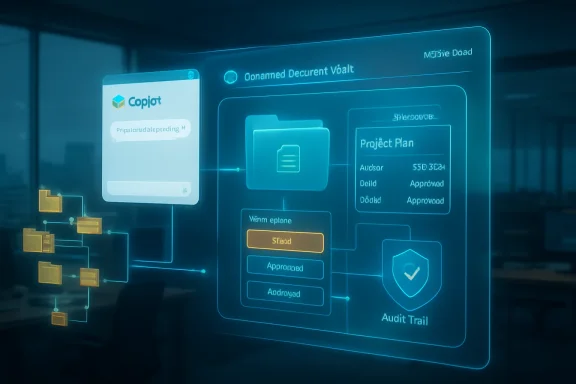 Copilot’s Trust Problem Starts in the Filing Cabinet
The enterprise AI story has been sold as a model story: better language models, larger context windows, smarter agents, and deeper app integrations. That is only partly true. In most organizations, the model is not the first bottleneck; the source material is.Microsoft 365 Copilot works best when it can retrieve the right information from the Microsoft Graph, reason over it, and return an answer that reflects the user’s permissions and work context. But “permission-aware” is not the same as “business-aware.” A user may technically have access to a 2021 contract draft, a superseded policy, a stale pricing sheet, and the board-approved version of the same document. Copilot can respect access controls and still be pointed at a mess.
That is the opening M-Files is trying to exploit. Its argument is that documents need to be understood by what they are, not merely where they live. A contract is not just a Word file in a folder; it belongs to a customer, a project, a jurisdiction, a lifecycle stage, a retention rule, and a set of people allowed to act on it.
The distinction matters because generative AI has made the old document-management problem visible at executive altitude. Before Copilot, poor information architecture meant wasted time and duplicated effort. After Copilot, the same weakness can become a confident answer based on the wrong source.
M-Files Sells Context as the Missing Layer
M-Files describes itself as a context-first document management platform, and the phrase is doing a lot of work. Traditional document management often begins with storage location: folders, sites, libraries, drives, and repositories. M-Files begins with metadata, relationships, workflows, and permissions.That sounds like vendor boilerplate until Copilot enters the equation. Metadata tells an AI system that two documents relate to the same customer, that one agreement supersedes another, or that a file is approved rather than merely uploaded. Workflow state tells it whether a document is in draft, review, approved, expired, or archived. Permissions define not just who can see the file, but who should see it in a given business context.
This is why M-Files’ pitch is more interesting than another “now with AI” announcement. The company is not merely saying Copilot can search M-Files content. It is saying Copilot should not be trusted until the content has been governed, classified, and connected to business meaning.
That framing puts M-Files in a strong position with customers that have already bought Microsoft 365 Copilot and are now confronting the harder second question: why do the answers vary, why are users skeptical, and why does the tool sometimes surface material that is technically accessible but operationally inappropriate?
Native Microsoft 365 Access Is the Real Strategic Move
The most important part of the announcement is not the AI language. It is the phrase “native access.” M-Files says its Microsoft 365 Copilot integration is designed so users can work with M-Files content inside Microsoft 365 in a way that resembles working with SharePoint or OneDrive content, rather than bouncing through a brittle third-party connector.That matters because enterprise software integrations often die from user inconvenience. If workers must leave Teams, Outlook, Word, or Copilot to retrieve the governed version of a document, many will use the nearest file instead. The result is a familiar split-brain architecture: official records in one system, real work in another.
M-Files is trying to collapse that gap. Its Microsoft 365 strategy is not to pull users away from Microsoft’s productivity suite, but to make M-Files’ governance model available inside it. That is a pragmatic bet. Microsoft 365 is where many organizations already live, and Copilot’s adoption path runs through those familiar surfaces.
The company’s broader message is that Microsoft’s ecosystem is not enough on its own for every document-heavy business. Microsoft provides the productivity fabric, identity layer, security controls, compliance services, storage primitives, and Copilot interface. M-Files wants to provide the semantic layer that tells those systems which documents matter and why.
The Cloud Requirement Draws a Hard Line
There is, however, a catch that customers will not miss. Native Microsoft 365 Copilot integration is available through M-Files Cloud, not as a full equivalent for on-premises deployments. That is not a minor deployment footnote; it is the architectural boundary around the whole proposition.The reason is understandable. Microsoft 365 Copilot is a cloud service built around Microsoft 365 data, Microsoft Graph, tenant security, and cloud-scale indexing. A native experience depends on content being available through the Microsoft 365 architecture rather than hidden behind an on-premises vault. The more seamless the Copilot experience becomes, the more gravity shifts toward the cloud.
For some organizations, that will be fine. Many have already accepted Microsoft 365 as the productivity control plane and will view M-Files Cloud as an extension of that direction. For others — especially regulated, conservative, or historically on-premises-heavy industries — the message will be more complicated.
M-Files’ answer is to keep Aino, its AI layer, relevant for on-premises vaults. Aino can support metadata extraction, classification, and improved search inside M-Files environments. But the full native Copilot story belongs to the cloud. That creates a migration incentive dressed as an AI feature, which is exactly how much of enterprise cloud strategy works in 2026.
Microsoft 365 Storage Changes the Economics
One notable part of the M-Files positioning is its emphasis on Microsoft 365 Storage. According to the company’s materials and the FinTech Global summary, documents are stored within the customer’s Microsoft 365 tenant, using Microsoft 365 Storage, rather than forcing customers to pay twice for raw storage capacity.That is a smart economic argument. Storage duplication has long been one of the quiet irritants of enterprise content management. A company buys Microsoft 365, pays for storage and compliance controls, then buys a document system that creates another storage and governance island. Even when the business case works, the architecture often feels redundant.
M-Files is trying to say: keep the storage inside the Microsoft boundary, and pay M-Files for governance, workflow, metadata, relationships, and contextual intelligence. That is a cleaner pitch than asking CIOs to fund yet another repository.
It also aligns with the way Microsoft wants partners to behave. The modern Microsoft ecosystem rewards vendors that extend Microsoft 365 rather than compete with it at the storage and collaboration layer. M-Files appears to have understood that the best way to survive Copilot is not to fight Microsoft’s center of gravity, but to become more valuable because of it.
Permissions Are Necessary, but Not Sufficient
Microsoft has consistently framed Microsoft 365 Copilot as respecting existing permissions, labels, compliance controls, and tenant boundaries. That is an essential baseline. Without it, Copilot would be a non-starter for serious enterprise use.But permission awareness has a subtle weakness: it assumes the permission model already reflects reality. In many organizations, it does not. SharePoint sites accumulate broad access. Teams channels outlive projects. OneDrive links spread. Former project members remain in groups. Sensitive documents sit in places that made sense three reorganizations ago.
Copilot does not create all of those problems, but it can amplify them. Search already made over-permissioned content discoverable; AI makes it conversational. The difference between typing a search term and asking “summarize everything we know about this customer dispute” is not just interface polish. It changes the practical reach of old access decisions.
M-Files’ include/exclude controls for Copilot access are therefore significant. The idea that organizations can mark which documents agents are allowed to reference gives administrators a more explicit governance lever than relying on broad repository-level assumptions. It recognizes that “the user can open this file” and “the AI should use this file to generate an answer” are related but not identical judgments.
Aino and Copilot Are Being Cast in Different Roles
The M-Files FAQ summarized by FinTech Global makes a useful distinction between M-Files Aino and Microsoft 365 Copilot. Aino is described as the AI fabric of the M-Files platform: it classifies, extracts metadata, improves search, and helps structure document-driven processes. Copilot sits closer to the user, answering questions, summarizing, drafting, and reasoning over content.That division of labor is important because every enterprise AI vendor now risks sounding as though it sells the same assistant. M-Files is trying not to compete with Copilot’s user-facing productivity role. Instead, it is positioning Aino as the system that prepares enterprise content so Copilot has better material to work with.
In other words, Aino is the kitchen; Copilot is the waiter. Aino cleans, labels, connects, and stages the ingredients. Copilot serves the user-facing response. If the kitchen is disorganized, the waiter can still be charming, but the meal will be unreliable.
This is also a defensive move. Microsoft is expanding Copilot aggressively across its own stack, and many independent software vendors must now explain why they are not simply features waiting to be absorbed. M-Files’ answer is that Microsoft does not automatically know the business meaning of every customer’s documents. That meaning must be modeled, governed, and maintained.
The Folder Hierarchy Finally Meets Its Natural Enemy
The old folder tree has survived because it is intuitive, visible, and good enough for small teams. It fails at scale because the same document belongs in multiple conceptual places. A contract can be part of a customer account, a legal matter, a renewal workflow, a revenue forecast, and a compliance obligation.Metadata-driven systems have been arguing this point for decades, often to limited enthusiasm. Users like folders. Administrators understand folders. Executives can see folders. Metadata feels like paperwork about paperwork.
Generative AI changes the politics of that argument. If an AI assistant must retrieve relevant content and explain it in context, metadata stops being administrative overhead and becomes retrieval fuel. The richer the business context, the better the system can distinguish the right document from the merely available one.
That does not mean metadata suddenly becomes easy. Someone still has to design schemas, govern terms, maintain lifecycle rules, and prevent classification drift. But AI gives metadata a stronger business case. It turns document hygiene from a compliance chore into a prerequisite for believable automation.
The Agent Builder Angle Raises the Stakes
M-Files is not limiting the pitch to Copilot chat. It is also tying its work to Microsoft 365 Copilot Agent Builder, where organizations can create more specialized AI agents for repeatable tasks. That is where document trust becomes even more consequential.A bad answer in a chat session is annoying. A bad answer embedded in an automated workflow can be operationally dangerous. If an agent drafts customer responses, routes contracts, summarizes claims, or prepares compliance packets, it needs more than access to files. It needs bounded, approved, current, and explainable source material.
This is where M-Files’ workflow and lifecycle claims become more than feature checkboxes. An agent should know whether a document is approved, whether it has been superseded, whether it belongs to the right matter, and whether the requesting user has the right relationship to it. The difference between an AI assistant and an AI process participant is governance.
The enterprise software market is moving quickly from “ask the chatbot” to “delegate the task.” M-Files’ bet is that delegation will expose every weak link in document management. Once AI agents begin acting on content, not merely summarizing it, organizations will need firmer controls over what counts as authoritative information.
Regulated Industries Will Hear the Pitch Differently
The M-Files message is likely to resonate in document-heavy sectors: financial services, legal, insurance, manufacturing, engineering, life sciences, and government-adjacent work. These organizations do not simply store documents; they live and die by versions, approvals, obligations, and audit trails.In those environments, the risk is not merely hallucination. It is a model summarizing the wrong clause, surfacing a pre-approval draft, mixing customer contexts, or overlooking a retention rule. The output may be fluent, but fluency is not evidence.
This is where the phrase trusted AI becomes both useful and dangerous. Useful, because trust in enterprise AI really does require governed information. Dangerous, because no document platform can guarantee that a generative model will always reason correctly. The honest claim is narrower: M-Files can improve the quality, structure, and permissioning of the material Copilot uses.
That narrower claim is still valuable. In regulated sectors, reducing ambiguity at the source is often the difference between a pilot and production. The companies that have struggled to move AI beyond demos are often not blocked by model access. They are blocked by the messy reality of their own information estates.
The Competitive Field Is Bigger Than M-Files Versus Microsoft
M-Files is not alone in seeing governance as the next AI battleground. Box, OpenText, Hyland, ServiceNow, Atlassian, Salesforce, Google, and Microsoft itself are all pushing variants of the same idea: enterprise AI needs governed content, workflow context, and permission-aware retrieval.The difference is in architectural allegiance. Some vendors want to be the system of record. Some want to be the AI workbench. Some want to be the connective tissue across repositories. M-Files is making a relatively Microsoft-friendly version of the argument: keep Microsoft 365 as the productivity and storage hub, and let M-Files add document intelligence.
That is a sensible posture, but it also narrows the company’s room for maneuver. The more M-Files depends on Microsoft 365 as the native environment, the more its differentiation must come from metadata, workflow sophistication, vertical expertise, and administrative control. It cannot win merely by being “where the files are” if Microsoft already owns that terrain.
The opportunity is that Microsoft’s breadth creates gaps. Microsoft 365 is enormous, general-purpose infrastructure. M-Files can focus on the document-specific semantics that many organizations do not want to build themselves. The risk is that Microsoft keeps moving up the stack.
The On-Premises Customer Gets a Nudge, Not a Hug
For on-premises M-Files customers, the message is carefully balanced. They are not abandoned, because Aino still has uses inside the vault. But they are plainly not at the center of the native Copilot story.This will sound familiar to anyone who has watched enterprise software over the last decade. Vendors rarely announce that on-premises customers are second-class citizens. Instead, the most compelling new features arrive in the cloud first, integrate with cloud-only services, and gradually redefine the “modern” version of the product.
From M-Files’ perspective, that is probably unavoidable. Building a seamless Microsoft 365 Copilot experience around on-premises content would be harder, less elegant, and less aligned with Microsoft’s own direction. From a customer perspective, it turns AI enthusiasm into another reason to revisit cloud migration plans.
That does not mean every organization should rush. Some will have data residency, latency, regulatory, or operational reasons to move slowly. But the strategic signal is clear: if Copilot is becoming central to knowledge work, document systems that want to feed Copilot will be pulled toward cloud-native patterns.
Adoption Will Be Decided by Administrators Before Users
The consumer AI boom trained people to think adoption begins with the user. In the enterprise, Copilot adoption begins with administrators. They decide licensing, access, indexing, retention, sensitivity labels, DLP policies, SharePoint hygiene, and which repositories are safe to expose.M-Files’ FAQ-style messaging around governance, licensing, storage, cloud deployment, and adoption strategy shows that the company understands the buyer anxiety. IT leaders are not merely asking whether users can summarize documents. They are asking what happens when Copilot sees the wrong document, how storage is billed, whether content leaves the tenant, how permissions are enforced, and what on-premises customers must do.
That is the right conversation. Enterprise AI projects fail when they are treated as feature rollouts rather than information architecture projects. A Copilot license can be assigned in minutes; cleaning up years of document sprawl can take months.
M-Files is effectively telling customers that the cleanup does not have to be a separate precondition. Its platform can become the mechanism for making documents AI-ready. That is a stronger adoption story than “buy Copilot and hope your content estate behaves.”
The Best Argument for M-Files Is Also an Indictment of Enterprise IT
There is an uncomfortable truth beneath the M-Files pitch: many organizations do not know what their documents mean. They know where files are stored. They know who owns the SharePoint site. They know which department created the folder. But they do not consistently know which document is authoritative, which business object it relates to, or which process state it represents.AI exposes that weakness because it collapses the distance between storage and decision-making. A human searching for a file may notice ambiguity, ask a colleague, or infer from context that something looks wrong. An AI assistant may confidently assemble a response from plausible fragments unless the underlying system gives it better signals.
That is why context-first document management has renewed relevance. It is not glamorous, and it will not generate the same excitement as a new model demo. But it addresses the operational layer where many AI initiatives stumble.
The irony is that enterprises spent years underinvesting in document hygiene because the pain was distributed across employees. Copilot concentrates the pain into visible AI failures. Suddenly, the cost of bad information architecture has an executive dashboard.
Microsoft Benefits Even When M-Files Takes the Credit
Microsoft has a strong interest in partners like M-Files succeeding. Copilot’s perceived quality depends heavily on the customer’s information environment, yet Microsoft cannot personally remodel every tenant’s document practices. If Copilot returns weak answers because a company has poor permissions and chaotic repositories, users will still blame Copilot.A partner that improves content readiness therefore protects Microsoft’s AI investment. M-Files can do the difficult domain work of metadata, workflows, classification, and document governance while Microsoft continues selling Copilot as the productivity interface. Both sides benefit if customers conclude that Copilot becomes more useful after M-Files is deployed.
This also helps explain why “native” matters politically. A clunky connector suggests Microsoft 365 is incomplete. A native-feeling integration suggests an ecosystem working as intended. For customers already committed to Microsoft 365, that can reduce procurement friction.
Still, Microsoft’s partner ecosystem always carries tension. Today’s partner advantage can become tomorrow’s platform feature. M-Files must keep proving that document context is deep enough, specialized enough, and customer-specific enough that it cannot be reduced to a generic Microsoft checkbox.
The AI Readiness Conversation Gets More Concrete
One of the more useful effects of the M-Files-Copilot story is that it makes “AI readiness” less abstract. Vendors often use that phrase to mean cultural openness, model experimentation, or executive sponsorship. Here it means something more measurable: which documents are approved, classified, permissioned, current, related to business objects, and available to Copilot under explicit rules.That is a healthier definition. It moves the conversation away from prompt magic and toward operational controls. It asks whether the information estate is fit for machine reasoning.
The M-Files model also suggests that AI readiness is not a one-time cleanup. Documents keep changing. Contracts are amended. Policies expire. Projects close. Employees move. Permissions drift. An AI-ready content estate requires ongoing lifecycle management, not a heroic migration weekend.
That is where workflow matters. If governance depends on manual cleanup after the fact, it will fail. If governance is embedded in document creation, review, approval, and retention, Copilot has a better chance of seeing the right thing at the right time.
The Copilot Era Rewards Boring Infrastructure
The hype cycle rewards visible AI features, but the durable value may belong to boring infrastructure. Metadata, permissions, lifecycle states, audit trails, retention policies, and storage architecture rarely make splashy demos. They determine whether those demos survive contact with production.M-Files is trying to attach itself to that durable layer. Its message is not that Copilot is untrustworthy by design. It is that Copilot inherits the strengths and weaknesses of the information estate beneath it. If the estate is governed, Copilot looks smarter. If the estate is chaotic, Copilot becomes a mirror held up to that chaos.
That is a credible argument, especially for WindowsForum readers who have lived through SharePoint sprawl, file server migrations, Teams proliferation, OneDrive sync confusion, and compliance retrofits. The tools change; the underlying problem remains depressingly familiar. Users create documents faster than organizations can govern them.
AI does not eliminate that problem. It raises the stakes. The same document disorder that once wasted an afternoon can now shape an automated answer delivered in seconds.
The Signal Behind M-Files’ Copilot Pitch Is Hard to Ignore
M-Files’ announcement is not just about one vendor integration; it is a signpost for where enterprise AI is heading. The next wave of competition will revolve around who can make corporate information usable, defensible, and safe enough for AI systems to act on.- M-Files is positioning itself as a context and governance layer for Microsoft 365 Copilot, not as a replacement for Copilot.
- The native Microsoft 365 Copilot integration is tied to M-Files Cloud, making cloud migration part of the strategic value proposition.
- Aino and Copilot are being separated into complementary roles, with Aino preparing and structuring content while Copilot delivers user-facing reasoning and summarization.
- Microsoft 365 Storage helps M-Files argue that customers can avoid duplicating raw storage costs while still paying for document intelligence and governance.
- Granular include and exclude controls matter because AI access should be narrower and more intentional than ordinary file visibility.
- The real test will be whether organizations maintain metadata, permissions, and lifecycle discipline after the initial Copilot rollout excitement fades.
Source: FinTech Global How M-Files makes Microsoft Copilot more trustworthy
