

Marks & Spencer is moving from AI experimentation to broad deployment, and this latest rollout signals a more ambitious phase in the retailer’s digital transformation. By giving 11,000 store managers and support centre colleagues access to Microsoft 365 Copilot, M&S is betting that everyday productivity gains will translate into faster decisions, better store execution, and more time on the shop floor. The move is notable not just for its scale, but for the way it connects frontline retail work with agentic AI and enterprise workflow automation.
M&S has been reshaping itself for several years, and technology has become one of the clearest threads running through that transformation. The company employs around 65,000 colleagues across stores, support centres, logistics, and international teams, which means even small efficiency gains can have a meaningful impact on the business as a whole. In practical terms, this is a retailer where operational complexity is the norm, not the exception.
That complexity helps explain why AI has become strategically important. M&S has already been using AI in stock forecasting, ordering, marketing content generation, and colleague support hubs powered by agents, according to the company’s own remarks. The new Copilot rollout extends that effort into a much wider group of store and support centre users, moving the technology from specialist functions into the rhythms of daily retail operations.
The timing also matters. Microsoft has been pushing harder into agentic AI for retail, including tools that can surface store operations data, automate workflows, and help store teams work through exceptions more quickly. In other words, the M&S announcement is part of a larger industry shift in which generative AI is being redefined from a writing assistant into an operational system.
It also reflects a broader retail logic. Store managers spend much of their time translating data into action, and support teams spend much of theirs turning messy reporting into guidance. If AI can reduce the friction in those workflows, the impact may be felt quickly in scheduling, briefing, analysis, and coordination. The promise is simple, but the execution will determine whether the benefit is real or merely theoretical.
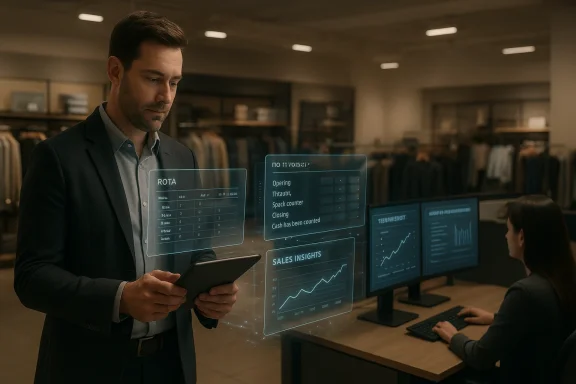
The company says store managers will use Copilot to produce meeting notes, sales insights, rotas, and shift handovers, while support centre colleagues will use it for meeting updates, trading summaries, and recommendations derived from complex reporting. The stated aim is to save time and improve decision quality, allowing colleagues to focus more on customers and team leadership.
The deeper Microsoft relationship is also important. M&S says it is working with Microsoft at scale across the organisation, which suggests this is not an isolated software purchase but part of a broader platform strategy. In retail, platform strategy matters because it can shape everything from data flow to process design to the way employees seek and act on information.
Copilot can help compress those tasks, especially when employees need to synthesise information from multiple sources. The value proposition is not mystical AI magic; it is time recovery. Even modest savings, multiplied across thousands of users, can become significant.
Microsoft has been positioning AI for precisely these sorts of use cases. Its recent retail messaging has focused on autonomous or semi-autonomous agents that can help with inventory, store operations, and real-time merchandising insight. The company’s Store Operations Agent materials, for example, describe a conversational control plane for store health, issue detection, and natural-language access to operational data.
That makes the M&S deployment a practical test case. If the retailer can move Copilot from generic productivity tasks into frontline retail operations, it could help set the pattern for other large chains. The real competition here is not just between retailers; it is between workflows with AI and workflows without it.
The biggest benefit may be consistency. A well-structured AI assistant can help standardise morning briefings, handovers, and performance summaries across a large estate. For a business the size of M&S, that can reduce variation and improve management quality.
That does not eliminate the need for human judgment. Instead, it creates more room for it. If the first draft arrives in seconds, colleagues can spend more time validating decisions, interpreting anomalies, and supporting stores directly.
The company’s own materials around store operations agents also stress the importance of knowledge sources, connectors, and workflows that ground the AI in business data. That is critical because retail environments are full of edge cases, and a generic chatbot without access to the right systems is unlikely to deliver useful results at scale.
M&S is therefore acting as both a customer and a proof point. If the rollout works, Microsoft can point to a flagship UK retailer showing how Copilot and agentic tools can be embedded in day-to-day operations. That’s valuable in a market where vendors are increasingly competing on the ability to demonstrate operational impact, not just model performance.
There is also a competitive angle. Other cloud and productivity vendors are racing to define the AI workplace. Microsoft’s advantage comes from integrating productivity, collaboration, and enterprise workflows into one stack. For customers, that can reduce friction; for Microsoft, it increases stickiness.
It is operational leverage. If AI can help a manager move from “here is the data” to “here is what we should do,” it becomes part of the management system. That is why the word agentic has become such a powerful marketing and product term.
This is especially important for frontline users. Store managers are busy, and they will not adopt a tool just because it is available. They will adopt it if it consistently saves time, reduces friction, and produces outputs they trust.
The training question is also cultural. AI changes how work feels, and that can create anxiety if colleagues think the technology is there to replace judgment rather than support it. M&S appears to be framing Copilot as a productivity aid, which is likely the right message for a retail workforce that values practicality.
If not, it risks becoming yet another enterprise license that looks impressive in a slide deck but fades in actual use. That is the classic enterprise AI failure mode.
Store execution could improve in subtle but important ways. Better handovers may reduce missed tasks, clearer summaries may improve the consistency of priorities, and faster access to trends may help managers respond more quickly to sales patterns or staffing issues. Those are not glamorous wins, but they are the kind that can affect store performance over time.
Support centre improvements may be less visible to customers, but they can still matter. If trading summaries are sharper and recommendations are clearer, then central teams can respond more effectively to the realities of individual stores. That can reduce the gap between central planning and local execution.
This is why the announcement resonates beyond M&S. Retailers have spent years chasing omnichannel sophistication, but the basic management challenge remains grounded in time, attention, and communication. AI can make those scarce resources go further.
That distinction matters because the market is increasingly crowded with AI claims. Retail leaders will be judged on outcomes, not on how many licenses they bought.
The market implication is that AI is shifting from a differentiator to a baseline capability. The question is no longer whether retailers should experiment with generative AI, but how deeply they should embed it in operations and how quickly they can prove value. That change tends to accelerate once one prominent player moves decisively.
There is also a labour-market dimension. Retailers are competing not just on customer experience but on how they support and equip colleagues. A well-executed AI rollout can become part of the employer value proposition, especially when paired with training and development.
The reverse is also true. If the rollout stumbles, the market may become more cautious about broad frontline AI deployments. Retail is pragmatic, and executives tend to reward results rather than novelty.
For enterprises, the lesson is more structural. AI is increasingly being used to redesign internal workflows, not just automate isolated tasks. That makes the technology a management issue as much as an IT issue.
If M&S connects those use cases to measurable outcomes, the business case becomes stronger over time. That is the kind of compounding advantage retailers want from technology.
The safer approach is to use AI as a first-pass assistant. Human review should remain central, especially in anything that affects customer service, labour planning, or performance management.
The retailer will need strong internal communication and support if it wants adoption to be broad and sustained. Technology rollout without management discipline is just expensive potential.
The company’s language suggests that AI is becoming embedded in how M&S thinks about growth, which means this may be only one step in a longer roadmap. As Microsoft’s retail tools mature, there is a strong chance that the retailer will expand from productivity assistants into more specialised agents, with deeper integration into operational systems. That is where the most interesting value could emerge.
Source: Retail Times M&S gives every store manager and every store support centre colleague latest AI tools with 11,000 Microsoft 365 Copilot licenses
 Background
M&S has been reshaping itself for several years, and technology has become one of the clearest threads running through that transformation. The company employs around 65,000 colleagues across stores, support centres, logistics, and international teams, which means even small efficiency gains can have a meaningful impact on the business as a whole. In practical terms, this is a retailer where operational complexity is the norm, not the exception.That complexity helps explain why AI has become strategically important. M&S has already been using AI in stock forecasting, ordering, marketing content generation, and colleague support hubs powered by agents, according to the company’s own remarks. The new Copilot rollout extends that effort into a much wider group of store and support centre users, moving the technology from specialist functions into the rhythms of daily retail operations.
The timing also matters. Microsoft has been pushing harder into agentic AI for retail, including tools that can surface store operations data, automate workflows, and help store teams work through exceptions more quickly. In other words, the M&S announcement is part of a larger industry shift in which generative AI is being redefined from a writing assistant into an operational system.
Why this rollout stands out
This is not a pilot tucked away in a digital lab. It is a company-wide deployment aimed at the people who run stores and support them. That makes the announcement important because it changes how AI is positioned: not as a specialist tool for head office, but as an everyday workplace companion. That shift is bigger than the license count suggests.It also reflects a broader retail logic. Store managers spend much of their time translating data into action, and support teams spend much of theirs turning messy reporting into guidance. If AI can reduce the friction in those workflows, the impact may be felt quickly in scheduling, briefing, analysis, and coordination. The promise is simple, but the execution will determine whether the benefit is real or merely theoretical.
Overview
The core of the announcement is straightforward. M&S is purchasing 11,000 Microsoft 365 Copilot licenses and pairing them with a training and development programme designed to help colleagues actually use the tools rather than merely possess them. That matters because most enterprise AI deployments fail not on the license procurement side, but on adoption, governance, and day-to-day usefulness.The company says store managers will use Copilot to produce meeting notes, sales insights, rotas, and shift handovers, while support centre colleagues will use it for meeting updates, trading summaries, and recommendations derived from complex reporting. The stated aim is to save time and improve decision quality, allowing colleagues to focus more on customers and team leadership.
The deeper Microsoft relationship is also important. M&S says it is working with Microsoft at scale across the organisation, which suggests this is not an isolated software purchase but part of a broader platform strategy. In retail, platform strategy matters because it can shape everything from data flow to process design to the way employees seek and act on information.
The operational logic behind the move
There is a strong internal logic here. A store manager is often buried under notes, performance data, staff scheduling, and communications, all while trying to stay visible on the shop floor. A support centre colleague faces a different but equally data-heavy reality, where insight needs to move from reports into recommendations quickly.Copilot can help compress those tasks, especially when employees need to synthesise information from multiple sources. The value proposition is not mystical AI magic; it is time recovery. Even modest savings, multiplied across thousands of users, can become significant.
What M&S is really buying
M&S is not just buying software licenses. It is buying a new interface layer for work, one that sits between raw data and human judgment. That is why the training programme is just as important as the technology itself, because without the right prompts, habits, and safeguards, even powerful tools can create noise instead of clarity.- Faster meeting preparation
- More concise shift handovers
- Quicker data summarisation
- Better access to trends and highlights
- Reduced admin burden on managers
- More time for customer-facing work
The Retail Context
Retail is one of the most natural homes for practical AI because so much of the work is repetitive, time-sensitive, and information-rich. Store teams constantly juggle stock movement, staffing, customer service, local trading conditions, and compliance, while support teams must keep stores aligned with central priorities. In that environment, any tool that reduces administrative drag has potential value.Microsoft has been positioning AI for precisely these sorts of use cases. Its recent retail messaging has focused on autonomous or semi-autonomous agents that can help with inventory, store operations, and real-time merchandising insight. The company’s Store Operations Agent materials, for example, describe a conversational control plane for store health, issue detection, and natural-language access to operational data.
That makes the M&S deployment a practical test case. If the retailer can move Copilot from generic productivity tasks into frontline retail operations, it could help set the pattern for other large chains. The real competition here is not just between retailers; it is between workflows with AI and workflows without it.
Store managers as AI users
Store managers are a compelling target group because they sit at the intersection of people, process, and performance. They need a fast read on what happened yesterday, what is happening today, and what is likely to happen next. That is exactly the kind of environment where a conversational assistant can be useful if it is grounded in trustworthy data.The biggest benefit may be consistency. A well-structured AI assistant can help standardise morning briefings, handovers, and performance summaries across a large estate. For a business the size of M&S, that can reduce variation and improve management quality.
Support centre productivity
Support centre colleagues face a different challenge. Their work often involves taking multiple inputs and turning them into coherent actions for stores, regional teams, or leadership. Copilot’s appeal here lies in its ability to draft, summarise, and reorganise information quickly.That does not eliminate the need for human judgment. Instead, it creates more room for it. If the first draft arrives in seconds, colleagues can spend more time validating decisions, interpreting anomalies, and supporting stores directly.
- Better meeting preparation
- Cleaner trading summaries
- Faster action tracking
- Less time spent on manual drafting
- Improved cross-functional communication
Microsoft’s Retail Strategy
Microsoft has been steadily reframing AI for retail from a support tool into a core operating layer. Its January 2026 retail push highlighted intelligent automation across functions and pointed to store operations agents that can answer natural-language questions, orchestrate workflows, and flag exceptions. That messaging is consistent with a broader industry trend: AI is moving closer to execution, not just analysis.The company’s own materials around store operations agents also stress the importance of knowledge sources, connectors, and workflows that ground the AI in business data. That is critical because retail environments are full of edge cases, and a generic chatbot without access to the right systems is unlikely to deliver useful results at scale.
M&S is therefore acting as both a customer and a proof point. If the rollout works, Microsoft can point to a flagship UK retailer showing how Copilot and agentic tools can be embedded in day-to-day operations. That’s valuable in a market where vendors are increasingly competing on the ability to demonstrate operational impact, not just model performance.
Why Microsoft needs retail wins
Retail is highly visible, operationally complex, and easy to benchmark. If a retailer can show that AI improved rota creation, meetings, and trading summaries, the benefits are intuitive to executives elsewhere. That makes retail one of the best industries for Microsoft to showcase practical AI outcomes.There is also a competitive angle. Other cloud and productivity vendors are racing to define the AI workplace. Microsoft’s advantage comes from integrating productivity, collaboration, and enterprise workflows into one stack. For customers, that can reduce friction; for Microsoft, it increases stickiness.
The significance of “agentic AI”
The phrase agentic AI matters because it suggests a step beyond text generation. An agent can help carry out a task, pull together information, or trigger a workflow, rather than merely draft words on a screen. In retail, that distinction is huge because the goal is not content production for its own sake.It is operational leverage. If AI can help a manager move from “here is the data” to “here is what we should do,” it becomes part of the management system. That is why the word agentic has become such a powerful marketing and product term.
Training, Adoption, and Change Management
The strongest technology rollouts are often the ones that treat adoption as a management discipline. M&S says it is backing the Copilot rollout with training and development, which is wise because retail colleagues will need guidance on prompting, verification, data handling, and the limits of AI-generated output. Without that support, the tools could be underused, misused, or ignored.This is especially important for frontline users. Store managers are busy, and they will not adopt a tool just because it is available. They will adopt it if it consistently saves time, reduces friction, and produces outputs they trust.
The training question is also cultural. AI changes how work feels, and that can create anxiety if colleagues think the technology is there to replace judgment rather than support it. M&S appears to be framing Copilot as a productivity aid, which is likely the right message for a retail workforce that values practicality.
Adoption depends on habit, not hype
A new tool only becomes valuable when it is embedded into routine. That means morning huddles, shift handovers, trading reviews, and store support conversations are the real battlegrounds for adoption. If Copilot becomes the default starting point for those tasks, the rollout can gain momentum.If not, it risks becoming yet another enterprise license that looks impressive in a slide deck but fades in actual use. That is the classic enterprise AI failure mode.
What good training should cover
M&S will need to go beyond a basic “how to use Copilot” session. Colleagues need practical examples, guardrails, and enough confidence to verify outputs before acting on them. In retail, mistakes can quickly become operational problems.- Prompting for concise summaries
- Checking outputs against source systems
- Understanding when not to rely on AI
- Using AI for first drafts, not final decisions
- Handling confidential information appropriately
- Building repeatable prompts for recurring tasks
Customer Service and Store Execution
The biggest promise of this rollout is not administrative convenience; it is better customer service. M&S argues that by reducing time spent on manual tasks, colleagues will have more time to support customers and teams. That claim is plausible because retail is a people business, and every minute reclaimed from admin can be redirected toward the shop floor.Store execution could improve in subtle but important ways. Better handovers may reduce missed tasks, clearer summaries may improve the consistency of priorities, and faster access to trends may help managers respond more quickly to sales patterns or staffing issues. Those are not glamorous wins, but they are the kind that can affect store performance over time.
Support centre improvements may be less visible to customers, but they can still matter. If trading summaries are sharper and recommendations are clearer, then central teams can respond more effectively to the realities of individual stores. That can reduce the gap between central planning and local execution.
The frontline productivity argument
There is a long-standing tension in retail between desk work and customer work. Managers often spend too much time assembling information and too little time using it. AI can help rebalance that equation if it reduces the clerical burden of management.This is why the announcement resonates beyond M&S. Retailers have spent years chasing omnichannel sophistication, but the basic management challenge remains grounded in time, attention, and communication. AI can make those scarce resources go further.
The customer impact test
The ultimate test is whether shoppers notice any difference. If the rollout leads to better service, more attentive teams, and fewer operational delays, then the AI strategy has a clear business case. If it simply creates faster internal paperwork, the customer impact will be weaker.That distinction matters because the market is increasingly crowded with AI claims. Retail leaders will be judged on outcomes, not on how many licenses they bought.
- Faster issue resolution
- More consistent store communication
- Better informed managers
- Cleaner task prioritisation
- More time on the shop floor
Competitive and Market Implications
M&S is not the only retailer exploring AI, but its announcement is important because of its scale and visibility. When a major British retailer commits to rolling out Copilot to thousands of colleagues, it raises expectations for peers across food, fashion, and general merchandise. It also increases the pressure on competitors to show a credible AI roadmap of their own.The market implication is that AI is shifting from a differentiator to a baseline capability. The question is no longer whether retailers should experiment with generative AI, but how deeply they should embed it in operations and how quickly they can prove value. That change tends to accelerate once one prominent player moves decisively.
There is also a labour-market dimension. Retailers are competing not just on customer experience but on how they support and equip colleagues. A well-executed AI rollout can become part of the employer value proposition, especially when paired with training and development.
What rivals will be watching
Competitors will likely watch three things: adoption rates, measurable productivity gains, and whether the technology improves service quality. If M&S can show that Copilot helps managers and support teams spend more time with customers, others will be tempted to follow.The reverse is also true. If the rollout stumbles, the market may become more cautious about broad frontline AI deployments. Retail is pragmatic, and executives tend to reward results rather than novelty.
Enterprise vs consumer impact
For consumers, the AI story is indirect but important. Shoppers do not care about licenses; they care about availability, service, speed, and consistency. If Copilot helps M&S operate better, customers may experience cleaner stores, better stock handling, and more responsive teams.For enterprises, the lesson is more structural. AI is increasingly being used to redesign internal workflows, not just automate isolated tasks. That makes the technology a management issue as much as an IT issue.
Strengths and Opportunities
The M&S rollout has several clear strengths. It is broad enough to matter, targeted enough to be practical, and supported by training rather than treated as a one-off software purchase. It also aligns well with the retailer’s ongoing transformation agenda and Microsoft’s retail AI strategy.- Scale with intent: 11,000 licenses is large enough to change habits, not just test ideas.
- Frontline relevance: Store managers and support colleagues deal with tasks Copilot can realistically improve.
- Training support: Adoption is more likely when users are helped to build confidence.
- Workflow fit: Meeting notes, summaries, and handovers are natural AI use cases.
- Platform alignment: The move fits M&S’s wider technology transformation.
- Operational leverage: Faster synthesis can improve decision-making across stores.
- Brand signal: The rollout reinforces M&S as a modern, data-led retailer.
Why this could compound
The best part of this rollout is that it can create a flywheel effect. As colleagues learn where Copilot helps, they will likely discover more use cases and share them across teams. That kind of bottom-up discovery can make AI adoption self-sustaining.If M&S connects those use cases to measurable outcomes, the business case becomes stronger over time. That is the kind of compounding advantage retailers want from technology.
Risks and Concerns
The risks are substantial, even if the announcement sounds straightforward. AI tools can produce confident but incorrect summaries, encourage overreliance on generated drafts, and create governance issues around data use and accountability. In retail, where decisions affect people, stock, and service levels, those risks should not be underestimated.- Hallucinated or inaccurate summaries could mislead managers.
- Overreliance on AI drafts may reduce critical thinking.
- Data governance concerns could arise if prompts touch sensitive information.
- Uneven adoption may create a two-speed organisation.
- Training gaps could lead to misuse or underuse.
- Integration limits may reduce the quality of outputs if data sources are fragmented.
- Expectation inflation could cause disappointment if gains are modest.
The accuracy problem
Copilot can speed up work, but it cannot replace validation. If managers begin trusting AI-generated summaries without checking them against source systems, small errors can cascade into poor decisions. That is especially true in trading and staffing contexts.The safer approach is to use AI as a first-pass assistant. Human review should remain central, especially in anything that affects customer service, labour planning, or performance management.
The organisational risk
Another risk is uneven rollout quality. Some stores may develop excellent AI habits, while others barely use the tools. That could widen capability gaps across the business and make performance comparisons more complicated.The retailer will need strong internal communication and support if it wants adoption to be broad and sustained. Technology rollout without management discipline is just expensive potential.
Looking Ahead
The next phase will be about proof, not announcement. M&S will need to show that Copilot is genuinely improving store operations, supporting managers, and simplifying support centre work. If it can tie the rollout to sharper execution and better colleague experience, the investment will look more like infrastructure than a software purchase.The company’s language suggests that AI is becoming embedded in how M&S thinks about growth, which means this may be only one step in a longer roadmap. As Microsoft’s retail tools mature, there is a strong chance that the retailer will expand from productivity assistants into more specialised agents, with deeper integration into operational systems. That is where the most interesting value could emerge.
What to watch next
- Adoption rates among store managers and support centre colleagues
- Evidence of time saved on meetings, handovers, and reporting
- Any new retail-specific agents or workflow automations
- Measurable effects on service quality and store execution
- How M&S governs accuracy, privacy, and AI usage at scale
Source: Retail Times M&S gives every store manager and every store support centre colleague latest AI tools with 11,000 Microsoft 365 Copilot licenses
Last edited:
