

Apple reportedly plans to release only a regular M6 chip in late 2026, skip M6 Pro and M6 Max, place existing M5 Pro and M5 Max processors in a rumored MacBook Ultra, and hold M7 Pro and M7 Max MacBook Pros until late 2027 or beyond. If Bloomberg’s Mark Gurman is correct, Apple would be separating chip generation, laptop design, and product status instead of advancing all three together. For buyers and IT departments, the familiar question—which new MacBook Pro should we buy?—could become considerably harder.
What to do: Buy now only when workload demands, failing hardware, support coverage, or lifecycle deadlines make replacement urgent. Defer discretionary high-end purchases until Apple announces the hardware reportedly planned for late 2026 or early 2027. Do not treat M6 as a fleet-wide replacement trigger.
The roadmap remains reporting rather than an Apple announcement. Plans, product names, configurations, and release windows can change. Even so, the report outlines an unusual purchasing sequence: a base M6 without professional variants, a new premium laptop using M5 silicon, and established high-end MacBook Pro models waiting until late 2027 or beyond for M7 Pro and M7 Max.
According to Gurman’s reporting, the regular M6 is expected to appear in the lowest-end 14-inch MacBook Pro in late 2026, but Apple does not currently plan M6 Pro or M6 Max variants. The rumored MacBook Ultra is expected in late 2026 or early 2027 with M5 Pro and M5 Max processors. High-end 14-inch and 16-inch MacBook Pro models would then move to M7 Pro and M7 Max in late 2027 or beyond.
That would weaken the generation number as a stand-alone buying signal. A regular M6 MacBook Pro may be newer by chip generation than an M5 Max MacBook Ultra while remaining the less powerful and less expensive system. Buyers would need to distinguish when a processor was introduced from which workloads and product tier it serves.
The MacBook Ultra name is also unconfirmed. If Apple uses it, “Ultra” may describe the laptop’s overall position rather than an Ultra-branded processor. That distinction will matter when comparing it with existing or future MacBook Pro configurations.
The report says the next high-end laptops are expected to receive the first cited major design changes since 2021. Beyond that point, details should not be assumed. A new physical platform could potentially affect accessories, service procedures, deployment documentation, or approved configurations, but those are conditional examples—not confirmed features or consequences of the rumored machine.
Under that interpretation, M6 serves a narrower role in the lowest-end 14-inch MacBook Pro rather than organizing the entire professional lineup. The MacBook Ultra could introduce Apple’s next premium portable hardware in late 2026 or early 2027 without waiting for M7 Pro and M7 Max. The established high-end MacBook Pro models would receive those later chips in late 2027 or beyond.
This is analysis, not a confirmed explanation of Apple’s strategy. The reported absence of M6 Pro and M6 Max could reduce direct branding conflict between a new M5-based premium laptop and newer high-end processors. It could also allow Apple to introduce hardware and silicon when each is ready rather than forcing them into one synchronized launch.
If the roadmap is accurate, Apple would need to explain why a newer generation number does not automatically identify the most capable MacBook. It would also need to differentiate a MacBook Ultra with M5 Pro or M5 Max from other systems using related chips—and later from M7 Pro and M7 Max MacBook Pros.
The result could resemble a familiar challenge in the Windows PC market: processor generation, chassis generation, graphics capability, and product tier do not always advance together. Buyers must compare complete configurations instead of relying on one number.
None of this means M5 Pro or M5 Max would become unsuitable when the regular M6 arrives. Performance requirements, memory capacity, storage, application behavior, and the cost of downtime matter more than naming order. A high-end M5 system can remain the appropriate choice for demanding work even when a newer base chip is available.
For individuals, the dividing line is necessity. Someone losing productive time to an inadequate laptop should buy for the work that must be completed now. Someone with a recent, reliable Apple-silicon Mac has a stronger case for waiting until Apple reveals the late-2026 or early-2027 hardware and its actual specifications.
For organizations, the central task is segmentation. Base-model users, developers, creators, executives, and employees running memory-intensive or sustained workloads should not be placed on the same replacement schedule simply because their systems share a MacBook Pro name.
Fleet managers should also avoid assuming that M6 will offer direct replacements for every M5 Pro and M5 Max configuration. Under the reported roadmap, it will not.
2021 — The last cited major design changes for Apple’s high-end laptops are introduced.
Late 2026 — The regular M6 is expected in the lowest-end 14-inch MacBook Pro.
Late 2026 or early 2027 — The rumored MacBook Ultra is expected with M5 Pro and M5 Max processors.
Late 2027 or beyond — High-end 14-inch and 16-inch MacBook Pro models are expected to move to M7 Pro and M7 Max.
That makes a universal recommendation impossible, but the operational verdict is straightforward. Replace machines now when workload or lifecycle needs justify the purchase. Wait on discretionary high-end spending until Apple announces the hardware reportedly planned for late 2026 or early 2027. Keep longer-range budgets flexible for M7 Pro and M7 Max, but do not leave failing or inadequate systems in service solely to reach them.
If the report proves accurate, Apple’s challenge will be explaining a lineup in which product tier, physical hardware, and processor generation no longer move in lockstep. Buyers, meanwhile, should ignore the temptation to choose by numeral alone. The most important “generation” may be the chip, the laptop platform, or simply the point at which existing hardware can no longer do the job.
What to do: Buy now only when workload demands, failing hardware, support coverage, or lifecycle deadlines make replacement urgent. Defer discretionary high-end purchases until Apple announces the hardware reportedly planned for late 2026 or early 2027. Do not treat M6 as a fleet-wide replacement trigger.
The roadmap remains reporting rather than an Apple announcement. Plans, product names, configurations, and release windows can change. Even so, the report outlines an unusual purchasing sequence: a base M6 without professional variants, a new premium laptop using M5 silicon, and established high-end MacBook Pro models waiting until late 2027 or beyond for M7 Pro and M7 Max.
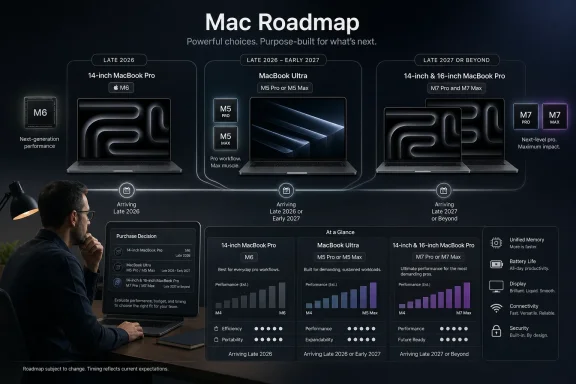 One Roadmap, Three Different Upgrade Moments
According to Gurman’s reporting, the regular M6 is expected to appear in the lowest-end 14-inch MacBook Pro in late 2026, but Apple does not currently plan M6 Pro or M6 Max variants. The rumored MacBook Ultra is expected in late 2026 or early 2027 with M5 Pro and M5 Max processors. High-end 14-inch and 16-inch MacBook Pro models would then move to M7 Pro and M7 Max in late 2027 or beyond.That would weaken the generation number as a stand-alone buying signal. A regular M6 MacBook Pro may be newer by chip generation than an M5 Max MacBook Ultra while remaining the less powerful and less expensive system. Buyers would need to distinguish when a processor was introduced from which workloads and product tier it serves.
The MacBook Ultra name is also unconfirmed. If Apple uses it, “Ultra” may describe the laptop’s overall position rather than an Ultra-branded processor. That distinction will matter when comparing it with existing or future MacBook Pro configurations.
The report says the next high-end laptops are expected to receive the first cited major design changes since 2021. Beyond that point, details should not be assumed. A new physical platform could potentially affect accessories, service procedures, deployment documentation, or approved configurations, but those are conditional examples—not confirmed features or consequences of the rumored machine.
| Reported model | Processor | Expected timeframe | Main buying consideration |
|---|---|---|---|
| Lowest-end 14-inch MacBook Pro | Regular M6 | Late 2026 | Newer base chip, but no reported M6 Pro or Max path |
| Rumored MacBook Ultra | M5 Pro or M5 Max | Late 2026 or early 2027 | Potential new premium hardware using existing high-end silicon |
| High-end 14-inch MacBook Pro | M7 Pro or M7 Max | Late 2027 or beyond | Later professional-silicon update |
| High-end 16-inch MacBook Pro | M7 Pro or M7 Max | Late 2027 or beyond | Longer wait for the next high-end generation |
What This Could Mean
The cleanest interpretation is that Apple may be placing mainstream silicon, premium laptop hardware, and next-generation professional processors on separate schedules.Under that interpretation, M6 serves a narrower role in the lowest-end 14-inch MacBook Pro rather than organizing the entire professional lineup. The MacBook Ultra could introduce Apple’s next premium portable hardware in late 2026 or early 2027 without waiting for M7 Pro and M7 Max. The established high-end MacBook Pro models would receive those later chips in late 2027 or beyond.
This is analysis, not a confirmed explanation of Apple’s strategy. The reported absence of M6 Pro and M6 Max could reduce direct branding conflict between a new M5-based premium laptop and newer high-end processors. It could also allow Apple to introduce hardware and silicon when each is ready rather than forcing them into one synchronized launch.
If the roadmap is accurate, Apple would need to explain why a newer generation number does not automatically identify the most capable MacBook. It would also need to differentiate a MacBook Ultra with M5 Pro or M5 Max from other systems using related chips—and later from M7 Pro and M7 Max MacBook Pros.
The result could resemble a familiar challenge in the Windows PC market: processor generation, chassis generation, graphics capability, and product tier do not always advance together. Buyers must compare complete configurations instead of relying on one number.
None of this means M5 Pro or M5 Max would become unsuitable when the regular M6 arrives. Performance requirements, memory capacity, storage, application behavior, and the cost of downtime matter more than naming order. A high-end M5 system can remain the appropriate choice for demanding work even when a newer base chip is available.
Buyer and Admin Decision Matrix
| Situation | Recommended action | Why |
|---|---|---|
| Urgent replacement | Buy the currently available configuration that meets measured requirements. | Failed, unsupported, unreliable, or workload-blocking hardware usually costs more than waiting saves. |
| Base MacBook Pro user | Consider the regular M6 in late 2026, but compare the complete system with current options. | M6 may be relevant to this tier even without Pro and Max variants. |
| High-end mobile workstation user | Defer discretionary purchases until Apple announces the hardware expected in late 2026 or early 2027. Buy now only for a documented performance or lifecycle need. | This group is most exposed to the reported split between new premium hardware and later M7 Pro and M7 Max models. |
| Mixed Windows/macOS fleet | Keep replacement policies workload-based and treat M6 as a targeted option, not a universal refresh event. | One generation label will not adequately describe the reported Mac lineup. |
For organizations, the central task is segmentation. Base-model users, developers, creators, executives, and employees running memory-intensive or sustained workloads should not be placed on the same replacement schedule simply because their systems share a MacBook Pro name.
Fleet managers should also avoid assuming that M6 will offer direct replacements for every M5 Pro and M5 Max configuration. Under the reported roadmap, it will not.
Timeline
2020 — Apple begins the Mac transition from Intel processors to Apple silicon.2021 — The last cited major design changes for Apple’s high-end laptops are introduced.
Late 2026 — The regular M6 is expected in the lowest-end 14-inch MacBook Pro.
Late 2026 or early 2027 — The rumored MacBook Ultra is expected with M5 Pro and M5 Max processors.
Late 2027 or beyond — High-end 14-inch and 16-inch MacBook Pro models are expected to move to M7 Pro and M7 Max.
Action Checklist for Admins
- Inventory Macs due for replacement before late 2027.
- Divide replacements into urgent, deferrable, and performance-critical groups.
- Base purchasing decisions on workload, memory, storage, lifecycle condition, warranty status, and support coverage.
- Do not rank an M6 system above an M5 Pro or M5 Max system solely because six is greater than five.
- Avoid fleet standards that assume M6 Pro and M6 Max will exist.
- Preserve budget flexibility for hardware that may be announced in late 2026 or early 2027.
- Keep accessory, service, and deployment assumptions provisional until Apple confirms physical specifications.
- Review approved Mac configurations separately from Windows refresh schedules.
- Treat the roadmap as planning intelligence, not an announced product schedule.
The Next Mac May Not Contain the Next High-End Chip
The reported roadmap turns a single “buy or wait” question into three decisions. The next base chip may be M6. The next premium laptop may use M5 Pro or M5 Max. The next high-end MacBook Pro processors may not arrive until M7 Pro and M7 Max in late 2027 or beyond.That makes a universal recommendation impossible, but the operational verdict is straightforward. Replace machines now when workload or lifecycle needs justify the purchase. Wait on discretionary high-end spending until Apple announces the hardware reportedly planned for late 2026 or early 2027. Keep longer-range budgets flexible for M7 Pro and M7 Max, but do not leave failing or inadequate systems in service solely to reach them.
If the report proves accurate, Apple’s challenge will be explaining a lineup in which product tier, physical hardware, and processor generation no longer move in lockstep. Buyers, meanwhile, should ignore the temptation to choose by numeral alone. The most important “generation” may be the chip, the laptop platform, or simply the point at which existing hardware can no longer do the job.
References
- Primary source: MacRumors
Published: 2026-07-10T15:20:16.985982
Loading…
www.macrumors.com - Official source: apple.com
Loading…
www.apple.com - Related coverage: investing.com
Loading…
www.investing.com - Official source: education-static.apple.com
What’s New for Education — October 2024 (PDF)
This customer-facing, leave-behind document can be used by Apple-badged and channel sellers. It provides a high-level recap of what’s new for education from Apple's latest product announcements.education-static.apple.com
- Related coverage: tomshardware.com
Apple will skip its high-end M6 Mac chips and fast-track an AI-focused M7 generation for 2027, report claims — may release a base M6 chip for entry-level Macs this year | Tom's Hardware
Pro, Max, and Ultra tiers move to the M7 line as Apple chases memory bandwidth for on-device AI.www.tomshardware.com - Related coverage: 9to5mac.com
Loading…
9to5mac.com