

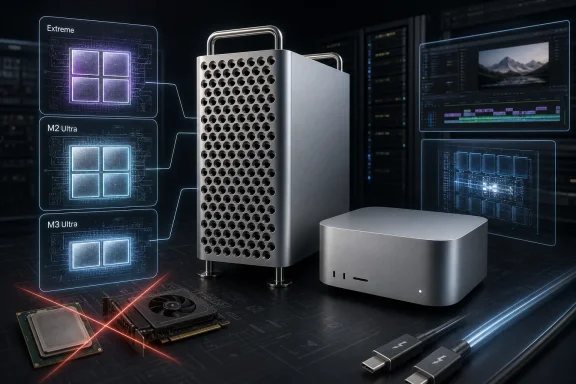
Apple’s abandoned Mac Pro roadmap was far more ambitious—and conflicted—than the tower Apple ultimately shipped. According to reporting from Bloomberg’s Mark Gurman, the company developed two unreleased “Extreme” processors, considered one final Intel-based Mac Pro, and prepared an M3 Ultra successor before deciding that none of them made commercial sense. The disclosures do more than fill gaps in Apple history: they show how the Mac Studio, chip economics, limited graphics-card support, and a shrinking market for modular workstations combined to end one of Apple’s most iconic product lines.
That flexibility mattered in film production, music studios, scientific computing, software development, and publishing. A Mac Pro could begin as one configuration and evolve with a customer’s workload, often remaining useful far longer than an ordinary desktop.
The Intel transition strengthened that formula. After moving the Mac from PowerPC to Intel processors in 2006, Apple could use workstation-class Xeon CPUs, industry-standard expansion technologies, and discrete graphics cards from AMD and Nvidia. The Mac Pro became a familiar, if expensive, alternative to a Windows or Linux workstation.
Apple publicly acknowledged that it had designed itself into a thermal corner. The company eventually responded with the 2019 Mac Pro, returning to a large aluminum tower with PCI Express slots, removable modules, extensive cooling, and support for enormous amounts of RAM.
The 2019 machine restored many capabilities professionals had requested. It also started at $5,999 in the United States before a display, while high-end configurations could cost tens of thousands of dollars. That pricing limited the machine primarily to organizations and specialists whose workloads could justify the investment.
Apple did not release an Apple silicon Mac Pro until June 2023. It used the same M2 Ultra processor available in the second-generation Mac Studio, meaning the expensive tower no longer possessed a fundamentally faster CPU or GPU than Apple’s much smaller desktop.
That was the central problem Apple never solved. The Mac Pro retained PCIe expansion, but its compute performance was effectively available in a less expensive box.
Gurman now reports that Apple developed both M2 Extreme and M3 Extreme projects before cancelling them. These were reportedly meaningful internal development efforts rather than names casually considered by the marketing department.
Neither chip was publicly announced, and Apple has not confirmed their specifications. Their reported existence nevertheless helps explain why the company took so long to introduce the Apple silicon Mac Pro and why the finished 2023 model felt less ambitious than expected.
An Extreme-class processor was expected to extend that concept by combining the equivalent resources of two Ultra chips. In simplified terms, that would mean four Max-class dies working together.
An M3 Extreme derived from the largest M3 Ultra configuration could theoretically have approached roughly 48 CPU cores and more than 150 GPU cores, although unreleased designs can change substantially during development. Memory capacity and bandwidth would also have needed to scale to prevent those additional compute units from being starved.
Such a component would have been unlike any other Apple processor. It could have given the Mac Pro a clear performance advantage over the Mac Studio rather than merely placing the same chip in a larger enclosure.
The challenge is not simply fitting more transistors into the Mac Pro. Apple would have needed an advanced package capable of moving vast quantities of data between the constituent dies without erasing the efficiency advantages of Apple silicon.
Software would also need to distribute work effectively across the enlarged GPU and memory system. Applications that scale well across many cores could gain dramatically, while lightly threaded or poorly optimized software might show far smaller improvements.
The Extreme project therefore represented more than “two Ultras glued together.” It required a credible answer to packaging, thermals, memory, software scaling, manufacturing yield, and market demand at the same time.
A multi-die processor can improve flexibility because individual chiplets are smaller than one monolithic chip. However, the completed package still requires several functional dies, a complex interconnect, and extensive validation. If any critical element fails, Apple may be unable to sell the package as its intended top-tier product.
Advanced process-node capacity is also valuable. The same production resources used for a low-volume Extreme processor could manufacture a larger number of chips for iPhones, iPads, MacBooks, or mainstream desktop Macs.
Apple therefore had to evaluate more than the selling price of an Extreme Mac Pro. It had to consider the opportunity cost of allocating premium manufacturing and engineering capacity to a tiny segment of the computer market.
Other professionals can complete their work on a MacBook Pro or Mac Studio. Apple silicon’s integrated media engines are particularly effective for supported video codecs, allowing relatively compact Macs to process workloads that once required expensive workstation hardware.
The Extreme customer would consequently have needed all of the following:
The problem was that Extreme risked becoming a technological demonstration with few practical buyers. A processor could be impressive in benchmarks while remaining less useful than Nvidia-based systems for machine learning or GPU rendering, particularly when applications depended on CUDA.
Apple could have built a spectacular Mac Pro without necessarily building the workstation that the market wanted. That distinction appears to have determined the project’s fate.
The project does not mean Apple planned to reverse its processor transition. It instead suggests that Apple recognized a gap between the strengths of its integrated silicon strategy and the requirements of certain professional users.
An Intel Mac Pro could preserve compatibility with established workstation components and software while Apple silicon matured. It might also have served customers whose investments in cards, drivers, plug-ins, virtualization tools, or x86 applications made an immediate architectural transition impractical.
That limitation fundamentally changed the value of the tower. In the 2019 Mac Pro, customers could select and upgrade high-end discrete graphics hardware. In the Apple silicon version, GPU compute remained inside the M2 Ultra package.
J170 may have provided a way to preserve discrete workstation graphics, although the precise purpose of the prototype has not been publicly detailed. The rationale could also have included high-memory configurations, specialized PCIe devices, x86 virtualization, or compatibility with existing enterprise software.
The important point is that Apple apparently explored an exception to its otherwise comprehensive silicon transition. That indicates the company understood that integrated Apple silicon did not replace every capability of a traditional workstation.
The system would also have confused Apple’s message. Customers were being encouraged to migrate applications to Arm, adopt Metal, and purchase Apple silicon Macs, yet Apple would simultaneously be selling a flagship Intel workstation as the solution for tasks its own chips could not address.
The disadvantages would have accumulated quickly:
On paper, J190 was easier to understand than J170. Apple could place the newer Ultra processor in the existing tower, update its internal controllers where necessary, and preserve PCIe expansion for supported professional cards.
Apple still chose not to release it. That decision suggests the problem was not that the company lacked a suitable processor or had been caught without a completed design.
The Mac Studio also occupies less desk space, consumes less material, and is easier for Apple to manufacture and distribute. For customers who use external Thunderbolt storage and interfaces, the absence of internal slots may be an acceptable compromise.
J190 therefore faced the same identity problem as the M2 Ultra Mac Pro. It was not the fastest Mac in a meaningful, universal sense; it was the most expandable enclosure for a processor available elsewhere.
However, Apple had removed one of the most commercially important expansion categories: upgradeable graphics. The company also tightly controls driver support, reducing the range of cards that manufacturers can realistically bring to macOS.
This left Apple selling a tower whose central feature was simultaneously important and restricted. Customers with supported cards could value it highly, but the broader workstation market had fewer reasons to choose it.
Cancelling J190 was effectively an admission that PCIe expansion, as implemented on the Apple silicon Mac Pro, could not justify an independent product family.
For many creative professionals, the Studio is a better value than the Mac Pro ever was. It can drive multiple displays, attach to fast external storage, connect to professional interfaces, and deliver workstation-class performance without requiring a floor-standing enclosure.
Apple’s reported roadmap reinforces that position. An M5 Ultra Mac Studio is expected in 2026, followed by a more ambitious M7 Ultra generation targeted for 2028. Those plans remain unannounced and could change, but there is no comparably credible Mac Pro successor on the horizon.
This approach has several benefits:
For an individual creator, replacing the entire Mac every few years may be acceptable. For a large studio accustomed to upgrading components over a workstation’s lifespan, the model can be more expensive and operationally restrictive.
This is an important distinction from a conventional PC workstation. A system might have 256GB of main memory but only 24GB or 48GB of VRAM available to its GPU. On a high-end Mac Studio, the integrated GPU can work within a much larger unified pool, subject to application design and system requirements.
That advantage has become increasingly relevant for local generative AI. Large models constrained by GPU memory on a PC can sometimes run on a Mac with a large unified-memory configuration, even if raw token generation or training performance does not match dedicated data-center accelerators.
For editors working in Final Cut Pro, DaVinci Resolve, and other optimized applications, this can produce excellent performance with comparatively modest power consumption and noise. A compact Mac Studio may outperform an older, much larger workstation in precisely the tasks that matter to a video-production team.
The limitation is specialization. Media engines excel at supported operations, but they do not transform the machine into a universal replacement for every rendering, simulation, AI, or engineering platform.
That matters in recording studios and editing rooms where fan noise is undesirable. It also matters in organizations deploying many systems, where energy use, cooling, physical footprint, and maintenance affect total cost.
The Mac Studio does not need to win every benchmark to be commercially effective. It needs to complete valuable workloads quickly, quietly, and reliably enough that customers prefer it to a more power-hungry workstation.
Apple offers Metal, Core ML, MLX, and its Neural Engine, but these technologies do not provide automatic compatibility with CUDA-dependent software. Porting a workload may require substantial engineering, and some commercial applications simply do not offer equivalent acceleration on macOS.
For professionals already invested in Nvidia infrastructure, the problem is not whether Apple silicon is technically impressive. The problem is whether the required application runs, whether it uses the available hardware efficiently, and whether results integrate with the organization’s existing pipeline.
A hypothetical M3 Extreme could have doubled Apple’s GPU resources and still failed to attract these customers. More cores cannot compensate for a missing software ecosystem.
This can produce two undesirable outcomes. Customers may overpay for capacity they do not immediately need, or they may underspecify a system that becomes constrained before the processor itself is obsolete.
Traditional workstations separate those decisions. An organization can add RAM, replace a GPU, expand storage, install faster networking, or repurpose the system over time. Apple’s model asks customers to exchange that flexibility for integration and efficiency.
Apple’s portfolio is much narrower. That simplicity benefits customers who fit within the supported model, but it leaves limited room for unusual requirements.
The absence of the Mac Pro means Apple is no longer trying to match the configurability of a high-end Windows or Linux tower. It is defining a different category of professional desktop and accepting that some customers will leave the Mac rather than adapt.
That makes the cancelled J170 project look even more temporary in retrospect. Had Apple released another Intel Mac Pro late in the transition, it would either have required an exceptional support policy or faced an unusually short path to architectural obsolescence.
Apple could theoretically have maintained Intel support for one flagship system, but doing so would have undermined the engineering savings created by dropping the architecture. Every additional year would require testing kernel components, security features, drivers, installation tools, recovery environments, and applications across both platforms.
Ending Intel Mac support allows Apple to design macOS around a more consistent collection of hardware capabilities. It can assume the presence of Apple-designed media engines, security hardware, unified memory behavior, and Arm instructions rather than preserving compatibility with a broad range of older Intel components.
Full Rosetta functionality is not intended to remain permanent. Apple has indicated that its role will narrow after macOS 27, with limited support retained for specific legacy scenarios such as older games dependent on Intel frameworks.
Organizations should therefore distinguish two deadlines:
Reports indicate that Apple has explored using Intel’s advanced fabrication processes for certain lower-end Apple-designed processors. Such chips would still use Apple’s architecture and run Apple software; Intel would act as a manufacturing partner rather than supplying the CPU design.
This distinction matters because claims that Intel is “returning to the Mac” can be misleading. A future M-series chip fabricated in an Intel plant would not make the Mac an Intel platform in the historical sense.
Intel would benefit from securing a prestigious foundry customer and demonstrating that its production technology can satisfy demanding external chip designers. Apple could gain additional capacity, leverage in supplier negotiations, and potentially more processors manufactured in the United States.
Any production arrangement remains subject to yields, cost, capacity, performance, and schedule. Apple is unlikely to transfer strategically important chips merely for symbolism; a foundry must deliver at the enormous scale and quality Apple requires.
The irony remains notable. Apple abandoned Intel’s processor architecture, considered one final Intel Mac Pro, and may now rely on Intel factories to manufacture some Apple-designed silicon. The relationship did not simply end—it evolved from platform dependency into a possible supplier arrangement.
A structured migration should include the following steps:
Even advanced enthusiasts are often better served by a Mac Studio than by a tower. The discontinued Mac Pro matters less as a lost purchasing option than as a signal of Apple’s priorities: integrated hardware, limited internal upgrades, and increasing reliance on external or networked expansion.
Prospective buyers should still avoid purchasing more performance than their applications can use. An Ultra processor may look future-proof, but software optimization, memory capacity, and accelerator compatibility can matter more than headline core counts.
If the M5 Ultra delivers a substantial improvement while remaining compact and comparatively efficient, Apple can argue that abandoning the tower allowed it to concentrate on a better product. If the update is modest or heavily constrained by price, former Mac Pro buyers may see the strategy as retreat rather than focus.
Observers should also watch whether Apple expands support for professional accelerator cards over Thunderbolt or future high-speed interconnects. External GPU support appears unlikely under the current architecture, but other categories of acceleration could become viable.
The meaningful questions will extend beyond Neural Engine performance. Professionals will want to know whether applications can access the new accelerators, whether models can operate across very large unified-memory pools, and whether Apple provides development tools capable of competing with mature alternatives.
A high theoretical AI score will not be enough. Apple must turn specialized hardware into repeatable performance improvements inside software customers already use.
The company must also persuade enterprises that the platform has a predictable lifecycle. Professionals buying expensive hardware expect operating-system support, replacement parts, compatible peripherals, and software stability over many years.
Finally, the industry should not assume the Mac Pro can never return. Apple has revived names and categories when technology or customer behavior changed. A future interconnect, modular compute architecture, or new accelerator market could make a tower commercially sensible again, but current evidence points firmly toward the Mac Studio.
Apple’s cancelled Intel Mac Pro and unreleased Extreme processors reveal a company willing to explore contradictory options before committing to a narrower strategy. It considered preserving the old workstation model, developed silicon powerful enough to distinguish a flagship tower, and prepared a more conventional M3 Ultra update, yet rejected all three paths. The Mac Pro did not disappear because Apple lacked the engineering ability to continue it; it disappeared because the economics, software ecosystem, and integrated design of Apple silicon made the traditional tower increasingly difficult to justify. The Mac Studio now carries Apple’s professional desktop ambitions, and its next generations must prove that efficiency, unified memory, and specialized acceleration can replace not only the Mac Pro’s speed, but also the freedom and longevity that made the tower valuable in the first place.
 Background
The Mac Pro was built around expansion
The Mac Pro originated as Apple’s answer to conventional professional workstations from Dell, HP, and other PC manufacturers. Its appeal was not merely that it shipped with a fast processor; customers could install more memory, storage, graphics hardware, networking interfaces, video-capture cards, and other specialized equipment.That flexibility mattered in film production, music studios, scientific computing, software development, and publishing. A Mac Pro could begin as one configuration and evolve with a customer’s workload, often remaining useful far longer than an ordinary desktop.
The Intel transition strengthened that formula. After moving the Mac from PowerPC to Intel processors in 2006, Apple could use workstation-class Xeon CPUs, industry-standard expansion technologies, and discrete graphics cards from AMD and Nvidia. The Mac Pro became a familiar, if expensive, alternative to a Windows or Linux workstation.
Apple repeatedly struggled to modernize the tower
Apple’s relationship with modularity became more complicated over time. The cylindrical 2013 Mac Pro attempted to replace internal expansion with Thunderbolt peripherals, dual workstation GPUs, and a compact thermal core, but the design proved difficult to update as professional computing moved toward larger and hotter graphics cards.Apple publicly acknowledged that it had designed itself into a thermal corner. The company eventually responded with the 2019 Mac Pro, returning to a large aluminum tower with PCI Express slots, removable modules, extensive cooling, and support for enormous amounts of RAM.
The 2019 machine restored many capabilities professionals had requested. It also started at $5,999 in the United States before a display, while high-end configurations could cost tens of thousands of dollars. That pricing limited the machine primarily to organizations and specialists whose workloads could justify the investment.
Apple silicon changed the workstation equation
When Apple announced its transition to Apple-designed Mac processors in June 2020, it promised to complete the move in roughly two years. The first M1 Macs arrived that November and delivered unusually strong performance per watt, but the Mac Pro remained on Intel longer than the rest of the range.Apple did not release an Apple silicon Mac Pro until June 2023. It used the same M2 Ultra processor available in the second-generation Mac Studio, meaning the expensive tower no longer possessed a fundamentally faster CPU or GPU than Apple’s much smaller desktop.
That was the central problem Apple never solved. The Mac Pro retained PCIe expansion, but its compute performance was effectively available in a less expensive box.
The Secret “Extreme” Chips
M2 Extreme and M3 Extreme went beyond speculation
The idea of an “M Extreme” processor circulated long before the latest report. Apple’s chip architecture appeared to leave room for a part positioned above the Ultra, and early reporting suggested that such a processor could be intended for the Mac Pro.Gurman now reports that Apple developed both M2 Extreme and M3 Extreme projects before cancelling them. These were reportedly meaningful internal development efforts rather than names casually considered by the marketing department.
Neither chip was publicly announced, and Apple has not confirmed their specifications. Their reported existence nevertheless helps explain why the company took so long to introduce the Apple silicon Mac Pro and why the finished 2023 model felt less ambitious than expected.
Doubling an Ultra was the apparent goal
Apple created the M1 Ultra and M2 Ultra by connecting two Max-class dies through its UltraFusion interconnect. To software, the package behaves largely like a single system on a chip, with CPU cores, GPU cores, media engines, and unified memory operating within a common architecture.An Extreme-class processor was expected to extend that concept by combining the equivalent resources of two Ultra chips. In simplified terms, that would mean four Max-class dies working together.
An M3 Extreme derived from the largest M3 Ultra configuration could theoretically have approached roughly 48 CPU cores and more than 150 GPU cores, although unreleased designs can change substantially during development. Memory capacity and bandwidth would also have needed to scale to prevent those additional compute units from being starved.
Such a component would have been unlike any other Apple processor. It could have given the Mac Pro a clear performance advantage over the Mac Studio rather than merely placing the same chip in a larger enclosure.
Packaging four dies is not a free upgrade
Connecting two large dies is difficult. Connecting four while maintaining low latency, coherent memory access, adequate bandwidth, manageable power consumption, and acceptable manufacturing yields is considerably harder.The challenge is not simply fitting more transistors into the Mac Pro. Apple would have needed an advanced package capable of moving vast quantities of data between the constituent dies without erasing the efficiency advantages of Apple silicon.
Software would also need to distribute work effectively across the enlarged GPU and memory system. Applications that scale well across many cores could gain dramatically, while lightly threaded or poorly optimized software might show far smaller improvements.
The Extreme project therefore represented more than “two Ultras glued together.” It required a credible answer to packaging, thermals, memory, software scaling, manufacturing yield, and market demand at the same time.
Why Apple Cancelled Extreme
Large chips carry disproportionate costs
Semiconductor manufacturing becomes increasingly unforgiving as die size and packaging complexity rise. Defects that might affect a small fraction of compact chips can sharply reduce the number of usable dies when each component occupies a larger area of a silicon wafer.A multi-die processor can improve flexibility because individual chiplets are smaller than one monolithic chip. However, the completed package still requires several functional dies, a complex interconnect, and extensive validation. If any critical element fails, Apple may be unable to sell the package as its intended top-tier product.
Advanced process-node capacity is also valuable. The same production resources used for a low-volume Extreme processor could manufacture a larger number of chips for iPhones, iPads, MacBooks, or mainstream desktop Macs.
Apple therefore had to evaluate more than the selling price of an Extreme Mac Pro. It had to consider the opportunity cost of allocating premium manufacturing and engineering capacity to a tiny segment of the computer market.
The potential audience was exceptionally narrow
Many demanding professional workloads no longer require a tower under every desk. Organizations increasingly use render farms, remote workstations, cloud GPU services, dedicated AI servers, or shared production infrastructure.Other professionals can complete their work on a MacBook Pro or Mac Studio. Apple silicon’s integrated media engines are particularly effective for supported video codecs, allowing relatively compact Macs to process workloads that once required expensive workstation hardware.
The Extreme customer would consequently have needed all of the following:
- The customer would need performance beyond an Ultra-class Mac Studio.
- The customer’s applications would need to scale across the additional CPU or GPU resources.
- The workflow would need to remain compatible with Apple’s Metal and unified-memory architecture.
- The organization would need to prefer local macOS hardware over Windows, Linux, cloud, or clustered alternatives.
- The buyer would need to accept a price likely far above that of an ordinary Mac Studio.
A showcase product still needs a business case
Apple has occasionally sold products whose influence exceeded their unit volume, but even a halo device must support a broader strategy. The Mac Pro could demonstrate engineering leadership, strengthen Apple’s relationship with creative industries, and reassure developers that macOS remained viable at the highest end.The problem was that Extreme risked becoming a technological demonstration with few practical buyers. A processor could be impressive in benchmarks while remaining less useful than Nvidia-based systems for machine learning or GPU rendering, particularly when applications depended on CUDA.
Apple could have built a spectacular Mac Pro without necessarily building the workstation that the market wanted. That distinction appears to have determined the project’s fate.
J170: The Intel Mac Pro Apple Never Shipped
An unexpected fallback project
The more surprising cancelled system reportedly carried the internal identifier J170. Apple developed it as an Intel-based Mac Pro even while the broader Mac lineup was moving decisively to Apple silicon.The project does not mean Apple planned to reverse its processor transition. It instead suggests that Apple recognized a gap between the strengths of its integrated silicon strategy and the requirements of certain professional users.
An Intel Mac Pro could preserve compatibility with established workstation components and software while Apple silicon matured. It might also have served customers whose investments in cards, drivers, plug-ins, virtualization tools, or x86 applications made an immediate architectural transition impractical.
PCIe graphics support is the obvious missing capability
Apple’s 2023 Mac Pro includes PCI Express expansion, but expansion does not mean unrestricted hardware compatibility. Customers can install supported storage, networking, audio, video, and interface cards, yet they cannot add conventional AMD or Nvidia graphics cards and use them to accelerate macOS workloads.That limitation fundamentally changed the value of the tower. In the 2019 Mac Pro, customers could select and upgrade high-end discrete graphics hardware. In the Apple silicon version, GPU compute remained inside the M2 Ultra package.
J170 may have provided a way to preserve discrete workstation graphics, although the precise purpose of the prototype has not been publicly detailed. The rationale could also have included high-memory configurations, specialized PCIe devices, x86 virtualization, or compatibility with existing enterprise software.
The important point is that Apple apparently explored an exception to its otherwise comprehensive silicon transition. That indicates the company understood that integrated Apple silicon did not replace every capability of a traditional workstation.
Why an Intel revival became untenable
Shipping J170 would have introduced substantial strategic and support complications. Apple would have needed to maintain Intel-specific operating-system code, drivers, validation procedures, security testing, and developer guidance for one low-volume machine.The system would also have confused Apple’s message. Customers were being encouraged to migrate applications to Arm, adopt Metal, and purchase Apple silicon Macs, yet Apple would simultaneously be selling a flagship Intel workstation as the solution for tasks its own chips could not address.
The disadvantages would have accumulated quickly:
- The Intel model would have extended platform fragmentation at the exact moment Apple was trying to eliminate it.
- Developers could have delayed Apple silicon optimization if Apple continued selling a premium x86 Mac.
- Enterprise customers might have questioned how long the exception would receive operating-system support.
- Apple would have remained responsible for third-party GPU drivers and compatibility problems it could not fully control.
- The machine’s performance per watt would likely have compared poorly with newer Apple silicon products.
J190 and the Missing M3 Ultra Mac Pro
The obvious update was apparently prepared
The second cancelled Mac Pro project, reportedly codenamed J190, used Apple silicon and was associated with the M3 Ultra generation. It represented the conventional upgrade many Mac Pro owners expected after Apple introduced the M3 Ultra Mac Studio in March 2025.On paper, J190 was easier to understand than J170. Apple could place the newer Ultra processor in the existing tower, update its internal controllers where necessary, and preserve PCIe expansion for supported professional cards.
Apple still chose not to release it. That decision suggests the problem was not that the company lacked a suitable processor or had been caught without a completed design.
The Mac Studio made J190 redundant
An M3 Ultra Mac Pro would have offered performance similar to the M3 Ultra Mac Studio in applications dependent on the CPU, integrated GPU, media engines, and Neural Engine. The tower would retain an advantage for workflows requiring PCIe cards, but most buyers would see comparable compute performance at a much higher price.The Mac Studio also occupies less desk space, consumes less material, and is easier for Apple to manufacture and distribute. For customers who use external Thunderbolt storage and interfaces, the absence of internal slots may be an acceptable compromise.
J190 therefore faced the same identity problem as the M2 Ultra Mac Pro. It was not the fastest Mac in a meaningful, universal sense; it was the most expandable enclosure for a processor available elsewhere.
Expansion alone could not carry the product
Internal PCIe slots remain valuable because Thunderbolt does not replace every use case. High-throughput video I/O, ultra-fast networking, low-latency audio processing, specialized accelerator cards, and large internal storage arrays can benefit from direct PCIe connectivity.However, Apple had removed one of the most commercially important expansion categories: upgradeable graphics. The company also tightly controls driver support, reducing the range of cards that manufacturers can realistically bring to macOS.
This left Apple selling a tower whose central feature was simultaneously important and restricted. Customers with supported cards could value it highly, but the broader workstation market had fewer reasons to choose it.
Cancelling J190 was effectively an admission that PCIe expansion, as implemented on the Apple silicon Mac Pro, could not justify an independent product family.
Mac Studio Becomes Apple’s Professional Desktop
Compact hardware won the internal competition
The Mac Studio began as a bridge between the Mac mini and Mac Pro, but it ultimately replaced the tower at the top of Apple’s desktop strategy. Its success came from concentrating Apple’s strongest advantages: custom silicon, unified memory, quiet cooling, media acceleration, and a compact design.For many creative professionals, the Studio is a better value than the Mac Pro ever was. It can drive multiple displays, attach to fast external storage, connect to professional interfaces, and deliver workstation-class performance without requiring a floor-standing enclosure.
Apple’s reported roadmap reinforces that position. An M5 Ultra Mac Studio is expected in 2026, followed by a more ambitious M7 Ultra generation targeted for 2028. Those plans remain unannounced and could change, but there is no comparably credible Mac Pro successor on the horizon.
External connectivity replaces some modularity
Apple’s preferred model is increasingly appliance-like. Customers select CPU, GPU, memory, and storage capacity at purchase, then use Thunderbolt, USB, Ethernet, and networked services for later expansion.This approach has several benefits:
- Apple can optimize cooling and power delivery around a known internal configuration.
- Unified memory avoids copying data between separate CPU and GPU memory pools.
- Compact systems are easier to deploy in offices, studios, and rack-mounted installations.
- External storage can move between machines without opening a chassis.
- Apple controls more of the complete hardware and driver stack.
For an individual creator, replacing the entire Mac every few years may be acceptable. For a large studio accustomed to upgrading components over a workstation’s lifespan, the model can be more expensive and operationally restrictive.
Apple Silicon’s Workstation Strengths
Unified memory changes what a desktop can do
Apple silicon’s unified-memory architecture allows CPUs, GPUs, and accelerators to access a common pool without maintaining entirely separate memory allocations. That can reduce copying overhead and enable workloads involving large media projects, scientific datasets, or local AI models to use more memory than a typical discrete GPU provides.This is an important distinction from a conventional PC workstation. A system might have 256GB of main memory but only 24GB or 48GB of VRAM available to its GPU. On a high-end Mac Studio, the integrated GPU can work within a much larger unified pool, subject to application design and system requirements.
That advantage has become increasingly relevant for local generative AI. Large models constrained by GPU memory on a PC can sometimes run on a Mac with a large unified-memory configuration, even if raw token generation or training performance does not match dedicated data-center accelerators.
Media engines offer targeted acceleration
Apple’s high-end chips include hardware blocks for encoding and decoding professional video formats. Applications that take advantage of these engines can process multiple high-resolution streams without relying exclusively on general-purpose CPU or GPU resources.For editors working in Final Cut Pro, DaVinci Resolve, and other optimized applications, this can produce excellent performance with comparatively modest power consumption and noise. A compact Mac Studio may outperform an older, much larger workstation in precisely the tasks that matter to a video-production team.
The limitation is specialization. Media engines excel at supported operations, but they do not transform the machine into a universal replacement for every rendering, simulation, AI, or engineering platform.
Efficiency remains a major competitive asset
Apple’s control over processor design, operating systems, development frameworks, and hardware lets it optimize the Mac as a complete platform. The result is frequently strong performance per watt and predictable thermal behavior.That matters in recording studios and editing rooms where fan noise is undesirable. It also matters in organizations deploying many systems, where energy use, cooling, physical footprint, and maintenance affect total cost.
The Mac Studio does not need to win every benchmark to be commercially effective. It needs to complete valuable workloads quickly, quietly, and reliably enough that customers prefer it to a more power-hungry workstation.
Where Apple Still Falls Short
CUDA remains a structural disadvantage
Nvidia’s CUDA ecosystem is deeply embedded in machine learning, scientific computing, 3D rendering, engineering, and research. Many applications and internal tools are built around Nvidia hardware, associated libraries, and years of accumulated optimization.Apple offers Metal, Core ML, MLX, and its Neural Engine, but these technologies do not provide automatic compatibility with CUDA-dependent software. Porting a workload may require substantial engineering, and some commercial applications simply do not offer equivalent acceleration on macOS.
For professionals already invested in Nvidia infrastructure, the problem is not whether Apple silicon is technically impressive. The problem is whether the required application runs, whether it uses the available hardware efficiently, and whether results integrate with the organization’s existing pipeline.
A hypothetical M3 Extreme could have doubled Apple’s GPU resources and still failed to attract these customers. More cores cannot compensate for a missing software ecosystem.
Fixed configurations limit long-term flexibility
The Mac Studio’s unified architecture provides efficiency but turns purchasing decisions into long-term commitments. Buyers must estimate future memory and storage requirements when ordering because neither can be upgraded in the traditional sense.This can produce two undesirable outcomes. Customers may overpay for capacity they do not immediately need, or they may underspecify a system that becomes constrained before the processor itself is obsolete.
Traditional workstations separate those decisions. An organization can add RAM, replace a GPU, expand storage, install faster networking, or repurpose the system over time. Apple’s model asks customers to exchange that flexibility for integration and efficiency.
Windows and Linux workstation vendors can specialize
PC workstation manufacturers do not need one architecture to satisfy every professional market. They can offer systems with different Intel or AMD processors, Nvidia or AMD GPUs, varying memory capacities, multiple accelerator cards, and operating systems selected for the workload.Apple’s portfolio is much narrower. That simplicity benefits customers who fit within the supported model, but it leaves limited room for unusual requirements.
The absence of the Mac Pro means Apple is no longer trying to match the configurability of a high-end Windows or Linux tower. It is defining a different category of professional desktop and accepting that some customers will leave the Mac rather than adapt.
The End of Intel Support Makes J170 Academic
macOS 27 closes the hardware transition
Apple’s operating-system roadmap has now caught up with its processor strategy. macOS 26 Tahoe is the final major release that supports Intel-based Macs, while macOS 27 Golden Gate requires Apple silicon.That makes the cancelled J170 project look even more temporary in retrospect. Had Apple released another Intel Mac Pro late in the transition, it would either have required an exceptional support policy or faced an unusually short path to architectural obsolescence.
Apple could theoretically have maintained Intel support for one flagship system, but doing so would have undermined the engineering savings created by dropping the architecture. Every additional year would require testing kernel components, security features, drivers, installation tools, recovery environments, and applications across both platforms.
Ending Intel Mac support allows Apple to design macOS around a more consistent collection of hardware capabilities. It can assume the presence of Apple-designed media engines, security hardware, unified memory behavior, and Arm instructions rather than preserving compatibility with a broad range of older Intel components.
Rosetta 2 is also approaching a narrower role
Rosetta 2 has made the Apple silicon transition unusually smooth by translating Intel applications on Apple-designed Macs. Many users could purchase an M1 or later system and continue running older software while developers produced native versions.Full Rosetta functionality is not intended to remain permanent. Apple has indicated that its role will narrow after macOS 27, with limited support retained for specific legacy scenarios such as older games dependent on Intel frameworks.
Organizations should therefore distinguish two deadlines:
- Intel Mac compatibility ends with macOS 26 Tahoe, because macOS 27 requires Apple silicon.
- Broad Intel application compatibility through Rosetta 2 continues in macOS 27, but is expected to become more limited in subsequent releases.
- Critical applications should be migrated, replaced, or isolated before those transitions affect production systems.
Intel and Apple Are Still Connected
Processor architecture and chip fabrication are different questions
Apple ending Intel processors in Macs does not mean it must avoid Intel as a manufacturer. Intel designs x86 processors, but Intel Foundry also seeks to manufacture chips designed by outside customers.Reports indicate that Apple has explored using Intel’s advanced fabrication processes for certain lower-end Apple-designed processors. Such chips would still use Apple’s architecture and run Apple software; Intel would act as a manufacturing partner rather than supplying the CPU design.
This distinction matters because claims that Intel is “returning to the Mac” can be misleading. A future M-series chip fabricated in an Intel plant would not make the Mac an Intel platform in the historical sense.
Supply-chain diversification has strategic value
Apple has relied heavily on Taiwan Semiconductor Manufacturing Company for its leading processors. TSMC remains central to Apple’s products, but using a second advanced manufacturer could reduce geographic and supply-chain concentration.Intel would benefit from securing a prestigious foundry customer and demonstrating that its production technology can satisfy demanding external chip designers. Apple could gain additional capacity, leverage in supplier negotiations, and potentially more processors manufactured in the United States.
Any production arrangement remains subject to yields, cost, capacity, performance, and schedule. Apple is unlikely to transfer strategically important chips merely for symbolism; a foundry must deliver at the enormous scale and quality Apple requires.
The irony remains notable. Apple abandoned Intel’s processor architecture, considered one final Intel Mac Pro, and may now rely on Intel factories to manufacture some Apple-designed silicon. The relationship did not simply end—it evolved from platform dependency into a possible supplier arrangement.
Enterprise and Professional Impact
Organizations must audit dependencies, not benchmarks
Businesses replacing Intel Mac Pros should begin with workflow requirements rather than synthetic performance charts. An M-series Mac Studio may be dramatically faster in one production application while being unusable for another because of a missing driver, plug-in, or accelerator framework.A structured migration should include the following steps:
- Inventory every critical application, plug-in, peripheral, kernel extension, and PCIe card.
- Confirm native Apple silicon support and the developer’s long-term roadmap.
- Benchmark representative projects rather than relying on generic CPU and GPU scores.
- Test memory usage under sustained production workloads.
- Identify tasks that must move to Windows, Linux, cloud infrastructure, or remote GPU servers.
- Create a security plan for Intel Macs that must remain in service.
- Budget for external enclosures, networking, storage, and replacement interfaces alongside the new Mac.
Consumers face a simpler choice
Most consumers do not need a Mac Pro replacement. The Mac mini, iMac, MacBook Air, and MacBook Pro cover ordinary productivity, entertainment, education, and light creative work.Even advanced enthusiasts are often better served by a Mac Studio than by a tower. The discontinued Mac Pro matters less as a lost purchasing option than as a signal of Apple’s priorities: integrated hardware, limited internal upgrades, and increasing reliance on external or networked expansion.
Prospective buyers should still avoid purchasing more performance than their applications can use. An Ultra processor may look future-proof, but software optimization, memory capacity, and accelerator compatibility can matter more than headline core counts.
Strengths and Opportunities
Apple’s decision to consolidate professional desktops around the Mac Studio creates several opportunities, even if it disappoints traditional workstation users.- Apple can focus engineering resources on a higher-volume professional desktop instead of dividing them between Studio and Pro models with similar processors.
- Larger unified-memory configurations can make the Mac increasingly attractive for local AI inference, especially when a model exceeds the VRAM available on common discrete graphics cards.
- Improved Metal and Core ML tools could narrow software gaps if Apple persuades developers to optimize directly for its GPUs and Neural Engines.
- Compact, energy-efficient systems suit distributed studios and enterprise deployments where noise, heat, and desk space matter.
- A clearer product hierarchy reduces buyer confusion, with Mac mini covering mainstream desktops and Mac Studio serving demanding professional workloads.
- Foundry diversification could strengthen Apple’s processor supply chain without returning to Intel-designed CPUs.
- Future Ultra chips can prioritize memory bandwidth, accelerators, and interconnect improvements rather than pursuing raw core-count growth at any cost.
Risks and Concerns
The end of the Mac Pro also exposes weaknesses that Apple cannot solve through faster annual chips alone.- Professional users may abandon macOS when their workloads require Nvidia GPUs, CUDA, or unsupported PCIe hardware.
- Fixed memory and storage configurations increase replacement costs and reduce the useful flexibility of expensive systems.
- The absence of a modular flagship weakens Apple’s visibility in engineering, scientific, and high-end 3D markets.
- Relying on external expansion can introduce cable complexity, bandwidth limits, additional power supplies, and more points of failure.
- A delayed or irregular Ultra roadmap could leave top-end buyers waiting years between meaningful upgrades.
- Narrowing Rosetta 2 support may strand organizations using irreplaceable Intel applications.
- Extreme-class performance may remain economically impossible if Apple cannot reuse the underlying package across enough products.
- AI-focused silicon could prioritize fashionable workloads while delivering limited gains to established professional software.
What to Watch Next
The M5 Ultra will test the Studio-only strategy
The next Ultra-class Mac Studio will be the first major opportunity to judge Apple’s post-Mac Pro direction. Performance will matter, but memory capacity, bandwidth, sustained thermals, external connectivity, and pricing will be equally important.If the M5 Ultra delivers a substantial improvement while remaining compact and comparatively efficient, Apple can argue that abandoning the tower allowed it to concentrate on a better product. If the update is modest or heavily constrained by price, former Mac Pro buyers may see the strategy as retreat rather than focus.
Observers should also watch whether Apple expands support for professional accelerator cards over Thunderbolt or future high-speed interconnects. External GPU support appears unlikely under the current architecture, but other categories of acceleration could become viable.
The M7 generation may reveal Apple’s AI priorities
Reports suggest Apple could move quickly from the base M6 generation to higher-end M7 Pro, Max, and Ultra designs, with the M7 Ultra targeted for 2028. The roadmap reportedly emphasizes on-device artificial intelligence and more demanding graphics workloads.The meaningful questions will extend beyond Neural Engine performance. Professionals will want to know whether applications can access the new accelerators, whether models can operate across very large unified-memory pools, and whether Apple provides development tools capable of competing with mature alternatives.
A high theoretical AI score will not be enough. Apple must turn specialized hardware into repeatable performance improvements inside software customers already use.
Software support will determine whether the gamble succeeds
Apple can design increasingly powerful silicon, but developers decide whether those resources solve real problems. Metal adoption, native Arm optimization, Core ML integration, and professional application support will determine the practical value of future Mac Studios.The company must also persuade enterprises that the platform has a predictable lifecycle. Professionals buying expensive hardware expect operating-system support, replacement parts, compatible peripherals, and software stability over many years.
Finally, the industry should not assume the Mac Pro can never return. Apple has revived names and categories when technology or customer behavior changed. A future interconnect, modular compute architecture, or new accelerator market could make a tower commercially sensible again, but current evidence points firmly toward the Mac Studio.
Apple’s cancelled Intel Mac Pro and unreleased Extreme processors reveal a company willing to explore contradictory options before committing to a narrower strategy. It considered preserving the old workstation model, developed silicon powerful enough to distinguish a flagship tower, and prepared a more conventional M3 Ultra update, yet rejected all three paths. The Mac Pro did not disappear because Apple lacked the engineering ability to continue it; it disappeared because the economics, software ecosystem, and integrated design of Apple silicon made the traditional tower increasingly difficult to justify. The Mac Studio now carries Apple’s professional desktop ambitions, and its next generations must prove that efficiency, unified memory, and specialized acceleration can replace not only the Mac Pro’s speed, but also the freedom and longevity that made the tower valuable in the first place.
References
- Primary source: Memeburn
Published: 2026-07-21T20:31:31+00:00
Loading…
memeburn.com - Related coverage: arstechnica.com
Loading…
arstechnica.com - Related coverage: macrumors.com
Loading…
www.macrumors.com - Related coverage: xenospectrum.com
The phantom "M2/M3 Extreme": why Apple never put 2x Ultra's cores in the Mac Pro | XenoSpectrum
Bloomberg reports that Apple's M2- and M3-generation flagship SoCs for the Mac Pro aimed to double the CPU/GPU core counts of the Ultra chips, but were never productized because the cost couldn't be justified against limited demand.xenospectrum.com - Related coverage: sempreupdate.com.br
Loading…
sempreupdate.com.br - Related coverage: donanimhaber.com
Loading…
www.donanimhaber.com