

Apple’s new Underdogs short leaves little to chance: a trade‑show full of blue screens, a single booth that keeps running, and a pithy marketing line that reduces a complex, multi‑vendor outage to a single lesson — “Macs don’t panic.”
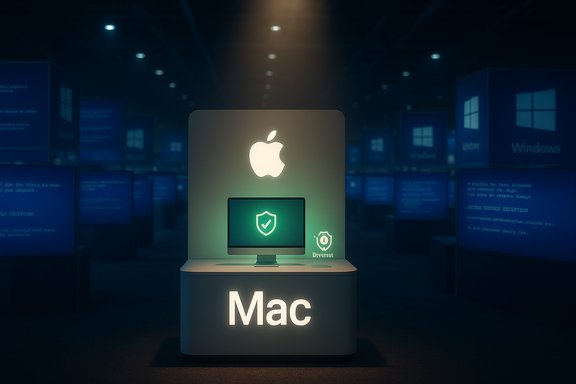
Apple released an eight‑to‑nine minute instalment in its “Underdogs” series that dramatizes a real‑world incident: the July 19, 2024 CrowdStrike Falcon update that triggered widespread crashes on Windows hosts. The ad stages a trade‑show (branded in the film as “Container Con”) where dozens of exhibitor machines display the Blue Screen of Death while one Mac‑based booth continues to function, using Apple ecosystem features to keep business moving. Apple’s narrator and an on‑screen “security expert” explicitly link the dramatized outage to platform design choices — namely, macOS protections such as System Integrity Protection (SIP), DriverKit, and the EndpointSecurity framework — and from that leap markets the Mac as the inherently more resilient choice.
That advertising move landed in October 2025 amid renewed conversation about Windows lifecycle milestones and device migrations, giving Apple an opportune moment to dramatize platform differentiation while many organizations consider device refreshes and operating system upgrades. The creative claim is simple, memorable and tailored to non‑technical buyers: control hardware plus control software equals fewer catastrophic failures. The problem is that this tidy equation compresses operational nuance into a marketing narrative.
Two technical points matter for context:
At the same time, Microsoft ships billions of Windows instances across an enormous diversity of hardware and third‑party drivers — that heterogeneity increases the surface area for compatibility and stability problems compared with Apple’s more constrained hardware+software ecosystem. The trade‑off is clear: flexibility and broad device choice versus a smaller, more controlled stack. Apple is explicitly selling the latter.
Strengths of the ad:
However, the ad is also a blunt instrument. It compresses a multi‑party operational failure into a platform morality play and invites viewers to overgeneralize a one‑off vendor rollout crisis into a universal indictment of an entire OS. The correct technical reading is not “Macs are immune,” but rather macOS is architected to reduce certain failure modes that historically made vendor updates more dangerous on some Windows deployments.
For IT leaders and buyers the practical takeaway is simple and unsexy: use this moment to harden update governance, test recovery plans and require stronger deployment and rollback guarantees from vendors. Architectural posture matters — but so do operational discipline, procurement rigor and tested recovery capabilities. Marketing can point to a problem; responsible IT practice is how you actually avoid it.
Apple’s ad will be remembered for its audacity and cinematic clarity. For professionals who actually manage fleets, it should be remembered as a prompt: tighten update controls, test your recovery tools, and base platform decisions on workload fit and operational readiness — not the punchline of a commercial.
Source: Dunia Games Portal Berita, Download Game dan Beli Voucher Game Terpercaya Di Indonesia
 Background / Overview
Apple released an eight‑to‑nine minute instalment in its “Underdogs” series that dramatizes a real‑world incident: the July 19, 2024 CrowdStrike Falcon update that triggered widespread crashes on Windows hosts. The ad stages a trade‑show (branded in the film as “Container Con”) where dozens of exhibitor machines display the Blue Screen of Death while one Mac‑based booth continues to function, using Apple ecosystem features to keep business moving. Apple’s narrator and an on‑screen “security expert” explicitly link the dramatized outage to platform design choices — namely, macOS protections such as System Integrity Protection (SIP), DriverKit, and the EndpointSecurity framework — and from that leap markets the Mac as the inherently more resilient choice.That advertising move landed in October 2025 amid renewed conversation about Windows lifecycle milestones and device migrations, giving Apple an opportune moment to dramatize platform differentiation while many organizations consider device refreshes and operating system upgrades. The creative claim is simple, memorable and tailored to non‑technical buyers: control hardware plus control software equals fewer catastrophic failures. The problem is that this tidy equation compresses operational nuance into a marketing narrative.
What actually happened in July 2024 (the factual anchor)
On July 19, 2024 a CrowdStrike Falcon content/configuration update contained a logic error that caused Windows hosts running that update to crash or enter boot loops. Vendor and independent reporting estimated the impact measured in the millions: Microsoft later estimated roughly 8.5 million Windows devices were affected (a small percentage of the global Windows install base, but with outsized impact because many were in enterprises and critical infrastructure). The incident disrupted airlines, broadcasters, banks and other services while CrowdStrike, Microsoft and partners rolled out remediation and recovery tools. CrowdStrike characterized the event as a faulty update rather than a deliberate attack.Two technical points matter for context:
- The root cause was a specific vendor update and its rollout mechanics — not an unpatchable, fundamental flaw intrinsic to the Windows kernel itself.
- The failure highlights operational risk (automation, staged rollouts, rollback playbooks) as much as it highlights architectural trade‑offs about where deep‑privilege endpoint code runs.
The technical argument Apple is pushing — and what’s true
Apple’s claim, in plain English
Apple’s commercial argues, at its core, that macOS reduces the attack and failure surface for third‑party endpoint software by limiting kernel‑level access and moving much of the previously kernel‑resident functionality into managed frameworks (DriverKit, System Extensions, EndpointSecurity). Apple positions these controls as architectural safeguards that make the kind of mass‑update meltdown dramatized in the ad less likely on Macs.What is technically accurate
- Kernel privilege is powerful and dangerous. Code running in kernel mode has full access to memory, devices and core OS state; bugs or bad updates at that level can cause system‑wide crashes. That fundamental statement is correct.
- Apple has reduced the need for arbitrary kernel extensions. Over recent macOS releases Apple has shifted third‑party driver and security integrations away from legacy kexts toward user‑space approaches like System Extensions and DriverKit, plus the EndpointSecurity API. This architectural move reduces one class of systemic risk.
- Windows ecosystem historically allowed deep kernel‑mode drivers for endpoint products. Many traditional Windows security agents operated with kernel‑level components to achieve deep visibility and blocking, which increased blast radius when things went wrong. The CrowdStrike incident demonstrates how privileged endpoint tooling can create large operational impact when a deployment goes awry.
Where the technical claim becomes an overreach
- Apple’s advertising implies a categorical immunity — that Macs simply cannot suffer equivalent large‑scale outages. That is not accurate. macOS has historically had vulnerabilities, kernel panics, supply‑chain risks and targeted malware that can and have caused significant incidents. Architectural protections reduce probability and blast radius for specific failure classes; they do not eliminate risk. Treat Apple’s phrasing as directional and marketing‑oriented rather than a technical guarantee.
Microsoft’s response and the wider platform picture
Microsoft’s response to the July 2024 outage combined immediate remediation guidance with longer‑term technical investments. The company published recovery tooling — including a WinRE/USB recovery flow that helped administrators clean affected hosts — and announced the Windows Resiliency Initiative and Quick Machine Recovery (QMR), designed to make out‑of‑band remediation easier and reduce recovery time for unbootable systems. Microsoft has also emphasized safer user‑mode APIs for endpoint vendors and promoted deployment best practices like staged rollouts, canary rings and rollback capabilities. Those engineering moves are concrete steps to reduce the class of incident dramatized in Apple’s ad.At the same time, Microsoft ships billions of Windows instances across an enormous diversity of hardware and third‑party drivers — that heterogeneity increases the surface area for compatibility and stability problems compared with Apple’s more constrained hardware+software ecosystem. The trade‑off is clear: flexibility and broad device choice versus a smaller, more controlled stack. Apple is explicitly selling the latter.
The marketing move: clever, effective — and reductive
Apple’s ad is textbook comparative advertising: it takes a memorable, emotive event (a sea of blue screens), compresses it into a simple narrative and offers a clean purchase logic for buyers who value predictability.Strengths of the ad:
- Memorable narrative and emotional resonance. The BSOD remains a culturally powerful image; turning it into a narrative hook is effective persuasion.
- Clear technical framing that non‑technical buyers can grasp. The ad converts a low‑level architectural distinction into a straightforward risk‑reduction story.
- Timing that amplifies impact. The ad appeared during a period when many organizations face Windows 10 end‑of‑support and device refresh decisions, increasing the likelihood that the dramatized message will influence procurement sentiment.
- Simplification to the point of misdirection. By focusing the blame on “the PC problem” the ad elides the vendor and deployment mechanics that actually caused the outage. That rhetorical move is persuasive but materially misleading if taken as a technical litmus test.
- Regulatory and reputational exposure. Comparative claims grounded in public incidents invite scrutiny. Advertising regulators and procurement officers increasingly expect verifiable context when commercials influence public procurement or public safety perceptions. Apple’s spot is light on careful qualifiers.
- Potential to harden opinions rather than inform decisions. The ad plays to emotion; IT procurement should weigh application compatibility, total cost of ownership and operational readiness — not emotional ads — when choosing platforms.
Practical, operational takeaways for IT managers and security teams
The ad’s value — despite its marketing slant — is as an operational prompt. The CrowdStrike incident and the ad’s framing both point to practical, actionable lessons:- Inventory critical agents and their privilege levels.
- Know which endpoints run kernel‑mode components and why.
- Maintain an auditable registry of agents and their update channels.
- Harden vendor update governance.
- Require canary channels, phased rollouts, signed content and documented rollback procedures.
- Insist vendors publish recovery playbooks as part of procurement contracts.
- Test recovery tooling before you need it.
- Build device recovery labs that simulate unbootable scenarios.
- Validate Microsoft’s WinRE/QMR flows and vendor recovery options with BitLocker/drive encryption enabled.
- Automate detection that will pause rollouts if systemic failures are detected.
- Reduce single‑vendor dependencies for mission‑critical controls.
- Layer defenses so that a single agent failure cannot bring the entire service plane down.
- Use native platform capabilities (Windows Defender/Intune) as first‑line protection combined with third‑party tooling for specialized functions.
- Treat architectural differences as one of many procurement inputs.
- The macOS model reduces a particular class of risk; it does not remove operational responsibility.
- Migration costs (application compatibility, management tooling, training) are real and often larger than ad‑driven sentiment.
Vendor accountability and procurement: what should change
The July 2024 event exposed a gap in how some high‑privilege vendors manage content, configuration and rollback. Organizations and procurement teams should demand stronger contractual guarantees:- Explicit staging and rollback SLAs for content updates.
- Proof of robust QA and canary deployment for content/config updates that impact kernel‑level behavior.
- Right to audit deployment telemetry and access to vendor canary/early channels for critical infrastructure.
Cross‑platform reality check: no OS is a silver bullet
Apple’s marketing claim — and the reaction it provokes — provides a useful corrective: platform design matters, but so do governance, testing and operational discipline.- macOS advantages are real and documented: reduced kernel extension surface via DriverKit, System Extensions, SIP and EndpointSecurity. Those choices make certain classes of mass‑update crashes harder to engineer.
- macOS is not invulnerable. Research, malware campaigns and real‑world incidents demonstrate exploitable vulnerabilities and high‑impact bugs on Apple platforms. The protection model raises the bar but does not make the platform impervious.
- Windows has responded with tangible resilience improvements: Quick Machine Recovery and a focused Windows Resiliency Initiative are designed to reduce the operational drag of catastrophic failures and make recovery easier when they occur. Those are concrete engineering responses to a clear lesson.
What to watch next (risks and open questions)
- Will regulators or advertising authorities challenge comparative claims that rely on public incidents without strong qualifiers? Expect scrutiny where ads influence public procurement or public safety decisions.
- Will procurement teams begin to require stronger guarantee clauses from endpoint vendors (staged rollouts, rollback SLAs, canary telemetry access)? The logic of liability and continuity suggests they will.
- Will Microsoft’s resiliency investments (QMR, user‑mode APIs) materially change the plugin model for security vendors and reduce the need for kernel‑mode components? Early product changes indicate momentum, but adoption by vendors and enterprises will take time.
- Can Apple sustain a comparative marketing strategy that directly dramatizes competitor incidents without inviting regulatory or reputational backlash? The tactic is effective but not risk‑free.
Quick checklist for Windows admins and decision makers
- Inventory: list all kernel‑mode agents and map their update channels.
- Test: validate recovery flows (WinRE, QMR) in a lab with encrypted drives.
- Vendor controls: require canaries, staged rollouts and rollback SLAs in contracts.
- Diversify: avoid single‑vendor dependency for mission‑critical controls.
- Plan: treat Windows 10 end‑of‑support deadlines as concrete operational planning milestones.
Final analysis and verdict
Apple’s “Underdogs” ad is a piece of highly effective marketing: it takes a vivid industry memory and translates it into a simple, persuasive product narrative. The ad’s core technical leverage — that reducing kernel‑level third‑party access reduces one class of systemic risk — is directionally true and grounded in real architectural differences. That makes Apple’s marketing claim technically defensible as a comparative point.However, the ad is also a blunt instrument. It compresses a multi‑party operational failure into a platform morality play and invites viewers to overgeneralize a one‑off vendor rollout crisis into a universal indictment of an entire OS. The correct technical reading is not “Macs are immune,” but rather macOS is architected to reduce certain failure modes that historically made vendor updates more dangerous on some Windows deployments.
For IT leaders and buyers the practical takeaway is simple and unsexy: use this moment to harden update governance, test recovery plans and require stronger deployment and rollback guarantees from vendors. Architectural posture matters — but so do operational discipline, procurement rigor and tested recovery capabilities. Marketing can point to a problem; responsible IT practice is how you actually avoid it.
Apple’s ad will be remembered for its audacity and cinematic clarity. For professionals who actually manage fleets, it should be remembered as a prompt: tighten update controls, test your recovery tools, and base platform decisions on workload fit and operational readiness — not the punchline of a commercial.
Source: Dunia Games Portal Berita, Download Game dan Beli Voucher Game Terpercaya Di Indonesia
