

Former Malaysian prime minister Mahathir Mohamad urged Malay voters on June 30, 2026, to support Malay candidates regardless of party affiliation, warning in a Facebook open letter that Malaysia could cease to remain “Tanah Melayu” if Malays failed to unite electorally. The remarks, reported by Free Malaysia Today, Sinar Harian, The Rakyat Post, and the South China Morning Post, are not an isolated provocation from a retired statesman with a still-active Facebook account. They are a reminder that Malaysia’s most durable political argument is also its most dangerous one: whether democracy should reward competence, coalition-building, and accountability, or whether it should be reduced to an ethnic roll call. Mahathir has always understood the emotional voltage of Malay political insecurity; the question now is whether Malaysia can afford to keep treating that voltage as a governing philosophy.
Mahathir’s message was simple enough to fit into a campaign slogan and old enough to feel familiar. If Malays want the country to remain “Tanah Melayu,” he said, they should vote for Malay candidates, not according to loyalty to parties or NGOs. It was a direct appeal to ethnic solidarity over institutional allegiance, ideological preference, coalition discipline, or candidate performance.
That is why the statement landed with such force. It did not merely say Malays should defend their interests, which is a normal feature of democratic politics in any plural society. It said the decisive test at the ballot box should be the ethnicity of the candidate.
The difference matters. A democracy can absorb parties that advocate for particular communities; most democracies already do, in one form or another. What corrodes democratic culture is the idea that the voter’s first duty is to ancestry rather than judgment.
Mahathir’s intervention also came at a moment when Malaysian politics is already fragmented along lines of race, religion, region, and coalition arithmetic. As the South China Morning Post noted in its coverage of the Johor political context, Malay unity appeals are again being deployed in a crowded electoral marketplace where multiple parties claim to be the authentic defender of Malay-Muslim power. In that environment, Mahathir’s Facebook post was less an aberration than an escalation.
The old grammar of Malaysian politics is being rewritten for a more chaotic age. Once, communal politics operated through disciplined coalitions and elite bargains. Now it increasingly travels through viral posts, factional alliances, and open warnings that demographic fear should override every other consideration.
But Mahathir mastered that system better than any other Malaysian politician. His long premiership from 1981 to 2003 fused Malay developmental nationalism, state-led modernisation, business patronage, institutional centralisation, and an unapologetic belief that politics must be organised around power before it can be organised around principle. He could speak the language of national progress while never losing sight of the ethnic anxieties that underpinned the ruling order.
That duality has always made Mahathir a more complicated figure than either his admirers or detractors prefer. He was the moderniser who pushed Malaysia toward industrialisation, infrastructure, and global ambition. He was also the communal strategist who understood that Malay political consolidation was the engine room of national power.
His later career sharpened the contradiction. In 2018, Mahathir returned to power at the head of Pakatan Harapan, a multiracial opposition coalition that defeated the Barisan Nasional machine he had once dominated. That victory was sold, at least in part, as a revolt against corruption, institutional decay, and one-party entitlement.
Yet Mahathir never fully became a post-communal democrat. His second premiership was haunted by the same old question: how far could reform go without unsettling Malay political primacy? The collapse of the Pakatan Harapan government in 2020 exposed the fragility of a coalition that tried to move beyond race without escaping race’s gravitational pull.
His latest appeal therefore feels less like a surprising turn than a return to first principles. When the system becomes unstable, Mahathir reaches for the oldest stabiliser he knows: Malay unity, defined not as shared citizenship or common prosperity, but as ethnic consolidation.
That formulation is radical in its own way. It subordinates party identity to ethnic identity. It tells voters that institutions, manifestos, governance records, corruption allegations, service delivery, and policy competence are secondary filters.
For a politician who spent decades building and breaking parties, that is an extraordinary admission. It suggests that parties themselves are now too weak, too distrusted, or too fragmented to serve as vessels for the Malay political project Mahathir still imagines. If the party cannot guarantee unity, the candidate’s ethnicity becomes the fallback mechanism.
This is also why the statement is more than symbolism. In Malaysia’s first-past-the-post electoral system, fragmentation can produce unexpected winners. When Malay votes divide among multiple Malay-led parties, non-Malay-backed or multiracial coalition candidates can prevail even where Malay voters form a numerical majority. Mahathir’s appeal is an attempt to simplify that calculation by telling voters to ignore party labels and consolidate around race.
The trouble is that democracy is supposed to make politics more accountable, not merely more arithmetical. A candidate is not a census category. A member of parliament is not an ethnic placeholder. When voters are told to treat representation as bloodline insurance, the office itself is diminished.
Mahathir’s message also assumes that a Malay candidate will necessarily defend Malay interests better than a non-Malay candidate, or better than a multiracial coalition candidate bound by constitutional obligations and public scrutiny. Malaysian history offers little support for such confidence. Corruption, incompetence, arrogance, and policy failure have never been confined to one community.
Inflation does not ask whether a household is Malay, Chinese, Indian, Iban, Kadazan, or Orang Asli before raising grocery bills. Floodwaters do not stop at the doorway to inspect an identity card. A delayed hospital project, a broken procurement system, a weak currency, a struggling school, or a corrupt land deal damages citizens across communal lines.
Malaysia’s most urgent problems are stubbornly practical. They require competence, honesty, fiscal discipline, institutional capacity, and political courage. None of those qualities is guaranteed by ethnicity.
This is where race-based voting becomes not merely divisive but inefficient. It encourages voters to reward symbolic alignment even when performance is poor. It lets politicians treat identity as a substitute for delivery.
A Malay candidate can be principled or predatory. A Chinese candidate can be public-spirited or cynical. An Indian candidate can be reformist or mediocre. A native candidate from Sabah or Sarawak can defend local rights or trade them away for position. Race may shape lived experience, but it does not certify integrity.
That distinction is especially important in a country where corruption has repeatedly damaged public trust. Malaysians did not experience the 1MDB scandal, procurement controversies, patronage networks, or political defections as abstract governance failures. They experienced them as evidence that leaders often invoke the people while serving themselves.
When identity becomes the first test of political legitimacy, accountability becomes negotiable. The politician who wraps himself in communal language asks voters to treat criticism as betrayal. That is a dangerous bargain for any community, including the one he claims to defend.
That makes the political question sharper. If Malay rights already have constitutional recognition, why must every election be framed as an existential ethnic emergency?
The answer is partly that constitutional guarantees do not automatically produce good outcomes. Rural poverty, educational inequality, weak delivery systems, uneven development, and elite capture can persist even when a community is formally protected. But that is an argument for better governance, not narrower voting.
Mahathir’s appeal directs Malay frustration outward and downward: toward the risk of voting for the wrong kind of candidate. It spends less energy on the harder question of why decades of Malay-led governments, Malay-majority cabinets, Malay-controlled institutions, and Malay-first rhetoric have not solved the insecurities that keep being invoked.
That is the uncomfortable heart of the issue. If Malay voters remain anxious after generations of politicians promising to defend them, perhaps the failure is not insufficient ethnic loyalty among voters. Perhaps the failure lies with leaders who converted communal trust into political capital and then delivered too little.
The same is true for non-Malay Malaysians, who are often asked to show patience with a system that treats their citizenship as constitutionally real but politically conditional. A country cannot build durable national loyalty if every election reopens the question of who truly belongs.
The constitutional bargain requires stewardship. It does not require voters to suspend judgment whenever a candidate shares their ethnicity.
Many Malays worry about economic security, cultural continuity, language, religion, urban inequality, and the possibility that political fragmentation could weaken their bargaining power. Those fears are not invented from nothing. They are part of Malaysia’s social fabric, shaped by history, demography, class, geography, and decades of political messaging.
A serious democracy must be able to discuss those anxieties without ridicule. Telling voters that their fears are stupid rarely makes them less fearful. It merely drives them toward politicians who promise to take those fears seriously, even if those politicians exploit them.
But acknowledging fear is not the same as surrendering to it. Fear is a warning light, not a steering wheel. It can alert a society to genuine vulnerability, but it cannot design a fair tax system, improve schools, reform procurement, build flood defences, or create high-value jobs.
Mahathir’s genius has always been his ability to make Malay insecurity feel strategic rather than emotional. He frames unity not as prejudice but as survival. That is why his language still travels.
Yet survival politics has a cost. It narrows the moral imagination of voters. It tells citizens that the safest future is one in which they retreat deeper into communal camps, even as the problems they face demand cross-communal solutions.
That does not mean Malaysia is ready for a naïve post-racial politics. It is not. Race and religion remain politically central, and any party pretending otherwise will quickly collide with electoral reality.
But there is a difference between recognising communal realities and weaponising them. A mature multiracial democracy can protect Malay interests, indigenous rights, minority citizenship, Islamic institutions, linguistic diversity, and regional autonomy without telling voters that the safest candidate is the one who shares their bloodline.
The real test is whether Malaysian politics can move from communal insurance to civic performance. Citizens should be able to ask what a candidate has done, what policies they support, whether they are clean, whether they are competent, whether they respect constitutional limits, and whether they can work across difference. Those questions do not erase identity. They put identity in its proper place.
Mahathir’s formula reverses that order. It begins with race and only later, if at all, asks about merit. That is not a democratic shortcut. It is a democratic downgrade.
The tragedy is that it also underestimates Malay voters. It assumes they need to be told to choose ethnicity over judgment, as though they cannot distinguish between a leader who serves them and a leader who merely resembles them.
Johor is symbolically important because it has long been central to UMNO’s political mythology and to the broader story of Malay political organisation. When appeals to Malay unity intensify there, they are not merely local. They speak to the future of national coalition politics.
The old Barisan Nasional model disciplined communal representation through hierarchy. UMNO dominated, MCA and MIC negotiated, and voters understood the bargain even when they disliked it. That system has been weakened by scandal, generational change, urbanisation, opposition breakthroughs, and the rise of alternative Malay parties.
The result is not a clean transition to issue-based politics. It is a more fragmented communal marketplace. UMNO, PAS, Bersatu, smaller Malay-based parties, reformist coalitions, and regional actors all compete for slices of legitimacy.
In such a marketplace, Mahathir’s message is attractive because it cuts through complexity. Do not study coalitions. Do not weigh party histories. Do not ask who can govern. Vote Malay.
That simplicity is its danger. It offers clarity by removing the very distinctions that democratic voters are supposed to make.
Malaysian parties have too often treated candidacy as a reward for loyalty, factional usefulness, patronage networks, or symbolic balance. Voters are then asked to choose among candidates whose primary qualification may be party placement rather than public service. In that environment, identity becomes an easy heuristic because parties have failed to supply better ones.
If parties want voters to move beyond race, they must offer candidates who make that move worthwhile. They must select people with clean records, local credibility, policy seriousness, and the courage to say no to communal baiting. They must also punish corruption and incompetence inside their own ranks rather than treating scandal as manageable when the numbers are convenient.
This is where the burden falls not only on voters but on political institutions. A voter facing weak candidates cannot be lectured into idealism. Parties that recycle compromised figures and then demand high-minded citizenship are asking the public to perform a virtue they themselves have abandoned.
Still, voters are not powerless. They can refuse the insult embedded in ethnic determinism. They can ask whether the candidate has served the constituency, whether they understand public finance, whether they will defend institutions, whether they will show up after floods, whether they can speak to all residents without treating some as guests.
Those questions are not anti-Malay, anti-Chinese, anti-Indian, anti-Islam, anti-indigenous, or anti-anyone. They are pro-government in the most basic sense. They ask whether the person seeking power is fit to wield it.
His latest appeal crystallises that paradox. A man who often urged Malays to become more competitive now asks them to make ethnicity the decisive electoral criterion. A leader who once returned to power through a multiracial coalition now warns Malays to vote as Malays first.
There is a weary circularity to it. Malaysia keeps being told it stands at an ethnic precipice, yet the leaders issuing the warning are often veterans of the very system that produced the anxiety. The fire alarm keeps ringing, but the arsonists are rarely named.
To be fair, Mahathir is no ordinary retiree tossing slogans into the void. At 100, he remains a symbol, a memory bank, a provocateur, and a political weather vane. When he speaks, he reveals what a certain generation of Malaysian power still believes.
That belief is that Malaysia can be managed through communal arithmetic indefinitely. The evidence suggests otherwise. Fragmentation, youth disillusionment, institutional mistrust, corruption fatigue, and economic pressure are all signs that voters increasingly want more than identity reassurance.
If voters accept that ethnicity is the highest democratic test, every party will adapt accordingly. Multiracial platforms will become more cautious. Minority candidates will be treated as liabilities in constituencies where they might otherwise serve well. Malay candidates themselves will be pressured to perform ethnic loyalty more loudly than administrative competence.
That is a bleak incentive structure. It rewards the loudest defender, not the best governor. It punishes nuance. It turns compromise into suspicion.
Malaysia has lived with communal politics for so long that many citizens have developed a grim realism about it. They know politicians invoke unity when they need votes and forget unity when contracts, appointments, and privileges are distributed. They know that ethnic rhetoric often protects elites more efficiently than ordinary people.
The ballot is one of the few instruments citizens have to disrupt that pattern. It is imperfect, blunt, and easily manipulated, but it still allows voters to say that performance matters. When Mahathir asks Malays to vote for Malay candidates regardless of party, he is asking them to narrow that instrument.
They should decline the offer. Not because Malay interests are illegitimate, but because Malay interests, like every community’s interests, are best served by capable, honest, accountable government.
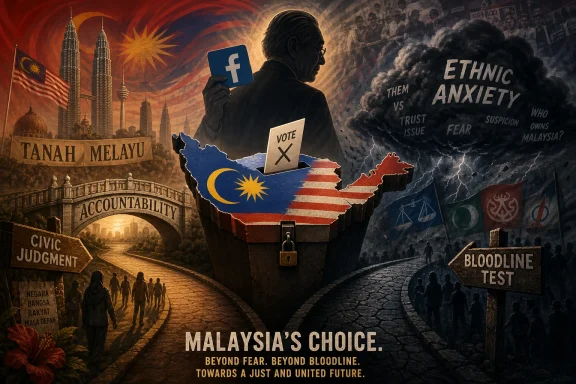 Mahathir Turns the Ballot Into a Bloodline Test
Mahathir’s message was simple enough to fit into a campaign slogan and old enough to feel familiar. If Malays want the country to remain “Tanah Melayu,” he said, they should vote for Malay candidates, not according to loyalty to parties or NGOs. It was a direct appeal to ethnic solidarity over institutional allegiance, ideological preference, coalition discipline, or candidate performance.That is why the statement landed with such force. It did not merely say Malays should defend their interests, which is a normal feature of democratic politics in any plural society. It said the decisive test at the ballot box should be the ethnicity of the candidate.
The difference matters. A democracy can absorb parties that advocate for particular communities; most democracies already do, in one form or another. What corrodes democratic culture is the idea that the voter’s first duty is to ancestry rather than judgment.
Mahathir’s intervention also came at a moment when Malaysian politics is already fragmented along lines of race, religion, region, and coalition arithmetic. As the South China Morning Post noted in its coverage of the Johor political context, Malay unity appeals are again being deployed in a crowded electoral marketplace where multiple parties claim to be the authentic defender of Malay-Muslim power. In that environment, Mahathir’s Facebook post was less an aberration than an escalation.
The old grammar of Malaysian politics is being rewritten for a more chaotic age. Once, communal politics operated through disciplined coalitions and elite bargains. Now it increasingly travels through viral posts, factional alliances, and open warnings that demographic fear should override every other consideration.
The Man Who Mastered Malaysia’s Communal Grammar Still Speaks Its Native Tongue
Mahathir did not invent race-based politics in Malaysia. The country’s founding bargain was built around communal representation, and its party system long reflected the same architecture. The Alliance model, later Barisan Nasional, institutionalised the idea that ethnic communities had political representatives who bargained on their behalf inside a larger coalition.But Mahathir mastered that system better than any other Malaysian politician. His long premiership from 1981 to 2003 fused Malay developmental nationalism, state-led modernisation, business patronage, institutional centralisation, and an unapologetic belief that politics must be organised around power before it can be organised around principle. He could speak the language of national progress while never losing sight of the ethnic anxieties that underpinned the ruling order.
That duality has always made Mahathir a more complicated figure than either his admirers or detractors prefer. He was the moderniser who pushed Malaysia toward industrialisation, infrastructure, and global ambition. He was also the communal strategist who understood that Malay political consolidation was the engine room of national power.
His later career sharpened the contradiction. In 2018, Mahathir returned to power at the head of Pakatan Harapan, a multiracial opposition coalition that defeated the Barisan Nasional machine he had once dominated. That victory was sold, at least in part, as a revolt against corruption, institutional decay, and one-party entitlement.
Yet Mahathir never fully became a post-communal democrat. His second premiership was haunted by the same old question: how far could reform go without unsettling Malay political primacy? The collapse of the Pakatan Harapan government in 2020 exposed the fragility of a coalition that tried to move beyond race without escaping race’s gravitational pull.
His latest appeal therefore feels less like a surprising turn than a return to first principles. When the system becomes unstable, Mahathir reaches for the oldest stabiliser he knows: Malay unity, defined not as shared citizenship or common prosperity, but as ethnic consolidation.
The Facebook Post Was a Campaign Message Without a Campaign
The most revealing part of Mahathir’s appeal is that it was not tied neatly to one party platform. He did not say Malays should vote for UMNO, Bersatu, PAS, Pejuang, or any specific coalition. He said they should vote for Malay candidates, regardless of party.That formulation is radical in its own way. It subordinates party identity to ethnic identity. It tells voters that institutions, manifestos, governance records, corruption allegations, service delivery, and policy competence are secondary filters.
For a politician who spent decades building and breaking parties, that is an extraordinary admission. It suggests that parties themselves are now too weak, too distrusted, or too fragmented to serve as vessels for the Malay political project Mahathir still imagines. If the party cannot guarantee unity, the candidate’s ethnicity becomes the fallback mechanism.
This is also why the statement is more than symbolism. In Malaysia’s first-past-the-post electoral system, fragmentation can produce unexpected winners. When Malay votes divide among multiple Malay-led parties, non-Malay-backed or multiracial coalition candidates can prevail even where Malay voters form a numerical majority. Mahathir’s appeal is an attempt to simplify that calculation by telling voters to ignore party labels and consolidate around race.
The trouble is that democracy is supposed to make politics more accountable, not merely more arithmetical. A candidate is not a census category. A member of parliament is not an ethnic placeholder. When voters are told to treat representation as bloodline insurance, the office itself is diminished.
Mahathir’s message also assumes that a Malay candidate will necessarily defend Malay interests better than a non-Malay candidate, or better than a multiracial coalition candidate bound by constitutional obligations and public scrutiny. Malaysian history offers little support for such confidence. Corruption, incompetence, arrogance, and policy failure have never been confined to one community.
Identity Can Mobilise Voters, but It Cannot Govern Floods, Prices, or Graft
The strongest argument against Mahathir’s appeal is not moral abstraction. It is administrative reality.Inflation does not ask whether a household is Malay, Chinese, Indian, Iban, Kadazan, or Orang Asli before raising grocery bills. Floodwaters do not stop at the doorway to inspect an identity card. A delayed hospital project, a broken procurement system, a weak currency, a struggling school, or a corrupt land deal damages citizens across communal lines.
Malaysia’s most urgent problems are stubbornly practical. They require competence, honesty, fiscal discipline, institutional capacity, and political courage. None of those qualities is guaranteed by ethnicity.
This is where race-based voting becomes not merely divisive but inefficient. It encourages voters to reward symbolic alignment even when performance is poor. It lets politicians treat identity as a substitute for delivery.
A Malay candidate can be principled or predatory. A Chinese candidate can be public-spirited or cynical. An Indian candidate can be reformist or mediocre. A native candidate from Sabah or Sarawak can defend local rights or trade them away for position. Race may shape lived experience, but it does not certify integrity.
That distinction is especially important in a country where corruption has repeatedly damaged public trust. Malaysians did not experience the 1MDB scandal, procurement controversies, patronage networks, or political defections as abstract governance failures. They experienced them as evidence that leaders often invoke the people while serving themselves.
When identity becomes the first test of political legitimacy, accountability becomes negotiable. The politician who wraps himself in communal language asks voters to treat criticism as betrayal. That is a dangerous bargain for any community, including the one he claims to defend.
The Constitution Already Recognises Malay Interests; Politics Keeps Failing Them
One reason Mahathir’s warning resonates is that it touches a real feature of Malaysian constitutional life. The Federal Constitution recognises the special position of Malays and the natives of Sabah and Sarawak while also protecting the legitimate interests of other communities. This is not a hidden arrangement or a temporary campaign promise. It is part of the constitutional settlement.That makes the political question sharper. If Malay rights already have constitutional recognition, why must every election be framed as an existential ethnic emergency?
The answer is partly that constitutional guarantees do not automatically produce good outcomes. Rural poverty, educational inequality, weak delivery systems, uneven development, and elite capture can persist even when a community is formally protected. But that is an argument for better governance, not narrower voting.
Mahathir’s appeal directs Malay frustration outward and downward: toward the risk of voting for the wrong kind of candidate. It spends less energy on the harder question of why decades of Malay-led governments, Malay-majority cabinets, Malay-controlled institutions, and Malay-first rhetoric have not solved the insecurities that keep being invoked.
That is the uncomfortable heart of the issue. If Malay voters remain anxious after generations of politicians promising to defend them, perhaps the failure is not insufficient ethnic loyalty among voters. Perhaps the failure lies with leaders who converted communal trust into political capital and then delivered too little.
The same is true for non-Malay Malaysians, who are often asked to show patience with a system that treats their citizenship as constitutionally real but politically conditional. A country cannot build durable national loyalty if every election reopens the question of who truly belongs.
The constitutional bargain requires stewardship. It does not require voters to suspend judgment whenever a candidate shares their ethnicity.
Fear Is a Powerful Campaign Tool Because It Contains a Grain of Truth
It would be too easy, and too lazy, to dismiss Mahathir’s appeal as mere bigotry or nostalgia. Fear works in politics because it attaches itself to something voters recognise.Many Malays worry about economic security, cultural continuity, language, religion, urban inequality, and the possibility that political fragmentation could weaken their bargaining power. Those fears are not invented from nothing. They are part of Malaysia’s social fabric, shaped by history, demography, class, geography, and decades of political messaging.
A serious democracy must be able to discuss those anxieties without ridicule. Telling voters that their fears are stupid rarely makes them less fearful. It merely drives them toward politicians who promise to take those fears seriously, even if those politicians exploit them.
But acknowledging fear is not the same as surrendering to it. Fear is a warning light, not a steering wheel. It can alert a society to genuine vulnerability, but it cannot design a fair tax system, improve schools, reform procurement, build flood defences, or create high-value jobs.
Mahathir’s genius has always been his ability to make Malay insecurity feel strategic rather than emotional. He frames unity not as prejudice but as survival. That is why his language still travels.
Yet survival politics has a cost. It narrows the moral imagination of voters. It tells citizens that the safest future is one in which they retreat deeper into communal camps, even as the problems they face demand cross-communal solutions.
The Multiethnic State Cannot Run on Permanent Suspicion
Malaysia’s pluralism is not a slogan; it is the operating system of the country. The economy, civil service, schools, towns, professions, supply chains, and electoral map all reflect a society too intertwined to be governed sensibly through ethnic suspicion alone.That does not mean Malaysia is ready for a naïve post-racial politics. It is not. Race and religion remain politically central, and any party pretending otherwise will quickly collide with electoral reality.
But there is a difference between recognising communal realities and weaponising them. A mature multiracial democracy can protect Malay interests, indigenous rights, minority citizenship, Islamic institutions, linguistic diversity, and regional autonomy without telling voters that the safest candidate is the one who shares their bloodline.
The real test is whether Malaysian politics can move from communal insurance to civic performance. Citizens should be able to ask what a candidate has done, what policies they support, whether they are clean, whether they are competent, whether they respect constitutional limits, and whether they can work across difference. Those questions do not erase identity. They put identity in its proper place.
Mahathir’s formula reverses that order. It begins with race and only later, if at all, asks about merit. That is not a democratic shortcut. It is a democratic downgrade.
The tragedy is that it also underestimates Malay voters. It assumes they need to be told to choose ethnicity over judgment, as though they cannot distinguish between a leader who serves them and a leader who merely resembles them.
The Johor Shadow Shows Why the Old Politics Still Has Buyers
The timing of Mahathir’s intervention matters because Malaysian politics is again entering a period where state contests, coalition manoeuvres, and general election positioning blur into one long campaign. Reports from outlets including the South China Morning Post have linked renewed Malay unity messaging to the Johor political battlefield, where coalition loyalties and ethnic calculations overlap.Johor is symbolically important because it has long been central to UMNO’s political mythology and to the broader story of Malay political organisation. When appeals to Malay unity intensify there, they are not merely local. They speak to the future of national coalition politics.
The old Barisan Nasional model disciplined communal representation through hierarchy. UMNO dominated, MCA and MIC negotiated, and voters understood the bargain even when they disliked it. That system has been weakened by scandal, generational change, urbanisation, opposition breakthroughs, and the rise of alternative Malay parties.
The result is not a clean transition to issue-based politics. It is a more fragmented communal marketplace. UMNO, PAS, Bersatu, smaller Malay-based parties, reformist coalitions, and regional actors all compete for slices of legitimacy.
In such a marketplace, Mahathir’s message is attractive because it cuts through complexity. Do not study coalitions. Do not weigh party histories. Do not ask who can govern. Vote Malay.
That simplicity is its danger. It offers clarity by removing the very distinctions that democratic voters are supposed to make.
Candidate Quality Is the Reform Malaysia Keeps Postponing
The most practical response to Mahathir is not to scold voters for caring about identity. It is to make candidate quality impossible to ignore.Malaysian parties have too often treated candidacy as a reward for loyalty, factional usefulness, patronage networks, or symbolic balance. Voters are then asked to choose among candidates whose primary qualification may be party placement rather than public service. In that environment, identity becomes an easy heuristic because parties have failed to supply better ones.
If parties want voters to move beyond race, they must offer candidates who make that move worthwhile. They must select people with clean records, local credibility, policy seriousness, and the courage to say no to communal baiting. They must also punish corruption and incompetence inside their own ranks rather than treating scandal as manageable when the numbers are convenient.
This is where the burden falls not only on voters but on political institutions. A voter facing weak candidates cannot be lectured into idealism. Parties that recycle compromised figures and then demand high-minded citizenship are asking the public to perform a virtue they themselves have abandoned.
Still, voters are not powerless. They can refuse the insult embedded in ethnic determinism. They can ask whether the candidate has served the constituency, whether they understand public finance, whether they will defend institutions, whether they will show up after floods, whether they can speak to all residents without treating some as guests.
Those questions are not anti-Malay, anti-Chinese, anti-Indian, anti-Islam, anti-indigenous, or anti-anyone. They are pro-government in the most basic sense. They ask whether the person seeking power is fit to wield it.
The Mahathir Paradox Is Now Malaysia’s Democratic Test
Mahathir’s career has always embodied a paradox. He helped build the modern Malaysian state, but he also normalised many of the habits that later constrained it. He spoke of excellence and discipline, yet presided over a political culture where loyalty often mattered more than institutional independence. He defeated the old ruling order in 2018, yet never fully escaped the worldview that sustained it.His latest appeal crystallises that paradox. A man who often urged Malays to become more competitive now asks them to make ethnicity the decisive electoral criterion. A leader who once returned to power through a multiracial coalition now warns Malays to vote as Malays first.
There is a weary circularity to it. Malaysia keeps being told it stands at an ethnic precipice, yet the leaders issuing the warning are often veterans of the very system that produced the anxiety. The fire alarm keeps ringing, but the arsonists are rarely named.
To be fair, Mahathir is no ordinary retiree tossing slogans into the void. At 100, he remains a symbol, a memory bank, a provocateur, and a political weather vane. When he speaks, he reveals what a certain generation of Malaysian power still believes.
That belief is that Malaysia can be managed through communal arithmetic indefinitely. The evidence suggests otherwise. Fragmentation, youth disillusionment, institutional mistrust, corruption fatigue, and economic pressure are all signs that voters increasingly want more than identity reassurance.
The Ballot Still Belongs to Citizens, Not Tribes
The immediate temptation is to ask whether Mahathir’s appeal will work. That is the wrong first question. The more important question is what kind of politics becomes normal when appeals like this are treated as ordinary campaign discourse.If voters accept that ethnicity is the highest democratic test, every party will adapt accordingly. Multiracial platforms will become more cautious. Minority candidates will be treated as liabilities in constituencies where they might otherwise serve well. Malay candidates themselves will be pressured to perform ethnic loyalty more loudly than administrative competence.
That is a bleak incentive structure. It rewards the loudest defender, not the best governor. It punishes nuance. It turns compromise into suspicion.
Malaysia has lived with communal politics for so long that many citizens have developed a grim realism about it. They know politicians invoke unity when they need votes and forget unity when contracts, appointments, and privileges are distributed. They know that ethnic rhetoric often protects elites more efficiently than ordinary people.
The ballot is one of the few instruments citizens have to disrupt that pattern. It is imperfect, blunt, and easily manipulated, but it still allows voters to say that performance matters. When Mahathir asks Malays to vote for Malay candidates regardless of party, he is asking them to narrow that instrument.
They should decline the offer. Not because Malay interests are illegitimate, but because Malay interests, like every community’s interests, are best served by capable, honest, accountable government.
Malaysia’s Next Vote Will Measure More Than Malay Unity
The practical lesson from Mahathir’s June 30 intervention is not that identity will vanish from Malaysian politics. It will not. The lesson is that voters and parties must decide whether identity is a starting point for representation or the endpoint of democratic judgment.- Mahathir’s appeal asked Malay voters to prioritise Malay candidates over party loyalty, turning ethnicity into the central electoral filter.
- The statement fits a longer pattern in Malaysian politics, where communal representation has often overshadowed candidate performance and institutional accountability.
- Malaysia’s constitutional framework already recognises Malay and indigenous interests, which means the harder challenge is governance quality rather than the absence of formal protection.
- Race-based voting cannot solve practical national problems such as corruption, inflation, weak public services, poor procurement, or disaster preparedness.
- Parties that want voters to move beyond ethnic calculation must nominate candidates whose integrity, competence, and local service make that choice credible.
- The danger of Mahathir’s message is not only that it divides Malaysians, but that it lowers the standard by which all candidates are judged.
References
- Primary source: Newswav
Published: 2026-07-06T00:50:12.224578
Loading…
newswav.com - Related coverage: therakyatpost.com
Loading…
www.therakyatpost.com - Related coverage: freemalaysiatoday.com
Loading…
www.freemalaysiatoday.com - Related coverage: nst.com.my
Loading…
www.nst.com.my - Related coverage: gutzy.asia
Loading…
gutzy.asia - Related coverage: thestar.com.my
Loading…
www.thestar.com.my
- Related coverage: scmp.com
Loading…
www.scmp.com