

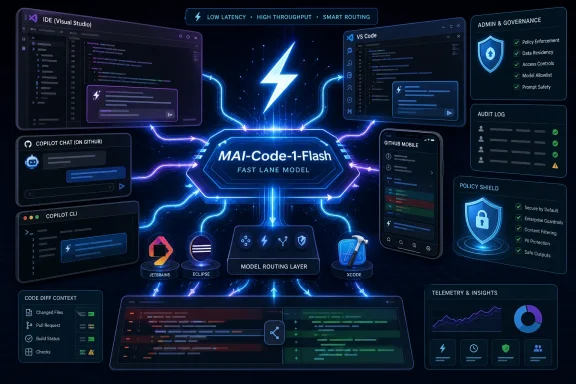
On June 18, 2026, GitHub said Microsoft’s MAI-Code-1-Flash coding model is expanding beyond its initial Copilot rollout to Copilot CLI, the GitHub Copilot app, Copilot Chat on GitHub, Visual Studio, GitHub Mobile, JetBrains IDEs, Eclipse, and Xcode. The announcement is small in word count but large in strategy. Microsoft is not merely adding another model to a picker; it is making a first-party coding model feel like native infrastructure across the developer estate.
That matters because Copilot is no longer a single assistant tucked into one editor. It is becoming a cross-surface development layer, spanning IDEs, terminals, mobile review flows, hosted GitHub experiences, and increasingly agentic workflows. MAI-Code-1-Flash is Microsoft’s argument that the model behind those interactions does not always need to be the biggest, most expensive, or most general-purpose system available. Sometimes the winning model is the one tuned tightly enough to be everywhere.
MAI-Code-1-Flash first appeared as a GitHub Copilot rollout earlier this month, beginning with Visual Studio Code availability. Two weeks later, GitHub is widening the aperture. The model is now listed for a much broader set of Copilot surfaces, including the command line, GitHub’s own web chat, Microsoft’s flagship IDE, mobile workflows, and third-party development environments.
That timing is the story. A cautious rollout in VS Code would have been easy to interpret as a limited experiment: useful, interesting, but still subordinate to the better-known frontier models that populate Copilot’s model picker. Expanding it across so many clients so quickly signals that Microsoft believes MAI-Code-1-Flash is good enough to become part of Copilot’s everyday machinery.
The word Flash is doing a lot of work here. Microsoft and GitHub are positioning this as a small, fast coding model rather than a maximum-reasoning monster designed to chew through architecture reviews for minutes at a time. The promise is responsiveness, acceptable quality, and fit-for-purpose behavior in common development tasks. That is a different bet from the industry’s more theatrical model race, where each launch tends to advertise larger context windows, deeper reasoning, and more expensive inference.
For WindowsForum readers, the important detail is not just that Visual Studio is on the list. It is that Visual Studio appears alongside JetBrains, Eclipse, Xcode, GitHub Mobile, and Copilot CLI. Microsoft is using GitHub Copilot as the distribution channel for a model that follows the developer, not the Windows desktop alone. That is a Microsoft platform play disguised as a GitHub changelog entry.
Those workloads reward speed and cost control. A model that is fast enough to stay in the developer’s flow can be more useful than a grander model that makes every interaction feel like a committee meeting. The friction is not just latency; it is cognitive. If invoking the assistant feels expensive, slow, or unpredictable, developers ration it.
MAI-Code-1-Flash is designed to attack that problem. GitHub describes it as purpose-built for Copilot and says it outperforms other small models in early testing. The phrase “for its size” is the qualifier that matters. Microsoft is not claiming this model replaces every high-reasoning option in the picker. It is claiming that a smaller model, tuned for GitHub Copilot’s actual workflows, can cover a large portion of daily coding assistance.
That is a subtle but important change in how model choice is being sold. The old pitch was “choose the smartest model.” The newer pitch is “choose the right model for the job.” In practice, most developers do not want to think about model selection every time they ask for a unit test or a shell command. They want the platform to make a sensible routing decision and stay out of the way.
This is where Microsoft’s control of the Copilot surface becomes powerful. A general model provider must serve many applications. Microsoft can train, tune, evaluate, and route a model around the specific interaction patterns of Copilot: code context, tool calls, editor state, repositories, pull requests, CLI tasks, and common developer prompts. That specialization may be less glamorous than a frontier benchmark, but it is the sort of boring advantage that compounds.
That platform logic explains why MAI-Code-1-Flash matters beyond its raw capability. If Copilot can route ordinary work to a fast first-party model, reserve heavier models for genuinely complex reasoning, and keep the user experience consistent across clients, Microsoft gains leverage on both quality and economics. The user sees a helpful answer. Microsoft sees lower inference cost and more control over performance.
This is particularly important now that Copilot’s model lineup includes offerings from multiple providers. GitHub’s documentation lists models from Microsoft, OpenAI, Anthropic, and Google, with model availability varying by plan, policy, surface, and release status. That breadth is useful, but it also creates complexity. Too much model choice can become another form of configuration fatigue.
Auto model selection is the obvious answer. If Copilot can decide when MAI-Code-1-Flash is sufficient and when a larger reasoning model is warranted, the user does not need to become a part-time model procurement specialist. The platform becomes valuable not because it exposes every option, but because it hides enough of the complexity to keep work moving.
There is a trade-off. Routing decisions can also obscure what is happening. Developers and administrators may want to know which model handled a prompt, what data policies applied, and whether behavior changed because a model checkpoint evolved. GitHub’s docs already describe MAI-Code-1-Flash as a continuously improving model whose performance and behavior may change over time. That is normal in AI products, but it is also precisely the sort of sentence that makes enterprise governance teams sit up straighter.
But the more strategically interesting surface may be Copilot CLI. Coding assistance in an IDE is powerful; coding assistance in the terminal is operationally dangerous and potentially transformative. The command line is where developers run migrations, manage branches, inspect failures, script deployments, and interact with infrastructure. A fast model that can help there without dragging the user into a browser or editor pane changes the rhythm of everyday work.
This is also where trust becomes less abstract. A bad suggestion in a code comment is annoying. A bad command in a shell can delete data, expose secrets, or break a build pipeline. Copilot CLI therefore needs more than model quality. It needs guardrails, previews, rollback patterns, clear user confirmation, and sane defaults.
MAI-Code-1-Flash’s expansion into the CLI should be read as a vote of confidence, not a guarantee of safety. A small model tuned for coding workflows may be excellent at fast edits and explanations, but terminal tasks require an additional layer of product design. The model is only one component in a system that must understand intent, environment, permissions, and blast radius.
For sysadmins and power users, this is where the Copilot story intersects with old-fashioned operational discipline. AI in the terminal should not be treated as magic. It should be treated like any other automation layer: useful, auditable, constrained, and reviewed before it touches production.
Individual plans are the natural proving ground for a model like this. They offer scale, feedback, and usage diversity without immediately forcing every large organization to update procurement, governance, and policy documentation. Enterprise customers need more than a model picker entry. They need admin controls, model availability policies, data handling clarity, auditability, and assurance that the model’s behavior will not change in ways that undermine compliance or secure development workflows.
This is especially relevant because GitHub’s model ecosystem is already heterogeneous. Organizations may restrict specific models. Some providers and models carry different data handling implications. Some features vary by client. Adding Microsoft’s own small model may simplify parts of the stack over time, but during rollout it adds another object for administrators to evaluate.
The “coming soon” language gives Microsoft room to stage that work. It also gives IT departments time to prepare the questions they should be asking. Is MAI-Code-1-Flash enabled by default when it arrives for Business and Enterprise? Can it be restricted separately from other models? How are prompts and outputs handled? What logs show model usage? Does auto selection route to it unless disabled? What happens when checkpoints are updated?
Those questions are not anti-AI obstructionism. They are the practical mechanics of deploying AI into professional software environments. Microsoft has spent years selling enterprise trust as a differentiator. Copilot’s model layer now has to earn that trust one model, policy, and audit event at a time.
But it would be equally wrong to understate the shift. MAI-Code-1-Flash is a Microsoft model, tuned for a Microsoft-owned developer platform, distributed through a Microsoft-owned subsidiary, and now expanding across Microsoft and non-Microsoft development surfaces. That is a meaningful step toward first-party control.
The model business rewards vertical integration. If Microsoft owns the cloud infrastructure, the developer platform, the product surface, the routing layer, and at least some of the models, it can optimize across the entire stack. It can decide when to use expensive third-party frontier capacity and when to serve a request with a cheaper in-house model. It can tune for product telemetry and developer behavior rather than abstract general-purpose chat performance.
That does not make third-party models irrelevant. Quite the opposite: Copilot’s value may increasingly come from being a managed marketplace and router for many models. But a strong Microsoft default changes the economics. The default model in a productivity tool often captures the bulk of mundane usage. Mundane usage is where the volume is.
This is why small models matter. The industry’s public imagination may be captured by the largest systems, but enterprise margins may be won by models that are “good enough” for millions of repetitive tasks. If MAI-Code-1-Flash can handle a significant share of Copilot interactions at lower cost and acceptable quality, Microsoft has made Copilot more scalable in the most literal sense.
GitHub’s own guidance around AI-generated code continues to emphasize human review, especially for security-sensitive work. That advice becomes more important, not less, as small models become embedded across more surfaces. If Copilot is present in the IDE, the browser, mobile, and CLI, it becomes easier for suggestions to move from casual prompt to committed change with fewer moments of reflection.
The right mental model is not “AI writes code for me.” It is “AI changes the cost of producing candidate code.” That distinction matters. Candidate code still needs tests, review, security analysis, and ownership. The developer remains accountable for what lands in the repository.
MAI-Code-1-Flash’s likely strength is everyday usefulness: completions, explanations, small functions, lightweight refactors, documentation, and quick fixes. Those are exactly the areas where developers may be tempted to accept output quickly. Teams should respond by tightening review habits around AI-assisted diffs rather than pretending that small changes are automatically safe.
For Windows admins and developers working in regulated or operational environments, this is not theoretical. A generated PowerShell snippet, a YAML change, a deployment script, or a cloud permissions tweak can carry more risk than a large block of application code. AI assistance lowers the barrier to creating those changes. It should also raise the expectation that teams inspect them carefully.
That can be useful. A mobile reviewer may ask for a summary of a pull request before deciding whether it needs deeper inspection at a workstation. A maintainer may use Copilot Chat on GitHub to understand an issue thread or draft a response. A developer in JetBrains may expect the same model options as a colleague in Visual Studio Code. Consistency lowers friction across teams that do not share a single toolchain.
But this also blurs the boundary between writing code and talking about code. AI-generated explanations can shape how reviewers understand a change. AI-generated summaries can influence which risks are noticed. AI-generated comments can make a discussion feel resolved before anyone has examined the underlying implementation.
The productivity upside is real, but so is the risk of automation-shaped consensus. When the assistant is available everywhere, it can become the first narrator of a codebase. Teams need to remember that narration is not verification. A confident summary is still just a summary.
This is where Microsoft’s model-tuning story becomes both promising and delicate. A model tuned specifically for Copilot may be better at repository-aware assistance and multi-turn development workflows. It may also become more influential because it is woven into the places where developers make decisions. The more native it feels, the more important its failure modes become.
MAI-Code-1-Flash complicates and potentially improves that picture. As a Microsoft model designed for Copilot, it may eventually be easier for Microsoft to document, govern, and support inside enterprise agreements than a sprawling set of third-party options. That could make it attractive to organizations that want Copilot but prefer tighter vendor accountability.
At the same time, “Microsoft model” does not automatically answer every question. Administrators still need clarity on data residency, retention, training use, logging, incident response, model updates, and compatibility with internal policy. They also need to know whether users can override defaults or whether auto selection may choose models that an organization has not explicitly approved.
The interesting future is not one where every developer manually chooses among a dozen models. It is one where enterprises define policy boundaries and Copilot routes intelligently within them. In that world, MAI-Code-1-Flash could become the safe, fast default for ordinary tasks, while larger models are reserved for heavier work and charged accordingly.
That vision is attractive because it maps to how IT already thinks. Not every workload gets the most expensive compute tier. Not every user gets the same privileges. Not every automation gets access to production. AI model selection is starting to look less like a novelty feature and more like resource governance.
That does not mean users will automatically see lower bills. Platform providers often convert efficiency gains into margin, broader access, or new features rather than direct price cuts. But efficiency still matters to users because it affects availability, responsiveness, and the willingness of a provider to include a model in lower-cost plans.
The fact that MAI-Code-1-Flash is available across Copilot Free, Student, Pro, Pro+, and Max plans is therefore notable. GitHub is not reserving the model only for the highest tiers. Instead, it is placing the small model in the broad user base where speed and cost efficiency are most valuable.
There is also a competitive angle. Developer AI tools increasingly compete not just on raw intelligence but on how often users can afford to invoke them. If a tool feels metered too aggressively, developers change behavior. They save prompts for “important” tasks and go back to search, snippets, and manual work for everything else. A capable small model can make AI feel abundant again.
This is the same pattern cloud computing went through years ago. The premium instance types got attention, but the default instance types carried the workloads. MAI-Code-1-Flash wants to be that default instance for coding assistance: not the biggest machine in the fleet, but the one that runs constantly.
Ambient tools succeed when users stop thinking about them. Spell checkers, autocomplete, search indexing, syntax highlighting, package restore, and background diagnostics all became part of the development environment because they were always there and usually useful. Microsoft wants Copilot to occupy that category.
MAI-Code-1-Flash helps because ambient tools cannot feel heavy. A slow assistant is a destination; a fast assistant is a reflex. If the model responds quickly enough, developers ask smaller questions more often. That changes the workflow more profoundly than occasional spectacular demos.
The Windows angle is broader than Visual Studio. Microsoft is building an AI layer across Windows, Azure, GitHub, Microsoft 365, and developer tooling. Copilot’s coding model strategy sits inside that larger effort. A first-party model that is optimized for Microsoft’s own stack can be reused, adapted, or at least conceptually aligned with adjacent products over time.
Still, developer trust is harder to win than consumer convenience. Programmers are unusually good at detecting when a tool is wasting their time. They will tolerate experimental features if they are useful, but they will not tolerate a model that confidently breaks builds or pollutes reviews. MAI-Code-1-Flash’s real test is not whether it appears in the picker. It is whether developers leave it selected.
That restraint is understandable, but it creates ambiguity. “Best-in-class quality for its size” is a marketing claim until users and independent testers can compare behavior across real workloads. “Early testing” is useful but not definitive. “Gradually over the coming weeks” is practical rollout language, but it means many users will look for the model and not find it immediately.
There is also a documentation wrinkle. GitHub’s supported-models documentation may lag or conflict with rollout language during rapid launches. That is not unusual in fast-moving product ecosystems, but it is exactly why administrators should treat changelog posts, docs pages, and in-product availability as three related but distinct signals.
The absence of enterprise availability at launch also means the most security-conscious customers are still waiting for the part of the story that matters most to them. Individual developers can experiment now. Organizations need policy-ready deployment.
Microsoft has every incentive to close those gaps quickly. The company does not want MAI-Code-1-Flash to be seen as a curiosity for hobbyists and Pro subscribers. It wants the model to become a trusted part of Copilot’s core experience. That requires more than availability. It requires transparency, controls, and repeatable performance.
That comparison should be practical, not ideological. Ask the same prompt of two models. Look at the diff. Run the tests. Check whether the answer is concise or merely shallow. Notice whether the model follows project conventions. The best model is the one that improves your actual workflow, not the one with the most impressive launch narrative.
Teams should also start discussing how model choice appears in code review. If AI-generated code becomes more common, reviewers may need lightweight conventions for describing when Copilot assisted a change, especially in sensitive repositories. This does not need to become theater. It does need to preserve accountability.
For administrators, the watch item is enterprise rollout. The moment MAI-Code-1-Flash becomes available to Copilot Business and Enterprise, it should be evaluated like any other model introduction. That means checking default settings, policy controls, audit events, documentation, and user education. The right time to decide model policy is before a thousand developers discover a new option in their tools.
That matters because Copilot is no longer a single assistant tucked into one editor. It is becoming a cross-surface development layer, spanning IDEs, terminals, mobile review flows, hosted GitHub experiences, and increasingly agentic workflows. MAI-Code-1-Flash is Microsoft’s argument that the model behind those interactions does not always need to be the biggest, most expensive, or most general-purpose system available. Sometimes the winning model is the one tuned tightly enough to be everywhere.
 Microsoft Moves Its Own Model From Option to Default Infrastructure
MAI-Code-1-Flash first appeared as a GitHub Copilot rollout earlier this month, beginning with Visual Studio Code availability. Two weeks later, GitHub is widening the aperture. The model is now listed for a much broader set of Copilot surfaces, including the command line, GitHub’s own web chat, Microsoft’s flagship IDE, mobile workflows, and third-party development environments.That timing is the story. A cautious rollout in VS Code would have been easy to interpret as a limited experiment: useful, interesting, but still subordinate to the better-known frontier models that populate Copilot’s model picker. Expanding it across so many clients so quickly signals that Microsoft believes MAI-Code-1-Flash is good enough to become part of Copilot’s everyday machinery.
The word Flash is doing a lot of work here. Microsoft and GitHub are positioning this as a small, fast coding model rather than a maximum-reasoning monster designed to chew through architecture reviews for minutes at a time. The promise is responsiveness, acceptable quality, and fit-for-purpose behavior in common development tasks. That is a different bet from the industry’s more theatrical model race, where each launch tends to advertise larger context windows, deeper reasoning, and more expensive inference.
For WindowsForum readers, the important detail is not just that Visual Studio is on the list. It is that Visual Studio appears alongside JetBrains, Eclipse, Xcode, GitHub Mobile, and Copilot CLI. Microsoft is using GitHub Copilot as the distribution channel for a model that follows the developer, not the Windows desktop alone. That is a Microsoft platform play disguised as a GitHub changelog entry.
The Small Model Is the Strategic Model
The AI industry has spent years training users to equate capability with scale. Larger models get the launch events, the benchmark charts, and the breathless comparisons. But coding assistants are not used only for heroic feats of reasoning. They are also used to rename functions, explain compiler errors, draft tests, complete boilerplate, summarize diffs, and answer the same syntax question for the tenth time.Those workloads reward speed and cost control. A model that is fast enough to stay in the developer’s flow can be more useful than a grander model that makes every interaction feel like a committee meeting. The friction is not just latency; it is cognitive. If invoking the assistant feels expensive, slow, or unpredictable, developers ration it.
MAI-Code-1-Flash is designed to attack that problem. GitHub describes it as purpose-built for Copilot and says it outperforms other small models in early testing. The phrase “for its size” is the qualifier that matters. Microsoft is not claiming this model replaces every high-reasoning option in the picker. It is claiming that a smaller model, tuned for GitHub Copilot’s actual workflows, can cover a large portion of daily coding assistance.
That is a subtle but important change in how model choice is being sold. The old pitch was “choose the smartest model.” The newer pitch is “choose the right model for the job.” In practice, most developers do not want to think about model selection every time they ask for a unit test or a shell command. They want the platform to make a sensible routing decision and stay out of the way.
This is where Microsoft’s control of the Copilot surface becomes powerful. A general model provider must serve many applications. Microsoft can train, tune, evaluate, and route a model around the specific interaction patterns of Copilot: code context, tool calls, editor state, repositories, pull requests, CLI tasks, and common developer prompts. That specialization may be less glamorous than a frontier benchmark, but it is the sort of boring advantage that compounds.
Copilot Is Becoming the Model Router Developers Actually Use
The expanded surface list shows how much Copilot has changed since its earliest incarnation as an autocomplete assistant in VS Code. GitHub Copilot now lives in chat panes, code review workflows, mobile interfaces, terminals, and agent-style task systems. The model picker is increasingly less like a menu of chatbots and more like a routing layer inside a development platform.That platform logic explains why MAI-Code-1-Flash matters beyond its raw capability. If Copilot can route ordinary work to a fast first-party model, reserve heavier models for genuinely complex reasoning, and keep the user experience consistent across clients, Microsoft gains leverage on both quality and economics. The user sees a helpful answer. Microsoft sees lower inference cost and more control over performance.
This is particularly important now that Copilot’s model lineup includes offerings from multiple providers. GitHub’s documentation lists models from Microsoft, OpenAI, Anthropic, and Google, with model availability varying by plan, policy, surface, and release status. That breadth is useful, but it also creates complexity. Too much model choice can become another form of configuration fatigue.
Auto model selection is the obvious answer. If Copilot can decide when MAI-Code-1-Flash is sufficient and when a larger reasoning model is warranted, the user does not need to become a part-time model procurement specialist. The platform becomes valuable not because it exposes every option, but because it hides enough of the complexity to keep work moving.
There is a trade-off. Routing decisions can also obscure what is happening. Developers and administrators may want to know which model handled a prompt, what data policies applied, and whether behavior changed because a model checkpoint evolved. GitHub’s docs already describe MAI-Code-1-Flash as a continuously improving model whose performance and behavior may change over time. That is normal in AI products, but it is also precisely the sort of sentence that makes enterprise governance teams sit up straighter.
Visual Studio Gets the Signal, But the CLI Gets the Leverage
Visual Studio’s inclusion is symbolically important for Microsoft’s traditional developer base. For .NET shops, Windows desktop developers, and enterprise teams that still live in full Visual Studio rather than VS Code, Copilot model availability is part of whether AI tooling feels first-class or bolted on. Bringing MAI-Code-1-Flash into Visual Studio tells those users they are not being left behind in the Copilot model rollout.But the more strategically interesting surface may be Copilot CLI. Coding assistance in an IDE is powerful; coding assistance in the terminal is operationally dangerous and potentially transformative. The command line is where developers run migrations, manage branches, inspect failures, script deployments, and interact with infrastructure. A fast model that can help there without dragging the user into a browser or editor pane changes the rhythm of everyday work.
This is also where trust becomes less abstract. A bad suggestion in a code comment is annoying. A bad command in a shell can delete data, expose secrets, or break a build pipeline. Copilot CLI therefore needs more than model quality. It needs guardrails, previews, rollback patterns, clear user confirmation, and sane defaults.
MAI-Code-1-Flash’s expansion into the CLI should be read as a vote of confidence, not a guarantee of safety. A small model tuned for coding workflows may be excellent at fast edits and explanations, but terminal tasks require an additional layer of product design. The model is only one component in a system that must understand intent, environment, permissions, and blast radius.
For sysadmins and power users, this is where the Copilot story intersects with old-fashioned operational discipline. AI in the terminal should not be treated as magic. It should be treated like any other automation layer: useful, auditable, constrained, and reviewed before it touches production.
The Enterprise Delay Is the Most Honest Part of the Announcement
GitHub says MAI-Code-1-Flash is available for Copilot Free, Student, Pro, Pro+, and Max plans, with availability starting for a limited set of users and expanding gradually over the coming weeks. Access for Copilot Business and Enterprise is coming soon. That sequencing is not incidental.Individual plans are the natural proving ground for a model like this. They offer scale, feedback, and usage diversity without immediately forcing every large organization to update procurement, governance, and policy documentation. Enterprise customers need more than a model picker entry. They need admin controls, model availability policies, data handling clarity, auditability, and assurance that the model’s behavior will not change in ways that undermine compliance or secure development workflows.
This is especially relevant because GitHub’s model ecosystem is already heterogeneous. Organizations may restrict specific models. Some providers and models carry different data handling implications. Some features vary by client. Adding Microsoft’s own small model may simplify parts of the stack over time, but during rollout it adds another object for administrators to evaluate.
The “coming soon” language gives Microsoft room to stage that work. It also gives IT departments time to prepare the questions they should be asking. Is MAI-Code-1-Flash enabled by default when it arrives for Business and Enterprise? Can it be restricted separately from other models? How are prompts and outputs handled? What logs show model usage? Does auto selection route to it unless disabled? What happens when checkpoints are updated?
Those questions are not anti-AI obstructionism. They are the practical mechanics of deploying AI into professional software environments. Microsoft has spent years selling enterprise trust as a differentiator. Copilot’s model layer now has to earn that trust one model, policy, and audit event at a time.
Microsoft’s OpenAI Dependency Is Becoming Less Simple
It would be easy to overstate this launch as Microsoft breaking away from OpenAI. That is not what the public evidence supports. Copilot continues to offer a broad model catalog, and OpenAI models remain part of that picture. Microsoft’s partnership with OpenAI is still one of the defining relationships in enterprise AI.But it would be equally wrong to understate the shift. MAI-Code-1-Flash is a Microsoft model, tuned for a Microsoft-owned developer platform, distributed through a Microsoft-owned subsidiary, and now expanding across Microsoft and non-Microsoft development surfaces. That is a meaningful step toward first-party control.
The model business rewards vertical integration. If Microsoft owns the cloud infrastructure, the developer platform, the product surface, the routing layer, and at least some of the models, it can optimize across the entire stack. It can decide when to use expensive third-party frontier capacity and when to serve a request with a cheaper in-house model. It can tune for product telemetry and developer behavior rather than abstract general-purpose chat performance.
That does not make third-party models irrelevant. Quite the opposite: Copilot’s value may increasingly come from being a managed marketplace and router for many models. But a strong Microsoft default changes the economics. The default model in a productivity tool often captures the bulk of mundane usage. Mundane usage is where the volume is.
This is why small models matter. The industry’s public imagination may be captured by the largest systems, but enterprise margins may be won by models that are “good enough” for millions of repetitive tasks. If MAI-Code-1-Flash can handle a significant share of Copilot interactions at lower cost and acceptable quality, Microsoft has made Copilot more scalable in the most literal sense.
A Faster Copilot Also Raises the Bar for Review
Developers often talk about AI coding tools in terms of productivity, but speed has a darker side. The faster an assistant produces plausible code, the faster bad assumptions can enter a codebase. The model does not need to be malicious or incompetent to create risk. It only needs to be convincing at the wrong moment.GitHub’s own guidance around AI-generated code continues to emphasize human review, especially for security-sensitive work. That advice becomes more important, not less, as small models become embedded across more surfaces. If Copilot is present in the IDE, the browser, mobile, and CLI, it becomes easier for suggestions to move from casual prompt to committed change with fewer moments of reflection.
The right mental model is not “AI writes code for me.” It is “AI changes the cost of producing candidate code.” That distinction matters. Candidate code still needs tests, review, security analysis, and ownership. The developer remains accountable for what lands in the repository.
MAI-Code-1-Flash’s likely strength is everyday usefulness: completions, explanations, small functions, lightweight refactors, documentation, and quick fixes. Those are exactly the areas where developers may be tempted to accept output quickly. Teams should respond by tightening review habits around AI-assisted diffs rather than pretending that small changes are automatically safe.
For Windows admins and developers working in regulated or operational environments, this is not theoretical. A generated PowerShell snippet, a YAML change, a deployment script, or a cloud permissions tweak can carry more risk than a large block of application code. AI assistance lowers the barrier to creating those changes. It should also raise the expectation that teams inspect them carefully.
The Surface Expansion Is Also a Culture Change
Copilot’s spread across GitHub Mobile and the GitHub Copilot app matters because it pulls AI assistance out of the traditional coding session. Developers increasingly review, triage, plan, and discuss code away from the main editor. If the same model family is available in those contexts, AI becomes part of the social and managerial layer of software development.That can be useful. A mobile reviewer may ask for a summary of a pull request before deciding whether it needs deeper inspection at a workstation. A maintainer may use Copilot Chat on GitHub to understand an issue thread or draft a response. A developer in JetBrains may expect the same model options as a colleague in Visual Studio Code. Consistency lowers friction across teams that do not share a single toolchain.
But this also blurs the boundary between writing code and talking about code. AI-generated explanations can shape how reviewers understand a change. AI-generated summaries can influence which risks are noticed. AI-generated comments can make a discussion feel resolved before anyone has examined the underlying implementation.
The productivity upside is real, but so is the risk of automation-shaped consensus. When the assistant is available everywhere, it can become the first narrator of a codebase. Teams need to remember that narration is not verification. A confident summary is still just a summary.
This is where Microsoft’s model-tuning story becomes both promising and delicate. A model tuned specifically for Copilot may be better at repository-aware assistance and multi-turn development workflows. It may also become more influential because it is woven into the places where developers make decisions. The more native it feels, the more important its failure modes become.
The Model Picker Is Becoming a Governance Boundary
For individual developers, a model picker is a convenience. For organizations, it is a policy surface. Which models are available, which are default, which can be used with enterprise data, and which are eligible for auto selection are all governance decisions masquerading as product settings.MAI-Code-1-Flash complicates and potentially improves that picture. As a Microsoft model designed for Copilot, it may eventually be easier for Microsoft to document, govern, and support inside enterprise agreements than a sprawling set of third-party options. That could make it attractive to organizations that want Copilot but prefer tighter vendor accountability.
At the same time, “Microsoft model” does not automatically answer every question. Administrators still need clarity on data residency, retention, training use, logging, incident response, model updates, and compatibility with internal policy. They also need to know whether users can override defaults or whether auto selection may choose models that an organization has not explicitly approved.
The interesting future is not one where every developer manually chooses among a dozen models. It is one where enterprises define policy boundaries and Copilot routes intelligently within them. In that world, MAI-Code-1-Flash could become the safe, fast default for ordinary tasks, while larger models are reserved for heavier work and charged accordingly.
That vision is attractive because it maps to how IT already thinks. Not every workload gets the most expensive compute tier. Not every user gets the same privileges. Not every automation gets access to production. AI model selection is starting to look less like a novelty feature and more like resource governance.
The Quiet Win Is Cost Discipline
GitHub’s brief announcement does not dwell on pricing mechanics, but cost is impossible to separate from small-model strategy. AI coding assistance at Copilot scale is expensive to run. Every chat, completion, explanation, and agentic step consumes compute somewhere. If Microsoft can satisfy common requests with a smaller model, the economics of Copilot improve.That does not mean users will automatically see lower bills. Platform providers often convert efficiency gains into margin, broader access, or new features rather than direct price cuts. But efficiency still matters to users because it affects availability, responsiveness, and the willingness of a provider to include a model in lower-cost plans.
The fact that MAI-Code-1-Flash is available across Copilot Free, Student, Pro, Pro+, and Max plans is therefore notable. GitHub is not reserving the model only for the highest tiers. Instead, it is placing the small model in the broad user base where speed and cost efficiency are most valuable.
There is also a competitive angle. Developer AI tools increasingly compete not just on raw intelligence but on how often users can afford to invoke them. If a tool feels metered too aggressively, developers change behavior. They save prompts for “important” tasks and go back to search, snippets, and manual work for everything else. A capable small model can make AI feel abundant again.
This is the same pattern cloud computing went through years ago. The premium instance types got attention, but the default instance types carried the workloads. MAI-Code-1-Flash wants to be that default instance for coding assistance: not the biggest machine in the fleet, but the one that runs constantly.
Microsoft Is Training Developers to Expect AI Everywhere
The Copilot surface expansion also serves a behavioral purpose. Once developers can invoke the same assistant from their editor, terminal, browser, phone, and review workflow, AI stops being a special tool and becomes ambient infrastructure. That is the product goal.Ambient tools succeed when users stop thinking about them. Spell checkers, autocomplete, search indexing, syntax highlighting, package restore, and background diagnostics all became part of the development environment because they were always there and usually useful. Microsoft wants Copilot to occupy that category.
MAI-Code-1-Flash helps because ambient tools cannot feel heavy. A slow assistant is a destination; a fast assistant is a reflex. If the model responds quickly enough, developers ask smaller questions more often. That changes the workflow more profoundly than occasional spectacular demos.
The Windows angle is broader than Visual Studio. Microsoft is building an AI layer across Windows, Azure, GitHub, Microsoft 365, and developer tooling. Copilot’s coding model strategy sits inside that larger effort. A first-party model that is optimized for Microsoft’s own stack can be reused, adapted, or at least conceptually aligned with adjacent products over time.
Still, developer trust is harder to win than consumer convenience. Programmers are unusually good at detecting when a tool is wasting their time. They will tolerate experimental features if they are useful, but they will not tolerate a model that confidently breaks builds or pollutes reviews. MAI-Code-1-Flash’s real test is not whether it appears in the picker. It is whether developers leave it selected.
The Announcement Leaves Important Gaps on Purpose
GitHub’s changelog entry is concise, which is normal for a rollout notice. It tells users where the model is available, which plans are included, and that Business and Enterprise access is coming. It does not provide detailed benchmark methodology, architectural disclosures, cost comparisons, or a full enterprise governance matrix.That restraint is understandable, but it creates ambiguity. “Best-in-class quality for its size” is a marketing claim until users and independent testers can compare behavior across real workloads. “Early testing” is useful but not definitive. “Gradually over the coming weeks” is practical rollout language, but it means many users will look for the model and not find it immediately.
There is also a documentation wrinkle. GitHub’s supported-models documentation may lag or conflict with rollout language during rapid launches. That is not unusual in fast-moving product ecosystems, but it is exactly why administrators should treat changelog posts, docs pages, and in-product availability as three related but distinct signals.
The absence of enterprise availability at launch also means the most security-conscious customers are still waiting for the part of the story that matters most to them. Individual developers can experiment now. Organizations need policy-ready deployment.
Microsoft has every incentive to close those gaps quickly. The company does not want MAI-Code-1-Flash to be seen as a curiosity for hobbyists and Pro subscribers. It wants the model to become a trusted part of Copilot’s core experience. That requires more than availability. It requires transparency, controls, and repeatable performance.
The Practical Read for Developers Who See the New Model Picker
The immediate advice is simple: try MAI-Code-1-Flash where it appears, but use it for the jobs it is designed to do. It is likely to be most valuable for quick coding tasks, explanations, small edits, documentation, and interactive back-and-forth. For deep refactoring, architectural planning, security-sensitive changes, or multi-file reasoning, compare it against stronger reasoning models rather than assuming one model should do everything.That comparison should be practical, not ideological. Ask the same prompt of two models. Look at the diff. Run the tests. Check whether the answer is concise or merely shallow. Notice whether the model follows project conventions. The best model is the one that improves your actual workflow, not the one with the most impressive launch narrative.
Teams should also start discussing how model choice appears in code review. If AI-generated code becomes more common, reviewers may need lightweight conventions for describing when Copilot assisted a change, especially in sensitive repositories. This does not need to become theater. It does need to preserve accountability.
For administrators, the watch item is enterprise rollout. The moment MAI-Code-1-Flash becomes available to Copilot Business and Enterprise, it should be evaluated like any other model introduction. That means checking default settings, policy controls, audit events, documentation, and user education. The right time to decide model policy is before a thousand developers discover a new option in their tools.
The Copilot Map Now Has a Microsoft Shortcut
GitHub’s expansion of MAI-Code-1-Flash is not a revolution by itself, but it is a clear marker of where the Copilot platform is going. The model layer is becoming more specialized, more Microsoft-controlled, and more deeply embedded in everyday development surfaces.- MAI-Code-1-Flash is now rolling out across major Copilot clients, including IDEs, GitHub web experiences, mobile, and Copilot CLI.
- The model is aimed at fast, everyday coding assistance rather than replacing every deep-reasoning model in Copilot’s catalog.
- Individual Copilot plans get the rollout first, while Business and Enterprise access remains on the near-term roadmap.
- The strategic value for Microsoft is not just model quality, but lower-cost routing, tighter product integration, and more control over Copilot’s default experience.
- Developers should treat the model as a useful fast lane for common work while continuing to review generated code with the same rigor they apply to human-written changes.
- Administrators should watch for policy controls, auditability, and default model behavior when enterprise availability arrives.
References
- Primary source: The GitHub Blog
Published: Thu, 18 Jun 2026 20:11:24 GMT
MAI-Code-1-Flash available on more Copilot surfaces - GitHub Changelog
MAI‑Code‑1‑Flash, Microsoft’s purpose‑built small coding model, is now available across additional GitHub Copilot surfaces. MAI‑Code‑1‑Flash can now be used in: Copilot CLI Copilot cloud agent GitHub Copilot app Copilot Chat…github.blog
- Official source: microsoft.ai
Introducing MAI-Code-1-Flash | Microsoft AI
 microsoft.ai
- Related coverage: aib.vote
Microsoft Announces MAI-Thinking-1 and MAI-Code-1-Flash Models | aib vote
Microsoft released two new text-focused large language models (LLMs) on June 2, 2026, aimed at distinct reasoning and coding applications. The first model, MAI-www.aib.vote - Official source: docs.github.com
Supported AI models in GitHub Copilot - GitHub Docs
Learn about the supported AI models in GitHub Copilot. docs.github.com
- Related coverage: enterprisedna.co
Microsoft Launches MAI-Code-1-Flash at Build 2026 — Enterprise DNA
MAI-Code-1-Flash is Microsoft's first coding model built entirely without OpenAI: 5B params, 60% fewer tokens, rolling out now in GitHub Copilot.enterprisedna.co - Related coverage: decodethefuture.org
Microsoft MAI-Code-1-Flash: Copilot's New Coding Model
Microsoft's MAI-Code-1-Flash is its first in-house coding model for GitHub Copilot: 137B MoE, 256K context, $0.75/$4.50 per 1M tokens. What it means. decodethefuture.org
- Official source: developer.microsoft.com
Microsoft Build 2026 recap: vision, launches, and top sessions - Microsoft for Developers
Catch up on Microsoft Build 2026 with the vision lead-off, top developer announcements, and must-watch sessions across the Microsoft developer ecosystem.developer.microsoft.com - Related coverage: awesomeagents.ai
MAI-Code-1-Flash | Awesome Agents
Microsoft's first in-house coding model, a 137B sparse MoE built natively for GitHub Copilot, beating Claude Haiku 4.5 on SWE-Bench Pro by 16 points.awesomeagents.ai - Related coverage: aidose.in
Microsoft Launches MAI-Code-1-Flash Coding Model Across GitHub Copilot Plans
Microsoft rolled out MAI-Code-1-Flash, its first in-house coding model, to every GitHub Copilot plan. The model outperforms Claude Haiku 4.5 across core coding benchmarks and solves harder problems with up to 60 percent fewer tokens.www.aidose.in - Related coverage: smartscope.blog
Microsoft MAI-Code-1-Flash in GitHub Copilot: Availability, Pricing, and Performance - SmartScope
MAI-Code-1-Flash is now rolling out in GitHub Copilot. This guide explains plan availability, VS Code rollout, AI Credits pricing, benchmark positioning, and how to use the model responsibly. smartscope.blog
- Related coverage: techradar.com
From code-first to intent-first: Microsoft Build 2026 could be the end of programming as we know it | TechRadar
Redefining what it means to be a developer with agentic AIwww.techradar.com - Related coverage: windowscentral.com
Microsoft cancels Claude Code licenses, shifting developers to GitHub Copilot CLI — a move likely driven by financial motives | Windows Central
Claude Code was popular among Microsoft engineers, but the company now wants them to shift to GitHub Copilot CLI.www.windowscentral.com - Related coverage: labs.cloudsecurityalliance.org
CSA research note vscode github token theft zero day 20260604 csa styled
PDF documentlabs.cloudsecurityalliance.org
