

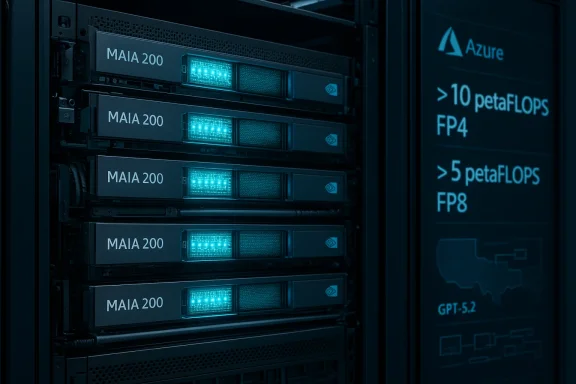
Microsoft’s Maia 200 lands as a sharp, strategic pivot: a purpose-built inference ASIC that promises to cut the cost of running generative AI at scale while reshaping how hyperscalers balance silicon, software and data-center systems. Announced on January 26, 2026, Microsoft describes Maia 200 as its most efficient inference system to date — an accelerator fabricated on TSMC’s 3-nanometer node, packing more than 140 billion transistors, 216 GB of HBM3e and specialized FP4/FP8 tensor pipelines — and already running in Azure’s US Central region to serve workloads such as OpenAI’s GPT-5.2 and Microsoft 365 Copilot. (blogs.microsoft.com)
Training once dominated the conversation about compute demands: it’s the bursty, resource-hungry phase where models are built. But in production, inference — every single user request or token generation — is the steady drumbeat that determines operating expense, energy use and scaling constraints for services that run millions or billions of queries per day. Optimizing inference directly reduces the per-query cost of deployed AI services and enables more features (longer context windows, added verification passes, multimodal pipelines) without linear increases in data-center power and spend. Microsoft’s Maia program explicitly targets that economics: lower tokens-per-dollar and tokens-per-joule for Azure-hosted models. (blogs.microsoft.com)
The industry pivot toward first-party silicon isn’t unique to Microsoft. Google has doubled down on TPU generations optimized for inference and tightly integrated with its software stack, while AWS has pushed its Trainium family for lower-cost training and serving. OpenAI, Meta and other big builders are also investing in or partnering for custom chips to manage the bottleneck of compute costs and supply. Maia 200’s launch is therefore less a solitary product release than a signpost of where hyperscaler strategy is headed: controlling chip design, software, networking and deployment as a unified stack.
Microsoft also outlines a dedicated DMA engine, a specialized NoC (network-on-chip) and a memory subsystem tuned to narrow-precision datatypes to sustain token throughput. The company pairs the hardware with a Maia SDK that includes PyTorch integration, a Triton compiler, a low-level programming language (NPL) and a simulator for early optimization. (blogs.microsoft.com)
These claims were echoed across press outlets and industry analysts immediately after the announcement, and Microsoft’s own numbers support the comparisons: its peak FP4 and FP8 teraflop figures exceed the published FP8 capacity of Trainium3 and the performance descriptions of Google’s Ironwood (TPU v7 family). That said, Microsoft’s benchmarks are expressed in peak FP4/FP8 FLOPS and system-level token economics rather than the kind of independent workload benchmarks that typically settle comparative debates.
For customers — particularly enterprises consuming Copilot features or Azure-hosted LLM endpoints — Maia’s promise is lower marginal cost per token and the ability to enable more expensive inference-side functionality (extra retrieval, reranking, fact checks) without proportional cost hikes.
But the narrative is only beginning. Independent benchmarks, broad SDK maturation, global supply availability and the real operational experience of Azure customers will determine whether Maia becomes a watershed moment or a strong but bounded increment in a heterogeneous AI infrastructure era. For now, Microsoft has signaled a clear intent: inference is strategic, and controlling the silicon-software stack is the next battle line in cloud AI economics. Watch for third-party workload results, customer migration stories, and how Microsoft prices Maia-backed services in market as the next, practical tests of the company’s claims. (blogs.microsoft.com)
What to monitor next (short checklist):
Source: observer.com Microsoft’s Maia Chip Targets A.I. Inference as Big Tech Rethinks Training
 Background: why inference chips matter now
Training once dominated the conversation about compute demands: it’s the bursty, resource-hungry phase where models are built. But in production, inference — every single user request or token generation — is the steady drumbeat that determines operating expense, energy use and scaling constraints for services that run millions or billions of queries per day. Optimizing inference directly reduces the per-query cost of deployed AI services and enables more features (longer context windows, added verification passes, multimodal pipelines) without linear increases in data-center power and spend. Microsoft’s Maia program explicitly targets that economics: lower tokens-per-dollar and tokens-per-joule for Azure-hosted models. (blogs.microsoft.com)The industry pivot toward first-party silicon isn’t unique to Microsoft. Google has doubled down on TPU generations optimized for inference and tightly integrated with its software stack, while AWS has pushed its Trainium family for lower-cost training and serving. OpenAI, Meta and other big builders are also investing in or partnering for custom chips to manage the bottleneck of compute costs and supply. Maia 200’s launch is therefore less a solitary product release than a signpost of where hyperscaler strategy is headed: controlling chip design, software, networking and deployment as a unified stack.
Maia 200: what’s under the hood
Key silicon and memory specs
Microsoft’s published spec sheet and blog post lay out several headline numbers:- Fabrication: TSMC 3 nm process.
- Transistor count: over 140 billion transistors per chip.
- Memory: 216 GB of HBM3e with roughly 7 TB/s of sustained bandwidth.
- On-die SRAM: 272 MB to serve as a large, fast cache for parameter and activation movement.
- Precision and compute: native FP4 and FP8 tensor cores delivering >10 petaFLOPS at FP4 and >5 petaFLOPS at FP8.
- Power envelope: a 750 W SoC TDP for the accelerator. (blogs.microsoft.com)
System-level design and networking
Maia 200’s architecture extends beyond the chip: Microsoft has paired accelerators with a two-tier scale-up fabric built on standard Ethernet, a custom transport layer and a tight NIC integration that Microsoft says yields predictable collective operations across clusters of up to 6,144 accelerators. At rack level, Microsoft connects four Maia accelerators per tray via direct non‑switched links, keeping local traffic local and reserving the large-scale fabric for inter-rack scaling. That choice — leaning on Ethernet rather than proprietary fabrics — is explicitly framed as a cost and reliability decision. (blogs.microsoft.com)Microsoft also outlines a dedicated DMA engine, a specialized NoC (network-on-chip) and a memory subsystem tuned to narrow-precision datatypes to sustain token throughput. The company pairs the hardware with a Maia SDK that includes PyTorch integration, a Triton compiler, a low-level programming language (NPL) and a simulator for early optimization. (blogs.microsoft.com)
Performance claims and the comparison landscape
Microsoft’s headline comparisons
Microsoft’s public claims are blunt: Maia 200 offers three times the FP4 performance of Amazon’s Trainium3 and FP8 performance above Google’s TPU v7, while delivering 30 percent better performance per dollar than Microsoft’s “latest generation” Azure hardware. The company positions Maia as “the most performant, first-party silicon from any hyperscaler” and stresses the inference economics for token generation. (blogs.microsoft.com)These claims were echoed across press outlets and industry analysts immediately after the announcement, and Microsoft’s own numbers support the comparisons: its peak FP4 and FP8 teraflop figures exceed the published FP8 capacity of Trainium3 and the performance descriptions of Google’s Ironwood (TPU v7 family). That said, Microsoft’s benchmarks are expressed in peak FP4/FP8 FLOPS and system-level token economics rather than the kind of independent workload benchmarks that typically settle comparative debates.
What other vendors are shipping
- AWS’s Trainium3 is marketed as a 3 nm generation chip focused on both training and inference; Amazon highlights FP8 performance and broad UltraServer scale-up for training clusters. Trainium3 UltraServers were announced as generally available in late 2025 with high aggregate FP8 throughput. Microsoft’s comparison targets Trainium’s inference FP4 numbers specifically.
- Google’s TPU v7 (branded in recent messaging as “Ironwood”) has been pitched as a TPU generation optimized for inference scale and energy efficiency. Google’s architecture emphasizes rack‑scale deployment and tight integration with TensorFlow and Google Cloud services. Microsoft’s FP8 claims are framed as exceeding the TPU v7’s FP8 throughput in comparable conditions.
- Nvidia remains the dominant commercial force in hyperscale AI with the Blackwell architecture series (H100 predecessors, B200/B300 enterprise variants), which are integrated into a broad CUDA software ecosystem and a wide set of OEM systems. Hyperscaler GPU pricing and the cost of black-box GPU systems are major drivers of interest in alternatives like Maia 200. Independent estimates place H100-class hardware in the tens of thousands of dollars per card, and full server stacks can be several hundred thousand dollars, depending on configuration.
Caveat: manufacturer numbers vs independent measurement
A critical point of journalistic rigor: Microsoft’s performance-per-dollar and cross-vendor comparisons are company-provided. Independent third-party benchmarks run on standardized inference workloads (open LLM benchmarks, diverse real-world request profiles) will be necessary to confirm the claimed 3× FP4 advantage over Trainium3 and the 30 percent cost improvement. Press coverage and vendor datasheets are consistent about the relative directions, but as of the announcement there aren’t public, vendor-neutral head-to-head results that validate sustained production throughputs under customer workloads. Readers should treat vendor claims as directional until independent labs or customer deployments publish reproducible results. (blogs.microsoft.com)Software, developer access and portability
Maia SDK: what Microsoft is offering
Microsoft shipped a Maia SDK preview emphasizing developer ergonomics and portability:- PyTorch integration and a Triton compiler for kernel optimization.
- A Maia-specific programming language (NPL) and a simulator to estimate costs and performance pre-deployment.
- An optimized kernel library and tooling for model porting.
The portability problem: CUDA vs. cloud ASICs
The larger software question is ecosystem lock-in. Nvidia’s CUDA and cuDNN ecosystem remains the default for many model developers, and porting optimized CUDA kernels to new ASICs or TPU stacks takes engineering time. Microsoft’s SDK and Triton support reduce the friction, but enterprises with deeply optimized CUDA pipelines will face non-trivial migration work to fully exploit Maia’s advantages. Long-term performance gains depend on both compiler maturity and the willingness of model vendors to target new precision formats (FP4/FP8) and new memory models. Microsoft’s preview SDK is promising, but the burden of proof will be measured in how many third‑party models and open-source libraries achieve parity or better on Maia with minimal rework. (blogs.microsoft.com)Deployment, use cases and immediate impact
Where Microsoft will use Maia 200 first
Microsoft says Maia 200 is already in production in the Azure US Central region near Des Moines, Iowa, with further rollouts planned to US West 3 and beyond. Initial workloads named by Microsoft include OpenAI’s GPT-5.2, Microsoft 365 Copilot and internal synthetic-data pipelines for Microsoft’s Superintelligence team. The company frames Maia as a core component of Azure’s heterogeneous inference fleet rather than an immediate replacement for GPUs across all workloads. (blogs.microsoft.com)For customers — particularly enterprises consuming Copilot features or Azure-hosted LLM endpoints — Maia’s promise is lower marginal cost per token and the ability to enable more expensive inference-side functionality (extra retrieval, reranking, fact checks) without proportional cost hikes.
Practical examples of what improved inference economics enable
- Longer context windows at equivalent cost, which helps summarization, legal/medical document analysis and multi-document reasoning.
- Extra verification passes (retrieval-augmented checks, on-the-fly hallucination mitigation) that improve output quality but would otherwise double or triple serving costs on older hardware.
- Synthetic data pipelines that can run more iterations per dollar, accelerating model improvement cycles for internal Microsoft models. (blogs.microsoft.com)
Supply chain, vendor strategy and industry ripples
Memory supply and component sourcing
High-capacity HBM3e — the 216 GB modules cited by Microsoft — is a critical supply component. Industry reporting suggests SK hynix is a primary HBM3e supplier for some top-tier ASICs, and constrained HBM supply could limit how quickly hyperscalers scale Maia deployments globally. Microsoft’s broader silicon efforts and SK hynix’s role are worth watching: memory constraints can bottleneck rollout pace and per-region availability.Strategic push against Nvidia
Maia 200 enters a market where Nvidia’s CUDA‑centric GPU ecosystem still dominates model training and many inference stacks. By controlling both hardware and a software SDK integrated with Azure, Microsoft is betting it can shift some workloads off GPUs while keeping customers inside Azure’s managed environment. This is a long-term competitive play: reducing dependence on third-party GPUs lowers hyperscalers’ exposure to external supply and pricing dynamics, and it also gives Microsoft more levers to differentiate Microsoft 365 and Azure AI margins. (blogs.microsoft.com)Industry follow-up: more ASICs, more heterogeneity
The trend is already clear: Google (TPU), AWS (Trainium/Inferentia), OpenAI (custom design with Broadcom), Meta and others are all racing to control compute economics. Maia 200’s arrival will intensify that race and make heterogeneous data centers — with GPUs, TPUs, ASICs and specialized inference accelerators coexisting — the default for large cloud providers. That heterogeneity is good for cost and specialization but raises software complexity and orchestration needs.Risks, limitations and what to watch for
1. Claims vs independent validation
Microsoft’s performance and cost claims are significant but currently come from the vendor. Independent, workload‑based benchmarks are needed to validate sustained throughput and real-world cost-per-token across a range of LLM types and user patterns. Until neutral third parties publish reproducible tests, treat 3× and 30% figures as Microsoft’s engineering‑validated targets rather than universal truths. (blogs.microsoft.com)2. Software ecosystem friction
Nvidia’s CUDA remains entrenched; migrating optimized CUDA workloads to a new stack needs engineering investment. While Microsoft’s SDK and Triton compiler aim to ease the path, customers should budget time for porting, regression testing and kernel tuning—especially for production-critical, latency‑sensitive services. Compatibility with ecosystem tools (monitoring, observability, profiler tooling) will decide how quickly operational teams adopt Maia at scale. (blogs.microsoft.com)3. Rollout and availability
Maia 200 is shipping inside Azure at limited scale and — initially — in selected regions. For enterprises contemplating wholesale migration of inference traffic, Microsoft’s regional availability schedule and the cadence for expanding into global regions will determine adoption speed. Those who need immediate, global inference capacity will continue to rely on broader GPU pools until Maia is widely available. (blogs.microsoft.com)4. Supply-chain constraints
High-bandwidth memory (HBM3e) supply is a global chokepoint with only a few qualified manufacturers. If SK hynix or other suppliers are the primary source for the high-capacity HBM modules Maia requires, production ramp and market competition for HBM could restrict expansion or drive component costs. This is a pragmatic supply-side risk that affects many custom ASIC programs.5. Lock-in and strategic trade-offs
Maia accentuates the trade-off every hyperscaler faces: control vs. openness. Vertical integration — chip, software, datacenter — can yield cost and performance improvements for Microsoft and its customers, but it also increases vendor lock-in for workloads heavily optimized for the Maia architecture. Enterprises must weigh the operational and migration costs of moving between accelerator families. (blogs.microsoft.com)What Maia 200 means for WindowsForum readers and Azure customers
- For developers building LLM-powered apps on Azure, Maia’s SDK preview is an invitation to experiment with low-precision inference formats and to profile token economics. Expect to see guidance from Microsoft about kernel patterns and model quantization that perform best on Maia.
- For enterprises relying on Azure-hosted Copilot and LLM endpoints, Maia’s promise of better performance-per-dollar suggests potential downward pressure on inference bills or, more likely, room to enable richer features without a proportional cost increase.
- For system integrators and datacenter operators, the move toward Ethernet-centric scale-up fabrics and liquid cooling HXUs is a reminder to prioritize network design and power/cooling planning for mixed-accelerator racks.
- For Windows-centric ISVs integrating Copilot features or delivering AI-backed desktop services, the immediate impact is indirect: more efficient inference infrastructure at Microsoft could accelerate the rollout and availability of richer AI features inside Microsoft 365 and Windows services. (blogs.microsoft.com)
Bottom line: a pragmatic, well‑timed bet — but not the final word
Maia 200 is a consequential step for Microsoft. It’s an inference-first ASIC with modern low-precision compute, a beefy memory subsystem and a systems-level approach that blends chip design with rack topology and software tooling. Microsoft’s claims — 3× FP4 versus Trainium3, FP8 advantage over TPU v7 and ~30% better performance-per-dollar in its fleet — are provocative and, if borne out by independent tests, could materially lower the cost of serving generative AI at hyperscale. (blogs.microsoft.com)But the narrative is only beginning. Independent benchmarks, broad SDK maturation, global supply availability and the real operational experience of Azure customers will determine whether Maia becomes a watershed moment or a strong but bounded increment in a heterogeneous AI infrastructure era. For now, Microsoft has signaled a clear intent: inference is strategic, and controlling the silicon-software stack is the next battle line in cloud AI economics. Watch for third-party workload results, customer migration stories, and how Microsoft prices Maia-backed services in market as the next, practical tests of the company’s claims. (blogs.microsoft.com)
What to monitor next (short checklist):
- Public, reproducible benchmarks comparing Maia 200, Trainium3 and TPU v7 on standard LLM inference workloads.
- Maia SDK release cadence and open-source integration with major frameworks and runtime tools.
- Region rollout schedule for Maia-backed Azure instances and any announced pricing differentials.
- Independent reporting on HBM3e supply constraints and any partnership confirmations with suppliers.
- Early customer case studies showing cost-per-token savings and any operational caveats encountered during migration.
Source: observer.com Microsoft’s Maia Chip Targets A.I. Inference as Big Tech Rethinks Training
