

Microsoft’s Maia 200 is not a modest evolution — it is a strategic statement: a next‑generation, inference‑focused AI accelerator built on TSMC’s 3‑nanometer process that Microsoft says is engineered to lower Azure’s token‑generation costs and to give the company greater independence from third‑party GPU vendors.
The hyperscalers have been designing their own chips for years. Google with TPUs and Amazon with Trainium and Inferentia pioneered the model of vertically integrated AI hardware: custom silicon tuned to internal software and services. Microsoft entered that club with the Maia 100 in 2023, but until now its first generation has played a measured role alongside traditional GPUs. Maia 200 is the company’s aggressive follow‑up — a purpose‑built inference accelerator that Microsoft positions as the most efficient, hyperscaler‑grade inference chip on the market today.
At a high level, Maia 200 is framed around three priorities that matter in production AI: raw low‑precision throughput for modern LLMs, a memory‑first architecture to keep long context and KV caches local and fast, and predictable, low‑latency behavior for multi‑tenant cloud serving. Microsoft’s narrative is tightly focused: inference at hyperscale is a cost center that can be optimized through vertically integrated silicon, software, racks and datacenter operations.
Readers should treat the performance statements as meaningful directional signals — Maia 200 is likely highly competitive on the kinds of quantized, memory‑heavy inference Microsoft cares about — but not definitive proof that it “beats” every other accelerator in every workload. The truth will emerge once neutral benchmarks appear that test Representative Production Workloads, at scale, under identical conditions.
Microsoft is previewing a Maia SDK with the explicit aim of lowering friction for model porting:
Yet the real test will not be a single specification sheet or a vendor benchmark: it will be how the Maia platform performs on neutral, representative workloads, how quickly Microsoft scales it across regions, and how the Maia SDK and tools lower the friction of porting popular models. Execution, supply chain stability, and ecosystem momentum will determine whether Maia 200 is a sustained disruptor or a specialized tool that complements the broader GPU ecosystem.
For now, Maia 200 tightens the infrastructure competition among the hyperscalers, pushes the market toward greater heterogeneity, and sharpens the question every cloud customer must ask: which compute architecture best fits my application’s performance, cost and operational profile? The answer will increasingly be both — and Maia 200 will be one of the choices in that evolving portfolio.
Source: AOL.com Microsoft takes aim at Google, Amazon, and Nvidia with new AI chip
 Background / Overview
The hyperscalers have been designing their own chips for years. Google with TPUs and Amazon with Trainium and Inferentia pioneered the model of vertically integrated AI hardware: custom silicon tuned to internal software and services. Microsoft entered that club with the Maia 100 in 2023, but until now its first generation has played a measured role alongside traditional GPUs. Maia 200 is the company’s aggressive follow‑up — a purpose‑built inference accelerator that Microsoft positions as the most efficient, hyperscaler‑grade inference chip on the market today.At a high level, Maia 200 is framed around three priorities that matter in production AI: raw low‑precision throughput for modern LLMs, a memory‑first architecture to keep long context and KV caches local and fast, and predictable, low‑latency behavior for multi‑tenant cloud serving. Microsoft’s narrative is tightly focused: inference at hyperscale is a cost center that can be optimized through vertically integrated silicon, software, racks and datacenter operations.
What Maia 200 actually is — the technical snapshot
Microsoft’s public materials and independent reporting converge on a concrete set of hardware characteristics. Key published specifications and system attributes include:- Process node: TSMC 3‑nanometer (N3 family).
- Compute: Native tensor cores supporting low‑precision formats (FP4 and FP8).
- Peak low‑precision throughput: Over 10 petaFLOPS in FP4 and over 5 petaFLOPS in FP8 per chip, quoted inside a 750 W SoC TDP envelope.
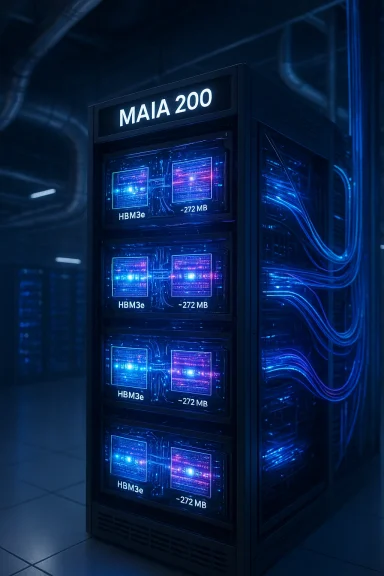
- Memory: 216 GB of HBM3e in six 12‑high stacks, with aggregate memory bandwidth in the neighborhood of ~7 TB/s.
- On‑chip SRAM: ~272 MB of fast on‑die SRAM to reduce off‑chip memory accesses.
- System packaging: Racks built from trays with four accelerators per tray, linked with direct local interconnects and standard Ethernet fabrics for scale‑up and scale‑out.
- Developer tooling: A Maia SDK that includes PyTorch integration, a Triton compiler, optimized kernel libraries, a simulator and a cost‑modeling tool.
Why Microsoft built Maia 200: the practical motivations
There are several pragmatic, business‑facing forces that drive a cloud operator to design in‑house chips. Microsoft’s public and private signals show the company is solving a tightly coupled stack problem:- Cost control: Inference at hyperscale is an enormous recurring expense. By designing chips that prioritize price‑to‑performance for the exact inference workloads Microsoft runs, the company aims to lower operating costs per token.
- Supply‑chain diversification: Heavy reliance on a handful of suppliers exposes hyperscalers to volatility. Custom silicon reduces Microsoft’s dependence on any single GPU vendor while keeping the option to buy GPUs for other workloads.
- Operational fit: Microsoft can co‑design racks, cooling and management software that lets Maia 200 be installed and made productive quickly in Azure regions — a non‑trivial operational advantage when every idle day reduces revenue generation.
- Product differentiation: Owning a unique inference stack enables Microsoft to tune Copilot, Microsoft 365, Azure OpenAI services and internal synthetic data pipelines for performance and economics that competitors may not replicate easily.
Deep dive: architecture and what it means for LLM inference
Maia 200’s design choices read like a checklist for serving today’s largest transformer models efficiently.Memory‑first layout
Large language models are memory‑bound at inference time — KV caches, embedding layers, and attention state consume huge capacity and demand bandwidth. Maia 200’s 216 GB of HBM3e paired with 272 MB of on‑chip SRAM is explicitly a memory‑heavy approach intended to keep critical working sets on or near the chip.- The HBM capacity reduces the need to shard KV caches across multiple accelerators for many practical model sizes.
- The on‑die SRAM acts as a local fast buffer to lower round‑trip latency for frequently accessed tensors and to speed tiled compute pipelines.
Low‑precision native support
Supporting native FP4 and FP8 tensor cores is a decisive optimization. FP4 provides high throughput for dense token generation, while FP8 provides a compromise of precision and breadth for larger, more complex model computations.- Microsoft’s numbers emphasize FP4 throughput (10+ PFLOPS) because many production inference workflows run quantized models where FP4 is viable and highly efficient.
- FP8 performance (5+ PFLOPS) lets Maia 200 handle larger model variants that need slightly more numeric range.
Data movement and scale
High token throughput depends on balanced data movement. Maia 200 implements data‑movement engines and a two‑tier scale‑up network design using commodity Ethernet, with local, direct links within a tray of four accelerators and unified transport across trays and racks. The goal is simpler operational networking than proprietary fabrics while still achieving high intra‑tray bandwidth.System packaging and cooling
A quoted 750 W SoC TDP envelope is high by CPU standards but conservative compared to top‑end multi‑die GPU modules that push 1,000–1,400 W. For Microsoft this means more practical thermal engineering (closed‑loop water cooling) and greater rack density per available power budget compared with some ultra‑high‑power GPU modules.Performance claims: what Microsoft says and what to believe
Microsoft positions Maia 200 as outperforming competing hyperscaler ASICs on specific metrics:- The company claims ~3× FP4 performance versus Amazon’s latest Trainium generation on targeted inference workloads.
- Microsoft claims FP8 performance above Google’s TPUv7 (Ironwood) on some metrics and points to higher HBM capacity than some competitor ASICs.
Readers should treat the performance statements as meaningful directional signals — Maia 200 is likely highly competitive on the kinds of quantized, memory‑heavy inference Microsoft cares about — but not definitive proof that it “beats” every other accelerator in every workload. The truth will emerge once neutral benchmarks appear that test Representative Production Workloads, at scale, under identical conditions.
Deployment, availability and the operational story
Microsoft emphasizes speed of deployment as a design objective: Maia 200 racks and trays are engineered so that chips can be installed and running models within days of arriving at a datacenter. Operational notes include:- Initial deployment regions: Microsoft has started Maia 200 rollouts in U.S. Central (Iowa) with planned expansion to other U.S. regions including the Phoenix area.
- Rack/tray design: Trays host four Maia 200 accelerators linked with local interconnects; racks are constructed for high rack‑density and liquid cooling compatibility.
- Integration with Azure: Maia hardware ties into Azure telemetry, security, management and orchestration stacks, plus a Maia SDK for developers (PyTorch + Triton compiler + simulator).
The software question: ecosystem, portability and the Maia SDK
Silicon alone is rarely decisive; the software stack determines how many models and customers can actually use a platform.Microsoft is previewing a Maia SDK with the explicit aim of lowering friction for model porting:
- PyTorch integration is a must for the research and production community.
- Triton compiler and optimized kernel libraries aim to accelerate common inference kernels.
- A simulator and cost‑calculator help developers understand performance and economics before committing code.
Strategic and competitive implications
Maia 200 is not just a chip; it’s a strategic instrument in several chess moves Microsoft is playing.- Cost of serving AI at scale: If Maia 200 delivers on Microsoft’s per‑dollar and per‑watt claims in production, Azure can offer lower cost to Microsoft’s own services and potentially to customers later, improving margins or enabling more aggressive pricing.
- Supplier leverage: Owning silicon and a growing in‑house hardware pipeline reduces Microsoft’s dependency on one dominant GPU vendor. That bargaining power is strategically valuable.
- Differentiation vs. GCP/AWS: Each hyperscaler now has custom silicon tailored to their ecosystems. Maia 200 positions Microsoft to optimize Copilot, Azure OpenAI, and Microsoft 365 more tightly than competitors who run on different hardware.
- Nvidia’s position is resilient but tested: Nvidia’s GPUs remain general purpose, highly programmable, and supported by a vast software base. Custom ASICs like Maia 200 are optimized for inference economics and specific workloads — but they are not a drop‑in replacement for Nvidia in every workload, especially training and workloads requiring matrix of multipurpose functionality.
Supply chain, manufacturing and memory politics
Maia 200 underscores some supply‑chain realities:- TSMC’s advanced process: Building Maia 200 at TSMC’s 3 nm node requires priority foundry capacity — a strategic dependency that most hyperscalers accept because TSMC is the leading high‑end logic foundry.
- HBM supply: Maia 200’s 216 GB HBM3e requirement brings memory suppliers into focus. Multiple industry reports indicate SK hynix as a major HBM3e supplier for Maia 200 stacks, with coverage suggesting SK hynix may be the primary or sole HBM3e partner for initial production. Microsoft’s own materials do not publicly name the memory supplier, so the exact contractual terms and supplier exclusivity remain industry‑reported rather than vendor‑confirmed.
- Capital intensity and wafer economics: Large‑die, high‑stack HBM packages are expensive to fab and test. The silicon program’s returns depend heavily on scale and utilization; the faster Microsoft deploys Maia 200 in production, the quicker the program amortizes wafer and system costs.
Risks, unknowns and cautionary points
No infrastructure program at this scale is without risks. Key caveats that should temper headline optimism:- Vendor metrics vs. independent benchmarks: Most performance claims from hyperscalers are measured on internally chosen workloads and configurations. Neutral, repeatable third‑party benchmarking across representative production workloads is needed to verify comparative claims.
- Workload specificity: Maia 200 is inference‑focused and memory‑heavy by design. For large training workloads or general‑purpose GPU applications, Maia 200 is not intended to replace high‑end, general‑purpose GPUs.
- Ecosystem lock‑in and portability: Convincing third‑party customers to adopt Maia 200 depends on the SDK, tooling, and the ability to run community models with minimal friction. Ecosystem inertia around Nvidia’s stack remains high.
- Supply constraints: HBM3e capacity and TSMC availability are real constraints. Initial volumes may be limited until supply chain ramps.
- Economic payback timing: Capital expenditure for custom racks, liquid cooling, and validation is front‑loaded. The economic payoff requires sustained utilization at scale; that depends on market demand, OpenAI partnerships and Azure customer adoption.
- Competitive escalation: Competitors will respond. Google’s TPU family and Amazon’s Trainium remain competitive, and Nvidia continues to innovate with next‑gen GPUs and software ecosystems. The hardware arms race will continue.
What this means for Azure customers, partners and the market
For enterprises and ISVs that consume Azure AI services, Maia 200’s near‑term impact is primarily internal to Microsoft’s stack:- Expect improved economics for Microsoft‑hosted Copilot and Azure OpenAI endpoints as Maia 200 scales up.
- Direct customer access to Maia 200 accelerators may follow after internal validation and limited previews; Microsoft’s rollout cadence will determine when external customers can provision Maia‑powered instances.
- For cloud buyers who need multi‑workload flexibility (training + inference + non‑AI workloads), GPUs will likely remain the primary option for the near term; Maia 200 will complement those choices for cost‑sensitive inference workloads.
Competitive snapshot: where every player stands
- Microsoft — Maia 200:
- Strengths: memory‑first inference design, integrated rack and software stack, cost intent.
- Weaknesses: newer ecosystem, constrained supply ramp, inference‑only focus.
- Google — TPU family (v7 and successors):
- Strengths: deep integration with Google Cloud, high bandwidth memory and scale, broad internal deployment.
- Weaknesses: ecosystem outside Google Cloud is smaller than Nvidia’s.
- Amazon — Trainium/Inferentia:
- Strengths: optimized for AWS workloads and pricing, strong cost competitiveness for certain models.
- Weaknesses: AWS customers that need GPU flexibility still rely on Nvidia.
- Nvidia — Blackwell family and broader ecosystem:
- Strengths: unmatched software ecosystem (CUDA, cuDNN), broad multipurpose GPU performance for training and inference, widespread third‑party tooling.
- Weaknesses: exposure to hyperscaler in‑house silicon reducing some cloud GPU spend; high price and power for top tiers.
Practical guidance for IT leaders and decision makers
If you manage AI infrastructure or cloud strategy, here are practical steps to consider:- Evaluate workload fit: Identify inference workloads where cost per token is dominant. Those are prime candidates to benefit from Maia‑style ASICs.
- Plan for heterogeneity: Design deployment plans that can leverage both GPUs and accelerators. Invest in orchestration and model portability tooling.
- Test early with previews: Engage with vendor previews and SDKs (Maia SDK, Triton, PyTorch integrations). Run representative portfolios of models to understand real performance and economics.
- Factor in cooling and power: Maia 200’s 750 W envelope requires liquid cooling support and power provisioning planning at scale.
- Monitor supply and pricing: HBM availability and component lead times can affect procurement timing. Budget for possible capital and time volatility.
Conclusion
Maia 200 is a major step in Microsoft’s long game to own more of the AI infrastructure stack. Technically, it is an ambitious, memory‑centric accelerator tuned for the economics of large‑scale inference: substantial HBM3e capacity, large on‑chip SRAM, low‑precision tensor cores and a systems design that emphasizes predictable latency and quick deployment. Strategically, it strengthens Microsoft’s position to reduce unit costs, improve operational control and differentiate Azure’s AI services.Yet the real test will not be a single specification sheet or a vendor benchmark: it will be how the Maia platform performs on neutral, representative workloads, how quickly Microsoft scales it across regions, and how the Maia SDK and tools lower the friction of porting popular models. Execution, supply chain stability, and ecosystem momentum will determine whether Maia 200 is a sustained disruptor or a specialized tool that complements the broader GPU ecosystem.
For now, Maia 200 tightens the infrastructure competition among the hyperscalers, pushes the market toward greater heterogeneity, and sharpens the question every cloud customer must ask: which compute architecture best fits my application’s performance, cost and operational profile? The answer will increasingly be both — and Maia 200 will be one of the choices in that evolving portfolio.
Source: AOL.com Microsoft takes aim at Google, Amazon, and Nvidia with new AI chip
