

From May 1 to June 19, 2026, Malaysian ministers, deputy ministers, senior civil servants and officials from 22 ministries reportedly undertook at least 50 overseas official trips across 48 cities and 24 countries, even as federal austerity measures squeezed public services, especially health care. The number is not just a statistic; it is a political image. A government that asks citizens and frontline agencies to absorb scarcity cannot look as if it has exempted itself from the discipline it prescribes. The controversy is therefore less about airplanes than about trust.
There are official trips that no serious observer would dispute. Prime ministers attend regional summits, foreign ministers negotiate, trade officials pursue market access, defence leaders meet counterparts, and health ministers engage global institutions. A small country with regional ambitions cannot run foreign policy from a locked office in Putrajaya.
But scale changes meaning. Fifty trips in fifty days turns individual justifications into a collective impression: a government in motion abroad while citizens are being told to make do at home. That impression matters because public finance is not only arithmetic; it is moral signalling.
When ministries are told to restrain spending, the first public test is whether restraint applies upward. If cost controls are visible only in hospitals, clinics, allowances, staffing, and procurement, while foreign delegations continue to appear in conference halls from Europe to Australasia, the austerity message begins to sound like a one-way instruction.
The government’s defenders can fairly argue that official travel is budgeted, planned, and sometimes unavoidable. That is true. Yet the public does not experience governance as a spreadsheet of separate allocations. It experiences governance as a hierarchy of priorities, and the hierarchy being projected here is awkward: overseas representation seems easier to fund than domestic relief.
This is where the politics becomes combustible. Citizens may tolerate difficult choices if they believe leaders are sharing the burden. They are far less forgiving when sacrifice appears to be downward-facing, landing on patients, junior doctors, civil servants, and households while senior officials continue to circulate internationally.
The health system is especially sensitive terrain. Malaysia’s public hospitals and clinics are not abstract budget lines; they are places where shortages become waiting times, burnout, delayed care, and family anxiety. Against that backdrop, photographs of delegations abroad become more than public-relations content. They become evidence, fair or not, in a national argument about who gets protected from scarcity.
Austerity is never only about saving money. It is about preserving legitimacy while saving money. The moment citizens suspect austerity is selective, every ringgit saved becomes politically expensive.
If a trip secures investment, say so. If it produces a signed agreement, publish it. If it advances a defence procurement milestone, explain what can be explained. If attendance is compulsory under treaty, regional, or institutional obligations, state that clearly.
The public does not need every diplomatic conversation disclosed. It does need a credible framework for distinguishing necessity from habit. In the absence of that framework, suspicion fills the space.
This is the bureaucratic danger of ornamental communication. A photo under a conference banner may reassure insiders that work has been done, but to citizens it often looks like proof of consumption rather than proof of achievement. Public communications that once passed as routine now read as evasive because the fiscal context has changed.
But public patience is not unlimited. When official descriptions include Amsterdam, Pisa, Florence, and historic attractions, voters struggling with living costs will not instinctively reach for the doctrine of professional military education. They will ask why the state appears able to fund European exposure for officials while other services are told to tighten.
That may be an unfair simplification, but politics often turns on simplifications that institutions fail to pre-empt. If such programmes are valuable, the burden is on the state to explain value in concrete terms. What curriculum requirement was met? How many participants attended? What was the total public cost? What domestic capability improved afterward?
Without those answers, “study tour” becomes a phrase that sounds less like capacity-building and more like administrative tourism. In an age of screenshots and viral outrage, that is a self-inflicted wound.
That information gap is not a technicality. It is the architecture of distrust.
Government secrecy often survives because each withheld detail looks small in isolation. One itinerary here, one hotel bill there, one delegation list somewhere else. But together, those missing details create the impression of a system designed to make accountability difficult.
The obvious reform is not revolutionary. Publish the itinerary, purpose, delegation composition, estimated cost, funding source, and outcome of every ministerial and senior official overseas trip within a fixed period after return. If a security exemption applies, state the exemption narrowly. If a commercial negotiation requires confidentiality, publish the parts that can be disclosed.
Transparency would not end criticism. It would improve the quality of criticism. It would let the public distinguish expensive but necessary diplomacy from expensive vanity travel, and modest working visits from bloated delegations.
That matters because official travel now requires a higher justification than it did in 2019. The question is no longer simply whether a meeting is useful. The question is whether being physically present adds enough value to justify the cost, time, emissions, security load, and opportunity cost.
Some meetings pass that test easily. Negotiations requiring personal trust, summits with protocol obligations, defence engagements, and high-stakes trade missions often require face-to-face contact. But seminars, forums, study sessions, and broad “experience sharing” programmes should face a tougher screen.
A modern travel policy would begin with a presumption against travel unless the sponsoring ministry can show why remote participation would materially weaken the outcome. That is not anti-diplomacy. It is pro-discipline.
This kind of contrast is dangerous because it is emotionally legible. Citizens do not need to understand the fine print of federal appropriations to understand unfairness. They can see it in the gap between a hospital cutting overtime and an official delegation posing abroad.
That is why government responses based purely on procedure will not be enough. Saying that trips were approved, budgeted, or in line with regulations may be true, but it does not answer the ethical question. The public is asking whether the governing class is living under the same constraints it imposes on everyone else.
This is where administrative legality and political legitimacy diverge. A trip can be lawful, budgeted, procedurally correct, and still politically damaging if it appears detached from national hardship.
A trade mission should identify investment leads, agreements signed, export opportunities opened, or regulatory barriers addressed. A health trip should identify policy commitments, technical assistance, procurement implications, or measurable institutional benefits. A defence visit should explain capability relevance within reasonable security limits. A study visit should disclose curriculum objectives and post-visit outputs.
The public sector does not need to become performatively hostile to travel. It needs to become competent at defending travel that deserves defending. Right now, the absence of routine disclosure makes every trip look like part of a cloud.
There is also a managerial benefit. When officials know that costs and outcomes will be published, delegations become leaner, itineraries become sharper, and vague participation becomes harder to justify. Transparency is not merely a democratic virtue; it is an operational control.
The better answer is a public travel discipline regime. It should be boring, repeatable, and difficult to evade. Every trip should face a pre-approval test, a delegation-size test, a class-of-travel test, a virtual-alternative test, and a post-trip reporting requirement.
The government should also separate ministerial travel from civil-service travel in reporting. Political leaders have representative duties that differ from technical officers. Senior officials may attend events that ministers need not, and ministers may attend summits that officials need not. Lumping everything together obscures whether the problem is political signalling, bureaucratic culture, or both.
A central dashboard would do more for public confidence than another statement about prudence. Citizens do not need polished slogans. They need receipts, outputs, and a reason to believe that public money is being treated as scarce even when spent abroad.
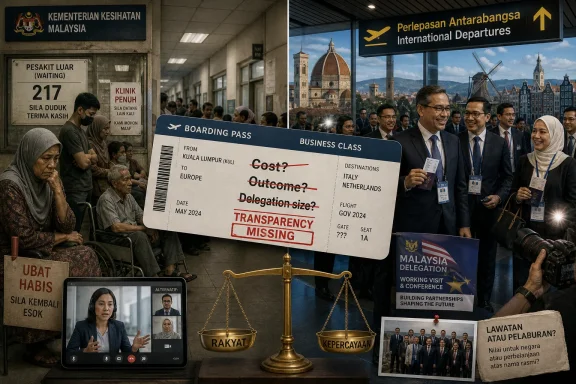 The Boarding Pass Has Become a Budget Document
There are official trips that no serious observer would dispute. Prime ministers attend regional summits, foreign ministers negotiate, trade officials pursue market access, defence leaders meet counterparts, and health ministers engage global institutions. A small country with regional ambitions cannot run foreign policy from a locked office in Putrajaya.But scale changes meaning. Fifty trips in fifty days turns individual justifications into a collective impression: a government in motion abroad while citizens are being told to make do at home. That impression matters because public finance is not only arithmetic; it is moral signalling.
When ministries are told to restrain spending, the first public test is whether restraint applies upward. If cost controls are visible only in hospitals, clinics, allowances, staffing, and procurement, while foreign delegations continue to appear in conference halls from Europe to Australasia, the austerity message begins to sound like a one-way instruction.
The government’s defenders can fairly argue that official travel is budgeted, planned, and sometimes unavoidable. That is true. Yet the public does not experience governance as a spreadsheet of separate allocations. It experiences governance as a hierarchy of priorities, and the hierarchy being projected here is awkward: overseas representation seems easier to fund than domestic relief.
Austerity Fails When It Looks Selective
The most damaging part of the story is its timing. The reported travel burst followed a late-April Ministry of Finance austerity directive and came amid reports of tighter controls across the public health service. That places every overseas itinerary against a background of constrained overtime, hiring limits, rationed tests, and contested specialist training opportunities.This is where the politics becomes combustible. Citizens may tolerate difficult choices if they believe leaders are sharing the burden. They are far less forgiving when sacrifice appears to be downward-facing, landing on patients, junior doctors, civil servants, and households while senior officials continue to circulate internationally.
The health system is especially sensitive terrain. Malaysia’s public hospitals and clinics are not abstract budget lines; they are places where shortages become waiting times, burnout, delayed care, and family anxiety. Against that backdrop, photographs of delegations abroad become more than public-relations content. They become evidence, fair or not, in a national argument about who gets protected from scarcity.
Austerity is never only about saving money. It is about preserving legitimacy while saving money. The moment citizens suspect austerity is selective, every ringgit saved becomes politically expensive.
The Government May Have Good Reasons, But It Has Not Shown Its Work
The central problem is not that ministers travelled. The central problem is that Malaysians are being asked to infer value from vague official language. “Strengthening ties,” “exploring cooperation,” “sharing expertise,” and “enhancing partnerships” are familiar phrases, but they do not tell taxpayers what was bought with time, airfare, hotel nights, allowances, security arrangements, and staff hours.If a trip secures investment, say so. If it produces a signed agreement, publish it. If it advances a defence procurement milestone, explain what can be explained. If attendance is compulsory under treaty, regional, or institutional obligations, state that clearly.
The public does not need every diplomatic conversation disclosed. It does need a credible framework for distinguishing necessity from habit. In the absence of that framework, suspicion fills the space.
This is the bureaucratic danger of ornamental communication. A photo under a conference banner may reassure insiders that work has been done, but to citizens it often looks like proof of consumption rather than proof of achievement. Public communications that once passed as routine now read as evasive because the fiscal context has changed.
Study Tours Are Where Optics Go to Die
The reported inclusion of study visits by military college participants to cultural and historical sites in the Netherlands and Italy is politically radioactive because it is easy to caricature. Defence education can legitimately include exposure to foreign institutions, history, urban systems, and strategic culture. Serious officers benefit from seeing the world beyond barracks and briefing rooms.But public patience is not unlimited. When official descriptions include Amsterdam, Pisa, Florence, and historic attractions, voters struggling with living costs will not instinctively reach for the doctrine of professional military education. They will ask why the state appears able to fund European exposure for officials while other services are told to tighten.
That may be an unfair simplification, but politics often turns on simplifications that institutions fail to pre-empt. If such programmes are valuable, the burden is on the state to explain value in concrete terms. What curriculum requirement was met? How many participants attended? What was the total public cost? What domestic capability improved afterward?
Without those answers, “study tour” becomes a phrase that sounds less like capacity-building and more like administrative tourism. In an age of screenshots and viral outrage, that is a self-inflicted wound.
The Missing Numbers Are the Real Scandal
The reported travel count is striking, but the deeper issue is what remains unknown. The public does not know the cost of the trips. It does not know delegation sizes. It does not know travel class. It does not know accommodation standards. It does not know whether private sponsors paid for anything. It does not know whether virtual participation was considered and rejected.That information gap is not a technicality. It is the architecture of distrust.
Government secrecy often survives because each withheld detail looks small in isolation. One itinerary here, one hotel bill there, one delegation list somewhere else. But together, those missing details create the impression of a system designed to make accountability difficult.
The obvious reform is not revolutionary. Publish the itinerary, purpose, delegation composition, estimated cost, funding source, and outcome of every ministerial and senior official overseas trip within a fixed period after return. If a security exemption applies, state the exemption narrowly. If a commercial negotiation requires confidentiality, publish the parts that can be disclosed.
Transparency would not end criticism. It would improve the quality of criticism. It would let the public distinguish expensive but necessary diplomacy from expensive vanity travel, and modest working visits from bloated delegations.
Video Calls Changed Business Faster Than Government
The pandemic permanently changed corporate travel norms. Multinational firms now conduct investor briefings, procurement negotiations, board meetings, compliance reviews, and technical workshops through video conferencing when physical presence is not essential. Governments adopted the same tools during crisis, then too often drifted back toward older habits once airports reopened.That matters because official travel now requires a higher justification than it did in 2019. The question is no longer simply whether a meeting is useful. The question is whether being physically present adds enough value to justify the cost, time, emissions, security load, and opportunity cost.
Some meetings pass that test easily. Negotiations requiring personal trust, summits with protocol obligations, defence engagements, and high-stakes trade missions often require face-to-face contact. But seminars, forums, study sessions, and broad “experience sharing” programmes should face a tougher screen.
A modern travel policy would begin with a presumption against travel unless the sponsoring ministry can show why remote participation would materially weaken the outcome. That is not anti-diplomacy. It is pro-discipline.
Malaysia’s Political Risk Is a Two-Economy Story
The most potent narrative emerging from the controversy is not “officials travel too much.” It is that Malaysia may be splitting into two lived economies. One economy waits in clinics, compares grocery prices, worries about wages, and hears that budgets are tight. The other economy moves through airports, conferences, motorcades, hotel lobbies, and reception halls.This kind of contrast is dangerous because it is emotionally legible. Citizens do not need to understand the fine print of federal appropriations to understand unfairness. They can see it in the gap between a hospital cutting overtime and an official delegation posing abroad.
That is why government responses based purely on procedure will not be enough. Saying that trips were approved, budgeted, or in line with regulations may be true, but it does not answer the ethical question. The public is asking whether the governing class is living under the same constraints it imposes on everyone else.
This is where administrative legality and political legitimacy diverge. A trip can be lawful, budgeted, procedurally correct, and still politically damaging if it appears detached from national hardship.
The Case for Travel Must Become Measurable
If official travel is an investment, it should be evaluated like one. That means outcomes, not adjectives. It means post-trip reporting that gives Parliament, the press, and citizens something firmer than ceremonial photographs.A trade mission should identify investment leads, agreements signed, export opportunities opened, or regulatory barriers addressed. A health trip should identify policy commitments, technical assistance, procurement implications, or measurable institutional benefits. A defence visit should explain capability relevance within reasonable security limits. A study visit should disclose curriculum objectives and post-visit outputs.
The public sector does not need to become performatively hostile to travel. It needs to become competent at defending travel that deserves defending. Right now, the absence of routine disclosure makes every trip look like part of a cloud.
There is also a managerial benefit. When officials know that costs and outcomes will be published, delegations become leaner, itineraries become sharper, and vague participation becomes harder to justify. Transparency is not merely a democratic virtue; it is an operational control.
The Reform Malaysia Needs Is Boring, Which Is Why It Might Work
The solution is not a theatrical ban on overseas travel. Blanket bans usually produce bad exceptions, back-channel workarounds, and performative frugality. Malaysia still needs diplomacy, trade outreach, defence engagement, and technical cooperation.The better answer is a public travel discipline regime. It should be boring, repeatable, and difficult to evade. Every trip should face a pre-approval test, a delegation-size test, a class-of-travel test, a virtual-alternative test, and a post-trip reporting requirement.
The government should also separate ministerial travel from civil-service travel in reporting. Political leaders have representative duties that differ from technical officers. Senior officials may attend events that ministers need not, and ministers may attend summits that officials need not. Lumping everything together obscures whether the problem is political signalling, bureaucratic culture, or both.
A central dashboard would do more for public confidence than another statement about prudence. Citizens do not need polished slogans. They need receipts, outputs, and a reason to believe that public money is being treated as scarce even when spent abroad.
The Frequent-Flyer State Now Has to Prove It Is Working
The immediate controversy will fade, but the standard it has raised should not. Malaysia’s government can no longer assume that foreign travel will be treated as routine background noise. In an austerity climate, every boarding pass is a political document.- The reported 50 overseas trips from May 1 to June 19, 2026, matter because their density clashes with the government’s own austerity messaging.
- The most serious accountability gap is not the existence of travel but the absence of published costs, delegation sizes, travel classes, funding sources, and measurable outcomes.
- Necessary diplomacy should be defended with evidence rather than hidden behind generic language about cooperation and engagement.
- Study tours and conference travel now require especially strong justification because remote participation has become normal across business and government.
- A public travel dashboard would help distinguish legitimate international work from trips that survive mainly because no one can see the bill.
References
- Primary source: Newswav
Published: 2026-06-27T23:50:13.921144
Frequent Flyer Government: 50 Overseas Trips in 50 Days - Newswav
Mihar Dias on Microsoft Copilot Frequent Flyer Government: 50 Overseas Trips in 50 Days By Mihar Dias June 2026Malaysians may have discovered the country's newenewswav.com
