

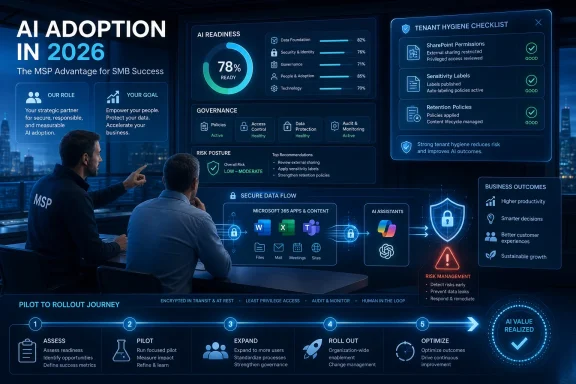
That distinction matters because small and medium-sized businesses are not waiting for perfect AI strategies. Employees are already pasting meeting notes, customer data, spreadsheets, source code, contracts, and HR drafts into whatever assistant happens to be open in a browser tab. The boardroom is asking about productivity; the security team is worrying about leakage; the MSP is often the only party close enough to translate both concerns into something workable.
The AI Sale Is Already Too Small for the Problem
The first wave of business AI adoption has a familiar channel shape: a vendor launches a product, customers ask whether they need it, and partners line up to transact the license. That model works well enough for endpoint security, backup, or email filtering, where a product can be wrapped in monitoring and support with relatively clear boundaries. AI does not behave that neatly.
A Microsoft 365 Copilot license, for example, is not just a productivity add-on. It is a new interface to a customer’s existing Microsoft 365 data estate. If permissions are messy, labels are missing, Teams sites are abandoned, and SharePoint libraries have years of inherited access sprawl, Copilot does not magically clean the house. It makes the house easier to search.
That is why AI is forcing MSPs into a more consultative posture. The customer’s question may be, “Should we buy Copilot?” The better MSP answer begins with, “What data would Copilot be allowed to see on day one?” That is a less glamorous conversation than a demo, but it is the one that determines whether the deployment becomes a productivity win or an uncomfortable audit.
The channel has seen this movie before. Cloud migrations began as mailbox moves and became identity, governance, security, backup, compliance, and cost-management programs. Zero trust began as a slogan and became a multi-year identity and endpoint hardening exercise. AI is following the same path, only faster, because the demand is coming from users as much as from executives.
Shadow AI Is the Demand Signal MSPs Should Not Ignore
Shadow AI is often described as a risk, and it is. But for MSPs, it is also a market signal written in fluorescent ink. Employees are using unauthorized AI tools because they believe the tools help them get work done, and in many cases they are right.
The danger is that the fastest route to value is also the fastest route around governance. A salesperson summarizes customer calls in a personal chatbot. A finance manager asks a public model to clean up a spreadsheet. A developer asks for help debugging proprietary code. An HR employee rewrites sensitive performance feedback in a consumer AI service because the output sounds more polished.
None of these examples require malice. That is what makes shadow AI so difficult to manage. The employee is not trying to steal data; the employee is trying to finish the workday.
For SMBs, the problem is compounded by thin internal IT staffing. Large enterprises may have AI steering committees, legal review, data-loss prevention programs, procurement gates, and security operations teams watching for odd behavior. Many smaller firms have a business owner, a controller, a few department heads, and an MSP. If the MSP is not shaping AI behavior, no one else may be doing it.
The instinct to ban unauthorized AI is understandable but usually ineffective. A ban without a usable alternative simply pushes activity further out of sight. The more durable answer is to provide approved tools, clear policies, training that reflects real workflows, and monitoring that can detect risky use without turning the workplace into a surveillance drama.
That is a managed service waiting to be packaged.
Copilot Reduces One Risk and Exposes Another
Microsoft 365 Copilot is the obvious anchor for many MSP AI offerings because so many SMBs already live inside Microsoft 365. It brings AI into Word, Excel, Outlook, Teams, SharePoint, and the broader Microsoft Graph. It also gives MSPs a vendor-supported story around enterprise data protection, identity, permissions, auditing, retention, and compliance controls.
That does not mean Copilot is risk-free. It means the risk shifts.
With consumer AI tools, the worry is often that employees are sending company information into services outside approved administrative control. With Copilot, the bigger concern is that the tool may surface information the user technically had permission to access but never realistically would have found before. AI does not merely retrieve data; it condenses, summarizes, and connects it.
That distinction is crucial. If a user has access to a forgotten SharePoint folder containing acquisition plans, salary data, legal correspondence, or customer exports, Copilot may treat that content as fair game. The problem is not that Copilot broke permissions. The problem is that the permission model was already broken.
For MSPs, this creates an uncomfortable but valuable service conversation. AI readiness is not a checkbox. It is a tenant hygiene program. It means reviewing SharePoint permissions, Teams ownership, external sharing, sensitivity labels, retention policies, conditional access, identity posture, and stale content. It means explaining to a customer that “we already have Microsoft 365” is not the same as “we are ready to expose Microsoft 365 to AI-assisted discovery.”
The sales pitch practically writes itself, but the delivery is harder. MSPs need repeatable assessment frameworks, remediation playbooks, reporting templates, and escalation paths. Without those, every AI project becomes a bespoke consulting exercise, which is difficult to scale and easy to underprice.
The Real Product Is Readiness, Not Rollout
The most mature MSPs will resist the temptation to lead with seats. They will lead with readiness.
A credible managed AI service should begin before a customer buys broad licenses. The first stage is discovery: which AI tools are already in use, which departments are asking for them, what data is likely to be involved, and where the business expects productivity gains. The MSP should not assume that the CEO’s enthusiasm maps cleanly onto employee workflows.
The second stage is tenant and data assessment. This is where the work becomes less exciting and more important. SharePoint sites need to be reviewed. Broad access groups need to be questioned. External sharing needs to be understood. Old Teams workspaces need owners. Sensitive data needs classification. Conditional Access policies need to match the risk profile of the environment.
The third stage is controlled enablement. That may mean a pilot group rather than a companywide launch. It may mean limiting early use to departments with cleaner data or lower exposure. It may mean deploying approved AI tools alongside policy updates and user training, rather than tossing licenses into the tenant and hoping adoption happens organically.
The fourth stage is measurement. AI projects fail when nobody can say whether the tool is helping. MSPs should track usage, adoption, license assignment, common use cases, user feedback, security events, and support requests. The question is not merely whether people are clicking the Copilot button. The question is whether the customer is getting business value without increasing unacceptable risk.
That loop is what turns AI into recurring revenue. Readiness leads to rollout. Rollout leads to adoption. Adoption produces new governance findings. Governance produces new training needs. Training produces new use cases. The service continues because the customer’s AI environment continues to change.
SMBs Need Advisors More Than They Need Another Admin Portal
The MSP value proposition has always depended on abstraction. Customers do not hire an MSP because they enjoy ticket queues, licensing matrices, endpoint dashboards, or conditional access policies. They hire one because technology has become too important and too complex to leave unmanaged.
AI intensifies that dynamic. SMB leaders can read headlines about productivity gains, but they often do not know where AI should enter the business first. Should it help sales write follow-ups? Should it summarize Teams meetings? Should it draft proposals? Should it analyze spreadsheets? Should it assist support staff? Should it help executives query internal documents?
Those are not purely technical questions. They are operational questions. An MSP that wants to win in AI must be comfortable discussing process, risk, training, and measurable outcomes.
This is where the channel’s old support reflex can become a liability. If the service desk waits for AI tickets, it will only see the symptoms: a user who cannot access Copilot, an output that looks wrong, a file that appeared in a response unexpectedly, a manager who wants to know why licenses are unused. The higher-value work happens before the ticket. It is the work of designing the guardrails.
MSPs do not need to become management consultancies overnight. But they do need to add advisory muscle around the areas they already know: identity, security, data governance, device management, compliance, backup, and user enablement. AI gives those existing competencies a new commercial frame.
Security Services Become More Valuable When AI Makes Data Visible
For years, MSPs have urged SMB customers to take data governance more seriously, often with limited success. File sprawl, stale permissions, poorly named SharePoint sites, and “temporary” external sharing links rarely feel urgent until something breaks. AI changes that psychology.
When a generative assistant can summarize internal data in seconds, old governance debt becomes visible in a new way. A folder that was technically accessible but practically obscure is no longer obscure. A poorly controlled document library becomes a source for authoritative-sounding answers. A permissive workspace becomes an AI-readable knowledge base, whether the business intended that or not.
That creates an opening for MSPs to reposition security and compliance work that customers may previously have treated as optional. Sensitivity labeling is no longer just a compliance feature. It becomes part of AI control. Least-privilege access is no longer just a security principle. It becomes a quality requirement for AI-generated answers. Data retention is no longer just about legal hold and storage management. It becomes part of reducing the junk that AI may retrieve.
This is the practical heart of managed AI: AI does not eliminate the need for conventional IT hygiene. It punishes the absence of it.
The best MSP packaging will make that connection explicit. A customer does not need “a Purview project” in the abstract. It needs confidence that the new AI assistant will not summarize confidential payroll data for someone who should never have had access to the folder in the first place. It needs a defensible process for deciding which data is ready for AI and which data should remain restricted until remediated.
Training Cannot Be a One-Hour Webinar
User training is often the least respected part of technology deployment, and AI will expose that weakness. A one-hour webinar and a PDF prompt guide may satisfy a project milestone, but it will not create durable adoption or safe behavior.
AI tools are probabilistic, context-sensitive, and workflow-dependent. Users need to learn not just where the button is, but how to judge output, when to verify, what data not to paste, how to structure prompts, and when AI is the wrong tool. They also need examples grounded in their actual jobs.
A generic prompt-training session is better than nothing. A finance-specific workshop on variance explanations, board-pack summaries, and spreadsheet review is better. A sales-focused session on call summaries, account research, and follow-up drafting is better still. The closer the training gets to the user’s real workflow, the more likely adoption becomes.
This is another recurring-service opportunity. MSPs can run quarterly enablement sessions, publish customer-specific prompt libraries, review usage analytics, identify departments lagging in adoption, and help power users share internal examples. They can also maintain policy refreshers as AI tools evolve.
The training work should not be framed as soft or secondary. Poorly trained users create both risk and waste. They may mishandle sensitive data, trust inaccurate outputs, abandon paid licenses, or retreat to unauthorized tools that feel easier. Adoption and governance are two sides of the same service.
The MSP Operating Model Has to Change Before the Customer Offer Can Scale
The uncomfortable truth is that many MSPs are not yet ready to deliver managed AI at scale. They may understand Microsoft 365 licensing, endpoint management, and security tooling, but AI service delivery requires a blend of skills that does not always exist inside the same team.
Technical staff need to understand Copilot architecture, tenant controls, Microsoft Purview, Entra ID, SharePoint permissions, Teams governance, and endpoint browser controls. Account managers need to understand business use cases and ROI conversations. Service desk staff need enough AI literacy to distinguish a support problem from a training problem. Leadership needs packaging, pricing, liability boundaries, and a view of how much consulting time each customer segment can bear.
That means MSPs must first build the service internally. They should use approved AI tools in their own operations, develop internal policies, document safe prompting standards, test governance controls, and learn where the tools fail. An MSP that has not governed its own AI use will struggle to advise customers credibly.
There is also a tooling gap. MSPs prefer multi-tenant dashboards, standardized policy baselines, automated reporting, and alerting that scales across customers. AI governance is still catching up to that reality. Some work can be automated, but much of the early value will come from assessment, judgment, and remediation planning.
That should not discourage MSPs. It should influence pricing. If the service requires senior engineering, security review, and advisory time, it cannot be priced like a commodity add-on. The worst outcome for the channel would be to sell AI governance cheaply, discover that every customer environment is a swamp, and then quietly abandon the service because margins collapsed.
Pricing AI Like Support Will Undervalue the Work
MSPs have a recurring-revenue instinct, and rightly so. But AI services will not fit neatly into a per-device or per-user support bundle unless the scope is tightly defined. The work cuts across licensing, governance, adoption, compliance, and process improvement.
A more realistic model may combine an upfront readiness assessment with a recurring managed AI plan. The assessment establishes the customer’s current state, identifies immediate risks, and defines a rollout path. The recurring service maintains the environment, monitors for drift, supports users, reviews adoption, and updates policy as tools and business needs evolve.
Some customers will want only a pilot. Others will need a full governance overhaul before AI deployment. A regulated professional services firm, healthcare provider, financial office, or legal practice will have a different risk tolerance from a small manufacturer or local retailer. MSPs need packaging that is repeatable but not naive.
The easiest mistake is to tie the whole service to Copilot resale. Copilot may be the center of gravity for Microsoft-centric customers, but AI use will not remain confined to one vendor’s interface. Browser-based tools, embedded SaaS assistants, CRM AI features, developer copilots, meeting bots, and industry-specific models will all enter the picture. A managed AI service should be vendor-aware without being vendor-blind.
The MSP’s defensible value is not “we can sell you Copilot.” It is “we can help your business use AI safely, visibly, and productively across the tools your employees will actually encounter.”
The Liability Conversation Is Coming
AI advisory work also raises a harder question: what is the MSP responsible for if something goes wrong?
If an employee leaks sensitive data through a personal AI account, the customer may ask why the MSP did not warn them. If Copilot surfaces sensitive information because permissions were too broad, the customer may ask why the MSP did not catch the exposure. If AI output leads to a business mistake, the customer may ask whether training was adequate. These questions may not always be fair, but they will be asked.
That makes scope and documentation essential. MSPs should define what their AI service includes, what it does not include, which controls are monitored, which tools are approved, which customer decisions are required, and what residual risks remain. AI governance should produce artifacts: policies, assessment reports, remediation plans, training records, access reviews, and adoption summaries.
This is not bureaucracy for its own sake. It is how the MSP proves value and manages liability. The customer gets a clearer view of risk. The MSP gets a record of recommendations and decisions. Both sides avoid pretending that AI can be made safe by enthusiasm alone.
The legal and regulatory environment will continue to evolve, but MSPs do not need to wait for every rule to settle before acting. The basic principles are already familiar: know what tools are in use, control access to sensitive data, train users, monitor risky behavior, document decisions, and review the program regularly. AI changes the surface area, not the need for governance.
The Channel Winners Will Productize Judgment
The phrase “trusted advisor” has been overused in the MSP world, but AI gives it sharper meaning. Customers do not just need someone to install software. They need someone to help decide where AI belongs, where it does not, and what must be fixed before it can be used safely.
That requires judgment, and judgment is hard to scale. The MSPs that win will be the ones that productize it without flattening it into useless checklists. They will build standardized assessments, baseline policies, deployment playbooks, training modules, reporting templates, and recurring review cycles. Then they will leave room for customer-specific nuance.
A law firm’s AI policy should not look identical to a construction company’s. A nonprofit with sensitive donor data has different concerns from a distributor trying to automate quoting. A medical office has different obligations from a marketing agency. The platform may be the same; the risk model is not.
This is where MSPs can defend margin. Commodity support answers the same question repeatedly. Advisory-led managed AI answers similar questions in context. The repeatability is in the method, not in pretending every customer has the same business.
The Service Stack Is Starting to Take Shape
The MSP AI offer will vary by customer maturity, but the outline is becoming clear. It begins with visibility into existing AI use, continues through Microsoft 365 and SaaS governance, and matures into adoption coaching and business-process advisory. The point is not to make every MSP a data-science shop. The point is to manage the real AI environment SMBs are already creating.
A practical service might include policy creation, approved-tool selection, Microsoft 365 Copilot readiness, permission review, sensitivity labeling support, Conditional Access hardening, browser and endpoint controls, user training, adoption reporting, and quarterly business reviews focused on AI outcomes. For more advanced customers, it may expand into custom agents, workflow automation, and integration with line-of-business systems.
But the foundation must come first. Jumping directly to custom AI agents while the tenant is riddled with overshared data is like building an executive dashboard on top of an unaudited spreadsheet. The demo may impress. The operating reality will not.
MSPs should also be honest about AI’s limits. Generative systems can draft, summarize, classify, and assist. They can also hallucinate, omit context, overstate confidence, and reflect the quality of the data they are given. A managed AI service should teach customers to use AI as an accelerator, not an unquestioned authority.
The MSPs That Move First Should Move Carefully
There is a strong first-mover advantage here, but also a first-mover trap. Rushing every customer into AI without readiness work may generate short-term revenue and long-term pain. Waiting until the market is fully mature may leave the MSP positioned as a late reseller in a category customers already associate with someone else.
The better path is staged. Start with internal enablement. Build a readiness assessment. Pilot with friendly customers. Document common remediation patterns. Package the recurring service. Train the service desk. Then expand.
MSPs should also segment their customer base. Some SMBs are already demanding Copilot and need immediate governance. Others need education before investment. Some have clean Microsoft 365 environments and can pilot quickly. Others need months of permission cleanup and policy work. Treating all of them the same will waste time and damage credibility.
The near-term market will reward MSPs that can say “not yet” as confidently as they say “yes.” If a customer’s data environment is not ready, the MSP should explain the risk and offer a path forward. That may slow the license sale, but it strengthens the advisory relationship.
AI Turns the Quarterly Business Review Into Something Customers May Actually Value
The quarterly business review has become a tired ritual in parts of the MSP industry. Too often, it is a slide deck of tickets closed, patches applied, incidents avoided, and licenses consumed. AI gives MSPs a chance to make that meeting strategic again.
An AI-focused review can show which departments are adopting approved tools, where licenses are underused, which workflows are producing measurable time savings, which risky behaviors have declined, and which data-governance issues remain unresolved. It can connect IT activity to business outcomes in a way customers understand.
That is especially important because AI budgets may come from business units rather than traditional IT. A sales leader does not care about a conditional access policy in isolation. They care that reps can safely summarize customer interactions and generate follow-ups without exposing confidential account data. A finance leader does not care about sensitivity labels as a feature. They care that payroll and forecast data are not accidentally surfaced to the wrong audience.
The MSP that can translate those controls into business language will have a stronger seat at the table. The one that reports only license counts will be treated like a procurement function.
The Practical Shape of a Managed AI Offer
Before MSPs promise transformation, they need a concrete service customers can understand. The most durable offers will be specific enough to sell and broad enough to evolve as tools change. The strongest starting point is not “AI for everything,” but “AI you can govern.”
- MSPs should begin by discovering where employees are already using approved and unapproved AI tools across the business.
- MSPs should assess Microsoft 365 permissions, sharing links, sensitivity labels, retention policies, and identity controls before broad Copilot rollout.
- MSPs should pilot AI with defined user groups, measurable use cases, and clear rules for what data can and cannot be used.
- MSPs should provide recurring training that is tailored to departments rather than relying on generic prompt-engineering sessions.
- MSPs should report adoption, risky behavior, configuration drift, and license utilization as part of an ongoing managed service.
- MSPs should document recommendations, customer decisions, and residual risks so that AI governance becomes an auditable program rather than informal advice.
The MSP channel has spent years telling SMBs that technology strategy and security cannot be reduced to buying tools. AI is now testing whether MSPs believe their own pitch. The customers are ready to experiment, the risks are already present, and the vendors will keep shipping features faster than most small businesses can govern them. The opportunity belongs to MSPs that can turn that chaos into a service: not a one-time Copilot rollout, but a recurring discipline of readiness, adoption, oversight, and practical advice that keeps customers close as AI becomes part of everyday work.
References
- How MSPs can turn AI demand into a scalable service ChannelE2E · 2026-06-23T13:00:15.950652