

Endpoint protection is rapidly becoming one of the most critical components of a business data-security strategy, and the latest PC Pro roundup (November 6, 2025) reinforces that endpoint management consoles are no longer optional — they are mission-critical infrastructure for any organisation that wants to keep endpoints patched, configured and resilient against modern attack chains. The piece highlights ManageEngine’s Endpoint Central as a comprehensive unified endpoint management (UEM) option and situates it in the practical reality IT teams face today: large, heterogeneous fleets; exploding patch volumes; and the operational friction of rolling updates across remote and hybrid users.
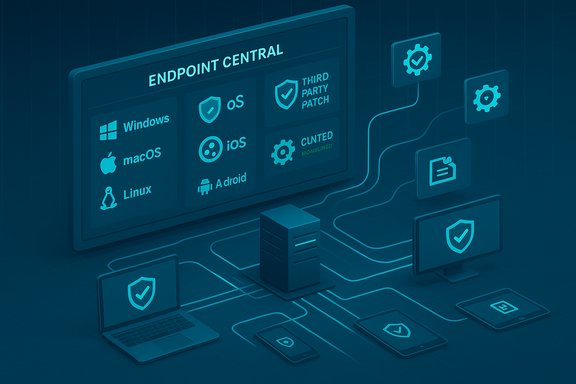
ManageEngine Endpoint Central (formerly Desktop Central) is positioned as a full-lifecycle UEM platform that bundles patch management, configuration management, asset inventory, remote control, mobile device management (MDM), application control, DLP-like peripheral controls and complementary endpoint security features into one console. The vendor describes it as capable of managing Windows, macOS, Linux, ChromeOS, iOS and Android endpoints and emphasizes automation for routine admin tasks such as patch orchestration, OS deployment and software distribution. That “everything on one console” message is central to ManageEngine’s pitch: patch more than 1,000 third‑party apps, orchestrate multi-OS updates, discover and lock down risky peripherals, and couple detection/response with policy enforcement from a single pane. Independent user reviews and marketplace listings confirm the same feature depth while also flagging usability and scale trade-offs that matter in real-world operations.
Independent vulnerability tracking (NVD) and vendor advisories show ManageEngine Endpoint Central had several notable CVEs during 2025 that administrators must treat seriously:
Endpoint management is now an explicit security priority, and PC Pro’s coverage is timely: consolidating management and security can reduce operational friction, but it raises the stakes on governance. ManageEngine Endpoint Central is a defensible, cost-effective platform for many organisations — provided teams treat the agent lifecycle with rigorous patching discipline, layered telemetry, and tested emergency procedures. The platform’s features can materially improve posture, but only when coupled with the operational practices that turn vendor capability into reliable, auditable security.
Source: Readly | All magazines - one magazine app subscription Manageengine endpoint central - 6 Nov 2025 - PC Pro Magazine - Readly
 Background / Overview
ManageEngine Endpoint Central (formerly Desktop Central) is positioned as a full-lifecycle UEM platform that bundles patch management, configuration management, asset inventory, remote control, mobile device management (MDM), application control, DLP-like peripheral controls and complementary endpoint security features into one console. The vendor describes it as capable of managing Windows, macOS, Linux, ChromeOS, iOS and Android endpoints and emphasizes automation for routine admin tasks such as patch orchestration, OS deployment and software distribution. That “everything on one console” message is central to ManageEngine’s pitch: patch more than 1,000 third‑party apps, orchestrate multi-OS updates, discover and lock down risky peripherals, and couple detection/response with policy enforcement from a single pane. Independent user reviews and marketplace listings confirm the same feature depth while also flagging usability and scale trade-offs that matter in real-world operations. What the PC Pro piece says — short summary
- The PC Pro article frames endpoint protection as the weakest link in business security and underlines the need for integrated endpoint management to reduce that exposure.
- ManageEngine Endpoint Central appears in the feature as a strong candidate for organisations that want a combined management + security approach, especially where budget and administrative resources favour a single‑vendor stack.
- The article stresses practical concerns for IT teams: agent deployment, patch testing, staged rollouts, and the necessity of maintaining inventories and emergency-change playbooks when management agents themselves are sensitive components in the attack surface.
Product snapshot: core capabilities of ManageEngine Endpoint Central
ManageEngine’s product literature and recent independent listings make the platform’s scope explicit. Highlights include:- Patch Management
- Automated patching for Windows, macOS, Linux and thousands of third‑party applications.
- Testing and approval workflows, scheduled rollouts, and reports for compliance.
- Vulnerability & Configuration Management
- Integrated vulnerability detection, CIS benchmark templates, and the ability to deploy mitigation scripts before vendor patches are available.
- Asset & License Management
- Live hardware and software inventory, software metering, license compliance reports.
- Remote Control & Support
- Encrypted remote sessions, file transfer, session recording and auditing for compliance.
- Endpoint Security & Hardening
- Endpoint privilege management, application control/allowlisting, device peripheral control (USB block, temporary access).
- “Ransomware protection” features, behavioural analysis and rollback options (vendor-marketed).
- Mobile & OS Deployment
- MDM features for iOS/Android, OS imaging and deployment across heterogeneous hardware.
- Reporting & Automation
- Pre-defined reports, automation templates, role-based access and policy-driven workflows.
How Endpoint Central stacks up in the field — strengths and practical wins
- Feature breadth: Endpoint Central covers the typical UEM checklist — patching, MDM, app distribution, inventory and basic endpoint hardening — reducing integration effort between disparate tools. This is borne out by vendor documentation and multiple marketplace lists that highlight its “one console” approach.
- Cost profile and SME fit: ManageEngine historically positions itself as mid-market friendly: a lot of capability for a lower list price than some enterprise incumbents, making it attractive to organisations that want a broad feature set without tier‑one enterprise pricing. This is reflected in user reviews and comparison pages.
- Practical automation: Users repeatedly point to automated patch cycles and bundled third‑party patch support as high‑value features — reducing the manual toil of chasing vendor updates for many applications. Real-world reviewers report tangible reductions in unpatched exposures after adoption.
- CIS and compliance tooling: Endpoint Central sells compliance value via CIS templates and pre-built reports, a useful short cut for teams trying to prove posture improvements in audits.
Known weaknesses, operational gaps and common user complaints
- Usability and UI complexity: TrustRadius and other user-feedback sources commonly cite the console as dense and at times cluttered. New operators often face a steeper learning curve compared with more streamlined (but narrower) SaaS competitors. The trade-off is capability for discoverability.
- Large-scale reliability & deployment edge cases: Several reviewers report occasional failures in large-scale software deployments or stress conditions where deployments to thousands of endpoints required manual retries. For organisations running tens of thousands of endpoints, these operational details matter.
- Support experiences vary: As with many large vendor portfolios, first-line support responsiveness and the speed of critical-ticket escalation are variables in customer reports. For high‑risk remediation windows, that variance can be consequential.
Critical risk vector: the management agent itself
The PC Pro piece rightly emphasises an uncomfortable truth: endpoint-management agents are powerful and therefore attractive targets. Vulnerabilities in management agents can produce high-impact outcomes — privileged local control, data exfiltration, or lateral movement — because the agent runs with elevated privileges and interfaces directly with system internals. That risk is not hypothetical: multiple CVEs reported in 2024–2025 illustrate this pattern across vendors.Independent vulnerability tracking (NVD) and vendor advisories show ManageEngine Endpoint Central had several notable CVEs during 2025 that administrators must treat seriously:
- CVE‑2025‑5494 — improper privilege management in agent setup (affects certain builds).
- CVE‑2025‑5496 — arbitrary file deletion in agent setup leading to local privilege escalation.
- CVE‑2025‑11248 — sensitive information logged in plaintext (exposes agent tokens to authenticated log viewers).
- CVE‑2025‑7473 — XML injection affecting some versions.
Cross‑check: vendor remediation and public vulnerability records
- Vendor advisories: ManageEngine publishes KBs and advisory pages for each vulnerability, with build numbers and mitigation steps. The product documentation explicitly calls out fixed builds and provides short-term mitigations where required. Administrators must follow these advisories exactly and validate version numbers across their estate.
- NVD/CVE records: The National Vulnerability Database entries reflect public CVE assignments and summarise affected versions and CWE classifications (e.g., CWE‑269 improper privilege management, CWE‑532 sensitive data in logs). Use NVD/CVE records to track timelines and to integrate into vulnerability management pipelines.
Practical recommendations for IT teams evaluating or operating Endpoint Central
- Inventory first
- Maintain an authoritative, queryable inventory of every endpoint agent, including version, installer build, and pairing status with the management server. This inventory must feed your emergency-change lane.
- Treat agent updates like critical infrastructure changes
- Schedule agent upgrades with staged rollouts, smoke tests and rollback plans. Agents should be updated early in non-production rings and only promoted once behavioral telemetry is validated.
- Validate fixed builds against vendor advisories
- When a vendor advisory lists a fixed build for a CVE, confirm exact version strings on endpoints (not just “patched” flags) and run authenticated scans to ensure the CVE no longer appears. Cross-check ManageEngine KBs with NVD CVE entries for audit records.
- Harden installation and bootstrap paths
- Limit who can run installers, require signed packages, and restrict local admin rights. Where possible, perform agent installation via trusted orchestration (Intune, SCCM, Jamf) rather than manual local installs.
- Integrate with EDR/SIEM and out-of-band logging
- Rely on multiple telemetry sources. If an agent’s logs are tampered with, SIEM and network logs may still surface anomalies. Capture integrity‑protected logs where feasible.
- Maintain emergency playbooks and test them
- The ability to isolate management servers, block agent server ports at the network boundary, or perform rapid credential rotation are essential capabilities for containment. Build exercise plans and verify they work.
- Use least privilege and ephemeral elevation
- Enforce least-privilege on endpoints and use Endpoint Central’s privilege management features sparingly and with strong audit logging.
- Evaluate embedded browsers and runtime dependencies
- Many endpoints host embedded runtimes (Electron, WebView2) that lag behind browser patching. Inventory these and include them in your patching strategy.
Operational trade-offs and procurement considerations
- Consolidation vs best-of-breed: Endpoint Central offers a lot within one stack — useful for organisations that want to reduce vendor sprawl and integration burden. But large, security-conscious enterprises sometimes favour best-of-breed — specialist EDR/XDR and separate UEM — when they need ultra-low false positives or advanced detection pipelines. TrustRadius reviews show customers appreciate Endpoint Central’s value but highlight that product maturity and scalability concerns can push some to specialist vendors for ultra-large environments.
- Pricing & licensing: ManageEngine’s positioning is cost-competitive for mid-market buyers. Budgets should account for operational costs: staging, testing, and potential third‑party audits when agents are expanded in scope. User reviews point to strong ROI in smaller estates but caution that hidden operational costs can emerge at massive scales.
- Support SLAs: For critical vulnerability windows, premium support levels or contracted response SLAs can be valuable. Where vendor support speed is unpredictable, maintain internal capabilities to execute emergency mitigations.
Security posture: what to expect post-deployment
- When well configured, Endpoint Central substantially raises the bar for opportunistic exploitation by automating patching and enforcing baseline configurations.
- The platform’s vulnerability management and CIS templating accelerate compliance posture improvements and produce auditable artefacts for regulators.
- Residual risk remains: the agent lifecycle (installer scripts, logging practices, privilege footprint) must be continuously monitored, and zero‑trust controls (network segmentation, conditional access, MFA) must complement endpoint controls rather than be assumed redundant.
Final analysis — strengths, risks, and pragmatic conclusion
ManageEngine Endpoint Central is a pragmatic, feature-rich UEM choice that delivers strong automation and a broad toolkit for organisations that prioritise consolidated endpoint management. It excels for mid-market and teams wanting to centralise OS, patch and application lifecycle tasks without stitching many point products together. Independent reviews and marketplace listings corroborate ManageEngine’s capability depth and competitive price point. However, the platform — like any powerful endpoint agent — introduces concentrated risk if the agent or its setup routines are vulnerable. Recent CVEs recorded in 2025 demonstrate that agent components can become attack vectors (privilege escalation, arbitrary file deletion, sensitive tokens in logs, XML parsing bugs). Those are not theoretical risks; they require disciplined patch governance, staged rollouts, and validated remediation. Administrators must treat every agent upgrade as a security event and preserve telemetry integrity, rollback capability, and an emergency isolation path. In short:- Strength: breadth of features, automation and compliance templates make Endpoint Central a powerful choice for teams that need wide capability without enterprise price tags.
- Risk: the agent itself is a privileged component and must be patched and managed with the same urgency and governance as any critical security control. Cross-check vendor advisories with CVE/NVD records and maintain fast, tested remediation lanes.
Action checklist for WindowsForum readers and IT teams (ready to use)
- Inventory: Export an authoritative list of endpoints, agent build versions and last‑checkin times.
- Verify fixed builds: Cross-reference your installed agent builds with ManageEngine KBs and NVD/CVE entries for recent CVEs. If any nodes show affected builds, schedule emergency remediation windows.
- Stage updates: Use a multi-ring deployment (pilot → small rollouts → broad) with smoke tests and automated verification.
- Harden bootstrap: Use signed installers, limited installer privileges, and central orchestration (Intune / SCCM / Jamf) where possible.
- Expand telemetry: Ensure SIEM ingestion of network and endpoint logs so an agent log tampering event can be detected via alternate channels.
- Test and rehearse: Execute a tabletop that simulates agent compromise, isolation of the management server and emergency rollout of compensating controls.
Endpoint management is now an explicit security priority, and PC Pro’s coverage is timely: consolidating management and security can reduce operational friction, but it raises the stakes on governance. ManageEngine Endpoint Central is a defensible, cost-effective platform for many organisations — provided teams treat the agent lifecycle with rigorous patching discipline, layered telemetry, and tested emergency procedures. The platform’s features can materially improve posture, but only when coupled with the operational practices that turn vendor capability into reliable, auditable security.
Source: Readly | All magazines - one magazine app subscription Manageengine endpoint central - 6 Nov 2025 - PC Pro Magazine - Readly
