

Mastercard’s push to define how AI agents buy things on our behalf marks a decisive turn: the payments network is not merely enabling “agentic commerce,” it is trying to set the rules that will govern who can act, how purchases are authorized, and which parties carry the risk when software — not a human — clicks “buy.”
Agentic commerce describes a simple but profound shift: software agents — from personal assistants in search boxes to autonomous procurement bots in company ERPs — will move beyond recommending products to acting for users, building carts, negotiating terms and initiating payments. That transition breaks the assumptions built into classic e‑commerce: the buyer is present, cards are entered at checkout, and a merchant’s website is the point of truth for inventory, pricing and returns.
Payment networks, platforms and retailers have spent 2024–2025 piloting these flows. Large incumbents quickly realized two things: (1) to scale safely you need tokenized, scoped payment credentials and verifiable agent identity, and (2) if you don’t design shared plumbing, the ecosystem will splinter into incompatible integrations. Mastercard’s Agent Pay program is a direct response — an attempt to create acceptance, tokenization and agent‑verification standards the industry will adopt.
That said, the technical blueprint is only the beginning. Heavy lifting — data hygiene, dispute semantics, cross‑border tax handling, agent identity standards, and merchant governance — remains essential. Without rigorous telemetry, independent audits, and clear opt‑in/opt‑out guardrails, agentic commerce risks producing new kinds of fraud, unfair discoverability economics, and legal headaches that could slow adoption or invite regulatory intervention.
Conclusion
The rise of agentic commerce forces a rethink of payments, identity and merchant governance. Mastercard’s Agent Pay is a credible attempt to design payment rails for an AI‑first world: tokenized credentials, agent verification and broad PSP integrations are the building blocks. Yet the transition from lab to ledger will be shaped as much by merchant readiness, independent validation of performance claims, and regulatory clarity as by the technical standard itself. The next year of pilots, audits and merchant rollouts will determine whether agentic commerce becomes a reliable new distribution channel — or a governance problem that regulators and merchants must painfully unwind.
Source: Axios Exclusive: Mastercard moves to set the rules for AI-driven commerce
 Background / Overview
Agentic commerce describes a simple but profound shift: software agents — from personal assistants in search boxes to autonomous procurement bots in company ERPs — will move beyond recommending products to acting for users, building carts, negotiating terms and initiating payments. That transition breaks the assumptions built into classic e‑commerce: the buyer is present, cards are entered at checkout, and a merchant’s website is the point of truth for inventory, pricing and returns.Payment networks, platforms and retailers have spent 2024–2025 piloting these flows. Large incumbents quickly realized two things: (1) to scale safely you need tokenized, scoped payment credentials and verifiable agent identity, and (2) if you don’t design shared plumbing, the ecosystem will splinter into incompatible integrations. Mastercard’s Agent Pay program is a direct response — an attempt to create acceptance, tokenization and agent‑verification standards the industry will adopt.
What Mastercard announced — the essentials
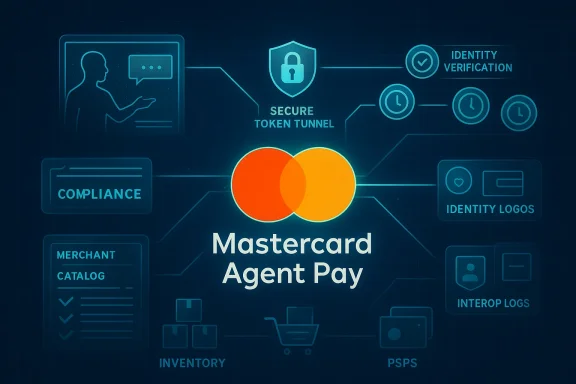
Mastercard’s public program for agentic commerce (branded as Mastercard Agent Pay) is an industry‑facing product and set of conventions that combine three practical elements:- Agentic tokens: Scoped, short‑lived tokenized credentials that allow an AI agent to initiate a payment without exposing raw card data. Tokens carry metadata about the agent, the merchant scope, and the permitted transaction envelope.
- Trusted agent registration and verification: A framework to register and authenticate agents so issuers, merchants and processors can distinguish authorized software from impostors. This is intended to reduce fraud and enable provenance tracking for agent‑initiated orders.
- Interoperability and partner integrations: Mastercard is positioning Agent Pay to plug into wallets and PSPs (for example, PayPal announced integration pilots) and to interoperate with major AI platform partners such as Microsoft, while vendors across the stack (processors, acquirers, marketplaces) pilot acceptance frameworks.
Why payments networks are racing to set rules
Payments networks have three structural reasons to lead here:- They control settlement rails. Who validates a transaction, who can settle it, and who can reverse it are core to payments; designing agentic payment semantics affects liability and reconciliation.
- They are trusted intermediaries for identity and fraud controls. Tokenization and issuer controls are natural extensions of existing anti‑fraud investments; they can also be a point of differentiation for cards vs. other payment options.
- They can shape commercial defaults. If networks standardize agent verification and token semantics, they influence how platforms design opt‑in/opt‑out behavior and how merchants negotiate placement economics within agentic discovery surfaces.
The technical anatomy — how agentic checkout will work in practice
The workhorse ecosystem partners describe are familiar to payments and platform engineers, but they are applied in new ways to the agentic context:- Scoped, ephemeral tokens. Tokens are issued with a merchant scope, agent identity and a short expiry window. They are single‑use or tightly bounded to reduce replay risk. This preserves PCI boundaries while letting agents request a settlement credential during a conversational flow.
- Agent identity and provenance trails. Transaction‑readable provenance records linking the agent’s prompts, the merchant feed record (SKU/GTIN), and the checkout token — crucial for audits, disputes and anti‑abuse measures.
- Canonical product feeds and cart semantics. Agents must rely on canonical, machine‑readable product data (GTINs, inventory counts, shipping windows) to avoid hallucinations and incorrect shipments; protocols propose standardized cart lifecycle events (create, update, validate, submit) so merchant systems understand agent actions.
- Delegated authorization / mandates. Some proposals use cryptographic authorization artifacts or “mandates” that specify what an agent is permitted to do on a cardholder’s behalf (spend limits, merchants allowed, authentication requirements). Google and others have explored analogous mandate concepts in related protocols.
Cross‑industry signals: who else is building what
Agentic commerce is not a Mastercard solo play. The ecosystem shows parallel standardization efforts:- Google and multiple partners unveiled proposals and protocols to standardize agentic checkout semantics and “mandates” that let agents act within defined boundaries. Acceptance by major marketplaces and PSPs gives these efforts momentum.
- Shopify, Microsoft and others have introduced Agentic Storefronts, Copilot Checkout, and open specifications meant to make merchant catalogs discoverable and shoppable by agents. Those initiatives emphasize canonical data, delegated tokens, and merchant‑preserving governance.
- Payment service providers and processors (Fiserv, Braintree, Checkout.com, PayPal) have announced integrations with network programs and acceptance frameworks to support agentic tokens and verification flows. These partnerships aim to let merchants accept agent‑initiated payments without rewriting settlement logic.
Strengths and immediate opportunities
Mastercard’s move has clear, tangible benefits if executed well:- Security alignment with existing rail controls. Tokenization and keep card networks central to settlement and dispute resolution, which reduces fragmentation risk for banks and merchants.
- r consumers. If agents can securely use pre‑authorized, scoped tokens, checkout becomes a one‑step confirmation inside a conversation — lowering abandonment and improving conversion when done responsibly.
- A standard for marketplaces and PSPs. Processor integrations that accept agentic tokens reduce involved merchants and accelerate adoption for sellers that want to appear in agentic surfaces.
- New product opportunities. Issuers and networks can offer differentiated agentic features — spending controls, loyalty integration, or premium “agentic security” tiers — that expand service offerings to cardholders and commercial customers.
Key risks and unresolved questions
The upside is real; the risks are equally material and deserve scrutiny.- Fraud and account takeover. AI agents could be hijacked or impersonated; token misuse and social engineering remain top threats unless agent identity verification and device‑level authentication are robust. Short‑lived tokens reduce exposure but do not eliminate attack surfaces.
- Operational mismatch and failed fulfillment. Agents may recommend items based on stale inventory or incorrect produ refunds, chargebacks and support overhead. Canonical product feeds are necessary but not sufficient — merchants must instrument reconciliatioalidation.
- Concentration and discoverability bias. If platforms favor merchants who integrate deeply (or pay for placement), recommendations co players, squeezing smaller merchants or long‑tail goods that aren’t “instant-buy” ready. That dynamic risks consolidating power with platform owners.
- **Legal and regonsumer protection regulators will examine disclosures for agentic recommendations, how consumers consent to agent authority, and liability for agent‑initiated transactions. Different jurisdictions may treat agentic authorization differently, complicating cross‑border rollouts.
- Opacity in measurement and vendor claims. Early vendor‑reported uplift figures are useful signals but must be validated with independent A/B tests; premature scale-ups based on optimistic metrics risk operational and reputational costs.
Practical readiness checklist for IT and merchant teams
Prepare now — a staged approach will reduce surprises:- Clean your catalog: Ensure GTINs, SKUs, inventory, weight/dimensions, return policies and high‑quality images are canonical and machine‑readable.
- Test token flows: Work with your PSP to validate token scope, expiry and refundxpired or replayed tokens and verify failure modes.
- Instrument provenance: Log agent prompts, agent identity metadata and the merchant St‑originated order so disputes can be audited.
- Harden fraud rules: Add agent‑aware velocity limits, device‑binding checks and step‑up authentication for high‑value
- Negotiate contract terms: Clarify opt‑in vs opt‑out mechanics, fee structures for in‑agent placements, and SLAs for dispute handling and refunds.
- Pilot small, analyze rigorously: Run controlled A/B tests with limited SKUs and instrument returns, disputes and customer satisfaction separately from web channels.
Regulatory and consumer‑protection considerations
Regulators are already focused on how AI changes disclosure and consent. Key areas likely to draw attention:- Clear disclosures that an AI agent is acting, whether recommendations are sponsored, and which party the consumer is contracting with.
- Consent mechanics for delegated spending: regulators will expect explicit, auditable consent flows and easy ways for consumers to revoke agent authority.
- Recordkeeping and audit trails for complaints and chargebacks: provenance logs will become mandatory evidence in disputes.
- Cross‑border compliance where tax, consumer protections and payments rules differ.
Adoption timeline and near‑term signals to watch
The ecosystem’s next 6–12 months will be revealing. Watch for:- Merchant participation rates and opt‑out behavior — high opt‑out suggests distrust or poor default mechanics; low opt‑out suggests rapid scale but greater governance risk.
- Independent performance studies measuring conversion lift, return and dispute rates, and customer satisfaction — vendor figures should be validated externally.
- Processor and network support — broader PSP integrations (Fiserv, Braintree, Checkout.com) are critical; announcements of production integrations accelerate merchant readiness.
- Regulatory guidance and enforcement actions — early guidance from consumer protection bodies or payments regulators will materially affect rollout speed and default behaviors.
Strategic verdict — pragmatic foundation, execution decides
Mastercard’s Agent Pay is a necessary and pragmatic move: payment rails need to adapt if agentic commerce is to scale safely. The program’s strengths are its alignment with tokenization, issuer visibility, and a partner‑centric rollout strategy that leverages wallets and PSPs.That said, the technical blueprint is only the beginning. Heavy lifting — data hygiene, dispute semantics, cross‑border tax handling, agent identity standards, and merchant governance — remains essential. Without rigorous telemetry, independent audits, and clear opt‑in/opt‑out guardrails, agentic commerce risks producing new kinds of fraud, unfair discoverability economics, and legal headaches that could slow adoption or invite regulatory intervention.
Bottom line for WindowsForum readers (IT decision makers, merchants and developers)
- Treat agentic commerce as a new channel that demands its own SLOs, security posture and operational playbook.
- Prioritize canonical data, token testing, and provenance logging now — these are the fundamentals that determine whether agentic revenue is reliable or corrosive.
- Demand transparency in placement economics and opt‑in defaults — merchant bargaining power is highest during pilots.
- Validate vendor uplift claims with controlled A/B tests and insist on auditor‑friendly telemetry for dispute resolution.
- Anticipate regulation: build consent revocation, clear labeling and auditable records into product workflows from day one.
Conclusion
The rise of agentic commerce forces a rethink of payments, identity and merchant governance. Mastercard’s Agent Pay is a credible attempt to design payment rails for an AI‑first world: tokenized credentials, agent verification and broad PSP integrations are the building blocks. Yet the transition from lab to ledger will be shaped as much by merchant readiness, independent validation of performance claims, and regulatory clarity as by the technical standard itself. The next year of pilots, audits and merchant rollouts will determine whether agentic commerce becomes a reliable new distribution channel — or a governance problem that regulators and merchants must painfully unwind.
Source: Axios Exclusive: Mastercard moves to set the rules for AI-driven commerce
