

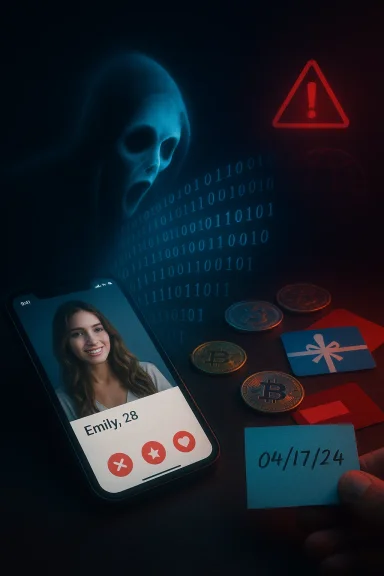
Matrimonial and dating platforms are fast becoming the new front line for financially devastating social‑engineering crimes: the Ministry of Home Affairs’ cyber‑unit has formally warned that fraudsters are using stolen photos, polished fake profiles and emotional grooming to push victims into investment and cryptocurrency schemes — and the pattern is now global, organised, and increasingly automated. s://www.etnownews.com/news/matrimonial-and-dating-platform-scams-using-these-apps-read-this-before-it-is-too-late-article-153576440)
Background / Overview
Matrimony and dating services were built to connect people, but they also provide the building blocks scammers need: demographic filters, personal photographs, employment and location cues, and a context where rapid trust can be formed. Indian authorities — through the National Cybercrime Threat Analytics Unit (NCTAU) at the Indian Cyber Crime Coordination Centre (I4C) under the Ministry of Home Affairs — have issued advisories describing a sharp rise in complaints where offenders create convincing personas and then convert emotional trust into cash transfers or crypto investments. The I4C and national helpline data show these alerts are reactive to a rising volume of reports on the National Cybercrime Reporting Portal and via the 1930 helpline.At the same time, international reporting and blockchain analytics trace a related criminal model — often called “pig‑butchering” — where romance and investment narratives are combined to create a long‑game fraud that funnels money into crypto accounts. Chainalysis and multiple financial commentators reported that revenue tied to those schemes grew sharply in 2024, while the FBI’s IC3 annual report shows investment fraud and crypto‑related losses are a major share of global reported losses. These are not isolated incidents; they are a convergent threat that exploits human vulnerability and modern payment rails.
How the scams work: anatomy of modern matrimonial/dating fraud
1. The profile — built to persuade
Scammers create profiles that match target demographics: age, income range, profession (often claiming to be NRIs, defence personnel or overseas professionals). They commonly use stolen photographs or morphed images persona. Reverse‑image checks often reveal the same picture across unrelated sites — a reliable early warning. The Indian advisory explicitly called out the use of stolen photos and fabricated backgrounds to simulate credibility.2. Grooming and emotional investment
Unlike a quick phishing email, these scams rely on time. Fraudsters invest in repeated chats, voice notes and staged video calls. Some use edited backdrops or synthetic video elements to create the impression of an overseas life. The objective is to create a psychological dependency so that monetary requests feel natural rather than suspicious. This is the essence of “pig‑butchering”: fatten the victim with attention, then harvest their savings via investment or emergency narratives.3. The pivot to money
Once trust is established, the scam morphs into one of two dominant scripts:- Emergency narrative: sudden medical bills, legal trouble, or travel problems that require instant funds.
- Investment narrative: the scammer claims to be trading crypto or forex and invites the victim to “invest.” Initial fabricated returns lure larger transfers until the victim’s funds are exhausted.
4. Disappearance and laundering
After funds move — often through exchanges, mixers and quick withdrawals — the scammer disappears or invents new obstacles (fake legal holds, verification fees) to extract more money. Recovery is hard, particularly once funds are converted to crypto and moved cross‑border. Chainalysis and law‑enforcement reports show recoveryws remain low.Why this wave is different now: technology + scale
- AI and deepfakes: Low‑cost AI tools can morph faces, generate convincing messages and even produce fake video snippets that pass casual inspection. Investigations show actors using face‑swap and synthetic video tools to deceive victims during live chats.
- Data fusion and scraping: Profiles and photos harvested from social media let criminals build rich, plausible personas quickly. Many users reuse images across platforms, which makes repackaging trivial.
- Crypto rails and mixers: Cryptocurrency provides speed and relative anonymity that fraudsters exploit. Chainalysis quantified a sharp increase in pig‑butchering deposits and revenue in 2024.
- Organised compounds and automation: Reporting indicates some operations are now industrialised: large call‑center–style farms, template scripts, and tasking that scales grooming across many victims simultaneously. Wired and other outlets have documented scam compounds in parts of Southeast Asia tied to romance and crypto fraud.
The numbers that matter
- The FBI’s Internet Crime Complaint Center recorded roughly 859,532 complaints and16 billion in losses in 2024 — with investment fraud and crypto‑related scams among the costliest categories.
- Chainalysis reported pig‑butchering (romance + investment scams) revenue rose by roughly 40% year‑on‑year in 2024, with a large increase in the number of deposits and victims.
- Indian authorities and major national outlets have documented a spike in matrimonial‑platform reports ons, prompting the MHA/I4C advisory and amplified public warnings.
Practical, verifiable steps every user should take — immediate checklist
- **Do a reverse imaofile photo that seems ‘too perfect’ or is used by someone who resists live checks. If the same image appears across unrelated sites, treat it as a red flag.
- Never send money to someone you have not met in person or verified through independent channels. Treat any financial request — even “to help with a short emergency” — as high risk.
- Refuse irreversible payment channels. Do not pay via cryptocurrency wallets, gift cards, or wire transfers for urgent, emotionally driven requests. These are the favourite rails for scammers.
- Insist on live, unique verification. Ask for a video call where the person performs a specific real‑time action (holding a handwritten note with the date). Consistent refusal is suspicious.
- Keep conversations inside the platform until you verify identity. Moving quickly to external messengers (WhatsApp, Telegram, SMS) is a common tactic to avoid platform moderation.
- Protect personal data. Never share copies of ID documents, bank details, Aadhaar/SSN numbers or tax documents with people you haven’t verified.
- Preserve evidence. If you suspect a scam, screenshot every message, record transaction receipts, and export chat logs. Early evidence increases chances of freeze/recovery.
- Report quickly. In India, use 1930 or the National Cybercrime Reporting Portal to file complaints; in the U.S. use IC3/FTC channels. Early reporting is essential for potential bank holds and tracing.
If you or someone you know is a victim — step‑by‑step response
- Stop all transfers immediately. Do not engage further with the scammer.
- Contact your bank or payment provider and request an urgent fraud investigation; ask them to place a hold or recall where possible.
- Preserve all evidence: screenshots, payment transaction IDs, account nameesses, emails and call logs.
- File an official complaint with the platform and the national cyber reporting portal (e.g., cybercrime.gov.in and helpline 1930 in India) and obtain complaint IDs.
- Report to law enforcement (local police and, where applicable, national agencies such as IC3 in the U.S.). Provide the evidtransaction receipts.
- If cryptocurrency was used, provide wallet addresses and timestamps to police; engage a trusted crypto‑forensics firm if recommended by authorities.
- Seek support for emotional harms — romance scams frequently leave victims feeling ashamed; connecting to victim‑support networks increases the chance of recovery and reduces isolation.
What platforms, banks and law enforcement must do — and where they’re falling short
- Platforms: verification badges, liveness checks and ID attestation help, but they are not foolproof. Verification signals that an image is genuine, not that the person’s story is true. Platforms must pair identity checks with behavioural detection — flagging grooming patterns like prolonged private messaging, repeated requests to move off‑platform, or fast escalation to investment talk.
- Banks and payment services: many fraudulent flows are enabled by insufficient transaction challenge protocols. Banks need better pattern detection for repeated small transfers preceding large withdrawals and for fast alerts when accounts send money to high‑risk crypto exchanges or mixers. Casework in theshown banks sometimes fail to connect the dots quickly enough.
- Law enforcement: cross‑border crypto flows require faster international cooperation and stronger technical partnerships with Recoveries are possible but time‑critical; joint public‑private action can improve success rates.
- Mandatory suspicious‑transaction reporting tied to known romance‑scam patterns.
- Standaring obligations to national cyber units to accelerate takedowns.
- Closer regulation and onboarding requirements for crypto on‑ and off‑ramps to reduce easy laundering paths.
Strengths in current responses — and the remaining gaps
Notable strengths:- Public advisories from national agencies (I4C/MHA in India) and active helplines (1930) are improving public visibility of the threat and providing clear reporting channels.
- Crypto‑forensics firms and international agencies are improving methods to trace scam proceeds on‑chain and identify weak links in exchange compliance. Chainalysis’ reporting has helped drive policy and law‑enforcement focus on pig‑butchering.
- Some platforms have instituted robust verification tools and proactive moderation, which raise the bar for casual scammers.
- Verification is not identity proof. Verified photos or IDs can be stolen or synthetically generated; liveness checks can be defeated by manipulated video tools.
- Speed and anonymity of crypto transfers still outpace most reconds are commingled and exchanged, recovery complexity explodes.
- Victim under‑reporting and stigma obscure true scale. People often delay reporting due to shame, which reduces recovery probability and degrades intelligence for pattern detection.
A measured, four‑part defence strategy for individuals and institutions
- Personal hygiene: strong passwords, 2FA, limited public profile data, reverse image checks and scepticism about rapid intimacy online.
- Platform responsibility: verification plus behavioural moderation, easy in‑app reporting flows, and mandatory red‑flag notifications for suspicious investment talk.
- Financial controls: banks should implement rapid‑response holds for suspected romance‑scam flows and mandatory escalation paths for high‑risk transfers to crypto or gift‑card purchases.
- Policy and cooperation: standardised reporting, international crypto compliance push, and sustained public education that focuses on behaviour — not just awareness — to mitigate “attention fatigue.”
Red flags — rapid checklist (if you only remember five things)
- Refusal to meet or provide live, specific verification.
- Pressure to move conversation off the dating/matrimony platform quickly.
- Requests for money using cryptocurrency, gift cards, or wire transfer.
- Promises of guaranteed, unusually high returns on “investments.”
- Profile photos that appear on multiple unrelated websites.
What claims are still uncertain or require verification
A caution on media summaries: specific numeric breakdowns (e.g., exact counts attributed to matrimonial platforms, or per‑country percentages in survey releases) are sometimes presented without underlying datasets. Where precise confidence intervals or raw survey methodology are not public, treat single‑figure headlines with care. I4C and national police bulletins give operational counts and advice; Chainalysis and FBI data provide complementary systemic numbers, but direct one‑to‑one attribution between a single platform and a chunk of global loss is rarely provable from public sources alone. Always check the methodology when a headline gives a precise metric.Final verdict: vigilance, not panic
The MHA/I4C advisory and corroborating international data make one thing clear: matrimonial and dating platforms are a high‑risk surface for organised financial fraud. The combination of emotional trust and irreversible payment rails has created a profitable criminal model that scales quickly. But this is not an unsolvable problem. Practical user behaviours, better platform moderation, stronger bank response protocols and international cooperation on tracing crypto flows will reduce harm. For users: stay sceptical, verify carefully, and report early. That hesitation you feel when something doesn’t add up is often the single most effective defence.If you use these services, apply the checklist in this article today: reverse‑image the photos, insist on live proof, refuse off‑platform payments, and keep your financial life separate from people you have not verified in person. When in doubt, report to your platform and the national cyber reporting channel — in India call 1930 or use the National Cybercrime Reporting Portal; where you are, use your country’s official online crime reporting systems. Early action saves both money and dignity.
Source: ET Now Matrimonial & dating platform scams: Using these apps? Read this before it’s too late
