

On July 3, 2026, Microsoft published a customer story describing how Türkiye’s Medicana Health Group built a custom Patient Experience Platform on Microsoft Power Platform with partner Parlon Solutions. The headline number is attractive: reporting time cut by as much as 90 percent, case resolution time improved by 50 percent, and feedback unified across 19 hospitals. But the more important story is not that low-code made healthcare software “easy.” It is that Medicana’s project shows where low-code is becoming serious enterprise middleware: not replacing complexity, but giving organizations a more manageable place to put it.
That distinction matters. Healthcare is where every lazy digital-transformation cliché goes to die. A hospital group cannot simply “move fast” when patient complaints, regulatory expectations, employee identities, access controls, third-party systems, and clinical-adjacent workflows all collide. Medicana’s experience is a useful case study precisely because it sounds messy, specific, and inconvenient — which is usually how real enterprise IT sounds before the slide deck gets polished.
Medicana’s problem was not a lack of data. It had too much of it, arriving through too many doors: SMS surveys, QR codes, email, websites, call centers, customer review platforms, and in-person patient experience offices. That is the modern customer experience problem in a healthcare wrapper: every channel promises convenience, and every channel creates another place where work can disappear.
The organization had grown into a network of 19 hospitals, including three medical clinics, with 10,000 employees and more than five million patients annually. At that scale, patient feedback is not a comments box. It is operational telemetry, risk signal, reputational early warning, and, sometimes, the first trace of a service failure that needs a human response.
Microsoft’s customer story says the old process involved disconnected systems, local Excel files, paper workflows, and manual consolidation. That combination will be instantly familiar to WindowsForum readers who have inherited departmental tooling that began as a quick spreadsheet and ended as a shadow ERP. The surprise is not that the process became fragile; the surprise is how long organizations can operate on such arrangements before the pain becomes impossible to ignore.
The off-the-shelf route apparently failed Medicana’s smell test because the group’s workflows were too department-specific. That is where Power Platform fits Microsoft’s broader enterprise argument. Power Apps, Power Automate, Dataverse, Power BI, SharePoint, Dynamics 365, Microsoft 365, and Copilot Studio are not being sold merely as separate products. They are being sold as a fabric for rebuilding the awkward middle layer between monolithic enterprise systems and the people who actually have to get work done.
The problem is that these bridges rarely remain temporary. A spreadsheet becomes a report. A report becomes a workflow. A workflow becomes an accountability mechanism. Eventually, someone realizes that the organization’s understanding of patient complaints depends on a file stored in the wrong place, maintained by a few overburdened people, and manually stitched together with data from systems that were never designed to agree with each other.
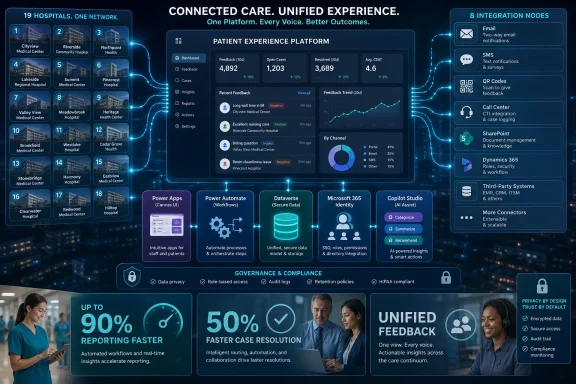
Medicana’s quoted pain points are revealing because they are not exotic. The group needed role-sensitive access for call center staff, patient rights teams, quality control, and board-level users. It needed to identify employees uniquely even when one person could work across multiple locations. It needed to bring in messages from multiple email channels and call center employees. It needed to integrate eight systems, including internal platforms and third-party providers.
None of this is glamorous. All of it is where enterprise projects succeed or fail. The difference between a digital platform and an expensive form is whether it can survive these identity, workflow, routing, and reporting details without requiring a heroic workaround every week.
This is where the Medicana story is stronger than many vendor case studies. It does not imply that a few citizen developers clicked together a hospital-wide patient experience platform over a long weekend. Instead, it names the implementation partner, Parlon Solutions, and acknowledges that the architecture had to be carefully thought through.
That matters for IT departments. Low-code is sometimes presented as a bypass around professional developers and system administrators. In mature environments, it is more often a collaboration layer. Business teams can express workflows faster, process owners can validate interfaces sooner, and IT can focus on governance, data modeling, integration, security, and lifecycle management.
Medicana used Power Apps, particularly Canvas Apps, to create a tailored user experience. It used Power Automate, Dataverse Web APIs, and custom connectors to bring together patient feedback channels. SharePoint handled document management, Power BI handled dashboards, Dynamics 365 Finance and Operations contributed role-based access and workflow forwarding, and Copilot Studio helped categorize incoming feedback.
That is not “an app.” It is a composite system. The lesson is not that low-code is simple; the lesson is that low-code has become one of Microsoft’s preferred ways to assemble complex systems without starting every layer from scratch.
The new platform reportedly gives staff real-time access to patient feedback across hospitals and departments. That is the operational prize. A patient complaint is not very useful if it becomes visible only after a weekly report is manually assembled, checked, forwarded, and discussed. By then, the patient has already formed an opinion, the staff involved may have moved on, and the organization has lost the chance to respond while the issue is still fresh.
The reporting improvement is dramatic: Microsoft says a consolidated report that previously required 17 employees and four to five hours can now be completed in about 30 minutes. That is the sort of number that sells projects, but it also deserves a sober reading. The value is not merely labor savings. It is cadence.
When reporting takes half a day and depends on 17 people, it becomes an event. When it takes 30 minutes, it can become part of management rhythm. That changes what the organization can ask of its data. Instead of asking, “What happened last week?” it can ask, “What is happening now, and who needs to act?”
Classification and triage are not trivial. In a high-volume environment, the first few minutes of a case can determine whether it reaches the right team or languishes in the wrong queue. If an AI-assisted layer reduces manual sorting and improves prioritization, it can make the human support process more responsive without pretending to replace it.
The key is that Medicana’s AI use appears embedded in a workflow rather than bolted on as a novelty. The feedback arrives, the system categorizes it, the case moves, dashboards update, and staff work from a shared platform. AI is not the product; it is one mechanism inside the product.
That is also where healthcare organizations should remain cautious. Patient feedback can contain sensitive personal data, emotional context, and complaints that require careful handling. Automated categorization can accelerate work, but it must be governed, audited, and corrected when wrong. The more consequential the routing decision, the more important it becomes to know whether the system is assisting a human or quietly making a decision no one reviews.
Merve Gurkan, a group manager at Medicana, is quoted as saying she was nervous at first but became comfortable within a couple of days. That is the sort of anecdote vendors love, but it points to a serious design constraint. In healthcare operations, a system that requires extensive retraining can become its own operational risk. The interface has to match how departments work, or users will recreate the old workaround outside the system.
Canvas Apps likely helped here because they allow builders to design highly tailored interfaces rather than forcing every process into a generic application frame. That flexibility is also dangerous if unmanaged. Without standards, low-code estates can become a sprawl of inconsistent apps, duplicated logic, unclear ownership, and fragile dependencies.
Medicana’s use of a partner and a group-wide design suggests a more controlled approach. The real governance question is what happens next: who owns the platform, how changes are requested, how connectors are monitored, how data access is reviewed, and how the system is tested when underlying Microsoft services change. Successful low-code projects do not end at launch. They become products, and products need owners.
Employee identity was one sticking point because one person could work in multiple locations. That sounds like a small data-modeling issue until you consider what it means for access, routing, accountability, reporting, and escalation. If the system cannot correctly understand who someone is, where they work, and what they are allowed to see or do, every downstream workflow becomes suspect.
Email was another messy input. Feedback arriving through various channels and individual call center employees is common in service organizations, and it is also a governance nightmare. Messages can be missed, duplicated, forwarded informally, or handled outside the official process. Pulling those channels into a shared platform is not just an efficiency play; it is a control play.
Custom connectors and Dataverse Web APIs are doing the less glamorous work here. They are the plumbing that lets Power Platform participate in a heterogeneous environment rather than only in a Microsoft-only demo tenant. For Windows and Microsoft 365 administrators, that is the practical edge: Power Platform’s value rises sharply when it can bridge legacy systems, third-party services, and Microsoft cloud identity without forcing a wholesale replacement of everything already deployed.
A partner that understands project management, healthcare operations, and Power Platform patterns can help translate departmental reality into a maintainable architecture. That is especially important when a system spans call centers, patient rights, quality control, hospital departments, and executive reporting. Each group wants a workflow that feels natural. The platform still needs shared data definitions, security boundaries, and a coherent operating model.
The danger for other organizations is to copy the product list without copying the discipline. Buying Power Apps, Power Automate, and Copilot Studio does not create a patient experience platform. It creates the possibility of one. The difference is process mapping, governance, integration design, data stewardship, training, and the willingness to say no to features that would make the system less maintainable.
Microsoft benefits when these stories appear to validate the platform as an enterprise standard. Customers should read them with a different lens. The question is not “Can Power Platform do this?” Increasingly, the answer is yes. The better question is “Do we have the operating model to own what we build?”
That does not mean every patient experience tool is a clinical system. Medicana’s platform, as described, is focused on feedback, workflows, reporting, and operational response. But healthcare’s sensitivity changes the expectations around privacy, auditability, access, and escalation. The same system that makes it easier to see feedback across departments must also make it harder for the wrong people to see the wrong information.
Role-based access is therefore not a feature checkbox. It is the foundation. Medicana’s need to serve call center staff, patient rights teams, quality control, and board members from the same platform illustrates the access-control challenge clearly. The board needs visibility; a call center agent needs actionability; a quality team needs patterns; patient rights staff need case detail. Those are not the same views, and they should not carry the same permissions.
For IT pros, this is where Microsoft’s stack can be both powerful and complicated. Entra identity, Microsoft 365 access patterns, Dataverse security roles, Dynamics data, SharePoint permissions, Power BI sharing, and connector policies all need to align. A user-friendly interface does not reduce the need for serious administrative design underneath it.
This strategy is especially attractive in sectors where standard software rarely matches reality. Healthcare groups, manufacturers, municipalities, universities, and regulated service organizations all have workflows shaped by local history, compliance obligations, acquisitions, geography, and legacy systems. A generic product can cover 70 percent of the process and still fail because the remaining 30 percent is where the institution’s actual operating model lives.
Power Platform’s promise is that the last mile can be built without commissioning a traditional custom software project for every departmental need. That is a compelling proposition. It is also why licensing, governance, and architecture decisions matter so much. A composable enterprise can become agile, or it can become a junk drawer.
Microsoft’s addition of Copilot Studio and AI agents sharpens the bet. Once data and workflows sit in Dataverse, Power Automate, Dynamics, and Microsoft 365, AI tools have more context and more places to act. That is the strategic logic behind “activating enterprise data” for copilots: the more work that flows through Microsoft’s business application layer, the more useful Microsoft’s AI layer can become.
For customers, the bargain is clear. Microsoft offers integration and acceleration. In return, the organization deepens its dependence on Microsoft’s cloud architecture, licensing model, governance tooling, and product roadmap. That may be a good trade. It is still a trade.
How will Medicana measure classification accuracy for AI-routed feedback? How often will role mappings be reviewed as employees change locations or responsibilities? What happens when a third-party system changes its API? Who approves changes to workflows that cross departments? How are Power Automate flows monitored for failures? What is the disaster recovery plan if a critical connector breaks?
These are not gotchas. They are the ordinary questions that determine whether a successful launch becomes a durable platform. Enterprise software history is littered with systems that worked beautifully at go-live and decayed as business rules changed, owners moved on, and integrations aged.
The hopeful sign is that Medicana appears to see the platform as a foundation rather than a finished destination. Microsoft says the group plans to extend the platform with social listening from channels such as Instagram and WhatsApp, use AI-driven agents to automate more patient interaction, and analyze trends in feedback to anticipate issues earlier. That roadmap makes sense, but it also increases the governance burden.
Social channels bring messier data. AI agents bring higher expectations and greater risk of inappropriate automation. Predictive insights can help leaders spot patterns earlier, but they can also create false confidence if the underlying data is incomplete or biased toward the channels most likely to be captured. The platform’s next phase will test whether Medicana can expand capability without diluting control.
Power Platform environments need data loss prevention policies. Connectors need approval. Service accounts and app registrations need scrutiny. SharePoint document libraries become part of application architecture. Power BI workspaces become executive reporting surfaces. Copilot Studio agents introduce new questions about data access, response quality, and user trust.
That means the boundary between “business app” and “IT system” is eroding. A patient experience app built in Power Platform may look like a departmental solution, but it depends on tenant-wide identity, security, compliance, and monitoring decisions. If IT treats it as someone else’s app, the organization inherits risk. If IT smothers it with traditional project controls, the business loses the speed that made the platform attractive in the first place.
The winning posture is somewhere in the middle: governed enablement. IT sets the rails, monitors the environment, defines security and data policies, and provides reusable patterns. Business teams and partners build within those rails. Medicana’s story is a reminder that low-code success is not an argument against IT involvement. It is an argument for a different kind of IT involvement.
That distinction matters. Healthcare is where every lazy digital-transformation cliché goes to die. A hospital group cannot simply “move fast” when patient complaints, regulatory expectations, employee identities, access controls, third-party systems, and clinical-adjacent workflows all collide. Medicana’s experience is a useful case study precisely because it sounds messy, specific, and inconvenient — which is usually how real enterprise IT sounds before the slide deck gets polished.
 Microsoft’s Low-Code Pitch Meets the Hospital Back Office
Medicana’s problem was not a lack of data. It had too much of it, arriving through too many doors: SMS surveys, QR codes, email, websites, call centers, customer review platforms, and in-person patient experience offices. That is the modern customer experience problem in a healthcare wrapper: every channel promises convenience, and every channel creates another place where work can disappear.The organization had grown into a network of 19 hospitals, including three medical clinics, with 10,000 employees and more than five million patients annually. At that scale, patient feedback is not a comments box. It is operational telemetry, risk signal, reputational early warning, and, sometimes, the first trace of a service failure that needs a human response.
Microsoft’s customer story says the old process involved disconnected systems, local Excel files, paper workflows, and manual consolidation. That combination will be instantly familiar to WindowsForum readers who have inherited departmental tooling that began as a quick spreadsheet and ended as a shadow ERP. The surprise is not that the process became fragile; the surprise is how long organizations can operate on such arrangements before the pain becomes impossible to ignore.
The off-the-shelf route apparently failed Medicana’s smell test because the group’s workflows were too department-specific. That is where Power Platform fits Microsoft’s broader enterprise argument. Power Apps, Power Automate, Dataverse, Power BI, SharePoint, Dynamics 365, Microsoft 365, and Copilot Studio are not being sold merely as separate products. They are being sold as a fabric for rebuilding the awkward middle layer between monolithic enterprise systems and the people who actually have to get work done.
The Spreadsheet Was a Symptom, Not the Disease
It is fashionable to sneer at Excel-driven operations, but Excel is usually not the villain. It is the pressure valve. When central IT cannot deliver a system quickly enough, when a vendor product cannot match the workflow, or when the budget cycle moves slower than the department’s needs, staff build their own bridge.The problem is that these bridges rarely remain temporary. A spreadsheet becomes a report. A report becomes a workflow. A workflow becomes an accountability mechanism. Eventually, someone realizes that the organization’s understanding of patient complaints depends on a file stored in the wrong place, maintained by a few overburdened people, and manually stitched together with data from systems that were never designed to agree with each other.
Medicana’s quoted pain points are revealing because they are not exotic. The group needed role-sensitive access for call center staff, patient rights teams, quality control, and board-level users. It needed to identify employees uniquely even when one person could work across multiple locations. It needed to bring in messages from multiple email channels and call center employees. It needed to integrate eight systems, including internal platforms and third-party providers.
None of this is glamorous. All of it is where enterprise projects succeed or fail. The difference between a digital platform and an expensive form is whether it can survive these identity, workflow, routing, and reporting details without requiring a heroic workaround every week.
Power Platform Wins When It Stops Pretending to Be Simple
The most interesting quote in Microsoft’s write-up comes from Yalın Yüksel, Medicana’s Power Platform Solution Architect, who says the integration process was the biggest challenge and that the project “seemed like an impossible task.” That is not the language of drag-and-drop fantasy. It is the language of enterprise integration, where low-code does not remove hard problems so much as change who can participate in solving them.This is where the Medicana story is stronger than many vendor case studies. It does not imply that a few citizen developers clicked together a hospital-wide patient experience platform over a long weekend. Instead, it names the implementation partner, Parlon Solutions, and acknowledges that the architecture had to be carefully thought through.
That matters for IT departments. Low-code is sometimes presented as a bypass around professional developers and system administrators. In mature environments, it is more often a collaboration layer. Business teams can express workflows faster, process owners can validate interfaces sooner, and IT can focus on governance, data modeling, integration, security, and lifecycle management.
Medicana used Power Apps, particularly Canvas Apps, to create a tailored user experience. It used Power Automate, Dataverse Web APIs, and custom connectors to bring together patient feedback channels. SharePoint handled document management, Power BI handled dashboards, Dynamics 365 Finance and Operations contributed role-based access and workflow forwarding, and Copilot Studio helped categorize incoming feedback.
That is not “an app.” It is a composite system. The lesson is not that low-code is simple; the lesson is that low-code has become one of Microsoft’s preferred ways to assemble complex systems without starting every layer from scratch.
The Real Product Is the Single Source of Truth
Every enterprise platform eventually claims to create a single source of truth. The phrase is overused because the need is real. Medicana’s old process created a familiar visibility problem: if patient feedback lives in disconnected tools and local files, leadership sees the business through a delay, and front-line teams work from partial information.The new platform reportedly gives staff real-time access to patient feedback across hospitals and departments. That is the operational prize. A patient complaint is not very useful if it becomes visible only after a weekly report is manually assembled, checked, forwarded, and discussed. By then, the patient has already formed an opinion, the staff involved may have moved on, and the organization has lost the chance to respond while the issue is still fresh.
The reporting improvement is dramatic: Microsoft says a consolidated report that previously required 17 employees and four to five hours can now be completed in about 30 minutes. That is the sort of number that sells projects, but it also deserves a sober reading. The value is not merely labor savings. It is cadence.
When reporting takes half a day and depends on 17 people, it becomes an event. When it takes 30 minutes, it can become part of management rhythm. That changes what the organization can ask of its data. Instead of asking, “What happened last week?” it can ask, “What is happening now, and who needs to act?”
AI Is Useful Here Because the Workflow Already Exists
Copilot Studio’s role in the Medicana story is narrow but important. Microsoft says AI capabilities help categorize incoming patient feedback as a complaint, suggestion, or appreciation, then route it to the appropriate team. That is exactly the kind of AI use case that deserves more attention than grander promises about autonomous enterprise reinvention.Classification and triage are not trivial. In a high-volume environment, the first few minutes of a case can determine whether it reaches the right team or languishes in the wrong queue. If an AI-assisted layer reduces manual sorting and improves prioritization, it can make the human support process more responsive without pretending to replace it.
The key is that Medicana’s AI use appears embedded in a workflow rather than bolted on as a novelty. The feedback arrives, the system categorizes it, the case moves, dashboards update, and staff work from a shared platform. AI is not the product; it is one mechanism inside the product.
That is also where healthcare organizations should remain cautious. Patient feedback can contain sensitive personal data, emotional context, and complaints that require careful handling. Automated categorization can accelerate work, but it must be governed, audited, and corrected when wrong. The more consequential the routing decision, the more important it becomes to know whether the system is assisting a human or quietly making a decision no one reviews.
Adoption Was the Quiet Test
The Microsoft story emphasizes that staff accessed the platform through a Microsoft 365 and intranet-based experience, avoiding multiple usernames and reducing friction. That may sound mundane, but it is one of the reasons Microsoft remains so hard to dislodge in enterprise environments. The shortest path to adoption is often through the identity, productivity, and collaboration tools employees already use.Merve Gurkan, a group manager at Medicana, is quoted as saying she was nervous at first but became comfortable within a couple of days. That is the sort of anecdote vendors love, but it points to a serious design constraint. In healthcare operations, a system that requires extensive retraining can become its own operational risk. The interface has to match how departments work, or users will recreate the old workaround outside the system.
Canvas Apps likely helped here because they allow builders to design highly tailored interfaces rather than forcing every process into a generic application frame. That flexibility is also dangerous if unmanaged. Without standards, low-code estates can become a sprawl of inconsistent apps, duplicated logic, unclear ownership, and fragile dependencies.
Medicana’s use of a partner and a group-wide design suggests a more controlled approach. The real governance question is what happens next: who owns the platform, how changes are requested, how connectors are monitored, how data access is reviewed, and how the system is tested when underlying Microsoft services change. Successful low-code projects do not end at launch. They become products, and products need owners.
Eight Integrations Tell the Story Better Than the Dashboard
The most revealing detail in the case study is that Medicana had to integrate eight systems. That number is not enormous by enterprise standards, but it is enough to expose the central truth of digital transformation: the front end is usually the easy part. The hard part is reconciling identities, permissions, data quality, process exceptions, and third-party dependencies.Employee identity was one sticking point because one person could work in multiple locations. That sounds like a small data-modeling issue until you consider what it means for access, routing, accountability, reporting, and escalation. If the system cannot correctly understand who someone is, where they work, and what they are allowed to see or do, every downstream workflow becomes suspect.
Email was another messy input. Feedback arriving through various channels and individual call center employees is common in service organizations, and it is also a governance nightmare. Messages can be missed, duplicated, forwarded informally, or handled outside the official process. Pulling those channels into a shared platform is not just an efficiency play; it is a control play.
Custom connectors and Dataverse Web APIs are doing the less glamorous work here. They are the plumbing that lets Power Platform participate in a heterogeneous environment rather than only in a Microsoft-only demo tenant. For Windows and Microsoft 365 administrators, that is the practical edge: Power Platform’s value rises sharply when it can bridge legacy systems, third-party services, and Microsoft cloud identity without forcing a wholesale replacement of everything already deployed.
The Partner Is Part of the Architecture
Medicana’s executives repeatedly emphasize the role of Parlon Solutions, and that should not be brushed aside as procurement politeness. Low-code does not eliminate implementation expertise. In some cases, it makes that expertise more important because the platform lowers the barrier to building, which can increase the risk of building the wrong thing quickly.A partner that understands project management, healthcare operations, and Power Platform patterns can help translate departmental reality into a maintainable architecture. That is especially important when a system spans call centers, patient rights, quality control, hospital departments, and executive reporting. Each group wants a workflow that feels natural. The platform still needs shared data definitions, security boundaries, and a coherent operating model.
The danger for other organizations is to copy the product list without copying the discipline. Buying Power Apps, Power Automate, and Copilot Studio does not create a patient experience platform. It creates the possibility of one. The difference is process mapping, governance, integration design, data stewardship, training, and the willingness to say no to features that would make the system less maintainable.
Microsoft benefits when these stories appear to validate the platform as an enterprise standard. Customers should read them with a different lens. The question is not “Can Power Platform do this?” Increasingly, the answer is yes. The better question is “Do we have the operating model to own what we build?”
Healthcare Makes the Stakes Less Abstract
In retail or hospitality, a customer feedback platform can improve service and protect revenue. In healthcare, patient experience has a sharper edge. A complaint may be about wait times, billing, communication, staff behavior, facilities, or confusion about a care journey. Some feedback will be routine. Some may be a sign that a process is failing in a way that affects safety, trust, or continuity of care.That does not mean every patient experience tool is a clinical system. Medicana’s platform, as described, is focused on feedback, workflows, reporting, and operational response. But healthcare’s sensitivity changes the expectations around privacy, auditability, access, and escalation. The same system that makes it easier to see feedback across departments must also make it harder for the wrong people to see the wrong information.
Role-based access is therefore not a feature checkbox. It is the foundation. Medicana’s need to serve call center staff, patient rights teams, quality control, and board members from the same platform illustrates the access-control challenge clearly. The board needs visibility; a call center agent needs actionability; a quality team needs patterns; patient rights staff need case detail. Those are not the same views, and they should not carry the same permissions.
For IT pros, this is where Microsoft’s stack can be both powerful and complicated. Entra identity, Microsoft 365 access patterns, Dataverse security roles, Dynamics data, SharePoint permissions, Power BI sharing, and connector policies all need to align. A user-friendly interface does not reduce the need for serious administrative design underneath it.
Microsoft’s Bigger Bet Is the Composable Enterprise
The Medicana project fits a larger Microsoft strategy: make the Microsoft cloud the place where organizations compose their own industry-specific systems. Instead of selling only finished applications, Microsoft sells the platform parts: data store, workflow engine, app builder, analytics layer, document repository, identity integration, and AI agent tooling.This strategy is especially attractive in sectors where standard software rarely matches reality. Healthcare groups, manufacturers, municipalities, universities, and regulated service organizations all have workflows shaped by local history, compliance obligations, acquisitions, geography, and legacy systems. A generic product can cover 70 percent of the process and still fail because the remaining 30 percent is where the institution’s actual operating model lives.
Power Platform’s promise is that the last mile can be built without commissioning a traditional custom software project for every departmental need. That is a compelling proposition. It is also why licensing, governance, and architecture decisions matter so much. A composable enterprise can become agile, or it can become a junk drawer.
Microsoft’s addition of Copilot Studio and AI agents sharpens the bet. Once data and workflows sit in Dataverse, Power Automate, Dynamics, and Microsoft 365, AI tools have more context and more places to act. That is the strategic logic behind “activating enterprise data” for copilots: the more work that flows through Microsoft’s business application layer, the more useful Microsoft’s AI layer can become.
For customers, the bargain is clear. Microsoft offers integration and acceleration. In return, the organization deepens its dependence on Microsoft’s cloud architecture, licensing model, governance tooling, and product roadmap. That may be a good trade. It is still a trade.
The Numbers Are Strong, But the Maintenance Story Comes Next
The reported results are impressive: 85 to 90 percent improvement in consolidating reports, 50 percent improvement in case solve duration, real-time dashboards, and better collaboration across 19 hospitals. Those are the numbers that will travel through Microsoft presentations. They should also prompt the next set of questions.How will Medicana measure classification accuracy for AI-routed feedback? How often will role mappings be reviewed as employees change locations or responsibilities? What happens when a third-party system changes its API? Who approves changes to workflows that cross departments? How are Power Automate flows monitored for failures? What is the disaster recovery plan if a critical connector breaks?
These are not gotchas. They are the ordinary questions that determine whether a successful launch becomes a durable platform. Enterprise software history is littered with systems that worked beautifully at go-live and decayed as business rules changed, owners moved on, and integrations aged.
The hopeful sign is that Medicana appears to see the platform as a foundation rather than a finished destination. Microsoft says the group plans to extend the platform with social listening from channels such as Instagram and WhatsApp, use AI-driven agents to automate more patient interaction, and analyze trends in feedback to anticipate issues earlier. That roadmap makes sense, but it also increases the governance burden.
Social channels bring messier data. AI agents bring higher expectations and greater risk of inappropriate automation. Predictive insights can help leaders spot patterns earlier, but they can also create false confidence if the underlying data is incomplete or biased toward the channels most likely to be captured. The platform’s next phase will test whether Medicana can expand capability without diluting control.
The WindowsForum Angle Is the Admin Layer Nobody Sees
For WindowsForum’s core audience, this story is less about hospitals in Türkiye and more about the direction of Microsoft-centered IT. The modern Windows estate is no longer just endpoints, Group Policy memories, Intune profiles, and Microsoft 365 administration. Increasingly, the business process layer is moving into tools that sit adjacent to those admin responsibilities.Power Platform environments need data loss prevention policies. Connectors need approval. Service accounts and app registrations need scrutiny. SharePoint document libraries become part of application architecture. Power BI workspaces become executive reporting surfaces. Copilot Studio agents introduce new questions about data access, response quality, and user trust.
That means the boundary between “business app” and “IT system” is eroding. A patient experience app built in Power Platform may look like a departmental solution, but it depends on tenant-wide identity, security, compliance, and monitoring decisions. If IT treats it as someone else’s app, the organization inherits risk. If IT smothers it with traditional project controls, the business loses the speed that made the platform attractive in the first place.
The winning posture is somewhere in the middle: governed enablement. IT sets the rails, monitors the environment, defines security and data policies, and provides reusable patterns. Business teams and partners build within those rails. Medicana’s story is a reminder that low-code success is not an argument against IT involvement. It is an argument for a different kind of IT involvement.
The Medicana Build Shows Where Low-Code Is Growing Up
Medicana’s project is not a universal template, but it gives IT leaders a concrete picture of how Microsoft wants Power Platform to be used in serious operational settings. The platform is most convincing when it unifies fragmented work, reduces manual reporting, and gives staff a workflow that reflects reality rather than vendor assumptions.- Medicana built a custom Patient Experience Platform on Microsoft Power Platform to consolidate patient feedback across 19 hospitals and multiple intake channels.
- The project integrated eight systems, including internal platforms and third-party providers, which made identity, routing, and workflow design central to the implementation.
- Power Apps, Power Automate, Dataverse, SharePoint, Power BI, Dynamics 365 Finance and Operations, Microsoft 365, and Copilot Studio each handled a different layer of the solution.
- Microsoft reports that consolidated reporting fell from a four-to-five-hour process involving 17 employees to roughly 30 minutes.
- The use of Copilot Studio for categorizing feedback is a practical AI deployment because it supports an existing workflow rather than trying to replace the human service model wholesale.
- The next challenge is governance, because expanding into social listening, AI agents, and predictive insight will make access control, auditing, and lifecycle management more important rather than less.
References
- Primary source: Microsoft
Published: 2026-07-03T11:30:22.713136
Medicana builds a bespoke patient experience solution on Microsoft Power Platform | Microsoft Customer Stories
Medicana unified patient feedback on Microsoft Power Platform, delivering real-time insights, faster response times, and AI-supported patient care.www.microsoft.com
