

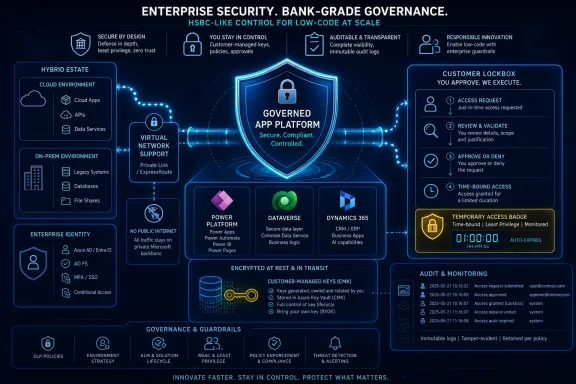
On May 27, 2026, Microsoft published a customer story describing how HSBC uses Microsoft Power Platform, Dynamics 365, Dataverse, virtual network support, customer-managed keys, and Customer Lockbox to secure low-code innovation across regulated banking workloads in more than 50 markets. The announcement is not just another enterprise case study with a familiar cloud-transformation gloss. It is Microsoft’s clearest pitch yet that Power Platform is no longer merely a productivity layer for citizen developers, but a governed application platform that can survive scrutiny from one of the world’s most security-conscious industries.
That matters because low-code has always carried a tension inside large enterprises. The very thing that makes it valuable — letting business experts build and automate without waiting months for central IT — is also what makes security teams nervous. HSBC’s use of Power Platform is a test case for whether Microsoft can turn that tension into an architecture: faster internal innovation, but with controls strong enough for banking.
For years, Power Platform’s appeal was easy to understand. It gave departments a way to build forms, workflows, dashboards, automations, and line-of-business apps without submitting every request to a traditional software backlog. In a bank, that promise is especially powerful because the distance between a business pain point and a production-grade internal tool can be painfully long.
But financial institutions do not adopt platforms because they are convenient. They adopt them because the convenience can be wrapped in auditability, identity controls, encryption, data-loss boundaries, and network governance. Microsoft’s HSBC story is therefore less about “citizen development” than about the harder sell: low-code as an enterprise substrate for regulated work.
That is a meaningful shift in tone. Microsoft is not positioning Power Platform as a shadow-IT antidote in the abstract; it is arguing that the platform can support controlled innovation by employees closest to the operational problems while still giving central security teams a defensible model. HSBC becomes the proof point because banking is where casual claims about trust tend to die quickly.
The phrase secure innovation is overused in enterprise marketing, but in this context it has a concrete meaning. HSBC wants subject-matter experts to solve problems without creating uncontrolled paths for sensitive data to leave protected systems. Microsoft wants to show that Power Platform can be the place where those competing demands meet.
Microsoft says Virtual Network support allows Power Platform integrations to use private networking rather than routing over the public internet. For HSBC, that means some connections that would be unacceptable or impractical over public paths can instead be handled through a more controlled network design. It also reduces the need to install and maintain gateways, which have historically been one of the operational compromises in hybrid and private connectivity scenarios.
This is the kind of feature that rarely excites casual users but changes the conversation in enterprise architecture reviews. A Power App that only manipulates test data is one thing. A Power Platform workload touching real banking processes, customer records, or regulated operational data is another. Private connectivity gives security architects more ways to say “yes” without pretending risk has disappeared.
The bank’s emphasis on delegated subnet sizing, performance, and utilization also matters. At small scale, network controls can be treated as configuration. At HSBC scale, they become capacity planning. A private path that bottlenecks or becomes hard to monitor will not survive production pressure, no matter how elegant it looks in a reference diagram.
That is where customer-managed keys, or CMK, enter the HSBC story. Microsoft says HSBC uses CMK with Dataverse and Power Platform workloads to gain more control over how sensitive data is encrypted and managed. In practical terms, CMK lets an organization use keys it controls through Azure key management infrastructure rather than relying solely on Microsoft-managed keys.
This does not magically solve every data protection problem. Encryption at rest does not prevent every form of operational access, nor does it replace identity governance, data classification, logging, or application design. But CMK changes the risk conversation because key ownership becomes a governed process inside the customer’s security model rather than an opaque platform default.
Microsoft’s own documentation also makes clear that key management carries operational risk. Expired keys, misconfigured permissions, or revoked access can cause outages. That is precisely why CMK is a serious enterprise feature rather than a checkbox for compliance theater. It gives customers more control, but it also gives them more responsibility.
For HSBC, that trade-off is part of the point. A bank that wants the advantages of cloud services while satisfying internal and regulatory requirements needs control planes it can explain to auditors. CMK is one of those control planes.
That may sound procedural, but it speaks to one of the oldest anxieties about cloud adoption. Enterprises can secure their users, harden their networks, encrypt their data, and monitor their workloads, but they still rely on the cloud provider’s operating model. Customer Lockbox is Microsoft’s answer to the awkward question: what happens when the vendor needs to look inside?
For regulated industries, the answer cannot be “trust us.” It has to be a workflow. The request must be visible, the approval must be explicit, and the resulting access must be auditable. HSBC’s use of Lockbox therefore fits neatly into a broader compliance posture where administrative access is not just restricted but documented.
There is a cost to that control. If Microsoft needs access to resolve a support issue and an administrator misses the approval request, resolution can be delayed. That is not a flaw so much as the unavoidable consequence of treating access as a security decision rather than an operational shortcut.
The broader significance is that Power Platform is being pulled into the same governance expectations that already apply to core cloud infrastructure. A low-code environment that stores sensitive data can no longer be treated as a lightweight sidecar. It has to behave like a first-class enterprise system.
Power Platform has sometimes been marketed as a way to empower “makers,” but in a bank the maker movement needs guardrails. HSBC’s example suggests a model in which business experts can still build and improve workflows, but only within a platform architecture that central teams can govern. That is a very different proposition from simply letting departments create apps and hoping policy catches up later.
This is where Dataverse becomes strategically important. If Power Platform apps use Dataverse as a governed data layer, administrators can apply environment policies, role-based access, auditing, encryption controls, and lifecycle management more consistently. The alternative is a sprawl of one-off apps glued to spreadsheets, personal storage, unmanaged connectors, and departmental databases.
The Microsoft-HSBC story is, in effect, an argument against unmanaged productivity. It says the future of low-code in regulated industries is not to ban it, but to centralize it into a controlled platform. That is convenient for Microsoft, of course, but it also reflects a real problem large organizations face.
Banks have already learned this lesson with spreadsheets, Access databases, macros, and local automation scripts. The workarounds never vanish; they just become invisible until something breaks. A governed low-code platform is an attempt to make the workaround visible, supportable, and securable.
Microsoft says CMK support now extends to Copilot Studio data, aligning it with the same security policies. That detail is easy to miss, but it is one of the more important signals in the story. If AI-generated agents and conversational workflows are going to touch enterprise data, they must inherit enterprise controls rather than float above them as experimental toys.
For WindowsForum readers managing Microsoft environments, this is the practical edge of the AI boom. The problem is not whether AI can generate a workflow. The problem is whether that workflow respects data boundaries, identity rules, logging requirements, and retention policies. If it does not, the productivity gain can quickly become an audit finding.
HSBC’s example hints at Microsoft’s preferred answer: AI, low-code, and business automation should live inside the same governed platform fabric. That fabric includes Dataverse, Power Platform admin controls, Azure networking, Purview-adjacent compliance features, and Microsoft’s broader identity stack. The ambition is not just to help employees build things faster; it is to make the safe path the default path.
That ambition will be tested as organizations move from demos to production agents. A simple internal chatbot is one thing. An agent that retrieves customer data, triggers processes, writes records, or summarizes regulated communications is another. The more capable these systems become, the more boring the governance layer must be.
The gap between available controls and applied controls is where many enterprise failures live. Virtual network support does not help if workloads are misclassified or if teams route around it for convenience. CMK does not help if key rotation, ownership, and alerting are poorly managed. Customer Lockbox does not help if administrators are not monitoring requests or if environments are not covered by the right policies.
There is also the licensing and operational maturity question. Advanced security features often require the right subscriptions, managed environments, administrative discipline, and cross-team coordination. A bank like HSBC can bring the people and process needed to operate those controls. Smaller organizations may buy the same platform and still struggle to implement the same posture.
This is why the HSBC story should be read as a blueprint, not a blanket endorsement. The headline is not “Power Platform is secure.” The more accurate conclusion is that Power Platform can be made credible for sensitive workloads when its security features are treated as architecture, not decoration.
That distinction matters. Low-code sprawl with premium security features unused is still sprawl. Low-code governed through environment strategy, private networking, encryption control, access approval, monitoring, and compliance processes is something else entirely.
That changes the job of administrators. The endpoint still matters, but the workflow is moving into cloud services where identity, conditional access, data connectors, and environment governance do more of the security work. The Windows desktop becomes one surface among many, while the real policy enforcement moves through Microsoft Entra ID, Power Platform admin controls, Dataverse, Azure networking, and Purview-style compliance tooling.
For sysadmins, this is both empowering and uncomfortable. It reduces the need to package and deploy traditional applications for every internal process. It also means a poorly governed cloud workflow can create risk without ever installing a suspicious executable on a PC.
The HSBC story is a reminder that the Microsoft stack is increasingly integrated at the control-plane level. Power Platform, Dynamics 365, Azure, Copilot Studio, Dataverse, and security tooling are not separate islands in Microsoft’s enterprise pitch. They are pieces of a single operating model for business data and automation.
That model rewards organizations that can think horizontally. Endpoint management, cloud networking, identity governance, data protection, and application lifecycle management must be planned together. If each team treats Power Platform as somebody else’s problem, the platform will still grow — just without coherent oversight.
That is a cultural change as much as a technical one. Traditional enterprise application delivery often assumes that business users describe needs and professional developers implement them. Low-code modifies that bargain by letting domain experts participate directly in building solutions. Security features determine whether that participation is tolerated, encouraged, or shut down.
In high-compliance environments, the default instinct is often to restrict. That instinct is understandable. A bad workflow in a bank can mishandle data, trigger incorrect processes, or create records that later become evidence. But blanket restriction has its own cost because employees will still find unofficial ways to solve operational friction.
HSBC’s approach, as presented by Microsoft, suggests a more mature compromise. Let employees innovate, but make the platform enforce boundaries. Let teams connect to useful data, but route sensitive integrations privately. Let the organization use cloud productivity, but control encryption keys and vendor access. Let the platform scale, but keep it visible to administrators.
That is the version of low-code that has a chance in banking. It is not the romantic vision of everyone building whatever they want. It is the institutional version: more people can build, but the institution decides where the walls are.
That matters because low-code has always carried a tension inside large enterprises. The very thing that makes it valuable — letting business experts build and automate without waiting months for central IT — is also what makes security teams nervous. HSBC’s use of Power Platform is a test case for whether Microsoft can turn that tension into an architecture: faster internal innovation, but with controls strong enough for banking.
 Microsoft Wants Low-Code to Graduate from Convenience to Critical Infrastructure
For years, Power Platform’s appeal was easy to understand. It gave departments a way to build forms, workflows, dashboards, automations, and line-of-business apps without submitting every request to a traditional software backlog. In a bank, that promise is especially powerful because the distance between a business pain point and a production-grade internal tool can be painfully long.But financial institutions do not adopt platforms because they are convenient. They adopt them because the convenience can be wrapped in auditability, identity controls, encryption, data-loss boundaries, and network governance. Microsoft’s HSBC story is therefore less about “citizen development” than about the harder sell: low-code as an enterprise substrate for regulated work.
That is a meaningful shift in tone. Microsoft is not positioning Power Platform as a shadow-IT antidote in the abstract; it is arguing that the platform can support controlled innovation by employees closest to the operational problems while still giving central security teams a defensible model. HSBC becomes the proof point because banking is where casual claims about trust tend to die quickly.
The phrase secure innovation is overused in enterprise marketing, but in this context it has a concrete meaning. HSBC wants subject-matter experts to solve problems without creating uncontrolled paths for sensitive data to leave protected systems. Microsoft wants to show that Power Platform can be the place where those competing demands meet.
The Real Story Is Data Egress, Not App Building
The most important technical detail in the HSBC case is Power Platform Virtual Network support. That may sound like plumbing, but in a bank, plumbing is strategy. If a low-code app must connect to internal services, databases, APIs, or Azure resources, the question is not simply whether the app works; it is how traffic moves and who can observe, intercept, or misroute it.Microsoft says Virtual Network support allows Power Platform integrations to use private networking rather than routing over the public internet. For HSBC, that means some connections that would be unacceptable or impractical over public paths can instead be handled through a more controlled network design. It also reduces the need to install and maintain gateways, which have historically been one of the operational compromises in hybrid and private connectivity scenarios.
This is the kind of feature that rarely excites casual users but changes the conversation in enterprise architecture reviews. A Power App that only manipulates test data is one thing. A Power Platform workload touching real banking processes, customer records, or regulated operational data is another. Private connectivity gives security architects more ways to say “yes” without pretending risk has disappeared.
The bank’s emphasis on delegated subnet sizing, performance, and utilization also matters. At small scale, network controls can be treated as configuration. At HSBC scale, they become capacity planning. A private path that bottlenecks or becomes hard to monitor will not survive production pressure, no matter how elegant it looks in a reference diagram.
Customer-Managed Keys Move Trust from Promise to Procedure
Encryption at rest is now table stakes for cloud platforms, and Microsoft-managed encryption keys are the default across many services. But for banks and other regulated customers, the sharper question is control. Who holds the keys, who can rotate them, and what happens if access must be revoked?That is where customer-managed keys, or CMK, enter the HSBC story. Microsoft says HSBC uses CMK with Dataverse and Power Platform workloads to gain more control over how sensitive data is encrypted and managed. In practical terms, CMK lets an organization use keys it controls through Azure key management infrastructure rather than relying solely on Microsoft-managed keys.
This does not magically solve every data protection problem. Encryption at rest does not prevent every form of operational access, nor does it replace identity governance, data classification, logging, or application design. But CMK changes the risk conversation because key ownership becomes a governed process inside the customer’s security model rather than an opaque platform default.
Microsoft’s own documentation also makes clear that key management carries operational risk. Expired keys, misconfigured permissions, or revoked access can cause outages. That is precisely why CMK is a serious enterprise feature rather than a checkbox for compliance theater. It gives customers more control, but it also gives them more responsibility.
For HSBC, that trade-off is part of the point. A bank that wants the advantages of cloud services while satisfying internal and regulatory requirements needs control planes it can explain to auditors. CMK is one of those control planes.
Customer Lockbox Turns Vendor Access into an Auditable Event
The second major governance feature in the HSBC story is Customer Lockbox. Its purpose is straightforward: if Microsoft personnel need access to customer data for support or troubleshooting, the customer can review and approve or reject that request. Access is temporary, governed, and logged.That may sound procedural, but it speaks to one of the oldest anxieties about cloud adoption. Enterprises can secure their users, harden their networks, encrypt their data, and monitor their workloads, but they still rely on the cloud provider’s operating model. Customer Lockbox is Microsoft’s answer to the awkward question: what happens when the vendor needs to look inside?
For regulated industries, the answer cannot be “trust us.” It has to be a workflow. The request must be visible, the approval must be explicit, and the resulting access must be auditable. HSBC’s use of Lockbox therefore fits neatly into a broader compliance posture where administrative access is not just restricted but documented.
There is a cost to that control. If Microsoft needs access to resolve a support issue and an administrator misses the approval request, resolution can be delayed. That is not a flaw so much as the unavoidable consequence of treating access as a security decision rather than an operational shortcut.
The broader significance is that Power Platform is being pulled into the same governance expectations that already apply to core cloud infrastructure. A low-code environment that stores sensitive data can no longer be treated as a lightweight sidecar. It has to behave like a first-class enterprise system.
HSBC Is Also a Message to Internal IT Departments
Microsoft’s customer story is aimed at buyers, but the audience inside enterprises is just as important. Every large organization has a quiet contest between central IT and business units. The business wants speed. IT wants standards. Security wants fewer surprises. Compliance wants evidence.Power Platform has sometimes been marketed as a way to empower “makers,” but in a bank the maker movement needs guardrails. HSBC’s example suggests a model in which business experts can still build and improve workflows, but only within a platform architecture that central teams can govern. That is a very different proposition from simply letting departments create apps and hoping policy catches up later.
This is where Dataverse becomes strategically important. If Power Platform apps use Dataverse as a governed data layer, administrators can apply environment policies, role-based access, auditing, encryption controls, and lifecycle management more consistently. The alternative is a sprawl of one-off apps glued to spreadsheets, personal storage, unmanaged connectors, and departmental databases.
The Microsoft-HSBC story is, in effect, an argument against unmanaged productivity. It says the future of low-code in regulated industries is not to ban it, but to centralize it into a controlled platform. That is convenient for Microsoft, of course, but it also reflects a real problem large organizations face.
Banks have already learned this lesson with spreadsheets, Access databases, macros, and local automation scripts. The workarounds never vanish; they just become invisible until something breaks. A governed low-code platform is an attempt to make the workaround visible, supportable, and securable.
The AI Angle Makes the Governance Story More Urgent
The HSBC announcement also lands in a moment when low-code platforms are becoming AI-assisted development environments. Copilot Studio, AI Builder, and natural-language app generation promise to make automation faster and more accessible. That raises the stakes for governance because the number of people who can create useful — and risky — workflows is expanding.Microsoft says CMK support now extends to Copilot Studio data, aligning it with the same security policies. That detail is easy to miss, but it is one of the more important signals in the story. If AI-generated agents and conversational workflows are going to touch enterprise data, they must inherit enterprise controls rather than float above them as experimental toys.
For WindowsForum readers managing Microsoft environments, this is the practical edge of the AI boom. The problem is not whether AI can generate a workflow. The problem is whether that workflow respects data boundaries, identity rules, logging requirements, and retention policies. If it does not, the productivity gain can quickly become an audit finding.
HSBC’s example hints at Microsoft’s preferred answer: AI, low-code, and business automation should live inside the same governed platform fabric. That fabric includes Dataverse, Power Platform admin controls, Azure networking, Purview-adjacent compliance features, and Microsoft’s broader identity stack. The ambition is not just to help employees build things faster; it is to make the safe path the default path.
That ambition will be tested as organizations move from demos to production agents. A simple internal chatbot is one thing. An agent that retrieves customer data, triggers processes, writes records, or summarizes regulated communications is another. The more capable these systems become, the more boring the governance layer must be.
The Risk Is That “Secure Low-Code” Becomes a Slogan
Microsoft’s case study makes a strong argument, but readers should keep the vendor framing in view. Customer stories are designed to highlight successful deployments, not messy implementation trade-offs. HSBC’s adoption is significant, but it does not mean every Power Platform environment is automatically safe because the product has advanced controls.The gap between available controls and applied controls is where many enterprise failures live. Virtual network support does not help if workloads are misclassified or if teams route around it for convenience. CMK does not help if key rotation, ownership, and alerting are poorly managed. Customer Lockbox does not help if administrators are not monitoring requests or if environments are not covered by the right policies.
There is also the licensing and operational maturity question. Advanced security features often require the right subscriptions, managed environments, administrative discipline, and cross-team coordination. A bank like HSBC can bring the people and process needed to operate those controls. Smaller organizations may buy the same platform and still struggle to implement the same posture.
This is why the HSBC story should be read as a blueprint, not a blanket endorsement. The headline is not “Power Platform is secure.” The more accurate conclusion is that Power Platform can be made credible for sensitive workloads when its security features are treated as architecture, not decoration.
That distinction matters. Low-code sprawl with premium security features unused is still sprawl. Low-code governed through environment strategy, private networking, encryption control, access approval, monitoring, and compliance processes is something else entirely.
For Windows and Microsoft Shops, the Platform Boundary Keeps Expanding
Power Platform sits in an interesting place for Windows-heavy organizations. It is not Windows, exactly, but it increasingly shapes how Windows users experience business applications. A process that once required a thick client, a custom intranet app, or a departmental script may now appear as a Power App, a Power Automate flow, a Teams-integrated tool, or a Copilot Studio agent.That changes the job of administrators. The endpoint still matters, but the workflow is moving into cloud services where identity, conditional access, data connectors, and environment governance do more of the security work. The Windows desktop becomes one surface among many, while the real policy enforcement moves through Microsoft Entra ID, Power Platform admin controls, Dataverse, Azure networking, and Purview-style compliance tooling.
For sysadmins, this is both empowering and uncomfortable. It reduces the need to package and deploy traditional applications for every internal process. It also means a poorly governed cloud workflow can create risk without ever installing a suspicious executable on a PC.
The HSBC story is a reminder that the Microsoft stack is increasingly integrated at the control-plane level. Power Platform, Dynamics 365, Azure, Copilot Studio, Dataverse, and security tooling are not separate islands in Microsoft’s enterprise pitch. They are pieces of a single operating model for business data and automation.
That model rewards organizations that can think horizontally. Endpoint management, cloud networking, identity governance, data protection, and application lifecycle management must be planned together. If each team treats Power Platform as somebody else’s problem, the platform will still grow — just without coherent oversight.
The Bank’s Bet Is Really About Who Gets to Build
The most interesting part of HSBC’s adoption is not that a bank uses Microsoft software. Large banks have used Microsoft software for decades. The interesting part is that HSBC appears to be making space for subject-matter experts to build and improve processes inside a controlled environment.That is a cultural change as much as a technical one. Traditional enterprise application delivery often assumes that business users describe needs and professional developers implement them. Low-code modifies that bargain by letting domain experts participate directly in building solutions. Security features determine whether that participation is tolerated, encouraged, or shut down.
In high-compliance environments, the default instinct is often to restrict. That instinct is understandable. A bad workflow in a bank can mishandle data, trigger incorrect processes, or create records that later become evidence. But blanket restriction has its own cost because employees will still find unofficial ways to solve operational friction.
HSBC’s approach, as presented by Microsoft, suggests a more mature compromise. Let employees innovate, but make the platform enforce boundaries. Let teams connect to useful data, but route sensitive integrations privately. Let the organization use cloud productivity, but control encryption keys and vendor access. Let the platform scale, but keep it visible to administrators.
That is the version of low-code that has a chance in banking. It is not the romantic vision of everyone building whatever they want. It is the institutional version: more people can build, but the institution decides where the walls are.
The HSBC Case Draws the Map for Regulated Low-Code
The practical lesson from HSBC’s Power Platform deployment is that low-code security is not one feature. It is a stack of decisions about network paths, encryption ownership, support access, environment policy, data residency, auditability, and operational process. Microsoft is trying to show that Power Platform can now meet that stack in places where the tolerance for improvisation is low.- HSBC is using Power Platform, Dynamics 365, and Dataverse in a regulated banking context where data protection and compliance requirements are central to adoption.
- Power Platform Virtual Network support is important because it can keep sensitive integrations on private network paths rather than forcing every connection through public internet routes or gateway-heavy designs.
- Customer-managed keys give organizations more control over encryption for supported Power Platform and Dataverse data, but they also require disciplined key management to avoid operational failures.
- Customer Lockbox makes Microsoft support access to customer data an explicit, auditable approval workflow rather than an invisible provider-side event.
- The HSBC example is strongest as an architecture pattern, not as proof that every low-code deployment is secure by default.
- AI-assisted low-code development will make these controls more important, because more users will be able to create workflows that interact with sensitive enterprise data.
References
- Primary source: Microsoft
Published: 2026-05-27T15:50:09.690658
HSBC drives innovation in Power Platform security | Microsoft Customer Stories
HSBC uses Microsoft Power Platform security features to protect sensitive data, support compliance, and drive secure innovation.www.microsoft.com
