

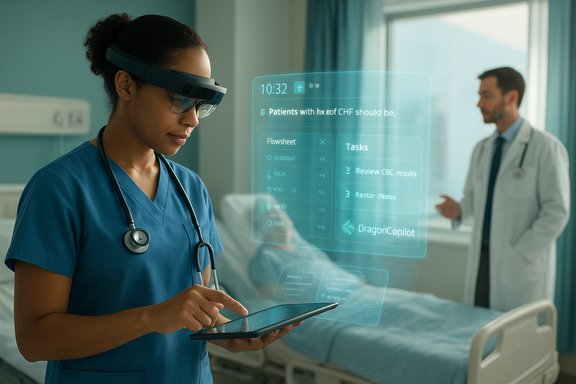
Mercy’s nursing floors are now a live testbed for one of the most consequential applications of generative AI in healthcare: an ambient, voice‑enabled documentation assistant built into Microsoft’s Dragon Copilot that Mercy helped design and pilot with frontline nurses — a tool Microsoft and Mercy say reduces documentation latency, shortens shifts by minutes per nurse, and promises to restore time for direct patient care while integrating drafts and flowsheet entries back into the electronic health record.
Microsoft’s Dragon Copilot is the latest step in a multi‑year evolution that merges clinical speech recognition, ambient audio capture, and a fine‑tuned generative AI layer into a single assistant that can create draft notes, extract structured data, and surface taskable outputs for clinician review. The platform brings together capabilities with roots in Nuance’s Dragon Medical One and Dragon Ambient eXperience (DAX), now positioned as a partner‑extensible Copilot experience for health systems. Mercy — a multi‑state health system with hundreds of hospitals, clinics and tens of thousands of caregivers — is one of the early U.S. partners Microsoft publicly highlights for shaping the nursing‑focused experience. Mercy reports live inpatient use in several hospitals and shares preliminary operational metrics for nurse workflows that Microsoft cites in its launch communications. Why this matters now: nurses are the largest single clinical workforce in acute care, and surveys consistently show documentation and administrative burden are central drivers of burnout and turnover. Tools that can reliably capture and structure bedside observations with minimal friction — and that keep a clinician in the loop for verification — directly address that operational pain point.
This is an inflection point for clinical documentation automation: when paired with careful measurement and governance, ambient nursing AI can reclaim meaningful bedside time and reduce burnout. Without that governance, the same tool can introduce new liabilities, erode trust, and create downstream clinical safety risks. Mercy’s early leadership and transparent pilots help map the path forward — but the wider industry must now invest equally in validation, oversight and clinician empowerment to make those gains durable.
Source: WV News Mercy Advances Groundbreaking AI Tool for Nursing Through Collaboration with Microsoft Dragon Copilot
 Background / Overview
Microsoft’s Dragon Copilot is the latest step in a multi‑year evolution that merges clinical speech recognition, ambient audio capture, and a fine‑tuned generative AI layer into a single assistant that can create draft notes, extract structured data, and surface taskable outputs for clinician review. The platform brings together capabilities with roots in Nuance’s Dragon Medical One and Dragon Ambient eXperience (DAX), now positioned as a partner‑extensible Copilot experience for health systems. Mercy — a multi‑state health system with hundreds of hospitals, clinics and tens of thousands of caregivers — is one of the early U.S. partners Microsoft publicly highlights for shaping the nursing‑focused experience. Mercy reports live inpatient use in several hospitals and shares preliminary operational metrics for nurse workflows that Microsoft cites in its launch communications. Why this matters now: nurses are the largest single clinical workforce in acute care, and surveys consistently show documentation and administrative burden are central drivers of burnout and turnover. Tools that can reliably capture and structure bedside observations with minimal friction — and that keep a clinician in the loop for verification — directly address that operational pain point. What Mercy and Microsoft Announced
- Mercy and Microsoft have collaborated to co‑design the first commercially available ambient AI capabilities tailored specifically to nursing workflows inside Dragon Copilot. Mercy nurses participated in iterative testing, narrating care in real time to shape the product’s behavior.
- The technology is in clinical use across Mercy inpatient units in St. Louis, Springfield (MO) and Fort Smith (AR), with broader Mercy rollouts planned.
- Microsoft’s Dragon Copilot now exposes partner extensibility so third‑party AI apps and “agents” can be embedded directly into the clinician workflow, enabling specialty functions (e.g., vocal biomarker analysis, CDS, prior authorization helpers) without leaving the Copilot surface.
How the Ambient Nursing Experience Works
Core capabilities
- Ambient audio capture: the system listens (with patient consent) and creates time‑stamped transcripts and conversational context.
- Generative summarization: models summarize interactions into structured draft content — flowsheet items, nursing notes, and task lists.
- EHR mapping and workflow integration: drafts and discrete extractions are queued for nurse review and, upon approval, populate EHR fields or workflow queues.
- In‑workflow access to trusted content: nurses can pull organization‑curated references and clinical guidance without switching apps.
- Partner micro‑agents: specialty AI apps can augment the Copilot experience with targeted capabilities (e.g., vocal biomarker analysis, decision support).
The human‑in‑the‑loop model
A central design principle is that autogenerated content is a draft — a time‑saving assistant, not an autonomous recorder that becomes the legal medical record without clinician verification. Nurses are shown captured content, can pause and edit, and must sign off before the item is filed. This human review step is emphasized as foundational to clinical safety and adoption.Mercy’s Early Outcomes: What the Numbers Say (and what to watch for)
Mercy — citing metrics provided by Microsoft — reports promising early operational improvements from pilot use:- 21% reduction in documentation latency (faster filing of notes).
- 65% improvement in perceived timeliness of documentation.
- 8–24 minutes saved per shift for high‑use nurses.
- 29% reduction in incremental overtime.
- 300% increase in mobile platform use.
- 4.5% increase in patient satisfaction.
Technical Architecture and the Partner Ecosystem
Dragon Copilot combines mature speech recognition with ambient capture and a generative AI layer tuned for healthcare language. Important architecture notes:- Dragon Medical One (DMO) remains the backbone for clinical speech recognition and medical vocabulary.
- Dragon Ambient eXperience (DAX) supplies ambient capture and summarization.
- A fine‑tuned generative layer produces structured outputs and taskable items.
- Copilot Studio and the healthcare agent service enable partners to build and deploy domain‑specific AI agents with built‑in compliance scaffolding.
Strengths: Why this could work for nurses
- Workflow‑first design: ambient capture embedded into nurse mobile apps and at‑bedside workflows avoids adding separate interfaces — a major adoption barrier for point‑of‑care staff.
- Clinician co‑design: Mercy reports sustained frontline nurse involvement during development, which increases the likelihood that outputs match clinical language and documentation expectations.
- Partner extensibility: the platform architecture permits third‑party capabilities to be surfaced inside the same assistant, reducing context switching and enabling specialty functionality where needed.
- Human‑in‑the‑loop safety: surfacing drafts for clinician review before records are finalized helps maintain clinical accountability while still returning time savings.
Key Risks, Limitations and Governance Imperatives
While promising, ambient clinical AI brings well‑known risks that organizations must mitigate deliberately.1. Model reliability and clinical accuracy
Large language models and extraction pipelines are vulnerable to:- Mistranscription of medication names, dosages, and clinical shorthand.
- Confusion in noisy or multi‑speaker environments (overlapping voices, patient murmurs).
- Omitted or incorrectly inferred discrete data (allergies, problem lists) that, if unchecked, can propagate downstream into orders and care plans.
2. Data governance and training guarantees
Claims that tenant data is not used for model training must be contractually explicit and technically auditable. Health systems should require:- Clear contractual language on whether and how audio, transcripts, and derived data are retained and used.
- Encryption in transit and at rest, pseudonymization where appropriate, and rights to export logs and model metadata for audits.
3. Regulatory classification
Ambient tools that analyze, summarize, or recommend clinical actions may be captured by medical‑device regulations in some jurisdictions. Evidence of device registration, clinical validation and post‑market surveillance may be required. Early Microsoft materials mention regulatory alignment steps in some markets, but legal teams must confirm local obligations.4. Workflow change management and clinician trust
Successful deployments need transparent SOPs for consent, clear edit/review workflows, training programs, and visible correction mechanisms. Both over‑trust (accepting drafts uncritically) and distrust (excess correction overhead) will blunt benefits. Organizations must monitor adoption and error‑correction time to calculate net productivity gains correctly.5. Vendor lock‑in and architectural risk
Entrusting ambient capture, transcription, and generative reasoning to a single vendor and cloud increases migration complexity. Hospitals should insist on:- Exportable, standard formats for transcripts and structured data.
- Versioned logs and rollback procedures.
- Fallback manual or scribe workflows for outages.
Practical Deployment Checklist for IT and Clinical Leaders
- Establish a governance board with clinical, legal, privacy, and IT representation.
- Define explicit human‑in‑the‑loop rules: which outputs require sign‑off and when.
- Contractually lock down data use, residency, retention, and training exclusions.
- Run short, instrumented pilots with telemetry and independent time‑and‑motion studies.
- Build audit trails and provenance logs for every AI output (who reviewed it, model version, data sources).
- Train nursing staff with role‑specific SOPs and measure correction time to compute net savings.
Legal, Privacy and Consent Considerations
Ambient tools implicate both patient consent and data protection. Mercy and Microsoft emphasize patient consent for ambient capture, but organizations must operationalize consent workflows (opt‑in, opt‑out, signage and documentation), manage audio retention policies, and ensure that any recorded or derived data used for debugging is pseudonymized. Request explicit contractual rights to transcripts and model metadata for forensic review. These capabilities are as essential to long‑term risk management as the initial productivity gains.The Market and Competitive Landscape
Microsoft’s strategy — folding Nuance’s mature clinical speech technology into the broader Copilot platform and enabling partner agents — is an ecosystem play. It reduces friction for organizations already invested in Microsoft 365 and Azure, and it creates a single procurement and integration surface for multiple AI capabilities. That is attractive to large health systems but raises competitive questions for specialist vendors and EHR incumbents. Hospitals should evaluate whether the integrated Copilot approach delivers better role‑specific outcomes than best‑of‑breed point solutions, and they should negotiate contractual protections to avoid untenable switching costs.Independent Validation: Why Mercy’s Numbers Still Need Scrutiny
Mercy’s early metrics are encouraging: measurable reductions in documentation latency and clear nurse reports of time saved. However, similar vendor‑sourced claims in other pilots have sometimes relied on self‑reported time savings or short pilots with enthusiastic early adopters. To translate pilot success into systemwide deployment with lasting benefit, organizations must insist on:- Independent, instrumented measurement (telemetry + time‑and‑motion studies).
- Stratification of results by unit type, shift, and nurse experience.
- Longitudinal studies that measure whether documentation accuracy, coding, billing, and patient outcomes change over time.
Realistic Impact on Nursing Workloads and Patient Experience
If the reported per‑shift savings (8–24 minutes) hold across entire units, they compound into real capacity gains: less overtime, fewer documentation backlogs, and more patient‑facing minutes. Even modest improvements in documentation timeliness and accuracy can improve handoffs, reduce medication errors due to late notes, and raise patient satisfaction scores. The Mercy pilots point in this direction, but systems should model the operational and staffing changes carefully rather than assuming straight linear gains from pilot samples.Recommendations for Hospitals Considering Ambient Nursing AI
- Start with low‑risk, high‑volume nursing workflows (e.g., flowsheets, routine vitals documentation, admission/discharge narratives).
- Require clinician sign‑off for any AI‑derived content that could alter care or billing.
- Negotiate strong contractual terms for data use, retention, model training exclusion, and audit rights.
- Instrument pilots with both subjective (surveys) and objective (system logs) measures — compare corrected draft time against baseline documentation times.
- Invest in robust training and human factors design: allow clinicians to pause, edit, and immediately correct drafts to build trust.
Final Analysis: A Cautiously Optimistic Verdict
Mercy’s collaboration with Microsoft to shape nursing‑specific ambient AI in Dragon Copilot is an important and credible step forward. The co‑design model — where frontline nurses narrate care and influence product behavior — addresses a frequent failure point of clinical AI: mismatch with real workflows. Early Mercy metrics show operational promise, and Microsoft’s platform approach offers a pragmatic integration path for partner apps that can expand functionality quickly. At the same time, adoption at scale must be accompanied by rigorous governance: transparent auditing, contractual guarantees on data use, independent accuracy validation, and robust clinician review rules. The technology is not a substitute for clinical judgment; it is a tool to reduce clerical burden — but that promise will only be realized if organizations treat accuracy, provenance and legal risk as first‑order implementation requirements.This is an inflection point for clinical documentation automation: when paired with careful measurement and governance, ambient nursing AI can reclaim meaningful bedside time and reduce burnout. Without that governance, the same tool can introduce new liabilities, erode trust, and create downstream clinical safety risks. Mercy’s early leadership and transparent pilots help map the path forward — but the wider industry must now invest equally in validation, oversight and clinician empowerment to make those gains durable.
Quick reference: What to watch next
- Broader published validation studies measuring transcription accuracy, documentation error rates, and downstream clinical outcomes.
- Regulatory guidance or device classifications in new jurisdictions as ambient tools mature.
- Real‑world longitudinal telemetry from large health systems showing sustained time savings after the novelty period.
Source: WV News Mercy Advances Groundbreaking AI Tool for Nursing Through Collaboration with Microsoft Dragon Copilot
