

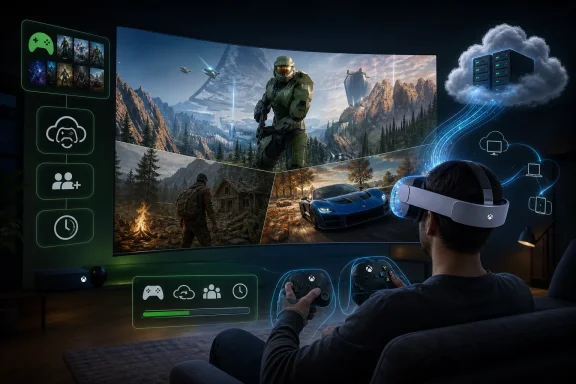
Microsoft and Meta are deepening their unlikely but increasingly practical gaming alliance by adding a starter edition of Xbox Game Pass to Meta Horizon+, turning the Quest subscription into a combined catalog of more than 150 virtual-reality and conventional games. Beginning July 21, 2026, eligible Horizon+ members in supported regions gain access to more than 50 Xbox titles, 10 hours of Xbox Cloud Gaming per month, multiplayer features, and Xbox Rewards benefits, while an upcoming controller-emulation update will let Quest Touch controllers stand in for a traditional Xbox gamepad. This is not an Xbox VR platform in the conventional sense, but it is another meaningful step toward Microsoft’s larger objective: making Xbox a service that follows players onto whatever screen they already own.
Microsoft and Meta have spent several years building connections between Xbox services and the Quest headset family, even as Microsoft itself has retreated from consumer virtual-reality hardware. The Xbox Cloud Gaming app arrived on supported Quest headsets in December 2023, allowing Game Pass subscribers to stream conventional Xbox games onto a large virtual display rather than running them natively as immersive VR experiences.
That distinction remains essential. Fallout 4, Grounded, SnowRunner, and the other Xbox games included in this new benefit do not suddenly become room-scale VR titles. They run in Microsoft’s cloud infrastructure and appear as two-dimensional games on a configurable virtual screen inside the Quest environment.
The new arrangement joins those previously separate subscriptions. Meta Horizon+ now includes a limited Game Pass tier, reducing the number of purchasing decisions facing a Quest owner who wants to try cloud gaming.
The hardware was always intended to be scarce, and Microsoft explicitly described it as a limited edition. Its disappearance from normal retail channels therefore did not end the partnership; instead, it served as a highly visible test of whether Xbox users would consider Quest hardware as another Game Pass screen.
That strategy ultimately contracted. Windows Mixed Reality was deprecated and removed from newer Windows releases, consumer headset momentum shifted elsewhere, and Microsoft never produced a dedicated Xbox VR headset. The Meta alliance consequently represents a more asset-light approach: Microsoft can participate in headset gaming without manufacturing or maintaining the underlying headset platform.
The added Game Pass offering expands the total advertised selection to more than 150 games. However, the two halves of that catalog use very different delivery models and should not be treated as one technically uniform library.
That assortment is broad enough to demonstrate the concept without matching the scale of Microsoft’s more expensive Game Pass plans. Horizon+ subscribers are receiving a gateway into the Xbox ecosystem, not a disguised Game Pass Ultimate membership.
Ten hours also changes how the benefit should be valued. It resembles a sampling tier designed to encourage discovery and eventual conversion rather than an unlimited entertainment service.
Instead, eligible downloads apply on compatible platforms covered by the starter subscription, such as a console or Windows PC. Quest playback remains cloud-based through the Xbox app, while cloud saves can preserve progress when a player moves between supported devices.
For Microsoft, that account relationship may be as strategically valuable as the 10 streaming hours. Once a Quest owner has an Xbox profile, cloud saves, friends, and accumulated progress, upgrading to a broader Game Pass plan becomes easier to justify.
This enables a lightweight standalone device to display games that would otherwise require an Xbox console or gaming PC. It also introduces networking constraints that do not affect locally installed Quest software.
This arrangement has a genuine appeal in spaces where a large television is unavailable. A Quest headset can create the perception of a private cinema-sized display in a bedroom, hotel, shared apartment, or temporary workspace without requiring a wall-mounted panel.
Latency, wireless interference, distance from Microsoft’s cloud infrastructure, router quality, packet loss, and household network congestion all influence the experience. A nominally fast connection can still produce stuttering or delayed controls if its consistency is poor.
Support for older hardware is particularly important because the Xbox Edition Quest 3S is no longer the center of the proposition. The alliance is now primarily about activating the installed base rather than selling one branded collector’s bundle.
The experience is not always identical across platforms, especially where a title has separate PC and console versions. Nevertheless, account continuity is the connective tissue that allows Microsoft to market Xbox as an ecosystem rather than a box under the television.
That should remove one of the most awkward steps in the current setup. Users will no longer need to find, pair, power, and hold a separate Bluetooth gamepad merely to test a streamed Xbox title.
The emulator can translate those controls into standard gamepad commands before sending them to the Xbox app. In practical terms, the left and right Touch controllers become two halves of one virtual Xbox controller.
Subscription services depend on impulse. If a user sees Grounded or Fallout 4 in the catalog, every additional setup screen, Bluetooth menu, missing battery, or forgotten controller creates an opportunity to abandon the session. Immediate Touch-controller support makes the included 10-hour allowance much more accessible.
Games that rely heavily on the D-pad, rapid face-button combinations, or precise simultaneous inputs may feel less natural. Serious players will probably continue to prefer a conventional gamepad, but emulation should be adequate for onboarding, casual play, and slower-paced genres.
It will not replace the Xbox Adaptive Controller or specialized accessibility hardware, and the final mapping options will determine its practical value. Even so, giving users another input method aligns with Microsoft’s broader effort to make Xbox experiences available through diverse hardware configurations.
Quest fits naturally into that model because Microsoft does not need to subsidize or support a new headset. Meta absorbs the hardware risk while Xbox gains another storefront-like surface for Game Pass.
That repositioning has competitive consequences. Microsoft can reach households that own a Quest but not an Xbox Series X or Series S, potentially converting Meta customers into Xbox subscribers without first persuading them to buy a console.
The 10-hour cap limits Microsoft’s delivery costs while still exposing users to the service. If those users want longer sessions, a larger library, better cloud priority, or premium features, Microsoft has a straightforward upgrade path.
This is consistent with Microsoft’s broader platform pragmatism. The company can concentrate on Azure-backed streaming, Xbox services, Windows gaming, identity, and content while relying on partners for specialized form factors.
The harder challenge is sustaining frequent use after the novelty fades. Many headset owners enjoy VR intensely but intermittently, and subscriptions only work when people continue finding reasons to put the device on.
Meta can therefore add dozens of recognizable games to Horizon+ without commissioning dozens of full VR conversions. The trade-off is that these titles strengthen Quest as a personal display rather than as a uniquely immersive gaming platform.
Xbox helps Meta frame Quest as a general spatial-computing device. Even users who stop buying native VR games might still return for a private virtual monitor or cloud gaming session.
However, catalog size alone does not guarantee engagement. Meta must ensure that people understand which games are downloaded to the headset, which run on PCs or consoles, and which consume the monthly cloud allowance.
For prospective subscribers, the decision is more complicated. The bundle has strong breadth, but its practical value depends on how much the buyer enjoys native VR, how often they use cloud gaming, and whether they already pay for another Game Pass plan.
Families with limited television access may also see value. A headset can provide a private gaming screen while another person uses the main display, although supervision, age suitability, comfort, and account management remain important.
Consumers should therefore compare account terms before treating the bundle as savings. Subscription combinations can look generous while merely repeating access a household already possesses.
This is why conventional Xbox games may be both strategically valuable and ergonomically challenging for Meta. They encourage longer seated sessions than many short-form VR experiences, precisely where headset comfort becomes most noticeable.
Quest remains a non-Windows device, but the service layer connecting it to Xbox is deeply tied to Microsoft’s cross-platform strategy. That makes the partnership relevant even to readers with no immediate interest in native VR.
Availability will vary by title, platform, and licensing arrangement. Users should not assume that every console-streaming title includes an identical Windows version, but the cross-device design makes the package more meaningful than a headset-only promotion.
This category could become more important as spatial computing matures. If headsets become lighter and better at displaying sharp text, Microsoft’s expertise in Windows desktops, cloud PCs, Xbox services, and productivity software would give it several routes into the same hardware.
Future Xbox hardware may share more technology and software with Windows PCs, which could theoretically reduce barriers to PC VR distribution. For now, however, Xbox on Quest means streamed flat-screen games, not a revival of Microsoft’s abandoned consumer mixed-reality platform.
The arrangement also reveals how the boundaries among console gaming, PC gaming, cloud services, and headset platforms are weakening. Competition increasingly occurs around accounts, content libraries, recurring subscriptions, and control of user attention.
Sony’s model can produce deeper VR experiences because software can target the headset’s specific tracking and display capabilities. Microsoft’s model is broader and less capital-intensive, but it lacks the immersion that defines purpose-built VR games.
Game Pass on Quest does not directly displace SteamVR because the included Xbox titles are displayed on a virtual screen. It does, however, compete for the same limited leisure time and makes a gaming PC less necessary for some headset owners.
Quest wins on perceived screen size, privacy, portability, and environmental isolation. Traditional displays win on convenience, social viewing, visual clarity without lenses, and the ability to play for hours without wearing equipment on the face.
The alliance works because each company supplies what the other lacks. Whether it lasts will depend on measurable engagement rather than strategic symmetry alone.
That creates a more resilient bundle, but also a more complicated one. Different catalogs, playback limits, platforms, account systems, and renewal terms can make it difficult for consumers to understand exactly what they are paying for.
This approach can be more effective than a short free trial. A continuing monthly allowance lets subscribers return repeatedly, preserving Microsoft’s opportunity to convert them after they discover a particularly compelling game.
Consumers should judge the service by relevant games, not raw volume. A smaller catalog containing several desired titles can be more valuable than hundreds of games that do not fit a player’s interests, comfort level, hardware, or available time.
Touch-controller emulation may therefore matter disproportionately. A reduction of only a few setup steps can increase the likelihood that a curious subscriber launches a game, and repeated launches are the foundation of subscription retention.
Microsoft and Meta will also need to clarify how starter entitlements interact with existing subscriptions. Account upgrades, overlapping plans, cloud-hour tracking, family use, and renewal behavior can become sources of frustration if the user experience is not transparent.
If engagement remains low, the benefit could settle into the background as another subscription perk. If users regularly consume the allowance, both companies will have evidence that a headset can function as a meaningful cloud-gaming screen.
Newer releases, family-friendly titles, and games well suited to short sessions could make the service more attractive. Conversely, frequent removals or unclear platform eligibility could weaken trust in the advertised catalog.
Microsoft could also improve continuity between the Xbox app on Quest and the Windows Xbox app. Unified recent-game lists, clearer platform labels, synchronized settings, and more visible Play Anywhere support would make the wider ecosystem easier to navigate.
If future Quest hardware begins to feel closer to ordinary eyewear, a private Xbox screen could become a mainstream use case. If headsets remain bulky and isolating, cloud gaming will continue to be a useful secondary feature rather than a replacement for televisions, monitors, or handhelds.
Microsoft and Meta have not announced an Xbox VR revolution; they have done something more restrained and potentially more realistic. By putting a limited version of Game Pass inside Horizon+ and turning Quest Touch controllers into an emulated Xbox gamepad, the companies are removing enough barriers for millions of headset owners to test Xbox without buying another device. The partnership’s future will depend less on metaverse rhetoric than on a simple question: when given more than 150 games and a giant virtual screen, will Quest owners keep putting the headset back on?
 Background
Microsoft and Meta have spent several years building connections between Xbox services and the Quest headset family, even as Microsoft itself has retreated from consumer virtual-reality hardware. The Xbox Cloud Gaming app arrived on supported Quest headsets in December 2023, allowing Game Pass subscribers to stream conventional Xbox games onto a large virtual display rather than running them natively as immersive VR experiences.That distinction remains essential. Fallout 4, Grounded, SnowRunner, and the other Xbox games included in this new benefit do not suddenly become room-scale VR titles. They run in Microsoft’s cloud infrastructure and appear as two-dimensional games on a configurable virtual screen inside the Quest environment.
From Xbox app to subscription bundle
The original Quest integration required users to bring their own qualifying Game Pass membership. Microsoft supplied the streaming application and cloud infrastructure, while Meta supplied the headset, display environment, tracking system, and operating platform.The new arrangement joins those previously separate subscriptions. Meta Horizon+ now includes a limited Game Pass tier, reducing the number of purchasing decisions facing a Quest owner who wants to try cloud gaming.
The limited-edition Xbox Quest experiment
The companies moved beyond software in June 2025 with the Meta Quest 3S Xbox Edition. That $399.99 limited-edition bundle included a 128GB Quest 3S finished in Xbox Carbon Black and Velocity Green, matching Touch Plus controllers, a pre-paired Xbox Wireless Controller, an Elite Strap, and three-month memberships for both Meta Horizon+ and Game Pass Ultimate.The hardware was always intended to be scarce, and Microsoft explicitly described it as a limited edition. Its disappearance from normal retail channels therefore did not end the partnership; instead, it served as a highly visible test of whether Xbox users would consider Quest hardware as another Game Pass screen.
Microsoft’s complicated VR history
Microsoft once appeared positioned to become a major mixed-reality platform owner. Windows Mixed Reality launched with Windows 10-era headsets from several PC manufacturers, while HoloLens pursued enterprise augmented reality through specialized hardware and expensive commercial deployments.That strategy ultimately contracted. Windows Mixed Reality was deprecated and removed from newer Windows releases, consumer headset momentum shifted elsewhere, and Microsoft never produced a dedicated Xbox VR headset. The Meta alliance consequently represents a more asset-light approach: Microsoft can participate in headset gaming without manufacturing or maintaining the underlying headset platform.
What Horizon+ Subscribers Now Receive
Meta Horizon+ costs $7.99 per month or $59.99 per year in the United States. Its existing proposition centers on a rotating catalog of more than 100 downloadable Quest VR games, supplemented by member discounts and other subscription benefits.The added Game Pass offering expands the total advertised selection to more than 150 games. However, the two halves of that catalog use very different delivery models and should not be treated as one technically uniform library.
More than 50 Xbox games
The starter Game Pass selection includes titles such as Fallout 4, Fallout 76, Overcooked 2, Grounded, DayZ, Deep Rock Galactic, and SnowRunner. It combines recognizable first-party Microsoft releases with multiplayer, cooperative, survival, simulation, and independent games.That assortment is broad enough to demonstrate the concept without matching the scale of Microsoft’s more expensive Game Pass plans. Horizon+ subscribers are receiving a gateway into the Xbox ecosystem, not a disguised Game Pass Ultimate membership.
Ten cloud hours per month
The most important limitation is the monthly allowance of 10 hours of cloud gaming. For an occasional player testing Xbox on a Quest, that may be sufficient for several evening sessions. For anyone trying to complete a lengthy role-playing game or use Quest as a primary Xbox device, it is restrictive.Ten hours also changes how the benefit should be valued. It resembles a sampling tier designed to encourage discovery and eventual conversion rather than an unlimited entertainment service.
Downloads require another compatible device
Meta says subscribers can download eligible games from the starter library for unlimited play. That does not mean conventional Xbox games can be installed locally onto the Quest headset, whose Horizon OS environment is not designed to execute Xbox console or Windows PC binaries.Instead, eligible downloads apply on compatible platforms covered by the starter subscription, such as a console or Windows PC. Quest playback remains cloud-based through the Xbox app, while cloud saves can preserve progress when a player moves between supported devices.
Rewards and multiplayer
The starter edition also includes Xbox Rewards for playing and access to relevant cloud and PC multiplayer functions. These features make the bundle more than a passive catalog preview because they introduce Horizon+ members to Microsoft accounts, achievements, social systems, progression, and reward loops.For Microsoft, that account relationship may be as strategically valuable as the 10 streaming hours. Once a Quest owner has an Xbox profile, cloud saves, friends, and accumulated progress, upgrading to a broader Game Pass plan becomes easier to justify.
How Xbox Gaming Works on Meta Quest
Xbox games on Quest are streamed remotely rather than rendered by the headset. Microsoft’s cloud servers execute the game, compress the video output, and transmit it to the headset, while the player’s controller inputs travel back to the remote system.This enables a lightweight standalone device to display games that would otherwise require an Xbox console or gaming PC. It also introduces networking constraints that do not affect locally installed Quest software.
The virtual-screen experience
Users can choose among multiple display sizes, with Meta advertising options up to a theater-like 26-foot virtual screen. The display can appear within the player’s physical room through mixed reality or inside an Xbox-themed immersive environment intended to reduce distractions.This arrangement has a genuine appeal in spaces where a large television is unavailable. A Quest headset can create the perception of a private cinema-sized display in a bedroom, hotel, shared apartment, or temporary workspace without requiring a wall-mounted panel.
Hardware and network requirements
A supported Quest headset, the Xbox app, a Microsoft account, and a sufficiently fast internet connection are required. Microsoft recommends 5GHz Wi-Fi and at least a 20Mbps downstream connection for cloud play, although bandwidth alone does not guarantee a smooth result.Latency, wireless interference, distance from Microsoft’s cloud infrastructure, router quality, packet loss, and household network congestion all influence the experience. A nominally fast connection can still produce stuttering or delayed controls if its consistency is poor.
Supported Quest models
Microsoft lists Meta Quest 2, Quest Pro, Quest 3, and Quest 3S as compatible with Xbox cloud gaming. That wide device range gives the subscription benefit a larger addressable audience than a promotion tied only to newly sold headsets.Support for older hardware is particularly important because the Xbox Edition Quest 3S is no longer the center of the proposition. The alliance is now primarily about activating the installed base rather than selling one branded collector’s bundle.
Cloud saves make device switching credible
A player can begin a supported game on Quest and later continue on an Xbox console, Windows PC, mobile device, television, or another cloud-capable endpoint. Achievements and cloud saves reduce the penalty for moving among screens.The experience is not always identical across platforms, especially where a title has separate PC and console versions. Nevertheless, account continuity is the connective tissue that allows Microsoft to market Xbox as an ecosystem rather than a box under the television.
Quest Touch Controllers Become Xbox Gamepads
The most immediately useful technical improvement is not the subscription catalog but the planned gamepad emulator. Meta says an update rolling out in the coming weeks will map Quest Touch controller inputs to the functions of an Xbox controller.That should remove one of the most awkward steps in the current setup. Users will no longer need to find, pair, power, and hold a separate Bluetooth gamepad merely to test a streamed Xbox title.
How the mapping is likely to work
Each Quest Touch controller already includes an analog stick, face buttons, triggers, grip controls, and system inputs. Collectively, the pair provides enough physical controls to approximate the core layout of an Xbox gamepad.The emulator can translate those controls into standard gamepad commands before sending them to the Xbox app. In practical terms, the left and right Touch controllers become two halves of one virtual Xbox controller.
Convenience matters more than novelty
Controller emulation does not create new gameplay mechanics, nor does it convert Xbox games into motion-controlled VR releases. Its significance lies in eliminating friction.Subscription services depend on impulse. If a user sees Grounded or Fallout 4 in the catalog, every additional setup screen, Bluetooth menu, missing battery, or forgotten controller creates an opportunity to abandon the session. Immediate Touch-controller support makes the included 10-hour allowance much more accessible.
Ergonomic compromises remain
Quest Touch controllers are optimized for tracked motion and split-hand interaction, not for reproducing the feel of a unified console gamepad. Button positions, muscle memory, trigger resistance, and prolonged hand posture will differ from an Xbox Wireless Controller.Games that rely heavily on the D-pad, rapid face-button combinations, or precise simultaneous inputs may feel less natural. Serious players will probably continue to prefer a conventional gamepad, but emulation should be adequate for onboarding, casual play, and slower-paced genres.
A possible accessibility benefit
Split controllers allow users to place their hands independently rather than holding them together around one device. For some players, that may reduce strain or accommodate a more comfortable seated position.It will not replace the Xbox Adaptive Controller or specialized accessibility hardware, and the final mapping options will determine its practical value. Even so, giving users another input method aligns with Microsoft’s broader effort to make Xbox experiences available through diverse hardware configurations.
Why Microsoft Wants Xbox Inside Quest
Microsoft’s gaming strategy increasingly treats hardware as one entry point among many. Consoles remain important, but cloud streaming, Windows PCs, handhelds, televisions, browsers, mobile devices, and VR headsets all extend the reach of Xbox accounts and subscriptions.Quest fits naturally into that model because Microsoft does not need to subsidize or support a new headset. Meta absorbs the hardware risk while Xbox gains another storefront-like surface for Game Pass.
Xbox without an Xbox console
The Quest integration reinforces Microsoft’s “This is an Xbox” message: a device can participate in the Xbox ecosystem without containing traditional Xbox console hardware. The defining components become the account, catalog, cloud service, controller protocol, saves, achievements, and social graph.That repositioning has competitive consequences. Microsoft can reach households that own a Quest but not an Xbox Series X or Series S, potentially converting Meta customers into Xbox subscribers without first persuading them to buy a console.
A low-cost acquisition channel
Bundling a constrained subscription tier gives Microsoft access to an audience that has already demonstrated willingness to pay for digital content. Horizon+ members are familiar with rotating libraries, recurring billing, downloadable games, and subscription-based discovery.The 10-hour cap limits Microsoft’s delivery costs while still exposing users to the service. If those users want longer sessions, a larger library, better cloud priority, or premium features, Microsoft has a straightforward upgrade path.
No need to revive Windows Mixed Reality
Building a modern consumer VR platform would require Microsoft to fund industrial design, optics, displays, tracking, developer tools, content acquisition, operating-system support, retail distribution, and customer service. Partnering with Meta provides access to an established headset family without recreating that entire stack.This is consistent with Microsoft’s broader platform pragmatism. The company can concentrate on Azure-backed streaming, Xbox services, Windows gaming, identity, and content while relying on partners for specialized form factors.
Why Meta Needs Xbox
Meta’s problem is no longer proving that standalone VR works. Quest has demonstrated that inside-out tracking, mobile processors, downloadable stores, and mixed-reality passthrough can support a viable consumer product.The harder challenge is sustaining frequent use after the novelty fades. Many headset owners enjoy VR intensely but intermittently, and subscriptions only work when people continue finding reasons to put the device on.
More content without more VR ports
Porting a conventional game into native VR can require redesigned cameras, movement systems, user interfaces, animation, comfort settings, performance targets, and interaction models. Cloud streaming avoids that expense because the game remains unchanged.Meta can therefore add dozens of recognizable games to Horizon+ without commissioning dozens of full VR conversions. The trade-off is that these titles strengthen Quest as a personal display rather than as a uniquely immersive gaming platform.
Increasing the headset’s utility
A device that only serves dedicated VR software competes for attention with consoles, PCs, phones, tablets, and televisions. A headset that can also provide cloud gaming, video entertainment, social communication, productivity screens, and mixed-reality applications has more opportunities to remain useful.Xbox helps Meta frame Quest as a general spatial-computing device. Even users who stop buying native VR games might still return for a private virtual monitor or cloud gaming session.
Subscription economics
Horizon+ becomes easier to explain when it offers both native VR and recognizable mainstream games. The annual price of $59.99 is substantially lower than paying $7.99 every month for a full year, while the combined catalog gives Meta a clearer value message.However, catalog size alone does not guarantee engagement. Meta must ensure that people understand which games are downloaded to the headset, which run on PCs or consoles, and which consume the monthly cloud allowance.
Consumer Impact
For existing Horizon+ members, the starter Game Pass edition is effectively an added benefit, provided they live in a supported region and can meet the network requirements. It introduces no need to replace a working Quest 2, Quest 3, Quest 3S, or Quest Pro.For prospective subscribers, the decision is more complicated. The bundle has strong breadth, but its practical value depends on how much the buyer enjoys native VR, how often they use cloud gaming, and whether they already pay for another Game Pass plan.
Who gains the most
The strongest audience consists of casual Xbox players who already own a Quest but lack an active Game Pass membership. They can sample a useful cross-section of games without buying a console, and the forthcoming Touch-controller emulation should reduce the cost of experimentation further.Families with limited television access may also see value. A headset can provide a private gaming screen while another person uses the main display, although supervision, age suitability, comfort, and account management remain important.
Existing Game Pass subscribers should check overlap
A Horizon+ member who already subscribes to a higher Game Pass tier may receive little incremental value from the starter edition. The included catalog and cloud allowance could duplicate benefits already available through the existing Microsoft subscription.Consumers should therefore compare account terms before treating the bundle as savings. Subscription combinations can look generous while merely repeating access a household already possesses.
The 10-hour calculation
Players can estimate the usefulness of the cloud allowance through a simple process:- Identify the Xbox games they realistically expect to play on Quest rather than on a television, PC, or handheld.
- Estimate the average session length, including time spent in menus, matchmaking, and failed connection attempts.
- Divide the 10-hour monthly allowance by that session length to determine how many sessions the benefit supports.
- Compare the result with the cost of a broader Game Pass tier if Quest cloud gaming becomes a regular habit.
Comfort remains the deciding factor
A massive private screen sounds compelling, but it requires wearing a headset for the duration of the session. Facial pressure, heat, lens fogging, glasses compatibility, battery life, motion sensitivity, and neck fatigue can outweigh the benefits of display size.This is why conventional Xbox games may be both strategically valuable and ergonomically challenging for Meta. They encourage longer seated sessions than many short-form VR experiences, precisely where headset comfort becomes most noticeable.
Windows and PC Gaming Implications
Windows users should view the announcement as part of a broader convergence among Xbox, Windows gaming, cloud delivery, and partner hardware. Microsoft increasingly wants a purchased game, subscription entitlement, or Xbox identity to travel across console, PC, handheld, browser, television, and headset.Quest remains a non-Windows device, but the service layer connecting it to Xbox is deeply tied to Microsoft’s cross-platform strategy. That makes the partnership relevant even to readers with no immediate interest in native VR.
PC downloads expand the benefit
Meta states that starter-library games can be downloaded for unlimited play where supported. For Horizon+ subscribers with gaming PCs, this potentially makes the benefit useful outside the headset and beyond the 10-hour cloud limit.Availability will vary by title, platform, and licensing arrangement. Users should not assume that every console-streaming title includes an identical Windows version, but the cross-device design makes the package more meaningful than a headset-only promotion.
Quest as a Windows display
Quest headsets can already act as virtual monitors through several applications and connection methods. Xbox cloud gaming adds another scenario in which Windows users may treat the headset less like a VR console and more like a wearable display terminal.This category could become more important as spatial computing matures. If headsets become lighter and better at displaying sharp text, Microsoft’s expertise in Windows desktops, cloud PCs, Xbox services, and productivity software would give it several routes into the same hardware.
Native Xbox VR remains unannounced
The partnership should not be interpreted as confirmation that Microsoft is preparing native VR games for Xbox consoles or a VR section of the Microsoft Store. Neither company’s July 21 announcement establishes such a roadmap.Future Xbox hardware may share more technology and software with Windows PCs, which could theoretically reduce barriers to PC VR distribution. For now, however, Xbox on Quest means streamed flat-screen games, not a revival of Microsoft’s abandoned consumer mixed-reality platform.
Competitive Implications
Meta occupies a particularly important position because few rivals combine standalone hardware, a mature content store, tracked controllers, mixed-reality capabilities, and consumer-scale distribution. Microsoft’s decision to partner rather than compete acknowledges that reality.The arrangement also reveals how the boundaries among console gaming, PC gaming, cloud services, and headset platforms are weakening. Competition increasingly occurs around accounts, content libraries, recurring subscriptions, and control of user attention.
Microsoft versus Sony
Sony offers dedicated virtual reality through PlayStation VR2, supported by native software and direct integration with PlayStation 5. Microsoft is taking almost the opposite approach by delivering conventional Xbox games to third-party headsets through the cloud.Sony’s model can produce deeper VR experiences because software can target the headset’s specific tracking and display capabilities. Microsoft’s model is broader and less capital-intensive, but it lacks the immersion that defines purpose-built VR games.
Microsoft versus Valve
Valve remains influential through SteamVR and PC gaming, where users can access a vast range of native VR software and conventional games. Steam’s openness to different PC headsets contrasts with Meta’s tightly integrated standalone ecosystem.Game Pass on Quest does not directly displace SteamVR because the included Xbox titles are displayed on a virtual screen. It does, however, compete for the same limited leisure time and makes a gaming PC less necessary for some headset owners.
Meta versus the television and handheld
The most relevant competitor may not be another headset. It may be a large television, laptop, tablet, or gaming handheld that presents the same Xbox game with less physical discomfort.Quest wins on perceived screen size, privacy, portability, and environmental isolation. Traditional displays win on convenience, social viewing, visual clarity without lenses, and the ability to play for hours without wearing equipment on the face.
A partnership built around complementary weaknesses
Microsoft has games, subscriptions, cloud infrastructure, and a large player network but no current consumer VR platform. Meta has the leading standalone VR platform but needs more familiar content and stronger reasons for owners to use their headsets regularly.The alliance works because each company supplies what the other lacks. Whether it lasts will depend on measurable engagement rather than strategic symmetry alone.
The Broader Subscription Strategy
Combining subscriptions has become a common method for technology companies to lower churn and increase perceived value. A customer may hesitate to cancel Horizon+ if doing so also removes Xbox access, even when neither component alone receives constant use.That creates a more resilient bundle, but also a more complicated one. Different catalogs, playback limits, platforms, account systems, and renewal terms can make it difficult for consumers to understand exactly what they are paying for.
Starter tiers as conversion funnels
The Game Pass starter edition appears carefully designed to expose users to Microsoft’s ecosystem without replacing premium subscriptions. It provides enough recognizable content to create interest, yet the 10-hour cloud ceiling leaves frequent users with a reason to upgrade.This approach can be more effective than a short free trial. A continuing monthly allowance lets subscribers return repeatedly, preserving Microsoft’s opportunity to convert them after they discover a particularly compelling game.
Catalog count versus practical value
Advertising more than 150 games produces an impressive headline, but the number combines at least two distinct pools: more than 100 VR titles through Horizon+ and more than 50 Xbox titles through the starter benefit. The Xbox component also has a cloud-time restriction that does not apply in the same way to locally installed Quest games.Consumers should judge the service by relevant games, not raw volume. A smaller catalog containing several desired titles can be more valuable than hundreds of games that do not fit a player’s interests, comfort level, hardware, or available time.
Churn, retention, and habit formation
Subscriptions become durable when they create habits. Meta wants people to put on Quest regularly, while Microsoft wants them to sign into Xbox, maintain saves, earn Rewards, and explore additional games.Touch-controller emulation may therefore matter disproportionately. A reduction of only a few setup steps can increase the likelihood that a curious subscriber launches a game, and repeated launches are the foundation of subscription retention.
Strengths and Opportunities
The agreement is modest in technical scope, but it gives both companies several practical opportunities without requiring new consumer hardware.- Horizon+ gains recognizable mainstream games. Titles such as Fallout 4, Grounded, and SnowRunner can attract users who are less familiar with dedicated VR releases.
- Xbox reaches non-console households. Quest owners can enter Microsoft’s gaming ecosystem without purchasing an Xbox console or gaming PC.
- Touch-controller emulation reduces setup friction. Users will soon be able to test Xbox cloud games without pairing a separate Bluetooth controller.
- The bundle strengthens cross-device play. Cloud saves, Xbox profiles, and compatible downloads allow progress to move among Quest, console, PC, and other supported devices.
- Microsoft avoids another hardware gamble. Meta handles headset development while Microsoft focuses on content, subscriptions, identity, and cloud delivery.
- Meta gives dormant headsets another purpose. Conventional cloud games can bring owners back even when they are not in the mood for motion-heavy or room-scale VR.
- Developers gain additional discovery. Games in the starter catalog can reach subscribers who might not encounter them through a console storefront.
- The partnership creates room for richer integration. Better account linking, social features, controller mappings, remote play, and mixed-reality interfaces could follow if usage justifies continued investment.
Risks and Concerns
The expanded bundle also carries limitations that could prevent it from changing Quest usage patterns in a lasting way.- Ten cloud hours may feel overly restrictive. Long games can consume the monthly allowance quickly, especially when menus and matchmaking count toward usage.
- Cloud quality varies by household and region. Latency, congestion, router performance, and server distance can undermine otherwise capable hardware.
- The catalog description may confuse buyers. Native VR downloads, PC or console downloads, and Quest cloud streaming are materially different forms of access.
- Headset comfort remains unresolved. A 26-foot virtual screen has limited value if users prefer a television after 30 minutes because of pressure, heat, or eyestrain.
- Touch emulation cannot fully reproduce an Xbox controller. Split motion controllers have different ergonomics and may be less suitable for demanding conventional games.
- Existing subscribers may receive duplicate benefits. Horizon+ users already paying for Game Pass should verify whether the starter tier adds anything to their accounts.
- The arrangement depends on two platforms. Changes to Meta’s headset strategy, Microsoft’s cloud pricing, licensing terms, or regional availability could alter the value quickly.
- Flat-screen games could overshadow native VR development. If cloud streaming becomes the easiest way to add content, investment in purpose-built immersive games may become harder to justify.
What to Watch Next
The first test will be the rollout of Quest Touch gamepad emulation. Its button mapping, remapping options, compatibility, haptic behavior, accessibility settings, and handling of system commands will determine whether it becomes a genuine alternative to an Xbox controller or merely an onboarding convenience.Microsoft and Meta will also need to clarify how starter entitlements interact with existing subscriptions. Account upgrades, overlapping plans, cloud-hour tracking, family use, and renewal behavior can become sources of frustration if the user experience is not transparent.
Usage beyond the promotional launch
The most revealing metric will not be how many Horizon+ subscribers receive Game Pass automatically. It will be how many launch an Xbox game, return the following month, exhaust the 10-hour allowance, and upgrade to another Microsoft plan.If engagement remains low, the benefit could settle into the background as another subscription perk. If users regularly consume the allowance, both companies will have evidence that a headset can function as a meaningful cloud-gaming screen.
Expansion of the starter catalog
The initial selection balances high-profile Bethesda and Obsidian games with cooperative and simulation titles. Future rotations will show whether Microsoft treats the benefit as a static sampler or an actively managed acquisition channel.Newer releases, family-friendly titles, and games well suited to short sessions could make the service more attractive. Conversely, frequent removals or unclear platform eligibility could weaken trust in the advertised catalog.
Better integration with Windows and remote play
Meta’s announcement references Xbox Remote Play as a separate capability requiring a supported console, compatible controller, and appropriate account configuration. Deeper integration could eventually let Quest users move more seamlessly among cloud games, remotely accessed personal consoles, and Windows PCs.Microsoft could also improve continuity between the Xbox app on Quest and the Windows Xbox app. Unified recent-game lists, clearer platform labels, synchronized settings, and more visible Play Anywhere support would make the wider ecosystem easier to navigate.
Hardware will still decide the category’s future
Software bundles can encourage experimentation, but they cannot eliminate the physical burden of current headsets. The long-term opportunity depends on lighter devices, sharper optics, wider fields of view, longer battery life, improved glasses accommodation, and reduced heat.If future Quest hardware begins to feel closer to ordinary eyewear, a private Xbox screen could become a mainstream use case. If headsets remain bulky and isolating, cloud gaming will continue to be a useful secondary feature rather than a replacement for televisions, monitors, or handhelds.
Microsoft and Meta have not announced an Xbox VR revolution; they have done something more restrained and potentially more realistic. By putting a limited version of Game Pass inside Horizon+ and turning Quest Touch controllers into an emulated Xbox gamepad, the companies are removing enough barriers for millions of headset owners to test Xbox without buying another device. The partnership’s future will depend less on metaverse rhetoric than on a simple question: when given more than 150 games and a giant virtual screen, will Quest owners keep putting the headset back on?