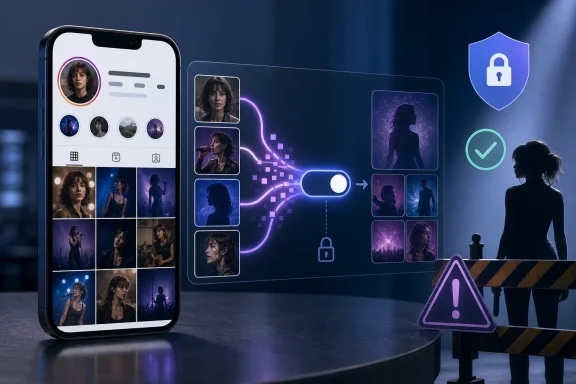
Meta withdrew Muse Image’s public-account referencing feature on Friday, a little over three days after introducing it on Tuesday, July 7. The feature had allowed Meta AI users to generate images by @-mentioning public Instagram accounts whose content was available for reference by default rather than through affirmative consent. Meta’s reversal was fast, but the failure was not merely a rushed launch or a badly explained privacy setting. The company treated a public profile as a ready-made generative asset, collapsing the distinction between permission to view a person and permission to manufacture new images of that person.
Muse Image itself remains available through Meta AI, including general image generation and direct photo-editing capabilities, according to Meta’s product announcement and subsequent reporting by Business Insider. What disappeared was the product’s most socially combustible shortcut: typing an @-mention and letting Meta AI turn another public Instagram account into reference material.
Meta introduced Muse Image on Tuesday, July 7, as the first image-generation model from Meta Superintelligence Labs. In its announcement, the company described the model as “the creative partner that knows your world” and said people could use it to create polished visuals that could be downloaded or shared to feeds, stories, or chats.
The announcement described several familiar generative-AI functions. Muse Image could generate images from prompts, work with existing photographs, and let users draw or annotate desired changes directly on an image. The controversial addition was the ability to @-mention public Instagram accounts and use their published material as visual reference content.
Meta’s own launch examples said the reference capability could be used to design a custom event invitation, mock up a collaborative creative concept, or generate a personalized graphic. Those were Meta’s examples, not proof that the system would be limited to cooperative or harmless scenarios.
The low-friction workflow was central to the feature’s appeal. Instagram already held public names, photographs, interests, posts, and social connections. It is reasonable to infer that connecting this material to Meta AI could make generations feel more personally relevant than images produced by an isolated text prompt. The same integration, however, removed the point at which a user might otherwise have stopped to obtain a photograph or ask the subject for permission.
Instead of uploading an authorized image or inviting the subject to participate, a user could invoke an account by name. Meta had converted part of Instagram’s public identity layer into an input selector for generative AI.
Gizmodo reported that material from qualifying public accounts was available to the feature by default. Business Insider likewise described a system that permitted Meta AI users to generate images referencing public Instagram content. The Associated Press reported after the withdrawal that the rollout prompted privacy concerns and instructions from users and organizations about how account holders could opt out.
The core dispute was therefore not whether public Instagram photographs were technically visible. It was whether visibility should silently become authorization for synthetic reuse. Public is not permission, particularly when the reuse does not merely redistribute the original photograph but creates a new image that may imply an event, relationship, endorsement, action, or statement that never existed.
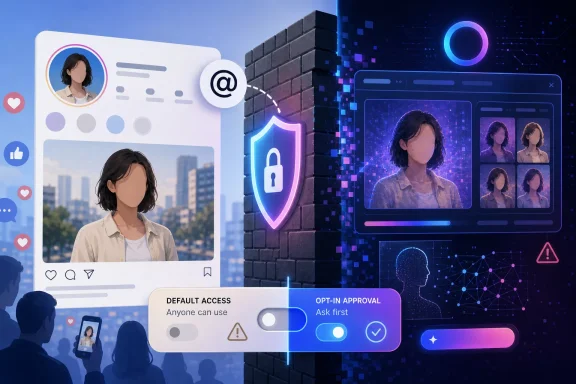
That distinction matters more than the mere existence of a settings toggle. An opt-out system begins with content available for the new use unless the account holder objects. An opt-in system keeps the likeness unavailable until its owner affirmatively agrees. For a feature that can create synthetic representations of real people, the default determines how broadly the product can operate before most users have evaluated it.
A public account may exist so potential customers, fans, employers, colleagues, or friends can see a person’s work. That choice does not necessarily communicate agreement to become a reusable character inside another person’s AI prompt.
Meaningful control requires more than a technically available switch. It requires notice that explains the new use, a choice presented before participation, and a practical way to withdraw that choice. Meta did not say that it expected every account holder to discover the setting independently, and that motive should not be attributed to the company as a reported fact. The foreseeable operational problem, however, was that many users would remain unaware of a new consequence attached to an old decision to maintain a public profile.
SAG-AFTRA directly challenged that structure. In its public response, the union said anything short of a “clear and conspicuous OPT-IN” was unacceptable and described Meta’s approach as an “utter miscalculation of public sentiment” concerning the dangers and harms of nonconsensual uses.
The issue extended beyond performers. Actors and broadcasters may treat their likeness as a contracted professional asset, but public-facing employees, executives, journalists, teachers, independent creators, small-business owners, and ordinary users also rely on photographs as part of their identity and reputation.
The launch’s principal components now have different outcomes:
Calling the reversal the death of Muse Image would therefore be inaccurate. Meta removed one method of supplying identity-rich reference material. It did not abandon the model, direct editing, or its broader effort to integrate generative imagery into Meta AI and social products.
Meta said it heard feedback that the feature had “missed the mark.” The company did more than promise clearer notices or a more visible opt-out: it removed the workflow that allowed one user to reference another public account by name.
That timeline does not, by itself, prove why every internal decision was made. It does show that Meta concluded within days that the capability should not remain available in its launched form.
Later — OpenAI secured a partnership with Disney covering authorized uses of Disney characters. That agreement and Sora 2’s eventual shutdown should be treated as separate developments unless OpenAI explicitly links them.
March — OpenAI shut down Sora 2. The supplied comparison establishes the month but does not support claiming that the Disney partnership caused the shutdown.
Tuesday, July 7 — Meta unveiled Muse Image and introduced the ability to create images by referencing qualifying public Instagram accounts through @-mentions.
Friday — Meta updated the announcement and withdrew the public-account referencing method after a little over three days.
The documented objections included statements from SAG-AFTRA, Creative Artists Agency, and privacy advocate Apar Gupta. It would be an overstatement to turn those named reactions into evidence of a larger organized coalition without additional reporting. Their concerns nevertheless addressed distinct dimensions of the same design: performer rights, documented consent, platform power, and personal privacy.
The model can therefore still create and transform visual material. Users may also obtain photographs by other means and submit them to generative tools. Removing @-mentions does not eliminate every possible misleading or nonconsensual image.
What the removal changes is Meta’s direct facilitation of the behavior. The platform no longer provides the same built-in command that converted an eligible public account into a convenient AI reference source.
Product design does not merely permit behavior; it can normalize it. When a workflow appears in a mainstream interface and in official examples, users may reasonably understand it as a use the provider considers acceptable. Meta’s initial design placed referencing another public account alongside ordinary creative operations. The response demonstrated that many account holders, performers, and representatives see a recognizable person as a fundamentally different kind of input.
The model survived; the permission shortcut did not.
A consent-based version would require a different experience. Meta could ask account holders whether they want to participate, restrict authorization to approved contacts, permit approval for a particular generation, limit outputs to defined audiences, or create invitation-based collaborative sessions. Those ideas are recommendations, not confirmed Meta plans.
SAG-AFTRA focused its response on nonconsensual digital replicas and demanded a clear opt-in standard. After Meta withdrew the feature, the union welcomed the discontinuance and described removal as the responsible decision.
Creative Artists Agency made a related argument in a statement reported by Variety. CAA said no third party, including an AI model, should use an individual’s name, image, likeness, voice, or creative work without clear, documented consent. The agency argued that innovation should protect creators’ rights and livelihoods while leaving them with meaningful control.
Those positions move the controversy beyond the wording of a privacy setting. The underlying dispute concerns who has authority to transform, simulate, distribute, or commercialize identity. Platforms may describe photographs as content governed by account-level reuse controls. Performers and representatives also see rights, compensation, attribution, reputation, and contractual approval.
Business Insider reported that Matthew McConaughey and Jeremy Clarkson had pursued trademark protections connected to their identities and recognizable personal attributes as defenses against unauthorized AI use. McConaughey has publicly said that he wants uses of his voice or likeness to occur with his approval. These reports illustrate a growing defensive strategy among public figures, but they do not establish that trademark registration will solve every form of AI impersonation or provide identical protection in every jurisdiction.
Most users do not have talent agencies or specialized intellectual-property portfolios. They can still suffer harm if generated imagery places them in a fabricated setting. A false image need not be cinematic or perfectly realistic to trigger harassment, workplace conflict, fraud, family distress, or public embarrassment.
Integrated generative tools also reduce the effort involved. Image manipulation long predates Muse Image, but older workflows generally required users to find source material, move it into editing software, and possess at least some technical skill. The withdrawn workflow compressed several of those steps into a username and a prompt.
Instagram public profiles may contain years of photographs, locations, workplaces, friendships, hobbies, clothing, family connections, and major life events. Even when each post was intentionally made public, the collection can function as a persistent identity record.
Generative referencing changes what can be done with that record. Ordinary viewing retrieves material a person actually posted. Generative processing can draw from that material to create a new representation whose setting, message, and implications were never selected by the account holder.
The argument that anyone could already save a public photograph therefore addresses only part of the issue. Manual copying was possible before Muse Image. The withdrawn feature integrated discovery, identity selection, and transformation inside the same corporate ecosystem that hosted the source account.
Meta’s description of Muse Image as a creative partner that knows “your world” highlighted its personalization ambitions. It also revealed the governance challenge: one user’s world contains other people, and those people may not be participants in the generation session.
An opt-in model would not prevent every misuse. It would, however, require the provider to explain the value and risk before making a person’s account directly referenceable through the feature.
Meta should not be described as having emphasized particular output safeguards unless a supporting company statement or report is available. The stronger point does not depend on that unsupported claim: even robust output filters would not resolve whether an account holder authorized the generation.
A synthetic wedding photograph, political-event image, romantic scene, product endorsement, workplace depiction, or joke may avoid graphic or otherwise prohibited content while falsely connecting someone to a person, belief, organization, or commercial message.
Enforcement is also frequently reactive. A service may detect an image automatically or act after someone reports it, but screenshots and copies can move beyond the originating platform before a review is completed.
Provenance markers and AI disclosures can help viewers identify synthetic media. They still do not answer a subject’s objection to being depicted. A perfectly accurate “AI-generated” label may tell the audience how the image was made while leaving the underlying unauthorized use unresolved.
For enterprises, this is an identity-security issue as well as a content-policy issue. Organizations already manage account takeovers, executive impersonation, fraudulent support accounts, and brand abuse. Generative images create another scenario in which authentic public material can lend visual credibility to a false narrative without an attacker stealing a password or administrator role.
The response must therefore extend beyond conventional account security. IT, security, communications, legal, human resources, and social-media teams need a shared process for synthetic impersonation involving executives, employees, customers, contractors, and branded properties.
Sora 2 involved video generation and recognizable protected characters, bringing copyright, trademark, licensing, and entertainment-industry concerns to the foreground. Muse Image’s withdrawn Instagram workflow involved real public-account holders, adding privacy, publicity, safety, impersonation, and digital-replica concerns.
OpenAI secured a Disney partnership involving authorized character use. Sora 2 later shut down in March. The available facts do not establish that the partnership caused the shutdown, so the developments should not be presented as a simple cause-and-effect sequence.
The common pattern is narrower: recognizable people and properties make generative systems attractive, but they also introduce stakeholders who may hold legal rights or reasonably demand control. A technically capable generator can still fail if the permission and licensing structure surrounding its most compelling uses is inadequate.
Negotiated licensing offers one answer for commercial intellectual property. Individual likeness requires a more personal permission system, but the basic rule remains applicable: access should be granted under understandable conditions rather than inferred from unrelated public availability.
Image generators are powerful marketing tools because their output requires little explanation. A productivity feature may need repeated use before its value becomes clear; a surprising synthetic image can circulate within minutes.
The tradeoff is that image generation directly intersects with human identity and cultural ownership. Systems become more engaging as they reproduce recognizable people, characters, places, and visual conventions, but each increase in recognition expands the set of people and rights holders who may demand approval, compensation, restrictions, or removal.
Meta’s access to Instagram’s public graph offered an obvious product advantage. The failure was treating that advantage as sufficient justification for default availability. The withdrawal does not mean consumer image generation is ending. It means future integrations will face scrutiny over notice, defaults, approval, logging, retention, reporting, and downstream distribution.
Organizations commonly operate public Instagram profiles for corporate brands, executives, recruitment teams, customer support, events, regional offices, products, and individual departments. Those accounts may contain high-resolution photographs that can support fake endorsements, fabricated announcements, fraudulent advertisements, executive impersonation, or misleading employee interactions.
Responsibility is often fragmented. Marketing may publish content, an outside agency may schedule posts, IT may control recovery information, communications may monitor press attention, and legal may handle takedowns. That arrangement leaves gaps unless one owner is accountable for each account.
A restored feature should require:
The episode establishes a useful product boundary: making content public for viewing is not a blank authorization for every future machine-mediated use. Organizations should convert that lesson into operational controls rather than wait for the next controversial rollout.
Inventory the accounts. Assign owners. Review the current settings. Reduce unnecessary likeness exposure. Monitor for misuse. Preserve evidence. Define takedown and escalation procedures. Give employees a clear reporting channel. Then repeat the process whenever a platform changes what “public” can mean.
Meta may eventually propose another way to connect social accounts with generative imagery. If it does, the test should be straightforward: participation must be informed, affirmative, limited, logged, revocable, and supported by fast remedies when something goes wrong. Without those elements, convenience is not a sufficient substitute for permission.
Muse Image itself remains available through Meta AI, including general image generation and direct photo-editing capabilities, according to Meta’s product announcement and subsequent reporting by Business Insider. What disappeared was the product’s most socially combustible shortcut: typing an @-mention and letting Meta AI turn another public Instagram account into reference material.
Direct answer
- Meta removed the public-account @-mention/reference workflow after a little over three days.
- Muse Image and its direct photo-editing functions remain available.
- Public Instagram users and organizations should still review account exposure, high-risk likeness content, and their procedures for detecting and responding to impersonation.
 Meta Turned a Public Profile Into a Generative Asset
Meta introduced Muse Image on Tuesday, July 7, as the first image-generation model from Meta Superintelligence Labs. In its announcement, the company described the model as “the creative partner that knows your world” and said people could use it to create polished visuals that could be downloaded or shared to feeds, stories, or chats.The announcement described several familiar generative-AI functions. Muse Image could generate images from prompts, work with existing photographs, and let users draw or annotate desired changes directly on an image. The controversial addition was the ability to @-mention public Instagram accounts and use their published material as visual reference content.
Meta’s own launch examples said the reference capability could be used to design a custom event invitation, mock up a collaborative creative concept, or generate a personalized graphic. Those were Meta’s examples, not proof that the system would be limited to cooperative or harmless scenarios.
The low-friction workflow was central to the feature’s appeal. Instagram already held public names, photographs, interests, posts, and social connections. It is reasonable to infer that connecting this material to Meta AI could make generations feel more personally relevant than images produced by an isolated text prompt. The same integration, however, removed the point at which a user might otherwise have stopped to obtain a photograph or ask the subject for permission.
Instead of uploading an authorized image or inviting the subject to participate, a user could invoke an account by name. Meta had converted part of Instagram’s public identity layer into an input selector for generative AI.
Gizmodo reported that material from qualifying public accounts was available to the feature by default. Business Insider likewise described a system that permitted Meta AI users to generate images referencing public Instagram content. The Associated Press reported after the withdrawal that the rollout prompted privacy concerns and instructions from users and organizations about how account holders could opt out.
The core dispute was therefore not whether public Instagram photographs were technically visible. It was whether visibility should silently become authorization for synthetic reuse. Public is not permission, particularly when the reuse does not merely redistribute the original photograph but creates a new image that may imply an event, relationship, endorsement, action, or statement that never existed.
The Default Setting Was Meta’s Real Product Decision
Meta said its intent was to provide a useful creative tool while giving people control over whether their public content could be referenced. The control initially took the form of an opt-out mechanism rather than a request for affirmative participation.That distinction matters more than the mere existence of a settings toggle. An opt-out system begins with content available for the new use unless the account holder objects. An opt-in system keeps the likeness unavailable until its owner affirmatively agrees. For a feature that can create synthetic representations of real people, the default determines how broadly the product can operate before most users have evaluated it.
A public account may exist so potential customers, fans, employers, colleagues, or friends can see a person’s work. That choice does not necessarily communicate agreement to become a reusable character inside another person’s AI prompt.
Meaningful control requires more than a technically available switch. It requires notice that explains the new use, a choice presented before participation, and a practical way to withdraw that choice. Meta did not say that it expected every account holder to discover the setting independently, and that motive should not be attributed to the company as a reported fact. The foreseeable operational problem, however, was that many users would remain unaware of a new consequence attached to an old decision to maintain a public profile.
SAG-AFTRA directly challenged that structure. In its public response, the union said anything short of a “clear and conspicuous OPT-IN” was unacceptable and described Meta’s approach as an “utter miscalculation of public sentiment” concerning the dangers and harms of nonconsensual uses.
The issue extended beyond performers. Actors and broadcasters may treat their likeness as a contracted professional asset, but public-facing employees, executives, journalists, teachers, independent creators, small-business owners, and ordinary users also rely on photographs as part of their identity and reputation.
The launch’s principal components now have different outcomes:
| Muse Image capability | What it did | Source material | Status after Friday | Central concern |
|---|---|---|---|---|
| Public-account @-mentions | Generated images by referencing a named public Instagram account | Eligible public Instagram content | Removed by Meta | Consent, impersonation, deepfakes, and likeness control |
| Direct photo editing | Let users make instructed edits to photographs | Images supplied to Muse Image | Remains available, according to Business Insider | Misleading edits and unauthorized source material remain possible |
| General image generation | Turned prompts and visual inputs into downloadable or shareable images | User prompts and supplied inputs | Remains available through Meta AI | Provenance, accuracy, deceptive use, and responsible distribution |
A Little Over Three Days Exposed the Consent Gap
Gizmodo reported that the public-account capability lasted a little over three days. Meta announced Muse Image on Tuesday, July 7, and by Friday had amended its announcement to say that the @-mention option was no longer available.Meta said it heard feedback that the feature had “missed the mark.” The company did more than promise clearer notices or a more visible opt-out: it removed the workflow that allowed one user to reference another public account by name.
That timeline does not, by itself, prove why every internal decision was made. It does show that Meta concluded within days that the capability should not remain available in its launched form.
Timeline
2025 — OpenAI released Sora 2. Reporting cited by Business Insider said its ability to generate video involving recognizable protected characters drew objections from entertainment rights holders.Later — OpenAI secured a partnership with Disney covering authorized uses of Disney characters. That agreement and Sora 2’s eventual shutdown should be treated as separate developments unless OpenAI explicitly links them.
March — OpenAI shut down Sora 2. The supplied comparison establishes the month but does not support claiming that the Disney partnership caused the shutdown.
Tuesday, July 7 — Meta unveiled Muse Image and introduced the ability to create images by referencing qualifying public Instagram accounts through @-mentions.
Friday — Meta updated the announcement and withdrew the public-account referencing method after a little over three days.
The documented objections included statements from SAG-AFTRA, Creative Artists Agency, and privacy advocate Apar Gupta. It would be an overstatement to turn those named reactions into evidence of a larger organized coalition without additional reporting. Their concerns nevertheless addressed distinct dimensions of the same design: performer rights, documented consent, platform power, and personal privacy.
Meta Pulled the Shortcut, Not the Model
Muse Image remains available through Meta AI. Business Insider reported that functions including direct editing of photographs continued after Meta withdrew the Instagram public-account reference workflow.The model can therefore still create and transform visual material. Users may also obtain photographs by other means and submit them to generative tools. Removing @-mentions does not eliminate every possible misleading or nonconsensual image.
What the removal changes is Meta’s direct facilitation of the behavior. The platform no longer provides the same built-in command that converted an eligible public account into a convenient AI reference source.
Product design does not merely permit behavior; it can normalize it. When a workflow appears in a mainstream interface and in official examples, users may reasonably understand it as a use the provider considers acceptable. Meta’s initial design placed referencing another public account alongside ordinary creative operations. The response demonstrated that many account holders, performers, and representatives see a recognizable person as a fundamentally different kind of input.
The model survived; the permission shortcut did not.
A consent-based version would require a different experience. Meta could ask account holders whether they want to participate, restrict authorization to approved contacts, permit approval for a particular generation, limit outputs to defined audiences, or create invitation-based collaborative sessions. Those ideas are recommendations, not confirmed Meta plans.
Hollywood Saw a Labor System Inside a Consumer Feature
Entertainment organizations reacted because a face, voice, name, and recognizable identity can be a professional asset tied to casting, contracts, endorsements, publicity rights, and future work.SAG-AFTRA focused its response on nonconsensual digital replicas and demanded a clear opt-in standard. After Meta withdrew the feature, the union welcomed the discontinuance and described removal as the responsible decision.
Creative Artists Agency made a related argument in a statement reported by Variety. CAA said no third party, including an AI model, should use an individual’s name, image, likeness, voice, or creative work without clear, documented consent. The agency argued that innovation should protect creators’ rights and livelihoods while leaving them with meaningful control.
Those positions move the controversy beyond the wording of a privacy setting. The underlying dispute concerns who has authority to transform, simulate, distribute, or commercialize identity. Platforms may describe photographs as content governed by account-level reuse controls. Performers and representatives also see rights, compensation, attribution, reputation, and contractual approval.
Business Insider reported that Matthew McConaughey and Jeremy Clarkson had pursued trademark protections connected to their identities and recognizable personal attributes as defenses against unauthorized AI use. McConaughey has publicly said that he wants uses of his voice or likeness to occur with his approval. These reports illustrate a growing defensive strategy among public figures, but they do not establish that trademark registration will solve every form of AI impersonation or provide identical protection in every jurisdiction.
Most users do not have talent agencies or specialized intellectual-property portfolios. They can still suffer harm if generated imagery places them in a fabricated setting. A false image need not be cinematic or perfectly realistic to trigger harassment, workplace conflict, fraud, family distress, or public embarrassment.
Integrated generative tools also reduce the effort involved. Image manipulation long predates Muse Image, but older workflows generally required users to find source material, move it into editing software, and possess at least some technical skill. The withdrawn workflow compressed several of those steps into a username and a prompt.
Privacy Advocates Challenged Implied Participation
Apar Gupta, the founding director of the Internet Freedom Foundation, criticized Meta’s approach in a video posted to X on Friday. Gupta argued that Meta had again used its platform dominance in a manner that undermined consent and privacy.Instagram public profiles may contain years of photographs, locations, workplaces, friendships, hobbies, clothing, family connections, and major life events. Even when each post was intentionally made public, the collection can function as a persistent identity record.
Generative referencing changes what can be done with that record. Ordinary viewing retrieves material a person actually posted. Generative processing can draw from that material to create a new representation whose setting, message, and implications were never selected by the account holder.
The argument that anyone could already save a public photograph therefore addresses only part of the issue. Manual copying was possible before Muse Image. The withdrawn feature integrated discovery, identity selection, and transformation inside the same corporate ecosystem that hosted the source account.
Meta’s description of Muse Image as a creative partner that knows “your world” highlighted its personalization ambitions. It also revealed the governance challenge: one user’s world contains other people, and those people may not be participants in the generation session.
An opt-in model would not prevent every misuse. It would, however, require the provider to explain the value and risk before making a person’s account directly referenceable through the feature.
Deepfake Controls Cannot Depend Only on Content Moderation
Output filtering and moderation are important, but they address a different question from permission. A moderation system asks whether an image violates platform rules. Consent asks whether the system should use the person as reference material at all.Meta should not be described as having emphasized particular output safeguards unless a supporting company statement or report is available. The stronger point does not depend on that unsupported claim: even robust output filters would not resolve whether an account holder authorized the generation.
A synthetic wedding photograph, political-event image, romantic scene, product endorsement, workplace depiction, or joke may avoid graphic or otherwise prohibited content while falsely connecting someone to a person, belief, organization, or commercial message.
Enforcement is also frequently reactive. A service may detect an image automatically or act after someone reports it, but screenshots and copies can move beyond the originating platform before a review is completed.
Provenance markers and AI disclosures can help viewers identify synthetic media. They still do not answer a subject’s objection to being depicted. A perfectly accurate “AI-generated” label may tell the audience how the image was made while leaving the underlying unauthorized use unresolved.
For enterprises, this is an identity-security issue as well as a content-policy issue. Organizations already manage account takeovers, executive impersonation, fraudulent support accounts, and brand abuse. Generative images create another scenario in which authentic public material can lend visual credibility to a false narrative without an attacker stealing a password or administrator role.
The response must therefore extend beyond conventional account security. IT, security, communications, legal, human resources, and social-media teams need a shared process for synthetic impersonation involving executives, employees, customers, contractors, and branded properties.
Sora 2 Provides a Related, but Not Identical, Comparison
Business Insider compared Meta’s reversal with the controversy surrounding OpenAI’s Sora 2. The comparison is useful if its limits are kept clear.Sora 2 involved video generation and recognizable protected characters, bringing copyright, trademark, licensing, and entertainment-industry concerns to the foreground. Muse Image’s withdrawn Instagram workflow involved real public-account holders, adding privacy, publicity, safety, impersonation, and digital-replica concerns.
OpenAI secured a Disney partnership involving authorized character use. Sora 2 later shut down in March. The available facts do not establish that the partnership caused the shutdown, so the developments should not be presented as a simple cause-and-effect sequence.
The common pattern is narrower: recognizable people and properties make generative systems attractive, but they also introduce stakeholders who may hold legal rights or reasonably demand control. A technically capable generator can still fail if the permission and licensing structure surrounding its most compelling uses is inadequate.
Negotiated licensing offers one answer for commercial intellectual property. Individual likeness requires a more personal permission system, but the basic rule remains applicable: access should be granted under understandable conditions rather than inferred from unrelated public availability.
AI Spectacle Carries a Permission Cost
Gizmodo has described a recurring generative-AI launch pattern in which visually striking capabilities attract rapid attention before providers fully resolve copyright, privacy, or identity concerns. Muse Image’s public-account integration fit that pattern: the feature was easy to demonstrate, personally recognizable, and immediately shareable.Image generators are powerful marketing tools because their output requires little explanation. A productivity feature may need repeated use before its value becomes clear; a surprising synthetic image can circulate within minutes.
The tradeoff is that image generation directly intersects with human identity and cultural ownership. Systems become more engaging as they reproduce recognizable people, characters, places, and visual conventions, but each increase in recognition expands the set of people and rights holders who may demand approval, compensation, restrictions, or removal.
Meta’s access to Instagram’s public graph offered an obvious product advantage. The failure was treating that advantage as sufficient justification for default availability. The withdrawal does not mean consumer image generation is ending. It means future integrations will face scrutiny over notice, defaults, approval, logging, retention, reporting, and downstream distribution.
Social-Media Administration Is Now Part of Identity Security
For IT professionals and administrators, Meta’s withdrawal is not a reason to cancel account reviews. Muse Image remains available, direct photo editing remains possible, and social-platform settings can acquire new consequences when products change.Organizations commonly operate public Instagram profiles for corporate brands, executives, recruitment teams, customer support, events, regional offices, products, and individual departments. Those accounts may contain high-resolution photographs that can support fake endorsements, fabricated announcements, fraudulent advertisements, executive impersonation, or misleading employee interactions.
Responsibility is often fragmented. Marketing may publish content, an outside agency may schedule posts, IT may control recovery information, communications may monitor press attention, and legal may handle takedowns. That arrangement leaves gaps unless one owner is accountable for each account.
WindowsForum Administration Checklist
- Inventory every official public Instagram account.
Record the username, purpose, business unit, public or private status, creation date if known, current administrators, recovery email address, linked phone number, connected Meta business assets, and any third-party publishing or analytics tools. Include dormant campaign, regional, recruitment, event, executive, and support accounts—not only the primary brand profile. - Name an accountable owner for every account.
Assign a business owner responsible for content and risk decisions and a technical custodian responsible for access, authentication, recovery, and integrations. Document a backup for both roles. An account managed by “the marketing team” does not have a sufficiently traceable owner. - Review current Meta AI, privacy, sharing, remixing, and reference controls.
Administrators should inspect the live controls available to each account and compare them with Meta’s current Help Center documentation. Menu labels and availability can differ by account type, region, app version, and rollout state. Because Meta withdrew the disputed workflow, organizations should not rely on obsolete instructions or assume that a previously reported path still exists. Record the review date, reviewer, selections, and screenshots of material controls. - Classify likeness content by risk.
Identify posts and reels containing executives, security personnel, public spokespeople, minors, customers, patients, protected locations, access badges, internal screens, recognizable vehicles, signatures, documents, or employees in sensitive roles. Give special attention to clear front-facing portraits, multiple-angle image sets, and clean audio or video samples that could assist impersonation. - Restrict, remove, or archive high-risk material where appropriate.
Do not delete useful communications content automatically. Evaluate whether each item still serves a legitimate public purpose. Where exposure exceeds current value, consider archiving it internally and removing it from public access, limiting its audience when the platform permits, replacing it with less identity-rich material, or publishing a lower-risk alternative. Preserve records when legal, regulatory, contractual, or litigation-hold obligations apply. - Reduce unnecessary identity detail.
Avoid combining a clear face, full name, job title, direct contact information, travel schedule, and location in a single post unless the communications benefit justifies the risk. Review captions and tags as well as images; synthetic impersonation often becomes more credible when public biographical details accompany source photographs. - Establish monitoring.
Monitor the organization’s name, account handles, executive names, campaign names, logos, product names, and common misspellings. Include fake support accounts, altered advertisements, suspicious direct messages, synthetic endorsements, and images that appear to place personnel in events or statements they did not authorize. Monitoring can combine platform searches, employee reports, customer-service feedback, brand-protection services, and media-monitoring tools. - Create an evidence-preservation procedure.
Before requesting removal, capture screenshots, profile names, timestamps, post identifiers, surrounding comments, advertisement disclosures, destination domains, and the reporting account’s observations. Preserve the original file when safely available and document where it was found. Do not ask employees to repeatedly download malicious files merely to collect evidence. - Define takedown ownership.
Specify who files platform impersonation, privacy, fraud, intellectual-property, or manipulated-media reports. The correct route may depend on whether the target is a person, a trademarked brand, a customer-support account, or a fraudulent advertisement. Record submission dates, case numbers, responses, appeals, and final disposition. - Set escalation thresholds.
Escalate immediately when synthetic or impersonating content involves financial instructions, credential theft, threats, intimate imagery, minors, election communications, safety claims, regulated disclosures, executive statements, customer data, or active advertising. Define contacts for security operations, legal counsel, communications leadership, human resources, law enforcement, insurers, and affected individuals. - Create an employee-reporting channel.
Employees should have a simple internal address, form, ticket queue, or security hotline for reporting suspected impersonation. Tell them what evidence to preserve, what not to forward, and when to contact emergency services. Reports involving intimate imagery, threats, or harassment should receive privacy-sensitive handling rather than being circulated through a broad help-desk queue. - Prepare public-response templates.
Draft short statements for fake executive posts, fraudulent support profiles, synthetic endorsements, and manipulated images. Templates should identify the authentic account, state that the content is unauthorized, tell customers what actions to avoid, and direct them to a verified source. Communications teams should be able to act without drafting every response from scratch during an incident. - Review agencies and vendors.
Confirm who retains account access, exported media libraries, employee photographs, campaign source files, and AI-generated drafts after a contract ends. Require prompt revocation of tokens and roles. Contracts should address approved AI uses, consent, retention, incident reporting, deletion, and responsibility for unauthorized likeness use. - Run a tabletop exercise.
Test a scenario in which a synthetic video appears to show an executive announcing layoffs, promoting an investment, requesting a wire transfer, or endorsing a political position. Measure detection time, verification, evidence collection, internal escalation, platform reporting, employee notification, and public correction. - Repeat the review after major platform announcements.
Treat new AI, remixing, sharing, voice, avatar, advertising, and collaboration features as changes to the organization’s identity-security posture. Do not assume that an old public/private decision carries the same consequences after a product update.
Forward-Looking Test for Any Restored Feature
Meta has not confirmed that it will restore the same public-account reference workflow. The following is a recommended test for Meta or any platform considering a similar capability, not a description of announced company plans.A restored feature should require:
- Affirmative opt-in: No account should become referenceable merely because it is public.
- Clear advance notice: The notice should explain what material may be referenced, who can initiate a generation, what outputs can depict, and where those outputs may be shared.
- Revocable participation: Account holders should be able to withdraw without navigating obscure controls, and the platform should explain what withdrawal does and does not do to prior outputs.
- Generation-specific or audience-limited approval: Users should be able to authorize one request, one collaborator, a defined group, or a limited distribution context instead of accepting unrestricted participation.
- Logging: Account holders should have access to a record showing when their account was referenced, by which authorized party, under what permission, and what sharing scope applied, subject to appropriate abuse and privacy protections.
- Rapid reporting and removal: Subjects should have a dedicated path for reporting unauthorized, deceptive, intimate, defamatory, fraudulent, or otherwise harmful generations, with expedited review for high-risk cases.
- Administrative controls for organizations: Business and institutional accounts should be able to disable participation centrally, establish approval roles, and export audit information.
- Protection against permission laundering: A user should not be able to grant consent on behalf of another person merely because that person appears in a photograph posted to the user’s account.
- Explicit rules for minors and sensitive contexts: Participation involving minors, health information, intimate settings, political persuasion, employment decisions, financial promotion, or regulated communications should face stricter restrictions or exclusion.
- Downstream disclosure: Outputs should carry durable provenance information where technically feasible, while recognizing that disclosure does not replace the subject’s permission.
The Reversal Sets a Boundary, Not a Resolution
Meta’s rapid withdrawal prevented the public-account @-mention workflow from becoming a permanent part of Muse Image in its original form. It did not eliminate direct photo editing, general image generation, or the broader challenge of synthetic impersonation.The episode establishes a useful product boundary: making content public for viewing is not a blank authorization for every future machine-mediated use. Organizations should convert that lesson into operational controls rather than wait for the next controversial rollout.
Inventory the accounts. Assign owners. Review the current settings. Reduce unnecessary likeness exposure. Monitor for misuse. Preserve evidence. Define takedown and escalation procedures. Give employees a clear reporting channel. Then repeat the process whenever a platform changes what “public” can mean.
Meta may eventually propose another way to connect social accounts with generative imagery. If it does, the test should be straightforward: participation must be informed, affirmative, limited, logged, revocable, and supported by fast remedies when something goes wrong. Without those elements, convenience is not a sufficient substitute for permission.
References
- Primary source: Gizmodo
Published: 2026-07-11T18:11:15.557028
The Public Got So Mad at Meta’s New AI Photo Tool That It’s Scrapped Already
"We’ve heard the feedback that this feature missed the mark, so it’s no longer available," Meta says. gizmodo.com
- Independent coverage: Business Insider
Published: Sat, 11 Jul 2026 16:41:08 GMT
Instagram Reverses Course on AI Image Feature After Privacy Backlash - Business Insider
Meta said that its new feature allowing users to generate AI images from public Instagram posts is no longer available.www.businessinsider.com - Related coverage: digitalcameraworld.com
Instagram’s controversial AI won’t just copy your face – Meta Muse Image imitates photography styles too | Digital Camera World
The new Meta Muse image generator is already facing a privacy backlash, but artists should know that the wrong privacy settings allow the AI to copy style toowww.digitalcameraworld.com - Related coverage: about.fb.com
Introducing Muse Image: Image Generation Built for Your World
Muse Image is the first image generation model from Meta Superintelligence Labs, now available in Meta AI.about.fb.com - Related coverage: techcrunch.com
Meta just launched a new AI generator, Muse Image, and users are already pushing back over use of their photos | TechCrunch
The new image-generating model has numerous use cases, including advertising and decorating, and creator-based opportunities.techcrunch.com - Related coverage: tomsguide.com
Meta is using your Instagram photos for AI — opt out now | Tom's Guide
Meta's new AI image tool automatically uses public Instagram photos unless you opt out.www.tomsguide.com
- Related coverage: engadget.com
Meta Deactivates Feature That Let You Generate AI Images Of Any Public Instagram Account
Meta has deactivated the Muse Image capability to create AI deepfakes of any public Instagram account you @-mention.www.engadget.com - Related coverage: gadgets360.com
- Related coverage: thehackernews.com
Meta's New AI Image Tool Lets Others Use Your Public Instagram Photos in AI Images
Meta Muse Image lets users tag public Instagram accounts to generate AI images, with public posts and reels reusable by default unless disabled.thehackernews.com
- Related coverage: macrumors.com
Stop Others Using Your Instagram Photos in AI Prompts: Here's How
On July 8, Meta launched Muse Image, an AI image generator now built into Meta AI, Instagram, and WhatsApp. It can do the typical text-to-image generative trick, but one feature in particular is causing controversy: Anyone can mention (@) a public Instagram account inside the Meta AI app, and it...www.macrumors.com - Related coverage: androidcentral.com
Meta's Muse Image can use public Instagram profiles for AI creations | Android Central
This is the next step in Meta's "people first" vision for its AI.www.androidcentral.com - Related coverage: forbes.com
Meta’s Muse Image AI Tool—Here’s How To Opt Out
Meta has released Muse Image, an AI tool that uses your Instagram profile pictures to generate images — unless you opt out. Here's how.www.forbes.com - Related coverage: mass.gov
- Related coverage: elpais.com
Meta permite que la IA genere imágenes a partir de tu perfil abierto de Instagram sin avisarte: así puedes protegerte | Tecnología | EL PAÍS
La herramienta Muse Image se alimenta de las fotos públicas subidas a la red social. Basta con etiquetar a un usuario y pedirle que lo represente haciendo algo y la imagen se crea en segundoselpais.com - Related coverage: cadenaser.com
Meta lanza una herramienta que permite manipular con IA las imágenes de perfiles públicos en Instagram | Ciencia y tecnología | Cadena SER
El generador, bautizado como 'Muse Image', permite utilizar las fotografías de Instagram sin necesidad de solicitar permisocadenaser.com - Related coverage: theguardian.com
Instagram’s AI image generator alarms privacy experts | Instagram | The Guardian
Instagram users should check privacy settings after rollout of new Meta AI image generator, advocates warnwww.theguardian.com - Related coverage: live.euronext.com
Meta scraps AI image feature days after launch following privacy backlash | live
By Natalia Bueno Rebolledo and Mrinmay Dey July 10 (Reuters) - Meta said on Friday it is discontinuing an AI feature launched this week that allowed users to generate images using public Instagram accounts, after drawing widespread criticism over privacy concerns, including from a Hollywood...live.euronext.com
- Related coverage: thenationalnews.com
Backlash against Meta's Muse Image AI as Instagram users seek to opt out | The National
Users need to change their settings to protect some of their contentwww.thenationalnews.com - Related coverage: findlaw.com
Meta’s Muse AI Has Opted In Your Public Instagram Photos. Many Users Are Unamused. - FindLaw
The release of Meta’s Muse Image service includes an automatic opt-in that allows others to take images from public Instagram accounts. Learn what that means and how to block it at FindLaw. www.findlaw.com
- Related coverage: axios.com
Meta's new AI image maker draws fire over consent
The backlash highlights a core AI-era fight of opt in vs. opt out.www.axios.com
- Related coverage: wired.com
Meta Now Lets Anyone Use Your Instagram Photos in AI Images—Unless You Opt Out | WIRED
As part of Meta’s Muse Image model rollout, Instagram users with public accounts need to opt out to block AI generations of their content.www.wired.com - Related coverage: techrepublic.com
Meta’s Muse Image Explained: What to Know About the New AI Image Model
Meta Muse Image brings AI image generation to Instagram, WhatsApp, and Meta AI. Here’s what users should know about features and privacy.www.techrepublic.com
- Related coverage: zdfheute.de
Meta zieht KI-Bildfunktion "Muse Image" nach Kritik zurück
Nur vier Tage nach dem Start zieht Meta seine KI-Bildfunktion "Muse Image" zurück. Sie war ohne Zustimmung der Nutzer aktiviert.www.zdfheute.de - Related coverage: copyrightalliance.org