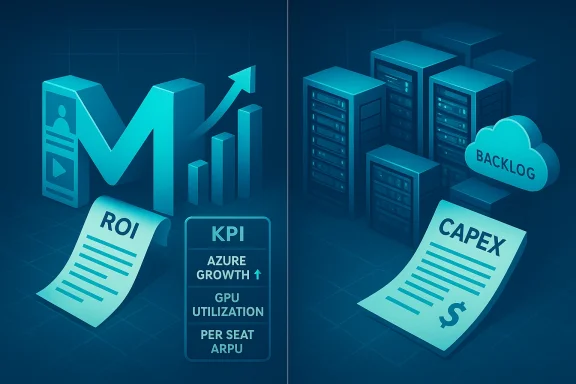
Meta’s Q4 blowout and Microsoft’s capex-heavy quarter produced a rare, stark split: investors rewarded visible AI-driven revenue and punished deferred AI payoffs. The market reaction—bullish for Meta, cautious for Microsoft—was less a referendum on product quality than a vote on timing and unit economics: Meta showed receipts; Microsoft showed the bill.
The latest reporting cycle crystallized a new investor demand in the AI era: measurable return on AI investments, now—not promises of future scale. Meta reported a December-quarter beat driven by ad volume and price improvements, then set an aggressive capital-expenditure plan for 2026. Microsoft also beat top-line and EPS expectations but disclosed a sizeable capex surge and a slight Azure deceleration that left markets questioning near-term margin and utilization dynamics.
This article examines the numbers, the business-model mechanics behind them, the risks investors and IT leaders should watch, and the practical metrics that will determine whether this quarter was an inflection point or an episodic market wobble.
Why that nuance matters:
This allocation trade-off has two implications:
Both companies still play complementary roles in the AI stack: Meta excels at converting attention into monetization quickly; Microsoft builds the enterprise-grade infrastructure and product surface area that could produce very large long-term cash flows. The question for investors and IT decision-makers is less about “who wins” and more about whether each company can demonstrate predictable, improving unit economics as they scale AI.
If you are allocating capital today, ask this of any AI-heavy company before you commit:
Conclusion
The Meta–Microsoft split is a defining moment in the AI investment cycle: the era of unquestioned AI spending is ending, and the era of accountable AI investments is beginning. For investors, CIOs, and product leaders, the imperative is the same—measure, quantify, and demand traceable unit economics. Companies that can connect AI spends to near-term, attributable financial outcomes will earn the market’s trust; companies that can’t will pay a valuation penalty until they do.
Source: WebProNews Meta’s AI Surge Crushes Microsoft’s Cloud Wobble
 Background
The latest reporting cycle crystallized a new investor demand in the AI era: measurable return on AI investments, now—not promises of future scale. Meta reported a December-quarter beat driven by ad volume and price improvements, then set an aggressive capital-expenditure plan for 2026. Microsoft also beat top-line and EPS expectations but disclosed a sizeable capex surge and a slight Azure deceleration that left markets questioning near-term margin and utilization dynamics.This article examines the numbers, the business-model mechanics behind them, the risks investors and IT leaders should watch, and the practical metrics that will determine whether this quarter was an inflection point or an episodic market wobble.
Earnings snapshot: the numbers that moved markets
Meta — Q4 2025 at a glance
- Reported revenue: $59.89 billion, up 24% year-over-year.
- Adjusted earnings per share: $8.88, topping forecasts.
- Daily active users (Family of Apps): 3.58 billion, up 7%.
- Ad impressions and pricing: management cited a meaningful rise in ad impressions and price, which directly drove the beat.
Microsoft — Q2 fiscal 2026 at a glance
- Reported revenue: $81.27 billion, marginally above consensus.
- Adjusted EPS: $4.14, beating expectations.
- Azure growth: 39%, a slight deceleration from the prior period.
- Capital expenditures + finance leases: $37.5 billion for the period, roughly a 66% jump year-over-year.
Why the market cared: receipts vs. bills
Investors are increasingly treating AI spending like any other strategic bet: they want measurable unit economics and near-to-medium-term payback. Two mechanics explain the divergence:- Meta’s investments plug into a tight monetization loop: more engagement => more impressions => more ad revenue. That makes causality visible and attributable in short order.
- Microsoft’s investments build shared infrastructure for enterprise AI, with value realized only when customers consume cloud compute or buy Copilot seats. That conversion path is longer, involves procurement cycles, and is sensitive to GPU availability and utilization.
Deep dive: Meta’s ad-driven AI playbook
Rebuilding ranking and ad systems
Meta has deliberately rebuilt ranking and ad-delivery systems around larger, unified models. The company attributes rising impressions and higher effective ad prices to these AI investments—metrics that advertisers directly care about. When AI improves relevance, advertisers receive better ROI, which justifies higher spend and higher CPMs.The capex acceleration—and why investors cheered
Meta guided to $115 billion–$135 billion in capital expenditures for 2026, nearly double its 2025 spend of about $72.22 billion, and justified that outlay as foundational to scaling model training and inference capacity tied to ad efficiency and new AI products. Investors interpreted this as capital aimed at revenue-generating surfaces, not purely experimental R&D.Why that nuance matters:
- Spending that directly increases paid impressions or ad yield can often be modeled with near-term ROI assumptions.
- Investors prefer capex that feeds a clear revenue loop—capex for open-ended moonshots tends to receive a discount.
Reality Labs remains a drag—but offset assumptions prevail
Reality Labs losses persist and remain a material negative for Meta’s consolidated margins. Management framed Reality Labs as a long-term investment while counting on Family of Apps operating profits to absorb that loss in the near term. The market’s willingness to look past Reality Labs depended on the clarity of ad-powered returns.Deep dive: Microsoft’s cloud capacity and capex conundrum
Azure growth and the allocation problem
Azure grew 39%—a robust rate by historical standards—but investors had been keyed to “north of 40%” growth expectations. Management said Azure growth would have registered higher had all new GPU capacity been routed to Azure rather than to internal or partner commitments. That comment exposed an allocation tension: Microsoft must balance internal product needs, partner arrangements (notably with OpenAI), and customer demand.This allocation trade-off has two implications:
- If Microsoft favors internal or partner workloads, the visible Azure growth paid by external customers may slow.
- If Microsoft favors external Azure customers, it risks under-resourcing internal AI initiatives that underpin other strategic products.
Capex: the headline number and why it matters
Microsoft disclosed roughly $37.5 billion in capex plus finance leases for the period—a large, headline-grabbing number. The spending is concentrated on data centers, high-end GPUs, and short-lived hardware to support AI workloads. Capital intensity at this scale raises two concerns:- Short-term margin pressure: depreciation and operational costs will weigh on profitability until utilization improves.
- Supply-chain sensitivity: GPU pricing and availability (and vendor pricing power) directly affect cost curves and return timelines.
Concentration risk: OpenAI in the backlog
Reports indicated a significant portion of Microsoft’s backlog (remaining performance obligations) was tied to OpenAI commitments—estimated at roughly 45% of the backlog. That concentration creates both upside (if OpenAI scales purchases) and concentration risk (if partners change strategy or multi-cloud commitments shift). Investors and enterprise customers will watch contractual disclosures closely.Market & sentiment: how traders framed the story
The social- and trading-room takeaway boiled down to one pithy framing: Meta showed receipts; Microsoft showed the bill. Traders highlighted:- Meta’s visible ad lift and confident guidance, which implied the company could spend aggressively with a plausible payback.
- Microsoft’s record capex and Azure deceleration, which forced the market to price in a period of subdued returns until utilization catches up.
Sector ripple effects: who else moved and why it matters
The Q4/Q2 split didn’t stay contained to two tickers. Broader sector moves included:- ServiceNow: the stock slumped after management’s defense of a high-touch, enterprise AI monetization model amid investor AI skepticism. Investors worried about corporate IT spending shifts and proof-of-value timelines.
- IBM: a beneficiary in the period, with AI bookings accelerating and investors rewarding its enterprise pivot.
- Alphabet and Amazon: their upcoming reports were framed as follow-ups in this same test—can consumer- and cloud-oriented AI investments produce credible near-term revenue signals?
Unit economics and the metrics that now matter
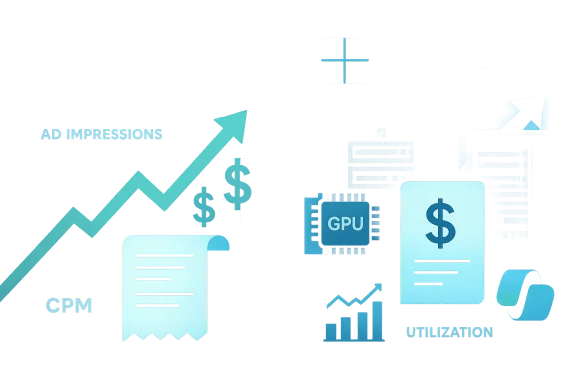
If you are an investor, CIO, or IT leader trying to separate signal from noise, prioritize the following metrics—the ones Wall Street is already watching:- Ad-driven metrics (Meta-relevant)
- Ad impressions growth (volume lift).
- Average price per ad / CPM changes (price lift).
- Revenue per daily active user (monetization efficiency).
- Cloud and enterprise metrics (Microsoft-relevant)
- Azure growth rate and sequential trendline.
- GPU utilization rates and capacity lead times.
- Price per inference / price per token (where disclosed) and Copilot seat ARPU.
- Remaining performance obligations (RPO) concentration and partner concentration (e.g., percent tied to OpenAI).
- Capital efficiency metrics
- Cost per training token or inference.
- Time-to-breakeven on GPU-backed product investments.
- Incremental operating margin produced by new AI-driven features.
Risks and open questions (what could go wrong)
No earnings call eliminates risk. The following are the highest-impact downside scenarios that could alter the narrative:- Meta’s “zero-click” risk: if conversational AI features reduce page views and impressions, ad monetization could structurally decline. Meta’s AI could cannibalize the inventory it sells unless it substitutes with other monetizable interactions.
- GPU supply and vendor pricing: both companies are exposed to concentrated supplier ecosystems. Nvidia pricing and allocation dynamics materially affect cost curves and speed of capacity ramp.
- Backlog concentration: Microsoft’s exposure to a single partner (OpenAI) for a large share of its backlog introduces concentration risk. Any strategic shift by a partner could delay or shrink expected conversion into billed revenue.
- Regulatory and privacy headwinds: advertising regulation, privacy changes, or antitrust interventions could alter ad-targeting economics—particularly for ad-dependent models like Meta’s.
- Execution risk in enterprise productization: Microsoft must demonstrate consistent Copilot seat growth, predictable per-seat economics, and smooth enterprise integration—no small feat given procurement cycles and governance needs.
Practical guidance for investors and IT leaders
For investors: how to think about Meta and Microsoft now
- Distinguish near-term receipts from long-term optionality. If you prize shorter payback horizons and visible ROI, Meta’s model will look attractive. If you prioritize diversification and larger long-term returns that require more patience, Microsoft’s enterprise play still appeals—but at a valuation that must discount short-term capex drag.
- Watch the five unit-econ signals listed above every quarter. If Azure growth re-accelerates alongside improving utilization metrics, Microsoft’s valuation risk fades. If Meta’s ad metrics revert or Reality Labs losses widen without offsetting ad gains, re-evaluate exposure.
For IT leaders and CIOs: vendor and capacity playbook
- Quantify proof-of-value before committing to Copilot-scale deployments. Demand KPIs that map to cost savings, revenue lift, or reduced time-to-market.
- Insure against capacity risk: consider hybrid architectures, contractual GPU capacity guarantees, or multi-cloud strategies to avoid single-supplier constraints.
- Negotiate SLAs and price-per-inference terms when contracting with hyperscalers; insist on usage and cost transparency to avoid surprise operational expenses.
What to watch next: the calendar and the cliff notes
- Quarterly updates from Alphabet and Amazon—both will offer clues about consumer- and cloud-driven AI monetization that can either validate or contradict the Meta/Microsoft divergence.
- Sequential Azure growth and GPU utilization disclosures—these will determine whether Microsoft’s capex is beginning to pay off.
- Meta’s Q1 guidance execution: sustaining ad-impression growth and pricing through early 2026 will be the clearest signal that infrastructure spending is justified.
Final analysis: a maturing market for AI ROI
This earnings pair-off marks a subtle but important market maturation. The narrative that “AI spending automatically begets valuation upside” is over; shareholders now demand proof that AI drives cash flow. Meta’s quarter was market-friendly because it converted AI investments into observable ad metrics that feed revenue immediately. Microsoft’s quarter was not punished for growth failure; it was discounted because the timing of returns and the capital intensity were more ambiguous.Both companies still play complementary roles in the AI stack: Meta excels at converting attention into monetization quickly; Microsoft builds the enterprise-grade infrastructure and product surface area that could produce very large long-term cash flows. The question for investors and IT decision-makers is less about “who wins” and more about whether each company can demonstrate predictable, improving unit economics as they scale AI.
If you are allocating capital today, ask this of any AI-heavy company before you commit:
- Can they show how AI changes revenue or costs on a per-unit basis?
- When will the incremental margins from AI investments show up?
- What are the downside scenarios if GPU pricing or partner concentration shifts?
Conclusion
The Meta–Microsoft split is a defining moment in the AI investment cycle: the era of unquestioned AI spending is ending, and the era of accountable AI investments is beginning. For investors, CIOs, and product leaders, the imperative is the same—measure, quantify, and demand traceable unit economics. Companies that can connect AI spends to near-term, attributable financial outcomes will earn the market’s trust; companies that can’t will pay a valuation penalty until they do.
Source: WebProNews Meta’s AI Surge Crushes Microsoft’s Cloud Wobble