

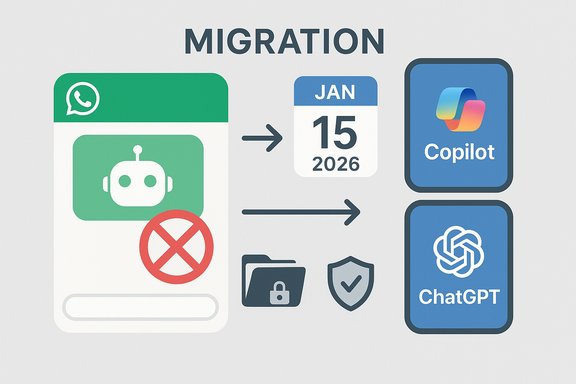
Meta's quiet rewrite of the WhatsApp Business Solution terms that blocks third‑party, general‑purpose AI chatbots has forced major vendors — including Microsoft’s Copilot and OpenAI’s ChatGPT — to withdraw those integrations and push users onto vendor-owned apps and web surfaces, with an effective enforcement date of January 15, 2026 and an urgent migration window for affected users.
Background and overview
Since late 2024, a wave of large language model (LLM) providers began delivering conversational assistants inside WhatsApp by using the WhatsApp Business API (also called the WhatsApp Business Solution). That low-friction distribution model let users message an AI contact like any other number — no separate app, no account sign-in — and it accelerated mainstream discovery of conversational AI in regions where WhatsApp is the dominant messaging layer.In mid‑October 2025, Meta updated the Business Solution Terms to add a new “AI providers” restriction that prohibits providers of large language models, generative AI platforms, and general‑purpose assistants from using the Business API when the AI assistant is the primary functionality offered. The policy gives Meta broad discretion to determine what counts as an “AI Provider” and becomes enforceable on January 15, 2026.
Major AI vendors responded quickly. Microsoft confirmed that Copilot on WhatsApp will stop functioning on January 15, 2026, and directed users to migrate to the Copilot mobile apps, Copilot on the web (copilot.microsoft.com), or the Windows Copilot experience. OpenAI issued similar guidance for ChatGPT users. Vendors warned that WhatsApp‑based conversations were often unauthenticated and therefore cannot be migrated automatically into account‑backed histories; users were urged to export chats or link accounts where supported.
What exactly changed in the Business Solution terms
The new clause in plain language
- The Business Solution Terms now include an explicit clause aimed at “AI Providers.”
- If a provider’s offering is a general‑purpose chatbot (i.e., open‑ended conversational assistant), that provider may not use the Business API to make the assistant available to end users.
- The policy preserves enterprise use cases where AI is ancillary to a broader business workflow (support bots, booking systems, transaction notifications).
The effective date and its implications
- Effective enforcement date: January 15, 2026. That deadline creates a short migration window for users, businesses, and smaller vendors that used WhatsApp as a zero‑install access point.
What the policy does not (explicitly) state
- The updated terms do not publish exact traffic thresholds, message‑volume limits, or a public enforcement protocol that explains how Meta will detect and block violations at scale. Because those operational metrics are not disclosed, the stated infrastructure reasons should be treated as company assertions rather than independently verified facts.
Immediate impact on users
Practical fallout
- If you used Copilot, ChatGPT, or another general‑purpose assistant inside WhatsApp, those contacts will stop responding after January 15, 2026. Vendors say the assistants will continue to exist — but on their own authenticated surfaces (apps, web).
- Chat histories created through WhatsApp are often unauthenticated and cannot be migrated automatically to vendor accounts; users should export conversations they want to retain.
What individual users should do now (short checklist)
- Export important WhatsApp chats with AI contacts using WhatsApp’s Export Chat tool. Choose “Include media” if images or attachments matter. Store exported files securely.
- Install the vendor’s official app (for example, Copilot on iOS/Android or the ChatGPT app) and sign in to create an authenticated history going forward.
- Where available, link your phone number to a vendor account (OpenAI provides this linkage option for some users) to preserve continuity. Note that not all vendors supported linking for WhatsApp sessions.
Export caveats and data portability limits
- WhatsApp’s export is archival — typically plaintext, JSON, or a zipped bundle — rather than a migration format that restores interactive history inside a new assistant. Expect records to be useful for reference, but not to recreate in‑app conversation context seamlessly.
Impact on businesses and developers
Short‑term operational consequences
- Companies that used WhatsApp as the primary distribution channel for a consumer‑facing assistant must re‑architect to comply or move to alternative channels (native apps, web, or other messaging platforms).
- Enterprise bots that used AI as a support tool are likely unaffected if the AI is clearly ancillary; however, hybrid or ambiguous cases will face uncertainty because the policy’s definition of “primary functionality” is broad and discretionary.
Business model and cost implications
- The Business API offered extremely low customer‑acquisition friction. For startups and small vendors, losing WhatsApp as a discovery surface raises acquisition costs and increases friction to scale. Many will have to invest more in marketing, app distribution, and account‑based onboarding.
Alternative channels and their trade‑offs
- Options include Telegram (different API terms), Signal, native iOS/Android apps, web PWAs, or SMS/RCS. Each choice trades reach for control. Messaging alternatives may have smaller audiences or stricter moderation; native apps require users to install and register.
Meta’s stated rationale — operational vs. strategic drivers
Operational explanation (Meta’s claim)
Meta frames the change as a restoration of the Business API’s intended purpose: enterprise‑to‑customer messaging (ticketing, notifications, customer service), not as a free distribution layer for open‑ended conversational assistants. Meta cites rising message volumes and the specialized support, moderation, and engineering commitments that general‑purpose LLM traffic requires. Those operational burdens are the public justification for the rule change.Strategic incentives (credible industry interpretation)
- Blocking third‑party assistants from WhatsApp also reduces a key low-friction channel that competitors used to reach WhatsApp’s billions of users. That advantage accrues to Meta by keeping conversational traffic inside its ecosystem where Meta AI can be promoted and monetized. Industry observers consider this a plausible strategic motive.
Monetization and product fit
- The Business API is a paid/structured channel (templates, notifications). Open‑ended chatbot traffic doesn’t fit neatly into that monetization model; restricting general‑purpose assistants preserves the API’s commerce‑centric contours.
Competition, regulation, and legal risk
Antitrust and competition scrutiny
- Because WhatsApp is a dominant distribution layer in many markets, the change has regulatory implications. Competition authorities in several jurisdictions are likely to evaluate whether the policy confers an unfair advantage to Meta’s own AI. The broad wording and Meta’s discretion to define “AI Provider” increase the probability of regulatory interest and potential probes.
Consumer protection and transparency concerns
- Users may lose conversational continuity or discover their chat histories are inaccessible unless they acted to export them. The opacity around enforcement and migration tools raises consumer‑protection issues that regulators may press on.
Data residency and privacy considerations
- Migrating users to vendor‑owned apps changes where conversational data is processed and stored. Vendors must make clear their data handling and retention practices during migration to meet GDPR and other compliance regimes.
Enforcement mechanics and open questions
- The Business Solution Terms reserve discretion to Meta in determining what qualifies as an AI Provider. Public communications do not detail how enforcement will work at scale: automated pattern detection, contractual audits, or manual reviews are all possibilities but not publicly described. That opacity raises fairness and predictability questions for developers.
- It remains unclear how borderline cases — hybrid enterprise assistants that also answer general queries — will be handled. Will Meta offer a compliance pathway or technical limits (rate caps, message shapes) to preserve some integrations? Public documentation is thin on operational exceptions.
- Because the company has framed the change partly around infrastructure, independent monitoring of message volumes and system load claims will be necessary before treating those numbers as proven technical causation rather than policy framing. Treat non‑disclosed numbers with caution.
Tactical guidance for IT teams and enterprises
For IT administrators and compliance teams
- Identify any workflows that routed AI assistant traffic through WhatsApp Business accounts; classify whether the AI is primary or ancillary. If primary, plan a migration or re‑architecting project.
- Export important conversational records before the cutoff and store them securely. For business continuity, document which users relied on WhatsApp as an entry point and prepare alternative onboarding flows.
- Update vendor contracts and SLAs to reflect where AI services will be delivered going forward (vendor app, web, other messaging channels), and validate data processing and residency terms for compliance.
For product and developer teams
- Prioritize identity and account‑based experiences: authenticated flows reduce portability risk and enable more robust moderation, billing, and personalization.
- Consider a multi‑channel strategy. Relying on a single platform with discretionary business terms is risky; plan fallback distribution methods (web, native apps, alternative messaging platforms).
- Build export and portability tools for end users; provide clear, time‑bounded migration instructions and automated linking where possible. Vendors that make migration painless will reduce churn.
Strengths, weaknesses, and the larger strategic picture
Notable strengths of Meta’s approach
- Preserves Business API intent. The policy clarifies the API’s design goal and protects enterprise messaging channels from high‑volume, unpredictable LLM traffic.
- Reduces operational complexity. Narrowing allowed use cases helps WhatsApp manage moderation and infrastructure resources more predictably.
- Encourages authenticated models. For the market, this nudges vendors toward account‑based assistants that support durable features (history, cross‑device sync).
Key risks and weaknesses
- Concentrates distribution power. The policy advantages Meta’s own AI and reduces frictionless discovery for competitors and startups. That raises competition and anti‑trust concerns.
- Erodes portability. Users lose a convenient in‑app experience and face data fragmentation unless they export or link accounts — which many may not do.
- Ambiguous enforcement. Broad, discretionary language makes it hard for developers to design compliant services and could chill innovation.
The longer view — what this episode signals
This change crystallizes a broader industry inflection: platform owners are treating messaging surfaces as strategic battlegrounds for AI. The convenience of “bot-as-a-contact” distribution is now less stable than previously assumed; AI providers will invest more in authenticated, owned channels (apps, web) and OS or device integrations to preserve direct user relationships. At the same time, regulators will increasingly scrutinize whether platform control of distribution channels undermines competition.Timeline recap and watch list
- Late 2024 – AI vendors begin experimenting with WhatsApp integrations.
- October 2025 – Meta quietly updates WhatsApp Business Solution Terms with the “AI providers” restriction.
- January 15, 2026 – Enforcement date: third‑party general‑purpose assistants must stop using the Business API. Vendors like Microsoft and OpenAI have announced discontinuations of their WhatsApp channels by this date.
- Public clarifications from Meta on enforcement mechanisms;
- Regulatory filings or antitrust inquiries challenging the policy;
- Emergence of standardized assistant interoperability or identity layers that restore cross‑platform portability.
Final assessment and recommended next steps
Meta’s Business API revision is both a pragmatic product governance decision and a strategic move that reshapes conversational AI distribution. For many users it creates immediate friction and potential data‑loss risk; for the industry it rewrites assumptions about where assistants can live and how they must be delivered. The practical actions that reduce disruption are clear:- Export important WhatsApp AI chats now and store them securely.
- Install and sign into vendor apps (Copilot, ChatGPT) to preserve authenticated histories and richer multimodal features.
- For developers and businesses, prioritize account‑backed experiences, adopt multi‑channel strategies, and prepare for increased customer acquisition costs if WhatsApp had been a primary driver.
Conclusion: The removal of third‑party, general‑purpose chatbots from WhatsApp’s Business API marks a decisive shift toward first‑party, authenticated AI experiences and away from zero‑install discovery inside dominant messaging apps. Users must act now to preserve history and continuity, businesses must re‑architect where necessary, and regulators will likely challenge the broader competitive consequences of Meta’s policy.
Source: pc-tablet.com Meta Blocks Rival AI Chatbots on WhatsApp to Boost Its Own AI Race
