

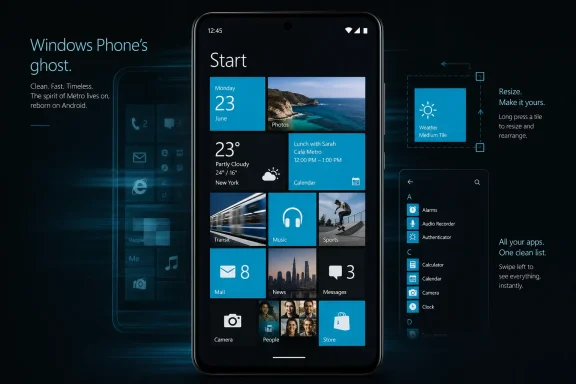
Windows Phone is not coming back, but its ghost keeps finding new hardware to haunt. The latest séance is METROV, an Android launcher that Windows Central readers are praising as the closest thing yet to the old Lumia feeling: tiles, motion, whitespace, and just enough restraint to make modern Android look like it briefly remembered 2014. That matters because Windows Phone nostalgia has usually been treated as a punchline, when in reality it is one of the clearest indictments of how little imagination remains in mainstream phone interfaces.
The interesting part of METROV is not that someone made Android look like Windows Phone. People have been doing that for years, with varying degrees of success, through launchers such as Launcher 10, Square Home, and a cottage industry of tile packs and icon themes. The interesting part is that users are describing METROV not merely as a skin, but as a reminder of a different philosophy of mobile computing.
Windows Central highlighted a Reddit post from u/fisforfaheem, who called METROV “the closest I’ve felt to using a Lumia again.” That line is doing more work than it first appears. It is not just praise for a convincing imitation; it is a complaint about everything that replaced Windows Phone after Microsoft walked away.
Android and iOS won the market, but they also flattened the market. The home screen became a grid of rounded rectangles, occasionally interrupted by widgets, folders, or an algorithmic feed. Windows Phone, for all its commercial failures, insisted that the home screen could be an information surface rather than a parking lot for app shortcuts.
That is why METROV’s appeal lands harder than its download count might suggest. According to the Windows Central report, the launcher launched on April 30, 2025, has passed 10,000 downloads, carries a 4.4 out of 5 rating on Google Play, and was updated recently to version 1.9.5. Those are not ecosystem-shaking numbers, but they are enough to prove that the old Metro idea still has a constituency.
But dead platforms do not all die the same way. Some disappear because nobody misses them. Windows Phone disappeared while leaving behind a user base that still argues, with suspiciously fresh emotion, that the product was right about a few things too early and wrong about a few things too expensively.
The Lumia era had real flaws. Microsoft never solved the app problem, never fully stabilized its developer story, and never stopped rebooting its mobile strategy long enough for buyers to trust it. Windows Phone 7, Windows Phone 8, Windows Phone 8.1, and Windows 10 Mobile formed a chain of ambition punctuated by incompatibility and strategic whiplash.
Yet the interface aged better than the business plan. Live Tiles gave users a way to scan their digital lives without opening everything. The vertical Start screen gave the phone a visual identity. Typography mattered. Motion mattered. Empty space was not treated as wasted space.
That is the piece METROV is trying to recover. Not the old app store. Not the carrier drama. Not the late Lumia hardware road map. It is trying to recover the feeling that a phone could be glanceable, personal, and calm without being inert.
The Windows Central piece notes that users are responding to the animations, the clean interface, and the way the layout evokes Windows Phone 8.1 rather than merely decorating Android with squares. That distinction matters. Many launchers can copy the visible parts of a design language. Fewer understand the rhythm.
Windows Phone’s Start screen was not simply a grid with bigger boxes. It was a hierarchy system. A large tile was a statement of importance. A small tile was a bookmark. The empty gaps and vertical flow made the screen feel like a personal dashboard instead of a tray of software brands fighting for attention.
METROV appears to have earned attention because it takes that hierarchy seriously. The praise from early users is not that it has the most features, or that it can out-customize long-running competitors. The praise is that it feels less like Android in costume.
That is a high bar, because Android constantly leaks through launchers. The notification shade, settings panels, permission prompts, app behavior, widgets, and gesture system all remind users what they are really holding. A launcher can change the first impression, but it cannot fully rewrite the operating system underneath.
That is not surprising. A launcher trying to emulate Windows Phone has to solve a more complicated problem than a conventional Android launcher. It must map Android’s app and notification model onto a design that was created for a different platform, with different assumptions about live content, tile behavior, and system integration.
The hardest part is live tiles. On Windows Phone, tiles were not just widgets pretending to be icons. They were part of the platform’s identity, tied to system APIs and app behaviors that developers could target. On Android, a launcher has to approximate that experience from the outside, often using notifications, widgets, shortcuts, or its own limited mechanisms.
That creates inevitable seams. Weather may behave differently from messages. Calendar information may depend on permissions or third-party app behavior. Some tiles may look authentic while others expose the compromise. Users who remember Lumia devices fondly will notice those seams faster than anyone.
Still, rough edges do not invalidate the project. If anything, they underscore how distinctive Windows Phone was. The fact that recreating it on Android is still difficult in 2026 shows that Microsoft’s mobile interface was not a simple theme. It was a system-level bet.
That history gives METROV both a burden and an opportunity. It cannot win merely by being tile-based. It has to justify itself against tools that already let users build highly customized, Windows Phone-inspired layouts.
The early argument for METROV seems to be authenticity over maximalism. Windows Central’s Reddit source said previous launchers still felt like “Android pretending to be a Windows Phone,” while METROV crossed some subjective line into familiarity. That is the kind of judgment that will infuriate spec-sheet thinkers, but interface nostalgia is made of subjective lines.
A launcher like Square Home may remain the more capable choice for many power users, especially those with foldables, tablets, or elaborate setups. Launcher 10 may still satisfy users who want deep control over tile layouts. METROV’s challenge is to become polished enough that “feels right” is not followed by “but I had to uninstall it.”
That is the central tension of any nostalgia product. It must be faithful enough to trigger memory, but modern enough to survive daily use. The first part gets attention. The second part keeps users.
That decision made business sense. Microsoft’s post-Windows Phone mobile strategy was not to rebuild Windows Phone on Android; it was to put Microsoft 365, OneDrive, Outlook, Teams, Edge, Copilot, and Phone Link wherever users already were. The company stopped trying to own the mobile operating system and focused on owning the work graph that sits above it.
But that left an emotional gap. Microsoft Launcher is useful, but it does not scratch the Lumia itch. It is a modern Android launcher with Microsoft services, not a resurrection of the design language that made Windows Phone feel singular.
METROV exists because Microsoft left that space open. The company that created Metro has spent the last decade slowly sanding down its sharpest interface opinions. Windows 11 has its own visual language, but it is not the same provocation. Microsoft’s mobile presence is now service-first, platform-agnostic, and commercially rational.
For Windows Phone fans, rationality is not the point. They do not miss Windows Phone because it was the safest strategic bet. They miss it because it was one of the last times a major tech company tried to make a phone interface that did not look like everyone else’s.
And yet users still invoke Lumia because the hardware and software were fused in memory. The Start screen felt at home on those devices. The physical design amplified the software’s personality. The entire package made Windows Phone feel less like a generic smartphone and more like an object with a point of view.
That is what modern phones often lack. The high end of the market is technically astonishing, but visually conservative. Flagships are glass sandwiches with camera islands, app grids, and incremental gestures toward personalization. Their differences are increasingly hidden in silicon, camera processing, AI features, and ecosystem lock-in.
Windows Phone was worse at many things, but better at being immediately recognizable. You could spot it across a room. That matters more than the industry likes to admit. Consumer technology is not just capability; it is identity.
METROV cannot recreate the whole Lumia stack, but it can restore the first five seconds. Wake the phone, see the tiles, scroll vertically, catch a flash of accent color, and for a moment the alternate timeline is back.
That argument is correct and incomplete. Market outcomes tell us who won, not which ideas were worth keeping. Betamax lost. WebOS lost. BlackBerry 10 lost. Windows Phone lost. Each still contained interface ideas that later platforms either absorbed poorly or ignored entirely.
Windows Phone’s great contribution was the belief that a home screen should be alive without being noisy. It offered information without forcing every app into a widget zoo. It made personalization structural rather than decorative. It gave the user a layout language, not just wallpaper and icons.
Modern Android has improved dramatically, and iOS has become more flexible than it once was. Widgets, lock-screen customization, theming, dynamic icons, and notification summaries all address parts of the problem. But they often feel bolted onto systems whose deepest assumption remains the app icon.
That is why METROV resonates. It is not asking users to believe Windows Phone secretly won. It is asking whether the winning platforms left something valuable behind.
For a nostalgic launcher, trust matters even more. Users are not just installing utility software; they are giving a third-party developer control over the most frequently viewed surface on the device. A launcher that promises a quiet, uncluttered experience cannot then behave like a data-hungry engagement machine.
This is one area where the Windows Phone memory has probably become rosier with time, but not entirely falsely. Windows Phone felt less desperate for attention than modern mobile platforms. Its interface was dynamic, but it was not built around infinite feeds. Its live tiles could surface information, but the system did not feel like it was constantly trying to pull the user into a monetized loop.
Of course, Microsoft was never a charity, and Windows Phone had its own commercial goals. But the product arrived before the current era of AI assistants, recommendation feeds, aggressive telemetry debates, and notification dark patterns. In retrospect, its restraint looks less like underdevelopment and more like taste.
If METROV can preserve that restraint while building a sustainable paid model through modest in-app purchases, it may avoid the trap that ruins many customization tools: becoming the very clutter it promised to remove.
The original Windows Phone design was built for candy-bar phones, not tablets that unfold into small workspaces. But its tile model is inherently spatial. It could adapt beautifully to larger canvases if a launcher treated the foldable not as a stretched phone, but as a two-pane information board.
Imagine tiles on one side and an app list on the other. Imagine work and personal tile groups changing with posture. Imagine a cover screen with a compact Start layout and an inner screen that behaves more like a dashboard. This is where nostalgia could become more than reconstruction.
The danger for METROV is that fidelity to Windows Phone 8.1 could become a ceiling. A launcher that only reproduces the old phone layout may satisfy purists, but it will struggle on hardware categories that did not exist in meaningful volume during the Lumia peak. The best version of METROV would not freeze Windows Phone in amber; it would ask how Metro would have evolved if Microsoft had stayed in the fight.
That is the difference between a tribute act and a living design system. A tribute act plays the hits. A living design system writes the next album.
But the underlying issue is real for any independent launcher developer. The audience most likely to care about a Windows Phone revival is also the audience most likely to be exacting about details. Tile spacing, animation easing, typography, icon treatment, app list behavior, and live tile timing will all be judged against memories that may be more consistent than reality ever was.
That can be brutal. A mainstream Android launcher can make a design choice and call it preference. A Windows Phone-style launcher makes a design choice and is told whether it is historically correct, spiritually correct, or neither.
The developer also has to navigate Android’s ongoing platform changes. Permissions, background limits, notification access, widget behavior, launcher APIs, gesture navigation, foldable layouts, and OEM-specific quirks can all break the illusion. Samsung, Google, OnePlus, Xiaomi, Motorola, and others do not ship identical Android experiences, even before users add custom settings.
So the bar for METROV is unfair by design. It must be nostalgic, modern, performant, privacy-conscious, customizable, and stable across a fragmented ecosystem. The fact that users are praising it anyway suggests the emotional payoff is unusually strong.
A launcher is powerful, but it is not sovereign. Android apps are designed for Android conventions. They open into Material Design patterns, bottom navigation bars, hamburger menus, permission dialogs, and notification behaviors. The home screen may whisper “Lumia,” but the apps speak Google.
That is why some users describe alternative launchers as “Android pretending.” The illusion breaks when the user leaves the Start screen. No launcher can make Instagram, WhatsApp, Outlook, Spotify, or banking apps behave like Windows Phone apps. No launcher can resurrect the old People hub or the panoramic app layouts that gave Windows Phone its distinctive flow.
Still, the home screen matters because it is where users begin. It frames the device. It determines whether the phone feels like a tool, a dashboard, a toy box, or a slot machine. METROV’s value is not that it can turn Android into Windows Phone completely. It is that it can make Android feel less resigned to being Android.
That may be enough. Most nostalgia products do not restore the past. They make the present more tolerable.
But Microsoft should pay attention to what projects like METROV reveal. The affection for Windows Phone is not just brand loyalty. It is a signal that some users still want Microsoft to bring stronger interface opinions to consumer devices.
Windows 11 has personality in places, but it often feels cautious. Microsoft’s AI-era interface work is increasingly centered on Copilot, search, and cloud-connected assistance. Those are important battlegrounds, but they do not replace the emotional power of a coherent visual and interaction language.
Metro, at its best, was coherent. It had rules. It had typography, motion, hierarchy, and confidence. It was not merely a coat of paint over legacy assumptions. That is why people still remember it.
The lesson for Microsoft is not “make another phone.” The lesson is that design conviction compounds. Even a failed product can leave behind ideas strong enough that independent developers are still chasing them more than a decade later.
But niche tools often reveal dissatisfaction before large companies admit it exists. The popularity of tiling window managers, minimalist launchers, distraction-free writing apps, and retro-styled devices all points to the same fatigue: users are tired of software that treats attention as quarry.
Windows Phone nostalgia fits that pattern. It is not only about missing a dead Microsoft product. It is about missing a phone that felt organized around the user’s glance rather than the platform’s appetite. It is about wanting the home screen to have shape, not just inventory.
METROV’s challenge is to turn that emotional hook into a durable product. It needs polish, foldable awareness, reliable live tile behavior, and a community relationship that can survive criticism. If it can do that, it will not bring back Windows Phone, but it may become the most convincing argument that Windows Phone’s interface deserved a longer life.
The smartphone wars are over in the way empires declare wars over: the borders are settled, the winners are rich, and everyone is expected to move on. METROV is a small refusal to move on completely, and that is why it matters. If the next generation of mobile interfaces is going to be more than AI pasted onto the same old icon grid, designers would do well to study why a handful of Android users are still chasing the feeling of a Lumia Start screen in 2026.
Source: Windows Central https://www.windowscentral.com/hardware/windows-phone/metrov-windows-phone-launcher/
 A Launcher Becomes a Small Rebellion Against the Icon Grid
The interesting part of METROV is not that someone made Android look like Windows Phone. People have been doing that for years, with varying degrees of success, through launchers such as Launcher 10, Square Home, and a cottage industry of tile packs and icon themes. The interesting part is that users are describing METROV not merely as a skin, but as a reminder of a different philosophy of mobile computing.Windows Central highlighted a Reddit post from u/fisforfaheem, who called METROV “the closest I’ve felt to using a Lumia again.” That line is doing more work than it first appears. It is not just praise for a convincing imitation; it is a complaint about everything that replaced Windows Phone after Microsoft walked away.
Android and iOS won the market, but they also flattened the market. The home screen became a grid of rounded rectangles, occasionally interrupted by widgets, folders, or an algorithmic feed. Windows Phone, for all its commercial failures, insisted that the home screen could be an information surface rather than a parking lot for app shortcuts.
That is why METROV’s appeal lands harder than its download count might suggest. According to the Windows Central report, the launcher launched on April 30, 2025, has passed 10,000 downloads, carries a 4.4 out of 5 rating on Google Play, and was updated recently to version 1.9.5. Those are not ecosystem-shaking numbers, but they are enough to prove that the old Metro idea still has a constituency.
Windows Phone Lost the War but Won a Strange Afterlife
Microsoft officially ended support for Windows Phone 8.1 in July 2017 and later ended support for Windows 10 Mobile in December 2019. In platform terms, that should have been the end. The Store withered, the app gap became a canyon, and even committed Lumia owners eventually had to choose between security, compatibility, and stubborn affection.But dead platforms do not all die the same way. Some disappear because nobody misses them. Windows Phone disappeared while leaving behind a user base that still argues, with suspiciously fresh emotion, that the product was right about a few things too early and wrong about a few things too expensively.
The Lumia era had real flaws. Microsoft never solved the app problem, never fully stabilized its developer story, and never stopped rebooting its mobile strategy long enough for buyers to trust it. Windows Phone 7, Windows Phone 8, Windows Phone 8.1, and Windows 10 Mobile formed a chain of ambition punctuated by incompatibility and strategic whiplash.
Yet the interface aged better than the business plan. Live Tiles gave users a way to scan their digital lives without opening everything. The vertical Start screen gave the phone a visual identity. Typography mattered. Motion mattered. Empty space was not treated as wasted space.
That is the piece METROV is trying to recover. Not the old app store. Not the carrier drama. Not the late Lumia hardware road map. It is trying to recover the feeling that a phone could be glanceable, personal, and calm without being inert.
METROV’s Best Feature Is That It Understands Restraint
The Google Play description for METROV emphasizes the expected launcher checklist: live tiles, tile resizing, accent colors, dark and light themes, an app drawer, and performance tuning. It also makes the increasingly meaningful promise of “no ads, no tracking, no clutter.” In 2026, that last phrase may be as nostalgic as the tiles.The Windows Central piece notes that users are responding to the animations, the clean interface, and the way the layout evokes Windows Phone 8.1 rather than merely decorating Android with squares. That distinction matters. Many launchers can copy the visible parts of a design language. Fewer understand the rhythm.
Windows Phone’s Start screen was not simply a grid with bigger boxes. It was a hierarchy system. A large tile was a statement of importance. A small tile was a bookmark. The empty gaps and vertical flow made the screen feel like a personal dashboard instead of a tray of software brands fighting for attention.
METROV appears to have earned attention because it takes that hierarchy seriously. The praise from early users is not that it has the most features, or that it can out-customize long-running competitors. The praise is that it feels less like Android in costume.
That is a high bar, because Android constantly leaks through launchers. The notification shade, settings panels, permission prompts, app behavior, widgets, and gesture system all remind users what they are really holding. A launcher can change the first impression, but it cannot fully rewrite the operating system underneath.
The Bugs Are Part of the Story, Not a Footnote
The METROV praise comes with caveats. Users cited by Windows Central mention bugs, live tile glitches, and rough edges. Others reportedly returned to Square Home because METROV does not yet match its maturity, including support for foldables.That is not surprising. A launcher trying to emulate Windows Phone has to solve a more complicated problem than a conventional Android launcher. It must map Android’s app and notification model onto a design that was created for a different platform, with different assumptions about live content, tile behavior, and system integration.
The hardest part is live tiles. On Windows Phone, tiles were not just widgets pretending to be icons. They were part of the platform’s identity, tied to system APIs and app behaviors that developers could target. On Android, a launcher has to approximate that experience from the outside, often using notifications, widgets, shortcuts, or its own limited mechanisms.
That creates inevitable seams. Weather may behave differently from messages. Calendar information may depend on permissions or third-party app behavior. Some tiles may look authentic while others expose the compromise. Users who remember Lumia devices fondly will notice those seams faster than anyone.
Still, rough edges do not invalidate the project. If anything, they underscore how distinctive Windows Phone was. The fact that recreating it on Android is still difficult in 2026 shows that Microsoft’s mobile interface was not a simple theme. It was a system-level bet.
Square Home and Launcher 10 Are the Incumbents METROV Must Respect
METROV is not entering an empty field. Launcher 10 and Square Home have been the default recommendations for years among Android users who want a Windows Phone-style home screen. Square Home in particular has built a loyal following because it is flexible, mature, and adaptable to modern Android hardware.That history gives METROV both a burden and an opportunity. It cannot win merely by being tile-based. It has to justify itself against tools that already let users build highly customized, Windows Phone-inspired layouts.
The early argument for METROV seems to be authenticity over maximalism. Windows Central’s Reddit source said previous launchers still felt like “Android pretending to be a Windows Phone,” while METROV crossed some subjective line into familiarity. That is the kind of judgment that will infuriate spec-sheet thinkers, but interface nostalgia is made of subjective lines.
A launcher like Square Home may remain the more capable choice for many power users, especially those with foldables, tablets, or elaborate setups. Launcher 10 may still satisfy users who want deep control over tile layouts. METROV’s challenge is to become polished enough that “feels right” is not followed by “but I had to uninstall it.”
That is the central tension of any nostalgia product. It must be faithful enough to trigger memory, but modern enough to survive daily use. The first part gets attention. The second part keeps users.
Microsoft Launcher Took a Different Road
There is an obvious corporate irony here: the most convincing Windows Phone revival is not coming from Microsoft. Microsoft Launcher for Android became a practical companion to Microsoft services, Windows integration, feeds, calendars, and productivity workflows. It did not become a Metro revival.That decision made business sense. Microsoft’s post-Windows Phone mobile strategy was not to rebuild Windows Phone on Android; it was to put Microsoft 365, OneDrive, Outlook, Teams, Edge, Copilot, and Phone Link wherever users already were. The company stopped trying to own the mobile operating system and focused on owning the work graph that sits above it.
But that left an emotional gap. Microsoft Launcher is useful, but it does not scratch the Lumia itch. It is a modern Android launcher with Microsoft services, not a resurrection of the design language that made Windows Phone feel singular.
METROV exists because Microsoft left that space open. The company that created Metro has spent the last decade slowly sanding down its sharpest interface opinions. Windows 11 has its own visual language, but it is not the same provocation. Microsoft’s mobile presence is now service-first, platform-agnostic, and commercially rational.
For Windows Phone fans, rationality is not the point. They do not miss Windows Phone because it was the safest strategic bet. They miss it because it was one of the last times a major tech company tried to make a phone interface that did not look like everyone else’s.
The Lumia Feeling Was Always About More Than Tiles
The phrase “using a Lumia again” is revealing because METROV cannot recreate Lumia hardware. It cannot bring back polycarbonate shells, dedicated camera buttons, PureView branding, Nokia’s color palette, or the peculiar confidence of a bright cyan slab in a sea of black rectangles. It cannot restore the old camera stack or the tactile pleasure of devices like the Lumia 920, 1020, 1520, or 950.And yet users still invoke Lumia because the hardware and software were fused in memory. The Start screen felt at home on those devices. The physical design amplified the software’s personality. The entire package made Windows Phone feel less like a generic smartphone and more like an object with a point of view.
That is what modern phones often lack. The high end of the market is technically astonishing, but visually conservative. Flagships are glass sandwiches with camera islands, app grids, and incremental gestures toward personalization. Their differences are increasingly hidden in silicon, camera processing, AI features, and ecosystem lock-in.
Windows Phone was worse at many things, but better at being immediately recognizable. You could spot it across a room. That matters more than the industry likes to admit. Consumer technology is not just capability; it is identity.
METROV cannot recreate the whole Lumia stack, but it can restore the first five seconds. Wake the phone, see the tiles, scroll vertically, catch a flash of accent color, and for a moment the alternate timeline is back.
Nostalgia Is Not the Same as Delusion
It is tempting to dismiss all of this as retro computing cosplay. Nobody serious should want Windows Phone back, the argument goes, because the market rendered its verdict years ago. Android and iOS won because they had the apps, developers, distribution, and momentum.That argument is correct and incomplete. Market outcomes tell us who won, not which ideas were worth keeping. Betamax lost. WebOS lost. BlackBerry 10 lost. Windows Phone lost. Each still contained interface ideas that later platforms either absorbed poorly or ignored entirely.
Windows Phone’s great contribution was the belief that a home screen should be alive without being noisy. It offered information without forcing every app into a widget zoo. It made personalization structural rather than decorative. It gave the user a layout language, not just wallpaper and icons.
Modern Android has improved dramatically, and iOS has become more flexible than it once was. Widgets, lock-screen customization, theming, dynamic icons, and notification summaries all address parts of the problem. But they often feel bolted onto systems whose deepest assumption remains the app icon.
That is why METROV resonates. It is not asking users to believe Windows Phone secretly won. It is asking whether the winning platforms left something valuable behind.
Privacy and Minimalism Have Become Part of the Appeal
The “no ads, no tracking” claim on METROV’s Play Store page is not incidental. Launchers occupy one of the most sensitive positions on a phone. They see what apps users open, how often they open them, what shortcuts they create, what widgets they place, and sometimes which notifications are worth surfacing.For a nostalgic launcher, trust matters even more. Users are not just installing utility software; they are giving a third-party developer control over the most frequently viewed surface on the device. A launcher that promises a quiet, uncluttered experience cannot then behave like a data-hungry engagement machine.
This is one area where the Windows Phone memory has probably become rosier with time, but not entirely falsely. Windows Phone felt less desperate for attention than modern mobile platforms. Its interface was dynamic, but it was not built around infinite feeds. Its live tiles could surface information, but the system did not feel like it was constantly trying to pull the user into a monetized loop.
Of course, Microsoft was never a charity, and Windows Phone had its own commercial goals. But the product arrived before the current era of AI assistants, recommendation feeds, aggressive telemetry debates, and notification dark patterns. In retrospect, its restraint looks less like underdevelopment and more like taste.
If METROV can preserve that restraint while building a sustainable paid model through modest in-app purchases, it may avoid the trap that ruins many customization tools: becoming the very clutter it promised to remove.
Foldables Expose the Limits of Simple Resurrection
One user cited by Windows Central reportedly returned to Square Home because it supports foldables. That sounds like a niche complaint until you remember that foldables are exactly the kind of hardware where a Windows Phone-style interface could become interesting again.The original Windows Phone design was built for candy-bar phones, not tablets that unfold into small workspaces. But its tile model is inherently spatial. It could adapt beautifully to larger canvases if a launcher treated the foldable not as a stretched phone, but as a two-pane information board.
Imagine tiles on one side and an app list on the other. Imagine work and personal tile groups changing with posture. Imagine a cover screen with a compact Start layout and an inner screen that behaves more like a dashboard. This is where nostalgia could become more than reconstruction.
The danger for METROV is that fidelity to Windows Phone 8.1 could become a ceiling. A launcher that only reproduces the old phone layout may satisfy purists, but it will struggle on hardware categories that did not exist in meaningful volume during the Lumia peak. The best version of METROV would not freeze Windows Phone in amber; it would ask how Metro would have evolved if Microsoft had stayed in the fight.
That is the difference between a tribute act and a living design system. A tribute act plays the hits. A living design system writes the next album.
The Developer’s Problem Is Bigger Than One Launcher
Small software projects live or die by attention, patience, and community tone. Windows Central’s report notes that some users praise METROV enthusiastically while others say it still needs work. There is also an unverified claim in the discussion that the developer “hates criticism,” which should be treated cautiously unless there is evidence.But the underlying issue is real for any independent launcher developer. The audience most likely to care about a Windows Phone revival is also the audience most likely to be exacting about details. Tile spacing, animation easing, typography, icon treatment, app list behavior, and live tile timing will all be judged against memories that may be more consistent than reality ever was.
That can be brutal. A mainstream Android launcher can make a design choice and call it preference. A Windows Phone-style launcher makes a design choice and is told whether it is historically correct, spiritually correct, or neither.
The developer also has to navigate Android’s ongoing platform changes. Permissions, background limits, notification access, widget behavior, launcher APIs, gesture navigation, foldable layouts, and OEM-specific quirks can all break the illusion. Samsung, Google, OnePlus, Xiaomi, Motorola, and others do not ship identical Android experiences, even before users add custom settings.
So the bar for METROV is unfair by design. It must be nostalgic, modern, performant, privacy-conscious, customizable, and stable across a fragmented ecosystem. The fact that users are praising it anyway suggests the emotional payoff is unusually strong.
The App Gap Is Gone, but the Interface Gap Remains
One of the more bitter ironies of Windows Phone nostalgia is that Android can now run the apps Windows Phone never had, while launchers like METROV can imitate the interface Windows Phone users preferred. In theory, this gives former Lumia owners the best of both worlds. In practice, it also underlines why operating systems matter.A launcher is powerful, but it is not sovereign. Android apps are designed for Android conventions. They open into Material Design patterns, bottom navigation bars, hamburger menus, permission dialogs, and notification behaviors. The home screen may whisper “Lumia,” but the apps speak Google.
That is why some users describe alternative launchers as “Android pretending.” The illusion breaks when the user leaves the Start screen. No launcher can make Instagram, WhatsApp, Outlook, Spotify, or banking apps behave like Windows Phone apps. No launcher can resurrect the old People hub or the panoramic app layouts that gave Windows Phone its distinctive flow.
Still, the home screen matters because it is where users begin. It frames the device. It determines whether the phone feels like a tool, a dashboard, a toy box, or a slot machine. METROV’s value is not that it can turn Android into Windows Phone completely. It is that it can make Android feel less resigned to being Android.
That may be enough. Most nostalgia products do not restore the past. They make the present more tolerable.
Microsoft Should Notice, Even If It Should Not Return
There is no serious argument that Microsoft should relaunch Windows Phone as a third mobile platform in 2026. The economics are worse now than they were when Microsoft still had Nokia hardware, carrier relationships, and a mobile operating system in active development. The app market is more consolidated, the regulatory environment is more complex, and user switching costs are higher.But Microsoft should pay attention to what projects like METROV reveal. The affection for Windows Phone is not just brand loyalty. It is a signal that some users still want Microsoft to bring stronger interface opinions to consumer devices.
Windows 11 has personality in places, but it often feels cautious. Microsoft’s AI-era interface work is increasingly centered on Copilot, search, and cloud-connected assistance. Those are important battlegrounds, but they do not replace the emotional power of a coherent visual and interaction language.
Metro, at its best, was coherent. It had rules. It had typography, motion, hierarchy, and confidence. It was not merely a coat of paint over legacy assumptions. That is why people still remember it.
The lesson for Microsoft is not “make another phone.” The lesson is that design conviction compounds. Even a failed product can leave behind ideas strong enough that independent developers are still chasing them more than a decade later.
METROV Is Small, but the Signal Is Loud
A launcher with 10,000-plus downloads is not a market revolution. It will not worry Google, Apple, Samsung, or Microsoft. It may never become more than a beloved niche tool for former Lumia owners and interface obsessives.But niche tools often reveal dissatisfaction before large companies admit it exists. The popularity of tiling window managers, minimalist launchers, distraction-free writing apps, and retro-styled devices all points to the same fatigue: users are tired of software that treats attention as quarry.
Windows Phone nostalgia fits that pattern. It is not only about missing a dead Microsoft product. It is about missing a phone that felt organized around the user’s glance rather than the platform’s appetite. It is about wanting the home screen to have shape, not just inventory.
METROV’s challenge is to turn that emotional hook into a durable product. It needs polish, foldable awareness, reliable live tile behavior, and a community relationship that can survive criticism. If it can do that, it will not bring back Windows Phone, but it may become the most convincing argument that Windows Phone’s interface deserved a longer life.
The smartphone wars are over in the way empires declare wars over: the borders are settled, the winners are rich, and everyone is expected to move on. METROV is a small refusal to move on completely, and that is why it matters. If the next generation of mobile interfaces is going to be more than AI pasted onto the same old icon grid, designers would do well to study why a handful of Android users are still chasing the feeling of a Lumia Start screen in 2026.
Source: Windows Central https://www.windowscentral.com/hardware/windows-phone/metrov-windows-phone-launcher/
