

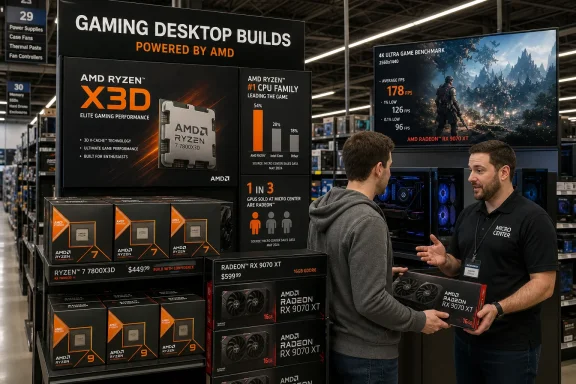
Micro Center says AMD Ryzen is now its leading gaming desktop CPU family and that roughly one in three gaming desktop graphics cards it sells is AMD Radeon, according to a July 7 Wccftech report quoting Micro Center president and CEO Rick Mershad. The claim is narrow but meaningful: this is not global market share, and it is not a Steam survey, but it is a signal from one of America’s most enthusiast-heavy PC retailers. AMD’s CPU win now looks less like a hot product cycle and more like a durable retail advantage. Radeon’s GPU showing, meanwhile, hints at something more fragile but potentially more consequential: AMD may finally have a mainstream graphics story that store associates can sell without apology.
There are retailers that move boxes, and then there is Micro Center. For PC builders in the United States, it has long functioned as part store, part pilgrimage site, part real-world benchmarking forum. Its shelves do not represent the entire PC market, but they do capture the instincts of people who build, upgrade, compare, and argue before they buy.
That makes Mershad’s reported comments interesting beyond the usual vendor victory lap. Wccftech’s Hassan Mujtaba frames the news around Micro Center’s latest sales momentum, with Ryzen occupying a leading position in gaming desktop CPUs and AMD chips reportedly taking eight of the top 10 most popular CPU slots at the retailer. The exact list can move with promos, inventory, and bundle pricing, but the shape of the market is hard to miss.
Ryzen has become the default enthusiast recommendation because AMD solved a problem Intel used to own: continuity. A builder can buy into an AMD platform with a reasonable expectation that the motherboard will not become obsolete the moment a new CPU generation lands. That matters in a world where a processor is no longer just a processor; it is a platform bet.
Radeon’s reported one-in-three share of gaming desktop GPU sales at Micro Center is the more surprising figure. Nvidia still dominates discrete graphics in broader industry reporting and mindshare, especially at the high end and in AI-adjacent branding. But in the physical retail aisle, where customers ask what performs well for the money today, AMD appears to be getting a hearing again.
AMD said at Computex 2026 that it was extending Socket AM5 support through 2029. That commitment is not a benchmark number, but it is an economic argument. If you are building a gaming PC, the idea that your motherboard can host several future CPU upgrades changes the way you justify the initial spend.
Intel’s desktop roadmap, by contrast, has often asked enthusiasts to tolerate socket churn as the price of staying current. That is not always unfair; new memory standards, power delivery, and I/O can require new platforms. But AMD has made the counterargument emotionally powerful: gamers remember being able to drop a later Ryzen X3D chip into an older board and feel as if they had beaten the upgrade treadmill.
The X3D lineup is the center of that story. AMD’s 3D V-Cache chips have turned cache into a retail talking point, which is no small achievement. Most people do not care about L3 cache in the abstract, but they do care when reviewers keep finding that a gaming-optimized Ryzen chip can outperform more expensive alternatives in the games people actually play.
That is why Micro Center’s reported ranking feels plausible. Store associates do not need a 20-minute architecture lesson to recommend an X3D chip to a gamer. They can say, in plain English, that the extra cache often helps games, that the platform has a long runway, and that the bundle price is competitive. That is retail gold.
For many WindowsForum readers, the old Intel pitch was simple. You bought Intel because it was fast, stable, easy to recommend, and usually the safest choice for gaming. AMD’s Ryzen resurgence disrupted that pitch first on core counts and value, then on platform longevity, and finally on gaming performance.
The X3D chips finished the argument in a particularly damaging way for Intel. They did not merely close the gaming gap; they made AMD feel specialized. A Ryzen X3D processor is not just a good CPU that happens to game well. It is sold, reviewed, and understood as a gaming CPU.
That distinction matters in stores. When a buyer walks into Micro Center asking for a gaming desktop CPU, the answer increasingly sounds like Ryzen by default. Intel can counter with discounts, productivity performance, or future architectures, but the retail narrative has moved.
This is also where Windows itself quietly enters the picture. Modern CPUs are more dependent than ever on firmware, scheduling, power management, and game behavior. The best enthusiast platform is not merely the one with the strongest silicon; it is the one where BIOS updates, chipset drivers, Windows behavior, and game engines produce predictable results.
AMD has not been flawless there. Early Ryzen generations had memory quirks, firmware drama, and scheduling oddities of their own. But in the current enthusiast conversation, AMD’s gaming CPUs feel settled, while Intel’s desktop story has too often felt transitional.
AMD launched the Radeon RX 9070 XT and RX 9070 in early 2025 as part of the RDNA 4-based RX 9000 series, with official pricing that positioned the cards below Nvidia’s most expensive halo territory. The RX 9070 XT in particular became the kind of card AMD needed: not a symbolic flagship, but a practical enthusiast GPU with enough performance, VRAM, and pricing appeal to make buyers pause before clicking on GeForce.
Mershad’s reported comment that the RX 9070 XT was one of Micro Center’s most exciting product launches in years is notable because retailers are brutally practical. They care about demand, availability, return rates, attach sales, and whether associates can explain a product without caveats. A launch that brings people into stores and keeps momentum afterward is not just a spec-sheet victory.
Still, one in three gaming desktop graphics cards at Micro Center does not mean Radeon has conquered the GPU market. It means AMD is converting a specific kind of buyer in a specific channel. That buyer is likely more price-sensitive, more self-directed, and more willing to compare rasterization performance, VRAM capacity, and feature tradeoffs than the average prebuilt shopper.
That is exactly where AMD can win first. The Radeon comeback does not need to begin with the most expensive GPU on the shelf. It needs to begin with the customer who says, “I want strong 1440p or entry 4K performance, I do not want to overpay, and I am willing to use AMD’s software stack if the value is there.”
That makes Radeon’s retail comeback harder than Ryzen’s. CPUs are comparatively easier to evaluate for gaming. A benchmark chart says the X3D chip is fast; the socket roadmap says the motherboard will last; the price says the bundle makes sense. GPUs carry more emotional baggage.
Ray tracing remains the most obvious pressure point. AMD has improved generation by generation, but Nvidia still benefits from the perception that if you care about top-end ray tracing, GeForce is the safe bet. Upscaling is similar: AMD’s FSR has become more capable and more broadly discussed, while FSR 4 brought machine-learning-based upscaling to the RX 9000 series, but Nvidia’s DLSS brand remains deeply entrenched.
There is also the software ecosystem problem. Radeon drivers are no longer the punchline they were in some older enthusiast circles, but reputation lags reality. Store associates can overcome that one customer at a time, especially if return rates are low and buyers are happy. Online, however, old narratives persist far longer than product cycles.
That is why the Micro Center figure matters. A physical sale is not a Reddit argument. It is a customer making a decision after seeing price tags, stock levels, sales advice, and competing boxes. If Radeon is winning one out of three of those decisions in gaming desktop GPUs at Micro Center, AMD has found a practical wedge.
The old weakness in that pitch was obvious: gamers might love Ryzen but still buy GeForce. That produced a strange asymmetry in AMD’s client business. The company could win the CPU socket and still watch the GPU slot go to Nvidia, turning every gaming build into a split-ticket election.
Radeon gaining traction at Micro Center suggests the split ticket may be narrowing, at least in enthusiast retail. A buyer who chooses Ryzen first is already listening to AMD. If the Radeon card beside it has competitive performance, sensible VRAM, and a lower price, the sales associate has an easier job than in prior generations.
There are also subtle advantages in platform bundling. Retailers can build promotions around CPU, motherboard, memory, and GPU combinations. AMD can market Smart Access Memory-style platform features, driver-level tuning, and a unified Adrenalin software experience. Not all of those features will sway a skeptical buyer, but together they make AMD feel less like the alternative and more like a complete build strategy.
The catch is that platform stories only work when each component is strong enough on its own. Ryzen can carry Radeon into the conversation, but it cannot carry a weak GPU across the checkout line. Radeon’s reported Micro Center momentum is therefore meaningful precisely because it appears attached to a product generation buyers wanted, not merely to AMD branding.
That is where AMD may have benefited from the messy dynamics of the GPU market. Nvidia’s high-end cards command enormous attention, but they also invite scarcity, inflated pricing, and buyer frustration. When a shopper walks into a store and finds the card they want is unavailable or priced beyond reason, the second-best theoretical option can become the best actual option.
AMD has historically suffered from its own supply problems, so this is not a permanent advantage. But the RX 9070 XT launch appears to have landed in a market hungry for alternatives. If Micro Center had enough Radeon inventory to meet visible demand while competing GeForce cards were harder to get or more expensive, retail share could move quickly.
This is also why broad market-share reports can miss the lived experience of buyers. A global number might show Nvidia dominant, which remains true in many slices of the market. But a shopper does not buy a global number; they buy the product in front of them, at the price offered that day, with the games and monitor they own.
For Windows enthusiasts, that distinction matters. The best GPU recommendation is not timeless. It changes with drivers, game bundles, monitor resolution, VRAM pressure, upscaling quality, and street pricing. Micro Center’s sales mix is a snapshot of those forces colliding in the aisle.
The console connection also gives AMD a credibility layer that Radeon sometimes lacks in enthusiast debate. Even when PC gamers argue about GeForce versus Radeon, they are often playing titles that already understand AMD GPU architectures through the console pipeline. That background does not erase Nvidia’s software advantages, but it complicates the idea that Radeon is an outsider platform.
AMD’s challenge is turning that console footprint into desktop confidence. PC gamers do not buy theoretical ecosystem influence; they buy drivers, frame pacing, feature support, and compatibility. The RX 9000 series has to prove that AMD can translate its console relevance into a smoother Radeon ownership experience on Windows.
This is where partnerships matter. AMD’s work with Microsoft and Sony in the console space gives it a seat at important gaming technology tables, while its Windows driver stack must continue to mature in public. Every smooth launch, every quick game-ready update, and every credible upscaling improvement chips away at the old assumption that Radeon is the budget compromise.
If Micro Center customers are now choosing Radeon at a one-in-three rate for gaming desktop cards, that suggests the compromise has become acceptable—or, in some builds, no compromise at all.
A GeForce buyer at the top of the stack may already be prepared to pay a premium. A Radeon buyer choosing a card because it offers better performance per dollar may be more sensitive to a $50 or $100 swing. If memory costs push AMD board prices higher, the fragile arithmetic that helped Radeon gain shelf momentum could weaken.
The same pressure applies to the broader DIY market. DDR5 pricing, SSD pricing, GPU memory, and motherboard costs all shape build decisions. When one component rises, buyers rebalance the whole system. A more expensive GPU may push someone to a cheaper CPU, a smaller SSD, or a delayed purchase.
AMD’s advantage is that Ryzen bundles can absorb some of that pain. If Micro Center can pair a strong Ryzen CPU deal with a Radeon card at a compelling combined price, AMD can preserve the platform pitch even when individual component prices fluctuate. But that requires coordination among AMD, board partners, retailers, and supply chains that are not fully under AMD’s control.
That is the less romantic side of this story. Momentum is not destiny. It is inventory, pricing, confidence, and timing, repeated week after week.
AMD’s CPU strategy meets that mood cleanly. Long socket support says the buyer is not a fool for investing today. X3D performance says the buyer does not have to sacrifice gaming speed for platform patience. Aggressive retail bundles say the savings are not only theoretical.
Radeon’s appeal is adjacent. It says the buyer may not need to accept Nvidia pricing to get a modern gaming experience. That message is weaker than Ryzen’s because Nvidia’s advantages are more durable and more visible in certain workloads. But for many gamers, especially at 1440p, the question is not whether Radeon wins every feature comparison. It is whether it wins enough of them for less money.
This is why AMD’s current retail story is so potent. It is not merely selling silicon; it is selling relief. Relief from platform churn, relief from GPU sticker shock, relief from the feeling that the obvious choice is also the most expensive one.
Intel and Nvidia can respond, of course. Intel can sharpen its desktop roadmap and pricing. Nvidia can rely on its software moat and performance leadership. But in the specific theater of Micro Center gaming builds, AMD has made the alternative feel mainstream.
Radeon’s case is more conditional. The RX 9000 series made AMD more competitive, especially where price and availability favor it, but Nvidia remains stronger in several high-end feature narratives. Buyers who rely heavily on ray tracing, CUDA-accelerated creative tools, certain AI workflows, or DLSS-supported titles still have reasons to lean GeForce.
The healthier takeaway is that GPU shopping is becoming less automatic. For several years, “buy Nvidia if you can afford it” was the default answer in many enthusiast spaces. That answer may still be valid for some buyers, but it is no longer intellectually honest as a universal rule.
The same applies to CPUs. Intel can still make sense depending on price, workload, motherboard availability, and specific performance needs. But for a gaming-first Windows desktop in 2026, AMD has earned the burden of being the default comparison point.
That is a remarkable reversal. A decade ago, AMD was the company enthusiasts wanted to root for but often could not recommend without caveats. Today, at least in Micro Center’s gaming CPU aisle, the caveats belong mostly to the other side.
Micro Center’s reported sales mix is a reminder that platform wars are not settled by keynote slides or forum arguments alone; they are settled when a buyer stands in front of a shelf, compares the price, asks what will last, and decides what goes into the next Windows build. Ryzen has become the safe recommendation by making performance and longevity feel like the same purchase, while Radeon is trying to turn a strong generation into a durable habit. If AMD can keep supply steady, software improving, and prices honest, the next few years of PC gaming hardware may be less about whether AMD can catch up and more about how long its rivals can keep charging for certainty.
 Micro Center Is Not the Whole Market, but It Is the Right Shop Window
There are retailers that move boxes, and then there is Micro Center. For PC builders in the United States, it has long functioned as part store, part pilgrimage site, part real-world benchmarking forum. Its shelves do not represent the entire PC market, but they do capture the instincts of people who build, upgrade, compare, and argue before they buy.That makes Mershad’s reported comments interesting beyond the usual vendor victory lap. Wccftech’s Hassan Mujtaba frames the news around Micro Center’s latest sales momentum, with Ryzen occupying a leading position in gaming desktop CPUs and AMD chips reportedly taking eight of the top 10 most popular CPU slots at the retailer. The exact list can move with promos, inventory, and bundle pricing, but the shape of the market is hard to miss.
Ryzen has become the default enthusiast recommendation because AMD solved a problem Intel used to own: continuity. A builder can buy into an AMD platform with a reasonable expectation that the motherboard will not become obsolete the moment a new CPU generation lands. That matters in a world where a processor is no longer just a processor; it is a platform bet.
Radeon’s reported one-in-three share of gaming desktop GPU sales at Micro Center is the more surprising figure. Nvidia still dominates discrete graphics in broader industry reporting and mindshare, especially at the high end and in AI-adjacent branding. But in the physical retail aisle, where customers ask what performs well for the money today, AMD appears to be getting a hearing again.
Ryzen Won by Making the Motherboard Feel Safe
AMD’s most important CPU feature in 2026 may not be cache, core count, or clock speed. It may be trust. The company spent years turning the AM4 socket from a platform into a promise, and it is now trying to repeat that strategy with AM5.AMD said at Computex 2026 that it was extending Socket AM5 support through 2029. That commitment is not a benchmark number, but it is an economic argument. If you are building a gaming PC, the idea that your motherboard can host several future CPU upgrades changes the way you justify the initial spend.
Intel’s desktop roadmap, by contrast, has often asked enthusiasts to tolerate socket churn as the price of staying current. That is not always unfair; new memory standards, power delivery, and I/O can require new platforms. But AMD has made the counterargument emotionally powerful: gamers remember being able to drop a later Ryzen X3D chip into an older board and feel as if they had beaten the upgrade treadmill.
The X3D lineup is the center of that story. AMD’s 3D V-Cache chips have turned cache into a retail talking point, which is no small achievement. Most people do not care about L3 cache in the abstract, but they do care when reviewers keep finding that a gaming-optimized Ryzen chip can outperform more expensive alternatives in the games people actually play.
That is why Micro Center’s reported ranking feels plausible. Store associates do not need a 20-minute architecture lesson to recommend an X3D chip to a gamer. They can say, in plain English, that the extra cache often helps games, that the platform has a long runway, and that the bundle price is competitive. That is retail gold.
Intel’s Problem Is Not That It Has Bad CPUs
It would be lazy to reduce this to “AMD good, Intel bad.” Intel still ships competent desktop processors, still has enormous OEM reach, and still carries brand recognition that AMD spent decades trying to dent. The problem is sharper than that: Intel has struggled to give DIY gamers a clean reason to choose it first.For many WindowsForum readers, the old Intel pitch was simple. You bought Intel because it was fast, stable, easy to recommend, and usually the safest choice for gaming. AMD’s Ryzen resurgence disrupted that pitch first on core counts and value, then on platform longevity, and finally on gaming performance.
The X3D chips finished the argument in a particularly damaging way for Intel. They did not merely close the gaming gap; they made AMD feel specialized. A Ryzen X3D processor is not just a good CPU that happens to game well. It is sold, reviewed, and understood as a gaming CPU.
That distinction matters in stores. When a buyer walks into Micro Center asking for a gaming desktop CPU, the answer increasingly sounds like Ryzen by default. Intel can counter with discounts, productivity performance, or future architectures, but the retail narrative has moved.
This is also where Windows itself quietly enters the picture. Modern CPUs are more dependent than ever on firmware, scheduling, power management, and game behavior. The best enthusiast platform is not merely the one with the strongest silicon; it is the one where BIOS updates, chipset drivers, Windows behavior, and game engines produce predictable results.
AMD has not been flawless there. Early Ryzen generations had memory quirks, firmware drama, and scheduling oddities of their own. But in the current enthusiast conversation, AMD’s gaming CPUs feel settled, while Intel’s desktop story has too often felt transitional.
Radeon’s One-in-Three Moment Is Smaller, Riskier, and More Interesting
If Ryzen’s Micro Center lead looks like the harvest from a decade of strategy, Radeon’s reported GPU momentum looks more like a live experiment. AMD has been here before: a competitive card, aggressive pricing, optimistic reviews, and a hope that this time the software, supply, and positioning will hold together. The difference in 2026 is that the GPU market is primed for an alternative.AMD launched the Radeon RX 9070 XT and RX 9070 in early 2025 as part of the RDNA 4-based RX 9000 series, with official pricing that positioned the cards below Nvidia’s most expensive halo territory. The RX 9070 XT in particular became the kind of card AMD needed: not a symbolic flagship, but a practical enthusiast GPU with enough performance, VRAM, and pricing appeal to make buyers pause before clicking on GeForce.
Mershad’s reported comment that the RX 9070 XT was one of Micro Center’s most exciting product launches in years is notable because retailers are brutally practical. They care about demand, availability, return rates, attach sales, and whether associates can explain a product without caveats. A launch that brings people into stores and keeps momentum afterward is not just a spec-sheet victory.
Still, one in three gaming desktop graphics cards at Micro Center does not mean Radeon has conquered the GPU market. It means AMD is converting a specific kind of buyer in a specific channel. That buyer is likely more price-sensitive, more self-directed, and more willing to compare rasterization performance, VRAM capacity, and feature tradeoffs than the average prebuilt shopper.
That is exactly where AMD can win first. The Radeon comeback does not need to begin with the most expensive GPU on the shelf. It needs to begin with the customer who says, “I want strong 1440p or entry 4K performance, I do not want to overpay, and I am willing to use AMD’s software stack if the value is there.”
Nvidia Still Owns the Luxury Suite
The danger for AMD is that GPU leadership is not measured only in frames per dollar. Nvidia has spent years making GeForce feel like the premium default through ray tracing performance, DLSS, creator workflows, CUDA gravity, streaming features, and now AI branding. Even gamers who do not use every Nvidia feature often buy into the sense that they might.That makes Radeon’s retail comeback harder than Ryzen’s. CPUs are comparatively easier to evaluate for gaming. A benchmark chart says the X3D chip is fast; the socket roadmap says the motherboard will last; the price says the bundle makes sense. GPUs carry more emotional baggage.
Ray tracing remains the most obvious pressure point. AMD has improved generation by generation, but Nvidia still benefits from the perception that if you care about top-end ray tracing, GeForce is the safe bet. Upscaling is similar: AMD’s FSR has become more capable and more broadly discussed, while FSR 4 brought machine-learning-based upscaling to the RX 9000 series, but Nvidia’s DLSS brand remains deeply entrenched.
There is also the software ecosystem problem. Radeon drivers are no longer the punchline they were in some older enthusiast circles, but reputation lags reality. Store associates can overcome that one customer at a time, especially if return rates are low and buyers are happy. Online, however, old narratives persist far longer than product cycles.
That is why the Micro Center figure matters. A physical sale is not a Reddit argument. It is a customer making a decision after seeing price tags, stock levels, sales advice, and competing boxes. If Radeon is winning one out of three of those decisions in gaming desktop GPUs at Micro Center, AMD has found a practical wedge.
The Platform Pitch Is AMD’s Real Weapon
Mershad’s quote, as reported by Wccftech, ties Ryzen and Radeon together into what AMD wants buyers to see as a full platform. That is not accidental. AMD has long wanted to tell a story in which the CPU, GPU, chipset, drivers, and gaming features add up to something more coherent than a parts-bin build.The old weakness in that pitch was obvious: gamers might love Ryzen but still buy GeForce. That produced a strange asymmetry in AMD’s client business. The company could win the CPU socket and still watch the GPU slot go to Nvidia, turning every gaming build into a split-ticket election.
Radeon gaining traction at Micro Center suggests the split ticket may be narrowing, at least in enthusiast retail. A buyer who chooses Ryzen first is already listening to AMD. If the Radeon card beside it has competitive performance, sensible VRAM, and a lower price, the sales associate has an easier job than in prior generations.
There are also subtle advantages in platform bundling. Retailers can build promotions around CPU, motherboard, memory, and GPU combinations. AMD can market Smart Access Memory-style platform features, driver-level tuning, and a unified Adrenalin software experience. Not all of those features will sway a skeptical buyer, but together they make AMD feel less like the alternative and more like a complete build strategy.
The catch is that platform stories only work when each component is strong enough on its own. Ryzen can carry Radeon into the conversation, but it cannot carry a weak GPU across the checkout line. Radeon’s reported Micro Center momentum is therefore meaningful precisely because it appears attached to a product generation buyers wanted, not merely to AMD branding.
Micro Center’s Floor Is Where Marketing Meets Inventory
The PC industry often talks as if launches happen in slide decks. They do not. They happen when a customer can actually buy the product at a price that resembles the promise.That is where AMD may have benefited from the messy dynamics of the GPU market. Nvidia’s high-end cards command enormous attention, but they also invite scarcity, inflated pricing, and buyer frustration. When a shopper walks into a store and finds the card they want is unavailable or priced beyond reason, the second-best theoretical option can become the best actual option.
AMD has historically suffered from its own supply problems, so this is not a permanent advantage. But the RX 9070 XT launch appears to have landed in a market hungry for alternatives. If Micro Center had enough Radeon inventory to meet visible demand while competing GeForce cards were harder to get or more expensive, retail share could move quickly.
This is also why broad market-share reports can miss the lived experience of buyers. A global number might show Nvidia dominant, which remains true in many slices of the market. But a shopper does not buy a global number; they buy the product in front of them, at the price offered that day, with the games and monitor they own.
For Windows enthusiasts, that distinction matters. The best GPU recommendation is not timeless. It changes with drivers, game bundles, monitor resolution, VRAM pressure, upscaling quality, and street pricing. Micro Center’s sales mix is a snapshot of those forces colliding in the aisle.
The Console Shadow Helps Radeon More Than People Admit
AMD’s console business rarely gets enough credit in desktop GPU discussions. The company’s semi-custom silicon powers the major modern game consoles from Sony and Microsoft, giving AMD a structural presence in the baseline hardware assumptions of many game developers. That does not automatically make Radeon desktop cards superior, but it keeps AMD close to the way games are built and optimized.The console connection also gives AMD a credibility layer that Radeon sometimes lacks in enthusiast debate. Even when PC gamers argue about GeForce versus Radeon, they are often playing titles that already understand AMD GPU architectures through the console pipeline. That background does not erase Nvidia’s software advantages, but it complicates the idea that Radeon is an outsider platform.
AMD’s challenge is turning that console footprint into desktop confidence. PC gamers do not buy theoretical ecosystem influence; they buy drivers, frame pacing, feature support, and compatibility. The RX 9000 series has to prove that AMD can translate its console relevance into a smoother Radeon ownership experience on Windows.
This is where partnerships matter. AMD’s work with Microsoft and Sony in the console space gives it a seat at important gaming technology tables, while its Windows driver stack must continue to mature in public. Every smooth launch, every quick game-ready update, and every credible upscaling improvement chips away at the old assumption that Radeon is the budget compromise.
If Micro Center customers are now choosing Radeon at a one-in-three rate for gaming desktop cards, that suggests the compromise has become acceptable—or, in some builds, no compromise at all.
The Memory Price Cloud Is Real
The upbeat Radeon story still runs into a less glamorous force: component cost. Wccftech notes that graphics cards are being affected by rising memory prices, with expectations that AMD Radeon gaming cards could see price increases in the coming months. That risk is not unique to AMD, but it may hurt AMD more because value is central to the Radeon pitch.A GeForce buyer at the top of the stack may already be prepared to pay a premium. A Radeon buyer choosing a card because it offers better performance per dollar may be more sensitive to a $50 or $100 swing. If memory costs push AMD board prices higher, the fragile arithmetic that helped Radeon gain shelf momentum could weaken.
The same pressure applies to the broader DIY market. DDR5 pricing, SSD pricing, GPU memory, and motherboard costs all shape build decisions. When one component rises, buyers rebalance the whole system. A more expensive GPU may push someone to a cheaper CPU, a smaller SSD, or a delayed purchase.
AMD’s advantage is that Ryzen bundles can absorb some of that pain. If Micro Center can pair a strong Ryzen CPU deal with a Radeon card at a compelling combined price, AMD can preserve the platform pitch even when individual component prices fluctuate. But that requires coordination among AMD, board partners, retailers, and supply chains that are not fully under AMD’s control.
That is the less romantic side of this story. Momentum is not destiny. It is inventory, pricing, confidence, and timing, repeated week after week.
The DIY Market Is Voting Against Forced Obsolescence
There is a broader consumer mood underneath Micro Center’s reported numbers. Enthusiast PC builders are tired of feeling trapped. They do not want a motherboard that ages out too quickly, a GPU that costs as much as the rest of the machine, or a feature stack that feels like a subscription to future disappointment.AMD’s CPU strategy meets that mood cleanly. Long socket support says the buyer is not a fool for investing today. X3D performance says the buyer does not have to sacrifice gaming speed for platform patience. Aggressive retail bundles say the savings are not only theoretical.
Radeon’s appeal is adjacent. It says the buyer may not need to accept Nvidia pricing to get a modern gaming experience. That message is weaker than Ryzen’s because Nvidia’s advantages are more durable and more visible in certain workloads. But for many gamers, especially at 1440p, the question is not whether Radeon wins every feature comparison. It is whether it wins enough of them for less money.
This is why AMD’s current retail story is so potent. It is not merely selling silicon; it is selling relief. Relief from platform churn, relief from GPU sticker shock, relief from the feeling that the obvious choice is also the most expensive one.
Intel and Nvidia can respond, of course. Intel can sharpen its desktop roadmap and pricing. Nvidia can rely on its software moat and performance leadership. But in the specific theater of Micro Center gaming builds, AMD has made the alternative feel mainstream.
Windows Builders Should Read the Fine Print, Not the Fan Chants
For WindowsForum readers, the practical lesson is not to pledge allegiance to a logo. It is to understand why the recommendations are changing. Ryzen is leading in gaming desktop CPUs at Micro Center because AMD has aligned performance, platform longevity, and retail economics better than Intel has in this segment.Radeon’s case is more conditional. The RX 9000 series made AMD more competitive, especially where price and availability favor it, but Nvidia remains stronger in several high-end feature narratives. Buyers who rely heavily on ray tracing, CUDA-accelerated creative tools, certain AI workflows, or DLSS-supported titles still have reasons to lean GeForce.
The healthier takeaway is that GPU shopping is becoming less automatic. For several years, “buy Nvidia if you can afford it” was the default answer in many enthusiast spaces. That answer may still be valid for some buyers, but it is no longer intellectually honest as a universal rule.
The same applies to CPUs. Intel can still make sense depending on price, workload, motherboard availability, and specific performance needs. But for a gaming-first Windows desktop in 2026, AMD has earned the burden of being the default comparison point.
That is a remarkable reversal. A decade ago, AMD was the company enthusiasts wanted to root for but often could not recommend without caveats. Today, at least in Micro Center’s gaming CPU aisle, the caveats belong mostly to the other side.
The Micro Center Aisle Now Explains AMD’s Comeback
The most concrete lesson from this report is that AMD’s gains are not abstract. They show up in retail rankings, associate recommendations, product bundles, and the choices of people building Windows gaming PCs with their own money.- AMD Ryzen is reportedly Micro Center’s leading gaming desktop CPU family, with X3D models anchoring the enthusiast appeal.
- Micro Center’s CEO says roughly one in three gaming desktop graphics cards sold by the retailer is now AMD Radeon.
- AMD’s AM5 support pledge through 2029 strengthens the argument that a Ryzen build is a safer long-term platform investment.
- Radeon’s RX 9000 series, especially the RX 9070 XT, appears to have given AMD a credible mainstream GPU story at retail.
- Nvidia remains the stronger brand in premium graphics features, but Radeon is no longer easy to dismiss when price and availability are favorable.
- Rising memory costs could test Radeon’s value pitch if board prices climb in the coming months.
Micro Center’s reported sales mix is a reminder that platform wars are not settled by keynote slides or forum arguments alone; they are settled when a buyer stands in front of a shelf, compares the price, asks what will last, and decides what goes into the next Windows build. Ryzen has become the safe recommendation by making performance and longevity feel like the same purchase, while Radeon is trying to turn a strong generation into a durable habit. If AMD can keep supply steady, software improving, and prices honest, the next few years of PC gaming hardware may be less about whether AMD can catch up and more about how long its rivals can keep charging for certainty.
References
- Primary source: Wccftech
Published: 2026-07-07T11:10:16.890499
AMD Ryzen Becomes The Top CPU Choice While Radeon Powers 1 In Every 3 Desktop Gaming GPUs Sold at Microcenter
AMD's Ryzen CPUs have become the top choice amongst gamers at Microcenter, while its Radeon GPUs see strong sales.wccftech.com
- Related coverage: microcenter.com
About Micro Center
About Micro Center - Information Technology Solutions for Critical Infrastructures - Thousands of products to buy: desktops, laptops, monitors, networking, digital imaging, printing supplies, portable devices, plus repair service, store hours, directions, and employment opportunities.www.microcenter.com - Related coverage: tomshardware.com
AMD Ryzen 5 7500X3D debuts in Micro Center pre-built PC — affordable gaming CPU seemingly exclusive to retailer for now | Tom's Hardware
You can now get an X3D pre-built gaming PC for just $900.www.tomshardware.com - Related coverage: windowscentral.com
AMD Ryzen 5 5600X3D launching exclusively at Micro Center on July 7th for $229 | Windows Central
You can only get AMD'S Ryzen 5 5600X3D at Micro Center.www.windowscentral.com - Related coverage: heise.de
Only one in ten desktop graphics cards still comes from AMD | heise online
AMD and Nvidia are selling fewer graphics cards, bucking the seasonal trend. AMD is being hit particularly hard. www.heise.de
- Related coverage: pcworld.com
AMD Ryzen 7 9800X3D review: New gaming titan obliterates Intel's best | PCWorld
Yes, AMD's Ryzen 7 9800X3D is the new CPU gaming champion -- but it's the productivity improvements that should be screamed about from rooftops.www.pcworld.com
- Related coverage: press.asus.com
ASUS Announces AMD Radeon RX 9070 and 9070 XT Graphics Cards | ASUS Pressroom - Official Global News & Updates
ASUS announces AMD Radeon RX 9070 and 9070 XT graphics cards featuring RDNA 4 architecture, 16GB VRAM, HYPR-RX, and AI-powered super resolution mode. Enjoy premium gaming with advanced cooling solutions and superior thermal conductivity. Subscribe to ASUS Pressroom for the latest tech updates! press.asus.com
- Related coverage: techspot.com
AMD Ryzen 7 9800X3D Review: The New Gaming CPU King | TechSpot
AMD's Ryzen 7 9800X3D is here, bringing powerful upgrades with 3D V-Cache tech and enhanced thermals. Without question, this is the best CPU released since the 7800X3D,...www.techspot.com - Related coverage: pcgamesn.com
AMD Radeon RX 9070 XT price, release date, and specs
The new flagship RDNA 4 AMD gaming GPU has now been officially unveiled, with AMD revealing the specs and release date, plus FSR 4 details.www.pcgamesn.com - Related coverage: pcguide.com
AMD Ryzen 9 9950X3D & 9900X3D reviews confirm Ryzen 7 is still way better value for gaming - PC Guide
AMD Ryzen 9 9950X3D and AMD Ryzen 9 9900X3D reviews have been published online a day ahead of launch, but the 9800X3D remains a strong pick.www.pcguide.com - Related coverage: amd.com
- Related coverage: d1io3yog0oux5.cloudfront.net
AMD Announces New Graphics and Gaming Products for Ultimate Gameplay Experience at CES
PDF documentd1io3yog0oux5.cloudfront.net
- Related coverage: ashgabattimes.com