

Benzinga’s 2026 Software-industry peer comparison means two things at once: for investors, Microsoft looks financially sturdy and comparatively less expensive on several valuation ratios, but with slower growth and weaker ROE versus an unspecified peer set; for enterprise buyers and Windows admins, that same financial strength points to continued licensing leverage, bundling pressure, procurement complexity, and tighter links between Windows, Microsoft 365, Azure, security, and Copilot.
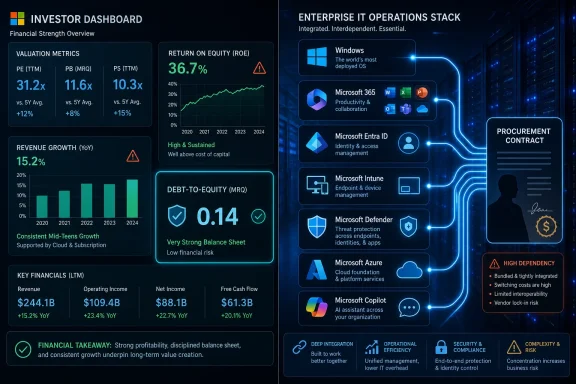
Benzinga’s automated peer-comparison article, which it says was reviewed by an editor, gives Microsoft a mixed financial profile. The company carries a 0.14 debt-to-equity ratio. Benzinga describes Microsoft’s PE, PB, and PS ratios as low compared with Software-industry peers. It also flags low ROE and low revenue growth, while noting high EBITDA and gross profit.
That is not a clean “buy” or “avoid” signal. It is a tension.
The surface read is that Microsoft looks financially stronger than many software rivals and, on common valuation ratios, less aggressively priced than the comparison group. The more useful read is narrower: Microsoft’s balance sheet appears conservative, its operating base remains powerful, and the market may be weighing that strength against questions about growth and returns on equity.
For WindowsForum readers, the Windows angle should come early. Microsoft’s financial profile is not just a Wall Street abstraction. It helps explain why Windows keeps becoming more tightly connected to Microsoft 365, OneDrive, Edge, Entra, Defender, Azure, Copilot, device management, and subscription licensing. If Microsoft has the financial room to keep investing and the market wants evidence of stronger growth, enterprise customers should expect more bundling, more platform integration, and more procurement pressure around the Microsoft stack.
The peer group also matters. Benzinga refers to Microsoft’s top four peers and broader Software-industry comparisons, but the provided source facts do not identify the peer companies. That means readers should treat the ratios as directional, not definitive. A comparison against smaller high-growth software vendors would tell a different story than a comparison against mature enterprise-platform companies.
For investors, that implies flexibility. A company with low leverage has more room to fund product development, infrastructure, security, acquisitions, shareholder returns, or long-term platform bets without appearing financially stretched.
For enterprise customers, the same number has a different meaning. Microsoft is a vendor that many organizations depend on for operating systems, productivity software, identity, endpoint management, cloud hosting, developer tooling, security, and collaboration. A conservative balance sheet reduces continuity risk. CIOs and procurement teams generally prefer strategic vendors that are unlikely to be forced into abrupt retrenchment because of debt pressure.
That does not mean Microsoft has no financial constraints. It means Benzinga’s debt metric points to resilience. A low debt-to-equity ratio gives Microsoft strategic room to keep funding Windows, Azure, Microsoft 365, Copilot, Defender, Entra, GitHub, and other platform layers over long planning cycles.
For admins, that matters because Microsoft roadmaps are rarely isolated. A balance sheet strong enough to support long-term investment also supports longer campaigns of product integration. Windows can become more cloud-connected. Microsoft 365 can absorb more security and AI features. Endpoint management can become more dependent on cloud policy. Identity, storage, browser policy, and device compliance can become harder to separate from the broader Microsoft platform.
That is the practical Windows-specific implication: Microsoft’s financial strength supports product continuity, but it can also strengthen Microsoft’s hand in licensing and bundling negotiations.
Low valuation ratios can mean investors are not pricing a company as aggressively as its peers. They can also mean investors expect slower growth, lower returns, or more difficult expansion from a company that is already enormous. With Microsoft, that second possibility cannot be ignored.
Microsoft is not an undiscovered software name. It is one of the most closely watched companies in enterprise technology. Its products are embedded across corporate IT, consumer PCs, cloud architecture, developer workflows, security operations, and productivity software. If its valuation ratios are low compared with a peer set, the explanation may not be simple mispricing. It may reflect the market asking whether Microsoft can keep expanding at a pace that justifies its scale.
That is the one strong explanation readers need. Low PE, PB, and PS ratios can point to potential undervaluation, but in Microsoft’s case they can also reflect growth skepticism. The same company can be financially powerful, operationally profitable, and still face pressure to prove that its next phase of growth is large enough to move the needle.
For Windows users and enterprise buyers, that distinction matters. A comparatively low stock-market multiple does not mean Microsoft will slow down its push into subscriptions, cloud attachment, AI features, or bundled security. If anything, pressure to show growth can reinforce Microsoft’s incentive to turn existing platforms into higher-value commercial channels.
This is not the profile of a distressed company. It is the profile of a giant platform company being measured against an unspecified Software-industry peer set. That caveat is important. Without knowing the peer names, investors should not treat the comparison as a precise ranking of Microsoft against like-for-like rivals.
The low ROE signal is the most awkward part of the table. Return on equity can be influenced by capital structure, retained earnings, buybacks, accounting treatment, and business mix. It should not be read in isolation. Still, when low ROE appears beside high EBITDA and high gross profit, the question is straightforward: Microsoft is producing large operating results, but how efficiently is it converting its equity base into returns compared with the companies in Benzinga’s peer set?
The revenue-growth signal is also easy to misread. Microsoft’s scale makes high percentage growth harder than it would be for a smaller software company. A narrower vendor can grow quickly from a smaller base; Microsoft has to move a much larger denominator. That does not excuse weak growth if it appears in future periods, but it explains why peer comparisons require context.
Automated financial comparison stories are useful for surfacing ratios quickly. They are less useful for explaining peer-set selection, product mix, enterprise customer behavior, Windows licensing, procurement implications, or why different metrics can conflict.
In this case, the automated piece produces a compact summary: Microsoft has low leverage, low valuation ratios versus peers, high EBITDA and gross profit, and weaker ROE and revenue growth. That is useful. But it is not enough to explain what the comparison means for a company that is simultaneously an operating-system vendor, productivity-suite owner, cloud provider, security vendor, developer-platform steward, gaming company, and AI product distributor.
That mixed identity is why peer selection matters so much. “Software industry” is a broad bucket. Microsoft is still a software company, but it is not only a software company in the narrow sense. Its financial profile reflects Windows, Microsoft 365, Azure, LinkedIn, GitHub, security, devices, gaming, advertising, and AI-related product work. A single peer group may flatten those differences.
So the right way to read Benzinga’s snapshot is as a prompt, not a final verdict. It tells investors where to look next. It tells enterprise buyers what kind of vendor they are negotiating with. It tells Windows admins why platform integration is likely to remain a business priority, not just a product preference.
Today, Microsoft’s growth story is broader. Azure, Microsoft 365, security, gaming, GitHub, LinkedIn, and AI features all matter. But Windows remains one of the main ways users experience Microsoft’s platform strategy.
That is why a peer-comparison article about Microsoft’s valuation ratios belongs on a Windows-focused forum. Microsoft’s financial priorities shape the operating system. If the company wants more cloud attachment, Windows can become more cloud-connected. If it wants more Microsoft 365 engagement, Windows can make account sign-in, OneDrive, Teams, Outlook, and Edge more central. If it wants more security adoption, Windows can steer organizations toward Defender, Entra, Intune, and compliance tooling. If it wants more Copilot usage, Windows can become another surface for AI interaction.
None of that requires a conspiracy theory. It is standard platform economics. Microsoft owns multiple layers of the enterprise stack, and Windows is one of the most important distribution points.
Admins already live with the consequences. A Windows deployment is no longer just an OS image. It includes identity policy, endpoint management, telemetry settings, update rings, browser configuration, storage redirection, compliance baselines, security tooling, licensing entitlements, and user training. The boundary between “Windows administration” and “Microsoft cloud administration” keeps getting thinner.
Benzinga’s financial metrics help explain why that trend is unlikely to reverse. A financially strong Microsoft can keep funding integration. A Microsoft facing slower growth comparisons has reason to extract more value from existing customers. A company with high EBITDA and gross profit has room to invest, but also strong incentives to preserve the economics of its platform.
That stability has real procurement value. A CIO does not want a critical identity provider, endpoint-management platform, productivity suite, or cloud vendor to be financially fragile. In that sense, Microsoft’s 0.14 debt-to-equity ratio is more than an investor datapoint. It is also a vendor-risk datapoint.
But the same strength gives Microsoft leverage. A financially strong, deeply embedded platform vendor can bundle aggressively, change licensing tiers, promote premium add-ons, and make optional services feel operationally inevitable. Customers may resist, but migration costs are high. The more Microsoft becomes the default layer for identity, productivity, endpoint security, and cloud policy, the harder it is for buyers to evaluate each product on a clean standalone basis.
That is the uncomfortable duality for CIOs and admins. Microsoft’s financial health reduces continuity risk while increasing dependency risk. The company can fund security improvements, AI tooling, compliance features, global cloud operations, and Windows platform work at a scale few vendors can match. It can also use those improvements to support more complex SKUs, higher-tier bundles, and tighter platform attachment.
Benzinga does not explore that enterprise consequence directly. But it is the natural WindowsForum reading of the metrics. A company with low leverage and high operating output is not desperate. It can choose where to apply commercial pressure. Enterprise customers should assume Microsoft will continue encouraging more workloads, workflows, identities, endpoints, and administrative surfaces into its subscription and cloud orbit.
Enterprise buyers and Windows admins should expect more bundling and platform pressure. Microsoft’s financial position gives it the capacity to keep integrating Windows, Microsoft 365, Azure, security, identity, device management, and AI features. Procurement teams should prepare for licensing conversations where “included,” “bundled,” “premium,” “enabled by default,” and “business critical” are not the same thing.
That is the action point: investors should track growth and ROE against valuation, while admins should map Microsoft dependency before the next renewal cycle.
A low revenue-growth signal does not show up in an admin console labeled “growth pressure.” It can show up as licensing changes, bundled features, subscription nudges, renamed plans, new defaults, or workflows that steer users toward higher-value Microsoft services. That does not mean every product change is driven by investor pressure. Security, usability, engineering constraints, compliance demands, and customer feedback all matter. But commercial incentives are real.
Microsoft is especially important because it owns so many layers. It can influence the endpoint through Windows, the browser through Edge, productivity through Microsoft 365, identity through Entra, cloud infrastructure through Azure, development through GitHub and Visual Studio, endpoint management through Intune, and security through Defender-branded services.
The smart enterprise response is not paranoia. It is discipline.
Organizations should evaluate Microsoft features on operational merit, not merely because they are bundled or because a roadmap deck labels them strategic. If Copilot improves a workflow, measure it. If OneDrive integration reduces data-loss risk, document the benefit. If a Defender feature replaces a third-party tool, compare detection quality, incident response, reporting, cost, support, and lock-in risk. If a licensing bundle looks cheaper in year one, model what it does to negotiating leverage in year three.
Microsoft’s high gross profit and EBITDA, as highlighted by Benzinga, suggest the company has substantial operating power. Customers should demand that this power translate into reliability, admin control, auditability, support clarity, and predictable licensing. Financial strength should raise expectations, not lower them.
The same logic applies to Windows consumers. A financially powerful Microsoft has the means to support security improvements, accessibility work, hardware transitions, and long-term servicing. It also has the incentive to keep nudging users toward Microsoft accounts, cloud backup, subscriptions, Edge, OneDrive, and AI-mediated experiences. Users should understand those decisions as part of a business model, not as isolated interface choices.
Peer selection can dramatically change the story. Compared with smaller software companies, Microsoft may look slower-growing. Compared with more mature enterprise vendors, its operating scale may look more formidable. Compared with more leveraged companies, its 0.14 debt-to-equity ratio looks conservative. Compared with asset-light software firms that do not carry the same infrastructure demands, its platform model may look more complex.
This is not a Benzinga-specific flaw. It is a general weakness of broad industry comparisons. Microsoft does not fit neatly into one software bucket. It is a Windows company, a cloud company, a productivity company, a security company, a developer-platform company, a gaming company, and an AI-platform company. Each of those businesses has different margins, investment cycles, customer behaviors, and competitive pressures.
The Software-industry label is still useful because Microsoft is a major software company. But readers should resist treating the comparison as a final grade. The better use is directional: Microsoft appears less leveraged, less richly priced on several ratios, operationally strong, and weaker on ROE and revenue growth relative to the unspecified comparison group.
That mixed verdict is more realistic than a simple bullish or bearish take. Microsoft is not obviously weak. It is not automatically cheap without caveats. It is not immune to growth questions. It is a mature platform giant being asked to prove that its existing dominance can still produce attractive future expansion.
So the disciplined version is this: Microsoft’s product strategy clearly includes cloud, AI, security, productivity, and Windows integration, and those areas shape how investors and customers think about the company. But based only on the Benzinga facts, readers should not claim that AI spending caused the low valuation ratios, low ROE, or low revenue growth. Those are possible areas to examine, not conclusions proven by the source.
That distinction matters. Unsupported certainty weakens the analysis. The safer and more useful interpretation is that Microsoft’s low leverage gives it capacity to invest, while its lower revenue-growth and ROE signals raise questions about how effectively the company converts scale into incremental growth and returns.
For Windows admins, the operational implication remains concrete even without overstating causality. Microsoft will likely continue making Windows part of a broader platform bundle because that is how the company organizes much of its enterprise value: identity, productivity, security, endpoint management, cloud services, and AI features work better for Microsoft when they reinforce one another.
For investors, the question is whether those integrations translate into durable financial improvement. For customers, the question is whether those integrations reduce complexity and risk — or simply move complexity into licensing, procurement, tenant administration, and dependency management.
Modern Windows procurement often touches Microsoft 365 plans, Entra identity, Intune management, Defender security capabilities, OneDrive storage, Teams, Edge policy, compliance tools, and now Copilot-related decisions. A financial snapshot of Microsoft matters because the company’s business incentives shape how those pieces are packaged.
If Microsoft is financially strong and operationally profitable, buyers should not expect weak-vendor discounts. If Microsoft is being challenged on growth comparisons, buyers should expect continued emphasis on higher-value bundles and premium services. If Microsoft’s valuation ratios look low relative to peers, investors will watch whether the company can use its installed base to produce more growth. That pressure may eventually reach customers through plan design, feature placement, and renewal conversations.
This is where admins can help procurement. Technical teams know which Microsoft features are actually used, which are merely enabled, which create support tickets, which reduce risk, and which increase lock-in. Procurement teams need that detail before renewal negotiations, not after a quote arrives.
The best Microsoft customers will treat licensing as architecture. Every bundle decision changes future options. Every “included” feature can become a dependency. Every dependency can become a renewal constraint. Every renewal constraint can become budget pressure.
The company’s 0.14 debt-to-equity ratio points to financial strength. Its high EBITDA and gross profit point to operating power. Its low PE, PB, and PS ratios versus Software-industry peers suggest potential undervaluation, but only with caveats. Its low ROE and low revenue growth relative to the comparison group are the warning lights investors should not ignore.
The missing peer names make the comparison less precise. Readers should treat the analysis as a starting point rather than a final judgment. The strongest conclusion is not that Microsoft is simply cheap or simply challenged. It is that Microsoft’s financial strength is real, while the market still has reason to ask how much growth and return improvement the company can generate from its enormous platform.
For WindowsForum readers, the takeaway is practical. Microsoft’s balance sheet gives it the ability to keep pushing integration across Windows, Microsoft 365, Azure, security, identity, endpoint management, and Copilot. That can produce better security, smoother administration, and more capable tools. It can also produce more bundling, more licensing complexity, more platform dependency, and more procurement pressure.
Investors should watch whether growth and ROE improve enough to support the valuation case. Admins should prepare for a Microsoft ecosystem that keeps getting more integrated, more subscription-driven, and harder to separate into clean product silos.
That is the forward-looking close: Microsoft’s ratios may look conservative, but its platform strategy is not. The company has the financial room to keep tightening the stack. The question for investors is whether that raises returns. The question for Windows customers is whether it raises value faster than it raises dependency.
 Microsoft Looks Cheap Only If You Ask Why
Benzinga’s automated peer-comparison article, which it says was reviewed by an editor, gives Microsoft a mixed financial profile. The company carries a 0.14 debt-to-equity ratio. Benzinga describes Microsoft’s PE, PB, and PS ratios as low compared with Software-industry peers. It also flags low ROE and low revenue growth, while noting high EBITDA and gross profit.That is not a clean “buy” or “avoid” signal. It is a tension.
The surface read is that Microsoft looks financially stronger than many software rivals and, on common valuation ratios, less aggressively priced than the comparison group. The more useful read is narrower: Microsoft’s balance sheet appears conservative, its operating base remains powerful, and the market may be weighing that strength against questions about growth and returns on equity.
For WindowsForum readers, the Windows angle should come early. Microsoft’s financial profile is not just a Wall Street abstraction. It helps explain why Windows keeps becoming more tightly connected to Microsoft 365, OneDrive, Edge, Entra, Defender, Azure, Copilot, device management, and subscription licensing. If Microsoft has the financial room to keep investing and the market wants evidence of stronger growth, enterprise customers should expect more bundling, more platform integration, and more procurement pressure around the Microsoft stack.
The peer group also matters. Benzinga refers to Microsoft’s top four peers and broader Software-industry comparisons, but the provided source facts do not identify the peer companies. That means readers should treat the ratios as directional, not definitive. A comparison against smaller high-growth software vendors would tell a different story than a comparison against mature enterprise-platform companies.
The 0.14 Debt-to-Equity Ratio Is the Cleanest Signal
Debt-to-equity is not the flashiest financial metric, but it is the clearest datapoint in Benzinga’s article. A 0.14 debt-to-equity ratio suggests Microsoft is not relying heavily on debt relative to equity. Benzinga treats that as a stronger financial position than its top four peers.For investors, that implies flexibility. A company with low leverage has more room to fund product development, infrastructure, security, acquisitions, shareholder returns, or long-term platform bets without appearing financially stretched.
For enterprise customers, the same number has a different meaning. Microsoft is a vendor that many organizations depend on for operating systems, productivity software, identity, endpoint management, cloud hosting, developer tooling, security, and collaboration. A conservative balance sheet reduces continuity risk. CIOs and procurement teams generally prefer strategic vendors that are unlikely to be forced into abrupt retrenchment because of debt pressure.
That does not mean Microsoft has no financial constraints. It means Benzinga’s debt metric points to resilience. A low debt-to-equity ratio gives Microsoft strategic room to keep funding Windows, Azure, Microsoft 365, Copilot, Defender, Entra, GitHub, and other platform layers over long planning cycles.
For admins, that matters because Microsoft roadmaps are rarely isolated. A balance sheet strong enough to support long-term investment also supports longer campaigns of product integration. Windows can become more cloud-connected. Microsoft 365 can absorb more security and AI features. Endpoint management can become more dependent on cloud policy. Identity, storage, browser policy, and device compliance can become harder to separate from the broader Microsoft platform.
That is the practical Windows-specific implication: Microsoft’s financial strength supports product continuity, but it can also strengthen Microsoft’s hand in licensing and bundling negotiations.
Low Valuation Ratios Are Not a Verdict by Themselves
Benzinga says Microsoft has low PE, PB, and PS ratios compared with Software-industry peers, suggesting potential undervaluation. That is a reasonable first-pass interpretation, but it needs limits.Low valuation ratios can mean investors are not pricing a company as aggressively as its peers. They can also mean investors expect slower growth, lower returns, or more difficult expansion from a company that is already enormous. With Microsoft, that second possibility cannot be ignored.
Microsoft is not an undiscovered software name. It is one of the most closely watched companies in enterprise technology. Its products are embedded across corporate IT, consumer PCs, cloud architecture, developer workflows, security operations, and productivity software. If its valuation ratios are low compared with a peer set, the explanation may not be simple mispricing. It may reflect the market asking whether Microsoft can keep expanding at a pace that justifies its scale.
That is the one strong explanation readers need. Low PE, PB, and PS ratios can point to potential undervaluation, but in Microsoft’s case they can also reflect growth skepticism. The same company can be financially powerful, operationally profitable, and still face pressure to prove that its next phase of growth is large enough to move the needle.
For Windows users and enterprise buyers, that distinction matters. A comparatively low stock-market multiple does not mean Microsoft will slow down its push into subscriptions, cloud attachment, AI features, or bundled security. If anything, pressure to show growth can reinforce Microsoft’s incentive to turn existing platforms into higher-value commercial channels.
The Metrics Point in Different Directions
Benzinga’s comparison is brief, but the signals are worth laying out because the contradictions are the point. Microsoft looks conservative on debt, strong on operating scale, potentially undervalued on common price multiples, and weaker on ROE and revenue growth relative to the comparison group.| Metric or signal | Benzinga’s characterization | Practical reading for Microsoft watchers |
|---|---|---|
| Debt-to-equity ratio | 0.14, stronger than top four peers | Low leverage suggests financial flexibility |
| PE ratio | Low compared with peers | Possible undervaluation, or lower expected earnings growth |
| PB ratio | Low compared with peers | Possible undervaluation, though book value can be a limited lens for platform software |
| PS ratio | Low compared with peers | Sales are priced less aggressively than the peer comparison |
| ROE | Low | Returns on equity trail the comparison group |
| EBITDA and gross profit | High | Microsoft’s operating base remains powerful |
| Revenue growth | Low | Scale and growth expectations remain key questions |
The low ROE signal is the most awkward part of the table. Return on equity can be influenced by capital structure, retained earnings, buybacks, accounting treatment, and business mix. It should not be read in isolation. Still, when low ROE appears beside high EBITDA and high gross profit, the question is straightforward: Microsoft is producing large operating results, but how efficiently is it converting its equity base into returns compared with the companies in Benzinga’s peer set?
The revenue-growth signal is also easy to misread. Microsoft’s scale makes high percentage growth harder than it would be for a smaller software company. A narrower vendor can grow quickly from a smaller base; Microsoft has to move a much larger denominator. That does not excuse weak growth if it appears in future periods, but it explains why peer comparisons require context.
The Automated Byline Is Not a Footnote
The Benzinga article’s disclosure matters: the article was generated by Benzinga’s automated content engine and reviewed by an editor. That does not make it wrong. It does define the type of analysis readers are seeing.Automated financial comparison stories are useful for surfacing ratios quickly. They are less useful for explaining peer-set selection, product mix, enterprise customer behavior, Windows licensing, procurement implications, or why different metrics can conflict.
In this case, the automated piece produces a compact summary: Microsoft has low leverage, low valuation ratios versus peers, high EBITDA and gross profit, and weaker ROE and revenue growth. That is useful. But it is not enough to explain what the comparison means for a company that is simultaneously an operating-system vendor, productivity-suite owner, cloud provider, security vendor, developer-platform steward, gaming company, and AI product distributor.
That mixed identity is why peer selection matters so much. “Software industry” is a broad bucket. Microsoft is still a software company, but it is not only a software company in the narrow sense. Its financial profile reflects Windows, Microsoft 365, Azure, LinkedIn, GitHub, security, devices, gaming, advertising, and AI-related product work. A single peer group may flatten those differences.
So the right way to read Benzinga’s snapshot is as a prompt, not a final verdict. It tells investors where to look next. It tells enterprise buyers what kind of vendor they are negotiating with. It tells Windows admins why platform integration is likely to remain a business priority, not just a product preference.
Windows Is No Longer the Whole Story, but It Is Still the Front Door
For decades, Microsoft’s financial story and Windows’ product story were inseparable. Windows defined the company’s consumer identity, enterprise footprint, OEM relationships, developer ecosystem, and regulatory battles.Today, Microsoft’s growth story is broader. Azure, Microsoft 365, security, gaming, GitHub, LinkedIn, and AI features all matter. But Windows remains one of the main ways users experience Microsoft’s platform strategy.
That is why a peer-comparison article about Microsoft’s valuation ratios belongs on a Windows-focused forum. Microsoft’s financial priorities shape the operating system. If the company wants more cloud attachment, Windows can become more cloud-connected. If it wants more Microsoft 365 engagement, Windows can make account sign-in, OneDrive, Teams, Outlook, and Edge more central. If it wants more security adoption, Windows can steer organizations toward Defender, Entra, Intune, and compliance tooling. If it wants more Copilot usage, Windows can become another surface for AI interaction.
None of that requires a conspiracy theory. It is standard platform economics. Microsoft owns multiple layers of the enterprise stack, and Windows is one of the most important distribution points.
Admins already live with the consequences. A Windows deployment is no longer just an OS image. It includes identity policy, endpoint management, telemetry settings, update rings, browser configuration, storage redirection, compliance baselines, security tooling, licensing entitlements, and user training. The boundary between “Windows administration” and “Microsoft cloud administration” keeps getting thinner.
Benzinga’s financial metrics help explain why that trend is unlikely to reverse. A financially strong Microsoft can keep funding integration. A Microsoft facing slower growth comparisons has reason to extract more value from existing customers. A company with high EBITDA and gross profit has room to invest, but also strong incentives to preserve the economics of its platform.
For Enterprise Buyers, Balance-Sheet Strength Cuts Both Ways
Microsoft’s financial strength is reassuring for enterprise customers. A vendor with low leverage, high gross profit, and high EBITDA is less likely to abruptly abandon core platforms or lose access to capital during stress. Large organizations choose Microsoft partly because it is durable. They expect Windows, Microsoft 365, Azure, identity services, and management tooling to exist across multiple refresh cycles.That stability has real procurement value. A CIO does not want a critical identity provider, endpoint-management platform, productivity suite, or cloud vendor to be financially fragile. In that sense, Microsoft’s 0.14 debt-to-equity ratio is more than an investor datapoint. It is also a vendor-risk datapoint.
But the same strength gives Microsoft leverage. A financially strong, deeply embedded platform vendor can bundle aggressively, change licensing tiers, promote premium add-ons, and make optional services feel operationally inevitable. Customers may resist, but migration costs are high. The more Microsoft becomes the default layer for identity, productivity, endpoint security, and cloud policy, the harder it is for buyers to evaluate each product on a clean standalone basis.
That is the uncomfortable duality for CIOs and admins. Microsoft’s financial health reduces continuity risk while increasing dependency risk. The company can fund security improvements, AI tooling, compliance features, global cloud operations, and Windows platform work at a scale few vendors can match. It can also use those improvements to support more complex SKUs, higher-tier bundles, and tighter platform attachment.
Benzinga does not explore that enterprise consequence directly. But it is the natural WindowsForum reading of the metrics. A company with low leverage and high operating output is not desperate. It can choose where to apply commercial pressure. Enterprise customers should assume Microsoft will continue encouraging more workloads, workflows, identities, endpoints, and administrative surfaces into its subscription and cloud orbit.
What Readers Should Do With This Takeaway
Investors should watch whether Microsoft’s growth and ROE improve enough to justify the valuation argument. The low PE, PB, and PS ratios in Benzinga’s comparison may suggest potential undervaluation, but that case is stronger only if Microsoft can show that growth and returns are not lagging for structural reasons. The key question is not whether Microsoft is financially strong. Benzinga’s figures suggest that it is. The key question is whether that strength converts into better growth and return metrics over time.Enterprise buyers and Windows admins should expect more bundling and platform pressure. Microsoft’s financial position gives it the capacity to keep integrating Windows, Microsoft 365, Azure, security, identity, device management, and AI features. Procurement teams should prepare for licensing conversations where “included,” “bundled,” “premium,” “enabled by default,” and “business critical” are not the same thing.
That is the action point: investors should track growth and ROE against valuation, while admins should map Microsoft dependency before the next renewal cycle.
Action Checklist for Admins
- Inventory where Windows endpoints depend on Microsoft cloud services, including identity, storage, update management, browser policy, security tooling, and device compliance.
- Map Microsoft renewal dates against Microsoft 365, security, AI, endpoint-management, and Windows licensing exposure.
- Separate “included,” “enabled by default,” “licensed,” “deployed,” and “actually adopted” Microsoft features in internal documentation.
- Pilot Copilot and AI-assisted workflows with measurable productivity, compliance, security, and support criteria.
- Review whether bundled Microsoft security tools are replacing third-party products because they are better, cheaper, easier to administer, or simply already present.
- Maintain mitigation plans for critical services where Microsoft bundling has reduced vendor diversity.
- Brief finance and procurement teams that Microsoft’s financial strength may reduce vendor-continuity risk while increasing lock-in risk.
- Track admin workload created by new defaults, licensing changes, tenant settings, policy migrations, and feature rollouts.
Investors See Ratios; IT Feels the Product Consequences
Financial articles often treat companies as bundles of ratios. IT departments encounter those ratios as product behavior.A low revenue-growth signal does not show up in an admin console labeled “growth pressure.” It can show up as licensing changes, bundled features, subscription nudges, renamed plans, new defaults, or workflows that steer users toward higher-value Microsoft services. That does not mean every product change is driven by investor pressure. Security, usability, engineering constraints, compliance demands, and customer feedback all matter. But commercial incentives are real.
Microsoft is especially important because it owns so many layers. It can influence the endpoint through Windows, the browser through Edge, productivity through Microsoft 365, identity through Entra, cloud infrastructure through Azure, development through GitHub and Visual Studio, endpoint management through Intune, and security through Defender-branded services.
The smart enterprise response is not paranoia. It is discipline.
Organizations should evaluate Microsoft features on operational merit, not merely because they are bundled or because a roadmap deck labels them strategic. If Copilot improves a workflow, measure it. If OneDrive integration reduces data-loss risk, document the benefit. If a Defender feature replaces a third-party tool, compare detection quality, incident response, reporting, cost, support, and lock-in risk. If a licensing bundle looks cheaper in year one, model what it does to negotiating leverage in year three.
Microsoft’s high gross profit and EBITDA, as highlighted by Benzinga, suggest the company has substantial operating power. Customers should demand that this power translate into reliability, admin control, auditability, support clarity, and predictable licensing. Financial strength should raise expectations, not lower them.
The same logic applies to Windows consumers. A financially powerful Microsoft has the means to support security improvements, accessibility work, hardware transitions, and long-term servicing. It also has the incentive to keep nudging users toward Microsoft accounts, cloud backup, subscriptions, Edge, OneDrive, and AI-mediated experiences. Users should understand those decisions as part of a business model, not as isolated interface choices.
The Peer Set Problem Makes the Verdict Less Clean
Benzinga’s comparison says Microsoft is being evaluated against top peers and the Software industry, but the provided facts do not name the peer companies. That limits how much weight readers should place on the comparison.Peer selection can dramatically change the story. Compared with smaller software companies, Microsoft may look slower-growing. Compared with more mature enterprise vendors, its operating scale may look more formidable. Compared with more leveraged companies, its 0.14 debt-to-equity ratio looks conservative. Compared with asset-light software firms that do not carry the same infrastructure demands, its platform model may look more complex.
This is not a Benzinga-specific flaw. It is a general weakness of broad industry comparisons. Microsoft does not fit neatly into one software bucket. It is a Windows company, a cloud company, a productivity company, a security company, a developer-platform company, a gaming company, and an AI-platform company. Each of those businesses has different margins, investment cycles, customer behaviors, and competitive pressures.
The Software-industry label is still useful because Microsoft is a major software company. But readers should resist treating the comparison as a final grade. The better use is directional: Microsoft appears less leveraged, less richly priced on several ratios, operationally strong, and weaker on ROE and revenue growth relative to the unspecified comparison group.
That mixed verdict is more realistic than a simple bullish or bearish take. Microsoft is not obviously weak. It is not automatically cheap without caveats. It is not immune to growth questions. It is a mature platform giant being asked to prove that its existing dominance can still produce attractive future expansion.
AI and Cloud Are Relevant, but the Claims Need Discipline
It is tempting to make every Microsoft valuation discussion about AI and cloud spending. That may be directionally sensible, but the Benzinga facts provided here do not quantify Microsoft’s AI spending, cloud capital expenditures, Azure growth, Copilot adoption, or specific causal links between those investments and the valuation ratios.So the disciplined version is this: Microsoft’s product strategy clearly includes cloud, AI, security, productivity, and Windows integration, and those areas shape how investors and customers think about the company. But based only on the Benzinga facts, readers should not claim that AI spending caused the low valuation ratios, low ROE, or low revenue growth. Those are possible areas to examine, not conclusions proven by the source.
That distinction matters. Unsupported certainty weakens the analysis. The safer and more useful interpretation is that Microsoft’s low leverage gives it capacity to invest, while its lower revenue-growth and ROE signals raise questions about how effectively the company converts scale into incremental growth and returns.
For Windows admins, the operational implication remains concrete even without overstating causality. Microsoft will likely continue making Windows part of a broader platform bundle because that is how the company organizes much of its enterprise value: identity, productivity, security, endpoint management, cloud services, and AI features work better for Microsoft when they reinforce one another.
For investors, the question is whether those integrations translate into durable financial improvement. For customers, the question is whether those integrations reduce complexity and risk — or simply move complexity into licensing, procurement, tenant administration, and dependency management.
The Windows Procurement Angle Is Getting Harder to Ignore
Windows used to be easier to isolate in procurement. Organizations bought devices, licensed the operating system, managed images, applied Group Policy, deployed Office, and handled security with a mix of Microsoft and third-party tools. That world has not disappeared, but it has become less clean.Modern Windows procurement often touches Microsoft 365 plans, Entra identity, Intune management, Defender security capabilities, OneDrive storage, Teams, Edge policy, compliance tools, and now Copilot-related decisions. A financial snapshot of Microsoft matters because the company’s business incentives shape how those pieces are packaged.
If Microsoft is financially strong and operationally profitable, buyers should not expect weak-vendor discounts. If Microsoft is being challenged on growth comparisons, buyers should expect continued emphasis on higher-value bundles and premium services. If Microsoft’s valuation ratios look low relative to peers, investors will watch whether the company can use its installed base to produce more growth. That pressure may eventually reach customers through plan design, feature placement, and renewal conversations.
This is where admins can help procurement. Technical teams know which Microsoft features are actually used, which are merely enabled, which create support tickets, which reduce risk, and which increase lock-in. Procurement teams need that detail before renewal negotiations, not after a quote arrives.
The best Microsoft customers will treat licensing as architecture. Every bundle decision changes future options. Every “included” feature can become a dependency. Every dependency can become a renewal constraint. Every renewal constraint can become budget pressure.
The Verdict
Benzinga’s comparison does not say Microsoft is broken. It says Microsoft is complicated.The company’s 0.14 debt-to-equity ratio points to financial strength. Its high EBITDA and gross profit point to operating power. Its low PE, PB, and PS ratios versus Software-industry peers suggest potential undervaluation, but only with caveats. Its low ROE and low revenue growth relative to the comparison group are the warning lights investors should not ignore.
The missing peer names make the comparison less precise. Readers should treat the analysis as a starting point rather than a final judgment. The strongest conclusion is not that Microsoft is simply cheap or simply challenged. It is that Microsoft’s financial strength is real, while the market still has reason to ask how much growth and return improvement the company can generate from its enormous platform.
For WindowsForum readers, the takeaway is practical. Microsoft’s balance sheet gives it the ability to keep pushing integration across Windows, Microsoft 365, Azure, security, identity, endpoint management, and Copilot. That can produce better security, smoother administration, and more capable tools. It can also produce more bundling, more licensing complexity, more platform dependency, and more procurement pressure.
Investors should watch whether growth and ROE improve enough to support the valuation case. Admins should prepare for a Microsoft ecosystem that keeps getting more integrated, more subscription-driven, and harder to separate into clean product silos.
That is the forward-looking close: Microsoft’s ratios may look conservative, but its platform strategy is not. The company has the financial room to keep tightening the stack. The question for investors is whether that raises returns. The question for Windows customers is whether it raises value faster than it raises dependency.
References
- Primary source: Benzinga
Published: 2026-07-09T09:59:12.836971
Assessing Microsoft's Performance Against Competitors In Software Industry - Microsoft (NASDAQ:MSFT) - Benzinga
In today's rapidly changing and highly competitive business world, it is imperative for investors and industry observers to carefully assess companies before making investment choices. In this article, we willwww.benzinga.com - Related coverage: cdn4.benzinga.com
Evaluating Microsoft Against Peers In Software Industry
In the ever-changing and fiercely competitive business landscape, conducting thorough company analysis is crucial for investors and industry experts. In ...cdn4.benzinga.com
- Related coverage: sahmcapital.com
Assessing Microsoft's Performance Against Competitors In Software Industry
Amidst the fast-paced and highly competitive business environment of today, conducting comprehensive company analysis is essential for investors and industry enthusiasts. In this article, we will delve into an extensive industry comparison, evalua...www.sahmcapital.com - Related coverage: uk.investing.com
Competitor Analysis: Evaluating Microsoft And Competitors In Software Industry By Benzinga
Competitor Analysis: Evaluating Microsoft And Competitors In Software Industryuk.investing.com - Official source: microsoft.gcs-web.com
- Related coverage: windowscentral.com
Everyone has an opinion on Microsoft’s spending, but the real story is what the numbers say about its position | Windows Central
Microsoft beat expectations again, but investors want proof that rising AI spending will deliver real profit down the road.www.windowscentral.com
