

Satya Nadella closed 2025 with a short, polished note about where Microsoft is headed in 2026 — and the company’s chief executive made it plain that the answer is AI, again and still, even if a loud and growing chorus of users respond with mockery and the one-word verdict “slop.”
Microsoft’s leadership framed the coming year as a shift from spectacle to substance: a move away from model-level demos toward engineered systems that deliver measurable, real-world outcomes. Nadella called out what he and other executives see as a “model overhang” — capabilities that outstrip the industry’s ability to reliably apply them outside controlled settings — and urged the design community and the public to stop privileging flashy demos over stable utility. That public posture landed in the middle of an active throat-clearing from press and users: Windows commentators pointed to an ecosystem where Copilot is preinstalled in Windows, Office, and other products but often behaves as an unreliable, clumsy add-on for everyday users. The contrast between Microsoft’s executive ambition and many users’ lived experience — buggy features, unfinished generative tools, and intrusive defaults — is the immediate context for Nadella’s plea to retire the “slop” shorthand.
Conclusion
The debate isn’t about words. It’s about whether the industry, and Microsoft specifically, can convert dazzling capability into dependable product outcomes that users trust and value. Satya Nadella’s request to stop using “slop” is a welcome rhetorical recalibration toward substance — but rhetoric without measurable, user‑facing improvements will only give critics more reasons to keep the term. The coming year will show whether Microsoft invests the engineering discipline and customer focus needed to make AI feel less like headline theatre and more like everyday help.
Source: Windows Central https://www.windowscentral.com/micr...ly-wants-you-to-stop-calling-ai-slop-in-2026/
 Background
Microsoft’s leadership framed the coming year as a shift from spectacle to substance: a move away from model-level demos toward engineered systems that deliver measurable, real-world outcomes. Nadella called out what he and other executives see as a “model overhang” — capabilities that outstrip the industry’s ability to reliably apply them outside controlled settings — and urged the design community and the public to stop privileging flashy demos over stable utility. That public posture landed in the middle of an active throat-clearing from press and users: Windows commentators pointed to an ecosystem where Copilot is preinstalled in Windows, Office, and other products but often behaves as an unreliable, clumsy add-on for everyday users. The contrast between Microsoft’s executive ambition and many users’ lived experience — buggy features, unfinished generative tools, and intrusive defaults — is the immediate context for Nadella’s plea to retire the “slop” shorthand. Overview: What Nadella actually said — and what he left out
The core message
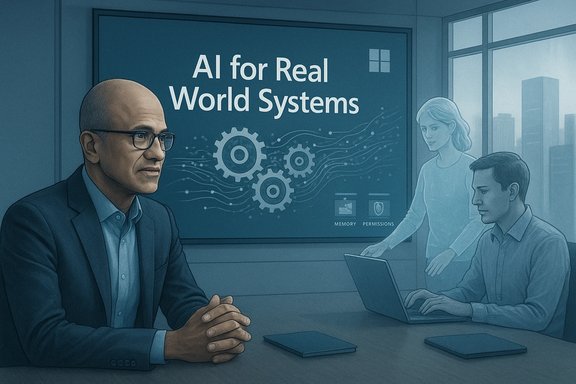
Nadella’s core argument is threefold: AI should be an amplifier of human capabilities (not a substitute), the industry must move from standalone models to integrated systems that handle memory, entitlements, and safe tool use, and society must demand demonstrable real‑world impacts before granting AI “permission” to proliferate widely. These points were presented as both a tactical product roadmap and a normative set of expectations for the technology at large.The omissions that matter
What the post — and corporate messaging more broadly — largely sidestepped were the acute customer complaints users have about product quality, pricing decisions in gaming and devices, and how workforce changes inside Microsoft are reshaping both product teams and morale. Those are not small side notes: if Microsoft’s “AI first” investments continue to consume engineering attention and capital while core experiences degrade, the claim that AI will scaffold human potential will feel hollow to the firm’s existing customers.Why “stop calling it slop” is more than semantic politicking
From spectacle to diffusion — the nuance Nadella is pushing
Nadella argues the hype cycle is giving way to diffusion: a phase in which capabilities need to be embedded in robust systems, not just exhibited in demos. The distinction matters because operationalizing LLMs and multimodal models requires disciplines most companies still lack: classical engineering rigor, observability, long‑term memory management, permissions and privacy controls, and resilient fallbacks when a model hallucinates. If those disciplines do not scale, “spectacle” remains the dominant product experience, and the industry loses sight of measurable outcomes.Why users said “slop” in the first place
“Slop,” as used by customers and critics, refers to a pattern: features rushed into shipping with poor reliability, disappointing results, or intrusive defaults that change workflows without delivering clear gains. Examples across the ecosystem include generative editing tools that fail to produce usable outputs, assistive features that misunderstand the user’s intent, and background “recall” mechanisms that trigger legitimate privacy worries. Those are not rhetorical grievances — they are product failures that erode trust.The commercial realities behind Nadella’s rhetoric
AI is already baked into Microsoft products — at scale and with internal tradeoffs
Microsoft’s commercial bet on AI is enormous and visible across its surface: Copilot is integrated into Windows and Microsoft 365, Azure is aggressively positioned for AI workloads, and strategic partnerships with OpenAI anchor the company’s strategy. That investment is not purely rhetorical: the company has reallocated teams, reorganized reporting lines, and made AI central to product roadmaps. But when the company spends heavily on future infrastructure, it also needs to maintain and support the products that bring recurring revenue today. Many users feel Microsoft’s attention is skewed toward the shiny new rather than the dependable existing.The workforce and productivity paradox
Leadership statements about AI-driven productivity gains are increasingly juxtaposed against rounds of job eliminations and reorganizations inside Microsoft. The company publicly reported large workforce adjustments in past years — a fact that helps explain user skepticism when executives say AI will “scaffold” people rather than replace them. That skepticism is not purely emotional; it’s grounded in corporate actions that reallocate headcount even as the company doubles down on AI capabilities. Readers should note that layoff counts and workforce changes have been widely reported across reliable outlets.Fact check: three contested claims and what the public record shows
1) “AI already touches a billion people every day” — the evidence and the caveats
There are multiple, industry‑level estimates that put aggregate AI engagement in the hundreds of millions to low billions of monthly active users when you count assistants embedded in large social platforms, dedicated AI apps, APIs and third‑party integrations. Major platform owners — including Meta, Google, and OpenAI — have reported user metrics for their AI offerings, and analysts have assembled those into broad totals. However, these numbers are estimates, often reported by companies with incentives to emphasize scale, and definitions (MAU, WAU, DAU) vary across vendors. The conservative reading: AI is massively more pervasive than two years ago, but exact “billion” claims should be treated as directional rather than precisely audited.2) “30% of Microsoft’s code is now written by AI” — what Nadella actually said
Nadella has publicly remarked that somewhere on the order of roughly 20–30% of code inside Microsoft repositories is now being influenced or produced by AI tooling — a figure he stated conversationally in a public talk. Multiple tech outlets reported the same number from the same public appearance; this matches broader industry commentary from other CEOs reporting comparable figures. That number is company‑reported, not independently audited, and it bundles a variety of behaviors (from autocompletion to fully generated modules), so the implication for software quality depends heavily on how teams validate AI‑produced code. Treat this as an executive disclosure of adoption levels rather than an incontrovertible, audited metric.3) “Microsoft has laid off tens of thousands” — timeline and scale
Microsoft announced and implemented several significant workforce reductions during the mid‑2020s era. Earlier, the company disclosed a 10,000‑job reduction in 2023; more recent rounds and targeted cuts have pushed cumulative totals in some reporting windows into the mid‑five figures for the year. Exact, up‑to‑the‑day totals vary by reporting period and are best sourced in official filings and company memos, but the broader pattern is clear: Microsoft has restructured repeatedly while redirecting capital to data centers, AI chips, and other large capital expenditures. Readers should treat specific headcount totals as time‑dependent and check corporate disclosures for the latest official numbers.The product gap: why Copilot feels like “slop” to many consumers
Preinstalled, persistent, and often unfinished
Copilot’s presence in Windows and Microsoft 365 is unmistakable: toolbars, prompts, and integrated chat windows appear in places where historically there was none. For some customers, these integrations are genuinely useful; for many others they read as prematurely shipped features — the sort of half‑baked assistance that interrupts workflows more than it helps. When generative edits fail or automatic suggestions create extra work in cleanup, the net productivity effect can be negative. That’s the concrete behavior behind “slop.”Design and validation problems are engineering problems
Nadella’s prescription — build complete systems that orchestrate models, manage entitlements, and provide fallbacks — is precisely the engineering response the product teams need. But producing those systems is expensive, time‑consuming, and often requires lowering the cadence of flashy feature launches in favor of long‑running reliability investments. The tension between shipping fast and shipping well is the tightrope Microsoft now walks across Windows, Office, and consumer apps like Photos or Clipchamp.Broader risks: social, economic, and technical
Hallucinations, misinformation, and trust erosion
Generative systems still hallucinate. When an assistant confidently invents facts or invents steps in a workflow, it damages trust — and restoring trust is much harder than building the initial demo. Companies need transparent error signaling, provenance, and easy verification tools for end users; without these, AI becomes a source of brittle convenience that undermines decisions. This is both a product engineering challenge and a public policy question.Economic risk: automation versus augmentation
Nadella casts AI as scaffolding for human potential, but many corporate behaviors suggest automation is also a job‑cost lever. The number one economic incentive for many executives is to reduce fixed labor costs; the adoption of AI for codegen, content production, and process automation can reduce the need for entry‑level staff in particular. That dynamic creates real tensions between company strategy and worker outcomes that cannot be papered over with optimistic rhetoric. The evidence is visible in hiring patterns and restructuring.Environmental and compute costs
Large models are resource‑intensive. The choices about where to deploy compute, who bears the cost, and how to measure impact are material. Nadella’s point that firms must make “deliberate choices” about scarce energy, compute, and talent resources is accurate — and the industry still lacks standardized, audited impact metrics that would make those choices transparent to customers and regulators.What Microsoft should do next — practical, testable recommendations
- Ship reliability before novelty.
- Prioritize hardening Copilot integrations so core flows work offline or degrade gracefully when model outputs are uncertain. This means investing in diagnostics, monitoring, and user‑facing fallbacks.
- Publish validated metrics.
- Release clear, audited metrics on model accept rates, regression rates for model outputs, and concrete productivity measures where Copilot is claimed to help. Transparency reduces the “slop” narrative by turning gut feeling into data.
- Create explicit consent and privacy primitives.
- Features that gather screen content, history, or personal documents require granular opt‑in, clear retention policies, and per‑task provenance that users can inspect.
- Fund human‑centered evaluation.
- Build an external testing program with customers and subject‑matter experts that measures real‑world impact across different domains (education, healthcare, knowledge work) and publishes results.
- Rebalance product teams.
- Allocate engineering cycles explicitly for maintenance and quality across legacy product lines so customers do not feel abandoned while new AI features roll out.
Strengths to acknowledge
- Microsoft has the scale and balance sheet to build the plumbing required for high‑integrity AI systems: global datacenters, enterprise relationships, and deep identity and compliance products.
- The company’s investment in partnerships and model access (including ties to OpenAI) remains a competitive moat when paired with disciplined engineering.
- Nadella’s framing — models to systems, reality over spectacles — is the correct high‑level response to the industry’s growing pains; the question is execution, not philosophy.
The reputational and strategic risk if Microsoft fails to follow through
If Microsoft doubles down on rapid feature launches without delivering the system-level engineering Nadella describes, the company risks three parallel failures: customer erosion (users migrating to alternatives or choosing to avoid Copilot), regulatory scrutiny (privacy, competition, and consumer protection complaints), and internal morale losses (engineers and managers disillusioned by repeatedly shipping low‑quality experiences). Those failures would erode the durable advantage Microsoft claims to be building. Recent layoffs and reported internal churn make this risk more than theoretical: they are real factors that could slow the work required to convert models into systems.Final analysis: why 2026 is a test of discipline more than invention
Satya Nadella’s rhetorical request — stop calling AI “slop” — is an invitation to hold the industry to higher engineering and ethical standards. That’s a defensible argument. But the credibility of that invitation depends entirely on execution.- If Microsoft can show incremental, measurable improvements in everyday product quality — safer recall tools, a noticeably reliable Copilot in Windows that reduces friction rather than adding to it, and verifiable productivity gains — then calling the technology “scaffolding” will be justified.
- If Microsoft continues to prioritize headline‑chasing launches over rigorous product validation, public cynicism will deepen and “slop” will remain a fair shorthand for many users.
Conclusion
The debate isn’t about words. It’s about whether the industry, and Microsoft specifically, can convert dazzling capability into dependable product outcomes that users trust and value. Satya Nadella’s request to stop using “slop” is a welcome rhetorical recalibration toward substance — but rhetoric without measurable, user‑facing improvements will only give critics more reasons to keep the term. The coming year will show whether Microsoft invests the engineering discipline and customer focus needed to make AI feel less like headline theatre and more like everyday help.
Source: Windows Central https://www.windowscentral.com/micr...ly-wants-you-to-stop-calling-ai-slop-in-2026/
