

Microsoft on May 5, 2026, published its 2026 Work Trend Index and a Microsoft 365 Copilot update positioning AI agents as the next operating layer for work across Microsoft 365, Agent 365, Copilot Cowork, and the new Microsoft 365 E7 suite. The company’s argument is no longer that Copilot can save workers a few minutes in Outlook. It is that organizations must redesign themselves around a new split of labor between people and software agents. That is a much bigger claim, and it deserves a much more skeptical reading.
The most important thing in Microsoft’s latest Copilot pitch is not a single feature. It is the change in grammar.
For two years, enterprise AI has been sold as a helper: draft this email, summarize that meeting, make this spreadsheet less miserable. Microsoft’s 2026 Work Trend Index shifts the frame from individual assistance to organizational design. Copilot is no longer merely something an employee uses; it is something a company is supposed to build around.
That explains the language Microsoft is using. “Human agency” sounds almost philosophical, but in product terms it means delegation. Workers define intent, agents perform more of the execution, and managers are asked to decide which workflows should be rebuilt rather than merely accelerated.
This is where Microsoft’s argument becomes both compelling and self-serving. If work really is becoming a system of humans directing fleets of agents, then the vendor that owns the productivity suite, identity layer, device management stack, security telemetry, and enterprise admin center has an extraordinary advantage. Microsoft is not just selling Copilot as a better chatbot. It is selling Microsoft 365 as the place where AI work should be governed.
The Work Trend Index has always served two functions. It reports on how work is changing, and it creates demand for Microsoft’s answer to that change. This year’s report is especially explicit about the second half of that equation, because the research lands alongside a wave of Copilot, Cowork, Agent 365, connector, and Microsoft 365 E7 announcements.
Still, the findings are not easy to dismiss. Microsoft says 49 percent of analyzed Copilot conversations support cognitive work: analyzing, solving, and thinking rather than simply producing boilerplate text. It also says 58 percent of AI users report producing work they could not have produced a year ago, rising to 80 percent among its most advanced “Frontier Professionals.”
Those numbers should be read carefully. Self-reported productivity gains are not the same thing as measured business value, and “work users could not have produced” can mean anything from a genuinely new analytical capability to a better-looking PowerPoint deck. But the direction of travel is clear enough. The daily use case for workplace AI is moving beyond text generation and toward decision support, synthesis, planning, and execution.
That matters because most companies adopted AI through experimentation. Employees tried tools, managers tolerated pilots, and IT departments tried to keep security from becoming a bonfire. Microsoft’s new message is that this experimental phase has reached its limit. If AI remains an individual productivity trick, organizations will get uneven gains and rising risk. If it becomes part of the operating model, Microsoft argues, the gains can compound.
The data Microsoft highlights makes that tension visible. Only one in four AI users say their leadership is clearly and consistently aligned on AI. At the same time, 65 percent fear falling behind if they do not use AI to adapt quickly, while 45 percent say it feels safer to focus on current goals than redesign how work gets done with AI.
That is the modern enterprise in miniature. Everyone wants transformation until transformation threatens the quarterly dashboard. Employees are told to innovate but measured on yesterday’s metrics. Managers are told to embrace AI but punished when experiments disrupt established workflows. Executives announce AI strategies while middle management absorbs the ambiguity.
The real bottleneck, then, is not prompt literacy. It is institutional permission. A worker can learn to delegate tasks to Copilot, but if the approval chain, compliance model, data access policy, and performance review process still assume human-only execution, the organization has not changed. It has merely added a chatbot to a broken process.
This is where Microsoft’s argument has teeth. AI adoption is often discussed as if the main challenge is getting users comfortable with the tools. Microsoft is saying the harder challenge is redesigning the flow of work itself. That is less glamorous than demos, but it is where enterprise technology either becomes infrastructure or becomes shelfware.
In the cloud era, employees adopted unsanctioned apps because official tools were too slow or too limited. In the agent era, employees can run local or third-party agents that touch files, credentials, browsers, codebases, calendars, and business systems. That is not just a procurement headache. It is a security model being rewritten in real time.
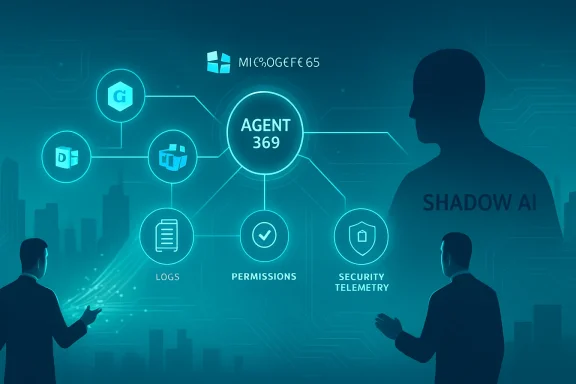
Microsoft says Agent 365 will help organizations govern, observe, and secure agents, including new preview capabilities to discover and manage shadow AI agents. The company specifically references local agents such as OpenClaw and Claude Code, with Defender and Intune becoming part of the visibility and control story.
This is the enterprise bargain in its purest form. Workers want powerful tools that can act on their behalf. IT wants to know what those tools can access, where they are running, and whether they are leaking sensitive data into workflows nobody approved. Microsoft wants to be the layer both sides must pass through.
That will be attractive to many CIOs, especially those already standardized on Microsoft 365, Defender, Entra, Intune, Purview, and Teams. It will also intensify the platform lock-in debate. If Microsoft controls the workplace surface, the AI assistant, the agent registry, the endpoint controls, the data connectors, and the compliance story, then “governance” and “dependency” begin to look like two names for the same architecture.
Traditional productivity software is built around artifacts: documents, messages, meetings, tickets, spreadsheets. Agentic software is built around goals that may span those artifacts. A worker does not just ask for a summary; she asks for a plan, a follow-up sequence, a budget review, a research packet, or a meeting cadence that changes over time.
That changes the user’s relationship with software. Instead of opening Word, Excel, Outlook, and PowerPoint as separate tools, the worker delegates across them. The agent becomes the connective tissue, and the apps become execution environments.
Microsoft’s advantage is obvious. Copilot can live inside the apps where knowledge workers already spend the day. It can use Microsoft Graph and Work IQ to understand organizational context. It can use connectors and plugins to pull in business systems beyond Microsoft 365. If this works well, the interface of work shifts from app switching to intent routing.
But that “if” is doing a lot of labor. Agentic workflows need trust, recoverability, transparency, and graceful failure. An agent that drafts a paragraph badly is annoying. An agent that changes a meeting cadence, updates a forecast, emails a customer, or touches a sensitive file incorrectly can create real damage. Microsoft’s challenge is not just making Cowork capable. It is making it inspectable enough that users and admins know when to trust it.
There is truth in that. A junior analyst who can use Copilot to synthesize data, draft narratives, and test assumptions may get access to work that previously required years of accumulated technique. A manager who can delegate status tracking and meeting hygiene may spend more time on judgment. A small team that can automate routine coordination may punch above its headcount.
But agency is not simply the ability to issue instructions. It also requires meaningful control, understanding, and responsibility. If an employee cannot see why an agent acted, cannot correct its path, or cannot contest its output inside the workflow, then the agent has not increased agency. It has merely moved work into a black box.
This is the line Microsoft must walk. The company wants Copilot to feel proactive, contextual, and agentic. Enterprise customers, meanwhile, will demand audit logs, permission boundaries, explainability, retention controls, and administrative override. The more powerful the agents become, the less tolerable “the AI did it” becomes as an explanation.
That is especially true in regulated industries. Healthcare, finance, law, government, and critical infrastructure will not evaluate Copilot agents only by whether they save time. They will ask who approved an action, what data was used, whether policy was enforced, and how mistakes are reconstructed after the fact. Human agency will be measured not in marketing language but in incident reports.
The bundle is important because it tells customers how Microsoft wants AI to be purchased. Copilot began as an add-on. Agent 365 adds a governance layer. E7 packages AI capability and AI control into a single premium tier. That is classic Microsoft: integrate the platform, simplify the buying motion, and make the alternative look operationally messy.
For IT leaders, the calculus will be practical. Buying one integrated Microsoft stack may be easier than stitching together separate AI assistants, agent frameworks, security brokers, endpoint controls, data connectors, and compliance dashboards. Procurement departments like bundles when bundles reduce vendor sprawl.
But bundles also shape markets. If Microsoft makes the best-governed AI experience easiest inside Microsoft 365 E7, competitors will have to fight not just on model quality or interface design but on administrative trust. That is a harder battle. Enterprise software is rarely won by the best demo alone; it is won by the product that security, compliance, finance, and operations can live with.
The question for customers is whether E7 becomes an accelerant or a ceiling. A deeply integrated AI suite could help organizations move from pilots to repeatable systems. It could also make them overdependent on Microsoft’s view of how work should be structured. The smartest buyers will treat E7 not as a strategy but as one implementation choice inside a broader AI governance and operating model.
Microsoft says custom plugins and native integrations with Fabric and Dynamics 365 are available in Cowork, with partner integrations coming from companies including London Stock Exchange Group, Miro, monday.com, S&P Global Energy, HubSpot, Moody’s, and Notion. Federated Copilot connectors are also becoming generally available in Microsoft 365 and Researcher, with Excel support planned for the summer.
This is Microsoft acknowledging the obvious: an enterprise AI assistant that only understands email and documents is useful, but limited. The real value is in stitching together context from systems that were never designed to cooperate. If Copilot can reason across a contract, a customer account, a market data feed, a project board, and a spreadsheet without forcing the user to manually assemble the puzzle, it becomes more than a productivity feature.
Yet connectors also expand the blast radius. Every new integration raises questions about permission trimming, data freshness, source reliability, retention, logging, and prompt injection. The more systems an agent can see, the more valuable it becomes. The more systems an agent can see, the more dangerous it becomes when misconfigured.
This is why Microsoft is pairing the connector story with Agent 365. It wants to say: yes, connect everything, but do it through our governed fabric. For customers, that tradeoff may be acceptable. But it also means Copilot’s usefulness will depend heavily on the cleanliness of an organization’s data estate. AI will not magically fix years of chaotic permissions, duplicate repositories, stale SharePoint sites, and undocumented business logic.
The more interesting reading is that Frontier Professionals expose inequality inside organizations. Some workers will gain leverage quickly because their roles, managers, data access, and personal confidence allow them to experiment. Others will be stuck in tightly constrained roles where AI use is discouraged, blocked, or irrelevant to how performance is measured.
That creates a new productivity divide. It is not simply between companies that adopt AI and companies that do not. It is between teams inside the same company that redesign work and teams that merely add AI to existing routines. The difference may compound over time.
Microsoft’s own research points in that direction. It says organizational factors such as culture, manager support, and talent practices account for more than twice the reported AI impact of individual factors such as mindset and behavior. That is a critical admission. The hero worker with great prompts is not the main unit of transformation. The team, manager, and operating model are.
This should worry executives who think they can buy Copilot licenses and wait for productivity to appear. If managers do not model AI use, if incentives do not change, if data access remains fragmented, and if employees are punished for redesigning workflows that temporarily slow current goals, the technology will underperform. The failure will look like a software adoption problem, but it will actually be a leadership problem.
Agents need identities. They need permissions. They need logging. They need lifecycle management. They need policies for what they can do when a user leaves the company, changes roles, or loses access to a system. They need a way to distinguish between reading, drafting, recommending, and executing.
That last distinction is going to become central. The enterprise can tolerate a relatively wide range of AI systems that suggest actions. It will demand far tighter controls over systems that take actions. An agent that finds five relevant documents is one class of risk. An agent that sends a vendor a revised contract, updates a customer record, or changes a production run is another.
Microsoft’s pitch to IT is that Agent 365 can become the registry and control plane for this world. That sounds plausible because Microsoft already owns much of the administrative substrate in many organizations. It also means IT teams will be asked to govern something messier than applications and more autonomous than scripts.
The old software inventory model will not be enough. Admins will need to know which agents exist, who owns them, what systems they touch, what actions they can take, what model or runtime they depend on, and what happens when they fail. In that sense, Agent 365 is less like a new admin console and more like the beginning of agent operations as a discipline.
If Copilot saves 30 minutes and the employee fills that time with more email, the organization has accelerated noise. If Copilot helps a team reduce coordination overhead and spend more time on product quality, customer insight, or risk reduction, the value is real. The difference is management.
This is why the phrase “own the outcomes” matters. AI can produce more artifacts, but organizations should care about outcomes: faster resolution, better analysis, fewer errors, stronger customer relationships, shorter cycles, improved compliance, higher-quality decisions. Without that discipline, AI becomes a machine for producing plausible work-shaped objects.
Microsoft has an incentive to emphasize capability. Customers need to emphasize accounting. What work changed? Which metric improved? What risk increased? Which human review steps are still necessary? Which tasks should not be automated even if they can be?
The next phase of Copilot deployment will be less about whether employees like the tool and more about whether organizations can measure the operating leverage it creates. That measurement will be uncomfortable, because it will reveal which meetings, reports, approvals, and coordination rituals were never as valuable as everyone pretended.
Trust has several layers. Users must trust the output enough to use it. Managers must trust the process enough to redesign work around it. IT must trust the controls enough to permit broad deployment. Legal and compliance teams must trust the logs enough to defend decisions after the fact.
Microsoft is better positioned than most vendors to make that argument, but it is not automatically entitled to the answer. Customers will remember past admin-center sprawl, licensing complexity, delayed feature parity, and uneven rollout messaging. They will also ask whether Microsoft’s AI stack is transparent enough for the level of dependency being proposed.
That scrutiny is healthy. The stakes are higher than adding another SaaS app. Microsoft is proposing that work itself become more agent-mediated, more context-aware, and more centrally governed. If the company gets it right, the productivity suite becomes an intelligent execution fabric. If it gets it wrong, enterprises inherit a new layer of opaque automation atop already messy systems.
Source: Microsoft Microsoft 365 Copilot, human agency, and the opportunity for every organization | Microsoft 365 Blog
 Microsoft Moves Copilot From Assistant to Org Chart
The most important thing in Microsoft’s latest Copilot pitch is not a single feature. It is the change in grammar.For two years, enterprise AI has been sold as a helper: draft this email, summarize that meeting, make this spreadsheet less miserable. Microsoft’s 2026 Work Trend Index shifts the frame from individual assistance to organizational design. Copilot is no longer merely something an employee uses; it is something a company is supposed to build around.
That explains the language Microsoft is using. “Human agency” sounds almost philosophical, but in product terms it means delegation. Workers define intent, agents perform more of the execution, and managers are asked to decide which workflows should be rebuilt rather than merely accelerated.
This is where Microsoft’s argument becomes both compelling and self-serving. If work really is becoming a system of humans directing fleets of agents, then the vendor that owns the productivity suite, identity layer, device management stack, security telemetry, and enterprise admin center has an extraordinary advantage. Microsoft is not just selling Copilot as a better chatbot. It is selling Microsoft 365 as the place where AI work should be governed.
The Work Trend Index Is a Sales Document With Real Signals Inside
Microsoft says the 2026 Work Trend Index is based on trillions of anonymized Microsoft 365 productivity signals, a survey of 20,000 AI-using workers across 10 countries, analysis of Copilot conversations, and interviews with experts in AI, work, and organizational psychology. That is a serious dataset, but it is not a neutral artifact.The Work Trend Index has always served two functions. It reports on how work is changing, and it creates demand for Microsoft’s answer to that change. This year’s report is especially explicit about the second half of that equation, because the research lands alongside a wave of Copilot, Cowork, Agent 365, connector, and Microsoft 365 E7 announcements.
Still, the findings are not easy to dismiss. Microsoft says 49 percent of analyzed Copilot conversations support cognitive work: analyzing, solving, and thinking rather than simply producing boilerplate text. It also says 58 percent of AI users report producing work they could not have produced a year ago, rising to 80 percent among its most advanced “Frontier Professionals.”
Those numbers should be read carefully. Self-reported productivity gains are not the same thing as measured business value, and “work users could not have produced” can mean anything from a genuinely new analytical capability to a better-looking PowerPoint deck. But the direction of travel is clear enough. The daily use case for workplace AI is moving beyond text generation and toward decision support, synthesis, planning, and execution.
That matters because most companies adopted AI through experimentation. Employees tried tools, managers tolerated pilots, and IT departments tried to keep security from becoming a bonfire. Microsoft’s new message is that this experimental phase has reached its limit. If AI remains an individual productivity trick, organizations will get uneven gains and rising risk. If it becomes part of the operating model, Microsoft argues, the gains can compound.
The Transformation Paradox Is Really a Management Problem
Microsoft’s most useful phrase in the new report is the “Transformation Paradox.” The company defines it as the tension between the forces pushing employees toward AI adoption and the organizational habits holding that adoption back. In plainer English: workers are moving faster than their companies.The data Microsoft highlights makes that tension visible. Only one in four AI users say their leadership is clearly and consistently aligned on AI. At the same time, 65 percent fear falling behind if they do not use AI to adapt quickly, while 45 percent say it feels safer to focus on current goals than redesign how work gets done with AI.
That is the modern enterprise in miniature. Everyone wants transformation until transformation threatens the quarterly dashboard. Employees are told to innovate but measured on yesterday’s metrics. Managers are told to embrace AI but punished when experiments disrupt established workflows. Executives announce AI strategies while middle management absorbs the ambiguity.
The real bottleneck, then, is not prompt literacy. It is institutional permission. A worker can learn to delegate tasks to Copilot, but if the approval chain, compliance model, data access policy, and performance review process still assume human-only execution, the organization has not changed. It has merely added a chatbot to a broken process.
This is where Microsoft’s argument has teeth. AI adoption is often discussed as if the main challenge is getting users comfortable with the tools. Microsoft is saying the harder challenge is redesigning the flow of work itself. That is less glamorous than demos, but it is where enterprise technology either becomes infrastructure or becomes shelfware.
Agent 365 Is Microsoft’s Answer to the Shadow AI Problem
The other half of Microsoft’s announcement is governance. Agent 365 is now generally available, and Microsoft is positioning it as a control plane for agents across the enterprise. That matters because the agent boom has introduced a new version of an old problem: shadow IT, now with more autonomy.In the cloud era, employees adopted unsanctioned apps because official tools were too slow or too limited. In the agent era, employees can run local or third-party agents that touch files, credentials, browsers, codebases, calendars, and business systems. That is not just a procurement headache. It is a security model being rewritten in real time.
Microsoft says Agent 365 will help organizations govern, observe, and secure agents, including new preview capabilities to discover and manage shadow AI agents. The company specifically references local agents such as OpenClaw and Claude Code, with Defender and Intune becoming part of the visibility and control story.
This is the enterprise bargain in its purest form. Workers want powerful tools that can act on their behalf. IT wants to know what those tools can access, where they are running, and whether they are leaking sensitive data into workflows nobody approved. Microsoft wants to be the layer both sides must pass through.
That will be attractive to many CIOs, especially those already standardized on Microsoft 365, Defender, Entra, Intune, Purview, and Teams. It will also intensify the platform lock-in debate. If Microsoft controls the workplace surface, the AI assistant, the agent registry, the endpoint controls, the data connectors, and the compliance story, then “governance” and “dependency” begin to look like two names for the same architecture.
Copilot Cowork Turns Delegation Into a Product Surface
Copilot Cowork is the more interesting user-facing piece of the puzzle. Microsoft describes it as a way to delegate work from a phone, pick it back up on a desktop, and keep tasks moving without breaking the flow. The point is not merely mobility; it is persistence.Traditional productivity software is built around artifacts: documents, messages, meetings, tickets, spreadsheets. Agentic software is built around goals that may span those artifacts. A worker does not just ask for a summary; she asks for a plan, a follow-up sequence, a budget review, a research packet, or a meeting cadence that changes over time.
That changes the user’s relationship with software. Instead of opening Word, Excel, Outlook, and PowerPoint as separate tools, the worker delegates across them. The agent becomes the connective tissue, and the apps become execution environments.
Microsoft’s advantage is obvious. Copilot can live inside the apps where knowledge workers already spend the day. It can use Microsoft Graph and Work IQ to understand organizational context. It can use connectors and plugins to pull in business systems beyond Microsoft 365. If this works well, the interface of work shifts from app switching to intent routing.
But that “if” is doing a lot of labor. Agentic workflows need trust, recoverability, transparency, and graceful failure. An agent that drafts a paragraph badly is annoying. An agent that changes a meeting cadence, updates a forecast, emails a customer, or touches a sensitive file incorrectly can create real damage. Microsoft’s challenge is not just making Cowork capable. It is making it inspectable enough that users and admins know when to trust it.
Human Agency Is the Slogan, Accountability Is the Test
Microsoft’s emphasis on human agency is not accidental. It is trying to answer the fear that agents will reduce workers to supervisors of opaque automation. The company’s preferred story is that AI gives people more agency by letting them direct outcomes instead of grinding through execution.There is truth in that. A junior analyst who can use Copilot to synthesize data, draft narratives, and test assumptions may get access to work that previously required years of accumulated technique. A manager who can delegate status tracking and meeting hygiene may spend more time on judgment. A small team that can automate routine coordination may punch above its headcount.
But agency is not simply the ability to issue instructions. It also requires meaningful control, understanding, and responsibility. If an employee cannot see why an agent acted, cannot correct its path, or cannot contest its output inside the workflow, then the agent has not increased agency. It has merely moved work into a black box.
This is the line Microsoft must walk. The company wants Copilot to feel proactive, contextual, and agentic. Enterprise customers, meanwhile, will demand audit logs, permission boundaries, explainability, retention controls, and administrative override. The more powerful the agents become, the less tolerable “the AI did it” becomes as an explanation.
That is especially true in regulated industries. Healthcare, finance, law, government, and critical infrastructure will not evaluate Copilot agents only by whether they save time. They will ask who approved an action, what data was used, whether policy was enforced, and how mistakes are reconstructed after the fact. Human agency will be measured not in marketing language but in incident reports.
The New Microsoft 365 E7 Is a Bundle and a Boundary
Microsoft 365 E7, now generally available, is the commercial wrapper around this strategy. It combines the familiar enterprise suite logic with the AI-era bundle: Microsoft 365, Copilot, Agent 365, security, governance, and the promise of an operating model for “Frontier Firms.”The bundle is important because it tells customers how Microsoft wants AI to be purchased. Copilot began as an add-on. Agent 365 adds a governance layer. E7 packages AI capability and AI control into a single premium tier. That is classic Microsoft: integrate the platform, simplify the buying motion, and make the alternative look operationally messy.
For IT leaders, the calculus will be practical. Buying one integrated Microsoft stack may be easier than stitching together separate AI assistants, agent frameworks, security brokers, endpoint controls, data connectors, and compliance dashboards. Procurement departments like bundles when bundles reduce vendor sprawl.
But bundles also shape markets. If Microsoft makes the best-governed AI experience easiest inside Microsoft 365 E7, competitors will have to fight not just on model quality or interface design but on administrative trust. That is a harder battle. Enterprise software is rarely won by the best demo alone; it is won by the product that security, compliance, finance, and operations can live with.
The question for customers is whether E7 becomes an accelerant or a ceiling. A deeply integrated AI suite could help organizations move from pilots to repeatable systems. It could also make them overdependent on Microsoft’s view of how work should be structured. The smartest buyers will treat E7 not as a strategy but as one implementation choice inside a broader AI governance and operating model.
Connectors Are Where the Copilot Story Either Scales or Stalls
Microsoft’s connector and plugin announcements may sound less exciting than agentic workflows, but they are central to whether the strategy works. Work does not live entirely inside Microsoft 365. It sprawls across CRMs, ERPs, data warehouses, design boards, ticketing systems, research tools, industry platforms, and departmental databases.Microsoft says custom plugins and native integrations with Fabric and Dynamics 365 are available in Cowork, with partner integrations coming from companies including London Stock Exchange Group, Miro, monday.com, S&P Global Energy, HubSpot, Moody’s, and Notion. Federated Copilot connectors are also becoming generally available in Microsoft 365 and Researcher, with Excel support planned for the summer.
This is Microsoft acknowledging the obvious: an enterprise AI assistant that only understands email and documents is useful, but limited. The real value is in stitching together context from systems that were never designed to cooperate. If Copilot can reason across a contract, a customer account, a market data feed, a project board, and a spreadsheet without forcing the user to manually assemble the puzzle, it becomes more than a productivity feature.
Yet connectors also expand the blast radius. Every new integration raises questions about permission trimming, data freshness, source reliability, retention, logging, and prompt injection. The more systems an agent can see, the more valuable it becomes. The more systems an agent can see, the more dangerous it becomes when misconfigured.
This is why Microsoft is pairing the connector story with Agent 365. It wants to say: yes, connect everything, but do it through our governed fabric. For customers, that tradeoff may be acceptable. But it also means Copilot’s usefulness will depend heavily on the cleanliness of an organization’s data estate. AI will not magically fix years of chaotic permissions, duplicate repositories, stale SharePoint sites, and undocumented business logic.
Frontier Professionals Are a Warning, Not Just a Persona
Microsoft’s “Frontier Professionals” are framed as the leading edge: advanced AI users who delegate well, build systems around themselves, and reinvest time into higher-value work. Every enterprise software company loves a maturity model, and this one is designed to make customers ask how many such workers they have.The more interesting reading is that Frontier Professionals expose inequality inside organizations. Some workers will gain leverage quickly because their roles, managers, data access, and personal confidence allow them to experiment. Others will be stuck in tightly constrained roles where AI use is discouraged, blocked, or irrelevant to how performance is measured.
That creates a new productivity divide. It is not simply between companies that adopt AI and companies that do not. It is between teams inside the same company that redesign work and teams that merely add AI to existing routines. The difference may compound over time.
Microsoft’s own research points in that direction. It says organizational factors such as culture, manager support, and talent practices account for more than twice the reported AI impact of individual factors such as mindset and behavior. That is a critical admission. The hero worker with great prompts is not the main unit of transformation. The team, manager, and operating model are.
This should worry executives who think they can buy Copilot licenses and wait for productivity to appear. If managers do not model AI use, if incentives do not change, if data access remains fragmented, and if employees are punished for redesigning workflows that temporarily slow current goals, the technology will underperform. The failure will look like a software adoption problem, but it will actually be a leadership problem.
IT Departments Become the Referees of Delegated Work
For sysadmins and IT pros, Microsoft’s agentic turn is not an abstract future-of-work essay. It is a ticket queue waiting to happen.Agents need identities. They need permissions. They need logging. They need lifecycle management. They need policies for what they can do when a user leaves the company, changes roles, or loses access to a system. They need a way to distinguish between reading, drafting, recommending, and executing.
That last distinction is going to become central. The enterprise can tolerate a relatively wide range of AI systems that suggest actions. It will demand far tighter controls over systems that take actions. An agent that finds five relevant documents is one class of risk. An agent that sends a vendor a revised contract, updates a customer record, or changes a production run is another.
Microsoft’s pitch to IT is that Agent 365 can become the registry and control plane for this world. That sounds plausible because Microsoft already owns much of the administrative substrate in many organizations. It also means IT teams will be asked to govern something messier than applications and more autonomous than scripts.
The old software inventory model will not be enough. Admins will need to know which agents exist, who owns them, what systems they touch, what actions they can take, what model or runtime they depend on, and what happens when they fail. In that sense, Agent 365 is less like a new admin console and more like the beginning of agent operations as a discipline.
The Productivity Gain Is Real, but the Accounting Is Immature
The most dangerous assumption in the current AI wave is that time saved automatically becomes value created. Microsoft gestures toward a better model when it says advanced users reinvest time saved into expanding what they can do. That reinvestment is the whole game.If Copilot saves 30 minutes and the employee fills that time with more email, the organization has accelerated noise. If Copilot helps a team reduce coordination overhead and spend more time on product quality, customer insight, or risk reduction, the value is real. The difference is management.
This is why the phrase “own the outcomes” matters. AI can produce more artifacts, but organizations should care about outcomes: faster resolution, better analysis, fewer errors, stronger customer relationships, shorter cycles, improved compliance, higher-quality decisions. Without that discipline, AI becomes a machine for producing plausible work-shaped objects.
Microsoft has an incentive to emphasize capability. Customers need to emphasize accounting. What work changed? Which metric improved? What risk increased? Which human review steps are still necessary? Which tasks should not be automated even if they can be?
The next phase of Copilot deployment will be less about whether employees like the tool and more about whether organizations can measure the operating leverage it creates. That measurement will be uncomfortable, because it will reveal which meetings, reports, approvals, and coordination rituals were never as valuable as everyone pretended.
Microsoft’s AI Future Still Depends on Trust
The company’s repeated invocation of Enterprise Data Protection, Work IQ, governance, observability, and security is not decorative. Microsoft knows the chief objection to agentic AI at work is trust. The more Copilot moves from writing suggestions to executing workflows, the more trust becomes the product.Trust has several layers. Users must trust the output enough to use it. Managers must trust the process enough to redesign work around it. IT must trust the controls enough to permit broad deployment. Legal and compliance teams must trust the logs enough to defend decisions after the fact.
Microsoft is better positioned than most vendors to make that argument, but it is not automatically entitled to the answer. Customers will remember past admin-center sprawl, licensing complexity, delayed feature parity, and uneven rollout messaging. They will also ask whether Microsoft’s AI stack is transparent enough for the level of dependency being proposed.
That scrutiny is healthy. The stakes are higher than adding another SaaS app. Microsoft is proposing that work itself become more agent-mediated, more context-aware, and more centrally governed. If the company gets it right, the productivity suite becomes an intelligent execution fabric. If it gets it wrong, enterprises inherit a new layer of opaque automation atop already messy systems.
The Copilot Era Will Reward the Organizations That Redesign the Work
Microsoft’s latest Copilot push leaves IT leaders with a more concrete set of decisions than the usual AI keynote rhetoric. The companies that benefit most will not be the ones that merely enable every shiny feature. They will be the ones that decide where delegation is appropriate, where human judgment is non-negotiable, and where governance must be built before enthusiasm outruns control.- Microsoft’s 2026 Work Trend Index reframes Copilot from a personal productivity assistant into part of a broader operating model for AI-mediated work.
- Agent 365 is the clearest sign that Microsoft sees shadow AI agents as an enterprise governance problem, not just a user-behavior problem.
- Copilot Cowork pushes Microsoft 365 toward persistent delegation, where tasks span apps, devices, and business systems rather than staying inside one document or inbox.
- Microsoft 365 E7 turns the AI workplace stack into a premium bundle, making the buying decision as much about governance and integration as features.
- The biggest barrier to value is not individual prompt skill but whether leaders, managers, incentives, and data systems support redesigned workflows.
- Human agency will be judged by whether workers can inspect, correct, and remain accountable for agentic work, not by whether software can act more autonomously.
Source: Microsoft Microsoft 365 Copilot, human agency, and the opportunity for every organization | Microsoft 365 Blog
