

Microsoft published its 2026 Environmental Sustainability Report on July 9, 2026, covering fiscal year 2025 against a 2020 baseline, and the headline is this: Microsoft matched 100% of its annual electricity use with renewable energy, replenished more water globally than it withdrew, and expanded reuse and recycling programs — while total emissions still rose 25% year over year.
For readers who want the practical takeaway first, here it is: Microsoft’s cloud and AI expansion is now large enough that enterprise customers should treat sustainability as part of Azure architecture, procurement, workload governance, and device planning. “Hosted in Azure” is not, by itself, a complete environmental answer. IT leaders should ask where workloads run, how electricity is procured for those regions, how much compute demand is being created by AI projects, how much data is being duplicated for analytics and AI use, and whether endpoint refresh plans are being driven by actual business need or by assumption.
The report is not a retreat from Microsoft’s sustainability commitments. It is a more complicated disclosure: strong operational progress in some areas, worsening aggregate emissions in another, and a clear signal that the next phase of cloud sustainability will be less about simple annual scorekeeping and more about infrastructure choices, supply chains, and local impacts.
Microsoft’s 2026 Environmental Sustainability Report is therefore less a victory lap than a reality check for the company’s growth model. The numbers show Microsoft can hit major clean-power, water, and circularity milestones while still moving further away from the simple story it told in 2020: that a cloud giant could keep growing, decarbonize, replenish more than it used, and turn waste into a design problem rather than a planetary one.
Microsoft says the report covers fiscal year 2025 and measures progress against its 2020 baseline, but it places that accounting inside a new infrastructure context. The company is not just reporting environmental performance; it is trying to explain what progress means when datacenter construction, advanced chips, electricity procurement, water stewardship, and circularity all have to be considered together.
The old version of the story was easier. Microsoft would become carbon negative, water positive, and zero waste; cloud scale would be made efficient; renewable procurement would match electricity demand; circular design would reduce material waste. That was ambitious, but it was still a relatively linear proposition: more commitments, more investment, more progress.
The current version is messier. Microsoft’s own framing emphasizes that sustainability has to be treated as an integrated infrastructure issue, not as separate scorecards for carbon, water, waste, and ecosystems. That matters because the report shows progress against several operating goals while also showing that total reported emissions are moving in the wrong direction.
There is a defensible argument that a company with Microsoft’s purchasing power can help bring new carbon-free electricity, reuse practices, lower-waste construction methods, and supplier improvements into the market faster than many smaller buyers could. Long-term procurement, supplier standards, reuse programs, and datacenter design can all move markets when applied at Microsoft’s scale.
But there is also a plain reading of the central number that cannot be softened: total emissions across Scopes 1, 2, and 3 increased 25% year over year. Microsoft ties the increase to the scale and pace of infrastructure expansion and to the way its greenhouse gas inventory is accounted for. The report also separates its official reported inventory from modeled scenarios that estimate what emissions may have looked like without selected interventions.
That distinction matters. Microsoft can argue that some choices may support more meaningful decarbonization over time, but stakeholders should not confuse that argument with emissions reductions that have already appeared in the reported inventory. The company’s solid-line emissions result is still the accountability number.
The detail behind it matters. Microsoft defines renewable energy as electricity from sources replenished at a rate greater than or equal to their rate of depletion, including geothermal, wind, solar, hydro, and biomass. The company says its 2025 renewable energy target includes two primary categories: renewable energy from contracted projects and grid mix.
Microsoft says the contracted-project category represents more than 90% of the renewable energy applied to achieve the 2025 target. It also says its target does not include short-term spot-market renewable energy credits sourced from operational clean-energy projects.
That distinction matters because corporate renewable accounting has long been scrutinized. A company can match annual electricity consumption with renewable attributes while still drawing power from a grid that is fossil-heavy at certain hours or in certain regions. Annual matching is not the same as hourly carbon-free operation, and Microsoft’s report does not treat the two as identical.
The more important operating concept is carbon-free electricity, or CFE. Microsoft defines CFE technologies as those with zero direct emissions and biogenic technologies with lifecycle emissions equivalent to renewables. Its examples include wind, solar, geothermal, sustainable biomass, hydropower, nuclear, fossil fuels with complete carbon capture, utilization, and sequestration, and storage charged with CFE generation.
That list is broader than standard renewable-energy branding. Nuclear sits beside wind and solar. Carbon capture appears beside hydropower. Storage is counted when charged with CFE generation. The message is that Microsoft is looking beyond a narrow renewable label toward a wider set of technologies it believes may be needed to serve growing electricity demand while reducing carbon intensity.
For Windows users, Azure customers, and enterprise IT teams, this shift is not abstract. The carbon profile of a workload increasingly depends not only on whether a vendor bought enough annual renewable energy, but on where the workload runs, when it runs, what grid serves it, and what kind of power procurement backs it. Microsoft’s report does not turn that into a simple customer scheduling rule, but it points toward a cloud market where carbon accounting becomes a placement, procurement, and governance issue.
The practical implication is that “hosted in Azure” is no longer environmentally self-explanatory. A CIO cannot treat hyperscale cloud as automatically cleaner than on-premises infrastructure without asking more granular questions. Microsoft has a strong case that its global scale can finance cleaner energy, but the report itself shows why annual matching alone is not enough to settle the matter.
Scope 2 now represents 13% of Microsoft’s total emissions, up from nearly 2% last year. That is a major shift in the composition of the company’s reported footprint. It means purchased-energy accounting has become a much larger part of the emissions story.
The phrase “reported footprint” is important. Microsoft says its emissions inventory for FY20 through FY25 was prepared in accordance with the GHG Protocol and management’s criteria, using a market-based emissions approach. It also presents a modeled counterfactual scenario showing where emissions may have been without selected interventions.
That counterfactual includes energy efficiency improvements for Xbox consoles, renewable energy purchases, sustainable aviation fuel and sustainable marine fuel certificates, and supply chain decarbonization of Surface devices. Microsoft is careful to say the dotted-line scenario is illustrative, directional, not part of the reported greenhouse gas inventory, and not a comprehensive measure of total reductions.
That caution is necessary. Counterfactual charts can easily become corporate climate fiction: a world in which every avoided emission is treated as an offsetting virtue, even as absolute emissions keep rising. Microsoft’s own framing tries to prevent that interpretation by separating the official inventory from the modeled comparison.
So the right way to read the chart is narrow and disciplined. The reported inventory says Microsoft’s total emissions rose. The modeled scenario says selected interventions may have avoided additional emissions compared with a hypothetical path. Those are not the same claim. The dotted line may help explain context, but it does not convert a 25% year-over-year increase in reported emissions into a reduction story.
Still, the presence of the chart tells us how Microsoft wants readers to think. The company is saying: do not look only at the solid line going up; also look at the selected actions that may have kept it from going higher. That may be fair as context. It is also a reminder that the central unit of accountability remains absolute reported emissions, not hypothetical emissions avoided.
The table tells a more honest story than any single headline could. Microsoft is succeeding in some operational domains while losing ground in the aggregate emissions picture. That is not hypocrisy by itself. It is what happens when efficiency, procurement, reuse, and replenishment programs run into rapid infrastructure growth.
The risk is that customers hear only the milestone and miss the pressure. “100% renewable” is not the same as “emissions are falling.” “Water positive globally” is not the same as “every local watershed is protected.” “Circular Centers” are not the same as “hardware growth has no material cost.”
Microsoft’s report is strongest when it admits those distinctions. It is weakest where readers may be tempted to collapse them.
The global number, however, is only the beginning of the water story. Microsoft says its water strategy is moving toward replenishing more water than it withdraws in the watersheds where it operates, with a focus on water-stressed areas and community-designed projects. That is the key attribution: Microsoft itself is framing the next phase as more local and more connected to the places where it operates.
That admission is important because water is not like carbon. A ton of carbon dioxide avoided in one place has atmospheric value elsewhere. Water benefits are more geographically bounded. Replenishing water in one watershed does not automatically relieve strain in another watershed where a datacenter is operating.
That means the water-positive milestone will be judged less by whether Microsoft can repeat the global number and more by how clearly it can explain the local math. Is the replenishment in the same watershed? Does it arrive on a useful timeline? Does it improve ecological resilience, or simply balance a corporate ledger? Does it account for drought conditions and competing municipal needs?
The report gestures toward those questions through its emphasis on watershed-level replenishment and community-designed projects, but it does not resolve every facility-level concern. That is not surprising; a corporate annual report cannot litigate every local infrastructure debate. But if Microsoft is going to keep emphasizing a community-first infrastructure approach, then the next reporting frontier is obvious: more detail, more local context, and careful separation between global progress and local outcomes.
The notable phrase is Microsoft’s own: “We are not rounding down.” That line works because it rejects the easy corporate instinct to declare victory at 99-plus percent and move on. Microsoft is saying the last fraction still counts.
There is a bigger point here for hardware design. Packaging is one of the few sustainability areas ordinary consumers can see. A Surface box, an Xbox package, accessory wrapping, inserts, protective films — these become physical evidence of whether a company’s environmental claims have made it into product operations.
But packaging is only the visible edge of the material problem. Microsoft says that across cloud operations it achieved 92% reuse and recycling of decommissioned servers and components for the second consecutive year. It also says it diverted 90.5% of construction and demolition waste from landfills and incinerators, and expanded its Circular Centers to seven facilities globally.
That is where the Windows and Azure audience should pay attention. Cloud sustainability is often discussed as an electricity problem, but it is also a hardware churn problem. Accelerators, servers, networking gear, storage, cooling systems, racks, backup power systems, concrete, steel, and other materials all move through the cloud supply chain.
Circular Centers are Microsoft’s attempt to industrialize reuse inside that cloud lifecycle. The best version of this strategy reduces both waste and embodied emissions by keeping components useful longer and recovering materials more effectively when reuse is not possible. It also gives Microsoft a lever that is less dependent on electricity procurement than power-sector decarbonization.
That does not make circularity a substitute for emissions reduction. Recycling a server does not erase the carbon cost of manufacturing it in the first place. But in a world where hardware cycles can be shaped by demand for specialized compute, reuse and recycling are no longer nice-to-have operational efficiencies. They are core infrastructure controls.
For enterprise IT teams, this should sound familiar. The cloud is doing at hyperscale what disciplined IT asset management has always tried to do locally: extend useful life, standardize disposal, reduce waste leakage, and document the chain of custody. The difference is that Microsoft’s version now carries planetary accounting weight.
The company is saying the old pillar model — carbon over here, water over there, waste somewhere else — no longer matches the operating reality of large-scale cloud infrastructure. Clean energy investments, water stewardship, hardware life extension, construction waste diversion, product packaging, and supplier practices all interact with the same expanding infrastructure base.
This is the correct diagnosis. It is also a more difficult form of accountability. A pillar model lets a company celebrate wins separately: electricity matched, water replenished, packaging improved. An integrated model forces harder tradeoff questions: did an infrastructure expansion improve one metric while worsening another? Did a procurement strategy support the grid where the load actually appeared? Did a water project benefit the watershed connected to the operation? Did reuse reduce waste while overall hardware demand still grew?
Microsoft’s community-first infrastructure language belongs in that context because the report itself ties infrastructure development to communities, water, energy, land, and ecosystems. The cautious way to read that language is not as proof that every local concern has been solved. It is a statement of the standard Microsoft is now setting for itself: infrastructure sustainability has to be understood in relation to the communities and ecosystems around it.
That physicality changes how enterprise customers should think about cloud computing. For years, buyers could treat cloud regions mostly as menu options for latency, compliance, resiliency, and price. Those factors still matter. But the sustainability profile of a region is increasingly part of the conversation, especially for organizations with their own environmental reporting obligations.
Microsoft’s repeated emphasis on integrated planning and community-first infrastructure is therefore not just decorative language. It is an acknowledgment that cloud infrastructure is physical. It consumes electricity, occupies land, requires materials, interacts with water systems, and depends on supply chains. The cloud may abstract those realities from the user interface, but it does not eliminate them.
Workload placement, retention policies, model size, training frequency, data duplication, endpoint refresh cycles, and procurement terms all have environmental consequences. The report does not give admins a dashboard answer to all of that, but it makes clear that compute demand, infrastructure growth, renewable procurement, water replenishment, and circularity now belong in the same strategic conversation.
That should change how IT departments talk to finance and sustainability teams. If AI pilots become production systems, they bring recurring compute demand. If every department stores redundant data “just in case” it becomes useful later, storage growth becomes a cost, governance, and infrastructure issue. If endpoints are refreshed for AI features before the end of their useful life, device sustainability becomes part of the Copilot rollout plan.
This is not an argument against AI adoption. It is an argument against treating AI as pure software. AI is software expressed through infrastructure, and infrastructure has energy, water, land, and material footprints.
That is especially true for Windows shops. The boundary between endpoint, cloud, and AI service keeps dissolving. A Copilot deployment is not simply a licensing event. It is identity, data governance, endpoint readiness, cloud service consumption, network behavior, compliance review, and now, increasingly, sustainability governance.
The conflict is that climate accounting, community impact, and corporate infrastructure planning operate on different clocks. Reported emissions are annual. Datacenter construction happens on project timelines. Grid expansion can take years. Water projects have local timelines. Product packaging changes can show visible progress faster than supply-chain emissions. Corporate climate commitments were often set before the current AI demand curve became obvious.
So when Microsoft says it is not lowering ambition, the right response is neither applause nor cynicism. The right response is: show the reported inventory, show the modeled assumptions separately, show which interventions are actually changing the trajectory, and show how global milestones translate into local outcomes.
That is the standard Microsoft has implicitly accepted by publishing a report this complicated. It wants credit for annual renewable matching, water replenishment, Circular Centers, packaging progress, and modeled avoided emissions. It also has to accept scrutiny for the 25% year-over-year increase in total reported emissions and the sharp rise in Scope 2’s share of the footprint.
For enterprise customers, the answer is not to reject Azure, Copilot, or cloud AI on environmental grounds. It is to stop treating sustainability as a vendor checkbox. The better posture is operational: measure your demand, govern your data, challenge unnecessary hardware refreshes, ask region-specific questions, and make AI workloads prove their value before they become permanent infrastructure.
Microsoft’s report is valuable because it makes the contradiction visible. The company can be making real progress in renewable procurement, water replenishment, waste diversion, and circular operations while still increasing its total emissions. Both can be true. That is the point.
The next phase of cloud sustainability will be judged by whether that contradiction narrows or hardens. If emissions growth slows, if local water reporting becomes more specific, if circularity keeps scaling, and if carbon-free electricity procurement becomes more closely tied to where and when electricity is consumed, Microsoft will have a stronger story to tell. If not, the 2026 report will read less like a turning point and more like an early warning.
For now, the most honest conclusion is also the least comfortable one: Microsoft has shown that it can hit major sustainability milestones. It has not yet shown that those milestones are enough to bend the total emissions curve in the right direction while its infrastructure footprint grows. That is the challenge the company has set for itself — and the one its customers should now factor into every serious cloud and AI decision.
For readers who want the practical takeaway first, here it is: Microsoft’s cloud and AI expansion is now large enough that enterprise customers should treat sustainability as part of Azure architecture, procurement, workload governance, and device planning. “Hosted in Azure” is not, by itself, a complete environmental answer. IT leaders should ask where workloads run, how electricity is procured for those regions, how much compute demand is being created by AI projects, how much data is being duplicated for analytics and AI use, and whether endpoint refresh plans are being driven by actual business need or by assumption.
The report is not a retreat from Microsoft’s sustainability commitments. It is a more complicated disclosure: strong operational progress in some areas, worsening aggregate emissions in another, and a clear signal that the next phase of cloud sustainability will be less about simple annual scorekeeping and more about infrastructure choices, supply chains, and local impacts.
Microsoft’s 2026 Environmental Sustainability Report is therefore less a victory lap than a reality check for the company’s growth model. The numbers show Microsoft can hit major clean-power, water, and circularity milestones while still moving further away from the simple story it told in 2020: that a cloud giant could keep growing, decarbonize, replenish more than it used, and turn waste into a design problem rather than a planetary one.
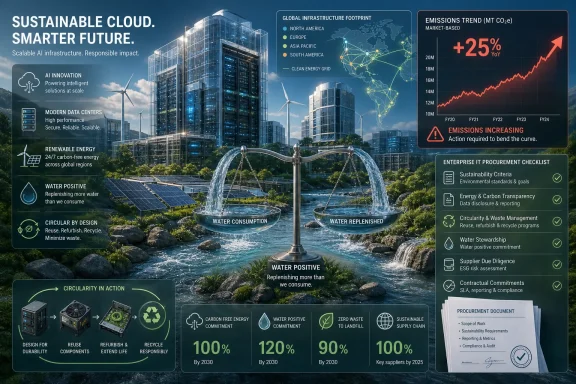 Microsoft’s AI Buildout Has Outgrown the Old Sustainability Narrative
Microsoft says the report covers fiscal year 2025 and measures progress against its 2020 baseline, but it places that accounting inside a new infrastructure context. The company is not just reporting environmental performance; it is trying to explain what progress means when datacenter construction, advanced chips, electricity procurement, water stewardship, and circularity all have to be considered together.The old version of the story was easier. Microsoft would become carbon negative, water positive, and zero waste; cloud scale would be made efficient; renewable procurement would match electricity demand; circular design would reduce material waste. That was ambitious, but it was still a relatively linear proposition: more commitments, more investment, more progress.
The current version is messier. Microsoft’s own framing emphasizes that sustainability has to be treated as an integrated infrastructure issue, not as separate scorecards for carbon, water, waste, and ecosystems. That matters because the report shows progress against several operating goals while also showing that total reported emissions are moving in the wrong direction.
There is a defensible argument that a company with Microsoft’s purchasing power can help bring new carbon-free electricity, reuse practices, lower-waste construction methods, and supplier improvements into the market faster than many smaller buyers could. Long-term procurement, supplier standards, reuse programs, and datacenter design can all move markets when applied at Microsoft’s scale.
But there is also a plain reading of the central number that cannot be softened: total emissions across Scopes 1, 2, and 3 increased 25% year over year. Microsoft ties the increase to the scale and pace of infrastructure expansion and to the way its greenhouse gas inventory is accounted for. The report also separates its official reported inventory from modeled scenarios that estimate what emissions may have looked like without selected interventions.
That distinction matters. Microsoft can argue that some choices may support more meaningful decarbonization over time, but stakeholders should not confuse that argument with emissions reductions that have already appeared in the reported inventory. The company’s solid-line emissions result is still the accountability number.
The 100% Renewable Claim Is Real, But It Is Not the Whole Story
Microsoft says it matched 100% of its annual global electricity consumption with renewable energy in FY25. That sentence will travel well because it is short, measurable, and favorable.The detail behind it matters. Microsoft defines renewable energy as electricity from sources replenished at a rate greater than or equal to their rate of depletion, including geothermal, wind, solar, hydro, and biomass. The company says its 2025 renewable energy target includes two primary categories: renewable energy from contracted projects and grid mix.
Microsoft says the contracted-project category represents more than 90% of the renewable energy applied to achieve the 2025 target. It also says its target does not include short-term spot-market renewable energy credits sourced from operational clean-energy projects.
That distinction matters because corporate renewable accounting has long been scrutinized. A company can match annual electricity consumption with renewable attributes while still drawing power from a grid that is fossil-heavy at certain hours or in certain regions. Annual matching is not the same as hourly carbon-free operation, and Microsoft’s report does not treat the two as identical.
The more important operating concept is carbon-free electricity, or CFE. Microsoft defines CFE technologies as those with zero direct emissions and biogenic technologies with lifecycle emissions equivalent to renewables. Its examples include wind, solar, geothermal, sustainable biomass, hydropower, nuclear, fossil fuels with complete carbon capture, utilization, and sequestration, and storage charged with CFE generation.
That list is broader than standard renewable-energy branding. Nuclear sits beside wind and solar. Carbon capture appears beside hydropower. Storage is counted when charged with CFE generation. The message is that Microsoft is looking beyond a narrow renewable label toward a wider set of technologies it believes may be needed to serve growing electricity demand while reducing carbon intensity.
For Windows users, Azure customers, and enterprise IT teams, this shift is not abstract. The carbon profile of a workload increasingly depends not only on whether a vendor bought enough annual renewable energy, but on where the workload runs, when it runs, what grid serves it, and what kind of power procurement backs it. Microsoft’s report does not turn that into a simple customer scheduling rule, but it points toward a cloud market where carbon accounting becomes a placement, procurement, and governance issue.
The practical implication is that “hosted in Azure” is no longer environmentally self-explanatory. A CIO cannot treat hyperscale cloud as automatically cleaner than on-premises infrastructure without asking more granular questions. Microsoft has a strong case that its global scale can finance cleaner energy, but the report itself shows why annual matching alone is not enough to settle the matter.
Scope 2 Is the New Warning Light
Microsoft says Scope 3 remains the largest share of its footprint overall. That is expected for a company whose emissions include hardware manufacturing, construction materials, logistics, and supply chains. What changed in FY25 is the contribution of Scope 2.Scope 2 now represents 13% of Microsoft’s total emissions, up from nearly 2% last year. That is a major shift in the composition of the company’s reported footprint. It means purchased-energy accounting has become a much larger part of the emissions story.
The phrase “reported footprint” is important. Microsoft says its emissions inventory for FY20 through FY25 was prepared in accordance with the GHG Protocol and management’s criteria, using a market-based emissions approach. It also presents a modeled counterfactual scenario showing where emissions may have been without selected interventions.
That counterfactual includes energy efficiency improvements for Xbox consoles, renewable energy purchases, sustainable aviation fuel and sustainable marine fuel certificates, and supply chain decarbonization of Surface devices. Microsoft is careful to say the dotted-line scenario is illustrative, directional, not part of the reported greenhouse gas inventory, and not a comprehensive measure of total reductions.
That caution is necessary. Counterfactual charts can easily become corporate climate fiction: a world in which every avoided emission is treated as an offsetting virtue, even as absolute emissions keep rising. Microsoft’s own framing tries to prevent that interpretation by separating the official inventory from the modeled comparison.
So the right way to read the chart is narrow and disciplined. The reported inventory says Microsoft’s total emissions rose. The modeled scenario says selected interventions may have avoided additional emissions compared with a hypothetical path. Those are not the same claim. The dotted line may help explain context, but it does not convert a 25% year-over-year increase in reported emissions into a reduction story.
Still, the presence of the chart tells us how Microsoft wants readers to think. The company is saying: do not look only at the solid line going up; also look at the selected actions that may have kept it from going higher. That may be fair as context. It is also a reminder that the central unit of accountability remains absolute reported emissions, not hypothetical emissions avoided.
| Microsoft FY25 sustainability signal | Reported result | Why it matters |
|---|---|---|
| Annual global electricity matched with renewable energy | 100% | Microsoft can meet a headline clean-power procurement target while emissions rise. |
| Total emissions across Scopes 1, 2, and 3 | Up 25% year over year | Infrastructure growth and emissions accounting choices are complicating the progress story. |
| Scope 2 share of total emissions | 13% | Purchased-energy accounting has become a much larger part of the footprint. |
| Global water replenishment | More than 14 million cubic meters | Microsoft says it replenished more water globally than it withdrew for the first time. |
| Server and component reuse/recycling | 92% | Circular cloud operations are becoming a material part of infrastructure sustainability. |
| Construction and demolition waste diversion | 90.5% | Datacenter growth makes construction waste a core cloud issue, not a side metric. |
| Circular Centers | Seven facilities globally | Microsoft is scaling reuse and recovery infrastructure inside its cloud operations. |
The risk is that customers hear only the milestone and miss the pressure. “100% renewable” is not the same as “emissions are falling.” “Water positive globally” is not the same as “every local watershed is protected.” “Circular Centers” are not the same as “hardware growth has no material cost.”
Microsoft’s report is strongest when it admits those distinctions. It is weakest where readers may be tempted to collapse them.
Water Positive Finally Has a Number, But Locality Is the Hard Part
Microsoft says that in FY25 it replenished more water globally than it withdrew for the first time: more than 14 million cubic meters. That is a significant milestone, and the company is right to highlight it. Datacenters have become a public flashpoint not only because they consume electricity, but because cooling systems, local climate conditions, and regional water stress can turn cloud infrastructure into a local issue.The global number, however, is only the beginning of the water story. Microsoft says its water strategy is moving toward replenishing more water than it withdraws in the watersheds where it operates, with a focus on water-stressed areas and community-designed projects. That is the key attribution: Microsoft itself is framing the next phase as more local and more connected to the places where it operates.
That admission is important because water is not like carbon. A ton of carbon dioxide avoided in one place has atmospheric value elsewhere. Water benefits are more geographically bounded. Replenishing water in one watershed does not automatically relieve strain in another watershed where a datacenter is operating.
That means the water-positive milestone will be judged less by whether Microsoft can repeat the global number and more by how clearly it can explain the local math. Is the replenishment in the same watershed? Does it arrive on a useful timeline? Does it improve ecological resilience, or simply balance a corporate ledger? Does it account for drought conditions and competing municipal needs?
The report gestures toward those questions through its emphasis on watershed-level replenishment and community-designed projects, but it does not resolve every facility-level concern. That is not surprising; a corporate annual report cannot litigate every local infrastructure debate. But if Microsoft is going to keep emphasizing a community-first infrastructure approach, then the next reporting frontier is obvious: more detail, more local context, and careful separation between global progress and local outcomes.
Waste Is Where Microsoft Has the Cleanest Story
If carbon is the troubled metric and water is the locality metric, waste is where Microsoft’s report has the most straightforward operational progress. The company says it has eliminated nearly all single-use plastics in primary product packaging, reducing the remaining share to 0.07% by weight, as designed, on a portfolio average basis, at the end of calendar year 2025.The notable phrase is Microsoft’s own: “We are not rounding down.” That line works because it rejects the easy corporate instinct to declare victory at 99-plus percent and move on. Microsoft is saying the last fraction still counts.
There is a bigger point here for hardware design. Packaging is one of the few sustainability areas ordinary consumers can see. A Surface box, an Xbox package, accessory wrapping, inserts, protective films — these become physical evidence of whether a company’s environmental claims have made it into product operations.
But packaging is only the visible edge of the material problem. Microsoft says that across cloud operations it achieved 92% reuse and recycling of decommissioned servers and components for the second consecutive year. It also says it diverted 90.5% of construction and demolition waste from landfills and incinerators, and expanded its Circular Centers to seven facilities globally.
That is where the Windows and Azure audience should pay attention. Cloud sustainability is often discussed as an electricity problem, but it is also a hardware churn problem. Accelerators, servers, networking gear, storage, cooling systems, racks, backup power systems, concrete, steel, and other materials all move through the cloud supply chain.
Circular Centers are Microsoft’s attempt to industrialize reuse inside that cloud lifecycle. The best version of this strategy reduces both waste and embodied emissions by keeping components useful longer and recovering materials more effectively when reuse is not possible. It also gives Microsoft a lever that is less dependent on electricity procurement than power-sector decarbonization.
That does not make circularity a substitute for emissions reduction. Recycling a server does not erase the carbon cost of manufacturing it in the first place. But in a world where hardware cycles can be shaped by demand for specialized compute, reuse and recycling are no longer nice-to-have operational efficiencies. They are core infrastructure controls.
For enterprise IT teams, this should sound familiar. The cloud is doing at hyperscale what disciplined IT asset management has always tried to do locally: extend useful life, standardize disposal, reduce waste leakage, and document the chain of custody. The difference is that Microsoft’s version now carries planetary accounting weight.
The Report’s Most Important Word Is “Integrated”
Microsoft says this year’s report takes a more integrated approach, placing progress against commitments in the broader context of how those commitments are operationalized across infrastructure and products. That could sound like bland report-writing language. It is actually the conceptual center of the document.The company is saying the old pillar model — carbon over here, water over there, waste somewhere else — no longer matches the operating reality of large-scale cloud infrastructure. Clean energy investments, water stewardship, hardware life extension, construction waste diversion, product packaging, and supplier practices all interact with the same expanding infrastructure base.
This is the correct diagnosis. It is also a more difficult form of accountability. A pillar model lets a company celebrate wins separately: electricity matched, water replenished, packaging improved. An integrated model forces harder tradeoff questions: did an infrastructure expansion improve one metric while worsening another? Did a procurement strategy support the grid where the load actually appeared? Did a water project benefit the watershed connected to the operation? Did reuse reduce waste while overall hardware demand still grew?
Microsoft’s community-first infrastructure language belongs in that context because the report itself ties infrastructure development to communities, water, energy, land, and ecosystems. The cautious way to read that language is not as proof that every local concern has been solved. It is a statement of the standard Microsoft is now setting for itself: infrastructure sustainability has to be understood in relation to the communities and ecosystems around it.
That physicality changes how enterprise customers should think about cloud computing. For years, buyers could treat cloud regions mostly as menu options for latency, compliance, resiliency, and price. Those factors still matter. But the sustainability profile of a region is increasingly part of the conversation, especially for organizations with their own environmental reporting obligations.
Microsoft’s repeated emphasis on integrated planning and community-first infrastructure is therefore not just decorative language. It is an acknowledgment that cloud infrastructure is physical. It consumes electricity, occupies land, requires materials, interacts with water systems, and depends on supply chains. The cloud may abstract those realities from the user interface, but it does not eliminate them.
Enterprise IT Now Owns Part of the Sustainability Stack
The 2026 report is not only a Microsoft corporate document. It is a warning to every organization moving aggressively into Copilot, Azure AI, custom model training, data lake expansion, and GPU-heavy analytics: your sustainability posture is becoming dependent on choices you used to classify as architecture decisions.Workload placement, retention policies, model size, training frequency, data duplication, endpoint refresh cycles, and procurement terms all have environmental consequences. The report does not give admins a dashboard answer to all of that, but it makes clear that compute demand, infrastructure growth, renewable procurement, water replenishment, and circularity now belong in the same strategic conversation.
That should change how IT departments talk to finance and sustainability teams. If AI pilots become production systems, they bring recurring compute demand. If every department stores redundant data “just in case” it becomes useful later, storage growth becomes a cost, governance, and infrastructure issue. If endpoints are refreshed for AI features before the end of their useful life, device sustainability becomes part of the Copilot rollout plan.
This is not an argument against AI adoption. It is an argument against treating AI as pure software. AI is software expressed through infrastructure, and infrastructure has energy, water, land, and material footprints.
Action checklist for admins
- Separate AI and high-performance workloads in your Azure inventory. Tag Azure OpenAI, Azure Machine Learning, GPU virtual machines, high-performance computing clusters, vector databases, large analytics jobs, and Copilot-adjacent integrations separately from ordinary application hosting so growth is visible in cost, capacity, and sustainability reviews.
- Ask Microsoft account teams how renewable matching applies to the Azure regions you use. Microsoft reports annual global renewable matching and describes contracted projects and grid mix as the major categories behind its 2025 target. Enterprise customers should ask how that global claim relates to the regions where their workloads actually run.
- Distinguish annual renewable matching from carbon-free electricity goals. Microsoft’s report treats renewable matching and carbon-free electricity as related but not identical concepts. When discussing cloud strategy internally, do not collapse them into a single “green cloud” label.
- Review GPU-heavy deployments before scaling pilots into production. Before expanding AI or analytics workloads, confirm the business owner, expected usage pattern, compute intensity, and whether the workload is still experimental or has become a long-running production dependency.
- Put data minimization into AI governance. Review how much data is being copied into lakes, indexes, vector stores, backups, test environments, and training workflows. Ask whether retention periods are justified, whether duplicate datasets can be eliminated, and whether stale indexes are being kept without an accountable owner.
- Tie Copilot and endpoint refresh plans to actual requirements. Before replacing PCs for AI features, document which users need new hardware, which workloads can run through cloud services, which devices can remain in service, and how retired devices will be reused, resold, recycled, or securely disposed of.
- Ask vendors for specific circularity and disposal practices. Microsoft’s report highlights reuse, recycling, construction and demolition waste diversion, and packaging reduction. Use that same specificity in procurement conversations: ask about reuse, recycling, certified disposal, packaging, repairability, and chain-of-custody practices.
- Include sustainability signals in cloud financial operations. FinOps reviews should not stop at spend. Ask which workloads are overprovisioned, which data stores are growing without policy, which environments have no active owner, and which high-growth services should be reviewed alongside sustainability and architecture teams.
- Assign business owners to high-growth workloads. Every major AI or analytics deployment should have an accountable owner who can justify compute frequency, data volume, retention period, regional placement, and expected business value.
That is especially true for Windows shops. The boundary between endpoint, cloud, and AI service keeps dissolving. A Copilot deployment is not simply a licensing event. It is identity, data governance, endpoint readiness, cloud service consumption, network behavior, compliance review, and now, increasingly, sustainability governance.
The Real Debate Is About Time Horizons
Microsoft’s own document takes the long view. It argues through its structure and disclosures that sustainability progress has to be evaluated across infrastructure, products, energy, water, waste, ecosystems, and supply chains, not just through one annual headline.The conflict is that climate accounting, community impact, and corporate infrastructure planning operate on different clocks. Reported emissions are annual. Datacenter construction happens on project timelines. Grid expansion can take years. Water projects have local timelines. Product packaging changes can show visible progress faster than supply-chain emissions. Corporate climate commitments were often set before the current AI demand curve became obvious.
So when Microsoft says it is not lowering ambition, the right response is neither applause nor cynicism. The right response is: show the reported inventory, show the modeled assumptions separately, show which interventions are actually changing the trajectory, and show how global milestones translate into local outcomes.
That is the standard Microsoft has implicitly accepted by publishing a report this complicated. It wants credit for annual renewable matching, water replenishment, Circular Centers, packaging progress, and modeled avoided emissions. It also has to accept scrutiny for the 25% year-over-year increase in total reported emissions and the sharp rise in Scope 2’s share of the footprint.
For enterprise customers, the answer is not to reject Azure, Copilot, or cloud AI on environmental grounds. It is to stop treating sustainability as a vendor checkbox. The better posture is operational: measure your demand, govern your data, challenge unnecessary hardware refreshes, ask region-specific questions, and make AI workloads prove their value before they become permanent infrastructure.
Microsoft’s report is valuable because it makes the contradiction visible. The company can be making real progress in renewable procurement, water replenishment, waste diversion, and circular operations while still increasing its total emissions. Both can be true. That is the point.
The next phase of cloud sustainability will be judged by whether that contradiction narrows or hardens. If emissions growth slows, if local water reporting becomes more specific, if circularity keeps scaling, and if carbon-free electricity procurement becomes more closely tied to where and when electricity is consumed, Microsoft will have a stronger story to tell. If not, the 2026 report will read less like a turning point and more like an early warning.
For now, the most honest conclusion is also the least comfortable one: Microsoft has shown that it can hit major sustainability milestones. It has not yet shown that those milestones are enough to bend the total emissions curve in the right direction while its infrastructure footprint grows. That is the challenge the company has set for itself — and the one its customers should now factor into every serious cloud and AI decision.
References
- Primary source: The Official Microsoft Blog
Published: 2026-07-09T16:10:16.246932
Loading…
blogs.microsoft.com - Related coverage: axios.com
Loading…
www.axios.com - Official source: microsoft.com
Loading…
www.microsoft.com - Official source: news.microsoft.com
Loading…
news.microsoft.com - Official source: marketingassets.microsoft.com
Loading…
marketingassets.microsoft.com - Official source: download.microsoft.com
Loading…
download.microsoft.com
- Official source: cdn-dynmedia-1.microsoft.com
- Related coverage: smartenergydecisions.com
2025 Microsoft Environmental Sustainability Report PDF.pdf
PDF documentwww.smartenergydecisions.com
- Related coverage: windowscentral.com
Microsoft sees its carbon emissions soar on a 168% glut in AI energy demand, "we recognize that we must also bring more carbon-free electricity onto the grids." | Windows Central
Microsoft's pledge to go carbon neutral by 2030 has hit an AI-shaped snag, as the firm's hunger for cloud growth impacts emissions targets.www.windowscentral.com - Related coverage: techradar.com
Loading…
www.techradar.com - Related coverage: tomshardware.com
Microsoft CEO says new AI data centers use as little water annually as a restaurant — closed-loop cooling system aims to slash consumption from millions of gallons as AI infrastructure faces mounting environmental scrutiny | Tom's Hardware
Critics say the plan does not solve the consumption issue of Microsoft's over 500 existing data centerswww.tomshardware.com