

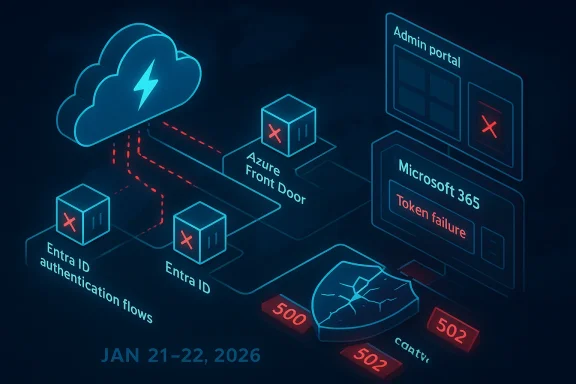
Microsoft’s cloud and security consoles showed fresh instability across January 21–22, 2026: administrators reported intermittent sign‑in failures, blank or erroring admin blades in the Azure and Microsoft 365 portals, and a short-lived 500/502 wave that affected the Microsoft Defender XDR (security.microsoft.com) portal for some tenants. Public outage trackers and Microsoft’s own status messages indicate two related but technically distinct incidents in quick succession — a Microsoft 365 service investigation logged under MO1220495 on January 21 that Microsoft tied to a possible third‑party networking issue, and follow‑on portal errors on January 22 that produced 500 responses from the Defender and other admin consoles.
Microsoft’s cloud stack exposes multiple surfaces: the data plane (compute, storage, app hosting) and the control plane (management portals, identity, configuration, and edge routing). Because identity and management consoles are globally fronted by shared edge fabrics such as Azure Front Door and centrally routed authentication (Entra ID / Azure AD), networking or edge anomalies can make well‑running backend services look unavailable to users. That architectural coupling is at the root of why portal errors or DNS/edge failures appear as broad outages for Microsoft 365, Azure, Defender XDR and other first‑party services. This failure model recent incidents and again during the Jan 21–22 window.
Source: DesignTAXI Community https://community.designtaxi.com/topic/22403-is-microsoft-azure-defender-xdr-down-january-22-2026/
 Background / Overview
Microsoft’s cloud stack exposes multiple surfaces: the data plane (compute, storage, app hosting) and the control plane (management portals, identity, configuration, and edge routing). Because identity and management consoles are globally fronted by shared edge fabrics such as Azure Front Door and centrally routed authentication (Entra ID / Azure AD), networking or edge anomalies can make well‑running backend services look unavailable to users. That architectural coupling is at the root of why portal errors or DNS/edge failures appear as broad outages for Microsoft 365, Azure, Defender XDR and other first‑party services. This failure model recent incidents and again during the Jan 21–22 window. What administrators saw (symptoms)
- Intermittent inability to sign in to Microsoft 365 apps and the Azure Portal, with many users reporting token or authentication failures.
- Elevated error counts and Downdetector spikes for Microsoft 365 and Teams around the business‑hour spike on January 21; some feeds reported thousands of user problem reports at the peak.
- On January 22, multiple tenants reported HTTP 500 / 502 errors when loading security.microsoft.com and the Exchange/Microsoft 365 admin blades; community posts and aggregator data registered the Defender portal as returning unexpected errors.
Timeline and verified signals
Jan 21, 2026 — Microsoft 365 investigation (MO1220495)
Microsoft created an incident entry (MO1220495) and posted public acknowledgements that it was investigating reports affecting Microsoft 365 services, including Teams and Outlook. Early public messaging signalled a possible third‑party networking issue as a likely contributor; independent outlets and outage trackers recorded rapid spikes in user reports beginning around 9:00 a.m. PT. Recovery signals followed over the next hours for many users, though follow‑on residual effects and tenant‑specific impacts persisted for some organizations.Jan 22, 2026 — Portal errors and Defender XDR 500s
On January 22 several admin portals — notably the Microsoft Defender portal (security.microsoft.com) — began to return HTTP 500 or 502 errors for some users and regions. Community telemetry, third‑party status aggregators and multiple administrator reports show the Defender portal experienced its own short‑duration faulting, with StatusGator and forum posts showing the portal returned errors that were later acknowledged in Microsoft’s health dashboard updates. These events appear to be related to control‑plane or edge routing problems rather than a wholesale failure of Defender XDR telemetry ingestion or backend detection engines, although tenant visibility into consoles and manual triage was impaired while the portal errors persisted.Technical anatomy: why an edge/network event looks like a security product outage
Microsoft uses a layered, global edge and identity fronting model to deliver low latency and centralized securityause wide‑area user impact when they fail:- Azure Front Door (AFD) and edge PoPs: these nodes terminate TLS, apply routing, and proxy requests to internal back‑ends. When an AFD PoP or route behaves incorrectly, browsers see TLS or gateway errors even if origin services are healthy.
- Shared identity plane (Entra ID / Azure AD): many services dec and validation performed through centralized endpoints. Network routing or DNS anomalies that break token flows cause immediate sign‑in failures across unrelated services.
- Control‑plane coupling: admin consoles and security portals share common hosting and routing layers; a single misconfiguration or upstream network fault can prevent GUI access while API‑driven telemetry and enforcement continue to function behind the scenes. Community reporting and operational post‑mortems from past incidents confirm this pattern.
Cross‑checked facts and verification
Key claims and where they were independently verified:- Microsoft acknowledged a Microsoft 365 incident under MO1220495 and stated a possible third‑party networking issue was under investigation. This is recorded in Microsoft’s status feeds and referenced by multiple outlets.
- Downdetector and similar trackers recorded high volumes of user problem reports on Jan 21; reporters and news sites tracked the spikes and subsequent declines as mitigation reduced error rates. These counters are indicative (user‑reported) rather than definitive counts of impacted seats.
- Defender portal 500 errors on Jan 22 were visible in community posts and were detected by status aggregators; aggregated telemetry shows short‑duration errors that were acknowledged in health messages. This event is distinct from the Jan 21 M365 investigation but likely shares causal pathways (edge/control‑plane routing).
- Specific claims that named national ticketing sites or carrier services were interrupted during this window are present in some community threads but remain unverified in official operator statements. Treat such claims as reported impact pending confirm likely happened (operational hypothesis)
What this means for Defeetection engines likely still ran:* Defender XDR’s correlation, alerting, and backend XDR processing are hosted on distributed back‑end infrastructure; a portal outage primarily affects visibility* and manual remediation workflows, not necessarily the core telemetry pipeline. However, when administrators or automation playbooks are inaccessible, human response and orchestration are hamstrung.
- False positives and stale telemetry risk: when a portal is partially reachable or returns errors, UI components might fail to show the latest state, generating a perception of missing alerts or stalled investigations. Always validate critical signals with API calls or alternate tooling where possible.
- Automation and playbook resilience matters: organizations that rely solely on portal‑driven manual actions can be blocked. Workflows that expose programmatic runbooks (Logic Apps, Sentinel playbooks) and pre‑authorized service principals retain function if their authentication paths remain intact.
Recommended immediate actions for IT and SOC teams
- Validate whether detection and ingestion are still flowing:
- Check Defender XDR ingestion APIs (advanced hunting / Graph calls) and Sentinel ingest counts from automation scripts or a non‑portal client. Prefer programmatic checks over the portal during edge incidents.
- Use alternate access paths:
- Attempt admin CLI/PowerShell or Microsoft Graph calls if the GUI is down; these sometimes bypass front‑end routing that affects browser‑based consoles.
- Clear local DNS caches and confirm upstream resolvers:
- If elated, clear caches on affected jumpboxes and force tests using trusted public resolvers (e.g., 1.1.1.1, 8.8.8.8) to check for name resolution anomalies.
- Use break‑glass and emergency accounts:
- Ensure at least one emergency account is reachable via an alternative authentication path (with privileged credentials stored out‑of‑band).
- Escalate with Microsoft support:
- Open the incident ID (if present) and capture tenant‑specific traces, timestamps and request IDs. Include time windows and examples of failing endpoints.
- Communicate transparently:
- Notify stakeholders with an explanation and expected impacts; differentiate between portal visibility outages and full telemetry/service failure.
- Decouple critical runbooks from portal UIs. Programmatic APIs and pre‑approved automation principals reduce the blast radius of portal availability problems.
- Harden DNS and TTL strategy. Longer DNS TTLs for critical management records and multi‑resolver strategies mitigate cascade effects of transient DNS anomalies.
- Practice failover drills for control‑plane events. Run tabletop exercises that simulate admin portal loss and validate alternative access and rollback procedures.
- Distribute critical workloads or maintain multi‑path access. For truly mission‑critical control functions, consider multi‑cloud or multi‑path designs for management access, or maintain an out‑of‑band admin ply on primary edge routing paths.
- Negotiate transparency and SLA remedies. After high‑impact incidents, customers should request detailed post‑incident reviews and consider contractual remedies or resilience commitments in procurement.
Strengths observed in Microsoft’s response — and where ri:
- Rapid acknowledgement and incident IDs. Microsoft posted incident identifiers and public acknowledgements quickly (MO1220495), which helps tenants map their internal telemetry to provider signals.
- Standard mitigation playbook. Past public RCAs and observed mitigation steps — halting rollouts, rerouting traffic, and restarting orchestration units — are proven containment tactics that limit blast radius when applied promptly.
- Third‑party dependencies. Microsoft’s early attribution to a third‑party networking issue highlights how external transit and peering events can propagate into major interruptions inside a hyperscaler’s ecosystem. Customers remain exposed to failures outside the provider’s direct control.
- Portal vs. backend ambiguity. Distinguishing between a portal outage (visibility) and a backend security failure is non‑trivial in live incidents; insufficient transparency or delayed RCAsn about their detection posture during the incident window.
How to read post‑incident communications (and what to demand)
When a hyperscaler publishes an incident summary, it’s important to look for:- Concrete timestamps for detection, mitigation, and resolution.
- The blast radius statement: which regions and service surfaces were affected.
- Whether the root cause is in the provider’s control plane, in a third‑party network, or in customer configuration.
- Specific mitigation steps and follow‑on changes (e.g., hardening rollouts, improved validation checks) that will reduce recurrence risk.
Final assessment and practical takeaways
- Was Microsoft Azure / Defender XDR “down” on January 21–22, 2026? The accurate, measured answer is nuanced: Microsoft acknowledged a Microsoft 365 incident (MO1220495) tied to a likely third‑party networking issue on January 21, and on January 22 several admin portals — including the Defender XDR console — returned HTTP 500/502 errors for some tenants. Those portal errors impaired visibility and manual response, but they do not necessarily mean all Defender XDR detection engines or back‑end telemetry pipelines were offline. Operators should therefore treat the events as control‑plane and edge fabric instability that temporarily reduced administrative access and UI visibility.
- Immediate priorities for IT teams remain: confirm telemetry ingestion via APIs, switch to programmatic remediation if the GUI is unavailable, escalate with Microsoft and capture tenant‑specific logs, and use the incident as a prompt to rehearse control‑plane failure playbooks.
- Longer term, organizations must invest in multi‑path access, resilient DNS strategy, and programmatic runbooks that tolerate temporary portal outages without compromising detection and response.
Source: DesignTAXI Community https://community.designtaxi.com/topic/22403-is-microsoft-azure-defender-xdr-down-january-22-2026/
