

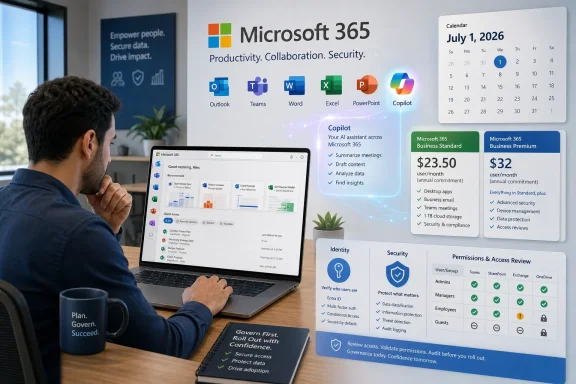
Microsoft is making Microsoft 365 Business Standard with Copilot and Microsoft 365 Business Premium with Copilot permanent small-business SKUs on July 1, 2026, priced at $23.50 and $32 per user per month respectively for one to 300 seats on annual billing. That is not merely a packaging change. It is Microsoft’s clearest signal yet that Copilot is moving from optional AI experiment to default productivity infrastructure for small and medium-sized businesses. For Windows shops, the real story is not the discount; it is the gradual disappearance of the neat boundary between “Microsoft 365” and “Microsoft 365 with AI.”
For the last few years, Microsoft has treated Copilot licensing like a market test wrapped in a product launch. First came the high-end enterprise framing: Copilot as the premium assistant for organizations already deep into Microsoft 365, Teams, SharePoint, Outlook, and Entra. Then came smaller-business eligibility, promotional pricing, and a growing number of ways to bolt Copilot onto an existing plan.
The July 1 change tidies that up for the SMB segment. Instead of asking a small company to buy Microsoft 365 Business Standard or Business Premium and then separately decide whether Copilot Business is worth the extra line item, Microsoft is creating permanent bundles that put the collaboration suite and AI assistant into one SKU. Business Standard with Copilot lands at $23.50 per user per month, while Business Premium with Copilot lands at $32 per user per month, both capped at the familiar one-to-300-seat SMB range.
That sounds administrative, and in one sense it is. Licensing friction matters enormously in small organizations, where the person approving software may also be the owner, office manager, part-time IT admin, and person everyone calls when Outlook misbehaves. A SKU that says “this is the business productivity suite with Copilot included” is easier to understand than a base plan, an add-on, eligibility rules, commitment terms, and a spreadsheet comparing who gets what.
But simplification is also strategy. Microsoft has learned from decades of Office bundling that the easiest way to normalize a feature is not always to win a feature-by-feature argument. It is to make the feature part of the thing customers were already going to buy.
That question is uncomfortable for every vendor selling generative AI into business workflows. The promise is broad and seductive: summarize meetings, draft emails, build presentations, query files, help with spreadsheets, turn Teams chatter into action items. The value, however, is unevenly distributed. A salesperson living in Outlook and Teams may find Copilot useful every day. A warehouse supervisor or bookkeeper may touch it only occasionally. A five-person firm may not have enough SharePoint hygiene for “grounded in your work data” to feel magical rather than messy.
Microsoft’s bundling push acknowledges that reality without saying it aloud. The company is reducing the moment of hesitation. Instead of Copilot being an obvious extra cost that someone must defend, it becomes part of a tiered productivity package. That does not make it free, and administrators should resist any framing that pretends otherwise. It makes it easier to buy, easier to renew, and easier for Microsoft partners to pitch as the new default.
There is a second SMB-specific factor: small organizations rarely have spare capacity for software change management. A Copilot deployment is not just a license assignment. To work well, it depends on permissions, data quality, user training, security posture, and some basic discipline around where work actually lives. Bundling can get Copilot into the tenant faster, but it does not automatically make the tenant ready for Copilot.
That is the carrot. The ratchet is what happens after customers get used to budgeting for AI as part of the suite.
Microsoft’s commercial cloud business has long relied on a familiar motion: expand the value of a bundle, make the bundle operationally convenient, then adjust pricing as the bundle becomes harder to remove. Office became Microsoft 365. Microsoft 365 became the home for security, compliance, identity, device management, collaboration, and now AI. Each new layer can be justified individually, but the cumulative effect is that businesses increasingly rent their operating system for work from Microsoft.
The new Copilot bundles fit that pattern. They lower the perceived risk of adoption while increasing the chance that Copilot becomes baked into everyday workflows before the next renewal conversation. Once employees rely on AI summaries in Outlook, draft generation in Word, meeting recaps in Teams, or presentation assistance in PowerPoint, removing Copilot becomes more than a procurement decision. It becomes a workplace disruption.
That is not necessarily sinister. Sticky software can be sticky because it works. But IT buyers should recognize the sequence. A promotional or discounted bundle is not only a savings opportunity; it is also a habit-forming mechanism.
Business Premium already occupies a particular niche in the Microsoft 365 lineup. It is the plan Microsoft wants serious small businesses to adopt when they outgrow email-and-Office basics but are not enterprise customers. It brings in management and security capabilities that matter in the real world: device management, conditional access-style controls, endpoint protection, and stronger defenses around email and collaboration.
Adding Copilot to that package lets Microsoft tell a cleaner story. AI is not just another app; it is a new interface over organizational data. If users can ask natural-language questions across documents, mail, meetings, and chats, then the permissions model and security posture behind those data sources become more important, not less. Copilot does not eliminate the old SharePoint mess. It makes the old SharePoint mess conversational.
That matters for WindowsForum readers because many SMB Windows environments are hybrids of good intentions and inherited chaos. There are personal OneDrive folders doubling as file servers, Teams channels created for projects that ended two years ago, stale guest accounts, unmanaged home PCs, and file permissions that made sense only to someone who left the company in 2021. Copilot can surface useful knowledge from that sprawl, but it can also expose how little governance existed before anyone asked an AI to summarize it.
Business Premium with Copilot is therefore the bundle that most honestly reflects the technical stakes. If AI becomes part of the productivity fabric, security and management cannot remain optional extras for the “grown-up” version of the business.
Small businesses can already buy AI in scattered ways. Employees may use consumer chatbots, browser assistants, AI note-takers, CRM features, accounting add-ons, design tools, or phone-system transcription services. That patchwork can be cheap and flexible, but it creates real governance problems. Data goes into unknown systems. Outputs are copied back into business documents. Nobody knows which tool generated what. The procurement record says “Microsoft 365,” while actual workflows leak across a half-dozen AI services.
Microsoft’s bundled approach says: stop assembling this yourself. Put AI where your mail, documents, meetings, and identity already are. Let Copilot be the sanctioned path, and let Microsoft’s compliance and security story do the reassuring.
That is a powerful pitch to an overworked admin. It is also a narrowing of choice. The more Microsoft embeds Copilot into the standard productivity purchase, the more alternative AI tools must justify themselves not merely against Copilot, but against Copilot’s convenience and bundle economics. A rival may be better at coding, research, creative drafting, customer support, or data analysis. But if Copilot is already in the tenant and already paid for, “better” may not be enough.
This is the classic bundle problem in modern form. Microsoft does not need Copilot to be the best AI assistant in every category. It needs Copilot to be good enough, integrated enough, governed enough, and financially bundled enough that the default decision becomes “use what we already have.”
Microsoft’s message is that the suite is gaining value. The buyer’s concern is that the suite is gaining inevitability. Those two things can both be true.
When software vendors add capabilities and raise prices, they prefer to talk about expanded value. Customers often experience the same event as reduced optionality. A feature they did not request becomes part of a bundle they cannot easily avoid, and a cost center they once understood becomes harder to model. The result is not always anger; sometimes it is simply budget fatigue.
For SMBs, even modest per-user changes matter. A 25-person company does not have enterprise software spend, but it also does not have enterprise negotiating leverage. A few dollars per user per month across Microsoft 365, security tools, backup services, endpoint management, password management, and industry-specific apps can add up quickly. AI bundling may be rational, but it arrives in an environment where every vendor is trying to reprice software around AI.
That is why Microsoft’s new SKUs are both welcome and worth scrutinizing. They may reduce confusion at purchase time. They do not remove the need for a disciplined renewal conversation.
The weakness of add-ons is that they expose every moment of doubt. If Copilot sits as a separate $21 or $30 line item, someone will ask whether it earned its keep. If the answer varies by role, the licensing conversation gets messy. Some users want it. Some users do not. Some managers want everyone to have it “for consistency.” Some admins want fewer license types. Some finance teams want hard usage evidence that may not exist.
Permanent bundles help Microsoft move past that mess. They reposition Copilot from “extra AI license” to “version of Microsoft 365.” That is a subtle but important change in buyer psychology. Businesses already understand tiering. They understand Basic, Standard, Premium. They understand paying more for a plan that includes more. Copilot becomes another reason to climb the ladder.
For partners, this is even cleaner. The sales motion becomes less about convincing a customer to add AI to an existing stack and more about moving that customer to the right Microsoft 365 Business with Copilot plan. That is easier to quote, easier to explain, and easier to renew.
Traditional file sprawl hid many sins. A user might technically have access to an old folder, but would never find the sensitive document buried five levels deep. A Teams channel might contain customer information from a past project, but only a few people remembered it existed. An over-shared SharePoint library could remain unnoticed until someone stumbled into it.
AI changes the discovery layer. If an assistant can help users find patterns across documents and messages, then dormant access becomes active access. That is the core governance challenge for Copilot in small organizations.
The answer is not panic. Microsoft 365 Copilot is designed to respect existing permissions, which is exactly what makes existing permissions so important. If a user should not be able to see a document, the fix is not a Copilot setting. The fix is access control, lifecycle management, and cleaning up the tenant before executives start asking why the AI knows things it should not know.
This is where the Business Premium bundle again becomes significant. The organizations most likely to benefit from Copilot are often the same organizations that need better identity, device, and data controls. Microsoft is betting that those needs can be sold together.
The strongest Copilot use cases are mundane in the best way. Summarizing a long email thread before a customer call. Turning rough notes into a first draft. Creating a presentation outline from a planning document. Extracting action items from a meeting. Helping a user understand an unfamiliar spreadsheet. These are not science-fiction demonstrations; they are the small frictions of office work.
The weaker use cases appear when Copilot is asked to compensate for unclear data, vague prompts, or business processes nobody has bothered to define. An AI assistant cannot reliably summarize what the organization never documented. It cannot create a good proposal from contradictory source material. It cannot fix a culture where important decisions happen in private chats and never reach the project workspace.
That divide will shape SMB reactions. Some employees will see Copilot as a time-saver. Others will see it as an expensive autocomplete feature. Some firms will find obvious value in meeting-heavy, document-heavy roles. Others will struggle to quantify gains beyond novelty. Bundling makes the purchase easier, but the lived experience still has to justify the renewal.
OpenAI, Google, Anthropic, and a growing field of specialized AI vendors can all make credible claims about model quality or workflow advantages. Microsoft’s advantage is tenant gravity. It owns the place where many businesses already manage users, licenses, devices, mailboxes, Teams, SharePoint, and Office apps. For a small business, that gravity is hard to escape.
The more Copilot is sold as a Microsoft 365 plan rather than a separate AI product, the more the competition has to overcome administrative inertia. A third-party tool must answer questions Microsoft can often answer with “it is already part of your Microsoft stack.” Where does the data go? How is identity handled? Can we manage access centrally? Will it work with our files? Who supports it? What does procurement need to approve?
That does not mean rivals are doomed. Many will win where they are more focused, cheaper, more flexible, or simply better. Developers may prefer coding assistants outside Microsoft’s productivity orbit. Designers may use creative AI tools that have nothing to do with Office. Customer-support teams may choose platforms built for ticketing and contact-center workflows. But for general office work, Microsoft is trying to make Copilot the path of least resistance.
That is why the SMB bundle matters beyond SMBs. It is a sign that Microsoft believes the AI productivity market will be won as much through packaging and distribution as through raw model capability.
Microsoft is also continuing promotions around Business Basic plus Copilot Business, including discounted offers intended to encourage adoption among lower-tier customers. That matters because Business Basic customers are often the most price-sensitive and may not need desktop apps or the fuller Premium security package. For them, Copilot can look like a way to modernize without moving all the way up the stack.
Still, every SMB should resist buying AI by slogan. The correct question is not “Should we adopt Copilot?” It is “Which roles have workflows where Copilot can save measurable time, and what must we clean up before broad deployment?” That question leads to a better pilot, even if the final purchase is a bundled SKU.
The best deployments will likely start with a realistic map of work. Sales, operations, management, finance, HR, and customer support may each use Copilot differently. Some departments may need training more than licenses. Others may need data cleanup before Copilot can be trusted. The companies that skip that work may still buy the bundle, but they will be buying convenience rather than transformation.
 Microsoft Turns the Add-On Into the Product
For the last few years, Microsoft has treated Copilot licensing like a market test wrapped in a product launch. First came the high-end enterprise framing: Copilot as the premium assistant for organizations already deep into Microsoft 365, Teams, SharePoint, Outlook, and Entra. Then came smaller-business eligibility, promotional pricing, and a growing number of ways to bolt Copilot onto an existing plan.The July 1 change tidies that up for the SMB segment. Instead of asking a small company to buy Microsoft 365 Business Standard or Business Premium and then separately decide whether Copilot Business is worth the extra line item, Microsoft is creating permanent bundles that put the collaboration suite and AI assistant into one SKU. Business Standard with Copilot lands at $23.50 per user per month, while Business Premium with Copilot lands at $32 per user per month, both capped at the familiar one-to-300-seat SMB range.
That sounds administrative, and in one sense it is. Licensing friction matters enormously in small organizations, where the person approving software may also be the owner, office manager, part-time IT admin, and person everyone calls when Outlook misbehaves. A SKU that says “this is the business productivity suite with Copilot included” is easier to understand than a base plan, an add-on, eligibility rules, commitment terms, and a spreadsheet comparing who gets what.
But simplification is also strategy. Microsoft has learned from decades of Office bundling that the easiest way to normalize a feature is not always to win a feature-by-feature argument. It is to make the feature part of the thing customers were already going to buy.
The SMB Market Was Always the Harder Copilot Test
Enterprise AI adoption gets the keynote demos, but the small-business market is the sterner test of whether Copilot can become ordinary software. Large companies can run pilots, hire consultants, establish AI governance committees, and absorb a few quarters of uneven productivity gains. SMBs tend to ask a blunter question: will this save us enough time to justify the monthly bill?That question is uncomfortable for every vendor selling generative AI into business workflows. The promise is broad and seductive: summarize meetings, draft emails, build presentations, query files, help with spreadsheets, turn Teams chatter into action items. The value, however, is unevenly distributed. A salesperson living in Outlook and Teams may find Copilot useful every day. A warehouse supervisor or bookkeeper may touch it only occasionally. A five-person firm may not have enough SharePoint hygiene for “grounded in your work data” to feel magical rather than messy.
Microsoft’s bundling push acknowledges that reality without saying it aloud. The company is reducing the moment of hesitation. Instead of Copilot being an obvious extra cost that someone must defend, it becomes part of a tiered productivity package. That does not make it free, and administrators should resist any framing that pretends otherwise. It makes it easier to buy, easier to renew, and easier for Microsoft partners to pitch as the new default.
There is a second SMB-specific factor: small organizations rarely have spare capacity for software change management. A Copilot deployment is not just a license assignment. To work well, it depends on permissions, data quality, user training, security posture, and some basic discipline around where work actually lives. Bundling can get Copilot into the tenant faster, but it does not automatically make the tenant ready for Copilot.
The Price Is a Discount, but the Direction Is a Ratchet
On paper, these bundles look attractive compared with older combined pricing. Microsoft 365 Copilot Business has been positioned at $21 per user per month, while Business Standard and Business Premium carry their own base costs. Bundled pricing at $23.50 and $32 per user per month effectively narrows the gap between ordinary Microsoft 365 and Microsoft 365 with Copilot.That is the carrot. The ratchet is what happens after customers get used to budgeting for AI as part of the suite.
Microsoft’s commercial cloud business has long relied on a familiar motion: expand the value of a bundle, make the bundle operationally convenient, then adjust pricing as the bundle becomes harder to remove. Office became Microsoft 365. Microsoft 365 became the home for security, compliance, identity, device management, collaboration, and now AI. Each new layer can be justified individually, but the cumulative effect is that businesses increasingly rent their operating system for work from Microsoft.
The new Copilot bundles fit that pattern. They lower the perceived risk of adoption while increasing the chance that Copilot becomes baked into everyday workflows before the next renewal conversation. Once employees rely on AI summaries in Outlook, draft generation in Word, meeting recaps in Teams, or presentation assistance in PowerPoint, removing Copilot becomes more than a procurement decision. It becomes a workplace disruption.
That is not necessarily sinister. Sticky software can be sticky because it works. But IT buyers should recognize the sequence. A promotional or discounted bundle is not only a savings opportunity; it is also a habit-forming mechanism.
Business Premium Is Where Microsoft’s Argument Is Strongest
The more interesting bundle is not Business Standard with Copilot. It is Business Premium with Copilot. That is where Microsoft can make a more coherent pitch: if you are going to put generative AI into business data, you should also buy the identity, device, and threat-protection controls that reduce the blast radius when users inevitably do risky things.Business Premium already occupies a particular niche in the Microsoft 365 lineup. It is the plan Microsoft wants serious small businesses to adopt when they outgrow email-and-Office basics but are not enterprise customers. It brings in management and security capabilities that matter in the real world: device management, conditional access-style controls, endpoint protection, and stronger defenses around email and collaboration.
Adding Copilot to that package lets Microsoft tell a cleaner story. AI is not just another app; it is a new interface over organizational data. If users can ask natural-language questions across documents, mail, meetings, and chats, then the permissions model and security posture behind those data sources become more important, not less. Copilot does not eliminate the old SharePoint mess. It makes the old SharePoint mess conversational.
That matters for WindowsForum readers because many SMB Windows environments are hybrids of good intentions and inherited chaos. There are personal OneDrive folders doubling as file servers, Teams channels created for projects that ended two years ago, stale guest accounts, unmanaged home PCs, and file permissions that made sense only to someone who left the company in 2021. Copilot can surface useful knowledge from that sprawl, but it can also expose how little governance existed before anyone asked an AI to summarize it.
Business Premium with Copilot is therefore the bundle that most honestly reflects the technical stakes. If AI becomes part of the productivity fabric, security and management cannot remain optional extras for the “grown-up” version of the business.
Microsoft Is Selling Less Choice and More Certainty
The marketing language around these bundles emphasizes simplicity, transparency, and having apps, AI, and security “in one place.” That message is not accidental. Microsoft knows that Copilot’s biggest SMB competitor is not always Google, OpenAI, Anthropic, or some vertical AI startup. Often, the competitor is indecision.Small businesses can already buy AI in scattered ways. Employees may use consumer chatbots, browser assistants, AI note-takers, CRM features, accounting add-ons, design tools, or phone-system transcription services. That patchwork can be cheap and flexible, but it creates real governance problems. Data goes into unknown systems. Outputs are copied back into business documents. Nobody knows which tool generated what. The procurement record says “Microsoft 365,” while actual workflows leak across a half-dozen AI services.
Microsoft’s bundled approach says: stop assembling this yourself. Put AI where your mail, documents, meetings, and identity already are. Let Copilot be the sanctioned path, and let Microsoft’s compliance and security story do the reassuring.
That is a powerful pitch to an overworked admin. It is also a narrowing of choice. The more Microsoft embeds Copilot into the standard productivity purchase, the more alternative AI tools must justify themselves not merely against Copilot, but against Copilot’s convenience and bundle economics. A rival may be better at coding, research, creative drafting, customer support, or data analysis. But if Copilot is already in the tenant and already paid for, “better” may not be enough.
This is the classic bundle problem in modern form. Microsoft does not need Copilot to be the best AI assistant in every category. It needs Copilot to be good enough, integrated enough, governed enough, and financially bundled enough that the default decision becomes “use what we already have.”
The Calendar Matters Because July Is Also a Pricing Moment
The July 1, 2026 date is doing more than introducing new Copilot bundles. It sits inside a broader Microsoft 365 pricing and packaging cycle in which Microsoft has been adjusting commercial plans and tying those changes to added capabilities, including AI and security features. For customers, that means Copilot’s SMB bundling should not be viewed in isolation.Microsoft’s message is that the suite is gaining value. The buyer’s concern is that the suite is gaining inevitability. Those two things can both be true.
When software vendors add capabilities and raise prices, they prefer to talk about expanded value. Customers often experience the same event as reduced optionality. A feature they did not request becomes part of a bundle they cannot easily avoid, and a cost center they once understood becomes harder to model. The result is not always anger; sometimes it is simply budget fatigue.
For SMBs, even modest per-user changes matter. A 25-person company does not have enterprise software spend, but it also does not have enterprise negotiating leverage. A few dollars per user per month across Microsoft 365, security tools, backup services, endpoint management, password management, and industry-specific apps can add up quickly. AI bundling may be rational, but it arrives in an environment where every vendor is trying to reprice software around AI.
That is why Microsoft’s new SKUs are both welcome and worth scrutinizing. They may reduce confusion at purchase time. They do not remove the need for a disciplined renewal conversation.
The Add-On Era Taught Microsoft Where the Friction Was
The earlier Copilot licensing model had a useful function: it let Microsoft measure demand without forcing every customer into the pool. Add-ons are good for pilots. They let a company assign a few licenses to managers, sales staff, finance users, or executives who are most likely to test the value. They give partners a reason to run workshops and adoption campaigns. They also provide a clean answer when the CFO asks, “Who exactly is using this?”The weakness of add-ons is that they expose every moment of doubt. If Copilot sits as a separate $21 or $30 line item, someone will ask whether it earned its keep. If the answer varies by role, the licensing conversation gets messy. Some users want it. Some users do not. Some managers want everyone to have it “for consistency.” Some admins want fewer license types. Some finance teams want hard usage evidence that may not exist.
Permanent bundles help Microsoft move past that mess. They reposition Copilot from “extra AI license” to “version of Microsoft 365.” That is a subtle but important change in buyer psychology. Businesses already understand tiering. They understand Basic, Standard, Premium. They understand paying more for a plan that includes more. Copilot becomes another reason to climb the ladder.
For partners, this is even cleaner. The sales motion becomes less about convincing a customer to add AI to an existing stack and more about moving that customer to the right Microsoft 365 Business with Copilot plan. That is easier to quote, easier to explain, and easier to renew.
Windows Admins Should Treat Copilot as a Permissions Audit
The most practical advice for SMB administrators is also the least glamorous: before turning Copilot loose broadly, assume it will reveal your information architecture. Not because Copilot is uniquely dangerous, but because any tool that makes it easier to search, summarize, and synthesize internal content raises the value of getting permissions right.Traditional file sprawl hid many sins. A user might technically have access to an old folder, but would never find the sensitive document buried five levels deep. A Teams channel might contain customer information from a past project, but only a few people remembered it existed. An over-shared SharePoint library could remain unnoticed until someone stumbled into it.
AI changes the discovery layer. If an assistant can help users find patterns across documents and messages, then dormant access becomes active access. That is the core governance challenge for Copilot in small organizations.
The answer is not panic. Microsoft 365 Copilot is designed to respect existing permissions, which is exactly what makes existing permissions so important. If a user should not be able to see a document, the fix is not a Copilot setting. The fix is access control, lifecycle management, and cleaning up the tenant before executives start asking why the AI knows things it should not know.
This is where the Business Premium bundle again becomes significant. The organizations most likely to benefit from Copilot are often the same organizations that need better identity, device, and data controls. Microsoft is betting that those needs can be sold together.
The User Experience Will Decide Whether the Bundle Feels Fair
Licensing can get Copilot into small businesses. It cannot make employees like it. The long-term success of these SKUs depends on whether Copilot becomes a genuinely useful layer inside Word, Excel, PowerPoint, Outlook, Teams, and the broader Microsoft 365 experience.The strongest Copilot use cases are mundane in the best way. Summarizing a long email thread before a customer call. Turning rough notes into a first draft. Creating a presentation outline from a planning document. Extracting action items from a meeting. Helping a user understand an unfamiliar spreadsheet. These are not science-fiction demonstrations; they are the small frictions of office work.
The weaker use cases appear when Copilot is asked to compensate for unclear data, vague prompts, or business processes nobody has bothered to define. An AI assistant cannot reliably summarize what the organization never documented. It cannot create a good proposal from contradictory source material. It cannot fix a culture where important decisions happen in private chats and never reach the project workspace.
That divide will shape SMB reactions. Some employees will see Copilot as a time-saver. Others will see it as an expensive autocomplete feature. Some firms will find obvious value in meeting-heavy, document-heavy roles. Others will struggle to quantify gains beyond novelty. Bundling makes the purchase easier, but the lived experience still has to justify the renewal.
The Competitive Fight Moves Into the Admin Center
The new SKUs also show how Microsoft intends to fight the broader AI productivity market. It is not just a model war. It is an admin-center war.OpenAI, Google, Anthropic, and a growing field of specialized AI vendors can all make credible claims about model quality or workflow advantages. Microsoft’s advantage is tenant gravity. It owns the place where many businesses already manage users, licenses, devices, mailboxes, Teams, SharePoint, and Office apps. For a small business, that gravity is hard to escape.
The more Copilot is sold as a Microsoft 365 plan rather than a separate AI product, the more the competition has to overcome administrative inertia. A third-party tool must answer questions Microsoft can often answer with “it is already part of your Microsoft stack.” Where does the data go? How is identity handled? Can we manage access centrally? Will it work with our files? Who supports it? What does procurement need to approve?
That does not mean rivals are doomed. Many will win where they are more focused, cheaper, more flexible, or simply better. Developers may prefer coding assistants outside Microsoft’s productivity orbit. Designers may use creative AI tools that have nothing to do with Office. Customer-support teams may choose platforms built for ticketing and contact-center workflows. But for general office work, Microsoft is trying to make Copilot the path of least resistance.
That is why the SMB bundle matters beyond SMBs. It is a sign that Microsoft believes the AI productivity market will be won as much through packaging and distribution as through raw model capability.
The Fine Print Still Belongs in the Budget Meeting
The headline prices are simple; the buying decision is not. These bundles are annual subscription offers with annual billing, and the one-to-300-seat range reinforces that they are aimed squarely at the small-business tier. Customers should also pay close attention to promotional offers, eligibility rules, renewal dates, and whether an apparently attractive discount creates a more expensive baseline later.Microsoft is also continuing promotions around Business Basic plus Copilot Business, including discounted offers intended to encourage adoption among lower-tier customers. That matters because Business Basic customers are often the most price-sensitive and may not need desktop apps or the fuller Premium security package. For them, Copilot can look like a way to modernize without moving all the way up the stack.
Still, every SMB should resist buying AI by slogan. The correct question is not “Should we adopt Copilot?” It is “Which roles have workflows where Copilot can save measurable time, and what must we clean up before broad deployment?” That question leads to a better pilot, even if the final purchase is a bundled SKU.
The best deployments will likely start with a realistic map of work. Sales, operations, management, finance, HR, and customer support may each use Copilot differently. Some departments may need training more than licenses. Others may need data cleanup before Copilot can be trusted. The companies that skip that work may still buy the bundle, but they will be buying convenience rather than transformation.
The Small Print Is Where the AI Strategy Becomes Real
Microsoft’s Copilot bundling for SMBs is easy to summarize, but harder to judge. A few concrete points should guide how WindowsForum readers think about it:- Microsoft is making Copilot a permanent part of selected SMB Microsoft 365 bundles starting July 1, 2026, rather than leaving it only as a separate add-on decision.
- The new Business Standard with Copilot and Business Premium with Copilot SKUs simplify purchasing, but they also make AI a more normal part of Microsoft 365 budgeting.
- Business Premium with Copilot is the more strategically coherent offer because AI adoption increases the importance of identity, device management, and security controls.
- Small businesses should audit permissions, stale data, guest access, and SharePoint or Teams sprawl before assuming Copilot will safely surface only the right information.
- The bundle pricing may be attractive compared with older combined offers, but annual terms, renewal timing, promotions, and future pricing changes still deserve careful review.
- Copilot’s success in SMBs will depend less on launch-day packaging than on whether ordinary users find daily value inside Outlook, Teams, Word, Excel, and PowerPoint.
References
- Primary source: Cloud Wars
Published: Wed, 10 Jun 2026 15:00:00 GMT
Microsoft Streamlines SMB AI Adoption with New Microsoft 365 Copilot Bundles - Cloud Wars
Microsoft is expanding its AI strategy by embedding Copilot directly into Microsoft 365 Business Standard and Premium plans, simplifying licensing and accelerating AI adoption among small and medium-sized businesses beginning July 1.cloudwars.com - Official source: microsoftpartners.microsoft.com
- Official source: microsoft.com
Your request has been blocked. This could be due to several reasons.
www.microsoft.com
- Official source: devicepartner.microsoft.com
Partner-led momentum, broader availability for SMB: Microsoft 365 Business with Copilot
Microsoft expands Microsoft 365 Business with Copilot, giving partners a simpler way to sell, renew, and scale AI productivity for SMB customers.devicepartner.microsoft.com
- Related coverage: trustedtechteam.com
Microsoft 365 Promotions & Discounts | Updated: July 2, 2026 – TrustedTech
Explore the latest Microsoft 365 promotions and discounts for 2026. Reduce licensing costs and scale AI capabilities for your business today. www.trustedtechteam.com
- Official source: techcommunity.microsoft.com
Partner Blog | Partner-led momentum, broader availability for SMB: Microsoft 365 Business with Copilot | Microsoft Community Hub
Small and medium-sized businesses (SMBs) are entering a new phase of AI adoption. It is no longer defined by experimentation. It is about moving from... techcommunity.microsoft.com
- Related coverage: windowscentral.com
Microsoft 365 is paywalling most of Copilot in its Office apps | Windows Central
Commercial customers will soon need a Microsoft 365 Copilot license to use Copilot Chat in Word, Excel, PowerPoint, and OneNote.www.windowscentral.com - Related coverage: techradar.com
Microsoft 365 is hiking prices for businesses - here's how much it will cost you | TechRadar
Business and government customers, brace yourselveswww.techradar.com - Official source: info.microsoft.com
- Related coverage: tminus365.com
- Official source: cdn-dynmedia-1.microsoft.com
- Related coverage: intuitionlabs.ai
- Official source: download.microsoft.com
