

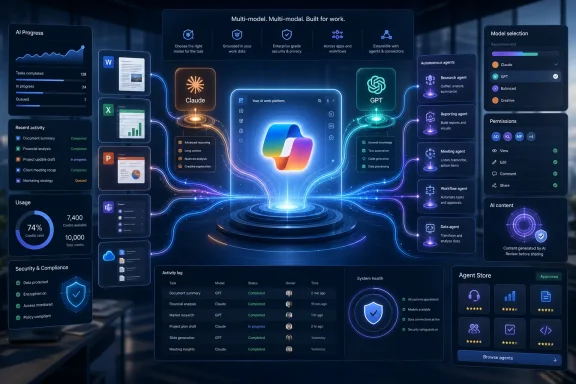
Microsoft’s July 2026 Copilot release wave marks a decisive shift from selling one branded assistant to operating a multi-model, agent-driven work platform. Across more than 40 changes in Microsoft 365 Copilot, the company added Anthropic’s Claude to Copilot Chat, expanded model choice in Copilot Cowork and PowerPoint, introduced AI-content watermarking, improved document and conversation navigation, strengthened Agent Builder, and launched permanent Copilot bundles for small businesses. The cumulative message is more important than any individual feature: Microsoft is prepared to surrender exclusive control over the model behind Copilot if doing so makes Microsoft 365 the preferred place where AI-assisted work happens.
Microsoft 365 Copilot began as a relatively straightforward proposition. Microsoft would combine large language models with Microsoft Graph data and familiar applications such as Word, Excel, PowerPoint, Outlook, and Teams, allowing users to generate content or ask questions without leaving their normal working environment.
That initial vision depended heavily on OpenAI technology and Microsoft’s substantial investment in the company. Although Microsoft consistently described Copilot as an orchestration system rather than a simple wrapper around one model, the product was widely perceived as the business-facing expression of the Microsoft–OpenAI partnership.
This evolution changes what customers should expect from the product. The important question is no longer simply, “Which model powers Copilot?” It is becoming, “Which combination of model, organizational data, permissions, tools, and runtime will complete this task most effectively?”
Microsoft calls its organizational context layer Work IQ. That layer is strategically significant because it can ground different underlying models in the same files, meetings, email, chats, people data, and business information, subject to the user’s existing permissions.
July brought the broader consolidation of those changes, including the July 1 release notes, the arrival of Claude Sonnet 5 in Cowork and PowerPoint on July 2, and another release-note wave on July 15. The result is a large, interconnected product update rather than a single launch-day package.
Users can select Claude for a particular task and then return to Microsoft’s default Copilot models when another request calls for different strengths. Model choice happens within the workflow rather than during account creation, reducing the pressure to commit an entire organization to one AI provider.
That creates both flexibility and complexity. A well-trained user may obtain better results by matching a model to a task, while an inexperienced user may spend time switching models without understanding why the outputs differ.
Microsoft can reduce that burden through intelligent routing. Its long-term opportunity is to let users specify the desired outcome while Copilot chooses the model automatically according to quality, latency, cost, organizational policy, and data-governance requirements.
No provider is likely to lead every category simultaneously. One model may excel at coding, another at long-context analysis, another at real-time conversational work, and another at low-cost document processing.
If a customer wants Claude, Microsoft would rather deliver Claude inside Microsoft 365 than force that customer to conduct sensitive work in a separate service. The company can preserve the value of its platform even when another vendor supplies the intelligence used for a particular request.
This resembles Microsoft’s broader cloud strategy. Azure succeeded partly because it supported technologies Microsoft did not own, including Linux, open-source databases, and competing development frameworks. Copilot is beginning to follow the same playbook.
The change does, however, make the relationship less exclusive at the product level. OpenAI models must now compete for workloads inside an interface Microsoft controls, while Microsoft gains negotiating leverage and reduces dependence on any single supplier.
For customers, that is generally healthy. Model competition can improve quality, reduce cost, encourage faster innovation, and lower the operational risk created by tying every AI workflow to one provider.
Cowork reached general availability on June 16, 2026, rather than first launching in July. Its significance nevertheless dominates Microsoft’s July Copilot story because the latest interface, model, billing, plugin, security, and administrative changes determine how organizations will use it at scale.
A user might ask Chat to identify problems in a project plan. Cowork can potentially inspect the relevant project documents, review conversations and meetings, assemble findings, produce a revised artifact, and report the steps it completed.
The typical Cowork process is:
Cloud execution also centralizes governance. Files do not need to be copied into a locally running autonomous agent, and the service can enforce tenant policies around identity, data access, auditing, and retention.
The tradeoff is that users must become comfortable with an AI service operating for longer periods and invoking multiple tools. Organizations will need clear approval boundaries, especially when tasks involve external communication, document changes, financial information, or customer records.
Microsoft is also bringing other frontier models into the Cowork environment, including GPT variants offered through its early-access Frontier program. A Microsoft-developed Cowork model is intended to address routine workloads at a lower cost.
Microsoft’s direction suggests three broad model categories:
Real-world results will vary according to prompt complexity, retrieved data, plugins, runtime, and the number of steps performed. Administrators should treat vendor benchmarks as a starting hypothesis, not as a substitute for testing representative tasks in their own tenants.
This hybrid model reflects the economics of autonomous or semi-autonomous AI. A two-minute chat response does not consume the same resources as a task that spends an hour retrieving files, reasoning across documents, invoking plugins, and creating multiple deliverables.
Microsoft has introduced controls intended to prevent agent costs from becoming unbounded:
A better evaluation compares the total cost of the agentic workflow with the human time, delay, error rate, and opportunity cost it replaces. Some tasks will justify premium model usage because they compress days of skilled work; others will remain cheaper and safer to perform manually.
The Microsoft 365 Copilot app now provides a clearer transition between Chat and Cowork. Users can begin by discussing a task and then move into Cowork when they are ready to delegate execution.
A smoother Chat-to-Cowork transition preserves that mental flow. It also helps Microsoft present Cowork as an advanced mode of Copilot rather than another standalone product employees must discover and learn.
Cowork supplies progress information, step-level activity, artifact previews, feedback controls, and the ability to cancel a task. These elements provide visibility into work that would otherwise take place behind an opaque loading indicator.
Word’s Copilot experience can make direct edits by default, although users can disable that behavior. Copilot-generated modifications remain reviewable and reversible, which is critical when AI moves from suggesting text to changing the working document itself.
The design challenge is to preserve a clear distinction between original content, AI proposals, and accepted edits. Convenience should not make it difficult to determine who changed a document or why.
This is primarily a transparency mechanism. It signals that media has been created or modified using AI, helping recipients assess its origin and reducing the chance that synthetic material will be mistaken for an untouched recording.
Watermarking can also support policy enforcement. Organizations may require labels on synthetic media used in marketing, recruitment, customer communications, or regulated workflows.
The feature offers several practical benefits:
Organizations should therefore avoid treating watermark presence as definitive proof of authenticity or treating watermark absence as proof that content is human-made. Durable provenance will require stronger metadata, signing, chain-of-custody mechanisms, and verification tools that survive common transformations.
The policy is still worthwhile. Transparency controls do not need to be tamper-proof to improve normal behavior, but they must not be oversold as protection against determined attackers.
An administrator reviews and approves the submission through the Microsoft 365 Admin Center before colleagues can discover and install it. This closes an important gap between building a useful agent and safely distributing it across a company.
The approval workflow allows administrators or designated reviewers to examine an agent before broad release. Review should cover its owner, purpose, underlying model, knowledge sources, permissions, instructions, connectors, expected users, support process, and data-handling behavior.
Microsoft has also introduced policy-based lifecycle features that can install approved first-party agents at scale and reassign agents whose original owners leave or change roles. These controls address a mundane but serious enterprise problem: abandoned automation can continue operating long after the person who understood it has disappeared.
This makes lightweight agents substantially more useful, but it increases the importance of permission hygiene. An agent usually does not create a new access problem by itself; it magnifies existing access because it can find and summarize information faster than a person.
Before expanding agent deployment, administrators should review overshared SharePoint sites, broadly accessible Teams channels, stale groups, public links, and sensitive files without appropriate labels. AI can turn years of neglected information architecture into an immediate discovery risk.
The target market is small and medium-sized organizations that may lack the licensing specialists, AI procurement teams, and deployment resources available to large enterprises. A combined offering simplifies purchasing and makes Copilot feel like part of the standard Microsoft 365 stack.
A Microsoft 365 bundle offers a more coherent alternative. Identity, applications, cloud storage, security controls, and AI access can be managed within the same environment.
Business Premium is particularly relevant for companies seeking stronger device, identity, and security management alongside Copilot. Business Standard offers a less security-intensive entry point for organizations primarily focused on productivity applications and collaboration.
Small businesses should complete several steps before broad deployment:
This reduces the attraction of unmanaged AI services, at least in theory. Employees can access Claude and GPT-class capabilities without creating separate accounts or manually transferring business documents into external chat interfaces.
Sensitivity labels can be inherited and displayed across the workflow. Data Loss Prevention coverage is expected to continue expanding, but organizations must verify the exact state of each control in their own tenant and region before relying on it.
The strongest enterprise value comes from continuity. A generated document should not fall outside governance merely because an AI agent created it, and an agent’s conversation history should not become invisible to authorized compliance teams.
Several new roles may emerge:
Model choice could eventually become a standard expectation. Users may come to view an AI assistant as a shell that provides access to several engines rather than as a single, fixed personality.
However, the brand “Copilot” becomes less technically specific. Two users can ask the same question in the same application and receive different results because they selected different models, used different organizational context, or had different permissions.
Support teams and documentation writers must become more precise. Reproducing a result may require recording the model, mode, prompt, attached files, data sources, agent configuration, and date of execution.
Cowork’s browser-use capability through Edge is especially notable. An agent that can browse under existing enterprise browser policies may automate workflows that span Microsoft 365 and web applications, although local browser interaction also expands the surface area administrators must evaluate.
That shifts competition away from benchmark scores alone. The winning platform may be the one that best connects models to business data, applications, permissions, and actions while keeping deployment manageable.
Anthropic still benefits because Claude gains exposure to Microsoft 365 users. Microsoft benefits because demand for Claude no longer automatically pulls work away from Copilot.
OpenAI faces a more complicated position. Its models remain deeply integrated into Microsoft’s stack, but ChatGPT must increasingly differentiate through its own interface, research features, agents, ecosystem, and direct customer relationship.
Microsoft’s response is openness. Rather than claiming that one in-house model is universally best, it can position Copilot as the neutral workplace where customers use whichever intelligence fits the task.
That neutrality has limits because Microsoft controls which models appear, how they are priced, and how requests are routed. Nevertheless, visible user choice is a meaningful competitive distinction.
Automatic routing will therefore be one of the most important areas to watch. Microsoft already has the ingredients to evaluate task type, data sensitivity, latency requirements, model cost, and administrator policy before selecting an engine.
A specialized Microsoft model could handle predictable tasks while Claude and advanced GPT models address harder requests. That would give Microsoft tighter control over costs and reduce its exposure to external model pricing.
The feature will need strict safeguards. Administrators should watch for controls covering allowed sites, credential use, transaction approval, form submission, downloads, external communication, and actions with legal or financial consequences.
The plugin catalog is also expanding across productivity, finance, data, content, and industry services. Each addition increases Cowork’s utility while reinforcing the need for a formal connector-review process.
Adoption statistics alone will not be sufficient. The decisive metrics will include task success, human correction time, error rates, business outcomes, security incidents, total consumption, and the cost of operating the governance layer around the system.
Microsoft’s July 2026 Copilot updates reveal a company increasingly comfortable competing at the platform level rather than defending exclusive ownership of the intelligence underneath it. Claude integration, Copilot Cowork, governed agent distribution, AI-content watermarking, improved document workflows, and small-business bundles collectively turn Copilot into a multi-model operating environment for work. If Microsoft can control cost, preserve permissions, make agent actions understandable, and keep model selection from overwhelming users, its willingness to let rival AI systems operate inside Microsoft 365 may become one of Copilot’s strongest advantages rather than a concession.
 Background
Microsoft 365 Copilot began as a relatively straightforward proposition. Microsoft would combine large language models with Microsoft Graph data and familiar applications such as Word, Excel, PowerPoint, Outlook, and Teams, allowing users to generate content or ask questions without leaving their normal working environment.That initial vision depended heavily on OpenAI technology and Microsoft’s substantial investment in the company. Although Microsoft consistently described Copilot as an orchestration system rather than a simple wrapper around one model, the product was widely perceived as the business-facing expression of the Microsoft–OpenAI partnership.
From assistant to orchestration layer
Copilot has gradually moved beyond the traditional chatbot pattern. Instead of merely responding to prompts, it can retrieve organizational context, generate Office documents, edit existing content, invoke tools, connect to business systems, and run multistep workflows.This evolution changes what customers should expect from the product. The important question is no longer simply, “Which model powers Copilot?” It is becoming, “Which combination of model, organizational data, permissions, tools, and runtime will complete this task most effectively?”
Microsoft calls its organizational context layer Work IQ. That layer is strategically significant because it can ground different underlying models in the same files, meetings, email, chats, people data, and business information, subject to the user’s existing permissions.
The July release window needs clarification
Although the updates are being discussed collectively as Microsoft’s July 2026 Copilot wave, not every headline feature first became available in July. Claude entered Microsoft 365 Copilot Chat in the June 16 release cycle, while Copilot Cowork reached general availability worldwide on June 16 after a three-month Frontier preview.July brought the broader consolidation of those changes, including the July 1 release notes, the arrival of Claude Sonnet 5 in Cowork and PowerPoint on July 2, and another release-note wave on July 15. The result is a large, interconnected product update rather than a single launch-day package.
Claude Arrives in Microsoft 365 Copilot Chat
The most strategically important change is the addition of Anthropic’s Claude as a selectable model in Microsoft 365 Copilot Chat. Microsoft specifically positions Claude for complex analysis, long-document understanding, multistep planning, and highly structured content generation.Users can select Claude for a particular task and then return to Microsoft’s default Copilot models when another request calls for different strengths. Model choice happens within the workflow rather than during account creation, reducing the pressure to commit an entire organization to one AI provider.
What users can do with Claude
The initial use cases promoted for Claude are deliberately practical:- Users can analyze long reports, policies, contracts, and technical documents.
- Teams can ask Claude to decompose complicated subjects into structured explanations.
- Employees can request multistage plans, detailed outlines, or organized business deliverables.
- Writers can use the model for content where structure, consistency, and document-wide context matter.
- Analysts can compare information distributed across several files without manually consolidating every passage first.
Model selection becomes a user skill
The model picker introduces a new productivity discipline. Employees will need to learn not only how to write prompts, but also when a faster model, a deeper reasoning model, or a document-oriented model is appropriate.That creates both flexibility and complexity. A well-trained user may obtain better results by matching a model to a task, while an inexperienced user may spend time switching models without understanding why the outputs differ.
Microsoft can reduce that burden through intelligent routing. Its long-term opportunity is to let users specify the desired outcome while Copilot chooses the model automatically according to quality, latency, cost, organizational policy, and data-governance requirements.
Why Microsoft Is Embracing a Rival Model
Microsoft did not develop Claude and does not control Anthropic. Licensing and integrating the model therefore represents more than a routine feature addition; it is an acknowledgment that enterprise AI will not be a single-model market.No provider is likely to lead every category simultaneously. One model may excel at coding, another at long-context analysis, another at real-time conversational work, and another at low-cost document processing.
The platform is more valuable than model exclusivity
Microsoft’s competitive advantage increasingly rests above the model layer. It controls the productivity applications, identity systems, access permissions, document repositories, compliance tools, administrative consoles, and business workflows used by millions of organizations.If a customer wants Claude, Microsoft would rather deliver Claude inside Microsoft 365 than force that customer to conduct sensitive work in a separate service. The company can preserve the value of its platform even when another vendor supplies the intelligence used for a particular request.
This resembles Microsoft’s broader cloud strategy. Azure succeeded partly because it supported technologies Microsoft did not own, including Linux, open-source databases, and competing development frameworks. Copilot is beginning to follow the same playbook.
Implications for OpenAI
Claude’s arrival does not mean Microsoft is abandoning OpenAI. Copilot continues to use OpenAI models, and Microsoft has expanded access to newer GPT systems across its productivity products.The change does, however, make the relationship less exclusive at the product level. OpenAI models must now compete for workloads inside an interface Microsoft controls, while Microsoft gains negotiating leverage and reduces dependence on any single supplier.
For customers, that is generally healthy. Model competition can improve quality, reduce cost, encourage faster innovation, and lower the operational risk created by tying every AI workflow to one provider.
Copilot Cowork Moves from Chat to Execution
Copilot Cowork is the largest functional expansion in the release wave. It is designed for long-running, multistep tasks that combine reasoning, organizational context, file manipulation, tool use, and business actions.Cowork reached general availability on June 16, 2026, rather than first launching in July. Its significance nevertheless dominates Microsoft’s July Copilot story because the latest interface, model, billing, plugin, security, and administrative changes determine how organizations will use it at scale.
How Cowork differs from Copilot Chat
Copilot Chat generally answers questions, generates drafts, and helps users reason through a task. Cowork is intended to continue beyond the recommendation stage and perform the work required to produce a completed result.A user might ask Chat to identify problems in a project plan. Cowork can potentially inspect the relevant project documents, review conversations and meetings, assemble findings, produce a revised artifact, and report the steps it completed.
The typical Cowork process is:
- The user describes an outcome rather than providing every individual instruction.
- Cowork creates a plan and identifies the data, tools, and models it expects to use.
- The service retrieves permitted Microsoft 365 context through Work IQ.
- It executes the task over time, displaying progress and a step-by-step activity log.
- The user reviews the resulting artifact, intervenes when required, or cancels the operation.
- The completed output remains subject to Microsoft 365 retention, discovery, labeling, and sharing controls.
Cloud execution matters
Cowork tasks run in the cloud, so they can continue when the user’s Windows PC is closed or disconnected. That makes the system suitable for workloads that require more time than an ordinary interactive prompt.Cloud execution also centralizes governance. Files do not need to be copied into a locally running autonomous agent, and the service can enforce tenant policies around identity, data access, auditing, and retention.
The tradeoff is that users must become comfortable with an AI service operating for longer periods and invoking multiple tools. Organizations will need clear approval boundaries, especially when tasks involve external communication, document changes, financial information, or customer records.
Claude Models Inside Copilot Cowork
Claude is not limited to ordinary Copilot Chat. At general availability, Cowork supported Anthropic models including Claude Opus 4.8, with Claude Sonnet 5 subsequently introduced as a more efficient option for everyday agentic tasks.Microsoft is also bringing other frontier models into the Cowork environment, including GPT variants offered through its early-access Frontier program. A Microsoft-developed Cowork model is intended to address routine workloads at a lower cost.
Matching capability to workload
The model selector gives organizations a direct way to balance capability and expense. A demanding research or synthesis task may justify a premium model, while repetitive document processing may be more economical on a smaller or more specialized system.Microsoft’s direction suggests three broad model categories:
- Frontier reasoning models are appropriate for complex planning, ambiguity, and difficult analytical work.
- Efficient general-purpose models are better suited to frequent workplace tasks where latency and cost matter.
- Specialized or post-trained models can handle predictable Copilot workflows without paying for unnecessary general intelligence.
A practical benchmark requires caution
Microsoft has said its internal testing found Copilot Cowork to be approximately 30 to 40 percent cheaper per prompt than Anthropic’s Claude Cowork when both used comparable Microsoft 365 connectivity and the same Opus-class model. That finding deserves scrutiny because Microsoft conducted the comparison and calculated the costs using its own workload design and internal logs.Real-world results will vary according to prompt complexity, retrieved data, plugins, runtime, and the number of steps performed. Administrators should treat vendor benchmarks as a starting hypothesis, not as a substitute for testing representative tasks in their own tenants.
The New Economics of Agentic Work
A traditional Microsoft 365 Copilot subscription provides a predictable per-user cost for Chat, application integration, Work IQ, Microsoft agents, and Agent Builder. Cowork adds usage-based charges for the agentic tasks it performs.This hybrid model reflects the economics of autonomous or semi-autonomous AI. A two-minute chat response does not consume the same resources as a task that spends an hour retrieving files, reasoning across documents, invoking plugins, and creating multiple deliverables.
Copilot Credits and administrative controls
Cowork consumption is denominated in Copilot Credits. Microsoft’s pay-as-you-go option prices credits at one cent each, while committed-capacity arrangements can provide discounts for organizations prepared to forecast usage.Microsoft has introduced controls intended to prevent agent costs from becoming unbounded:
- Administrators can keep Cowork disabled until the organization is ready.
- Access can be assigned to selected users or groups rather than the entire tenant.
- Spending limits can be configured at tenant, group, and user levels.
- Alerts can notify designated personnel when usage reaches defined thresholds.
- Users can request additional credits when a task exceeds their allocation.
- Reports can break down consumption by feature, group, and user.
- Task-level pricing visibility is designed to show employees the cost of individual operations.
Measuring value rather than activity
Organizations should avoid treating the number of completed Cowork tasks as proof of success. High consumption could indicate valuable automation, but it could also reveal inefficient prompts, duplicated work, poor retrieval, or employees delegating low-value tasks to expensive models.A better evaluation compares the total cost of the agentic workflow with the human time, delay, error rate, and opportunity cost it replaces. Some tasks will justify premium model usage because they compress days of skilled work; others will remain cheaper and safer to perform manually.
Interface and Document Workflow Improvements
The July update wave is not limited to models and agents. Microsoft is also reducing the navigational friction that can make AI features feel separate from the documents and conversations users are trying to understand.The Microsoft 365 Copilot app now provides a clearer transition between Chat and Cowork. Users can begin by discussing a task and then move into Cowork when they are ready to delegate execution.
Better continuity between conversation and action
This interface direction matters because users do not naturally divide work into “chat tasks” and “agent tasks.” A person may start by asking for an explanation, refine the objective through several messages, and only then decide that Copilot should create or modify an artifact.A smoother Chat-to-Cowork transition preserves that mental flow. It also helps Microsoft present Cowork as an advanced mode of Copilot rather than another standalone product employees must discover and learn.
Cowork supplies progress information, step-level activity, artifact previews, feedback controls, and the ability to cancel a task. These elements provide visibility into work that would otherwise take place behind an opaque loading indicator.
Document access becomes more direct
Recent Copilot changes also bring documents closer to the conversation. PDFs can open within Copilot Chat instead of forcing users into a separate viewer, while generated content is increasingly collected in a centralized Library.Word’s Copilot experience can make direct edits by default, although users can disable that behavior. Copilot-generated modifications remain reviewable and reversible, which is critical when AI moves from suggesting text to changing the working document itself.
The design challenge is to preserve a clear distinction between original content, AI proposals, and accepted edits. Convenience should not make it difficult to determine who changed a document or why.
AI Watermarking and Content Transparency
Microsoft has added an administrative policy that can place visual or audio watermarks on video and audio generated or altered by AI in Microsoft 365. The feature is available across Android, Windows, iOS, macOS, and the web, subject to organizational policy and rollout status.This is primarily a transparency mechanism. It signals that media has been created or modified using AI, helping recipients assess its origin and reducing the chance that synthetic material will be mistaken for an untouched recording.
What watermarking can accomplish
Visible and audible labels can improve internal communication norms. A training video, product mock-up, synthetic voiceover, or executive presentation can carry an immediate indication that AI contributed to the material.Watermarking can also support policy enforcement. Organizations may require labels on synthetic media used in marketing, recruitment, customer communications, or regulated workflows.
The feature offers several practical benefits:
- It creates a consistent disclosure method across Microsoft 365.
- It gives administrators centralized control instead of relying on each employee to add a label manually.
- It helps recipients distinguish synthetic or altered media from conventional recordings.
- It supports organizational rules around responsible AI use.
- It can reduce accidental misrepresentation when generated content is shared outside its original context.
What watermarking cannot accomplish
A watermark is not a cryptographic guarantee. A visible mark may be cropped, an audio signal may be removed, and content may be re-encoded, recorded, or processed through another application.Organizations should therefore avoid treating watermark presence as definitive proof of authenticity or treating watermark absence as proof that content is human-made. Durable provenance will require stronger metadata, signing, chain-of-custody mechanisms, and verification tools that survive common transformations.
The policy is still worthwhile. Transparency controls do not need to be tamper-proof to improve normal behavior, but they must not be oversold as protection against determined attackers.
Agent Builder Becomes an Internal Distribution Platform
Microsoft is expanding Agent Builder from a personal creation tool into a governed enterprise distribution system. Customers can now submit agents created in Agent Builder for inclusion in the Agent Store’s “Built by your org” area.An administrator reviews and approves the submission through the Microsoft 365 Admin Center before colleagues can discover and install it. This closes an important gap between building a useful agent and safely distributing it across a company.
Governance before discoverability
Without a managed publication process, organizations risk accumulating private agents of unknown quality, duplicated purpose, and unclear ownership. Employees may build slightly different assistants for the same department, each using different instructions and data sources.The approval workflow allows administrators or designated reviewers to examine an agent before broad release. Review should cover its owner, purpose, underlying model, knowledge sources, permissions, instructions, connectors, expected users, support process, and data-handling behavior.
Microsoft has also introduced policy-based lifecycle features that can install approved first-party agents at scale and reassign agents whose original owners leave or change roles. These controls address a mundane but serious enterprise problem: abandoned automation can continue operating long after the person who understood it has disappeared.
Richer organizational grounding
Declarative agents can draw on mail, people information, Teams conversations, meeting transcripts, and other Microsoft 365 sources. They can also generate Word documents, Excel workbooks, and PowerPoint presentations, saving the resulting files to OneDrive.This makes lightweight agents substantially more useful, but it increases the importance of permission hygiene. An agent usually does not create a new access problem by itself; it magnifies existing access because it can find and summarize information faster than a person.
Before expanding agent deployment, administrators should review overshared SharePoint sites, broadly accessible Teams channels, stale groups, public links, and sensitive files without appropriate labels. AI can turn years of neglected information architecture into an immediate discovery risk.
Microsoft 365 Business with Copilot
On July 1, Microsoft introduced permanent Microsoft 365 Business Standard with Copilot and Microsoft 365 Business Premium with Copilot subscriptions. These packages combine the existing business productivity suites with Copilot in a unified SKU.The target market is small and medium-sized organizations that may lack the licensing specialists, AI procurement teams, and deployment resources available to large enterprises. A combined offering simplifies purchasing and makes Copilot feel like part of the standard Microsoft 365 stack.
Why bundling matters
Small businesses often adopt AI through scattered consumer accounts because those services are easy to buy. That can create fragmented billing, inconsistent security, uncertain data handling, and little control over which company information employees upload.A Microsoft 365 bundle offers a more coherent alternative. Identity, applications, cloud storage, security controls, and AI access can be managed within the same environment.
Business Premium is particularly relevant for companies seeking stronger device, identity, and security management alongside Copilot. Business Standard offers a less security-intensive entry point for organizations primarily focused on productivity applications and collaboration.
Deployment is still not automatic
Simplified licensing does not eliminate the work required for safe adoption. A ten-person company can have the same fundamental data-governance problems as a multinational corporation, even if it has fewer documents and users.Small businesses should complete several steps before broad deployment:
- Review who can access sensitive SharePoint, OneDrive, and Teams content.
- Remove obsolete sharing links and inactive external accounts.
- Define which information employees may use with Copilot.
- Pilot the service with a small group and representative workflows.
- Train users to verify outputs and recognize sensitive material.
- Monitor adoption, cost, and unexpected data exposure.
- Expand access only after the organization has established support and accountability.
Enterprise Impact
For large organizations, July’s updates turn Copilot into a more credible control plane for enterprise AI. Multiple models, managed agents, Work IQ grounding, compliance integration, and usage controls can be administered within a familiar Microsoft environment.This reduces the attraction of unmanaged AI services, at least in theory. Employees can access Claude and GPT-class capabilities without creating separate accounts or manually transferring business documents into external chat interfaces.
Security and compliance continuity
Microsoft says Cowork prompts, responses, and generated artifacts operate within the Microsoft 365 trust boundary. Relevant data can flow through auditing, eDiscovery, retention, insider-risk, communication-compliance, and data-security controls.Sensitivity labels can be inherited and displayed across the workflow. Data Loss Prevention coverage is expected to continue expanding, but organizations must verify the exact state of each control in their own tenant and region before relying on it.
The strongest enterprise value comes from continuity. A generated document should not fall outside governance merely because an AI agent created it, and an agent’s conversation history should not become invisible to authorized compliance teams.
New operational responsibilities
AI administration now extends beyond enabling or disabling Copilot. Enterprises must manage model availability, agent publication, plugin approval, consumption budgets, task logs, ownership, and acceptable autonomous actions.Several new roles may emerge:
- AI platform owners will define approved models and services.
- Security teams will evaluate connectors, plugins, and information exposure.
- Finance teams will monitor usage-based agent spending.
- Departmental owners will validate agent outputs and business value.
- Compliance teams will determine retention and disclosure requirements.
- Help desks will support model selection, failed tasks, and permission-related behavior.
Consumer and Individual User Impact
Most of the headline changes target commercial Microsoft 365 customers rather than ordinary Windows users with a free Copilot account. Even so, the broader direction will influence how Microsoft designs consumer AI experiences.Model choice could eventually become a standard expectation. Users may come to view an AI assistant as a shell that provides access to several engines rather than as a single, fixed personality.
More power, more ambiguity
Individual professionals gain practical flexibility from the model picker. A researcher can use Claude for a long document, switch to another model for a fast factual request, and use Cowork when the task requires action across several files.However, the brand “Copilot” becomes less technically specific. Two users can ask the same question in the same application and receive different results because they selected different models, used different organizational context, or had different permissions.
Support teams and documentation writers must become more precise. Reproducing a result may require recording the model, mode, prompt, attached files, data sources, agent configuration, and date of execution.
Windows remains the front door
On Windows, the Microsoft 365 Copilot app becomes an increasingly important access point for work-focused AI. Cross-platform availability remains central, but Windows offers Microsoft the closest integration with Edge, Office, identity, notifications, and enterprise device management.Cowork’s browser-use capability through Edge is especially notable. An agent that can browse under existing enterprise browser policies may automate workflows that span Microsoft 365 and web applications, although local browser interaction also expands the surface area administrators must evaluate.
Competitive Implications
Microsoft’s multi-model strategy places pressure on Google, OpenAI, Anthropic, and independent enterprise-AI vendors. The company is effectively arguing that customers do not need to choose between leading models if Microsoft 365 can provide governed access to several of them.That shifts competition away from benchmark scores alone. The winning platform may be the one that best connects models to business data, applications, permissions, and actions while keeping deployment manageable.
Pressure on standalone AI subscriptions
A standalone AI service must persuade businesses to add another account, another data boundary, another administrative console, and another integration layer. Microsoft can offer comparable model access inside software the customer already licenses.Anthropic still benefits because Claude gains exposure to Microsoft 365 users. Microsoft benefits because demand for Claude no longer automatically pulls work away from Copilot.
OpenAI faces a more complicated position. Its models remain deeply integrated into Microsoft’s stack, but ChatGPT must increasingly differentiate through its own interface, research features, agents, ecosystem, and direct customer relationship.
Google’s counterargument
Google can make a similar integration case through Gemini, Workspace, Chrome, Android, and Google Cloud. It also controls both the model and productivity platform more directly than Microsoft controls all of Copilot’s models.Microsoft’s response is openness. Rather than claiming that one in-house model is universally best, it can position Copilot as the neutral workplace where customers use whichever intelligence fits the task.
That neutrality has limits because Microsoft controls which models appear, how they are priced, and how requests are routed. Nevertheless, visible user choice is a meaningful competitive distinction.
Strengths and Opportunities
The July 2026 Copilot wave gives Microsoft several clear advantages as enterprise AI moves from experimentation into operational deployment.- Multi-model access reduces lock-in. Customers can use Claude and GPT-class systems without rebuilding their Microsoft 365 data connections for every provider.
- Work IQ increases platform stickiness. Microsoft’s context layer can make several models more useful by grounding them in permitted organizational information.
- Cowork expands Copilot from generation to execution. Long-running tasks create opportunities to automate workflows that ordinary chat cannot complete.
- Usage controls make agentic deployment more manageable. Budgets, limits, alerts, and reporting give administrators tools to contain unpredictable compute spending.
- Agent Store publishing encourages internal reuse. Governed distribution can turn successful departmental experiments into shared organizational capabilities.
- Watermarking establishes a baseline disclosure mechanism. The policy can improve transparency for AI-generated or altered media.
- Small-business bundles simplify procurement. Permanent Copilot SKUs reduce the licensing friction that can push smaller companies toward unmanaged consumer tools.
- Cross-platform support broadens adoption. Claude and watermarking are not restricted to Windows, helping organizations maintain a more consistent experience across devices.
Risks and Concerns
The same flexibility that makes Copilot more capable also makes it more difficult to govern, predict, and support.- Model choice can confuse users. Employees may not know which model to select or may assume one model is universally superior.
- Usage-based billing can produce unexpected costs. Long-running tasks, repeated retries, large context windows, and plugin calls can consume substantial credits.
- Agents amplify existing permission problems. Overshared files become easier to discover and synthesize when an agent can search across Microsoft 365 automatically.
- Third-party models complicate data assurance. Customers must understand Microsoft’s contractual, processing, retention, and regional arrangements for each model provider.
- Plugins expand the attack surface. Every external connector can introduce new permissions, dependencies, data flows, and failure modes.
- Watermarks can be removed. The feature improves ordinary disclosure but does not authenticate content against deliberate manipulation.
- Autonomous edits may reduce human attention. Users can accept document changes without understanding how Copilot reached its conclusions.
- Vendor benchmarks may not reflect customer workloads. Cost and quality claims require independent testing with realistic organizational data.
- Agent sprawl can become a governance burden. Poorly maintained or duplicative agents may outlive their owners and continue distributing outdated guidance.
- Model behavior can change over time. Updates may alter output style, accuracy, latency, or cost even when the visible Copilot interface remains the same.
What to Watch Next
Microsoft’s immediate challenge is to make multi-model Copilot feel simpler despite the additional machinery behind it. Users want better outcomes, not a daily lesson in model architecture.Automatic routing will therefore be one of the most important areas to watch. Microsoft already has the ingredients to evaluate task type, data sensitivity, latency requirements, model cost, and administrator policy before selecting an engine.
Cowork 1 and model economics
Microsoft’s planned Cowork 1 model could become strategically important if it performs routine workplace tasks at a materially lower cost. Premium frontier models are powerful, but enterprises will not use them indiscriminately if every workflow generates a significant variable bill.A specialized Microsoft model could handle predictable tasks while Claude and advanced GPT models address harder requests. That would give Microsoft tighter control over costs and reduce its exposure to external model pricing.
Browser actions and plugin expansion
Cowork’s Edge-based browser capability could open a much broader category of automation. Many business processes still require employees to move information between websites, internal portals, Microsoft 365, and legacy applications.The feature will need strict safeguards. Administrators should watch for controls covering allowed sites, credential use, transaction approval, form submission, downloads, external communication, and actions with legal or financial consequences.
The plugin catalog is also expanding across productivity, finance, data, content, and industry services. Each addition increases Cowork’s utility while reinforcing the need for a formal connector-review process.
Evidence of return on investment
Microsoft must prove that Cowork creates measurable value beyond impressive demonstrations. Customers will look for evidence that agents shorten cycle times, improve quality, reduce repetitive work, or enable employees to complete tasks that were previously impractical.Adoption statistics alone will not be sufficient. The decisive metrics will include task success, human correction time, error rates, business outcomes, security incidents, total consumption, and the cost of operating the governance layer around the system.
Microsoft’s July 2026 Copilot updates reveal a company increasingly comfortable competing at the platform level rather than defending exclusive ownership of the intelligence underneath it. Claude integration, Copilot Cowork, governed agent distribution, AI-content watermarking, improved document workflows, and small-business bundles collectively turn Copilot into a multi-model operating environment for work. If Microsoft can control cost, preserve permissions, make agent actions understandable, and keep model selection from overwhelming users, its willingness to let rival AI systems operate inside Microsoft 365 may become one of Copilot’s strongest advantages rather than a concession.
References
- Primary source: iNews Zoombangla
Published: 2026-07-22T12:41:51+00:00
Loading…
inews.zoombangla.com - Official source: microsoft.com
Copilot Cowork is now generally available | Microsoft 365 Blog
Copilot Cowork is now generally available worldwide, bringing secure, AI-powered automation for complex enterprise tasks in Microsoft 365.www.microsoft.com - Official source: learn.microsoft.com
What's new in Copilot Cowork | Microsoft Learn
Discover the latest features and improvements in Microsoft 365 Copilot Cowork.learn.microsoft.com - Official source: techcommunity.microsoft.com
Loading…
techcommunity.microsoft.com