

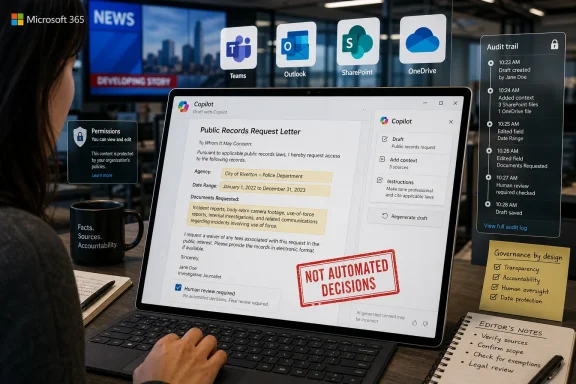
USA TODAY Network newsroom teams have built a Microsoft 365 Copilot-based agent, described by Microsoft on June 2, 2026, to help journalists draft and route public records requests from inside familiar workplace tools such as Teams, Outlook, SharePoint, and OneDrive. The news is not that a media company has found a flashy new use for generative AI. The news is that one of America’s best-known newspaper brands is putting AI into a deliberately narrow workflow where speed matters, mistakes matter more, and human accountability cannot be outsourced. That makes this less a story about automation than about what responsible newsroom software may look like when the hype cycle finally runs into a filing deadline.
For the last two years, newsrooms have been told that artificial intelligence will transform everything from headline writing to audience analytics to story discovery. Much of that pitch has been either too vague to evaluate or too dangerous to accept at face value. Journalism is a trust business, and trust does not survive long when a publication treats language generation as a substitute for reporting.
USA TODAY’s approach, as described in Microsoft’s customer story, is more interesting precisely because it is constrained. The agent is aimed at public records requests: the formal letters journalists send to government agencies to obtain documents, emails, contracts, databases, and other material that can prove or disprove a story. That is the kind of work that is essential to accountability journalism but often slow, repetitive, and easy to defer when reporters are already juggling breaking news, interviews, edits, and production demands.
This is the part of AI adoption that rarely photographs well. There is no robot reporter, no algorithmic front page, no grand claim that software now understands a community better than the people who live in it. Instead, the system tries to compress the administrative drag between a reporter’s question and the legal mechanism that might answer it.
That is a more credible model for AI in journalism than the broad, breathless claim that machines can “create content.” The value is not that AI writes journalism. The value is that it may help journalists get to the documents faster.
That makes records work a perfect candidate for assistance, but a poor candidate for full automation. A records request is not simply a template with names swapped in. It reflects a reporting theory: which agency is likely to hold the documents, what time frame matters, which exemptions might be invoked, and how much specificity will help rather than narrow the result into uselessness.
The Microsoft post quotes Thomas Elia of The Palm Beach Post describing the old burden in blunt terms: requests take time to compose, must be carefully written, and need to go to the right agency. He also describes the process as something that could consume an hour drafting a legal-style letter. Any local reporter who has tried to get a police department, school district, city hall, or public hospital to produce records will recognize the problem.
The hour matters. Local journalism is not operating with the fat staffing buffers of another era. When one administrative task can eat a meaningful portion of a reporter’s day, the task does not simply become annoying; it becomes a quiet tax on accountability.
That matters because enterprise software adoption is often decided by friction rather than ambition. A tool that requires journalists to stop, open a separate system, remember a new interface, paste material between windows, and then return to email is already losing. A tool that appears inside the existing workstream has a better chance of becoming a habit rather than a pilot project.
This is where Microsoft’s enterprise advantage becomes obvious. Copilot’s strongest argument has never been that it is the only AI capable of drafting text. It is that Microsoft already owns the digital office where much of the white-collar world spends its day. Outlook holds the message, Teams holds the conversation, SharePoint holds the institutional memory, OneDrive holds the working files, and Microsoft 365 identities determine who is allowed to see what.
For a newsroom, that integration cuts both ways. It can reduce tool-switching and make the agent useful faster. It also raises the governance stakes, because any AI system pointed at internal knowledge sources must respect permissions, retention policies, editorial sensitivity, and the basic newsroom norm that unpublished reporting material is not just another productivity artifact.
That is why the architecture is part of the story. USA TODAY is not simply “using AI.” It is testing whether the Microsoft 365 environment can become a controlled place for narrow, reviewable newsroom assistance.
That division of labor is the entire ethical hinge. The machine can help with mechanics: structure, phrasing, routing, perhaps reminders about standard request language or likely custodians. The journalist still has to know what they are trying to find and why it matters.
This distinction is easy to blur in AI marketing. “Drafting” sounds like writing, and writing sounds like journalism. But the newsroom value here is closer to paralegal scaffolding than authorship. A good records request is a means to obtain evidence; it is not the published work.
If the agent helps a reporter turn a vague lead into a sharper request, the newsroom gains time. If it creates a false sense of legal or factual certainty, the newsroom inherits risk. The difference depends on review, training, and whether the tool is treated as an assistant or an authority.
Microsoft’s post leans hard on that boundary. The quoted principle from USA TODAY’s side is that AI is a tool and is not in charge. That line may sound obvious, but in journalism it is not a decorative disclaimer. It is the minimum condition for legitimacy.
But it also exposes where the agent’s contribution ends. A public records request may produce documents, but documents do not call sources, confront officials, verify timelines, explain consequences, or find the affected family, employee, patient, parent, tenant, taxpayer, or voter. The reporting still happens after the file arrives.
That is why this example is healthier than the genre of AI newsroom experiments that begin with output volume. The point is not to generate more copy. The point is to remove one obstacle between a reporter and primary evidence.
For local and regional newsrooms, that distinction is existential. The industry does not need more synthetic summaries of public life. It needs more original reporting about school boards, police departments, courts, hospitals, zoning fights, contracts, budgets, and public officials who would prefer fewer questions.
If AI can help lower the effort required to ask those questions formally, it can be useful. If it becomes an excuse to publish more machine-shaped filler while cutting human reporters, it will do the opposite.
A public records request can be defective in several ways. It can ask the wrong agency. It can be too broad and invite delays or fees. It can be too narrow and miss the evidence. It can cite the wrong law or omit language that matters under a state statute. It can accidentally reveal more about a reporting inquiry than the journalist intended. It can even create legal or reputational problems if sent carelessly.
That means review cannot be ceremonial. The reporter or editor has to understand the request well enough to own it. If the request goes out under a journalist’s name, accountability goes with that name, not with Copilot, not with Microsoft, and not with the IT department that enabled the tool.
The encouraging part of the USA TODAY example is that the described workflow preserves that final human act. The journalist reviews, edits, and sends. The less encouraging industry context is that many organizations under cost pressure will always be tempted to turn assistance into substitution.
That is where newsroom leadership matters. Responsible AI policy is not a poster on a wall. It is a set of choices about where automation is allowed to touch the work, where it is forbidden, and who is answerable when something goes wrong.
The ingredients are familiar to any Microsoft 365 administrator. Identity, permissions, SharePoint content, OneDrive files, Outlook workflows, Teams collaboration, and Copilot agents are being presented as a platform for task-specific automation. The newsroom is just the case study; the enterprise pattern is much larger.
That pattern creates an uncomfortable but necessary conversation for IT departments. The more useful an agent becomes, the more it needs access to internal context. The more context it can access, the more important it becomes to govern permissions, sensitivity labels, logging, data loss prevention, retention, and user training.
In other words, the AI project is never just an AI project. It is an information architecture audit wearing a futuristic badge.
A newsroom that points an agent at sensitive internal material has to know whether the right people can access that material in the first place. So does a hospital, a law firm, a school district, a manufacturer, or a city government. Copilot does not magically fix messy permissions; it can make the consequences of messy permissions more visible and more painful.
Low-code agent building is attractive because process experts can shape tools close to the work. A newsroom product manager, operations lead, or technically minded editor may understand the public records workflow better than a central software team. Give that person a manageable builder, and the organization can experiment quickly.
But low-code does not eliminate the need for high-discipline governance. In fact, it may increase it. When more people can build agents, more people can accidentally connect the wrong knowledge source, expose sensitive information, create brittle workflows, or deploy tools whose outputs sound more authoritative than they are.
This is the same lesson enterprises learned with spreadsheets, Access databases, SharePoint lists, Power Automate flows, and every other wave of democratized software creation. The tools that empower departments also create shadow systems. AI agents add a new layer because they do not merely store or route information; they generate language and recommendations that users may over-trust.
The right lesson is not to ban low-code agents. It is to treat them as production systems once they influence real work. If an agent helps send public records requests, approve invoices, summarize HR cases, triage security incidents, or answer customer complaints, it deserves lifecycle management rather than casual enthusiasm.
This is the pattern other organizations should study. Find a workflow where skilled employees lose time to repeatable mechanics, but where judgment still clearly belongs to the human. Build assistance around the bottleneck. Keep the output reviewable. Measure whether the work improves in real terms.
Public records requests are especially well suited because they have semi-standard forms, recurring legal language, known destinations, and high value when done well. But the same logic applies to other domains: incident summaries, contract intake, grant applications, compliance evidence gathering, procurement questions, internal policy navigation, and customer escalation preparation.
The trap is to generalize too quickly. An agent that helps draft a request for public documents is not evidence that an agent should write published articles, conduct interviews, or decide what a community needs to know. Narrow success does not confer universal authority.
That may be the central discipline of the next phase of AI adoption. Organizations will need to become better at saying, “This works here,” without pretending that “here” means everywhere.
In that context, any AI tool arrives with two meanings. The first is the official one: a productivity aid that reduces drudgery. The second is the labor-market fear: another step toward replacing people or devaluing their craft.
The USA TODAY example does not erase that tension. It does, however, suggest a more defensible boundary. Using AI to help reporters file more records requests is not the same as using AI to generate local news articles at scale. One aims to increase the supply of evidence available to human reporters. The other risks flooding the public sphere with cheap text detached from lived reporting.
News organizations should be judged by which side of that line they invest in. Tools that help reporters investigate, verify, organize, translate, transcribe, search, and access documents can strengthen journalism if governed well. Tools that replace reporting with plausible prose weaken it, even when the prose is grammatically tidy.
The public does not need newsrooms to be anti-technology. It needs them to be pro-accountability.
How often does the agent produce a request that needs substantial correction? How does the newsroom track errors or near misses? Are there state-by-state legal variations built into the system? Who updates the knowledge base when public records law changes or when an agency’s routing practice shifts? What happens when a request concerns sensitive reporting, confidential sources, or potential litigation?
Those are not objections to the project. They are the operational questions that determine whether the project matures.
The same is true for any Microsoft 365 Copilot deployment in serious work. Initial demos tend to focus on time saved. Mature deployments have to focus on reliability, governance, auditability, and the situations where the tool should stay silent. The difference between novelty and infrastructure is the ability to survive edge cases.
Newsrooms are particularly useful test beds because their errors are public and reputationally expensive. If an AI-assisted workflow breaks trust, the damage does not stay inside a quarterly productivity report. It becomes part of the publication’s relationship with readers.
That pressure may make journalism a better proving ground for responsible AI than industries where failures can be hidden behind internal dashboards.
The front-page anecdote from Newsquest points toward a better standard. Did the tool help produce work that mattered? Did it make a meaningful story more likely to happen? Did it free skilled people to do the parts of the job that only skilled people can do?
For journalism, that means more records obtained, more officials questioned, more claims verified, more communities served, and more stories grounded in primary evidence. For an IT department, it might mean fewer unresolved tickets, faster incident response, cleaner compliance packages, or more accurate internal knowledge retrieval. The metric has to be tied to the mission.
This is where many AI programs will fail. They will show activity without proving impact. They will demonstrate that workers can ask the system questions without proving that the answers improved decisions. They will report adoption without measuring whether the underlying work became better.
USA TODAY’s records-request agent is a reminder that the boring metric may be the important one. If a reporter files a stronger request sooner and that request leads to a document-backed story, the AI contribution is real even if the software never produces a publishable sentence.
That is a powerful proposition because it meets enterprises where they already are. It is also a lock-in proposition, because the more workflows an organization builds around Microsoft 365 agents, the more deeply Microsoft becomes embedded in daily operations. For many IT leaders, both statements will be true at once.
The USA TODAY case shows why customers may accept that bargain. If the work happens in Outlook, Teams, SharePoint, and OneDrive already, the path of least resistance is to add intelligence there rather than introduce a parallel AI stack. The appeal is not theoretical elegance. It is operational convenience.
But convenience is not neutrality. Choosing the Microsoft stack for AI workflows means accepting Microsoft’s security model, admin controls, licensing structure, product roadmap, and pace of change. It also means training users to understand where Copilot ends and organizational responsibility begins.
That may be fine. It may even be the most practical answer for many organizations. But it should be understood as a strategic platform decision, not merely a feature rollout.
That lesson travels well beyond journalism, but only if organizations copy the discipline rather than the slogan. The win is not “AI in the newsroom.” The win is a carefully bounded agent inside a workflow where speed, institutional knowledge, and human review can reinforce each other.
 The AI Story Here Is Smaller Than the Hype, and That Is Why It Matters
For the last two years, newsrooms have been told that artificial intelligence will transform everything from headline writing to audience analytics to story discovery. Much of that pitch has been either too vague to evaluate or too dangerous to accept at face value. Journalism is a trust business, and trust does not survive long when a publication treats language generation as a substitute for reporting.USA TODAY’s approach, as described in Microsoft’s customer story, is more interesting precisely because it is constrained. The agent is aimed at public records requests: the formal letters journalists send to government agencies to obtain documents, emails, contracts, databases, and other material that can prove or disprove a story. That is the kind of work that is essential to accountability journalism but often slow, repetitive, and easy to defer when reporters are already juggling breaking news, interviews, edits, and production demands.
This is the part of AI adoption that rarely photographs well. There is no robot reporter, no algorithmic front page, no grand claim that software now understands a community better than the people who live in it. Instead, the system tries to compress the administrative drag between a reporter’s question and the legal mechanism that might answer it.
That is a more credible model for AI in journalism than the broad, breathless claim that machines can “create content.” The value is not that AI writes journalism. The value is that it may help journalists get to the documents faster.
Public Records Work Is the Unsexy Machinery of Accountability
Public records requests sit at the awkward intersection of civic principle and bureaucratic endurance. In the United States, federal Freedom of Information Act requests and state-level open-records laws are supposed to give the public access to government information. In practice, a useful request has to be precise enough to survive agency pushback, broad enough to capture relevant material, and routed to the right office before the clock even starts.That makes records work a perfect candidate for assistance, but a poor candidate for full automation. A records request is not simply a template with names swapped in. It reflects a reporting theory: which agency is likely to hold the documents, what time frame matters, which exemptions might be invoked, and how much specificity will help rather than narrow the result into uselessness.
The Microsoft post quotes Thomas Elia of The Palm Beach Post describing the old burden in blunt terms: requests take time to compose, must be carefully written, and need to go to the right agency. He also describes the process as something that could consume an hour drafting a legal-style letter. Any local reporter who has tried to get a police department, school district, city hall, or public hospital to produce records will recognize the problem.
The hour matters. Local journalism is not operating with the fat staffing buffers of another era. When one administrative task can eat a meaningful portion of a reporter’s day, the task does not simply become annoying; it becomes a quiet tax on accountability.
Microsoft’s Pitch Is Really About Workflow Gravity
The practical detail in the USA TODAY case is not merely that an AI agent exists. It is where the agent lives. Microsoft says the experience fits into the tools journalists already use, including Teams and Outlook, and can draw on knowledge sources in SharePoint and OneDrive.That matters because enterprise software adoption is often decided by friction rather than ambition. A tool that requires journalists to stop, open a separate system, remember a new interface, paste material between windows, and then return to email is already losing. A tool that appears inside the existing workstream has a better chance of becoming a habit rather than a pilot project.
This is where Microsoft’s enterprise advantage becomes obvious. Copilot’s strongest argument has never been that it is the only AI capable of drafting text. It is that Microsoft already owns the digital office where much of the white-collar world spends its day. Outlook holds the message, Teams holds the conversation, SharePoint holds the institutional memory, OneDrive holds the working files, and Microsoft 365 identities determine who is allowed to see what.
For a newsroom, that integration cuts both ways. It can reduce tool-switching and make the agent useful faster. It also raises the governance stakes, because any AI system pointed at internal knowledge sources must respect permissions, retention policies, editorial sensitivity, and the basic newsroom norm that unpublished reporting material is not just another productivity artifact.
That is why the architecture is part of the story. USA TODAY is not simply “using AI.” It is testing whether the Microsoft 365 environment can become a controlled place for narrow, reviewable newsroom assistance.
The Agent Does Not Replace the Reporter’s Theory of the Case
The workflow described by Microsoft is intentionally simple. A journalist begins with the story question that needs proof. The agent helps shape that idea into a public records request, helps route it correctly, and then leaves the journalist to review, edit, and send.That division of labor is the entire ethical hinge. The machine can help with mechanics: structure, phrasing, routing, perhaps reminders about standard request language or likely custodians. The journalist still has to know what they are trying to find and why it matters.
This distinction is easy to blur in AI marketing. “Drafting” sounds like writing, and writing sounds like journalism. But the newsroom value here is closer to paralegal scaffolding than authorship. A good records request is a means to obtain evidence; it is not the published work.
If the agent helps a reporter turn a vague lead into a sharper request, the newsroom gains time. If it creates a false sense of legal or factual certainty, the newsroom inherits risk. The difference depends on review, training, and whether the tool is treated as an assistant or an authority.
Microsoft’s post leans hard on that boundary. The quoted principle from USA TODAY’s side is that AI is a tool and is not in charge. That line may sound obvious, but in journalism it is not a decorative disclaimer. It is the minimum condition for legitimacy.
The Most Important Output Is Not the Request; It Is the Story That Follows
One of the more revealing details in the Microsoft account comes from Jody Doherty-Cove, Head of AI at Newsquest, who says he has seen five or six front-page stories come from requests enabled by the agent. That is a striking claim because it measures AI usefulness in newsroom terms rather than demo terms. The front page is an editor’s declaration that a story has public weight.But it also exposes where the agent’s contribution ends. A public records request may produce documents, but documents do not call sources, confront officials, verify timelines, explain consequences, or find the affected family, employee, patient, parent, tenant, taxpayer, or voter. The reporting still happens after the file arrives.
That is why this example is healthier than the genre of AI newsroom experiments that begin with output volume. The point is not to generate more copy. The point is to remove one obstacle between a reporter and primary evidence.
For local and regional newsrooms, that distinction is existential. The industry does not need more synthetic summaries of public life. It needs more original reporting about school boards, police departments, courts, hospitals, zoning fights, contracts, budgets, and public officials who would prefer fewer questions.
If AI can help lower the effort required to ask those questions formally, it can be useful. If it becomes an excuse to publish more machine-shaped filler while cutting human reporters, it will do the opposite.
The Newsroom Guardrail Is Human Accountability, Not Human Vibes
“Human in the loop” has become one of the most overused phrases in AI governance. It can mean serious review, or it can mean a person glancing at a machine output just long enough for an organization to claim accountability. In a newsroom, the difference is not academic.A public records request can be defective in several ways. It can ask the wrong agency. It can be too broad and invite delays or fees. It can be too narrow and miss the evidence. It can cite the wrong law or omit language that matters under a state statute. It can accidentally reveal more about a reporting inquiry than the journalist intended. It can even create legal or reputational problems if sent carelessly.
That means review cannot be ceremonial. The reporter or editor has to understand the request well enough to own it. If the request goes out under a journalist’s name, accountability goes with that name, not with Copilot, not with Microsoft, and not with the IT department that enabled the tool.
The encouraging part of the USA TODAY example is that the described workflow preserves that final human act. The journalist reviews, edits, and sends. The less encouraging industry context is that many organizations under cost pressure will always be tempted to turn assistance into substitution.
That is where newsroom leadership matters. Responsible AI policy is not a poster on a wall. It is a set of choices about where automation is allowed to touch the work, where it is forbidden, and who is answerable when something goes wrong.
The Microsoft 365 Angle Makes This a WindowsForum Story
For WindowsForum readers, the significance is not only media-industry novelty. This is a live example of Microsoft’s broader enterprise AI strategy moving from keynote abstraction into a domain with unusually high trust requirements. The same architecture being pitched to sales teams, HR departments, legal groups, and operations staff is now being framed as useful in investigative journalism.The ingredients are familiar to any Microsoft 365 administrator. Identity, permissions, SharePoint content, OneDrive files, Outlook workflows, Teams collaboration, and Copilot agents are being presented as a platform for task-specific automation. The newsroom is just the case study; the enterprise pattern is much larger.
That pattern creates an uncomfortable but necessary conversation for IT departments. The more useful an agent becomes, the more it needs access to internal context. The more context it can access, the more important it becomes to govern permissions, sensitivity labels, logging, data loss prevention, retention, and user training.
In other words, the AI project is never just an AI project. It is an information architecture audit wearing a futuristic badge.
A newsroom that points an agent at sensitive internal material has to know whether the right people can access that material in the first place. So does a hospital, a law firm, a school district, a manufacturer, or a city government. Copilot does not magically fix messy permissions; it can make the consequences of messy permissions more visible and more painful.
Low-Code Does Not Mean Low-Stakes
Microsoft’s post also notes that Newsquest’s Calum Banister described breaking the workflow into base components and picking up the approach quickly from a low-code background. That detail matters because it reflects where enterprise AI is heading. Many organizations will not wait for large engineering teams to build every internal agent from scratch.Low-code agent building is attractive because process experts can shape tools close to the work. A newsroom product manager, operations lead, or technically minded editor may understand the public records workflow better than a central software team. Give that person a manageable builder, and the organization can experiment quickly.
But low-code does not eliminate the need for high-discipline governance. In fact, it may increase it. When more people can build agents, more people can accidentally connect the wrong knowledge source, expose sensitive information, create brittle workflows, or deploy tools whose outputs sound more authoritative than they are.
This is the same lesson enterprises learned with spreadsheets, Access databases, SharePoint lists, Power Automate flows, and every other wave of democratized software creation. The tools that empower departments also create shadow systems. AI agents add a new layer because they do not merely store or route information; they generate language and recommendations that users may over-trust.
The right lesson is not to ban low-code agents. It is to treat them as production systems once they influence real work. If an agent helps send public records requests, approve invoices, summarize HR cases, triage security incidents, or answer customer complaints, it deserves lifecycle management rather than casual enthusiasm.
The Public Records Use Case Is Narrow, but the Template Is Broad
The USA TODAY case is compelling because it starts from a concrete pain point rather than an executive mandate to “add AI.” That is the right order. The human problem came first: records requests take time, require care, and can slow investigative momentum. The agent followed.This is the pattern other organizations should study. Find a workflow where skilled employees lose time to repeatable mechanics, but where judgment still clearly belongs to the human. Build assistance around the bottleneck. Keep the output reviewable. Measure whether the work improves in real terms.
Public records requests are especially well suited because they have semi-standard forms, recurring legal language, known destinations, and high value when done well. But the same logic applies to other domains: incident summaries, contract intake, grant applications, compliance evidence gathering, procurement questions, internal policy navigation, and customer escalation preparation.
The trap is to generalize too quickly. An agent that helps draft a request for public documents is not evidence that an agent should write published articles, conduct interviews, or decide what a community needs to know. Narrow success does not confer universal authority.
That may be the central discipline of the next phase of AI adoption. Organizations will need to become better at saying, “This works here,” without pretending that “here” means everywhere.
Journalism’s AI Anxiety Is Earned
Media workers have good reasons to be wary of AI announcements. The industry has already seen experiments in automated content that produced embarrassing errors, opaque disclosures, and public backlash. At the same time, many journalists are working inside companies that have endured years of cuts, consolidation, and pressure to produce more with less.In that context, any AI tool arrives with two meanings. The first is the official one: a productivity aid that reduces drudgery. The second is the labor-market fear: another step toward replacing people or devaluing their craft.
The USA TODAY example does not erase that tension. It does, however, suggest a more defensible boundary. Using AI to help reporters file more records requests is not the same as using AI to generate local news articles at scale. One aims to increase the supply of evidence available to human reporters. The other risks flooding the public sphere with cheap text detached from lived reporting.
News organizations should be judged by which side of that line they invest in. Tools that help reporters investigate, verify, organize, translate, transcribe, search, and access documents can strengthen journalism if governed well. Tools that replace reporting with plausible prose weaken it, even when the prose is grammatically tidy.
The public does not need newsrooms to be anti-technology. It needs them to be pro-accountability.
The Real Test Will Come After the Pilot Glow Fades
Customer stories are designed to show the happy path. A workflow was identified, a tool was built, users adopted it, and valuable stories followed. That does not make the account false, but it does mean the harder questions live beyond the brochure.How often does the agent produce a request that needs substantial correction? How does the newsroom track errors or near misses? Are there state-by-state legal variations built into the system? Who updates the knowledge base when public records law changes or when an agency’s routing practice shifts? What happens when a request concerns sensitive reporting, confidential sources, or potential litigation?
Those are not objections to the project. They are the operational questions that determine whether the project matures.
The same is true for any Microsoft 365 Copilot deployment in serious work. Initial demos tend to focus on time saved. Mature deployments have to focus on reliability, governance, auditability, and the situations where the tool should stay silent. The difference between novelty and infrastructure is the ability to survive edge cases.
Newsrooms are particularly useful test beds because their errors are public and reputationally expensive. If an AI-assisted workflow breaks trust, the damage does not stay inside a quarterly productivity report. It becomes part of the publication’s relationship with readers.
That pressure may make journalism a better proving ground for responsible AI than industries where failures can be hidden behind internal dashboards.
The Front Page Is a Better Metric Than the Prompt Count
Enterprise AI vendors love usage metrics. Prompts submitted, minutes saved, chats created, files summarized, meetings recapped: these numbers are easy to count and easy to put on slides. They are also often poor measures of value.The front-page anecdote from Newsquest points toward a better standard. Did the tool help produce work that mattered? Did it make a meaningful story more likely to happen? Did it free skilled people to do the parts of the job that only skilled people can do?
For journalism, that means more records obtained, more officials questioned, more claims verified, more communities served, and more stories grounded in primary evidence. For an IT department, it might mean fewer unresolved tickets, faster incident response, cleaner compliance packages, or more accurate internal knowledge retrieval. The metric has to be tied to the mission.
This is where many AI programs will fail. They will show activity without proving impact. They will demonstrate that workers can ask the system questions without proving that the answers improved decisions. They will report adoption without measuring whether the underlying work became better.
USA TODAY’s records-request agent is a reminder that the boring metric may be the important one. If a reporter files a stronger request sooner and that request leads to a document-backed story, the AI contribution is real even if the software never produces a publishable sentence.
The Copilot Bet Is Becoming an Institutional Bet
Microsoft’s larger strategy is increasingly clear. Copilot is not just a chatbot bolted onto Office. It is becoming a layer across Microsoft 365 where organizations can create task-specific agents grounded in their own data and distributed through familiar apps.That is a powerful proposition because it meets enterprises where they already are. It is also a lock-in proposition, because the more workflows an organization builds around Microsoft 365 agents, the more deeply Microsoft becomes embedded in daily operations. For many IT leaders, both statements will be true at once.
The USA TODAY case shows why customers may accept that bargain. If the work happens in Outlook, Teams, SharePoint, and OneDrive already, the path of least resistance is to add intelligence there rather than introduce a parallel AI stack. The appeal is not theoretical elegance. It is operational convenience.
But convenience is not neutrality. Choosing the Microsoft stack for AI workflows means accepting Microsoft’s security model, admin controls, licensing structure, product roadmap, and pace of change. It also means training users to understand where Copilot ends and organizational responsibility begins.
That may be fine. It may even be the most practical answer for many organizations. But it should be understood as a strategic platform decision, not merely a feature rollout.
A Narrow Newsroom Agent Offers a Wider Enterprise Lesson
The USA TODAY example is useful because it resists the fantasy that AI value must arrive as a sweeping replacement for human expertise. Its lesson is narrower and more durable: take a workflow that matters, remove the drag around it, and keep accountability attached to the person doing the work.That lesson travels well beyond journalism, but only if organizations copy the discipline rather than the slogan. The win is not “AI in the newsroom.” The win is a carefully bounded agent inside a workflow where speed, institutional knowledge, and human review can reinforce each other.
- The strongest AI use cases begin with a real bottleneck, not with a mandate to deploy a model somewhere.
- The public records workflow is a smart target because it is repetitive enough to assist but consequential enough to require human review.
- Microsoft’s advantage is the gravity of Teams, Outlook, SharePoint, and OneDrive, where many organizations already keep their work and knowledge.
- The biggest governance risk is not that the agent becomes magical, but that users treat fluent output as if it were verified judgment.
- The newsroom metric that matters is not how much text the agent generates, but whether it helps reporters produce document-backed accountability journalism.
- IT leaders should read this as a permissions, data governance, and workflow-design story as much as an AI story.
References
- Primary source: Microsoft
Published: 2026-06-02T18:42:10.140299
USA TODAY brings AI into real newsroom workflows - Microsoft in Business Blogs
How newsroom teams at USA TODAY are using AI with intentionality to remove friction without compromising editorial integrity.www.microsoft.com - Official source: support.microsoft.com
Microsoft 365 Copilot in SharePoint help & learning | Microsoft Support
Learn how to boost productivity with Copilot in SharePoint. Your AI-powered assistant can help you streamline workflows, enhance collaboration, and simplify content creation.support.microsoft.com - Official source: developer.microsoft.com
Microsoft 365 Copilot | Extend and Customize Copilot
Extend, enrich, and customize Microsoft Microsoft 365 Copilot. Explore Copilot extensibility options such as agents, API plugins, and Copilot connectors to expand AI-powered productivity, skills, and creativity.developer.microsoft.com - Official source: learn.microsoft.com
Agents for Microsoft 365 Copilot Chat | Microsoft Learn
Guidelines on use of agents in Microsoft 365 Copilot Chat.learn.microsoft.com - Related coverage: techradar.com
Microsoft has unleashed Copilot AI agents on OneDrive, so have fun with that | TechRadar
OneDrive .agent files can access up to 20 different files, Microsoft sayswww.techradar.com - Related coverage: windowscentral.com
Claude AI now plugs into Outlook, Teams, and OneDrive | Windows Central
Microsoft's AI diversification continues as it pulls away from overreliance on OpenAI.www.windowscentral.com
- Official source: adoption.microsoft.com
- Official source: techcommunity.microsoft.com
