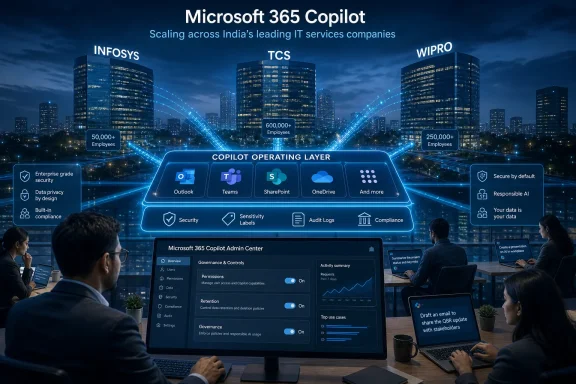
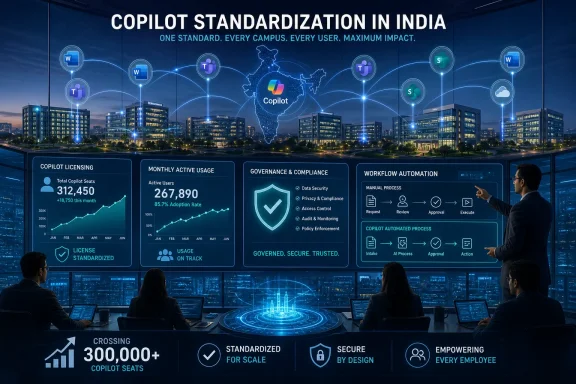
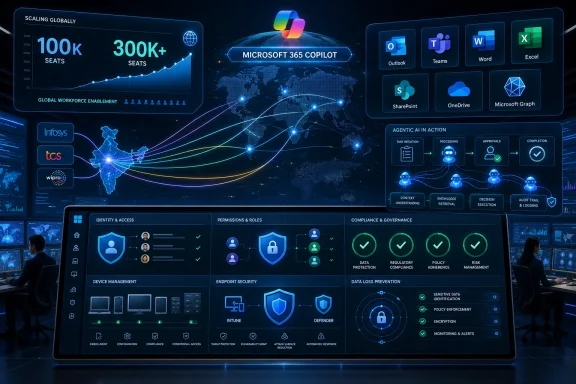
Microsoft said on June 3, 2026, that Infosys, Tata Consultancy Services, and Wipro have each expanded Microsoft 365 Copilot licensing to more than 100,000 employees, pushing their combined commitment beyond 300,000 seats in less than six months. That is not just a large software order. It is Microsoft’s clearest attempt yet to turn Copilot from a productivity add-on into the operating layer for enterprise work. The bet is that Indian IT services giants, long used as the implementation arms of global technology shifts, can now become the proof case for agentic AI at industrial scale.
For the past two years, Microsoft has sold Copilot with the language of inevitability. The pitch was simple: put generative AI inside the tools people already use, tie it to enterprise identity and data, and the spreadsheet, inbox, meeting, and document would become intelligent surfaces rather than static containers. That argument always sounded plausible, but enterprise software does not become real because a keynote says it is real.
The Infosys, TCS, and Wipro announcement matters because it shifts the evidence from pilots to population. Each company has now moved beyond 100,000 licensed employees, after Microsoft highlighted roughly 50,000-seat deployments in December 2025. In enterprise software terms, doubling that footprint in six months is the difference between “strategic initiative” and “this is now part of how the firm expects people to work.”
Microsoft also claims broader momentum for Microsoft 365 Copilot: 20 million paid seats globally, seats added in the quarter up more than 250 percent, and a fourfold year-over-year increase in customers with more than 50,000 seats. Those figures are still vendor-reported, and they do not answer every question about usage depth or return on investment. But they do suggest Copilot has escaped the procurement purgatory that traps many enterprise AI experiments.
That distinction is important for WindowsForum readers because Microsoft 365 Copilot is not merely a cloud application. It sits across Teams, Outlook, Word, Excel, PowerPoint, SharePoint, OneDrive, Microsoft Graph, Entra identity, compliance tooling, and endpoint-managed workstations. When a company rolls Copilot to 100,000 employees, the actual story is not a chatbot; it is a new dependency chain running through the Microsoft stack.
These companies are not typical software customers. They are also systems integrators, outsourcing partners, application modernization vendors, cloud migration shops, and advisory firms. When they deploy Copilot internally, they are training their own consultants and delivery teams on the same operating model they can later sell to banks, manufacturers, retailers, healthcare firms, and governments.
That creates a powerful flywheel for Microsoft. A Copilot deployment at a conventional enterprise produces internal case studies. A Copilot deployment at TCS or Infosys produces internal case studies, delivery playbooks, packaged services, governance templates, training programs, and client-facing sales motions. Microsoft is not just landing seats; it is recruiting the channel that will help normalize Copilot elsewhere.
There is also a regional signal here. Microsoft’s announcement frames India as one of Asia’s fastest-moving markets for Copilot and agentic AI adoption. That fits a broader pattern in which India’s technology services sector is moving quickly to reposition itself from labor-arbitrage outsourcing toward AI-assisted delivery. The uncomfortable subtext is obvious: if AI can compress research, documentation, reporting, testing, and analysis cycles, the firms that once sold headcount must now sell AI-augmented throughput.
At the shallow end, Copilot adoption means workers use AI to summarize meetings, draft emails, generate first-pass documents, and retrieve information from enterprise content. That is helpful, but it is not a new firm. It is a faster office.
At the deeper end, agents begin to sit inside workflows that used to require manual coordination: preparing project updates, reconciling support information, drafting client deliverables, triaging operational data, assembling evidence for performance reviews, and moving tasks between systems. That is where Microsoft wants the story to go. It is also where CIOs and security teams begin to ask harder questions.
The dividing line is agency. A summarizer reduces cognitive load. An agent that initiates steps, chains tasks, invokes tools, or changes records becomes part of the control plane of the enterprise. Once AI moves from “help me write this” to “help run this process,” governance stops being an appendix and becomes the product.
Infosys says its Copilot expansion has reached more than 91 percent monthly active users across delivery, engineering, and corporate functions. TCS says 86 percent of Copilot-licensed associates actively use AI in daily work. Wipro reports more than 95 percent monthly active usage, 7.5 million prompts per month, and an average of 23 actions per user per week.
Those are the kinds of metrics that enterprise AI buyers increasingly want to see. They still leave room for interpretation: a monthly active user can be light-touch, prompts vary wildly in value, and “actions” can range from trivial assistance to meaningful process acceleration. But they move the conversation away from the tired question of whether employees will try AI tools and toward the more material question of whether AI becomes habitual.
Habit is the hidden prize. Software that is used occasionally remains a tool. Software that becomes a daily reflex becomes infrastructure. Microsoft’s argument is that Copilot is crossing that line inside some of the world’s largest IT workforces.
That is the frontier Microsoft cares about. The productivity suite is no longer just receiving AI features from Redmond. Employees and business units are building agents on top of enterprise data and workflows, creating a long tail of automation that central IT could never manually specify in advance.
There is promise in that model. The people closest to a process often know which small frictions consume the most time. Giving them controlled ways to build personal and team-level agents could uncover efficiency gains that never appear in a top-down transformation roadmap.
There is also risk. End-user computing has always produced shadow systems, from rogue Access databases to fragile Excel macros running critical finance tasks. Agentic AI may become the twenty-first century version of that problem, only with natural-language interfaces, dynamic behavior, and access to far more context. The more impressive the agent count, the more important the governance story becomes.
That is why Microsoft keeps emphasizing trust, security, compliance, and governance. The company understands that its AI pitch depends on customers believing the enterprise boundary still means something. If Copilot can see the right content, respect permissions, follow retention rules, and operate under identity controls, it becomes an extension of the existing Microsoft 365 estate. If it cannot, it becomes a data exposure nightmare with a friendly icon.
For sysadmins, this is where the announcement becomes practical rather than abstract. A 100,000-seat Copilot deployment forces organizations to revisit information architecture, labeling, oversharing, stale permissions, Teams sprawl, SharePoint hygiene, and identity governance. Copilot does not create all of those problems, but it makes them visible faster.
That visibility can be brutal. The old enterprise bargain was that badly governed information stayed buried unless someone knew where to look. AI changes that by making retrieval conversational. If the wrong people can access the wrong files, Copilot may simply make the mistake more efficient.
They should still be treated as early operating signals, not universal laws. Productivity improvements in research and content production do not automatically translate to margin expansion, revenue growth, or fewer working hours. Saved time has to be harvested, redirected, or converted into better output. Otherwise it becomes slack absorbed by meetings, review cycles, and the next layer of process.
That is not a reason to dismiss the claims. It is a reason to ask the next question. If a consulting team produces a draft faster, does it ship faster, or does the review burden shift upward? If an analyst generates insights twice as quickly, does decision-making accelerate, or does the organization simply request more analysis? If a performance-review agent cuts administrative effort, does it improve evaluation quality, or merely automate a ritual employees already mistrust?
The winners in enterprise AI will not be the firms that generate the most prompts. They will be the firms that redesign workflows so AI-assisted speed changes the economics of delivery. Microsoft’s “operating model” language is clunky, but it points at the right issue.
By adopting Copilot at scale, these firms are not only improving internal productivity. They are creating an answer to clients who ask whether the service provider is cannibalizing itself before someone else does. The message is: yes, AI changes delivery economics, and we are already rebuilding around it.
Infosys frames its rollout through Infosys Topaz, its AI-led transformation portfolio. TCS ties the work to tcsAI and a “Human + AI” operating model. Wipro positions the deployment under Wipro Intelligence and a “proof-over-promise” principle. The branding differs, but the strategic posture is the same: turn internal AI adoption into client-facing credibility.
That creates a tension Microsoft will quietly welcome. The IT services firms are customers, partners, and case studies at once. Their internal adoption helps Microsoft sell Copilot. Their consulting arms help other enterprises implement it. Their competitive pressure helps normalize the idea that large workforces should be AI-enabled by default.
Most Copilot usage in these environments will happen on corporate Windows PCs, through Office apps, Teams, Outlook, Edge, browsers, and managed identity flows. Endpoint configuration, data loss prevention, conditional access, device compliance, browser policies, and update cadence all become part of the Copilot experience. The AI layer may be cloud-delivered, but the user’s trust boundary still begins at the device.
That matters because Microsoft’s AI strategy increasingly blurs the line between Windows, Microsoft 365, Edge, Entra, Intune, Purview, Defender, and Azure. Copilot is not a standalone island; it is a way of making the whole Microsoft estate feel more integrated. Enterprises that already live inside that estate will find adoption easier. Enterprises with fragmented identity, mixed productivity suites, and messy content governance will find Copilot exposes the seams.
For Windows shops, the practical lesson is simple: AI readiness is not just model readiness. It is tenant readiness, endpoint readiness, permission readiness, and process readiness. A Copilot deployment can fail for reasons that have nothing to do with the model’s intelligence.
The most immediate concern is oversharing. Many enterprises have years of accumulated permissions debt: broad SharePoint access, inherited groups, abandoned Teams, sensitive files without labels, and documents copied across projects. Copilot does not need to breach a system to surface information users technically already had permission to access.
The second concern is agent behavior. As organizations move from prompt-response assistance to agents that perform tasks, auditability becomes critical. Who created the agent? What data can it access? Which actions can it take? Does it require human approval? Is its output retained? Can security teams investigate what happened after the fact?
The third concern is cultural. Employees may trust AI output too much, use it for work it is poorly suited to perform, or unknowingly feed it sensitive context in ways that complicate compliance. Training cannot be a one-time launch webinar. At this scale, AI literacy becomes a control, not a perk.
That is why the 20 million paid-seat figure matters. Microsoft 365 is already one of the most successful enterprise software franchises in history. Adding a paid AI layer on top of it gives Microsoft a way to reprice the workplace without asking customers to migrate to an unfamiliar environment. It is the classic Microsoft move: make the new thing feel like the next setting inside the old thing.
The Infosys, TCS, and Wipro deployments strengthen that argument because they show Copilot can be sold and activated at a scale few vendors can even address. Plenty of AI startups can produce impressive demos. Very few can support procurement, identity, compliance, admin tooling, telemetry, and global rollout for hundreds of thousands of enterprise users.
That does not make Microsoft’s vision automatically correct. It does make it hard to ignore. The company is not merely competing on model quality; it is competing on distribution, integration, and administrative familiarity.
But any serious discussion of large-scale AI adoption in IT services has to acknowledge labor implications. If research tasks become 25 percent faster, insight generation doubles, and review processes require dramatically less effort, companies will eventually revisit staffing models. They may grow without hiring as quickly. They may shift work to smaller teams. They may change entry-level roles that traditionally trained junior employees through repetitive tasks.
The first wave may not look like mass replacement. It may look like attrition not backfilled, pyramids reshaped, utilization targets revised, and junior employees expected to produce at mid-level speed with AI assistance. That is still a labor transformation, even if it arrives through budgeting language rather than dramatic layoffs.
For IT professionals, this is both threat and opportunity. The safest roles will not simply be those that use AI. They will be those that can supervise, validate, secure, integrate, and improve AI-assisted systems. The enterprise will still need humans, but it will reward different habits.
At 10,000 seats, a company can still treat Copilot as a controlled experiment. At 100,000 seats, the organization has to develop support models, internal champions, training paths, governance structures, reporting practices, and business-unit accountability. It has to decide which workflows deserve redesign and which should remain human-led.
That is where many enterprises will struggle. Buying Copilot is easier than changing work. Managers may lack the skills to redesign processes around AI. Employees may use Copilot unevenly. Some teams will produce impressive gains, while others will add AI steps without removing old ones. The result can be productivity theater: lots of prompts, lots of dashboards, little structural change.
The better path is measurement tied to actual workflows. Not “how many people used Copilot this month,” but “how long does this support process take now,” “how many defects appear in this deliverable,” “how much review time did we remove,” and “which decisions improved because better information surfaced sooner.” Microsoft’s customers will need that discipline if the Copilot boom is to survive CFO scrutiny.
 Microsoft’s Copilot Story Has Moved From Demo Theater to Seat Count Politics
For the past two years, Microsoft has sold Copilot with the language of inevitability. The pitch was simple: put generative AI inside the tools people already use, tie it to enterprise identity and data, and the spreadsheet, inbox, meeting, and document would become intelligent surfaces rather than static containers. That argument always sounded plausible, but enterprise software does not become real because a keynote says it is real.The Infosys, TCS, and Wipro announcement matters because it shifts the evidence from pilots to population. Each company has now moved beyond 100,000 licensed employees, after Microsoft highlighted roughly 50,000-seat deployments in December 2025. In enterprise software terms, doubling that footprint in six months is the difference between “strategic initiative” and “this is now part of how the firm expects people to work.”
Microsoft also claims broader momentum for Microsoft 365 Copilot: 20 million paid seats globally, seats added in the quarter up more than 250 percent, and a fourfold year-over-year increase in customers with more than 50,000 seats. Those figures are still vendor-reported, and they do not answer every question about usage depth or return on investment. But they do suggest Copilot has escaped the procurement purgatory that traps many enterprise AI experiments.
That distinction is important for WindowsForum readers because Microsoft 365 Copilot is not merely a cloud application. It sits across Teams, Outlook, Word, Excel, PowerPoint, SharePoint, OneDrive, Microsoft Graph, Entra identity, compliance tooling, and endpoint-managed workstations. When a company rolls Copilot to 100,000 employees, the actual story is not a chatbot; it is a new dependency chain running through the Microsoft stack.
India Is Becoming Microsoft’s Enterprise AI Proving Ground
The geography is not incidental. Infosys, TCS, and Wipro are headquartered in India, but their client bases are global, their workforces are distributed, and their operating models are built around scaling process changes across enormous delivery organizations. If Microsoft wants a proof point that Copilot can live inside real enterprise workflows, Indian IT services is an unusually useful laboratory.These companies are not typical software customers. They are also systems integrators, outsourcing partners, application modernization vendors, cloud migration shops, and advisory firms. When they deploy Copilot internally, they are training their own consultants and delivery teams on the same operating model they can later sell to banks, manufacturers, retailers, healthcare firms, and governments.
That creates a powerful flywheel for Microsoft. A Copilot deployment at a conventional enterprise produces internal case studies. A Copilot deployment at TCS or Infosys produces internal case studies, delivery playbooks, packaged services, governance templates, training programs, and client-facing sales motions. Microsoft is not just landing seats; it is recruiting the channel that will help normalize Copilot elsewhere.
There is also a regional signal here. Microsoft’s announcement frames India as one of Asia’s fastest-moving markets for Copilot and agentic AI adoption. That fits a broader pattern in which India’s technology services sector is moving quickly to reposition itself from labor-arbitrage outsourcing toward AI-assisted delivery. The uncomfortable subtext is obvious: if AI can compress research, documentation, reporting, testing, and analysis cycles, the firms that once sold headcount must now sell AI-augmented throughput.
The “Frontier Firm” Is a Sales Phrase With a Real Operational Question Inside
Microsoft describes these companies as examples of the “Frontier Firm,” a phrase from its Work Trend Index 2026 framing organizations that redesign work around human-agent teams. Like most executive vocabulary, it is partly branding and partly prediction. The useful question is whether the phrase describes an actual operating model or merely a new label for giving employees access to AI assistants.At the shallow end, Copilot adoption means workers use AI to summarize meetings, draft emails, generate first-pass documents, and retrieve information from enterprise content. That is helpful, but it is not a new firm. It is a faster office.
At the deeper end, agents begin to sit inside workflows that used to require manual coordination: preparing project updates, reconciling support information, drafting client deliverables, triaging operational data, assembling evidence for performance reviews, and moving tasks between systems. That is where Microsoft wants the story to go. It is also where CIOs and security teams begin to ask harder questions.
The dividing line is agency. A summarizer reduces cognitive load. An agent that initiates steps, chains tasks, invokes tools, or changes records becomes part of the control plane of the enterprise. Once AI moves from “help me write this” to “help run this process,” governance stops being an appendix and becomes the product.
The Numbers Are Big, but Usage Is the More Interesting Claim
Seat counts are easy to understand and easy to exaggerate. A license assigned to an employee does not prove that employee uses the product well, often, or safely. Microsoft’s announcement is therefore more interesting where it describes activity, not just entitlement.Infosys says its Copilot expansion has reached more than 91 percent monthly active users across delivery, engineering, and corporate functions. TCS says 86 percent of Copilot-licensed associates actively use AI in daily work. Wipro reports more than 95 percent monthly active usage, 7.5 million prompts per month, and an average of 23 actions per user per week.
Those are the kinds of metrics that enterprise AI buyers increasingly want to see. They still leave room for interpretation: a monthly active user can be light-touch, prompts vary wildly in value, and “actions” can range from trivial assistance to meaningful process acceleration. But they move the conversation away from the tired question of whether employees will try AI tools and toward the more material question of whether AI becomes habitual.
Habit is the hidden prize. Software that is used occasionally remains a tool. Software that becomes a daily reflex becomes infrastructure. Microsoft’s argument is that Copilot is crossing that line inside some of the world’s largest IT workforces.
Wipro’s Agent Count Shows Where the Story Is Headed
Among the company-specific disclosures, Wipro’s numbers are the most revealing. Microsoft says Wipro has more than 29,000 end-user developed agents and more than 60 enterprise-grade agentic solutions in use across functions. The company also says an appraisal agent has cut performance review effort by nearly 70 percent through evidence-based goal tracking.That is the frontier Microsoft cares about. The productivity suite is no longer just receiving AI features from Redmond. Employees and business units are building agents on top of enterprise data and workflows, creating a long tail of automation that central IT could never manually specify in advance.
There is promise in that model. The people closest to a process often know which small frictions consume the most time. Giving them controlled ways to build personal and team-level agents could uncover efficiency gains that never appear in a top-down transformation roadmap.
There is also risk. End-user computing has always produced shadow systems, from rogue Access databases to fragile Excel macros running critical finance tasks. Agentic AI may become the twenty-first century version of that problem, only with natural-language interfaces, dynamic behavior, and access to far more context. The more impressive the agent count, the more important the governance story becomes.
Copilot’s Real Customer Is the Enterprise Graph
Microsoft’s advantage in this market is not that it has the only capable AI models. It is that Microsoft 365 already contains the daily exhaust of enterprise work. Email, calendars, chats, meetings, files, permissions, org charts, and document histories flow through Microsoft Graph, and Copilot becomes powerful when it can reason over that context.That is why Microsoft keeps emphasizing trust, security, compliance, and governance. The company understands that its AI pitch depends on customers believing the enterprise boundary still means something. If Copilot can see the right content, respect permissions, follow retention rules, and operate under identity controls, it becomes an extension of the existing Microsoft 365 estate. If it cannot, it becomes a data exposure nightmare with a friendly icon.
For sysadmins, this is where the announcement becomes practical rather than abstract. A 100,000-seat Copilot deployment forces organizations to revisit information architecture, labeling, oversharing, stale permissions, Teams sprawl, SharePoint hygiene, and identity governance. Copilot does not create all of those problems, but it makes them visible faster.
That visibility can be brutal. The old enterprise bargain was that badly governed information stayed buried unless someone knew where to look. AI changes that by making retrieval conversational. If the wrong people can access the wrong files, Copilot may simply make the mistake more efficient.
The Productivity Claims Are Useful, but They Are Not Yet an Economic Model
TCS reports 20 to 25 percent productivity improvements in research and content production tasks, twice-faster insight generation, and 25 to 35 percent reductions in selective work-cycle time through AI assistance. Wipro says its Copilot use translates into more than 250,000 full-time-equivalent days saved every quarter. These are striking numbers, and they are exactly the numbers Microsoft wants CIOs to repeat in budget meetings.They should still be treated as early operating signals, not universal laws. Productivity improvements in research and content production do not automatically translate to margin expansion, revenue growth, or fewer working hours. Saved time has to be harvested, redirected, or converted into better output. Otherwise it becomes slack absorbed by meetings, review cycles, and the next layer of process.
That is not a reason to dismiss the claims. It is a reason to ask the next question. If a consulting team produces a draft faster, does it ship faster, or does the review burden shift upward? If an analyst generates insights twice as quickly, does decision-making accelerate, or does the organization simply request more analysis? If a performance-review agent cuts administrative effort, does it improve evaluation quality, or merely automate a ritual employees already mistrust?
The winners in enterprise AI will not be the firms that generate the most prompts. They will be the firms that redesign workflows so AI-assisted speed changes the economics of delivery. Microsoft’s “operating model” language is clunky, but it points at the right issue.
The IT Services Giants Are Also Defending Their Own Business Model
Infosys, TCS, and Wipro have strong incentives to move quickly. Generative AI directly challenges the labor-intensive model that has powered large IT services firms for decades. If software can assist with documentation, code analysis, testing, reporting, support workflows, knowledge retrieval, and business process operations, then clients will eventually ask why old staffing ratios still apply.By adopting Copilot at scale, these firms are not only improving internal productivity. They are creating an answer to clients who ask whether the service provider is cannibalizing itself before someone else does. The message is: yes, AI changes delivery economics, and we are already rebuilding around it.
Infosys frames its rollout through Infosys Topaz, its AI-led transformation portfolio. TCS ties the work to tcsAI and a “Human + AI” operating model. Wipro positions the deployment under Wipro Intelligence and a “proof-over-promise” principle. The branding differs, but the strategic posture is the same: turn internal AI adoption into client-facing credibility.
That creates a tension Microsoft will quietly welcome. The IT services firms are customers, partners, and case studies at once. Their internal adoption helps Microsoft sell Copilot. Their consulting arms help other enterprises implement it. Their competitive pressure helps normalize the idea that large workforces should be AI-enabled by default.
The Windows Angle Is Not the Logo, It Is the Managed Workday
This is not a Windows 11 feature story in the narrow sense. The announcement is about Microsoft 365 Copilot, not a new taskbar button or a local NPU benchmark. But for Windows administrators, the implications land directly on the managed workday.Most Copilot usage in these environments will happen on corporate Windows PCs, through Office apps, Teams, Outlook, Edge, browsers, and managed identity flows. Endpoint configuration, data loss prevention, conditional access, device compliance, browser policies, and update cadence all become part of the Copilot experience. The AI layer may be cloud-delivered, but the user’s trust boundary still begins at the device.
That matters because Microsoft’s AI strategy increasingly blurs the line between Windows, Microsoft 365, Edge, Entra, Intune, Purview, Defender, and Azure. Copilot is not a standalone island; it is a way of making the whole Microsoft estate feel more integrated. Enterprises that already live inside that estate will find adoption easier. Enterprises with fragmented identity, mixed productivity suites, and messy content governance will find Copilot exposes the seams.
For Windows shops, the practical lesson is simple: AI readiness is not just model readiness. It is tenant readiness, endpoint readiness, permission readiness, and process readiness. A Copilot deployment can fail for reasons that have nothing to do with the model’s intelligence.
The Security Story Must Survive Contact With Scale
Microsoft’s announcement leans heavily on enterprise-grade trust, compliance, and governance. It has to. No CIO wants to tell a board that 100,000 employees now have an AI assistant grounded in enterprise data unless the organization can explain what that assistant can see, what it can do, and how misuse is detected.The most immediate concern is oversharing. Many enterprises have years of accumulated permissions debt: broad SharePoint access, inherited groups, abandoned Teams, sensitive files without labels, and documents copied across projects. Copilot does not need to breach a system to surface information users technically already had permission to access.
The second concern is agent behavior. As organizations move from prompt-response assistance to agents that perform tasks, auditability becomes critical. Who created the agent? What data can it access? Which actions can it take? Does it require human approval? Is its output retained? Can security teams investigate what happened after the fact?
The third concern is cultural. Employees may trust AI output too much, use it for work it is poorly suited to perform, or unknowingly feed it sensitive context in ways that complicate compliance. Training cannot be a one-time launch webinar. At this scale, AI literacy becomes a control, not a perk.
Microsoft’s Vendor Math Is Stronger Than Its Philosophy
Microsoft’s public language around Copilot often reaches for grand theory: human ambition, intelligence plus trust, Frontier Firms, durable competitive advantage. The language is predictable, but the business logic underneath is formidable. Copilot turns Microsoft 365 from a mature productivity subscription into a higher-value AI platform with expansion potential across every knowledge worker.That is why the 20 million paid-seat figure matters. Microsoft 365 is already one of the most successful enterprise software franchises in history. Adding a paid AI layer on top of it gives Microsoft a way to reprice the workplace without asking customers to migrate to an unfamiliar environment. It is the classic Microsoft move: make the new thing feel like the next setting inside the old thing.
The Infosys, TCS, and Wipro deployments strengthen that argument because they show Copilot can be sold and activated at a scale few vendors can even address. Plenty of AI startups can produce impressive demos. Very few can support procurement, identity, compliance, admin tooling, telemetry, and global rollout for hundreds of thousands of enterprise users.
That does not make Microsoft’s vision automatically correct. It does make it hard to ignore. The company is not merely competing on model quality; it is competing on distribution, integration, and administrative familiarity.
The Labor Question Is Being Politely Deferred
The announcement emphasizes human agency expanding as AI takes on more execution. That is the optimistic version of the story, and there is truth in it. Employees freed from low-value work can focus on judgment, creativity, client outcomes, and higher-order problem solving.But any serious discussion of large-scale AI adoption in IT services has to acknowledge labor implications. If research tasks become 25 percent faster, insight generation doubles, and review processes require dramatically less effort, companies will eventually revisit staffing models. They may grow without hiring as quickly. They may shift work to smaller teams. They may change entry-level roles that traditionally trained junior employees through repetitive tasks.
The first wave may not look like mass replacement. It may look like attrition not backfilled, pyramids reshaped, utilization targets revised, and junior employees expected to produce at mid-level speed with AI assistance. That is still a labor transformation, even if it arrives through budgeting language rather than dramatic layoffs.
For IT professionals, this is both threat and opportunity. The safest roles will not simply be those that use AI. They will be those that can supervise, validate, secure, integrate, and improve AI-assisted systems. The enterprise will still need humans, but it will reward different habits.
The Evidence Is Good Enough to Act, Not Good Enough to Stop Measuring
The strongest version of Microsoft’s announcement is not “Copilot has solved enterprise productivity.” It is that large, operationally sophisticated companies are now willing to deploy it widely enough to learn what it actually changes. That is a meaningful threshold.At 10,000 seats, a company can still treat Copilot as a controlled experiment. At 100,000 seats, the organization has to develop support models, internal champions, training paths, governance structures, reporting practices, and business-unit accountability. It has to decide which workflows deserve redesign and which should remain human-led.
That is where many enterprises will struggle. Buying Copilot is easier than changing work. Managers may lack the skills to redesign processes around AI. Employees may use Copilot unevenly. Some teams will produce impressive gains, while others will add AI steps without removing old ones. The result can be productivity theater: lots of prompts, lots of dashboards, little structural change.
The better path is measurement tied to actual workflows. Not “how many people used Copilot this month,” but “how long does this support process take now,” “how many defects appear in this deliverable,” “how much review time did we remove,” and “which decisions improved because better information surfaced sooner.” Microsoft’s customers will need that discipline if the Copilot boom is to survive CFO scrutiny.
The 300,000-Seat Signal Enterprises Should Not Ignore
The practical lesson from the Infosys, TCS, and Wipro rollout is not that every company should immediately copy their seat counts. Few organizations have their scale, consulting muscle, or incentive to turn internal adoption into market positioning. The lesson is that Copilot has entered the phase where enterprise AI programs will be judged by operational integration rather than novelty.- Microsoft 365 Copilot is now being deployed at workforce scale by three of the world’s largest IT services companies, with each crossing 100,000 licensed employees.
- The most important metric is shifting from licenses assigned to usage patterns, workflow impact, and whether AI assistance changes how teams actually deliver work.
- Wipro’s large number of end-user developed agents shows why governance will matter as much as enthusiasm in the next phase of enterprise AI.
- Windows and Microsoft 365 administrators should treat Copilot readiness as a broader discipline covering identity, permissions, endpoint management, data governance, and user training.
- The productivity claims are promising, but enterprises still need to prove that saved time turns into better economics, faster delivery, or higher-quality outcomes.
- IT services firms are using Copilot adoption not only to improve internal operations, but also to defend and repackage their business models for an AI-first consulting market.
References
- Primary source: Microsoft Source
Published: Wed, 03 Jun 2026 03:33:07 GMT