

Microsoft 365 administrators should begin building Copilot release rings now, but they should not treat them as a Windows Update-style mechanism for delaying everything. The practical model is a small, tightly governed Frontier lab for pre-GA experiments, a Standard cohort that validates the general-availability experience as Microsoft intends it to ship, and a Deferred cohort limited to users whose work cannot absorb a major Copilot change without preparation.
Microsoft’s new audience-based model—Frontier, Standard, and Deferred—makes that approach possible, but it also places a clear limit on what “rings” can promise. As Microsoft explains in its Microsoft 365 documentation, Standard is the default and the recommended primary release channel for most organizations; Deferred is a selective preparation window for certain major Copilot updates, not a tenant-wide pause button.
That distinction matters because Copilot is not a single desktop application with one predictable servicing cadence. It is a set of cloud experiences, agents, controls, and integrations that can affect user behavior, internal data access, help desk demand, compliance review, and custom business processes. A release-ring plan should therefore define who validates what and who needs continuity, rather than attempting to hold every change behind a wall.
Start by assigning each release audience a purpose that can be explained to leadership, security, support, and the affected users. Do not create rings merely because Microsoft has created release labels.
Frontier should be an experimentation lab, not an early-access entitlement. Frontier provides opt-in access to pre-GA Copilot capabilities that are subject to change and are outside general-availability service-level commitments. Tenant administrators can control which people use Frontier features and agents, which makes this group the right place for a deliberately small set of technically capable participants: Copilot product owners, security and compliance representatives, service desk leads, information-management specialists, and power users from a few business units.
The goal is not to forecast every interface tweak before it happens. The goal is to discover whether a preview feature creates a governance problem, exposes a training gap, changes the volume or quality of support requests, or delivers enough business value to justify a later rollout. Frontier participants should expect breakage, revisions, and withdrawal; anyone who needs stable workflows should be excluded by design.
Standard should be the working validation cohort and, for most users, the destination. Microsoft recommends Standard as the primary channel because it receives fully supported features at general availability. That does not mean Standard needs to be an unexamined mass rollout. Assign enough users to expose realistic usage patterns across departments, content types, permissions models, and support personas, while keeping the group representative of the wider organization.
For many tenants, that means Standard includes IT, a cross-section of ordinary knowledge workers, Copilot champions, and managers who can report whether a change affects real work. It should also include people who depend on the Microsoft 365 behaviors likely to surface downstream effects: sharing, meetings, access management, internal search, and organization-specific agents. This is where the organization validates the GA experience before a Deferred population receives eligible changes.
Deferred should protect continuity where validation time has a clear owner. Put business-critical users here only when a 30-day preparation window materially changes the outcome. Candidates may include regulated teams, executive support functions, groups running heavily documented processes, departments with extensive internal training obligations, or teams dependent on deployed Copilot agents and carefully controlled data practices.
The key test is simple: if an eligible major Copilot change arrives, who will use those 30 days to make a decision, revise guidance, complete review, train users, or prepare support? If no one owns that work, Deferred has become delay for delay’s sake.
For an eligible feature, Deferred users receive it 30 days after the global GA rollout begins for Standard. The clock does not wait until rollout is complete, nor does it begin when a local IT team first notices the Message Center post. That makes Message Center triage an operational obligation, not a passive notification stream.
Treat the alert as the beginning of a short change cycle:
Before enabling a Frontier agent for any user, establish a short test charter. State the business scenario, the authorized test data, the expected output, the people who may use it, and the condition that ends the test. Do not allow an open-ended “try it and see” deployment where agents can become embedded in live processes before anyone has decided who is accountable for the results.
The evaluation should concentrate on four practical areas:
That calls for a controls matrix maintained alongside the ring roster. For each meaningful Copilot change, record three things: whether its release is audience-controlled, whether a tenant-wide setting affects all users, and who has authority to alter that setting. If the answer to the second question is yes, the release-ring plan needs a separate communications and governance path.
This is also why an organization should avoid moving all users into Deferred out of caution. Such a move can create inconsistent experience, defer only a subset of changes, and encourage the false belief that production is insulated from Copilot evolution. Microsoft’s own position is that Standard should remain the primary channel. The stronger pattern is to retain that default posture while using Deferred for business functions with a documented readiness requirement.
Review those assignments after meaningful Copilot changes. A team that has completed its training, documented its process, and gained confidence in its controls may no longer need Deferred. Conversely, a newly deployed agent, a sensitive data workflow, or an upcoming internal rollout may justify temporarily moving a narrowly defined group into Deferred.
Communications should follow the same discipline. Frontier users need explicit notice that they are using preview capabilities and should not build irreversible business processes around them. Standard users need short, practical notices when a change alters an established workflow. Deferred users need a date, a preparation expectation, and a named path for reporting issues—not vague assurances that IT is “monitoring” the release.
No. Microsoft recommends Standard as the primary release channel. Deferred is best reserved for users with a concrete validation, governance, training, or continuity need tied to an eligible major Copilot update.
Does Deferred delay every Copilot feature by 30 days?
No. It initially applies only when Microsoft marks a Copilot change in Message Center as both a major update and deferred-capable. The 30 days begin when Standard GA rollout starts globally.
Can Frontier be used as a production pilot?
It can inform a future production decision, but it should not be treated as production. Frontier features are pre-GA, subject to change, and outside GA service-level commitments.
Do release audiences prevent tenant-wide Copilot changes from reaching Deferred users?
Not necessarily. Tenant-wide changes can apply across audiences, so administrators need separate controls and communications for changes governed at the tenant level.
The immediate task is not to slow Copilot universally. It is to define a small Frontier lab, make Standard the organization’s real-world validation path, and reserve Deferred for the users whose extra 30 days will be actively used. That operating model will remain valuable even as Microsoft expands the audience-based release approach beyond the Copilot changes it covers today.
Microsoft’s new audience-based model—Frontier, Standard, and Deferred—makes that approach possible, but it also places a clear limit on what “rings” can promise. As Microsoft explains in its Microsoft 365 documentation, Standard is the default and the recommended primary release channel for most organizations; Deferred is a selective preparation window for certain major Copilot updates, not a tenant-wide pause button.
That distinction matters because Copilot is not a single desktop application with one predictable servicing cadence. It is a set of cloud experiences, agents, controls, and integrations that can affect user behavior, internal data access, help desk demand, compliance review, and custom business processes. A release-ring plan should therefore define who validates what and who needs continuity, rather than attempting to hold every change behind a wall.
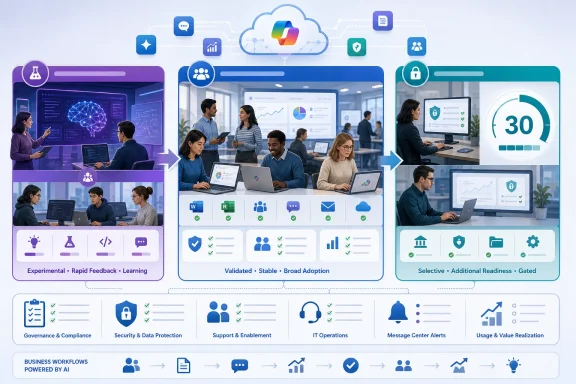 Build three operating cohorts, not three silos
Start by assigning each release audience a purpose that can be explained to leadership, security, support, and the affected users. Do not create rings merely because Microsoft has created release labels.Frontier should be an experimentation lab, not an early-access entitlement. Frontier provides opt-in access to pre-GA Copilot capabilities that are subject to change and are outside general-availability service-level commitments. Tenant administrators can control which people use Frontier features and agents, which makes this group the right place for a deliberately small set of technically capable participants: Copilot product owners, security and compliance representatives, service desk leads, information-management specialists, and power users from a few business units.
The goal is not to forecast every interface tweak before it happens. The goal is to discover whether a preview feature creates a governance problem, exposes a training gap, changes the volume or quality of support requests, or delivers enough business value to justify a later rollout. Frontier participants should expect breakage, revisions, and withdrawal; anyone who needs stable workflows should be excluded by design.
Standard should be the working validation cohort and, for most users, the destination. Microsoft recommends Standard as the primary channel because it receives fully supported features at general availability. That does not mean Standard needs to be an unexamined mass rollout. Assign enough users to expose realistic usage patterns across departments, content types, permissions models, and support personas, while keeping the group representative of the wider organization.
For many tenants, that means Standard includes IT, a cross-section of ordinary knowledge workers, Copilot champions, and managers who can report whether a change affects real work. It should also include people who depend on the Microsoft 365 behaviors likely to surface downstream effects: sharing, meetings, access management, internal search, and organization-specific agents. This is where the organization validates the GA experience before a Deferred population receives eligible changes.
Deferred should protect continuity where validation time has a clear owner. Put business-critical users here only when a 30-day preparation window materially changes the outcome. Candidates may include regulated teams, executive support functions, groups running heavily documented processes, departments with extensive internal training obligations, or teams dependent on deployed Copilot agents and carefully controlled data practices.
The key test is simple: if an eligible major Copilot change arrives, who will use those 30 days to make a decision, revise guidance, complete review, train users, or prepare support? If no one owns that work, Deferred has become delay for delay’s sake.
The 30-day window starts sooner than many plans assume
Deferred is useful, but it has narrow eligibility and a fixed clock. Initially, it applies only to Microsoft 365 Copilot changes that Microsoft identifies in Message Center as both a major update and deferred-capable. A feature that does not carry both designations is not held back simply because a user belongs to the Deferred audience.For an eligible feature, Deferred users receive it 30 days after the global GA rollout begins for Standard. The clock does not wait until rollout is complete, nor does it begin when a local IT team first notices the Message Center post. That makes Message Center triage an operational obligation, not a passive notification stream.
Treat the alert as the beginning of a short change cycle:
- Identify whether the post is both a major update and deferred-capable, then record the date Standard GA begins.
- Name a business owner, a security or compliance reviewer where applicable, a support owner, and a communications owner on the same day.
- Test the change with the Standard cohort against the workflows, agents, data boundaries, and documentation that matter to the Deferred group.
- Decide whether the response is acceptance, revised internal guidance, targeted training, a configuration adjustment, or an escalation to Microsoft through the available support path.
- Communicate the arrival date and expected user impact to Deferred users before the 30-day window closes.
Test agents as data-governance changes, not just productivity tools
Frontier deserves the strictest operating rules because its features and agents are pre-GA. A promising agent may become a useful production tool later, but its preview status means administrators should evaluate it as an experiment with real organizational consequences.Before enabling a Frontier agent for any user, establish a short test charter. State the business scenario, the authorized test data, the expected output, the people who may use it, and the condition that ends the test. Do not allow an open-ended “try it and see” deployment where agents can become embedded in live processes before anyone has decided who is accountable for the results.
The evaluation should concentrate on four practical areas:
- Confirm that the agent’s intended users have access only to information they are already authorized to use, and test with realistic permission differences rather than a single administrator account.
- Review whether prompts, outputs, or agent actions create new retention, discovery, records-management, or sensitivity-labeling questions for the organization.
- Test outputs for misleading summaries, overconfident recommendations, and failures to preserve the context a user needs to make a responsible decision.
- Define an exit path: remove the pilot users, stop relying on the agent for a workflow, and preserve only the test evidence the organization is permitted to retain.
Release audiences do not override tenant-wide change
The biggest design error would be treating Frontier, Standard, and Deferred as guaranteed containment boundaries. Microsoft notes that tenant-wide changes can apply to everyone regardless of a user’s Standard or Deferred audience assignment. A release audience governs the delivery of the features it covers; it does not automatically supersede every tenant-level change or every administrative control.That calls for a controls matrix maintained alongside the ring roster. For each meaningful Copilot change, record three things: whether its release is audience-controlled, whether a tenant-wide setting affects all users, and who has authority to alter that setting. If the answer to the second question is yes, the release-ring plan needs a separate communications and governance path.
This is also why an organization should avoid moving all users into Deferred out of caution. Such a move can create inconsistent experience, defer only a subset of changes, and encourage the false belief that production is insulated from Copilot evolution. Microsoft’s own position is that Standard should remain the primary channel. The stronger pattern is to retain that default posture while using Deferred for business functions with a documented readiness requirement.
Make ring membership a living operational decision
A useful ring plan names entry and exit criteria, not just groups. A person belongs in Frontier because they can test a defined scenario and report an actionable outcome. A person belongs in Standard because their work represents real use and they can tolerate GA change. A person belongs in Deferred because a known operational dependency requires a formal preparation period.Review those assignments after meaningful Copilot changes. A team that has completed its training, documented its process, and gained confidence in its controls may no longer need Deferred. Conversely, a newly deployed agent, a sensitive data workflow, or an upcoming internal rollout may justify temporarily moving a narrowly defined group into Deferred.
Communications should follow the same discipline. Frontier users need explicit notice that they are using preview capabilities and should not build irreversible business processes around them. Standard users need short, practical notices when a change alters an established workflow. Deferred users need a date, a preparation expectation, and a named path for reporting issues—not vague assurances that IT is “monitoring” the release.
Frequently Asked Questions
Should most Microsoft 365 Copilot users be assigned to Deferred?No. Microsoft recommends Standard as the primary release channel. Deferred is best reserved for users with a concrete validation, governance, training, or continuity need tied to an eligible major Copilot update.
Does Deferred delay every Copilot feature by 30 days?
No. It initially applies only when Microsoft marks a Copilot change in Message Center as both a major update and deferred-capable. The 30 days begin when Standard GA rollout starts globally.
Can Frontier be used as a production pilot?
It can inform a future production decision, but it should not be treated as production. Frontier features are pre-GA, subject to change, and outside GA service-level commitments.
Do release audiences prevent tenant-wide Copilot changes from reaching Deferred users?
Not necessarily. Tenant-wide changes can apply across audiences, so administrators need separate controls and communications for changes governed at the tenant level.
The immediate task is not to slow Copilot universally. It is to define a small Frontier lab, make Standard the organization’s real-world validation path, and reserve Deferred for the users whose extra 30 days will be actively used. That operating model will remain valuable even as Microsoft expands the audience-based release approach beyond the Copilot changes it covers today.
References
- Primary source: learn.microsoft.com
Configure new Standard and Deferred release options for Microsoft 365 - Microsoft 365 admin | Microsoft Learn
Learn how to set up standard, deferred, and frontier release options for new features in Microsoft 365 to better manage your organization.learn.microsoft.com - Independent coverage: microsoft.com
Microsoft 365 Roadmap | Microsoft 365
The Microsoft 365 Roadmap lists updates that are currently planned for applicable subscribers. Check here for more information on the status of new features and updates.www.microsoft.com
- Independent coverage: techcommunity.microsoft.com
- Primary source: WindowsForum
Microsoft 365 Release Audiences: When to Use Standard, Deferred, and Targeted | Windows Forum
Administrators deciding whether to move Microsoft 365 users to Deferred release should keep most users on Standard release unless a specific, major...windowsforum.com
