

Microsoft’s latest Copilot move is less about a flashy chatbot update and more about a strategic redefinition of what productivity software is supposed to do. With the March 9, 2026 unveiling of Copilot Cowork, the company is pushing Microsoft 365 Copilot beyond one-shot prompts and into long-running, multi-step work that can unfold over minutes, hours, or even longer. The important twist is the Anthropic collaboration: Microsoft says it has brought the technology behind Claude Cowork into Microsoft 365 Copilot to power this new agentic experience.
That matters because the real competition in enterprise AI has shifted from “who answers the best” to “who can safely execute the most useful work.” Microsoft is now framing Copilot as an execution layer for the modern office, not just a writing assistant. The launch also signals a broader model-diversity strategy, with Microsoft bringing Anthropic models deeper into its stack alongside OpenAI rather than betting on a single frontier partner.
The rise of Copilot Cowork makes more sense when placed inside Microsoft’s broader frontier-AI roadmap. Over the past year, Microsoft has steadily expanded Anthropic support across products like Copilot Studio and Microsoft 365 Copilot’s Researcher agent, adding Claude-based options and enterprise controls that let administrators decide when and where those models can be used. That gradual rollout established a pattern: Microsoft wants customers to see frontier AI as a governed capability, not an experimental toy.
The company has also spent the last several quarters repositioning Microsoft 365 Copilot as a platform for agents, not just a generative assistant. In its March 9 “Frontier Suite” announcements, Microsoft described new capabilities that let Copilot break down complex requests, reason across tools and files, and carry work forward with visible progress and opportunities to steer. That is a profound conceptual change, because it implies that the user’s role becomes supervision, prioritization, and judgment rather than micromanagement.
What makes the Anthropic tie-up noteworthy is not simply that another model vendor is involved. It is that Microsoft is explicitly choosing a reasoning architecture for tasks that need chained decisions and persistence over time. In practical terms, that suggests use cases like research synthesis, meeting preparation, and workflow coordination, where the value comes from continuity as much as from raw language quality.
This also fits a larger industry shift. Enterprise buyers have grown increasingly skeptical of chat-style copilots that are impressive in demos but weak when a task stretches across multiple systems, files, and approvals. By placing Copilot Cowork inside Microsoft 365, Microsoft is attempting to reduce that gap between conversation and completion.
Another important backdrop is Microsoft’s enterprise trust story. The company has emphasized security, identity, governance, and enterprise data protection throughout its frontier announcements, while also clarifying where Anthropic models are and are not available. In other words, the strategy is not only to add capability, but to prove that capability can survive the compliance demands of real organizations.
That distinction sounds subtle, but it is operationally huge. In the old model, employees had to break work into dozens of small prompts, constantly re-establishing context. In the new model, Copilot can carry the thread, which is exactly what enterprise workflows demand when a task depends on emails, documents, calendars, and changing priorities.
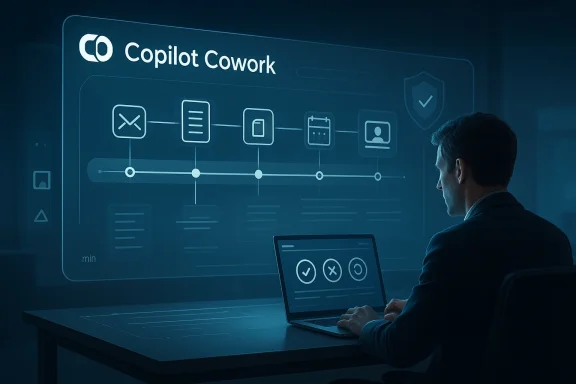
Microsoft’s description of visible progress and user steering is important here. It implies that the company is trying to avoid the black-box problem that has haunted agentic AI demos. If users can inspect, adjust, pause, or stop the work, the system becomes more acceptable for real business operations.
Key implications include:
Anthropic has been integrated incrementally across Microsoft products, including Copilot Studio and Researcher, before reaching this more ambitious agentic use case. That sequence suggests Microsoft has spent months testing administrative controls, rollout mechanics, and practical customer demand before introducing a more complex automation layer. The new launch therefore looks less like a sudden leap and more like a staged escalation.
This is especially relevant for tasks that span internal documents and external research. Microsoft has already positioned Claude in Researcher as a way to gather, analyze, and summarize information from work files and the web, which makes Cowork feel like the next logical layer: not just researching, but taking the next operational steps.
The broader market implication is that vendors will increasingly be judged on orchestration quality, not just model benchmark scores. If Copilot can reliably coordinate work across Microsoft 365, that creates a differentiated product even if competitors can match raw model intelligence. In enterprise software, integration is the moat.
That kind of messaging is not decorative. For many organizations, the question is not whether AI can help, but whether it can help without creating audit, privacy, or data residency headaches. Microsoft’s answer is to make Anthropic-powered features available under enterprise policy controls rather than as an uncontrolled public endpoint.
Microsoft’s examples point to a world where the assistant compiles meeting notes, checks calendars, reviews email threads, and assembles a ready-to-use agenda. That is not glamorous, but it is the kind of labor that often stalls decision-making in real organizations. The productivity gain comes from compression: fewer handoffs, fewer repeated searches, fewer interruptions.
That is why Microsoft’s emphasis on observability is so important. If the agent is meant to act as an executive copilot, the system must expose enough of its work to let humans judge whether its recommendations are grounded and timely. That transparency is what turns AI from novelty into infrastructure.
The likely near-term effect will be uneven. Power users and busy managers will probably adopt it first, because they stand to gain the most from time savings. More cautious teams will wait until the product proves it can handle edge cases without creating cleanup work.
Practical use cases are likely to include:
That is the right approach for a capability with genuinely high operational stakes. Long-running agents can create trust quickly if they work well, but they can also create damage quickly if they misread a process, mis-handle permissions, or continue acting on stale assumptions. A phased release reduces that blast radius.
It also lets Microsoft test the politics of enterprise AI adoption. Different departments will tolerate different levels of automation, and different industries will want different controls. A financial services customer, for example, will demand a different risk profile than a marketing team.
The phased strategy offers a few advantages:
The move also sharpens competition with Google, Salesforce, and other enterprise software vendors building AI into their own suites. Microsoft’s advantage is obvious: it owns a massive productivity surface area where email, files, meetings, and collaboration already live. That gives it a natural platform from which to launch agents that can actually do things rather than merely suggest them.
There is also a strategic hedge in Microsoft’s multi-model posture. By showing that Anthropic can sit alongside OpenAI within its ecosystem, Microsoft reduces the risk that any one model family becomes a single point of failure. That flexibility may become attractive to CIOs who want negotiating leverage as much as technical performance.
At the same time, the shift intensifies pressure on rivals to solve the same hard problem: turning AI into governed work execution. That is far more complex than generating text. It requires permissions, traceability, human-in-the-loop controls, and operational guardrails that survive real company chaos.
Microsoft says Cowork works within its security, identity, and governance framework, and that progress can be reviewed, guided, or stopped. The broader Anthropic documentation also makes clear that model access depends on admin approval and phased availability. Those controls are not footnotes; they are the product.
The company has also stressed that data used in these enterprise offerings is not used to train public AI models, which should help with customer concerns around confidentiality and trade secrets. For highly regulated sectors, that assurance is as important as any model benchmark. It is the difference between piloting a tool and approving it for actual work.
Important governance questions include:
Copilot Cowork’s biggest appeal may be that it attacks the invisible work that surrounds visible work. Nobody gets promoted for manually compiling meeting packets or repeatedly chasing background context, but those chores consume enormous amounts of labor. An agent that removes them can create outsized value very quickly.
This is also why the feature may resonate more in larger enterprises than in small businesses at first. Big companies have more fragmented data, more recurring coordination overhead, and more tolerance for managed rollout programs. Smaller organizations may want the capability, but they will likely wait until it is simpler to adopt.
A realistic scaling sequence could look like this:
There is also a market risk: if Copilot Cowork is positioned too aggressively, customers may expect near-autonomous execution before the software is truly ready. That could trigger disappointment, especially in organizations that have already grown weary of AI hype. Microsoft will need to keep emphasizing guardrails, not just capability.
The broader industry will be watching whether this becomes the new default for productivity software: a system that can reason, persist, and act, all while staying inside enterprise policy boundaries. If Microsoft proves that this combination works at scale, competitors will have to respond quickly. If it does not, the market may conclude that agentic AI remains more promise than practice.
Source: Mix Vale Microsoft launches Copilot Cowork with Anthropic technology to automate business tasks
That matters because the real competition in enterprise AI has shifted from “who answers the best” to “who can safely execute the most useful work.” Microsoft is now framing Copilot as an execution layer for the modern office, not just a writing assistant. The launch also signals a broader model-diversity strategy, with Microsoft bringing Anthropic models deeper into its stack alongside OpenAI rather than betting on a single frontier partner.
 Background
The rise of Copilot Cowork makes more sense when placed inside Microsoft’s broader frontier-AI roadmap. Over the past year, Microsoft has steadily expanded Anthropic support across products like Copilot Studio and Microsoft 365 Copilot’s Researcher agent, adding Claude-based options and enterprise controls that let administrators decide when and where those models can be used. That gradual rollout established a pattern: Microsoft wants customers to see frontier AI as a governed capability, not an experimental toy.The company has also spent the last several quarters repositioning Microsoft 365 Copilot as a platform for agents, not just a generative assistant. In its March 9 “Frontier Suite” announcements, Microsoft described new capabilities that let Copilot break down complex requests, reason across tools and files, and carry work forward with visible progress and opportunities to steer. That is a profound conceptual change, because it implies that the user’s role becomes supervision, prioritization, and judgment rather than micromanagement.
What makes the Anthropic tie-up noteworthy is not simply that another model vendor is involved. It is that Microsoft is explicitly choosing a reasoning architecture for tasks that need chained decisions and persistence over time. In practical terms, that suggests use cases like research synthesis, meeting preparation, and workflow coordination, where the value comes from continuity as much as from raw language quality.
This also fits a larger industry shift. Enterprise buyers have grown increasingly skeptical of chat-style copilots that are impressive in demos but weak when a task stretches across multiple systems, files, and approvals. By placing Copilot Cowork inside Microsoft 365, Microsoft is attempting to reduce that gap between conversation and completion.
Another important backdrop is Microsoft’s enterprise trust story. The company has emphasized security, identity, governance, and enterprise data protection throughout its frontier announcements, while also clarifying where Anthropic models are and are not available. In other words, the strategy is not only to add capability, but to prove that capability can survive the compliance demands of real organizations.
What Copilot Cowork Actually Changes
Copilot Cowork is best understood as a move from single-turn assistance to task persistence. A conventional assistant responds, then disappears until the next prompt. Cowork, by contrast, is designed to keep working across time, preserving context, surfacing progress, and asking for input only when needed.That distinction sounds subtle, but it is operationally huge. In the old model, employees had to break work into dozens of small prompts, constantly re-establishing context. In the new model, Copilot can carry the thread, which is exactly what enterprise workflows demand when a task depends on emails, documents, calendars, and changing priorities.
From Prompting to Delegation
The most consequential shift is psychological as well as technical. Once a system can keep working in the background, users stop thinking of AI as a fancy autocomplete and start treating it like a delegated operator. That may sound like a branding change, but in enterprise software, delegation is the point at which AI starts to affect workflows, staffing patterns, and management expectations.Microsoft’s description of visible progress and user steering is important here. It implies that the company is trying to avoid the black-box problem that has haunted agentic AI demos. If users can inspect, adjust, pause, or stop the work, the system becomes more acceptable for real business operations.
Key implications include:
- Less time spent rewriting the same context across apps.
- More continuity for multi-day or multi-hour tasks.
- Greater potential for background automation without giving up oversight.
- A more natural fit for project management and executive support.
- Higher expectations for reliability than ordinary chat interfaces.
Why Anthropic Matters in Microsoft 365
Microsoft’s collaboration with Anthropic is strategically more interesting than a simple model swap. The company is effectively saying that different workloads deserve different model strengths, and that enterprise software should be model-diverse rather than model-monogamous. That is a notable departure from the earlier era when one vendor’s stack tended to dominate the whole assistant story.Anthropic has been integrated incrementally across Microsoft products, including Copilot Studio and Researcher, before reaching this more ambitious agentic use case. That sequence suggests Microsoft has spent months testing administrative controls, rollout mechanics, and practical customer demand before introducing a more complex automation layer. The new launch therefore looks less like a sudden leap and more like a staged escalation.
The Reasoning Advantage
Microsoft is effectively betting that Anthropic’s reasoning-oriented architecture is a better match for long-running tasks than a generic chat model. That matters because enterprise automation rarely fails on the first step; it fails on the third, fourth, or fifteenth step when context gets lost or assumptions drift. A model designed to chain reasoning and maintain task coherence is better suited to that environment.This is especially relevant for tasks that span internal documents and external research. Microsoft has already positioned Claude in Researcher as a way to gather, analyze, and summarize information from work files and the web, which makes Cowork feel like the next logical layer: not just researching, but taking the next operational steps.
The broader market implication is that vendors will increasingly be judged on orchestration quality, not just model benchmark scores. If Copilot can reliably coordinate work across Microsoft 365, that creates a differentiated product even if competitors can match raw model intelligence. In enterprise software, integration is the moat.
Enterprise Trust and Control
Microsoft has also been careful to keep the trust narrative front and center. The company says the system operates inside Microsoft’s security, identity, and governance framework, with progress review and stop controls built in. It has also said that customer data processed for these offerings is not used to train public models, which is a critical point for regulated industries.That kind of messaging is not decorative. For many organizations, the question is not whether AI can help, but whether it can help without creating audit, privacy, or data residency headaches. Microsoft’s answer is to make Anthropic-powered features available under enterprise policy controls rather than as an uncontrolled public endpoint.
- Anthropic support expands Microsoft’s model choice story.
- Reasoning-heavy workloads are a natural fit for multi-step agents.
- Governance controls are essential for adoption in regulated sectors.
- The partnership reduces reliance on any single AI vendor.
- Model diversity may become a competitive differentiator in productivity suites.
What It Means for Everyday Work
For employees, Copilot Cowork is less about abstract AI capability and more about tedious work that no one wants to do twice. Meeting prep, follow-up synthesis, task tracking, and first-pass research are exactly the sort of activities that consume time without always adding much creative value. If the agent can absorb those chores, knowledge workers may reclaim meaningful blocks of attention.Microsoft’s examples point to a world where the assistant compiles meeting notes, checks calendars, reviews email threads, and assembles a ready-to-use agenda. That is not glamorous, but it is the kind of labor that often stalls decision-making in real organizations. The productivity gain comes from compression: fewer handoffs, fewer repeated searches, fewer interruptions.
Consumer-Style Convenience vs. Enterprise Reality
It is tempting to compare Cowork to consumer AI assistants that can draft an email or summarize a document. But enterprise work is more demanding because it involves permissions, dependencies, and accountability. A consumer bot can be “helpful” when it is wrong; an enterprise agent can be disruptive when it is wrong.That is why Microsoft’s emphasis on observability is so important. If the agent is meant to act as an executive copilot, the system must expose enough of its work to let humans judge whether its recommendations are grounded and timely. That transparency is what turns AI from novelty into infrastructure.
The likely near-term effect will be uneven. Power users and busy managers will probably adopt it first, because they stand to gain the most from time savings. More cautious teams will wait until the product proves it can handle edge cases without creating cleanup work.
Practical use cases are likely to include:
- Executive meeting preparation.
- Cross-functional project coordination.
- Research summarization across internal and external sources.
- Drafting follow-up actions from prior meetings.
- Monitoring progress on long-running workstreams.
The Frontier Program Rollout Strategy
Microsoft is not launching Copilot Cowork as an all-or-nothing feature. Instead, the company is using a research preview and then rolling access forward through the Frontier program in late March 2026. This staged rollout is a telltale sign that Microsoft expects to learn as much from real-world usage as from lab testing.That is the right approach for a capability with genuinely high operational stakes. Long-running agents can create trust quickly if they work well, but they can also create damage quickly if they misread a process, mis-handle permissions, or continue acting on stale assumptions. A phased release reduces that blast radius.
Why Controlled Production Matters
Microsoft’s language about limited customers and visible progress suggests an intentional move toward production realism without full scale risk. That matters because many AI pilots succeed in demos but fail once they encounter messy organizational life: ambiguous ownership, half-finished documents, and inconsistent naming conventions. Frontier testing gives Microsoft a chance to refine those problems before broad exposure.It also lets Microsoft test the politics of enterprise AI adoption. Different departments will tolerate different levels of automation, and different industries will want different controls. A financial services customer, for example, will demand a different risk profile than a marketing team.
The phased strategy offers a few advantages:
- More time to tune reliability before scale.
- Better detection of workflow-specific failure modes.
- Stronger customer confidence in governance controls.
- A cleaner path to feedback-driven product improvements.
- Lower risk of a high-profile automation failure.
Competitive Pressure Across the AI Market
Copilot Cowork raises the bar for every company claiming to sell “agentic” productivity. If Microsoft can make background execution feel native inside Microsoft 365, then standalone AI chat tools will look increasingly narrow unless they can match the same depth of workflow integration. That has implications for both incumbents and challengers.The move also sharpens competition with Google, Salesforce, and other enterprise software vendors building AI into their own suites. Microsoft’s advantage is obvious: it owns a massive productivity surface area where email, files, meetings, and collaboration already live. That gives it a natural platform from which to launch agents that can actually do things rather than merely suggest them.
The Platform Advantage
Platform advantage matters because AI value accumulates where context already exists. Microsoft 365 has the documents, calendars, and communication graph that an execution agent needs to be useful. A competitor may have a strong model, but if it lacks deep access to enterprise workflow data, it will struggle to deliver the same seamless experience.There is also a strategic hedge in Microsoft’s multi-model posture. By showing that Anthropic can sit alongside OpenAI within its ecosystem, Microsoft reduces the risk that any one model family becomes a single point of failure. That flexibility may become attractive to CIOs who want negotiating leverage as much as technical performance.
At the same time, the shift intensifies pressure on rivals to solve the same hard problem: turning AI into governed work execution. That is far more complex than generating text. It requires permissions, traceability, human-in-the-loop controls, and operational guardrails that survive real company chaos.
- Microsoft is competing on workflow depth, not just model quality.
- Enterprise distribution is a huge advantage in agent deployment.
- Multi-model flexibility could appeal to risk-conscious buyers.
- Competitors must prove safe execution, not just smart answers.
- Productivity suites may become the main battleground for agentic AI.
Security, Compliance, and Governance
If Copilot Cowork succeeds, it will be because Microsoft convinces enterprises that agentic AI can be controlled. If it fails, it will likely fail on security or governance, not on model intelligence. That is why the company has invested so much in framing the feature as part of its existing trust architecture rather than as a standalone experiment.Microsoft says Cowork works within its security, identity, and governance framework, and that progress can be reviewed, guided, or stopped. The broader Anthropic documentation also makes clear that model access depends on admin approval and phased availability. Those controls are not footnotes; they are the product.
The Importance of Permission Boundaries
Permission boundaries are especially important in a tool that can traverse email, calendars, and documents. An agent that is too permissive becomes a security risk; an agent that is too restricted becomes useless. Microsoft’s challenge is to find the narrow band where the system can move quickly without overstepping organizational policy.The company has also stressed that data used in these enterprise offerings is not used to train public AI models, which should help with customer concerns around confidentiality and trade secrets. For highly regulated sectors, that assurance is as important as any model benchmark. It is the difference between piloting a tool and approving it for actual work.
Important governance questions include:
- Who can authorize an agent to act?
- What happens when the agent encounters ambiguity?
- How are actions logged for audit purposes?
- How are sensitive documents protected during processing?
- How are regional data and residency rules handled?
Business Use Cases That Could Scale Fast
The clearest early winners are likely to be organizations that run on coordination, documentation, and time-sensitive follow-up. That includes consulting, finance, legal-adjacent operations, sales teams, and large internal operations departments. These are the groups where small efficiency gains can compound into real money.Copilot Cowork’s biggest appeal may be that it attacks the invisible work that surrounds visible work. Nobody gets promoted for manually compiling meeting packets or repeatedly chasing background context, but those chores consume enormous amounts of labor. An agent that removes them can create outsized value very quickly.
Where It Fits First
Microsoft’s own examples suggest a few natural entry points: executive briefings, account overviews, project tracking, and market research. Those workflows all share a common need: multiple information sources, recurring updates, and a final synthesis that is useful only if it is current. That is exactly the kind of problem an always-on agent can solve better than a single chat response.This is also why the feature may resonate more in larger enterprises than in small businesses at first. Big companies have more fragmented data, more recurring coordination overhead, and more tolerance for managed rollout programs. Smaller organizations may want the capability, but they will likely wait until it is simpler to adopt.
A realistic scaling sequence could look like this:
- Executive assistance and meeting prep.
- Research summarization and briefing generation.
- Project progress monitoring.
- Cross-app workflow orchestration.
- Broader department-level automation.
- High-frequency coordination tasks are prime targets.
- Meeting preparation is an obvious first win.
- Research-heavy teams can benefit from synthesis.
- Large enterprises can absorb gradual rollout better than SMBs.
- Multi-app workflows are where the ROI becomes visible.
Strengths and Opportunities
Microsoft’s Copilot Cowork strategy has several obvious strengths. It builds on an installed base of Microsoft 365 customers, integrates with familiar tools, and arrives with an enterprise trust narrative that most AI startups cannot match. Just as important, it is aimed at boring but expensive work, which is often where the fastest ROI lives.- Deep integration with Microsoft 365.
- Anthropic-powered reasoning for long-running tasks.
- Strong enterprise security and governance framing.
- A phased rollout that should improve product quality.
- Clear productivity use cases in meetings, research, and coordination.
- Model diversity that reduces dependency on one AI vendor.
- Potential to reshape how executives delegate administrative work.
Risks and Concerns
The same features that make Copilot Cowork attractive also make it risky. Any system that can continue working over time has a longer window in which to be wrong, and enterprise environments are unforgiving when automated actions drift from intent. The bigger the task, the more expensive the mistake.- Long-running agents may accumulate errors across steps.
- Permission mistakes could expose sensitive information.
- Overreliance could reduce human review in critical workflows.
- Complex tasks may still require substantial cleanup.
- Different departments may interpret “automation” differently.
- Regulatory requirements could slow adoption in some sectors.
- Users may struggle to know when to trust the agent fully.
There is also a market risk: if Copilot Cowork is positioned too aggressively, customers may expect near-autonomous execution before the software is truly ready. That could trigger disappointment, especially in organizations that have already grown weary of AI hype. Microsoft will need to keep emphasizing guardrails, not just capability.
Looking Ahead
The next few months will tell us whether Copilot Cowork is a meaningful enterprise breakthrough or simply a well-packaged preview of where the market is heading. Because Microsoft is rolling the feature out through Frontier, the company has a genuine chance to learn from customers before declaring victory. That should help, but it will also surface the hard truth about how messy real workflows can be.The broader industry will be watching whether this becomes the new default for productivity software: a system that can reason, persist, and act, all while staying inside enterprise policy boundaries. If Microsoft proves that this combination works at scale, competitors will have to respond quickly. If it does not, the market may conclude that agentic AI remains more promise than practice.
What to Watch
- How quickly Frontier customers report measurable productivity gains.
- Whether enterprise admins embrace Anthropic model controls.
- How well Cowork handles multi-day, multi-source workflows.
- Whether Microsoft expands from executive support to broader departmental automation.
- How competitors respond in Google Workspace, Salesforce, and adjacent platforms.
Source: Mix Vale Microsoft launches Copilot Cowork with Anthropic technology to automate business tasks
