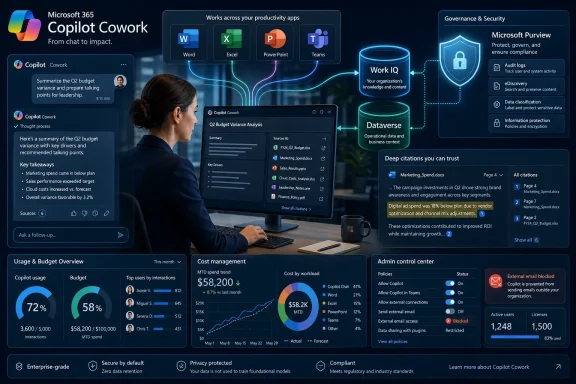
Microsoft added Microsoft 365 Roadmap item 567005 on June 30, 2026, describing a July 2026 general availability release of deeper Copilot Cowork adoption and impact analytics in Viva Insights, exposed through the new AI Cost dashboard, the Copilot dashboard, exports, and advanced insights queries. The feature sounds narrow, almost administrative. It is not. Microsoft is quietly building the accounting layer for a future in which AI work is no longer measured by seat counts alone, but by delegated tasks, consumption, adoption, and claimed business impact.
For the first two years of Microsoft 365 Copilot, the dominant enterprise question was simple: who gets a license? That question made sense when Copilot was sold as a premium assistant bolted onto Word, Excel, Outlook, Teams, and the Microsoft Graph. Adoption dashboards could tell executives whether employees were trying the tool, which apps they were using, and whether usage looked healthy enough to justify the procurement cycle.
Copilot Cowork changes the shape of the argument. A chat assistant is something an employee uses; a cowork-style agent is something an employee delegates to. That shift forces IT, finance, and business leaders to ask a more uncomfortable question: not merely whether people are using AI, but whether the organization understands what the AI is doing, what it costs, and whether the results justify expanding it.
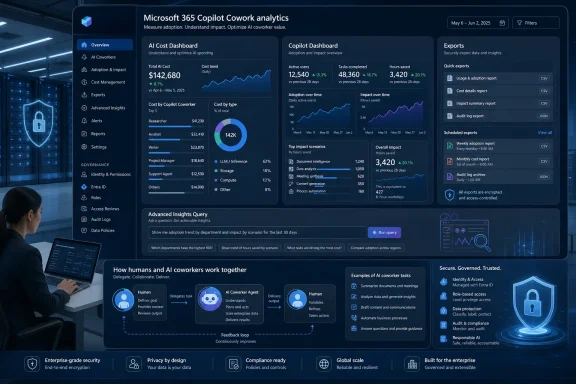
Roadmap ID 567005 is Microsoft’s answer to that pressure. The company says deeper insights into Cowork adoption and impact will be accessible from the new AI Cost dashboard and Copilot dashboard, with export capability and a new AI cost query in advanced insights. In plain English, Microsoft is preparing to let analysts interrogate Cowork usage as a measurable business system rather than a novelty inside a productivity suite.
That is the right move, but it also reveals the problem. If Microsoft has to build a dashboard specifically to explain Cowork adoption and cost, then Cowork is not just another Copilot button. It is a new operational layer, and operational layers need governance.
Cowork makes that model incomplete because it implies multi-step work. The value proposition is not just “summarize this meeting” or “draft this email.” It is closer to “handle this workflow,” “coordinate this task,” or “move this project forward while I do something else.” Once AI crosses that line, usage frequency is no longer enough.
A user who opens Copilot five times a day may be doing shallow work. A user who launches one Cowork task may be consuming more compute, touching more business context, and creating a larger downstream effect than a dozen prompts in Word. That makes the traditional adoption chart feel like counting telephone calls in an era of cloud applications.
Microsoft appears to understand this. The roadmap language emphasizes adoption and impact, and it places those signals inside cost-oriented and dashboard-oriented surfaces. That pairing matters. Microsoft is not presenting Cowork as a magic productivity vapor; it is preparing to give organizations the instrumentation to defend, tune, or constrain it.
The tension is that impact metrics are always political. A dashboard can count usage, model cost, and compare departments, but it cannot automatically prove that the work was good, necessary, compliant, or strategically useful. The more Microsoft pushes Cowork as enterprise-ready digital labor, the more customers will ask for evidence that looks like business accounting rather than product telemetry.
That is especially true for agentic systems. A conventional SaaS app is expensive because a human uses it. An AI agent can be expensive because it keeps working after the human has stopped typing. If the promise of Cowork is long-running, multi-step work, then the cost model has to account for persistence, complexity, model routing, data retrieval, and retries.
The dashboard is therefore not just a reporting convenience. It is a political instrument for CIOs and CFOs who will be asked why the AI bill is rising, which teams are driving it, and whether those teams are producing measurable returns. Without that layer, Copilot risks becoming another sprawling enterprise platform whose enthusiastic launch is followed by a grim quarterly review.
This is where Microsoft has an advantage. Because Copilot lives inside Microsoft 365, the company can connect usage signals to identity, collaboration patterns, organizational metadata, and existing Viva Insights reporting. That does not automatically make the conclusions correct, but it gives Microsoft a much richer substrate than a standalone chatbot vendor can easily provide.
It also gives Microsoft a governance burden. The more granular the AI cost picture becomes, the more likely it is to expose uncomfortable truths: some teams may use Cowork heavily without measurable benefit, while others may underuse it because their workflows are too sensitive, too specialized, or too poorly documented for AI delegation. A mature dashboard will not simply celebrate adoption. It will reveal unevenness.
For Copilot Cowork, export matters because the audience is bigger than IT. Finance will want cost allocation. Security teams will want patterns of risky usage. Compliance officers may want retention and review processes. Business-unit leaders will want to compare promised productivity gains against headcount, output, customer response times, or project cycle time.
A dashboard without export is a product demo. A dashboard with export can become part of enterprise governance. Microsoft’s roadmap language suggests it knows customers will not accept AI impact claims that can only be viewed inside a Microsoft-controlled experience.
There is also a subtler point: exportability changes incentives. Once data can leave the dashboard, it can be challenged. Analysts can compare Microsoft’s adoption narratives against internal metrics. They can ask whether Cowork usage correlates with actual project outcomes or merely with departments that have enthusiastic managers and generous license pools.
That is healthy. The enterprise AI market has suffered from too much storytelling and not enough measurement. If Microsoft wants Cowork to become part of everyday business operations, it should welcome customers putting its metrics under pressure.
Analyst-queryable metrics let customers move beyond canned views. A global firm may want to compare Cowork adoption between regions with different data residency expectations. A consulting company may want to map Cowork usage against billable work. A software company may want to understand whether AI delegation helps program managers but barely moves the needle for engineers. A public-sector organization may want stricter oversight and a narrower definition of acceptable impact.
This is where Viva Insights becomes more than a reporting surface. It becomes the analytic environment in which Microsoft tries to make AI work measurable inside organizational behavior. That is powerful, but it also raises the stakes for data quality, permissions, privacy boundaries, and interpretability.
Microsoft will need to be careful about what these metrics imply. “Impact” is a seductive word. It can suggest causation where there is only correlation, or productivity where there is only activity. A team that uses Cowork heavily may be more productive because of Cowork, or it may be using Cowork heavily because it is already under pressure, understaffed, or drowning in coordination work.
That is not an argument against analytics. It is an argument for humility. The most useful AI cost query will not be the one that tells executives a simple success story. It will be the one that lets analysts separate signal from noise.
Microsoft generally frames Viva Insights and Copilot analytics around organizational-level patterns rather than individual surveillance, and that distinction matters. Aggregation, minimum group sizes, role-based access, and privacy controls are essential to making workplace analytics acceptable. But the arrival of Cowork adds a new emotional charge because the system is no longer merely measuring human activity. It is measuring the handoff between humans and AI.
Employees may reasonably ask whether Cowork analytics will be used to identify departments that are “behind” on AI, managers who are not pushing adoption, or roles that appear ripe for automation. Even if Microsoft’s product design avoids individual scorekeeping, customers can still misuse aggregated metrics in blunt ways. A dashboard does not have to name and shame a single worker to reshape workplace pressure.
That puts IT leaders in an awkward position. They need the analytics to manage cost and risk, but they also need trust from the people expected to use Cowork. If workers believe every AI delegation becomes evidence in a productivity trial, adoption will become performative. People will use the tool to look compliant rather than because it helps.
The smart organizations will separate governance from coercion. They will explain what is being measured, why it is being measured, who can see it, and what decisions it will not be used to make. Microsoft can provide the controls, but customers will set the culture.
The urgency makes sense. Enterprise AI is moving from pilot budgets into operational budgets, and that transition is brutal. Pilots tolerate fuzziness. Operations require accountability. A CIO can sponsor experimentation with a few hundred users, but broad deployment demands a view of who is using the system, what it is doing, and why the invoice is defensible.
Copilot Cowork also arrives in a market that is learning the difference between impressive demos and durable workflow value. AI agents can look magical when they complete a scripted task. They become harder to justify when they require supervision, create rework, or fail silently in edge cases. Analytics will not solve those problems, but it can reveal where they are happening.
That is why the cost dashboard may become the most consequential part of Microsoft’s AI management story. The industry has talked obsessively about model capability, context windows, and agent frameworks. Enterprises will care about something more mundane: whether the thing saves more money than it costs, without creating unacceptable risk.
Microsoft is effectively admitting that AI adoption can no longer be treated as a sentiment campaign. It needs metering, reporting, export, and query. That is less glamorous than a new Copilot skill, but far more important for whether Cowork survives procurement scrutiny.
The first-order work will be licensing and access. Organizations will need to decide who gets Cowork, which groups should be measured together, and how usage should be tied to business units or cost centers. That is not just a procurement exercise; it is an identity and governance exercise.
The second-order work will be data readiness. Cowork will only be as safe and useful as the Microsoft 365 environment around it. Overshared SharePoint sites, messy Teams sprawl, stale permissions, and unclear sensitivity labels will all become more consequential when AI systems can act across work context. Analytics may show adoption and cost, but it cannot clean up the tenant by itself.
The third-order work will be operational response. If the dashboard shows high Cowork use in one department and little impact, who investigates? If exports show rising AI costs tied to a small group of power users, does IT throttle, train, or expand? If analysts find strong impact in one workflow, how does the organization safely replicate it elsewhere?
These are not futuristic questions. They are the same questions administrators already face with cloud services, security tooling, and collaboration platforms. AI simply compresses the timeline and raises the visibility.
A product can measure whether a user launched Cowork, how often, in which context, and perhaps how much cost was associated with that activity. It can infer certain patterns from collaboration metadata and workflow signals. But “impact” in a business sense depends on what the organization values: faster sales cycles, fewer support escalations, better documents, shorter meetings, more code shipped, less burnout, or lower contractor spend.
That variability means Microsoft’s impact story will inevitably be partly standardized and partly customer-defined. Out-of-the-box dashboards can provide a shared language, but they cannot know every company’s operating model. The new advanced insights query is important because it gives customers a way to bring their own analytical frame.
Still, there is a danger in dressing activity up as value. The enterprise software industry has spent decades selling dashboards that imply progress because lines go up. Copilot Cowork will need stronger evidence than rising usage if it is to avoid the same trap.
The best version of this feature would help customers find both successes and failures. It would show where Cowork saves time, where it merely shifts work around, where it generates avoidable cost, and where adoption is being blocked by training, data quality, or trust. The worst version would become a trophy case for AI enthusiasm.
That is not a failure of the technology. It is the sign that AI is entering the boring phase of enterprise adoption, which is where durable platforms are either built or exposed. Microsoft has enough experience in enterprise software to know that the boring phase is where customers decide whether a product becomes infrastructure.
Copilot Cowork analytics will not determine the success of Cowork on its own. The underlying agent experience still has to be reliable, understandable, secure, and worth paying for. But without these analytics, the product would be nearly impossible to govern at scale.
The roadmap item is therefore more revealing than it first appears. Microsoft is not simply adding another chart to Viva Insights. It is constructing the management plane for delegated AI work inside Microsoft 365.
 Microsoft Moves Copilot From Rollout Story to Cost-Center Story
For the first two years of Microsoft 365 Copilot, the dominant enterprise question was simple: who gets a license? That question made sense when Copilot was sold as a premium assistant bolted onto Word, Excel, Outlook, Teams, and the Microsoft Graph. Adoption dashboards could tell executives whether employees were trying the tool, which apps they were using, and whether usage looked healthy enough to justify the procurement cycle.Copilot Cowork changes the shape of the argument. A chat assistant is something an employee uses; a cowork-style agent is something an employee delegates to. That shift forces IT, finance, and business leaders to ask a more uncomfortable question: not merely whether people are using AI, but whether the organization understands what the AI is doing, what it costs, and whether the results justify expanding it.
Roadmap ID 567005 is Microsoft’s answer to that pressure. The company says deeper insights into Cowork adoption and impact will be accessible from the new AI Cost dashboard and Copilot dashboard, with export capability and a new AI cost query in advanced insights. In plain English, Microsoft is preparing to let analysts interrogate Cowork usage as a measurable business system rather than a novelty inside a productivity suite.
That is the right move, but it also reveals the problem. If Microsoft has to build a dashboard specifically to explain Cowork adoption and cost, then Cowork is not just another Copilot button. It is a new operational layer, and operational layers need governance.
Cowork Makes the Old Copilot Metrics Look Too Small
The original Copilot analytics story fit neatly into a software-as-a-service adoption playbook. Administrators could monitor readiness, license assignment, activation, app usage, and broad impact signals. The message was familiar: deploy the tool, train users, watch adoption, and look for productivity gains.Cowork makes that model incomplete because it implies multi-step work. The value proposition is not just “summarize this meeting” or “draft this email.” It is closer to “handle this workflow,” “coordinate this task,” or “move this project forward while I do something else.” Once AI crosses that line, usage frequency is no longer enough.
A user who opens Copilot five times a day may be doing shallow work. A user who launches one Cowork task may be consuming more compute, touching more business context, and creating a larger downstream effect than a dozen prompts in Word. That makes the traditional adoption chart feel like counting telephone calls in an era of cloud applications.
Microsoft appears to understand this. The roadmap language emphasizes adoption and impact, and it places those signals inside cost-oriented and dashboard-oriented surfaces. That pairing matters. Microsoft is not presenting Cowork as a magic productivity vapor; it is preparing to give organizations the instrumentation to defend, tune, or constrain it.
The tension is that impact metrics are always political. A dashboard can count usage, model cost, and compare departments, but it cannot automatically prove that the work was good, necessary, compliant, or strategically useful. The more Microsoft pushes Cowork as enterprise-ready digital labor, the more customers will ask for evidence that looks like business accounting rather than product telemetry.
The AI Cost Dashboard Is the More Important Half of the Announcement
The phrase “AI Cost dashboard” deserves more attention than the typical roadmap entry will receive. Microsoft has spent years training customers to think in per-user subscription terms. AI workloads are pushing the industry toward a more complicated blend of seats, consumption, model selection, premium features, and capacity management.That is especially true for agentic systems. A conventional SaaS app is expensive because a human uses it. An AI agent can be expensive because it keeps working after the human has stopped typing. If the promise of Cowork is long-running, multi-step work, then the cost model has to account for persistence, complexity, model routing, data retrieval, and retries.
The dashboard is therefore not just a reporting convenience. It is a political instrument for CIOs and CFOs who will be asked why the AI bill is rising, which teams are driving it, and whether those teams are producing measurable returns. Without that layer, Copilot risks becoming another sprawling enterprise platform whose enthusiastic launch is followed by a grim quarterly review.
This is where Microsoft has an advantage. Because Copilot lives inside Microsoft 365, the company can connect usage signals to identity, collaboration patterns, organizational metadata, and existing Viva Insights reporting. That does not automatically make the conclusions correct, but it gives Microsoft a much richer substrate than a standalone chatbot vendor can easily provide.
It also gives Microsoft a governance burden. The more granular the AI cost picture becomes, the more likely it is to expose uncomfortable truths: some teams may use Cowork heavily without measurable benefit, while others may underuse it because their workflows are too sensitive, too specialized, or too poorly documented for AI delegation. A mature dashboard will not simply celebrate adoption. It will reveal unevenness.
Export Capability Turns a Product Dashboard Into an Audit Trail
The inclusion of export capability is easy to overlook, but it is one of the most practical details in the roadmap item. Enterprise administrators rarely live inside one vendor dashboard. They export, blend, archive, reconcile, and argue over data in Power BI, Excel, data warehouses, procurement systems, and internal reporting packs.For Copilot Cowork, export matters because the audience is bigger than IT. Finance will want cost allocation. Security teams will want patterns of risky usage. Compliance officers may want retention and review processes. Business-unit leaders will want to compare promised productivity gains against headcount, output, customer response times, or project cycle time.
A dashboard without export is a product demo. A dashboard with export can become part of enterprise governance. Microsoft’s roadmap language suggests it knows customers will not accept AI impact claims that can only be viewed inside a Microsoft-controlled experience.
There is also a subtler point: exportability changes incentives. Once data can leave the dashboard, it can be challenged. Analysts can compare Microsoft’s adoption narratives against internal metrics. They can ask whether Cowork usage correlates with actual project outcomes or merely with departments that have enthusiastic managers and generous license pools.
That is healthy. The enterprise AI market has suffered from too much storytelling and not enough measurement. If Microsoft wants Cowork to become part of everyday business operations, it should welcome customers putting its metrics under pressure.
Advanced Insights Gives Analysts the Keys Microsoft Cannot Hold Alone
The new AI cost query in advanced insights is the most technical piece of the roadmap item, and probably the one that will matter most to mature organizations. Prebuilt dashboards are useful for executives, but they rarely survive first contact with real enterprise complexity. Every company has its own org structure, cost centers, regulated workflows, seasonal cycles, and definition of productivity.Analyst-queryable metrics let customers move beyond canned views. A global firm may want to compare Cowork adoption between regions with different data residency expectations. A consulting company may want to map Cowork usage against billable work. A software company may want to understand whether AI delegation helps program managers but barely moves the needle for engineers. A public-sector organization may want stricter oversight and a narrower definition of acceptable impact.
This is where Viva Insights becomes more than a reporting surface. It becomes the analytic environment in which Microsoft tries to make AI work measurable inside organizational behavior. That is powerful, but it also raises the stakes for data quality, permissions, privacy boundaries, and interpretability.
Microsoft will need to be careful about what these metrics imply. “Impact” is a seductive word. It can suggest causation where there is only correlation, or productivity where there is only activity. A team that uses Cowork heavily may be more productive because of Cowork, or it may be using Cowork heavily because it is already under pressure, understaffed, or drowning in coordination work.
That is not an argument against analytics. It is an argument for humility. The most useful AI cost query will not be the one that tells executives a simple success story. It will be the one that lets analysts separate signal from noise.
The Privacy Debate Will Not Stay Outside the Dashboard
Any feature that measures AI adoption and impact inside a workplace will invite suspicion from employees. That suspicion is not irrational. Workers have watched productivity suites become collaboration platforms, collaboration platforms become telemetry systems, and telemetry systems become management dashboards.Microsoft generally frames Viva Insights and Copilot analytics around organizational-level patterns rather than individual surveillance, and that distinction matters. Aggregation, minimum group sizes, role-based access, and privacy controls are essential to making workplace analytics acceptable. But the arrival of Cowork adds a new emotional charge because the system is no longer merely measuring human activity. It is measuring the handoff between humans and AI.
Employees may reasonably ask whether Cowork analytics will be used to identify departments that are “behind” on AI, managers who are not pushing adoption, or roles that appear ripe for automation. Even if Microsoft’s product design avoids individual scorekeeping, customers can still misuse aggregated metrics in blunt ways. A dashboard does not have to name and shame a single worker to reshape workplace pressure.
That puts IT leaders in an awkward position. They need the analytics to manage cost and risk, but they also need trust from the people expected to use Cowork. If workers believe every AI delegation becomes evidence in a productivity trial, adoption will become performative. People will use the tool to look compliant rather than because it helps.
The smart organizations will separate governance from coercion. They will explain what is being measured, why it is being measured, who can see it, and what decisions it will not be used to make. Microsoft can provide the controls, but customers will set the culture.
Microsoft Is Building the Meters Before the Real Bill Arrives
The timing is notable. Microsoft lists the feature as in development with general availability planned for July 2026, barely after the roadmap item’s June 30 creation date. That suggests this is not a far-off concept but a near-term addition to the Copilot Analytics stack.The urgency makes sense. Enterprise AI is moving from pilot budgets into operational budgets, and that transition is brutal. Pilots tolerate fuzziness. Operations require accountability. A CIO can sponsor experimentation with a few hundred users, but broad deployment demands a view of who is using the system, what it is doing, and why the invoice is defensible.
Copilot Cowork also arrives in a market that is learning the difference between impressive demos and durable workflow value. AI agents can look magical when they complete a scripted task. They become harder to justify when they require supervision, create rework, or fail silently in edge cases. Analytics will not solve those problems, but it can reveal where they are happening.
That is why the cost dashboard may become the most consequential part of Microsoft’s AI management story. The industry has talked obsessively about model capability, context windows, and agent frameworks. Enterprises will care about something more mundane: whether the thing saves more money than it costs, without creating unacceptable risk.
Microsoft is effectively admitting that AI adoption can no longer be treated as a sentiment campaign. It needs metering, reporting, export, and query. That is less glamorous than a new Copilot skill, but far more important for whether Cowork survives procurement scrutiny.
Windows Admins Should Read This as a Governance Signal
For WindowsForum readers, the obvious angle is Microsoft 365 rather than Windows itself. But the practical audience includes the same people who manage Entra ID groups, Microsoft 365 licensing, endpoint security posture, data loss prevention, Purview policies, Teams governance, and user training. Copilot Cowork analytics will land in the middle of that administrative reality.The first-order work will be licensing and access. Organizations will need to decide who gets Cowork, which groups should be measured together, and how usage should be tied to business units or cost centers. That is not just a procurement exercise; it is an identity and governance exercise.
The second-order work will be data readiness. Cowork will only be as safe and useful as the Microsoft 365 environment around it. Overshared SharePoint sites, messy Teams sprawl, stale permissions, and unclear sensitivity labels will all become more consequential when AI systems can act across work context. Analytics may show adoption and cost, but it cannot clean up the tenant by itself.
The third-order work will be operational response. If the dashboard shows high Cowork use in one department and little impact, who investigates? If exports show rising AI costs tied to a small group of power users, does IT throttle, train, or expand? If analysts find strong impact in one workflow, how does the organization safely replicate it elsewhere?
These are not futuristic questions. They are the same questions administrators already face with cloud services, security tooling, and collaboration platforms. AI simply compresses the timeline and raises the visibility.
The Word “Impact” Will Do a Lot of Work
Microsoft’s roadmap language promises deeper insights into adoption and impact. Adoption is comparatively easy. Impact is where the argument begins.A product can measure whether a user launched Cowork, how often, in which context, and perhaps how much cost was associated with that activity. It can infer certain patterns from collaboration metadata and workflow signals. But “impact” in a business sense depends on what the organization values: faster sales cycles, fewer support escalations, better documents, shorter meetings, more code shipped, less burnout, or lower contractor spend.
That variability means Microsoft’s impact story will inevitably be partly standardized and partly customer-defined. Out-of-the-box dashboards can provide a shared language, but they cannot know every company’s operating model. The new advanced insights query is important because it gives customers a way to bring their own analytical frame.
Still, there is a danger in dressing activity up as value. The enterprise software industry has spent decades selling dashboards that imply progress because lines go up. Copilot Cowork will need stronger evidence than rising usage if it is to avoid the same trap.
The best version of this feature would help customers find both successes and failures. It would show where Cowork saves time, where it merely shifts work around, where it generates avoidable cost, and where adoption is being blocked by training, data quality, or trust. The worst version would become a trophy case for AI enthusiasm.
The Dashboard Era of AI Will Be Less Magical and More Useful
The romance of generative AI has always been in the prompt: type a request, watch the machine respond, imagine a future with less drudgery. Enterprise reality is less cinematic. It is dashboards, permissions, exports, queries, billing reviews, exception handling, training plans, and uncomfortable meetings about why one division is spending twice as much as another.That is not a failure of the technology. It is the sign that AI is entering the boring phase of enterprise adoption, which is where durable platforms are either built or exposed. Microsoft has enough experience in enterprise software to know that the boring phase is where customers decide whether a product becomes infrastructure.
Copilot Cowork analytics will not determine the success of Cowork on its own. The underlying agent experience still has to be reliable, understandable, secure, and worth paying for. But without these analytics, the product would be nearly impossible to govern at scale.
The roadmap item is therefore more revealing than it first appears. Microsoft is not simply adding another chart to Viva Insights. It is constructing the management plane for delegated AI work inside Microsoft 365.
The Fine Print IT Should Circle Before July
Microsoft’s July 2026 target gives customers little time to treat this as a distant roadmap curiosity. The organizations most likely to benefit are the ones that prepare their governance model before the dashboard arrives, not after the first executive asks why a department’s AI costs spiked.- Organizations should decide in advance which teams are allowed to use Copilot Cowork and how those groups map to cost centers, departments, or business outcomes.
- Administrators should review Microsoft 365 permissions, sensitivity labels, and oversharing risks before encouraging more delegated AI work.
- Analysts should plan how exported Cowork metrics will be combined with internal performance, finance, and operational data.
- IT leaders should communicate clearly whether Copilot and Cowork analytics will be used for adoption coaching, cost governance, productivity measurement, or all three.
- Executives should resist treating usage growth as proof of return on investment until impact metrics are tested against real business outcomes.
References
- Primary source: Microsoft 365 Roadmap
Published: 2026-06-30T22:57:58.6723014Z
Microsoft 365 Roadmap | Microsoft 365
The Microsoft 365 Roadmap lists updates that are currently planned for applicable subscribers. Check here for more information on the status of new features and updates.www.microsoft.com
- Official source: learn.microsoft.com
Copilot Analytics introduction | Microsoft Learn
Explains how to set up and use Copilot Analytics in Viva Insights, including the Microsoft Copilot Dashboard and Advanced Reporting.learn.microsoft.com - Official source: techcommunity.microsoft.com
- Related coverage: windowscentral.com
This is Microsoft's new "Copilot Cowork": An experiment with Anthropic's Claude AI models that plans and delegates your work | Windows Central
Microsoft ships Copilot Cowork to its Frontier program.www.windowscentral.com - Official source: adoption.microsoft.com
- Related coverage: techradar.com
Microsoft makes Copilot Cowork open to everyone, and wants to help you tackle even the trickiest work tasks | TechRadar
Copilot Cowork gets an upgrade as it opens to all userswww.techradar.com
- Related coverage: itpro.com
Copilot Cowork is now generally available: Everything you need to know, including pricing, usage limits, and new features | IT Pro
Microsoft has announced that Copilot Cowork is now generally available for users globally, following a beta period via the tech giant’s Frontier program.www.itpro.com - Official source: news.microsoft.com
- Related coverage: dashboard.adoptify.ai