

Microsoft said Microsoft 365 Copilot passed a March 2026 ISO/IEC 42001 surveillance audit with no non-conformities or improvement observations, and the audited scope now includes Copilot Studio alongside the core Copilot services. That sounds like a narrow compliance update, but it lands at a much larger inflection point for enterprise AI. Microsoft is no longer just selling a chatbot inside Office; it is asking customers to let AI agents operate across workflows, data repositories, approvals, and business applications. The clean audit matters because the blast radius has changed.
The obvious headline is that Microsoft 365 Copilot has once again cleared ISO/IEC 42001 scrutiny. The more important story is that Copilot Studio is now reportedly inside the certified scope, which moves the audit beyond the familiar terrain of summarizing documents, drafting email, and answering questions over Microsoft 365 data.
That distinction matters because Copilot Studio is where Copilot stops being a productivity assistant and starts becoming an enterprise automation layer. A user asking Copilot to summarize a Teams meeting creates one kind of governance problem. A department publishing an agent that can consult internal systems, trigger workflow steps, or respond to customers creates another.
ISO/IEC 42001 is built for that second problem more than most consumer-facing AI debates acknowledge. It is a management-system standard for artificial intelligence, not a benchmark for model intelligence and not a guarantee that an answer will be correct. Auditors are looking for the machinery around AI: policies, accountability, risk assessment, monitoring, documentation, improvement cycles, and control ownership.
That makes Microsoft’s result useful but easy to misread. A clean audit does not mean Copilot is safe in every tenant, harmless in every workflow, or immune to prompt injection, oversharing, hallucination, or misconfiguration. It means Microsoft has persuaded an external assessor that its AI governance system, across the audited scope, is structured and operating without identified non-conformities.
For CIOs and security teams, that is not nothing. It is also not enough.
That is why Microsoft’s audit result has commercial weight. Large organizations are under pressure to adopt generative AI without turning their tenants into uncontrolled experiments. Procurement teams want evidence. Legal teams want accountability. Security teams want to know who owns the risk when AI touches regulated information or business-critical processes.
ISO/IEC 42001 helps answer those questions at the management layer. It asks whether an organization has defined the scope of its AI management system, identified relevant risks, assigned responsibilities, maintained documentation, evaluated performance, and improved controls over time. Those are the kinds of things enterprises expect from a platform vendor that wants AI embedded into everyday work.
But the standard’s strength is also its limitation. It certifies a system of governance, not every deployment pattern that customers invent after the software lands in their tenant. Microsoft can define responsible AI processes, model selection controls, review mechanisms, and escalation paths; customers still decide which users get Copilot licenses, which SharePoint sites are overexposed, which agents get published, and which connectors reach production data.
That is the line enterprise buyers cannot afford to blur. A vendor-side AI management certificate can support due diligence. It cannot replace tenant-side architecture review.
That turns AI governance from a content problem into a systems problem. The relevant questions are no longer only about whether an answer is accurate. They are about what an agent can reach, what it can do, who approved it, how it logs its behavior, how it handles unsafe requests, and whether its permissions match the human process it is supposed to augment.
This is where many AI pilots break down. A demo agent that answers HR policy questions is easy to celebrate. A production agent that can read employee records, invoke a ticketing workflow, and respond to ambiguous user requests is a different beast. It needs access controls, testing, change management, monitoring, rollback plans, and a clear owner.
Microsoft has been pushing Copilot Studio as the place where organizations can build and manage that agent layer. Bringing it into the ISO/IEC 42001 scope is therefore more than a paperwork update. It is Microsoft saying that the governance framework extends into the part of Copilot where customers will create the most bespoke risk.
That is the right direction. It also raises the bar for what customers should demand from their own internal deployments. If Copilot Studio agents are now serious enough to sit inside Microsoft’s audited AI governance scope, they are serious enough to require the same kind of review enterprises already apply to workflow automation, SaaS integrations, and privileged applications.
That shift is strategically sensible. Different models have different strengths, and enterprise customers increasingly want choice for reasoning, automation, coding-adjacent tasks, cost, latency, or policy reasons. Microsoft also has an obvious incentive not to let Copilot be perceived as merely a branded wrapper around one AI supplier.
But multi-model systems create governance complexity. If one environment allows Anthropic models and another does not, if one agent falls back to GPT-4o when an external model path is disabled, and if regional or cloud availability differs, then the compliance posture is no longer a single checkbox. It becomes an environment-by-environment control matrix.
That is where admins matter. Microsoft’s documentation around model selection and external model access points to a world in which administrators can gate access, decide which models are available to makers, and manage differences across environments. This is the right administrative shape, but it does not remove the need for operational discipline.
A model choice is not merely a performance preference. It can affect data handling assumptions, output behavior, safety characteristics, reliability, latency, and the audit trail an organization expects to preserve. Even when Microsoft brokers the experience through its platform, enterprise teams will want to understand what is sent where, under which contractual and technical controls, and how that changes across geographies.
In other words, model choice gives enterprises flexibility. It also gives them one more thing to misconfigure.
The reason is simple: enterprise AI risk is rarely confined to the model. It emerges from the connection between the model, the user, the data, the permissions layer, the workflow, and the surrounding business process. A technically impressive model can still produce a harmful result if it is granted too much access, given a poorly scoped instruction, or placed in front of users who assume it has authority it does not actually possess.
This is why Copilot Studio deserves special scrutiny. It empowers business units and technical teams to create agents that feel local, useful, and tailored. That is the value proposition. It is also the risk proposition, because local teams often understand the workflow better than central IT but may not understand the security implications of every connector, permission, or fallback behavior.
Microsoft’s audit result gives those central teams a stronger basis for saying the platform itself is not an ungoverned science project. But the harder work happens inside the customer organization. Who can build an agent? Who can publish one? Who reviews connectors? Who validates prompts? Who checks whether an agent’s data access exceeds the job it is supposed to perform?
These questions are not anti-AI bureaucracy. They are the minimum price of putting AI into business processes that matter.
That has been one of the most practical concerns around Microsoft 365 Copilot since its enterprise debut. Copilot generally works within existing access controls, which is exactly what customers should want. But “within existing access controls” is only reassuring if those controls are clean.
Copilot Studio adds a new layer to that concern. An agent may be designed for a specific audience, but its usefulness often comes from the systems and documents it can reach. If those connections are too broad, the agent can become a friendly interface to data sprawl. If they are too narrow, the agent disappoints users and invites shadow workarounds.
This is why the clean audit should be treated as a platform signal rather than a deployment shortcut. Microsoft can document governance controls. It cannot retroactively classify every customer file, rationalize every group, or decide which internal process should permit an AI agent to act.
Before broad rollout, enterprises still need to test Copilot and Copilot Studio against real data boundaries. That means using representative users, representative content, and representative workflows — not sanitized demos. The question is not whether Copilot behaves well in an ideal tenant. The question is whether it behaves acceptably in yours.
That matters because accountability depends on reconstructing what happened. If an agent gives bad guidance, exposes information, initiates an incorrect workflow, or fails to escalate a risky request, the organization needs a record that is useful to investigators and defensible to auditors. “The AI did it” is not an incident report.
Microsoft’s broader Copilot governance pitch leans on logging, data boundary commitments, admin controls, and responsible AI review processes. Those are essential foundations. But enterprises should still evaluate whether the logs they can actually access are sufficient for their regulatory and internal needs.
The most important evidence may not be the final answer shown to a user. It may be the chain around that answer: which identity invoked the agent, which data sources were retrieved, which model was used, which connector was called, whether a fallback occurred, whether a safety system intervened, and whether a human approved the resulting action.
This is where AI governance becomes indistinguishable from old-fashioned IT governance. If a process matters enough to automate, it matters enough to log. If it matters enough to log, it matters enough to review.
That does not mean ISO/IEC 42001 is a magic compliance shield. It is not a substitute for legal analysis, and it does not automatically prove compliance with every AI regulation. But it can become useful evidence that a vendor has a structured AI management system and that customers are not relying solely on marketing assurances.
This is especially relevant for Microsoft because Copilot sits inside the productivity layer used by regulated industries, government contractors, schools, hospitals, banks, manufacturers, and law firms. The same tool that helps a sales manager summarize email may also touch sensitive customer data, regulated records, confidential strategy, or employee information. That breadth makes governance claims more consequential.
The enterprise AI market is gradually sorting itself into vendors that can produce serious control evidence and vendors that cannot. Microsoft wants to be in the first group, and ISO/IEC 42001 is one way to signal that. Smaller AI vendors may move faster, but they will increasingly be asked to answer the same governance questions that cloud vendors learned to answer years ago.
For buyers, the lesson is not to worship the certificate. It is to use the certificate as a starting point for sharper questions.
That is why Copilot’s governance story matters so much. If Microsoft can convince customers that AI agents can be governed through familiar administrative patterns, it gains an advantage that pure AI labs cannot easily replicate. Entra ID, Purview, Microsoft 365 admin controls, tenant boundaries, sensitivity labels, audit logs, and environment-level policies are not glamorous, but they are what make enterprise adoption possible.
Copilot Studio fits neatly into that strategy. Microsoft is not merely selling AI answers; it is selling the idea that AI agents can be built, deployed, and controlled inside an enterprise management framework. The ISO/IEC 42001 audit reinforces that positioning by placing the agent-building layer under the same broad governance umbrella.
But this advantage only holds if the controls are understandable and usable. Admins cannot govern what they cannot see. Security teams cannot approve what they cannot model. Compliance teams cannot defend what they cannot document. Microsoft’s next challenge is therefore not only to pass audits but to make the resulting controls legible to the people who must operate them.
A clean certificate is valuable. A clear control plane is more valuable.
That is where Microsoft’s clean audit should inform, not relax, customer discipline. A responsible deployment of Copilot Studio should look less like turning on a feature and more like introducing a new application platform. Organizations should define approved patterns, review data access, test representative prompts, monitor behavior, and create a path for users to report failures.
They should also resist the temptation to treat all agents as equal. An agent that answers questions from a public FAQ carries a different risk profile from one that can inspect internal financial records or initiate a customer support workflow. A low-risk agent may need lightweight review. A high-impact agent should face the same scrutiny as any other system touching regulated or operationally critical data.
The governance model should also account for drift. Agents change. Business processes change. Connectors change. Models change. A deployment that looked acceptable in June may behave differently in October because the underlying workflow, content corpus, or model availability has shifted.
ISO/IEC 42001’s emphasis on continual improvement is useful precisely because AI systems are not static. Enterprises should borrow that mindset for their own Copilot programs. The goal is not a one-time approval. The goal is a living control system.
The inclusion of Copilot Studio makes the result more consequential because it reaches into the agent layer, where enterprises are likely to create the most powerful and risky deployments. It also arrives after Microsoft’s Copilot stack began embracing a more explicit multi-model architecture, including Anthropic options in some Copilot Studio and Microsoft 365 Copilot scenarios. The governance problem is no longer just “Can we trust this chatbot?” It is “Can we govern a platform of agents, models, connectors, and workflows?”
That is the right question. It is also the question Microsoft must keep answering as Copilot becomes more autonomous. The more agents can do, the less persuasive it becomes to talk about AI safety only in terms of output moderation or model behavior. Enterprise trust will depend on identity, permissions, logging, review, rollback, data boundaries, and human accountability.
The certificate helps Microsoft’s case. It does not finish the customer’s job.
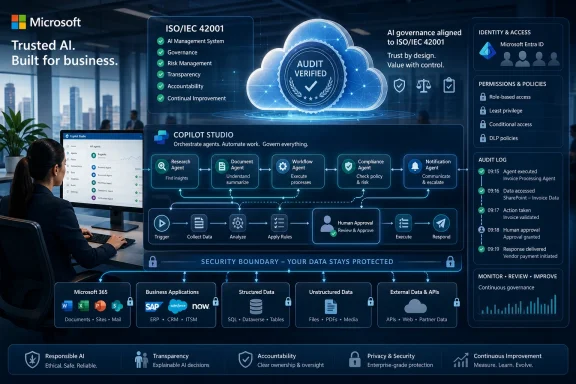 Microsoft’s Clean Audit Is Really a Statement About Agent Trust
The obvious headline is that Microsoft 365 Copilot has once again cleared ISO/IEC 42001 scrutiny. The more important story is that Copilot Studio is now reportedly inside the certified scope, which moves the audit beyond the familiar terrain of summarizing documents, drafting email, and answering questions over Microsoft 365 data.That distinction matters because Copilot Studio is where Copilot stops being a productivity assistant and starts becoming an enterprise automation layer. A user asking Copilot to summarize a Teams meeting creates one kind of governance problem. A department publishing an agent that can consult internal systems, trigger workflow steps, or respond to customers creates another.
ISO/IEC 42001 is built for that second problem more than most consumer-facing AI debates acknowledge. It is a management-system standard for artificial intelligence, not a benchmark for model intelligence and not a guarantee that an answer will be correct. Auditors are looking for the machinery around AI: policies, accountability, risk assessment, monitoring, documentation, improvement cycles, and control ownership.
That makes Microsoft’s result useful but easy to misread. A clean audit does not mean Copilot is safe in every tenant, harmless in every workflow, or immune to prompt injection, oversharing, hallucination, or misconfiguration. It means Microsoft has persuaded an external assessor that its AI governance system, across the audited scope, is structured and operating without identified non-conformities.
For CIOs and security teams, that is not nothing. It is also not enough.
ISO 42001 Gives Buyers a Governance Signal, Not a Hall Pass
The enterprise software industry loves certificates because they compress a messy trust conversation into a procurement artifact. ISO 27001, SOC 2, FedRAMP, and the rest do not eliminate risk, but they give buyers a shared grammar for asking whether vendors have repeatable controls. ISO/IEC 42001 is now being pushed into that same role for AI.That is why Microsoft’s audit result has commercial weight. Large organizations are under pressure to adopt generative AI without turning their tenants into uncontrolled experiments. Procurement teams want evidence. Legal teams want accountability. Security teams want to know who owns the risk when AI touches regulated information or business-critical processes.
ISO/IEC 42001 helps answer those questions at the management layer. It asks whether an organization has defined the scope of its AI management system, identified relevant risks, assigned responsibilities, maintained documentation, evaluated performance, and improved controls over time. Those are the kinds of things enterprises expect from a platform vendor that wants AI embedded into everyday work.
But the standard’s strength is also its limitation. It certifies a system of governance, not every deployment pattern that customers invent after the software lands in their tenant. Microsoft can define responsible AI processes, model selection controls, review mechanisms, and escalation paths; customers still decide which users get Copilot licenses, which SharePoint sites are overexposed, which agents get published, and which connectors reach production data.
That is the line enterprise buyers cannot afford to blur. A vendor-side AI management certificate can support due diligence. It cannot replace tenant-side architecture review.
Copilot Studio Moves the Audit Boundary Into the Messy Part of Enterprise AI
Copilot Studio’s inclusion changes the significance of the audit because custom agents are where enterprise AI gets politically and technically complicated. The early Copilot sales pitch was largely about making Microsoft 365 more useful: summarize a meeting, draft a document, search your files, catch up on a thread. Copilot Studio invites organizations to build their own agents, wire them into processes, and expose them to users with specific roles and business tasks.That turns AI governance from a content problem into a systems problem. The relevant questions are no longer only about whether an answer is accurate. They are about what an agent can reach, what it can do, who approved it, how it logs its behavior, how it handles unsafe requests, and whether its permissions match the human process it is supposed to augment.
This is where many AI pilots break down. A demo agent that answers HR policy questions is easy to celebrate. A production agent that can read employee records, invoke a ticketing workflow, and respond to ambiguous user requests is a different beast. It needs access controls, testing, change management, monitoring, rollback plans, and a clear owner.
Microsoft has been pushing Copilot Studio as the place where organizations can build and manage that agent layer. Bringing it into the ISO/IEC 42001 scope is therefore more than a paperwork update. It is Microsoft saying that the governance framework extends into the part of Copilot where customers will create the most bespoke risk.
That is the right direction. It also raises the bar for what customers should demand from their own internal deployments. If Copilot Studio agents are now serious enough to sit inside Microsoft’s audited AI governance scope, they are serious enough to require the same kind of review enterprises already apply to workflow automation, SaaS integrations, and privileged applications.
The Multi-Model Era Makes Governance Harder Than the Chatbot Era
The timing of the audit matters because Microsoft’s Copilot stack has been moving away from a simple “Microsoft plus OpenAI” mental model. In September 2025, Microsoft announced Anthropic models for Copilot Studio and expanded model choice across parts of Microsoft 365 Copilot. OpenAI remained the default in key places, but the direction was clear: Copilot was becoming a multi-model platform.That shift is strategically sensible. Different models have different strengths, and enterprise customers increasingly want choice for reasoning, automation, coding-adjacent tasks, cost, latency, or policy reasons. Microsoft also has an obvious incentive not to let Copilot be perceived as merely a branded wrapper around one AI supplier.
But multi-model systems create governance complexity. If one environment allows Anthropic models and another does not, if one agent falls back to GPT-4o when an external model path is disabled, and if regional or cloud availability differs, then the compliance posture is no longer a single checkbox. It becomes an environment-by-environment control matrix.
That is where admins matter. Microsoft’s documentation around model selection and external model access points to a world in which administrators can gate access, decide which models are available to makers, and manage differences across environments. This is the right administrative shape, but it does not remove the need for operational discipline.
A model choice is not merely a performance preference. It can affect data handling assumptions, output behavior, safety characteristics, reliability, latency, and the audit trail an organization expects to preserve. Even when Microsoft brokers the experience through its platform, enterprise teams will want to understand what is sent where, under which contractual and technical controls, and how that changes across geographies.
In other words, model choice gives enterprises flexibility. It also gives them one more thing to misconfigure.
Microsoft Is Selling Control Because AI Autonomy Makes Buyers Nervous
Microsoft’s responsible AI messaging has long centered on principles such as fairness, reliability, safety, privacy, security, inclusiveness, transparency, and accountability. Those principles can sound abstract until they meet an agent that has access to business systems. At that point, the abstract vocabulary becomes an operational checklist.The reason is simple: enterprise AI risk is rarely confined to the model. It emerges from the connection between the model, the user, the data, the permissions layer, the workflow, and the surrounding business process. A technically impressive model can still produce a harmful result if it is granted too much access, given a poorly scoped instruction, or placed in front of users who assume it has authority it does not actually possess.
This is why Copilot Studio deserves special scrutiny. It empowers business units and technical teams to create agents that feel local, useful, and tailored. That is the value proposition. It is also the risk proposition, because local teams often understand the workflow better than central IT but may not understand the security implications of every connector, permission, or fallback behavior.
Microsoft’s audit result gives those central teams a stronger basis for saying the platform itself is not an ungoverned science project. But the harder work happens inside the customer organization. Who can build an agent? Who can publish one? Who reviews connectors? Who validates prompts? Who checks whether an agent’s data access exceeds the job it is supposed to perform?
These questions are not anti-AI bureaucracy. They are the minimum price of putting AI into business processes that matter.
The Certificate Does Not Fix the Oldest Copilot Problem: Overshared Data
For all the attention on models and audits, many Copilot risks still begin with classic Microsoft 365 hygiene. If a company has years of overshared SharePoint sites, permissive Teams channels, stale groups, and poorly classified files, Copilot can make that mess easier to discover. The AI did not create the permissions problem; it made the permission problem conversational.That has been one of the most practical concerns around Microsoft 365 Copilot since its enterprise debut. Copilot generally works within existing access controls, which is exactly what customers should want. But “within existing access controls” is only reassuring if those controls are clean.
Copilot Studio adds a new layer to that concern. An agent may be designed for a specific audience, but its usefulness often comes from the systems and documents it can reach. If those connections are too broad, the agent can become a friendly interface to data sprawl. If they are too narrow, the agent disappoints users and invites shadow workarounds.
This is why the clean audit should be treated as a platform signal rather than a deployment shortcut. Microsoft can document governance controls. It cannot retroactively classify every customer file, rationalize every group, or decide which internal process should permit an AI agent to act.
Before broad rollout, enterprises still need to test Copilot and Copilot Studio against real data boundaries. That means using representative users, representative content, and representative workflows — not sanitized demos. The question is not whether Copilot behaves well in an ideal tenant. The question is whether it behaves acceptably in yours.
Agent Logs Are Becoming the New Compliance Evidence
One of the more underappreciated shifts in enterprise AI is the rise of agent activity as an audit object. Traditional software logs show authentication, API calls, file access, workflow events, and administrative actions. AI agents add a more interpretive layer: prompts, responses, tool calls, grounding sources, escalation behavior, and sometimes rejected or flagged interactions.That matters because accountability depends on reconstructing what happened. If an agent gives bad guidance, exposes information, initiates an incorrect workflow, or fails to escalate a risky request, the organization needs a record that is useful to investigators and defensible to auditors. “The AI did it” is not an incident report.
Microsoft’s broader Copilot governance pitch leans on logging, data boundary commitments, admin controls, and responsible AI review processes. Those are essential foundations. But enterprises should still evaluate whether the logs they can actually access are sufficient for their regulatory and internal needs.
The most important evidence may not be the final answer shown to a user. It may be the chain around that answer: which identity invoked the agent, which data sources were retrieved, which model was used, which connector was called, whether a fallback occurred, whether a safety system intervened, and whether a human approved the resulting action.
This is where AI governance becomes indistinguishable from old-fashioned IT governance. If a process matters enough to automate, it matters enough to log. If it matters enough to log, it matters enough to review.
Regulators Are Not Waiting for Perfect AI Standards
The ISO/IEC 42001 result also lands in a broader regulatory moment. Governments are moving faster than most corporate AI governance programs, and organizations are trying to map voluntary standards, vendor claims, and emerging legal duties onto each other. The EU AI Act, sector rules, privacy laws, and procurement requirements are all pushing enterprises toward documented AI oversight.That does not mean ISO/IEC 42001 is a magic compliance shield. It is not a substitute for legal analysis, and it does not automatically prove compliance with every AI regulation. But it can become useful evidence that a vendor has a structured AI management system and that customers are not relying solely on marketing assurances.
This is especially relevant for Microsoft because Copilot sits inside the productivity layer used by regulated industries, government contractors, schools, hospitals, banks, manufacturers, and law firms. The same tool that helps a sales manager summarize email may also touch sensitive customer data, regulated records, confidential strategy, or employee information. That breadth makes governance claims more consequential.
The enterprise AI market is gradually sorting itself into vendors that can produce serious control evidence and vendors that cannot. Microsoft wants to be in the first group, and ISO/IEC 42001 is one way to signal that. Smaller AI vendors may move faster, but they will increasingly be asked to answer the same governance questions that cloud vendors learned to answer years ago.
For buyers, the lesson is not to worship the certificate. It is to use the certificate as a starting point for sharper questions.
Microsoft’s Advantage Is the Admin Plane, Not the Model Alone
Microsoft’s strongest enterprise argument has never been that it alone has access to the best model. The model landscape changes too quickly for that claim to be durable. Its stronger argument is that it owns the productivity surface, the identity layer, the admin plane, the compliance tooling, and the data graph where enterprise work already lives.That is why Copilot’s governance story matters so much. If Microsoft can convince customers that AI agents can be governed through familiar administrative patterns, it gains an advantage that pure AI labs cannot easily replicate. Entra ID, Purview, Microsoft 365 admin controls, tenant boundaries, sensitivity labels, audit logs, and environment-level policies are not glamorous, but they are what make enterprise adoption possible.
Copilot Studio fits neatly into that strategy. Microsoft is not merely selling AI answers; it is selling the idea that AI agents can be built, deployed, and controlled inside an enterprise management framework. The ISO/IEC 42001 audit reinforces that positioning by placing the agent-building layer under the same broad governance umbrella.
But this advantage only holds if the controls are understandable and usable. Admins cannot govern what they cannot see. Security teams cannot approve what they cannot model. Compliance teams cannot defend what they cannot document. Microsoft’s next challenge is therefore not only to pass audits but to make the resulting controls legible to the people who must operate them.
A clean certificate is valuable. A clear control plane is more valuable.
The Real Copilot Test Starts After Procurement Says Yes
The most dangerous moment in an enterprise AI rollout is often after the contract is signed. During procurement, everyone is focused on terms, certifications, security reviews, and executive promises. After rollout begins, the pressure shifts to adoption, use cases, productivity metrics, and impatient business units that want agents in production.That is where Microsoft’s clean audit should inform, not relax, customer discipline. A responsible deployment of Copilot Studio should look less like turning on a feature and more like introducing a new application platform. Organizations should define approved patterns, review data access, test representative prompts, monitor behavior, and create a path for users to report failures.
They should also resist the temptation to treat all agents as equal. An agent that answers questions from a public FAQ carries a different risk profile from one that can inspect internal financial records or initiate a customer support workflow. A low-risk agent may need lightweight review. A high-impact agent should face the same scrutiny as any other system touching regulated or operationally critical data.
The governance model should also account for drift. Agents change. Business processes change. Connectors change. Models change. A deployment that looked acceptable in June may behave differently in October because the underlying workflow, content corpus, or model availability has shifted.
ISO/IEC 42001’s emphasis on continual improvement is useful precisely because AI systems are not static. Enterprises should borrow that mindset for their own Copilot programs. The goal is not a one-time approval. The goal is a living control system.
The Cleanest Audit Still Leaves Work on the Customer Side
Microsoft’s March 2026 result is strongest when understood as evidence of maturity at the platform governance layer. It suggests that Microsoft has built enough process, documentation, oversight, and review into its Copilot program to satisfy an external audit across an expanded scope. That is meaningful in a market where many AI products still ask customers to trust vague safety language and a glossy demo.The inclusion of Copilot Studio makes the result more consequential because it reaches into the agent layer, where enterprises are likely to create the most powerful and risky deployments. It also arrives after Microsoft’s Copilot stack began embracing a more explicit multi-model architecture, including Anthropic options in some Copilot Studio and Microsoft 365 Copilot scenarios. The governance problem is no longer just “Can we trust this chatbot?” It is “Can we govern a platform of agents, models, connectors, and workflows?”
That is the right question. It is also the question Microsoft must keep answering as Copilot becomes more autonomous. The more agents can do, the less persuasive it becomes to talk about AI safety only in terms of output moderation or model behavior. Enterprise trust will depend on identity, permissions, logging, review, rollback, data boundaries, and human accountability.
The certificate helps Microsoft’s case. It does not finish the customer’s job.
Where WindowsForum Readers Should Draw the Line
For IT pros, the practical lesson is to treat the audit as a useful trust signal and then do the unglamorous tenant work anyway. The certificate belongs to Microsoft’s governance system; the deployment risk belongs to your organization once agents meet your data, your users, and your workflows.- Microsoft’s clean March 2026 ISO/IEC 42001 audit is meaningful because the reported scope now includes Copilot Studio, not just the more familiar Microsoft 365 Copilot experience.
- ISO/IEC 42001 evaluates an AI management system, so it supports vendor due diligence but does not certify that every Copilot output or customer-built agent will be safe.
- Copilot Studio raises the stakes because custom agents can connect to business systems, participate in workflows, and expose permission problems that were already present in Microsoft 365.
- Multi-model Copilot deployments give organizations more flexibility, but they also require admins to understand model availability, fallback behavior, regional limits, and environment-specific controls.
- Enterprise rollouts should test real permissions, real content, real connectors, and real logging before expanding Copilot Studio agents beyond controlled pilots.
- The most important customer-side control is ownership: every production agent should have a business owner, a technical owner, an access model, a review process, and an incident path.
References
- Primary source: WinBuzzer
Published: 2026-05-30T21:37:13.886476
- Official source: microsoft.com

Anthropic joins the multi-model lineup in Microsoft Copilot Studio | Microsoft Copilot Blog
In addition to default OpenAI models, Copilot Studio customers can now build agents with Anthropic models Claude Sonnet 4 and Claude Opus 4.1www.microsoft.com - Official source: learn.microsoft.com

Select a primary AI model for your agent - Microsoft Copilot Studio
Choose an AI model for your Microsoft Copilot Studio agent. You can select default models and try out experimental models.learn.microsoft.com - Related coverage: itpro.com

Satya Nadella says “our multi-model approach goes beyond choice’ as Microsoft adds Claude AI models to 365 Copilot
Users can choose between both OpenAI and Anthropic models in Microsoft 365 Copilot www.itpro.com