

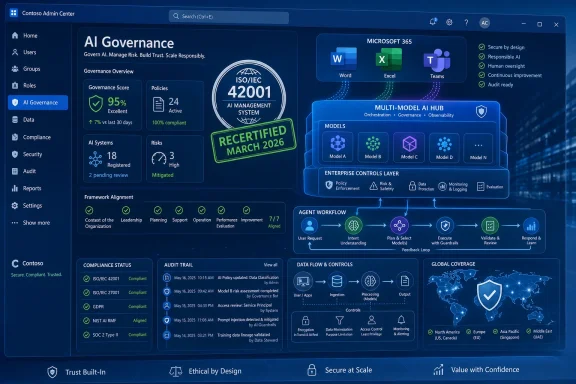
Microsoft 365 Copilot was recertified in March 2026 under ISO/IEC 42001:2023 by an independent auditor, with Microsoft saying the audit found zero non-conformities and zero improvement observations across its expanded enterprise AI management system. That sounds like compliance boilerplate until you notice what changed underneath it. Copilot is no longer a single-model productivity assistant bolted onto Office; it is becoming a governed, multi-model AI layer across Microsoft 365, Copilot Studio, and agentic workflows. The clean audit is therefore less a trophy than a statement of intent: Microsoft wants the AI trust market to move at Microsoft 365 scale.
Microsoft has never lacked distribution. It owns the inbox, the spreadsheet, the slide deck, the meeting, the identity provider, and in many organizations the compliance console. What it has lacked, at least in the AI era, is the kind of simple sentence a risk committee can understand: this system has been independently audited against a recognized AI management standard.
ISO/IEC 42001 gives Microsoft that sentence. The standard is not a model benchmark, a security penetration test, or a guarantee that Copilot will never produce a hallucination. It is a management-system certification for how an organization governs AI: policies, risk assessment, documentation, monitoring, human oversight, data practices, supplier management, and continual improvement.
That distinction matters because Microsoft 365 Copilot is being sold into places where “the demo was impressive” is not a procurement criterion. Banks, hospitals, universities, public-sector agencies, law firms, and regulated manufacturers do not merely ask whether a chatbot can summarize a Teams meeting. They ask who can see the transcript, how prompts are logged, which models process the data, whether retention policies apply, and what happens when a third-party model provider enters the chain.
Microsoft’s latest recertification gives the company a cleaner answer to those questions. The company says the 2026 audit did not merely preserve the prior certificate but validated an expanded and more mature AI governance program. In Microsoft’s telling, the audit covered a product that has changed materially since the first certification in 2025, including expanded scope for Copilot Studio and the move toward a multi-model architecture that includes Anthropic’s Claude models alongside OpenAI models.
That is why this development deserves more attention than the usual corporate trust-center update. Microsoft is trying to make AI governance a feature of the platform rather than an after-the-fact PDF. If it succeeds, the real competitive advantage may not be that Copilot writes better emails than a rival assistant on any given Tuesday. It may be that Microsoft can make AI adoption feel administratively boring.
The 2026 recertification is a different kind of milestone. It arrives after Microsoft changed the underlying product architecture, expanded the role of agents, and began bringing non-OpenAI models into the Copilot ecosystem. A clean audit under those conditions is more meaningful than a static renewal, because the auditor is not simply checking whether last year’s paperwork still exists.
Copilot’s evolution also makes the risks less theoretical. The original pitch for Microsoft 365 Copilot was largely assistant-shaped: summarize this document, draft this message, prepare this deck, answer a question from my corporate data. The newer pitch is more agentic. Copilot Studio lets organizations build custom agents, connect business systems, automate workflows, and expose AI capabilities to more users and processes.
That shift expands the blast radius of bad governance. A clumsy assistant might draft an inaccurate paragraph. A poorly governed agent might retrieve sensitive data, trigger a workflow, rely on the wrong connector, or expose internal knowledge in ways the organization did not anticipate. The more Copilot moves from “help me write” to “help me do,” the more Microsoft must prove that its controls can scale with the ambition.
The clean audit does not prove that every enterprise deployment is safe. It does suggest that Microsoft has been able to document, operate, and improve an AI management system across a moving product surface. For IT leaders, that is the difference between a vendor saying “trust us” and a vendor saying “here is the control framework we are prepared to have examined.”
What it does is impose a structured discipline around AI risk. That includes defining responsibilities, identifying risks, documenting mitigations, monitoring systems, managing suppliers, and creating feedback loops for improvement. In plain English, it asks whether an organization has a serious operating model for AI rather than a collection of slogans.
For enterprise customers, that is useful because the hardest part of AI adoption is often not buying the license. It is deciding who is accountable. Security teams worry about data exposure. Legal teams worry about copyright, privacy, and regulatory scrutiny. Records managers worry about retention. HR worries about employee monitoring and bias. Business leaders worry that strict controls will slow adoption, while users worry that the tool is unreliable or invasive.
A certification cannot resolve all of those tensions. But it can give organizations a common starting point. If Microsoft 365 Copilot is within the scope of an audited AI management system, a customer’s internal audit, procurement, and risk teams can map their own controls against something more concrete than marketing language.
That is especially important in schools and universities, where Copilot may touch student data, research material, administrative files, and communications. It is also important in heavily regulated industries, where executives are being pressed to adopt AI but cannot afford to treat governance as an experiment. Microsoft’s advantage is that many of those organizations already use Microsoft 365 as their system of work. The certification helps Microsoft argue that adding Copilot is an extension of existing governance, not a separate leap into the unknown.
OpenAI gave Microsoft a first-mover advantage in generative AI at enterprise scale. But dependence on one model family creates business, technical, and perception risks. If a rival model is better at coding, reasoning, document analysis, or long-horizon planning, Microsoft cannot afford to make Copilot feel locked to yesterday’s winner. If customers want choice, Microsoft has to provide it without making procurement and compliance teams start over.
Adding Anthropic’s Claude models is therefore not merely a feature update. It is a strategic adjustment. Microsoft is trying to position Copilot as a governed orchestration layer over multiple frontier models, rather than a branded wrapper around one supplier’s technology. That sounds sensible, but it complicates the trust story.
Every additional model provider introduces questions. Where is data processed? Which contractual terms apply? Are customer prompts used for training? Which regions are supported? What happens in sovereign cloud, government cloud, or EU data-boundary scenarios? Can administrators disable specific model providers? How does the product explain which model handled which task?
Microsoft has already had to address some of those questions through admin controls and subprocessor documentation. The fact that Anthropic models are not uniformly available in every region or cloud environment is not a footnote for multinational enterprises; it is an operational constraint. A global company may find that a Copilot experience behaves differently depending on geography, tenant configuration, or regulatory boundary.
That is where ISO 42001’s supplier-management dimension becomes more than paperwork. In a multi-model world, trust is not only about Microsoft’s own engineering culture. It is about how Microsoft governs dependencies, documents responsibilities, and gives customers enough control to make informed choices. A clean audit does not erase the complexity, but it lets Microsoft say the complexity is being managed under an externally reviewed system.
That is powerful because the best enterprise AI use cases are rarely generic. A claims processor, legal operations analyst, service desk worker, procurement specialist, or campus administrator does not merely need a chatbot that knows how to write polite prose. They need an assistant that understands internal processes, approved knowledge sources, and the boundaries of the job.
Copilot Studio exists to bridge that gap. It allows organizations to create agents, connect them to data, shape their behavior, and deploy them into workflows. But the same flexibility that makes the platform useful also makes it harder to govern. Once departments can build AI agents, the risk surface spreads from central IT to business units, power users, and citizen developers.
This is familiar territory for anyone who has lived through SharePoint sprawl, Power Platform governance, or Teams lifecycle management. Microsoft democratizes a capability, adoption accelerates, and then IT discovers that the real work is not enabling the tool but controlling the ecosystems that grow around it. Copilot Studio is likely to follow that pattern, only with higher stakes because AI agents can interpret, generate, retrieve, and act.
The audit’s inclusion of Copilot Studio is therefore a useful signal, but it should not lull organizations into complacency. Microsoft can certify its management system. It cannot certify that every customer-built agent is well designed, least-privileged, properly scoped, and monitored. That responsibility lands squarely inside the tenant.
The practical consequence is that Copilot governance cannot be delegated entirely to Microsoft. Administrators will need naming conventions, environment policies, connector controls, review processes, data-loss-prevention rules, sensitivity labels, lifecycle management, and logs that someone actually examines. The product may be certified, but the deployment can still be a mess.
Still, the phrase should be read carefully. It means the audited management system satisfied the requirements of the audit at the time of review. It does not mean Copilot is risk-free. It does not mean every configuration is safe. It does not mean a future feature will never create new exposure. It does not mean users will stop pasting secrets into prompts, over-sharing SharePoint folders, or trusting AI summaries without checking them.
This distinction is important because AI risk is unusually dynamic. Traditional enterprise software changes, but an AI assistant’s behavior can shift based on model updates, prompt engineering, retrieval configuration, connectors, grounding data, and user patterns. The system is not just code; it is code plus data plus model behavior plus organizational context.
That makes continuous governance more important than point-in-time validation. Microsoft’s argument is that ISO 42001 fits this reality because it requires ongoing management rather than a one-off review. If Copilot changes, the management system is supposed to account for that change. If the risk profile evolves, the risk process should evolve with it.
The hard question is whether enterprise customers can match that cadence. Microsoft may have a mature internal AI risk process, but many organizations buying Copilot are still cleaning up years of permission sprawl. A certified platform plugged into an overexposed SharePoint estate can still surface information users should never have been able to find. That is not a failure of the certificate; it is a reminder that Copilot inherits the truth of the tenant.
Copilot sits inside Microsoft 365, which means it can inherit identity from Entra ID, permissions from Microsoft Graph-connected services, compliance policies from Purview, and administrative controls from the Microsoft 365 ecosystem. That integration is not always simple, and Microsoft’s licensing can be maddening. But for enterprises, integration often beats elegance.
A rival AI assistant may produce a better answer in a clean benchmark. That does not automatically make it easier to deploy across a 50,000-seat organization with legal holds, sensitivity labels, regional compliance obligations, and a board-level AI policy. Microsoft’s bet is that the winning enterprise AI assistant will be the one that can be governed at scale.
The ISO 42001 recertification reinforces that bet. It lets Microsoft say that trust is not an add-on marketplace item; it is part of the managed service. That pitch is designed for chief information security officers and compliance teams as much as for end users. The person approving a Copilot rollout may never ask Copilot to write a sales email, but they will ask whether audit artifacts exist.
This also explains why Microsoft has been so aggressive in connecting Copilot to broader platform offerings. Copilot is not just a product SKU. It is a wedge into E5, Purview, SharePoint governance, security tooling, Copilot Studio, and eventually broader agent management. The certificate helps make that bundle feel less like an upsell and more like a governance architecture.
That gap explains the importance of trust signals. Microsoft does not merely need early adopters. It needs skeptical mainstream enterprises to move from pilots to broad deployment. The barrier is not only price, though price matters. The barrier is confidence that Copilot will deliver enough value without creating a governance headache.
Many IT departments are still in the messy middle. They are testing Copilot with executives, sales teams, developers, analysts, and service desks. They are discovering that some users love meeting summaries while others barely touch the tool. They are learning that data readiness work is not optional. They are also finding that AI adoption requires training, workflow redesign, and a realistic understanding of what the assistant can and cannot do.
A clean ISO 42001 audit helps with one part of that equation: institutional trust. It does not solve user adoption. It does not prove return on investment. It does not make a mediocre prompt produce a brilliant spreadsheet model. Microsoft still has to show that Copilot can become a daily habit rather than an expensive icon in the ribbon.
That is why the recertification should be read as a foundation rather than a finish line. Microsoft is building the conditions under which enterprises can say yes. It still has to make the yes feel worth the money.
Using AI to improve AI governance is also logically appealing. Automated validation can scale checks that would be impractical for humans alone. AI-assisted review can help find policy gaps, inspect documentation, analyze patterns, and support risk workflows. Humans remain in the loop, but the system gives them leverage.
The danger is circularity. If a vendor says its AI helped validate the processes that govern its AI, customers will reasonably ask where independent review begins and vendor optimism ends. That is why the external audit matters. Microsoft can use internal AI systems to improve its governance machinery, but the credibility comes from having that machinery examined by a third party.
Even then, customers should avoid confusing Microsoft’s internal maturity with their own. Microsoft may have dedicated responsible AI teams, engineering telemetry, internal governance playbooks, and direct access to product groups. A school district or mid-market manufacturer does not. The relevant question for customers is not “Does Microsoft have a process?” but “Can we operate our side of the shared process?”
That is where many deployments will struggle. AI governance sounds abstract until a department asks to build an agent with access to finance data, HR policies, and customer records. At that moment, the organization needs more than a certificate. It needs decision rights, escalation paths, technical controls, and the willingness to say no.
Copilot does not magically grant users access to data they are not permitted to see, but that reassurance is only comforting if permissions are correct. In many organizations, they are not. Years of collaboration-first defaults have produced broad access patterns that were tolerable when users had to manually hunt for files. AI changes the economics of discovery.
This is one of the underappreciated consequences of enterprise AI. It turns latent governance debt into an active operational problem. A file buried six folders deep in a forgotten SharePoint site may have been technically overexposed for years. Copilot makes it easier for an authorized-but-unintended user to surface its contents through natural language.
Microsoft knows this, which is why the company increasingly talks about SharePoint Advanced Management, Restricted SharePoint Search, sensitivity labels, Purview, and lifecycle controls in the same breath as Copilot. These are not ancillary products. They are the plumbing that determines whether Copilot feels safe at scale.
The audit tells customers Microsoft has a responsible AI management system. It does not clean up the customer’s documents. That remains the uncomfortable work of administrators, records owners, security teams, and business leaders who have to decide what their organization’s knowledge graph should actually expose.
For IT leaders, that is a healthier conversation. Copilot should not be approved because Microsoft has a certificate, and it should not be rejected because AI feels risky in general. It should be evaluated like a major enterprise capability that touches identity, data, workflow, compliance, and culture.
 Microsoft Turns an Audit Badge Into an Enterprise Sales Argument
Microsoft has never lacked distribution. It owns the inbox, the spreadsheet, the slide deck, the meeting, the identity provider, and in many organizations the compliance console. What it has lacked, at least in the AI era, is the kind of simple sentence a risk committee can understand: this system has been independently audited against a recognized AI management standard.ISO/IEC 42001 gives Microsoft that sentence. The standard is not a model benchmark, a security penetration test, or a guarantee that Copilot will never produce a hallucination. It is a management-system certification for how an organization governs AI: policies, risk assessment, documentation, monitoring, human oversight, data practices, supplier management, and continual improvement.
That distinction matters because Microsoft 365 Copilot is being sold into places where “the demo was impressive” is not a procurement criterion. Banks, hospitals, universities, public-sector agencies, law firms, and regulated manufacturers do not merely ask whether a chatbot can summarize a Teams meeting. They ask who can see the transcript, how prompts are logged, which models process the data, whether retention policies apply, and what happens when a third-party model provider enters the chain.
Microsoft’s latest recertification gives the company a cleaner answer to those questions. The company says the 2026 audit did not merely preserve the prior certificate but validated an expanded and more mature AI governance program. In Microsoft’s telling, the audit covered a product that has changed materially since the first certification in 2025, including expanded scope for Copilot Studio and the move toward a multi-model architecture that includes Anthropic’s Claude models alongside OpenAI models.
That is why this development deserves more attention than the usual corporate trust-center update. Microsoft is trying to make AI governance a feature of the platform rather than an after-the-fact PDF. If it succeeds, the real competitive advantage may not be that Copilot writes better emails than a rival assistant on any given Tuesday. It may be that Microsoft can make AI adoption feel administratively boring.
The First Certification Was About Legitimacy; the Second Is About Change
When Microsoft 365 Copilot first received ISO/IEC 42001 certification in 2025, the story was straightforward: one of the world’s most widely deployed enterprise AI products had cleared a new external AI governance standard. That mattered because ISO 42001 was still young, and enterprise buyers were still trying to separate vendor promises from auditable practice.The 2026 recertification is a different kind of milestone. It arrives after Microsoft changed the underlying product architecture, expanded the role of agents, and began bringing non-OpenAI models into the Copilot ecosystem. A clean audit under those conditions is more meaningful than a static renewal, because the auditor is not simply checking whether last year’s paperwork still exists.
Copilot’s evolution also makes the risks less theoretical. The original pitch for Microsoft 365 Copilot was largely assistant-shaped: summarize this document, draft this message, prepare this deck, answer a question from my corporate data. The newer pitch is more agentic. Copilot Studio lets organizations build custom agents, connect business systems, automate workflows, and expose AI capabilities to more users and processes.
That shift expands the blast radius of bad governance. A clumsy assistant might draft an inaccurate paragraph. A poorly governed agent might retrieve sensitive data, trigger a workflow, rely on the wrong connector, or expose internal knowledge in ways the organization did not anticipate. The more Copilot moves from “help me write” to “help me do,” the more Microsoft must prove that its controls can scale with the ambition.
The clean audit does not prove that every enterprise deployment is safe. It does suggest that Microsoft has been able to document, operate, and improve an AI management system across a moving product surface. For IT leaders, that is the difference between a vendor saying “trust us” and a vendor saying “here is the control framework we are prepared to have examined.”
ISO 42001 Is Not Magic, but It Is the Language Buyers Understand
There is a temptation in technology coverage to treat certifications as either meaningless paperwork or definitive proof of safety. ISO 42001 is neither. It does not certify that Copilot’s answers are correct, that every customer tenant is perfectly configured, or that no prompt injection attack will ever succeed.What it does is impose a structured discipline around AI risk. That includes defining responsibilities, identifying risks, documenting mitigations, monitoring systems, managing suppliers, and creating feedback loops for improvement. In plain English, it asks whether an organization has a serious operating model for AI rather than a collection of slogans.
For enterprise customers, that is useful because the hardest part of AI adoption is often not buying the license. It is deciding who is accountable. Security teams worry about data exposure. Legal teams worry about copyright, privacy, and regulatory scrutiny. Records managers worry about retention. HR worries about employee monitoring and bias. Business leaders worry that strict controls will slow adoption, while users worry that the tool is unreliable or invasive.
A certification cannot resolve all of those tensions. But it can give organizations a common starting point. If Microsoft 365 Copilot is within the scope of an audited AI management system, a customer’s internal audit, procurement, and risk teams can map their own controls against something more concrete than marketing language.
That is especially important in schools and universities, where Copilot may touch student data, research material, administrative files, and communications. It is also important in heavily regulated industries, where executives are being pressed to adopt AI but cannot afford to treat governance as an experiment. Microsoft’s advantage is that many of those organizations already use Microsoft 365 as their system of work. The certification helps Microsoft argue that adding Copilot is an extension of existing governance, not a separate leap into the unknown.
The Multi-Model Pivot Raises the Stakes for Trust
The most interesting part of Microsoft’s 2026 message is not the absence of audit findings. It is the fact that Microsoft is emphasizing the audit after moving Copilot toward a multi-model architecture. For much of Copilot’s public life, the product was understood through Microsoft’s OpenAI partnership. That was both a strength and a constraint.OpenAI gave Microsoft a first-mover advantage in generative AI at enterprise scale. But dependence on one model family creates business, technical, and perception risks. If a rival model is better at coding, reasoning, document analysis, or long-horizon planning, Microsoft cannot afford to make Copilot feel locked to yesterday’s winner. If customers want choice, Microsoft has to provide it without making procurement and compliance teams start over.
Adding Anthropic’s Claude models is therefore not merely a feature update. It is a strategic adjustment. Microsoft is trying to position Copilot as a governed orchestration layer over multiple frontier models, rather than a branded wrapper around one supplier’s technology. That sounds sensible, but it complicates the trust story.
Every additional model provider introduces questions. Where is data processed? Which contractual terms apply? Are customer prompts used for training? Which regions are supported? What happens in sovereign cloud, government cloud, or EU data-boundary scenarios? Can administrators disable specific model providers? How does the product explain which model handled which task?
Microsoft has already had to address some of those questions through admin controls and subprocessor documentation. The fact that Anthropic models are not uniformly available in every region or cloud environment is not a footnote for multinational enterprises; it is an operational constraint. A global company may find that a Copilot experience behaves differently depending on geography, tenant configuration, or regulatory boundary.
That is where ISO 42001’s supplier-management dimension becomes more than paperwork. In a multi-model world, trust is not only about Microsoft’s own engineering culture. It is about how Microsoft governs dependencies, documents responsibilities, and gives customers enough control to make informed choices. A clean audit does not erase the complexity, but it lets Microsoft say the complexity is being managed under an externally reviewed system.
Copilot Studio Makes Governance Everyone’s Problem
The expansion of ISO 42001 scope to include Microsoft Copilot Studio is arguably the most consequential part of the story for administrators. Microsoft 365 Copilot is the visible product. Copilot Studio is where organizations begin turning AI from a user-facing assistant into a factory for business-specific agents.That is powerful because the best enterprise AI use cases are rarely generic. A claims processor, legal operations analyst, service desk worker, procurement specialist, or campus administrator does not merely need a chatbot that knows how to write polite prose. They need an assistant that understands internal processes, approved knowledge sources, and the boundaries of the job.
Copilot Studio exists to bridge that gap. It allows organizations to create agents, connect them to data, shape their behavior, and deploy them into workflows. But the same flexibility that makes the platform useful also makes it harder to govern. Once departments can build AI agents, the risk surface spreads from central IT to business units, power users, and citizen developers.
This is familiar territory for anyone who has lived through SharePoint sprawl, Power Platform governance, or Teams lifecycle management. Microsoft democratizes a capability, adoption accelerates, and then IT discovers that the real work is not enabling the tool but controlling the ecosystems that grow around it. Copilot Studio is likely to follow that pattern, only with higher stakes because AI agents can interpret, generate, retrieve, and act.
The audit’s inclusion of Copilot Studio is therefore a useful signal, but it should not lull organizations into complacency. Microsoft can certify its management system. It cannot certify that every customer-built agent is well designed, least-privileged, properly scoped, and monitored. That responsibility lands squarely inside the tenant.
The practical consequence is that Copilot governance cannot be delegated entirely to Microsoft. Administrators will need naming conventions, environment policies, connector controls, review processes, data-loss-prevention rules, sensitivity labels, lifecycle management, and logs that someone actually examines. The product may be certified, but the deployment can still be a mess.
“Zero Non-Conformities” Is a Strong Result, Not a Free Pass
Microsoft’s claim of zero non-conformities and zero improvement observations is notable because auditors usually have room to find something. A non-conformity indicates a failure to meet a requirement. An improvement observation is softer, pointing to an area where the system could be enhanced even if it meets the standard. Getting neither is the kind of audit result vendors like to frame and hang in the lobby.Still, the phrase should be read carefully. It means the audited management system satisfied the requirements of the audit at the time of review. It does not mean Copilot is risk-free. It does not mean every configuration is safe. It does not mean a future feature will never create new exposure. It does not mean users will stop pasting secrets into prompts, over-sharing SharePoint folders, or trusting AI summaries without checking them.
This distinction is important because AI risk is unusually dynamic. Traditional enterprise software changes, but an AI assistant’s behavior can shift based on model updates, prompt engineering, retrieval configuration, connectors, grounding data, and user patterns. The system is not just code; it is code plus data plus model behavior plus organizational context.
That makes continuous governance more important than point-in-time validation. Microsoft’s argument is that ISO 42001 fits this reality because it requires ongoing management rather than a one-off review. If Copilot changes, the management system is supposed to account for that change. If the risk profile evolves, the risk process should evolve with it.
The hard question is whether enterprise customers can match that cadence. Microsoft may have a mature internal AI risk process, but many organizations buying Copilot are still cleaning up years of permission sprawl. A certified platform plugged into an overexposed SharePoint estate can still surface information users should never have been able to find. That is not a failure of the certificate; it is a reminder that Copilot inherits the truth of the tenant.
Microsoft’s Real Advantage Is the Compliance Console, Not the Chat Window
The consumer AI market is obsessed with model quality. Enterprise AI buyers care about quality too, but they also care about identity, audit, retention, eDiscovery, data boundaries, admin controls, and whether the tool fits into the security stack they already operate. This is where Microsoft’s position is unusually strong.Copilot sits inside Microsoft 365, which means it can inherit identity from Entra ID, permissions from Microsoft Graph-connected services, compliance policies from Purview, and administrative controls from the Microsoft 365 ecosystem. That integration is not always simple, and Microsoft’s licensing can be maddening. But for enterprises, integration often beats elegance.
A rival AI assistant may produce a better answer in a clean benchmark. That does not automatically make it easier to deploy across a 50,000-seat organization with legal holds, sensitivity labels, regional compliance obligations, and a board-level AI policy. Microsoft’s bet is that the winning enterprise AI assistant will be the one that can be governed at scale.
The ISO 42001 recertification reinforces that bet. It lets Microsoft say that trust is not an add-on marketplace item; it is part of the managed service. That pitch is designed for chief information security officers and compliance teams as much as for end users. The person approving a Copilot rollout may never ask Copilot to write a sales email, but they will ask whether audit artifacts exist.
This also explains why Microsoft has been so aggressive in connecting Copilot to broader platform offerings. Copilot is not just a product SKU. It is a wedge into E5, Purview, SharePoint governance, security tooling, Copilot Studio, and eventually broader agent management. The certificate helps make that bundle feel less like an upsell and more like a governance architecture.
Paid Seats Are Growing, but the Enterprise Jury Is Still Out
Microsoft has claimed tens of millions of paid Microsoft 365 Copilot seats and has pointed to strong growth in adoption and usage. That is real momentum by almost any enterprise software standard. Yet it must be placed next to the enormous Microsoft 365 installed base, where paid Copilot penetration remains a fraction of the total opportunity.That gap explains the importance of trust signals. Microsoft does not merely need early adopters. It needs skeptical mainstream enterprises to move from pilots to broad deployment. The barrier is not only price, though price matters. The barrier is confidence that Copilot will deliver enough value without creating a governance headache.
Many IT departments are still in the messy middle. They are testing Copilot with executives, sales teams, developers, analysts, and service desks. They are discovering that some users love meeting summaries while others barely touch the tool. They are learning that data readiness work is not optional. They are also finding that AI adoption requires training, workflow redesign, and a realistic understanding of what the assistant can and cannot do.
A clean ISO 42001 audit helps with one part of that equation: institutional trust. It does not solve user adoption. It does not prove return on investment. It does not make a mediocre prompt produce a brilliant spreadsheet model. Microsoft still has to show that Copilot can become a daily habit rather than an expensive icon in the ribbon.
That is why the recertification should be read as a foundation rather than a finish line. Microsoft is building the conditions under which enterprises can say yes. It still has to make the yes feel worth the money.
The “Customer Zero” Story Cuts Both Ways
Microsoft often describes itself as an early internal adopter of its own AI systems, using Copilot and related tooling to improve governance, validation, and product quality. There is value in that. A company of Microsoft’s size is a plausible test bed for enterprise complexity: multiple business units, sensitive data, regulated customers, developers, sales operations, legal teams, and sprawling collaboration environments.Using AI to improve AI governance is also logically appealing. Automated validation can scale checks that would be impractical for humans alone. AI-assisted review can help find policy gaps, inspect documentation, analyze patterns, and support risk workflows. Humans remain in the loop, but the system gives them leverage.
The danger is circularity. If a vendor says its AI helped validate the processes that govern its AI, customers will reasonably ask where independent review begins and vendor optimism ends. That is why the external audit matters. Microsoft can use internal AI systems to improve its governance machinery, but the credibility comes from having that machinery examined by a third party.
Even then, customers should avoid confusing Microsoft’s internal maturity with their own. Microsoft may have dedicated responsible AI teams, engineering telemetry, internal governance playbooks, and direct access to product groups. A school district or mid-market manufacturer does not. The relevant question for customers is not “Does Microsoft have a process?” but “Can we operate our side of the shared process?”
That is where many deployments will struggle. AI governance sounds abstract until a department asks to build an agent with access to finance data, HR policies, and customer records. At that moment, the organization needs more than a certificate. It needs decision rights, escalation paths, technical controls, and the willingness to say no.
The Security Conversation Is Really a Data Hygiene Conversation
For WindowsForum readers, the most practical lesson is that Copilot security begins long before a user opens Word and asks for a draft. It begins with the state of the tenant. Permissions, labels, stale sites, guest access, unmanaged sharing links, abandoned Teams, and unclear data ownership all become more visible when an AI assistant can search and summarize across corporate knowledge.Copilot does not magically grant users access to data they are not permitted to see, but that reassurance is only comforting if permissions are correct. In many organizations, they are not. Years of collaboration-first defaults have produced broad access patterns that were tolerable when users had to manually hunt for files. AI changes the economics of discovery.
This is one of the underappreciated consequences of enterprise AI. It turns latent governance debt into an active operational problem. A file buried six folders deep in a forgotten SharePoint site may have been technically overexposed for years. Copilot makes it easier for an authorized-but-unintended user to surface its contents through natural language.
Microsoft knows this, which is why the company increasingly talks about SharePoint Advanced Management, Restricted SharePoint Search, sensitivity labels, Purview, and lifecycle controls in the same breath as Copilot. These are not ancillary products. They are the plumbing that determines whether Copilot feels safe at scale.
The audit tells customers Microsoft has a responsible AI management system. It does not clean up the customer’s documents. That remains the uncomfortable work of administrators, records owners, security teams, and business leaders who have to decide what their organization’s knowledge graph should actually expose.
The Clean Audit Leaves IT With Fewer Excuses and More Work
The most concrete reading of Microsoft’s recertification is not that every organization should immediately deploy Copilot everywhere. It is that the lazy objections are getting weaker. “There is no external AI governance validation” is harder to say when Microsoft can point to ISO 42001 certification and a clean 2026 audit. The better objections now have to be more specific: readiness, licensing, data hygiene, use-case quality, regional constraints, and operational ownership.For IT leaders, that is a healthier conversation. Copilot should not be approved because Microsoft has a certificate, and it should not be rejected because AI feels risky in general. It should be evaluated like a major enterprise capability that touches identity, data, workflow, compliance, and culture.
- Microsoft 365 Copilot’s 2026 ISO/IEC 42001 recertification strengthens Microsoft’s claim that its AI governance program can survive product change, not merely preserve last year’s paperwork.
- The inclusion of Copilot Studio matters because custom agents will create more governance risk than ordinary chat-style assistance.
- The move to Anthropic Claude alongside OpenAI models gives customers more technical choice while making supplier oversight, regional availability, and admin controls more important.
- A clean audit result improves Microsoft’s enterprise trust story, but it does not fix customer-side permission sprawl, weak labeling, stale SharePoint sites, or poor adoption planning.
- Organizations evaluating Copilot should treat the certification as a useful control artifact, not as a substitute for their own risk assessment and deployment governance.
References
- Primary source: Neowin
Published: 2026-05-28T02:50:12.992294
Loading…
www.neowin.net - Official source: blogs.microsoft.com

Introducing the First Frontier Suite built on Intelligence + Trust - The Official Microsoft Blog
Today Microsoft is announcing: Wave 3 of Microsoft 365 Copilot Expanded model diversity with Claude and next-gen OpenAI models available today General availability of Agent 365 on May 1 for $15 per user General availability of the new Microsoft 365 E7: The Frontier Suite on May 1 for $99 per... blogs.microsoft.com
- Official source: learn.microsoft.com

Anthropic as a subprocessor for Microsoft Online Services
Learn about Anthropic as a subprocessor for Microsoft Online Services.learn.microsoft.com - Official source: microsoft.com

Anthropic joins the multi-model lineup in Microsoft Copilot Studio | Microsoft Copilot Blog
In addition to default OpenAI models, Copilot Studio customers can now build agents with Anthropic models Claude Sonnet 4 and Claude Opus 4.1www.microsoft.com - Related coverage: techcrunch.com

Microsoft says it has over 20M paid Copilot users, and they really are using it | TechCrunch
Despite the lingering perception that no one really uses Copilot, Microsoft said on Wednesday that the number of users and engagement is growing. techcrunch.com
- Related coverage: computerworld.com
Microsoft touts M365 Copilot momentum, claims 15M paid users
Although the company is boasting about the popularity of its genAI tools, one analyst labeled the latest numbers a ‘disappointing uptake.’ www.computerworld.com
- Official source: techcommunity.microsoft.com
Microsoft 365 Copilot Achieves ISO/IEC 42001:2023 Certification | Microsoft Community Hub
Another certification milestone for Microsoft 365 Copilot! techcommunity.microsoft.com
- Official source: news.microsoft.com
Loading…
news.microsoft.com - Related coverage: majormatters.co

Microsoft Copilot Studio: The Enterprise AI Agent Platform With 450 Million Users Behind It | Review
Microsoft Copilot Studio is the enterprise AI agent platform backed by 450 million Microsoft 365 users, 1,400+ connectors, and a new Copilot Cowork feature built with Anthropic's Claude. We scored it 4/5 in our AI Agent Platforms review.majormatters.co
- Official source: cdn-dynmedia-1.microsoft.com
Loading…
cdn-dynmedia-1.microsoft.com - Official source: directionsonmicrosoft.com
M365 Copilot Adds Choice (and Risk) with Anthropic’s Claude
Microsoft has partnered with Anthropic, adding its Claude models to Microsoft 365 Copilot (M365 Copilot). Claude’s Sonnet and Opus models are popular models that rivaled or surpassed OpenAI’s GPT models. This partnership answers customers’ demand for multi-model options to avoid vendor lock-in... www.directionsonmicrosoft.com