

Copilot’s Hardest Data Problem Is Becoming Time
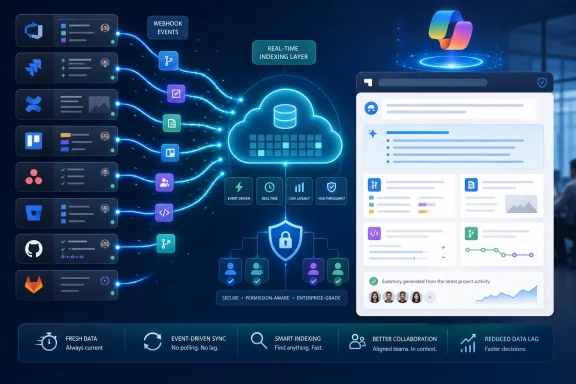
Microsoft has spent much of the Copilot era arguing that enterprise AI becomes more useful when it can draw on organizational data rather than the public web alone. Copilot connectors are central to that proposition: they bring external content into Microsoft 365 so that Copilot and Microsoft Search can find it, reason over it, and point users back to the underlying source.
Microsoft Support describes connectors as a bridge to knowledge bases, ticketing platforms, wikis, file stores, customer systems, and other services outside Microsoft 365. The company’s documentation emphasizes that users should see only the connected content they already have permission to access and that Copilot can cite external items in its answers.
That solves the where problem. It does not automatically solve the when problem.
A Jira ticket can move from open to resolved after Copilot’s last synchronization. A Confluence page can be replaced with a new incident procedure while the indexed copy still contains the old steps. An engineering lead can reassign a task, change its priority, or add a release blocker, yet a Copilot summary generated from the previous indexed state may confidently present the superseded plan.
None of those failures requires the language model to hallucinate in the traditional sense. The model may summarize its evidence perfectly while still giving the wrong operational answer because the evidence is stale.
That distinction is critical. AI quality is often discussed as if it were primarily a model problem, but enterprise answers travel through a longer chain: the source application, its permissions and APIs, the connector, Microsoft’s ingestion and indexing systems, retrieval, and finally generation. A freshness delay near the beginning can contaminate everything that follows without producing an obvious error message.
Roadmap item 505441 is Microsoft’s attempt to tighten that chain for eight prominent development, project-management, and collaboration services. The feature remains listed as in development, with Preview associated with August 2025 and General Availability targeted for October 2026 in the Worldwide Standard Multi-Tenant cloud.
Webhooks Replace Waiting With a Signal
Traditional synchronization typically asks a source system what has changed at scheduled intervals. This polling model is predictable, but it forces a trade-off: poll frequently and consume more API, compute, and indexing capacity, or poll less frequently and accept longer periods in which Microsoft 365 holds an outdated copy.
Webhook-led notifications invert the first part of that process. Instead of Microsoft repeatedly checking whether something happened, the source service can emit an event notification when a relevant change occurs. That notification can prompt the connector to begin retrieving and processing the updated item more quickly.
The roadmap’s wording is deliberately narrow. Microsoft says the connectors will provide improved content freshness through more frequent synchronization using webhook event notifications. It does not promise instantaneous updates, a specific maximum delay, or real-time consistency.
That restraint matters because a webhook is a signal, not the updated record itself. After receiving the signal, the connector may still need to authenticate to the source, retrieve the changed object, map its properties and identities, process permissions, submit it for indexing, and wait until that index is available to Copilot’s retrieval layer.
The result should therefore be understood as event-driven freshness, not guaranteed real-time truth. Webhooks can reduce the time spent waiting for the next scheduled discovery cycle, but they cannot eliminate every queue, source-side delay, throttling condition, indexing failure, or permission-processing step downstream.
Microsoft’s existing connector documentation reinforces this distinction. Connection statistics track discovered items, fully and partially indexed items, failed items, and content that remains in the index but is out of sync with the source. Microsoft also provides an index browser through which administrators can inspect an item’s status, refresh time, properties, and access controls.
Those tools will remain important after webhooks arrive. A connector receiving more event notifications is useful only if those events reliably produce updated, correctly permissioned, searchable content.
There is also no reason to assume that scheduled crawls will disappear. Event-driven systems commonly retain periodic reconciliation because notifications can be delayed, source services can become unavailable, credentials can expire, and large update queues can outlive the event that created them. The roadmap does not describe Microsoft’s final reconciliation design, but webhook notifications are best viewed as an acceleration layer rather than proof that every older synchronization mechanism will be retired.
Microsoft Starts Where Staleness Has Immediate Consequences
The eight connectors in scope are not a random sample of enterprise software. They cluster around the systems in which teams record changing work: issues, tasks, project boards, engineering discussions, repository activity, documentation, and operational decisions.
| Connector | Broad system role | Why freshness matters |
|---|---|---|
| Azure DevOps | Engineering work and project knowledge | Bugs, tasks, assignments, priorities, and plans can change rapidly |
| Jira Cloud | Issue and project tracking | Status, ownership, blockers, and comments affect daily decisions |
| Confluence Cloud | Wiki and knowledge management | Runbooks, decisions, and procedures can supersede older guidance |
| Trello | Board-based task management | Card movement, ownership, and due-date changes alter project state |
| Asana | Task and project coordination | Assignments, dependencies, and completion state drive team planning |
| Bitbucket | Development collaboration | Recent repository context can affect engineering summaries and searches |
| GitHub | Development collaboration | Fast-changing project and repository information shapes technical decisions |
| GitLab | Development collaboration | Current engineering activity is essential to accurate project reporting |
Microsoft’s choice of targets reveals the operational case for better freshness. These are not primarily archives whose value lies in stable historical documents. They are working systems where yesterday’s truth may be actively misleading today.
Consider a manager asking Copilot for a summary of release blockers. If the connected issue tracker has not synchronized the latest status changes, Copilot could continue listing a resolved issue while omitting a newly escalated one. The generated prose might be elegant, organized, and fully grounded in indexed data—and still send the meeting in the wrong direction.
The same problem becomes sharper during incidents. An engineer asking for the current remediation procedure should not receive a recently retired runbook simply because the newer Confluence page has not reached the index. Faster synchronization does not certify the procedure as correct, but it reduces one avoidable reason for surfacing the wrong version.
Development systems also produce high-value changes in small increments. A new comment may explain why a bug cannot be reproduced. An assignment change may establish who owns the response. A status transition may determine whether an issue belongs in an executive report. The size of the edit is small, but its importance to an AI-generated answer can be disproportionate.
This is why freshness is not merely a performance enhancement. In a conventional search interface, an old result may be visible as an old result, with its timestamp and context available for inspection. Copilot compresses several retrieved records into a single answer, potentially making the age of each supporting item less obvious unless the user opens and examines the citations.
The more effectively Copilot synthesizes information, the more easily stale evidence can disappear behind smooth prose. Faster connector updates are therefore also a trust feature.
A Faster Index Can Still Preserve the Wrong Permission
Content freshness and security freshness are related, but they are not necessarily the same process. Microsoft’s connector model indexes more than item text: it also handles properties and access information so that connected content can be filtered according to the user’s rights in the underlying system.
Microsoft’s current documentation distinguishes between full and incremental crawls. Incremental crawls update items changed since the previous crawl, but the documentation says they do not handle deletions and do not currently process permission updates. Full crawls cover the complete source, reflect deletions, and update permissions.
Roadmap item 505441 does not state that webhook notifications change those rules. It promises more frequent synchronization of updates, but it does not define whether every relevant event type—content edits, deletions, project moves, membership changes, or access-control changes—will be treated identically.
That omission does not mean the feature is unsafe. It means administrators should avoid translating “webhook-led” into “all dimensions of the index become current immediately.”
A task whose description changed and a task whose visibility changed present different risks. If the first update is delayed, Copilot may give an obsolete answer. If the second is delayed, Copilot’s index may temporarily hold an access state that no longer matches the source, although Microsoft’s wider retrieval and authorization controls may still affect whether that item is returned.
The safest administrative assumption is that permission reconciliation, identity mapping, and deletion handling remain distinct tests until Microsoft documents otherwise for each connector. The freshness upgrade should be welcomed, but it should not be used as a reason to stop checking scheduled crawl behavior or indexed access-control lists.
Microsoft already gives administrators several ways to investigate this layer. The connection details view reports whether items are completely indexed, partially indexed, failed, or out of sync. The index browser can be used to inspect an individual item and verify the users and groups associated with it.
Those capabilities will become more—not less—important when synchronization grows more frequent. A busier pipeline creates more opportunities for throttling, failed source authentication, incomplete properties, identity-mapping errors, and update backlogs to influence the results.
More Notifications Do Not Automatically Mean More Capacity
Event-driven synchronization changes the shape of connector traffic. Polling creates work according to a schedule, while webhooks can create bursts tied to real user activity: a large issue migration, a project reorganization, an automated workflow, or a busy development cycle may generate many updates in a short period.
Microsoft’s error documentation already anticipates conditions such as source throttling and a large number of queued updates. It also distinguishes between source availability problems, authentication failures, expired credentials, permission failures, tenant quotas, connection quotas, formatting problems, and items that remain out of sync.
Webhooks cannot bypass those constraints. They can tell Microsoft about a change sooner, but they do not guarantee that the source will allow the connector to retrieve it immediately or that Microsoft’s indexing service will process it without delay.
This creates an important measurement problem. If administrators look only at whether a connection reports a ready or healthy state, they may miss the operational question the roadmap feature is intended to improve: how much time passes between a source change and the moment Copilot can use it?
That interval could be called truth lag. It begins when an authoritative source changes and ends when a properly authorized user can retrieve the new state through Copilot or Microsoft Search. Roadmap item 505441 aims to reduce one component of truth lag, but tenants will need testing to determine the actual end-to-end improvement.
The right test is not to edit a task and immediately ask Copilot once. A meaningful pilot should cover multiple change types, periods of normal and heavy activity, updates to content and ownership, deletions, and changes to source permissions. Administrators should compare the source timestamp, the connector’s indexed refresh information, and the answer presented to the user.
They should also expect variation by connector. Jira Cloud, Confluence Cloud, GitHub, GitLab, Asana, Trello, Bitbucket, and Azure DevOps expose different object models, event systems, permission structures, and API limits. Microsoft has placed them under one roadmap item, but that does not prove that their observed freshness or failure behavior will be identical.
The Roadmap’s Dates Demand Careful Reading
Roadmap item 505441 contains an unusual chronology. It lists Preview availability as August 2025, yet the item’s created timestamp is October 31, 2025—after the stated Preview month.
The roadmap does not explain this discrepancy. It could reflect a roadmap entry added after preview activity had begun, a migration or republication of metadata, or an internal planning date that does not correspond to broad tenant access. Without an explicit Microsoft explanation, those possibilities remain speculation.
What can be said with confidence is that the item was last updated on July 9, 2026, remained marked in development, and targeted General Availability for October 2026. That combination is more useful than treating the preview field as proof that every tenant has already seen the feature in production.
Microsoft 365 Roadmap dates are plans, not service-level commitments. Features can be staged, delayed, revised, limited by tenant configuration, or delivered with connector-specific differences. Administrators should use the roadmap to plan testing and change management, not to declare implementation complete.
The release rings also include both Preview and General Availability, and the cloud instance is Worldwide Standard Multi-Tenant. The listed platform is Web, underscoring that this is a Microsoft 365 cloud and connector-service change rather than a Windows client update requiring a particular desktop build.
For Windows users, the effect should therefore appear in the quality and currency of Microsoft 365 Copilot results rather than as a conspicuous operating-system feature. A user may never see a new button announcing webhook support. Ideally, the improvement will be visible only as fewer answers based on old tickets, boards, wiki pages, or development records.
Timeline
August 2025 — Microsoft lists Preview availability for webhook-led freshness improvements across the eight in-scope Copilot connectors.
October 31, 2025 — Roadmap item 505441 receives its recorded creation timestamp, later than the listed Preview month.
July 9, 2026 — Microsoft records the item’s latest update while its status remains in development.
October 2026 — Microsoft targets General Availability in the Worldwide Standard Multi-Tenant cloud.
The Preview Should Be Treated as a Data-Quality Pilot
Organizations that already depend on connected project and development data should not evaluate this feature as a simple enablement exercise. The relevant question is not whether webhook notifications exist; it is whether they measurably improve the accuracy, timeliness, and predictability of real Copilot answers.
A pilot should begin with a controlled set of content whose source state is easy to verify. Administrators can then introduce representative edits and record when each change appears in the connector index, Microsoft Search, and Copilot responses.
Testing should include both high-visibility and low-visibility items. An obvious change to a title may be easy to detect, while a small but consequential update to a priority, assignment, dependency, or comment may reveal whether the connector processes the fields users actually rely on.
The organization should also define acceptable freshness by use case. A knowledge page used for long-term policy research may tolerate a longer delay than an issue tracker used to generate an incident briefing. Declaring one universal threshold for all connected content risks treating very different operational needs as equivalent.
Users should be told what the feature does not establish. A recently synchronized ticket may still contain inaccurate human input. A fresh wiki page may still be poorly governed. A current repository record may still lack the business context needed to answer a management question.
Freshness improves the probability that Copilot sees the latest recorded truth; it does not prove that the source system contains the truth. Good data ownership remains upstream of good AI.
Action checklist for admins
- Inventory existing Azure DevOps, Jira Cloud, Confluence Cloud, Trello, Asana, Bitbucket, GitHub, and GitLab connections and identify their business owners.
- Record current full- and incremental-crawl settings before the webhook change reaches the tenant.
- Establish an end-to-end freshness baseline using controlled source updates and repeatable Copilot or Microsoft Search queries.
- Test content edits, status transitions, assignments, deletions, and permission changes separately rather than assuming they share one synchronization path.
- Use connection statistics and the index browser to check refresh times, incomplete items, access controls, and out-of-sync content.
- Monitor source throttling, expired credentials, item failures, identity-mapping problems, quotas, and queued updates during high-activity tests.
- Roll out to a limited audience first and define an escalation path for answers that cite outdated connected content.
- Retain periodic reconciliation and crawl monitoring unless Microsoft explicitly documents that webhook processing replaces them for the relevant connector.
Freshness Turns Connector Operations Into AI Operations
Before generative AI, connector administration could be treated largely as a search-engine concern. An indexing delay was inconvenient, but users often understood that search results might lag behind the source and could open the original system to confirm.
Copilot changes the stakes because the index becomes evidence for generated analysis. It may consolidate tickets into a status briefing, summarize development work for an executive, compare project risks, or describe what a team should do next. The connector is no longer merely helping someone locate a record; it is helping construct an answer.
That means connector health belongs in AI governance. Organizations monitoring Copilot adoption should track not only license use and user satisfaction but also the quality of the knowledge pipeline feeding it.
A strong governance model will separate at least four questions. Is the required source content covered by the connector? Is it indexed with the necessary properties? Is access represented correctly? Is the indexed version recent enough for the intended decision?
Webhook notifications primarily address the fourth question, though they may also make synchronization failures easier to detect because organizations can compare expected event-driven behavior with observed refresh times. They do not remove the need to answer the first three.
This is particularly important for cross-functional prompts. A user might ask Copilot to combine an engineering tracker, a project board, and a knowledge wiki into one report. If the three connectors update at different speeds, the answer can merge source states that never actually coexisted.
One system might show a newly resolved blocker, another might still contain the old delivery date, and a third might have already published a revised procedure. Each retrieved fact may be individually grounded, yet the combined narrative may represent an inconsistent moment in time.
Microsoft has not said that roadmap item 505441 creates a transactionally consistent snapshot across connectors. Administrators should not expect it to. The practical goal is more modest but still valuable: reduce avoidable delay within each connector and make the overall collection of evidence more current.
Microsoft Is Building Toward a More Reactive Knowledge Layer
The deeper significance of roadmap item 505441 is architectural. Copilot is being positioned less like a chatbot that occasionally searches corporate material and more like an interface over an active organizational knowledge layer.
An active knowledge layer cannot depend indefinitely on slow, broad recrawls. Teams expect an assistant to know that a task was closed, a board was reorganized, a wiki was corrected, or an engineering record was updated without waiting for an arbitrary synchronization window.
Webhooks are a natural step toward that model. They allow changes in operational systems to propagate toward Copilot according to events rather than only a clock.
But a more reactive knowledge layer also magnifies the importance of observability. When synchronization was understood to be periodic, a delay could be explained by the schedule. When updates are advertised as webhook-led, users and administrators will expect a clearer account of what happened to a missing event.
Microsoft will eventually need to make the freshness promise more measurable. Connector dashboards should help administrators distinguish event receipt, source retrieval, item processing, permission processing, index publication, and downstream availability. Without that visibility, “more frequent” may be technically true while remaining difficult for customers to validate.
The company will also need connector-specific documentation explaining which event types are supported and how fallbacks work. A content-edit webhook, a deletion event, a repository event, and an access-control change are not interchangeable. The roadmap currently groups the connectors around one benefit, but administrators will require more granular behavior before using that benefit in operational assurances.
There is a commercial dimension as well. Microsoft 365 Copilot’s value depends on how successfully it reaches beyond Microsoft-native documents into the systems where organizations actually conduct work. If external data feels old or incomplete, users will retreat to the source applications and question why Copilot was introduced as a unifying interface.
Improved freshness therefore protects more than answer quality. It protects Microsoft’s argument that Copilot can become a credible front door to enterprise knowledge.
What IT Should Carry Into the October Rollout
Roadmap item 505441 is a focused engineering improvement with consequences that reach into search quality, AI trust, security validation, and operational decision-making. The feature deserves attention precisely because most users will never see its machinery.
- The change covers Azure DevOps, Jira Cloud, Confluence Cloud, Trello, Asana, Bitbucket, GitHub, and GitLab.
- Webhook event notifications should reduce the delay before connectors discover updates, but Microsoft has not promised instantaneous synchronization.
- The roadmap remains marked in development and targets worldwide General Availability in October 2026.
- Preview is listed for August 2025, despite the item carrying a later creation timestamp of October 31, 2025.
- Faster content updates should not be assumed to provide equally fast deletion, identity, or permission updates.
- Administrators should measure source-to-index-to-answer delay and continue monitoring crawls, errors, access controls, and out-of-sync items.
Microsoft’s webhook-led connector upgrade is ultimately an admission of a basic truth about enterprise AI: grounding is not enough when the ground has already moved. If the company delivers reliable event-driven synchronization, Copilot’s answers should become more useful precisely where work changes fastest—but the next phase will require Microsoft to turn “improved freshness” from a roadmap promise into an observable, connector-by-connector standard that administrators can test and trust.
References
- Microsoft Copilot (Microsoft 365): Improved content freshness using Copilot connectors with webhooks-led notifications Microsoft 365 Roadmap · 2026-07-09T23:00:39.7653153Z