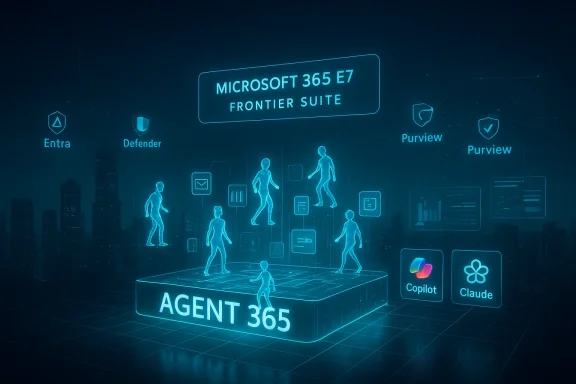
Microsoft has formally launched a new top-tier enterprise bundle — Microsoft 365 E7: The Frontier Suite — that packages Microsoft 365 E5, Microsoft 365 Copilot, and the new Agent 365 control plane into a single offering priced at $99 per user per month, with Agent 365 also available separately at $15 per user per month, both becoming generally available on May 1, 2026. (blogs.microsoft.com) (microsoft.com)
Microsoft’s announcement positions E7 as the company’s answer to the next wave of enterprise AI: an attempt to convert agent-driven automation and Copilot assistants from experimental toys into a governed, auditable part of the corporate stack. Judson Althoff, head of Microsoft’s commercial business, framed the release as solving a simple enterprise problem — customers “do not want multiple tools stitched together, they want one trusted solution” — while Microsoft security leadership pitched Agent 365 as a way to stop AI agents from becoming ungoverned “double agents.” (blogs.microsoft.com) (microsoft.com)
Enterprise press and analyst outlets quickly replicated Microsoft’s topline details and added early cndependent reporting noted the $99 pupm headline and underlined that Gartner’s early math showed the bundled discount against buying the pieces separately is modest, at roughly 13.2 percent. Community and partner commentary collected in customer-facing channels also flagged questions about licensing mechanics for digital workers and the potential for consumption-based or hybrid metered models.
Microsoft also published operational metrics as proof points: the company reports tens of millions of agents registered in preview programs, with Microsoft itself tracking roughly 500,000 internal agents and agents generating tens of thousands of responses per day during early use. Those figures are presented as early-signal adoption evidence. (blogs.microsoft.com)
Directions on Microsoft and other enterprise-focused commentators dug into the wider licensing landscape and surfaced other cost angles: E7 represents a substantial uplift over E5 list prices (E5 itself moves in Microsoft’s refreshed pricing cadence), and the bundle’s attractiveness depends heavily on how many seats actually need Copilot and agent governance. For organizations where only a fraction of users will ever use Copilot or agents, E7’s per-seat math can be hard to justify. (directionsonmicrosoft.com)
CRN and Microsoft partners, meanwhile, pushed back that Agent 365 centralizes things partners already help customers accomplish — but also noted partners may profit by implementing governance and service layers around the new suite. That nuance matters: partners see commercial opportunity even if in-house IT teams question immediate ROI. (crn.com)
However, organizations must not mistake the existence of controls for immediate safety. Effective governance requires policy design, rules for least privilege in access packages, monitoring logic tuned to agent-specific behavior, and legal workflows to handle generated content. Those human processes and the operational burden to tune them are the true costs behind the E7 sticker price — and Microsoft acknowledges that parts of the capability remain in preview. (microsoft.com)
Competitors and partners are already responding: third-party governance vendors and service providers are positioning to fill gaps where Agent 365 may be immature, and other cloud vendors are emphasizing open model choice, consumption billing, or different data handling commitments. For Microsoft customers, the choice will be between the convenience and integration of a single-pane solution and the flexibility — and potential cost arbitrage — of best-of-breed stacks. Independent community threads captured in customer forums reflect both eagerness and skepticism about the trade-offs.
That said, the headline price and Microsoft’s claim of being cheaper than buying à la carte should be scrutinized. Early analyst work suggests the bundle’s discount is modest, and Agent 365’s initial feature set is still maturing; both factors argue for pilots, careful contract terms, and pricing negotiations. Enterprises should treat E7 as strategic leverage in renewals and procurement discussions — not as an automatic, one-size-fits-all upgrade. (blogs.microsoft.com)
Source: theregister.com Microsoft 365 confirms new premium tier with a premium price
 Background
Microsoft’s announcement positions E7 as the company’s answer to the next wave of enterprise AI: an attempt to convert agent-driven automation and Copilot assistants from experimental toys into a governed, auditable part of the corporate stack. Judson Althoff, head of Microsoft’s commercial business, framed the release as solving a simple enterprise problem — customers “do not want multiple tools stitched together, they want one trusted solution” — while Microsoft security leadership pitched Agent 365 as a way to stop AI agents from becoming ungoverned “double agents.” (blogs.microsoft.com) (microsoft.com)Enterprise press and analyst outlets quickly replicated Microsoft’s topline details and added early cndependent reporting noted the $99 pupm headline and underlined that Gartner’s early math showed the bundled discount against buying the pieces separately is modest, at roughly 13.2 percent. Community and partner commentary collected in customer-facing channels also flagged questions about licensing mechanics for digital workers and the potential for consumption-based or hybrid metered models.
What Microsoft 365 E7 actually contains
Bundle contents and prices
- Microsoft 365 E5 (the current top-of-core-suite SKU)
- Microsoft 365 Copilot (enterprise Copilot capabilities and agent experiences)
- Agent 365 (control plane and governance tooling for AI agents) — $15 pupm when bought standalone
- Microsoft Entra Suite and advanced Defender, Intune, and Purview security capabilities
Agent 365: the new control plane
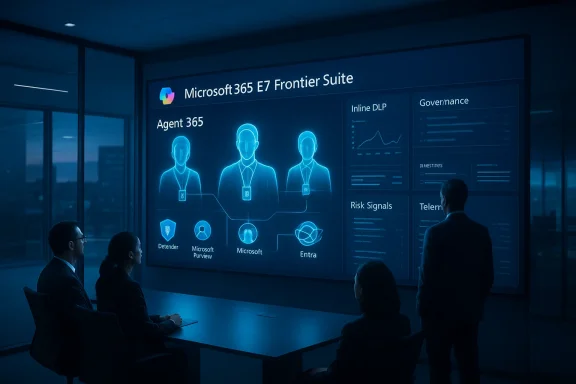
Agent 365 is pitched as a unified control plane that gives IT, security, and business teams an inventory of agents, per-agent observability, identity controls (Agent ID via Entra), risk signals from Defender and Purview, DLP for prompts, retention and eDiscovery for agent artifacts, and runtime protections for model and prompt integrity. Microsoft emphasizes that Agent 365 extends existing security and compliance tooling so agents are treated like first-class identities within the tenant. (microsoft.com)Microsoft also published operational metrics as proof points: the company reports tens of millions of agents registered in preview programs, with Microsoft itself tracking roughly 500,000 internal agents and agents generating tens of thousands of responses per day during early use. Those figures are presented as early-signal adoption evidence. (blogs.microsoft.com)
Independent reaction: discounts, value, and vendor claims
The math: not a jaw-dropping discount
Several independent outlets and analysts immediately examined the economics and concluded the headline bundle is less of a deep discount than it might appear. Gartner’s early modelling — cited by multiple outlets — calculated the E7 “discount” at about 13.2% versus buying E5 + Copilot + Agent 365 separately, and warned that larger bundles should yield larger discounts. That analysis has driven skepticism about whether E7 will be compelling for a majority of knowledge workers.Directions on Microsoft and other enterprise-focused commentators dug into the wider licensing landscape and surfaced other cost angles: E7 represents a substantial uplift over E5 list prices (E5 itself moves in Microsoft’s refreshed pricing cadence), and the bundle’s attractiveness depends heavily on how many seats actually need Copilot and agent governance. For organizations where only a fraction of users will ever use Copilot or agents, E7’s per-seat math can be hard to justify. (directionsonmicrosoft.com)
Analyst caution about Agent 365’s maturity
Analysts described Agent 365 as functionally important but not yet delivering enough new, differentiated capability to justify its $15 pupm price for many customers. The critiques typically characterize it as an essential control-plane concept whose early feature set is still maturing: observability, identity, and DLP are valuable, but several enterprise buyers will weigh whether Agent 365 materially changes day-to-day outcomes versus stitching Defender/Entra/Purview policies together today.CRN and Microsoft partners, meanwhile, pushed back that Agent 365 centralizes things partners already help customers accomplish — but also noted partners may profit by implementing governance and service layers around the new suite. That nuance matters: partners see commercial opportunity even if in-house IT teams question immediate ROI. (crn.com)
Technical analysis: what Agent 365 brings — and what it doesn’t
Strengths (what Microsoft has built)
- Identity-aware agents: Agent ID in Entra provides each agent a unique identity, enabling conditional access, identity protection, and scoped access packages. This elevates agents to auditable identities rather than ephemeral API consumers. (microsoft.com)
- Integrated compliance and DLP for prompts and artifacts: Microsoft extends Purview controls to agent interactions, enabling inline DLP and audit trails for prompts and generated content, which helps legal and compliance teams reason about agent outputs. (microsoft.com)
- Observability and risk signals: Built-in linkage of agent telemetry into Defender, Purview, and Entra centralizes risk scoring and incident workflows. For security operations teams, seeing agent behavior alongside user and application telemetry is a meaningful operational improvement. (microsoft.com)
- Runtime and model protections: Microsoft claims runtime protections for prompt injection, model tampering detection, and agent-specific threat hunting capabilities — important features as adversaries weaponize generative models. (microsoft.com)
Limits and open implementation questions
- Feature maturity: Many of the announced capabilities are rolling out from public preview into GA on May 1; several document notes and Microsoft’s own blog make clear that parts of the feature set remain in preview and will continue to evolve. Customers should assume feature parity will improve but is not guaranteed day one. (microsoft.com)
- Licensing mechanics for agents: Microsoft has not exhaustively detailed how agent identities that act like users will be licensed when they require mailboxes, Teams presence, or per-agent resources. Early signals indicate Microsoft is considering hybrid seat + consumption models, but the specifics are not fully public. That ambiguity can create billing surprises. (directionsonmicrosoft.com)
- Vendor lock-in and operational overhead: The deeper an organization integrates agents with Entra, Purview, and Defender capabilities, the harder it becomes to decouple from Microsoft’s control plane without substantial migration work — a classic lock-in trade-off in exchange for integration and simplified management. (microsoft.com)
Business implications: who should care and who should wait
Where E7 can make immediate sense
- Organizations deploying Copilot broadly and creating many internal agent workflows (e.g., large contact centers, finance/process automation, HR and legal triage) will find E7’s integrated governance and security stack helpful for operationalizing agent use at scale. Microsoft’s own customer references and adoption metrics point to early high-use scenarios in manufacturing, financial services, and retail. (blogs.microsoft.com)
- Regulated industries (healthcare, finance, public sector) that require auditable trails for automated actions and enforced DLP will appreciate the ability to treat agents as identities and apply existing compliance policies across agent interactions. (microsoft.com)
Where to be cautious
- Enterprises with only a handful of Copilot users or limited agent use cases should be cautious; analyst models suggest E7’s value diminishes if Copilot adoption remains low or agent use is limited to small pilot groups. Gartner and independent observers specifically advise restraint before buying E7 at scale.
- Buyers in the middle of enterprise agreements (EAs) or multi-year commitments should watch contract language carefully for non-reduction or non-retroactivity clauses that could block future beneficial pricing changes if Microsoft adjusts list prices or bundle structures. Analysts recommend avoiding clauses that lock you out of taking advantage of future reductions.
Practical procurement and negotiation checklist
- Review current Copilot usage and adoption metrics before deciding. If fewer than ~30–40% of knowledge workers use Copilot actively, E7’s per-seat price may not deliver expected ROI. Use Viva Insights or other adoption reports to quantify real usage and business outcomes. (directionsonmicrosoft.com)
- Insist on clarity for agent licensing mechanics. Ask Microsoft to document how Agent IDs that require mailboxes, Teams presences, or OneDrive will be billed. Demand scenarios (per-agent seats, metered consumption, and hybrid approaches) be specified in writing. (directionsonmicrosoft.com)
- Avoid contract language that prevents you from benefiting from future product or price changes (no nonreduction clauses). Make sure audit, downgrade, and migration paths are clearly defined. Analysts explicitly flagged this as a risk.
- Pilot with limited E7 seats tied to clear KPIs. Use small, measurable rollouts to evaluate Agent 365’s practical value before enterprise-wide upgrades. Microsoft itself positions Agent 365 as the control-plane for scale; you should validate that claim on real workloads. (blogs.microsoft.com)
- Factor partner services into TCO calculations. Implementation, policy tuning, and change management will likely absorb the bulk of the project cost; partners often offer packaged services that materially affect time-to-value. (crn.com)
Security and compliance: real improvements — with caveats
Agent 365 moves the ball forward by making agents visible, identifiable, and subject to the same compliance controls that govern users. From a security operations perspective, integrating agent telemetry into Defender and Purview and enabling conditional access for agents reduces blind spots that would otherwise be exploited via prompt injection or stolen credentials.However, organizations must not mistake the existence of controls for immediate safety. Effective governance requires policy design, rules for least privilege in access packages, monitoring logic tuned to agent-specific behavior, and legal workflows to handle generated content. Those human processes and the operational burden to tune them are the true costs behind the E7 sticker price — and Microsoft acknowledges that parts of the capability remain in preview. (microsoft.com)
How E7 fits into the larger vendor and market dynamics
Microsoft is racing to make the enterprise contract and operational story for agents as painless as it has for cloud identities and endpoints. By folding agents into the existing identity and compliance ecosystems, Microsoft is betting that customers will prefer a single vendor stack with controlled governance rather than a heterogeneous one that requires stitching disparate tools.Competitors and partners are already responding: third-party governance vendors and service providers are positioning to fill gaps where Agent 365 may be immature, and other cloud vendors are emphasizing open model choice, consumption billing, or different data handling commitments. For Microsoft customers, the choice will be between the convenience and integration of a single-pane solution and the flexibility — and potential cost arbitrage — of best-of-breed stacks. Independent community threads captured in customer forums reflect both eagerness and skepticism about the trade-offs.
Final assessment: cautious optimism, but don’t sign blind
Microsoft 365 E7 and Agent 365 represent a logical and consequential push to institutionalize agentic AI inside enterprise IT: integrated identity, DLP, observability, and runtime protections are genuinely useful. For organizations committed to broad Copilot adoption and heavy internal agent usage, E7 can simplify procurement and deliver a more auditable agent lifecycle.That said, the headline price and Microsoft’s claim of being cheaper than buying à la carte should be scrutinized. Early analyst work suggests the bundle’s discount is modest, and Agent 365’s initial feature set is still maturing; both factors argue for pilots, careful contract terms, and pricing negotiations. Enterprises should treat E7 as strategic leverage in renewals and procurement discussions — not as an automatic, one-size-fits-all upgrade. (blogs.microsoft.com)
Quick takeaways for IT leaders
- Validate actual Copilot and agent usage metrics before evaluating E7 at scale; small adoption undermines the economics. (directionsonmicrosoft.com)
- Pilot Agent 365 with a focused team (security, compliance, and a high-value business workflow) and quantify the risk reduction and productivity gains. (microsoft.com)
- Negotiate contract protections (no nonreduction clauses, clear agent licensing, migration/downgrade pathways) to avoid being locked into tomorrow’s pricing or product structure.
- Include partners in the TCO: implementation, policy configuration, and change management typically drive most of the cost and will determine whether E7 delivers measurable ROI. (crn.com)
Source: theregister.com Microsoft 365 confirms new premium tier with a premium price