Microsoft Frontier Suite: E7 Copilot Cowork and Agent 365 for Enterprise AI

  • Thread Author
Microsoft's newest enterprise push makes a clear bet: the next phase of productivity is not just about smarter assistants, it's about agentic AI that plans, executes, and reports across the full stack of work — and it's packaged as a new premium tier and management plane aimed squarely at large organizations. The company unveiled Microsoft 365 E7 (branded internally as The Frontier Suite), a new Copilot capability called Copilot Cowork (built with Anthropic technology), and Agent 365, a control plane to govern and monitor long-running AI agents. These components are positioned to move businesses from pilot projects and one-off automations into scaled, governed AI-driven workflows inside the Microsoft ecosystem.

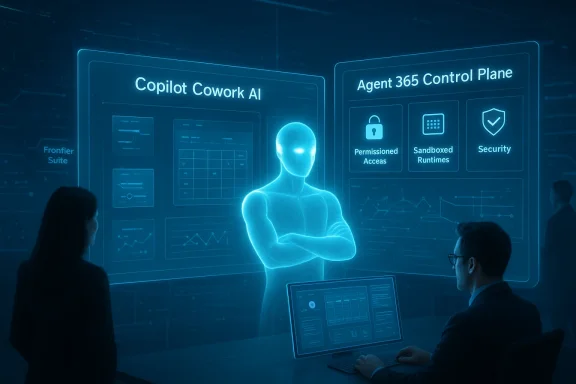
A futuristic office with glowing holographic dashboards centered on Agent 365.Background: where this fits in Microsoft's AI roadmap​

Microsoft has iterated Copilot as an in-app assistant for months, embedding generative AI into Outlook, Word, Excel, Teams, and Power Platform. What changes with the E7 launch is a clear shift from prompt-driven helpers to autonomous, stateful agents that can carry out multi-step processes over time, operate across apps, and be managed centrally by IT teams. This represents a maturation from augmentative AI to what vendors now call agentic systems of work.
The Frontier Suite idea bundles security, identity, and the new agent management features into a single SKU so enterprises have a turnkey path to adopt agentic workflows without assembling a dozen separate contracts and integrations. Microsoft positions this as an answer to two enterprise challenges: how to safely scale AI-driven automation, and how to retain governance, telemetry, and control while delegating meaningful work to AI.

What Microsoft announced: E7, Copilot Cowork and Agent 365 — the essentials​

Microsoft 365 E7: The Frontier Suite​

Microsoft 365 E7 is a new premium bundle that combines Microsoft 365 E5 with Microsoft 365 Copilot, the Microsoft Entra Suite, and Agent 365 — plus enhanced Defender, Intune, and Purview capabilities. It is being marketed as the packaged route to deploy agentic AI at scale while maintaining enterprise-grade security and identity posture. Microsoft says the E7 SKU will be generally available on May 1, 2026, priced at $99 per user per month.
Key bundle elements:
  • Microsoft 365 E5 (core productivity and advanced security)
  • Microsoft 365 Copilot (AI across email, docs, meetings, spreadsheets, and business apps)
  • Agent 365 (control plane for creating, governing, and observing agents)
  • Microsoft Entra Suite (identity and access control)
  • Advanced Microsoft Defender, Intune, and Purview integrations

Copilot Cowork: agentic workflows powered with Anthropic technology​

Copilot Cowork is Microsoft’s new capability to enable long-running, multi-step tasks executed on behalf of users. Built in close collaboration with Anthropic, Cowork brings the underlying ideas of Anthropic's Claude Cowork into the Microsoft Copilot environment. Instead of answering discrete prompts, Cowork can learn a user's desired outcome, create a stepwise plan, and then execute that plan across multiple Microsoft 365 surfaces — pausing for checkpoints where the user can review or alter behavior. Microsoft is previewing Cowork in a research-limited program and plans broader availability through the Frontier program in late March and beyond.

Agent 365: the governance and observability plane​

Agent 365 is marketed as the administrative backbone for organizations that want to run many agents safely. It provides:
  • Centralized cataloging and lifecycle management of agents
  • Policies and controls tied into Entra identity and Defender security signals
  • Telemetry, auditing, and observability for agent behavior and outcomes
    Microsoft has set Agent 365 for general availability on May 1, 2026, with stand-alone pricing reported around $15 per user per month for organizations that want the agent-control plane without the full E7 bundle.

Why this matters: enterprise opportunity and problem framing​

For enterprises that have already piloted Copilot and other generative features, the E7 strategy closes several gaps that prevent broad deployment today.
  • From pilots to production: Many organizations limit AI to sandboxed projects because they lack tooling to manage a fleet of autonomous agents. Agent 365 aims to provide that, reducing operational friction.
  • Security and compliance: Bundling Defender, Intune, Purview, and Entra with agent management gives a pre-integrated path to apply existing compliance and zero-trust policies to agent behavior.
  • Single-vendor integration: For customers already invested in Microsoft 365 and Azure, the E7 bundle offers predictable compatibility and a streamlined procurement model.
These are genuine enterprise pain points. Scaling "agentic" automation without adequate governance risks inconsistent outputs, data leakage, and compliance violations — problems that often surface in regulated industries. Microsoft is clearly framing E7 as the answer to these constraints, promising both productivity gains and the controls IT demands.

Technical deep-dive: what Copilot Cowork and Agent 365 actually do​

Copilot Cowork — autonomy, orchestration, and checkpoints​

At a technical level, Copilot Cowork introduces several capabilities that distinguish it from session-bound Copilot features:
  • Stateful execution: Cowork can maintain state over time, enabling tasks that require waiting for external events, progressive refinement, or staged approvals.
  • Cross-app orchestration: Cowork can act across Outlook, Teams, Word, Excel, and other Microsoft surfaces to read context, modify documents, schedule meetings, and update business systems.
  • Checkpoints and human-in-the-loop: To mitigate risk, Cowork inserts checkpoints that require user confirmation or allow users to pause or adjust an ongoing workflow.
  • Sandboxed execution: Tasks run in isolated cloud sandboxes to limit data exposure and provide a clean boundary for monitoring.
These features are architected to make agents useful without giving them carte blanche access to enterprise data. They also map to enterprise needs for observability, rollback, and audit trails.

Agent 365 — the control plane​

Agent 365 functions as the administrative brain for fleets of agents. Its important components include:
  • Agent catalog: IT can register approved agent templates and restrict which ones employees may instantiate.
  • Policy engine: Administrators can create rules for data access, external integrations, and operational limits tied to identity conditions provided by Entra.
  • Telemetry and logging: Audit trails, behavior logs, and outcome records enable compliance reporting and incident investigation.
  • Role-based access and approval flows: Agent creation, escalation, and execution can be gated by role-based workflows.
  • Integration points: Built-in hooks to Defender and Purview provide a way to apply existing threat detection and data loss prevention policies to agent activity.
By centralizing these controls, Microsoft is trying to offer the governance equivalents of what cloud providers already provide for infrastructure — but for autonomous software workers.

Business and partner implications​

Pricing and GTM posture​

Microsoft's pricing strategy positions E7 at a premium — $99/user/month for the Frontier Suite — with Agent 365 available as an add-on for organizations that want governance without the full bundle. This creates a clear upsell motion for customers on E5 and a pathway for partners to build services around agentization, PoC accelerators, and managed services. Partners will find opportunities in migration, secure deployment, and change management programs as firms adopt agentic automation.

Competitive landscape and vendor dynamics​

The Anthropic collaboration signals a strategic broadening of Microsoft’s AI vendor relationships beyond its long-standing OpenAI partnership. Anthropic's Claude technology — now rebranded into a Cowork capability for Microsoft — brings an alternative model of instruction-following and safety-first engineering that enterprises value. This has two implications:
  • It reduces single-vendor risk for Microsoft customers by integrating multiple LLM providers.
  • It signals that Microsoft will continue to orchestrate third-party models inside its ecosystem rather than relying on a single backend.
This dynamic should increase competition and innovation in agent capabilities, but also raises questions about consistency of behavior, model provenance, and where liability lies when agents make consequential errors.

Security, privacy, and governance: strengths and open questions​

Strengths Microsoft is emphasizing​

  • Integrated identity and policy enforcement: Tying Agent 365 into Entra provides enterprises with familiar policy primitives for agents.
  • Sandboxes and telemetry: Running agents in protected environments and logging actions helps with forensics and compliance.
  • Pre-bundled data protection: Including Defender, Intune, and Purview in E7 makes it easier to extend DLP and endpoint controls to agent-driven actions.

Notable risks and unanswered questions​

Despite the controls, several risk areas require careful attention from enterprises:
  • Data exfiltration via agents: Stateful agents that can touch email, files, and external APIs present a new attack surface. Effective DLP policies and strict identity binding will be essential.
  • Model hallucination and decision-critical errors: Agents executing multi-step workflows could perform unauthorized financial actions or publish incorrect content if models hallucinate. Checkpointing helps, but critical workflows may still demand human approvals.
  • Third-party model provenance: Using Anthropic models inside Microsoft services raises questions about where model governance and incident response responsibilities lie — with Microsoft, Anthropic, or both.
  • Complexity of policy management: Enterprises will need to expand governance playbooks to cover agent lifecycles, including decommissioning, forensics, and versioning of agent templates.
  • Regulatory scrutiny: In regulated sectors (finance, healthcare, government), agents will trigger new compliance workflows and likely require formal attestations about model behavior and data handling.
Microsoft’s documentation highlights mitigations (RBAC, sandboxes, policy engines), but organizations will still need to build operational practices — testing, staging, monitoring, and kill-switch mechanisms — to safely run agents at scale.

Operational playbook: how enterprises should approach adoption​

Adoption of agentic AI should be staged and governed. Recommended steps:
  • Inventory high-value use cases that are repetitive, rules-based, and have well-defined inputs/outputs.
  • Start with pilot agents in a low-risk domain, using Agent 365’s sandboxes and telemetry to validate behavior.
  • Define policy guardrails in Entra and Purview for data access and retention.
  • Instrument Defender and endpoint controls to detect anomalous agent activity.
  • Create a human-in-the-loop policy for any workflow that can affect financials, legal commitments, or public communications.
  • Develop rollback and kill-switch procedures and test them regularly.
  • Train users and administrators on agent design, approval workflows, and incident response.
Following a staged, risk-aware approach reduces surprises while letting teams learn how agents behave in production. The goal is to make the technology safe enough to delegate routine tasks without exposing the organization to outsized risk.

Integration and developer experience​

From the developer and automation perspective, the E7 announcements suggest Microsoft will expose APIs and templates for agent creation, likely integrated with Power Platform and Microsoft Graph. Enterprises should expect:
  • Agent templates and SDKs to accelerate building reusable agents tied to business processes.
  • Graph APIs for provisioning, telemetry, and admin workflows.
  • Pre-built connectors to Microsoft 365 data surfaces (Outlook, SharePoint, Teams) and potential marketplace connectors for common enterprise systems.
This will make it easier for internal automation teams and ISVs to deliver value quickly. However, firms must maintain strict source control, test harnesses, and CI/CD pipelines for agents just as they do for traditional software to avoid configuration drift and security gaps.

The legal and compliance horizon​

Agentic AI raises fresh legal issues:
  • Attribution and liability: Who is responsible for agent actions? The agent designer, the organization, or the platform?
  • Records and auditability: Many regulations require immutable logs and records — Agent 365’s telemetry must satisfy those requirements.
  • Data residency and cross-border processing: Enterprises with strict residency requirements will need assurances about where agent processing occurs and whether third-party model inference crosses borders.
Legal teams should be involved early in deployment planning to define acceptable use cases, escalation paths, and contractual protections when third-party LLMs are used. Microsoft’s bundling of compliance tools helps, but legal frameworks will still need to catch up.

Competitive and market implications​

Microsoft’s E7 move is both defensive and offensive. It defends its enterprise moat by offering an integrated, secure path to the most advanced AI workflows and it competes directly with specialist agent platforms and cloud-native automation vendors. By partnering with Anthropic, Microsoft also sends a signal that enterprises will be able to access multiple model providers through its platform — a critical differentiator for customers concerned about single-provider lock-in.
For the broader market, expect:
  • Increased enterprise demand for agent governance tooling and third-party verification services.
  • A flurry of partner offerings for migration, policy design, and managed agent operations.
  • Greater scrutiny from regulators and auditors as agentic systems become more prevalent in sensitive domains.
Microsoft’s strategy pressures rivals to match an integrated, security-first approach to agentic AI or to differentiate on openness and multi-cloud extensibility.

Practical recommendations for IT leaders​

  • Treat agentic AI as a platform program, not a departmental pilot. Assign clear ownership and cross-functional governance.
  • Prioritize identity-first policies using Entra to minimize scope creep when agents access data.
  • Require staged approvals and manual checkpoints for any workflow with legal, financial, or reputational impact.
  • Build observability and alerting into agent deployments from day one; assume you will need forensic logs.
  • Engage legal and compliance teams early to define acceptable use, retention, and audit requirements.
  • Consider a hybrid approach: run high-sensitivity workflows in-house while leveraging cloud agent capabilities for lower-risk automation.
These practices align with Microsoft’s built-in tooling, but organizations should not assume default configurations will meet their compliance needs. Fine-grained policy design and operational discipline remain essential.

Final analysis: promise, prudence, and the next 12 months​

Microsoft’s E7, Copilot Cowork, and Agent 365 form a coherent product narrative: make agents useful, make them safe, and package governance into a purchasable path for enterprises. The promise is substantial — significant productivity gains for knowledge workers, faster automation of complex workflows, and centralized controls for IT. The practical benefits are real for organizations that already use Microsoft 365 and want a lower-friction route to agentic automation.
But there is also a cautionary tale. The technical measures Microsoft is announcing — sandboxes, checkpoints, Entra policies, Defender and Purview integration — are necessary but not sufficient on their own. Enterprises will need to operationalize these controls, expand governance into procurement and legal processes, and prepare for new attack surfaces and liability questions. The next 12 months will show whether Microsoft’s bundled approach reduces friction without creating hidden compliance debts, and whether partners and customers can build the operational muscle to manage fleets of software agents safely and effectively.
Ultimately, Microsoft’s bet is that organizations will choose a managed, integrated route to agentic AI rather than stitching together point solutions — and that the combination of identity, security, and governance will be a decisive buyer enabler. If that proves true, E7 and Agent 365 could become the default on-ramp for enterprise-scale AI workers. If not, we’ll see hybrid approaches and third-party governance platforms step in to fill the gaps. Either way, the era of Copilot execution has arrived — and with it a new set of operational responsibilities for IT leaders.
Conclusion: Microsoft’s Frontier Suite is the clearest signal yet that agentic AI is moving from novelty to a mainstream enterprise platform. The upside is productivity at scale; the downside is governance and complexity. Adopting organizations will need to balance ambition with rigorous controls, and the industry will be watching closely to see whether the promise of autonomous work is realized safely.

Source: Mix Vale Microsoft boosts enterprise AI with launch of E7 Suite, Copilot Cowork and Agent 365
 

Microsoft’s latest push into “agentic” AI changes how brands and agencies should think about productivity: Copilot is no longer just a writing or research assistant — Microsoft this week announced Copilot Cowork, a Claude‑powered, long‑running agent that can plan, execute and return finished work across Microsoft 365; the rollout is bundled with a new enterprise control plane called Agent 365, a Work IQ intelligence layer, and a premium Microsoft 365 E7 “Frontier” suite that brings governance, security and model choice to the center of workplace automation. ([blogs.microsoft.coosoft.com/blog/2026/03/09/introducing-the-first-frontier-suite-built-on-intelligence-trust/)

A holographic AI figure stands between panels labeled Copilot Cowork AI and Agent 365 Control Plane.Background / Overview​

Microsoft 365 Copilot has evolved quickly from a chat‑first writing helper into a platform for productivity automation. Early deployments focused on drafting, summarization and single‑turn assistance inside Word, Excel, PowerPoint, Outlook and Teams. The new phase — which Microsoft describes as "agentic" — aims to let AI perform multi‑step workflows autonomousl behalf of users, while giving IT teams a single place to observe and govern those agents.
Anthropic’s Claude Cowork, introduced earlier this year as a desktop and plugin capable “doing” agent, provided a clear design template: an agent that can read files, manipulate spreadsheets, call APIs and run multi‑step business tasks inside a protected runtime. Microsoft’s Copilot Cowork is built in close collaboration with Anthropic anerprise‑grade implementation of similar agentic capabilities into Microsoft 365. That partnership signals a deliberate move from a single‑model Copilot to a managed, multi‑model orchestration strategy.
Key announcements in this wave:
  • Copilot Cowork — an Anthropic‑powered agentic experience in Microsoft 365 that runs long‑running, multi‑step tasks with permissioned access to calendars, email and files.
  • Agent 365 — a control plane for provisioning, monitoring, and governing AI agents at enterprise scale.
  • Work IQ — an intelligence layer that ties Copilot to a company’s collaboration graph, content and usage telemetry to provide context.
  • Microsoft 365 E7 (the Frontier Suite) — a new top‑tier SKU that bundles Copilot, Agent 365 and security/identity controls, shipping May 1, 2026 at a stated retail price.

What Copilot Cowork actually does (and how it differs from prior Copilot capabilities)​

From “assist” to “do”​

Where prior Copilot experiences focused on generating text, answers and one‑off outputs, Copilot Cowork is explicitly designed to complete work for you: scheduling meetings, drafting and iterating spreadsheets, compiling cross‑document reports, and following multi‑step business processes until they finish or reach a human checkpoint. It runs as a permissioned, long‑running assistant rather than a momentary chat.

Permissioned access and enterprise sandboxing​

Microsoft positions Copilot Cowork to operate with explicit, permissioned access to Microsoft 365 data — email, calendar, OneDrive/SharePoint files — inside a controlled runtime. Microsoft emphasizes sandboxing and enterprise controls to keep agent operations observable and auditable for IT and security teams. That governance promise is central to the commercial positioning of Agent 365 and the Frontier Suite.

Multi‑model routing and model choice​

Copilot now supports Anthropic’s Claude family as a first‑class model option alongside OpenAI and Microsoft’s own models. Organizations can route different workloads to the model that best fits the task, trading off style, safety, latency and cost. That multi‑model stance reduces single‑vendor dependency but introduces operational complexity.

Long‑running tasks and continuity​

Unlike chat sessions tied to a single device, agentic workflows can continue in the cloud, persist statdevices — allowing a Copilot Cowork agent to keep working while a human moves between meetings or time zones. Microsoft says Copilot Cowork will act like a background teammate that returns finished outputs.

Why brands and agencies should care now​

This shift matters for marketing and agency teams for three linked reasons: speed at scale, workflow automation, and the changing role of governance.
  • Speed: Agents that can run multi‑step processes reduce cycle time on repetitive, multi‑tool tasks like campaign reporting, creative assembly, media buy reconciliation and post‑mortems.
  • Scale: An agentic layer lets you instantiate hundreds of specialized “workbots” — programmatic assistants that operate inside different channels, teams or client accounts — while central governance reduces risk.
  • Control and auditability: Agencies that handle client data and regulated industries need observable, auditable agents. Agent 365 prane; it becomes a procurement and security requirement.
Concrete marketing use cases:
  • Automated campaign briefs: provide a target audience, KPI set and assets folder; Copilot Cowork drafts a multi‑channel brief, populates calendars, and prepares a rollout checklist across Teams and Planner.
  • Ongoing performance reconciliation: agent monitors campaign metrics, updates an Excel model, reconciles billing line items and prepares a monthly client report without repeated human handoffs.
  • Rapid creative iterations: agent ingests client brand guidelines and past creative, drafts multiple concept directions in PowerPoint, and prepares a deliverable-ready deck for human polish.
  • Media ops assistant: agent executes a standard operating playbook to negotiate insertion orders, validate trafficking data and log receipts into finance systems via APIs or connectors.
Each of these examples replaces a chain of manual steps with a single agent request, freeing talent to focus on strategy and higher‑value creative work. But this also concentrates responsibility: who verifies the agent’s output before it reaches a client? That’s the heart of the governance challenge.

Agent 365 and enterprise governance: the control plane explained​

Agent 365 is Microsoft’s answer to the governance problem. It’s marketed as a single place for IT, security and compliance teams to register agents, set permissions, apply policy, monitor activity and enforce lifecycle rules. Microsoft says Agent 365 will be generally available on May 1, 2026, with a per‑user price for the product and a bundled option inside Microsoft 365 E7.
Why this matters for brands and agencies:
  • Central policy enforcement: Agent 365 can define which data stores and connectors are available to which agents, reducing accidental data leakage across clients or accounts.
  • Observability: centralized logs and dashboards make it easier to show auditors who approved automated outputs and when.
  • Lifecycle controls: IT can retire or update agents across dozens of teams, ensuring a consistent security posture.
But Agent 365 is not a silver bullet. The quality of governance depends on policy design, integration with existing SIEM/identity tools, and the maturity of change‑management processes inside agencies. Expect an implementation curve and the need for cross‑discipline governance playbooks.

Pricing, availability and what to budget for​

Microsoft has tied these agentic features to its new enterprise pricing tiers:
  • Microsoft 365 E7 (Frontier Suite) — announced price, available May 1, 2026, and intended as a consolidated SKU to bring together Copilot, Agent 365 and identity controls. Published price guidance has been widely reported and appears in Microsoft’s announcement.
  • Agent 365 — part of the E7 bundle and also called out as a separately priced control plane in reporting; some outlets cite a figure for Agent 365 per user per month that agencies should factor into TCO modeling.
Agencies must plan for both direct licensing costs and indirect costs:
  • Licensing: per‑user fees for Copilot/Agent 365/E7.
  • Integration: staff time to connect agents to marketing tech stacks, data connectors, and automation flows.
  • Governance: investments in policy design, audits and training.
  • Validation: QA processes and creative passes to verify agent outputs before external delivery.
Treat the announced prices as planning figures; contract negotiation, promotions for early adopters, or channel packs may change effective costs. Always confirm exact licensing with your Microsoft account team before committing.

Risks, caveats and what can go wrong​

1) Model behavior, hallucination and bralifies the impact of model errors. A mis‑interpreted brief, an incorrect financial reconciliation or a hallucinated claim in a client report can quickly become a reputational problem. Brands must implement layered verification and human‑in‑the‑loop checkpoints, especially where client‑facing communications are automated.​

2) Da and cross‑client leakage​

Agents with permissioned access to multiple data silos raise the risk of accidental cross‑pollination between clients. Agent 365’s controls reduce that risk, but configuration mistakes and overly broad permissions are common in early rollouts. Strict RBAC, tenant‑level policy and connector whitelists are essential.

3) Vendor and operational complexity​

Multi‑model orchestration provides choice but increases vendor management: different backends have different safety behaviors, latency profiles and cost structures. Agencies will need model routing strategies: which model for creative briefs, for numeric analysis, for client‑sensitive tasks, etc. This is an operational discipline many agencies do not yet have.

4) Compliance and regulatory risk​

For regulated industries (healthcare, finance, CPG with sensitive consumer data), automated agents must be validated for compliance with sector rules. Auditors will ask for chain‑of‑custody, human approvals and test records for agent behavior. Expect compliance teams to demand conservative settings and additional logging.

5) Talent and change management​

Automation changes job definitions. Agencies must retrain staff to design prompts, verify outputs, and manage agents rather than doing every mechanical step themselves. Those shifts require investment in internal training programs and revised performance measures.

Practical playbook: how brands and agencies should prepare (step‑by‑step)​

  • Conduct a 30‑day readiness audit.
  • Inventory where Microsoft 365 is already used (mailboxes, SharePoint, OneDrive).
  • Map existing processes that are repetitive and multi‑step (report generation, campaign rollups, billing reconciliation).
  • Define a governance baseline.
  • Establish owner roles for agent approvals and a checklist of data access controls required for client safety.
  • Prepare template policies for Agent 365 that include RBAC, connector whitelists, and audit logging.
  • Pilot a constrtart with a low‑risk, high‑value workflow (internal campaign reporting or creative asset assembly).
  • Measure cycle time, error rate, and human time saved. Use the pilot to validate the agent’s outputs and to refine verification gates.
  • Define model routing rules.
  • Decide which model families to use for which task types (e.g., numeric analysis vs. narrative drafting).
  • Document fallback and escalation paths when a model’s confidence or validation checks fail.
  • Train the team and revise SLAs.
  • Update client SLAs to account for agent‑generated deliverables and incorporate human sign‑off requirements.
  • Run workshops for creatives, analysts and account teams to learn agent‑centric workflows.
  • Integrate with existing security controls.
  • Ensure Agent 365 is tied into identity providers, DLP and SIEM so agent activity is visible in existing security operations.
  • Measure and iterate.
  • Track ROI: time saved, error reduction, and creative throughput gains.
  • Maintain a continuous improvement loop where agent prompts, connectors and governance rules are refined based on observed failures.

Strategic analysis: strengths, opportunities and long‑term risks​

Strengths and opportunities​

  • Rapid efficiency gains: automating repetitive, multi‑tool processes delivers measurable productivity improvements and can lower cost‑to‑serve.
  • Better model choice: multi‑model orchestration lets agencies select tools optimized for safety, creativity or numeric reasoning.
  • Differentiation: agencies that master agent design, governance and measurement will be able to offer faster, cheaper and more consistent service bundles to clients.

Long‑term risks and competitive dynamics​

  • Platform concentration: Microsoft’s bundling of Copilot, Agent 365 and security tools into an E7 package accelerates platform consolidation. That can make switching costs high and create vendor lock‑in unless agencies maintain multi‑cloud or multi‑model backup strategies.
  • Erosion of craft if verification is neglected: speed without rigorous QA risks a decline in creative quality and brand consistency; the worst outcomes are public errors that damage client trust.
  • Market fragmentation: model proliferation will create an ecosystem where the best‑in‑class solutions are distributed across vendors; agencies will need to operate as integrators rather than single‑vendor adopters.

How to evaluate Copilot Cowork for a client engagement​

  • Security posture: ask for specifics on tenant isolation, sandboxing, and DLP integration; confirm that Agent 365 logs are available for your SIEM.
  • Data handling: verify what data is retained, how long, and whether logs or stateful artifacts ever leave the tenant’s jurisdiction.
  • Human‑in‑the‑loop controls: ensure the workflow contains mandatory checkpoints for client‑facing assets and financial reconciliations.
  • Model performance: request model routing guidance and test the same prompt across supported models to compare accuracy, hallucination propensity and style.

The broader trend: agentic AI and multi‑model orchestration​

Copilot Cowork is not an isolated product — it’s a visible signal that enterprise AI is moving into a new era:
  • Agentic AI: systems are being built to do work autonomously and persistently rather than only to generate text on demand. This changes how organizations design human‑AI workflows.
  • Multi‑model platforms: enterprises will increasingly demand model choice so they can tune safety, cost and performance per workload.
  • Governance as infrastructure: control planes like Agent 365 will be treated as core IT infrastructure, much like identity or endpoint management used to be.
Strategically, we should expect more alliances like Microsoft‑Anthropic: large platform vendors will bring third‑party agent technology into their stacks to accelerate capability while adding governance layers to meet enterprise requirements. That arrangement creates both competition and dependency: competition among models, dependency on platform carriers for data plumbing and identity.

Final recommendations for agency leaders and brand CMOs​

  • Treat agentic AI as a transformation program, not a feature toggle. Assign a cross‑functional sponsor and measurable KPIs.
  • Start small, measure rigorously, and scale only after governance, compliance and human verification are proven in production.
  • Build vendor‑agnostic evaluation criteria: don’t buy into a single model or platform without testing exit and continuity scenarios.
  • Invest in human capital: the highest value roles will be those that design agent workflows, verify outputs, and translate business strategy into agent prompts and checks.
  • Update client contracts and SLAs to reflect agentic automation, data handling and liability boundaries.

Microsoft’s Copilot Cowork and the Agent 365 control plane mark a meaningful inflection point for practical, enterprise‑grade agentic AI. For brands and agencies, the upside is clear: faster delivery, consistent workflows and the ability to programmatically scale routine work. But the tradeoffs are equally material: added operational complexity, governance burden, and new forms of brand risk. Agencies that prepare methodically — auditing systems, piloting constrained workflows, enforcing verification gates, and negotiating clear licensing — will be best placed to turn Copilot Cowork from a marketing line into a reliable competitive advantage.

Source: Ad Age Emerging technology trends brands and agencies need to know about
 

Microsoft’s latest structural maneuver around Copilot isn’t a cosmetic shuffle — it’s a deliberate attempt to turn a sprawling, multi‑model experiment into a single, sellable product family with clearer ownership, tighter commercialization, and a set of operational guardrails that enterprises can buy into. The company’s recent announcements — the research‑preview launch of Copilot Cowork (built with Anthropic technology), the new Microsoft 365 E7 “Frontier” bundle, and the Agent 365 control plane — represent a coordinated push to make Copilot less a diffuse set of features and more a coherent platform for agentic AI inside the enterprise.

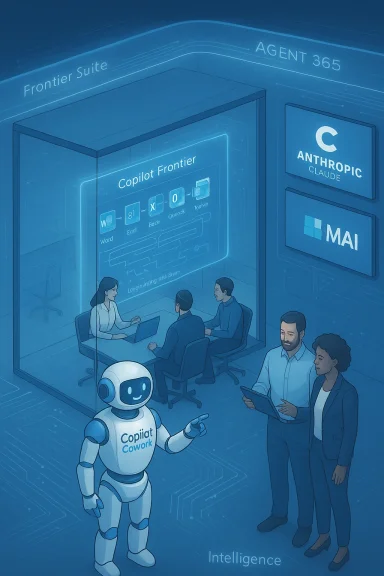
A friendly robot guides a team inside the futuristic Copilot Frontier coworking hub.Background / Overview​

Microsoft debuted Copilot as a productivity layer that augmented Word, Excel, PowerPoint, Outlook and Teams with generative assistance. Over the past two years that assistive layer has steadily evolved into a hybrid product family: hosted models from partners, internal MAI (Microsoft AI) models, orchestration tools, and now — agentic, long‑running workflows that do work rather than just suggest it. The net result is a powerful stack that spans model supply, orchestration, app integration, and commercial packaging — but it has also become organizationally fragmented.
Microsoft’s recent move seeks to address that fragmentation by aligning product engineering, sales and commercial operations more tightly around a single Copilot narrative. The company is packaging new agent capabilities and model choice into a premium enterprise SKU while simultaneously re‑emphasizing governance and security controls intended to reassure large customers. That combination — product coherence plus enterprise assurance — is the core of the company’s message.

What Microsoft announced (the essentials)​

Copilot Cowork: an agentic coworker​

  • Microsoft introduced Copilot Cowork, a research‑preview feature that brings Anthropic’s Claude Cowork technology into Microsoft 365 so Copilot can run long‑running, multi‑step tasks across apps and files with permissioned access to email, calendar and documents. The capability is pitched as a way for Copilot to plan, execute and return finished work on behalf of users rather than only returning drafts or analysis.
  • Microsoft positions Cowork as a research preview initially available to select customers and to the company’s Frontier program; operational availability will follow a staged rollout. Independent outlets characterized the move as Microsoft deliberately diversifying Copilot’s model architecture — adding Anthropic’s tooling and models as first‑class options inside the Copilot ecosystem.

Microsoft 365 E7 and Agent 365​

  • Microsoft bundled Copilot, a new Agent 365 control plane (for agent governance and management), and advanced security and identity tooling into a new enterprise tier called Microsoft 365 E7 (“First Frontier Suite”). The company published list pricing and availability: E7 will be offered at $99 per user per month with general availability on May 1, 2026, while Agent 365 will be offered separately at about $15 per user per month. Microsoft frames the bundle as a way to make agentic AI a manageable, auditable product for enterprise IT.

Commercial and organizational context​

  • The product push is accompanied by a commercial rebalancing that concentrates go‑to‑market authority and execution around leaders whose remit is to sell AI to large customers. The broader executive reorg that elevated Judson Althoff to greater commercial responsibility — freeing Satya Nadella and his engineering leaders to focus more on technical strategy — is part of the same playbook: separate the business of selling AI from the business of building it. Bloomberg and other outlets documented the leadership shifts earlier, and Microsoft’s own commercial announcements make clear the emphasis on narrowing the commercial‑to‑engineering feedback loop.

Why Microsoft needs coherence — and why this move makes sense​

1) Product complexity was hitting GTM and adoption roadblocks​

Copilot’s footprint grew quickly: multiple model sources (OpenAI, in‑house MAI models, now Anthropic), add‑on agent tooling, a spectrum of security overlays, and a patchwork of commercial SKUs. That breadth required a coherent narrative for CIOs and procurement teams who still measure AI purchases in contractual predictability and auditability. Bringing the pieces together into an opinionated bundle marketed as a security‑first, enterprise‑grade agent stack reduces procurement friction and gives sales teams a single story to take to customers. Microsoft’s own product announcements explicitly tie Cowork and Agent 365 to Work IQ — the intelligence layer that maps AI behavior to work context — reinforcing that the company sees Copilot as an integrated, not ad hoc, platform.

2) Commercialization—turning research into recurring revenue​

AI consumption economics differ from traditional software licensing. By packaging Copilot plus agent governance and advanced security in E7, Microsoft creates a relatively simple buying decision for enterprises willing to pay for managed AI capabilities and for the risk mitigation that Microsoft promises. The $99 E7 SKU is positioned at a premium, but it consolidates components that would be pricier if purchased a la carte; this is a classic consumption bundling play meant to increase average revenue per user. Analysts and trade outlets immediately framed E7 as Microsoft’s lever to accelerate Copilot monetization.

3) Product‑engineering focus and model diversification​

Relying on a single external partner at the model layer creates fragility and limits product differentiation. Microsoft has been clear about pursuing a multi‑model orchestration strategy: OpenAI models where they fit, its own MAI models where latency or cost matters, and third‑party models such as Anthropic’s Claude for specialized agentic workloads. Centralizing Copilot’s roadmap helps reconcile engineering tradeoffs (latency, cost, safety) with clear product responsibilities and performance targets. File‑level community discussion among enterprise admins and engineers shows the same conclusion: Microsoft is making Copilot into an orchestration platform rather than a single‑model product.

The technical and operational anatomy of the new push​

How Copilot Cowork works (as described)​

  • Cowork runs agents in a sandboxed, cloud‑hosted environment with permissioned access to a user’s Microsoft 365 signals (mail, calendar, Teams, files) so agents can perform multi‑step tasks that span apps and persist across device sessions. Microsoft describes Work IQ as the layer that maps organizational context to agent behavior and Agent 365 as the control plane for managing, auditing, and governing these agents. The intent is that agents operate with enterprise‑grade boundaries and traceability rather than unmediated access to systems.
  • Anthropic’s Claude Cowork brings a different reasoning and agent execution stack into the mix; Microsoft says the company integrated Claude Cowork’s agent harness and model family (including Claude Sonnet models) to handle long‑running, multi‑step business workflows that previously challenged purely conversational assistants. Independent coverage confirmed the integration and noted Microsoft’s decision to accept third‑party agents into its orchestration layer.

Licensing and governance plumbing​

  • Agent 365 provides centralized policy controls, logs, and administrative visibility. Microsoft’s security commentary stresses sandboxing, identity and access boundaries through Entra, and integration with Defender and Purview so that agent operations can be inspected and constrained in enterprise environments. The new E7 bundle is meant to consolidate these services under one procurement umbrella. Enterprises should still expect a complex rollout and tailored configuration to match data residency, compliance and third‑party model usage policies.

Strengths: what Microsoft did right​

  • Product‑level clarity. Packaging Copilot agents, governance, identity, and security into a single suite reduces ambiguity for purchasers who want clear SLAs, audit trails, and a vendor to hold accountable. This addresses a real enterprise demand for operationalized AI, not laboratory demos.
  • Model choice without chaos. By supporting multiple model providers in a managed way, Microsoft can route workloads to the best‑fitting engine (cost/latency/accuracy tradeoffs) while retaining a single control plane. That’s a defensible engineering stance for large, heterogeneous customers.
  • Commercial discipline. The E7 SKU is a direct answer to the hard business question: how does Microsoft make money from Copilot beyond goodwill and headlines? Bundled pricing and a clear date of availability give enterprise buyers and partners a definable milestone to plan around.
  • Enterprise‑grade governance commitments. Microsoft’s security blog and product documentation emphasize sandboxing, identity enforcement, and logging — features enterprises require before allowing systems to act autonomously on sensitive data. Those commitments are material for procurement decisions.

Risks, trade‑offs and places to watch​

1) Data flows and third‑party exposure​

Integrating Anthropic (or any non‑Microsoft model provider) into a Copilot experience necessarily introduces additional data flows and subprocessors. Even when sandboxed, the presence of external models that operate outside a tenant’s direct control raises questions about data residency, regulatory boundaries, and downstream auditing. Microsoft’s documentation highlights enterprise features, but real deployments will expose the nuanced policy and legal work required to make third‑party model use compliant in regulated sectors. Industry chatter and forum posts already flag these concerns.

2) Governance becomes more complex, not simpler​

Agentic systems introduce new failure modes: agents taking unexpected actions, stale permissions, or chaining behaviors that inadvertently exfiltrate data. A single control plane is necessary but not sufficient; it must be paired with rigorous lifecycle management, human‑in‑the‑loop checkpoints for high‑risk operations, and tooling to detect anomalous agent behavior. The presence of Agent 365 helps, but the operational burden will fall on CIOs and security teams — and on MSP partners who will be expected to shoulder much of the heavy lifting.

3) Pricing and adoption friction​

$99 per user per month for E7 is a meaningful premium and will reshape the economics for customers who previously relied on lower‑cost or free Copilot experiences. For some organizations E7 will be a clear productivity and governance win; for many others the sticker price will force staged pilots or selective seat allocation. The aggregate effect could be to slow enterprise‑wide adoption, concentrating Copilot agents in high‑value teams first while leaving the long tail of users on cheaper, less capable SKUs.

4) Supplier concentration and competitive dynamics​

Microsoft’s move to accept multiple model providers is clever but also risky: enterprises may now face a second layer of vendor selection (which external model to allow, when) and must maintain contractual relationships with more than one AI supplier, each with different security models and obligations. Microsoft’s platform approach reduces friction, but it does not eliminate the complexity of multi‑vendor governance.

5) Execution risk within Microsoft​

Reorgs create short‑term disruption. Microsoft has repeatedly reshuffled product and sales leadership in response to the AI moment; while the aim is clearer focus, the risk is that organizations in transition can leave customers with inconsistent roadmaps or unclear support commitments. External reporting on organizational change at Microsoft has signaled both opportunity and internal strain; execution matters more than vision at this inflection point.

What this means for enterprise IT teams and MSPs​

Enterprises should approach Copilot Cowork and E7 with a disciplined plan that treats these capabilities as a new class of automation platform — more akin to deploying an RPA fleet combined with a SaaS governance layer than to flipping on a productivity toggle.
  • Prioritize high‑value workflows for early agent pilots: legal summarization, CRM automation, scheduled reporting and internal knowledge orchestration are the natural first candidates.
  • Enforce strict least privilege and human review for any agent that acts on financial, legal, HR or regulated datasets.
  • Map data residency and subprocessors: if you plan to let Anthropic models access tenant data, validate subprocessors against your compliance checklist.
  • Budget for seat economics: E7 will likely start in pockets — expect to pair E7 seats for agent owners with broader, lower‑tier Copilot access for general users.
  • Use the Agent 365 control plane as a central point for logging, policy, and approvals, but do not outsource policy design; that must remain an internal function.
Community discussion already shows managed service providers framing Copilot as an ongoing revenue play: transform internal pilots into packaged governance, deployment and ongoing tuning services. MSPs will need to invest in AI operational tooling and compliance expertise if they want to be the glue between Microsoft’s control plane and customers’ internal policy needs.

Practical rollout checklist (for CIOs and IT leaders)​

  • Inventory: Identify the top 10 workflows that would benefit from agentic automation and categorize by risk (low/medium/high).
  • Legal & Compliance: Map any data that agents would access to legal constraints and data protection regimes; require subprocessors disclosures.
  • Pilot design: Begin with low‑risk agents and define explicit human approval gates for high‑impact steps.
  • Security baseline: Enable Entra identity controls, Defender protections and Purview logging for any pilot workspace; verify Agent 365 audit logs are routed to SIEM.
  • Monitoring & rollback: Build automated monitors for anomalous agent actions and a tested rollback procedure for removing agent access quickly.
  • Commercial proof: Run a TCO comparison of E7 vs. assembling E5 + Copilot + Agent 365 components à la carte to confirm the price/performance case for your organization.

The broader industry and regulatory lens​

Microsoft’s move crystallizes a broader industry trend: the migration from model research and demo UXs to operational, auditable AI that enterprises can buy and manage. That transition invites regulatory scrutiny — particularly where third‑party models are used on private data and where agents take autonomous actions that affect people and markets.
Legal scholars and policy thinkers have warned that workplace AI regulation is still nascent and that specific rules around workplace use, auditability and liability are needed. Companies that adopt agentic AI ahead of clear regulatory standards should plan for evolving obligations and the possibility of jurisdictional limits on data flow or model use. Enterprises will want contractual protections and technical controls in place before agents become mission‑critical.

How this ties to Microsoft’s longer story: Windows, MAI, and the Agentic OS​

This reorganization is not isolated to Copilot: Microsoft has been reorganizing Windows engineering with an explicit ambition to evolve the OS into an “agentic OS” that better surfaces multimodal AI, on‑device inference and persistent agents. That platform‑level ambition aligns with Copilot’s agentic direction: agents that act across apps are most powerful when the underlying operating system and cloud stack are designed to support persistent, secure agent execution. The Windows reorg and Copilot commercialization push are two sides of the same strategic bet: owning the stack from silicon and OS to cloud models and enterprise sales.
Microsoft is also developing more of its own models (MAI) and selectively partnering with third parties; this hybrid approach reduces single‑vendor dependency and gives the company levers to optimize for latency, cost and product‑fit across scenarios. Community and industry reporting noted MAI model rollouts and the start of in‑house model deployments within Copilot surfaces in 2026. That model diversification supports a resilient platform approach — but also multiplies the policy and verification burden.

Final assessment: coherent direction, hard operational work ahead​

Microsoft’s Copilot reorganization and the simultaneous product packaging around Copilot Cowork, Agent 365 and Microsoft 365 E7 represent a clear strategic pivot: move from a scattered set of AI demos and pilots into a disciplined, commercial‑grade platform for agentic work at enterprise scale. The company has assembled the right technical pieces — model diversity, agent orchestration, identity and security integration — and given the sales organization a straightforward commercial vehicle.
But translating that coherence into predictable, safe enterprise deployments is nontrivial. The technical guarantees (sandboxing, Entra identity, Defender integrations) are necessary but not sufficient; organizations will still bear the operational burden of defining acceptable agent behavior, building human‑in‑the‑loop policies, and managing third‑party subprocessors. The $99 E7 price settles the question of Microsoft’s commercial intent: this is now a productized platform and a revenue line, not an academic experiment.
For enterprise readers, the pragmatic path is clear: pilot conservatively, instrument aggressively, and treat agents as software systems with the same lifecycle controls you apply to critical infrastructure. For Microsoft, the bet is that coherence plus governance will be the bridge they need to take Copilot from a high‑profile capability to a durable, recurring revenue product that enterprises can actually rely on. The next 12 months — agent rollouts, security audits, early customer outcomes and regulatory responses — will determine whether coherence becomes durable advantage or simply the latest iteration in a high‑stakes product race.


Source: WSJ https://www.wsj.com/tech/ai/microso...efforts-with-copilot-reorganization-a985b374/
 

Back
Top