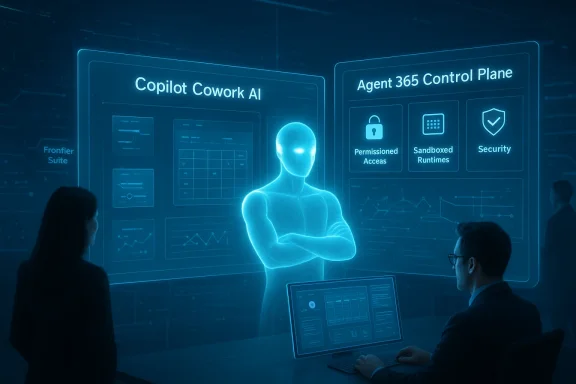
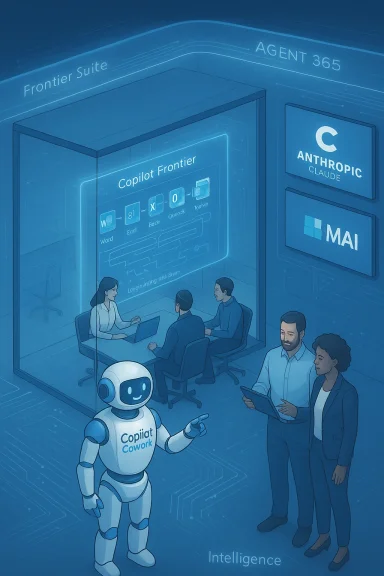
Microsoft's newest enterprise push makes a clear bet: the next phase of productivity is not just about smarter assistants, it's about agentic AI that plans, executes, and reports across the full stack of work — and it's packaged as a new premium tier and management plane aimed squarely at large organizations. The company unveiled Microsoft 365 E7 (branded internally as The Frontier Suite), a new Copilot capability called Copilot Cowork (built with Anthropic technology), and Agent 365, a control plane to govern and monitor long-running AI agents. These components are positioned to move businesses from pilot projects and one-off automations into scaled, governed AI-driven workflows inside the Microsoft ecosystem.
Microsoft has iterated Copilot as an in-app assistant for months, embedding generative AI into Outlook, Word, Excel, Teams, and Power Platform. What changes with the E7 launch is a clear shift from prompt-driven helpers to autonomous, stateful agents that can carry out multi-step processes over time, operate across apps, and be managed centrally by IT teams. This represents a maturation from augmentative AI to what vendors now call agentic systems of work.
The Frontier Suite idea bundles security, identity, and the new agent management features into a single SKU so enterprises have a turnkey path to adopt agentic workflows without assembling a dozen separate contracts and integrations. Microsoft positions this as an answer to two enterprise challenges: how to safely scale AI-driven automation, and how to retain governance, telemetry, and control while delegating meaningful work to AI.
Key bundle elements:
For the broader market, expect:
But there is also a cautionary tale. The technical measures Microsoft is announcing — sandboxes, checkpoints, Entra policies, Defender and Purview integration — are necessary but not sufficient on their own. Enterprises will need to operationalize these controls, expand governance into procurement and legal processes, and prepare for new attack surfaces and liability questions. The next 12 months will show whether Microsoft’s bundled approach reduces friction without creating hidden compliance debts, and whether partners and customers can build the operational muscle to manage fleets of software agents safely and effectively.
Ultimately, Microsoft’s bet is that organizations will choose a managed, integrated route to agentic AI rather than stitching together point solutions — and that the combination of identity, security, and governance will be a decisive buyer enabler. If that proves true, E7 and Agent 365 could become the default on-ramp for enterprise-scale AI workers. If not, we’ll see hybrid approaches and third-party governance platforms step in to fill the gaps. Either way, the era of Copilot execution has arrived — and with it a new set of operational responsibilities for IT leaders.
Conclusion: Microsoft’s Frontier Suite is the clearest signal yet that agentic AI is moving from novelty to a mainstream enterprise platform. The upside is productivity at scale; the downside is governance and complexity. Adopting organizations will need to balance ambition with rigorous controls, and the industry will be watching closely to see whether the promise of autonomous work is realized safely.
Source: Mix Vale Microsoft boosts enterprise AI with launch of E7 Suite, Copilot Cowork and Agent 365
 Background: where this fits in Microsoft's AI roadmap
Microsoft has iterated Copilot as an in-app assistant for months, embedding generative AI into Outlook, Word, Excel, Teams, and Power Platform. What changes with the E7 launch is a clear shift from prompt-driven helpers to autonomous, stateful agents that can carry out multi-step processes over time, operate across apps, and be managed centrally by IT teams. This represents a maturation from augmentative AI to what vendors now call agentic systems of work.The Frontier Suite idea bundles security, identity, and the new agent management features into a single SKU so enterprises have a turnkey path to adopt agentic workflows without assembling a dozen separate contracts and integrations. Microsoft positions this as an answer to two enterprise challenges: how to safely scale AI-driven automation, and how to retain governance, telemetry, and control while delegating meaningful work to AI.
What Microsoft announced: E7, Copilot Cowork and Agent 365 — the essentials
Microsoft 365 E7: The Frontier Suite
Microsoft 365 E7 is a new premium bundle that combines Microsoft 365 E5 with Microsoft 365 Copilot, the Microsoft Entra Suite, and Agent 365 — plus enhanced Defender, Intune, and Purview capabilities. It is being marketed as the packaged route to deploy agentic AI at scale while maintaining enterprise-grade security and identity posture. Microsoft says the E7 SKU will be generally available on May 1, 2026, priced at $99 per user per month.Key bundle elements:
- Microsoft 365 E5 (core productivity and advanced security)
- Microsoft 365 Copilot (AI across email, docs, meetings, spreadsheets, and business apps)
- Agent 365 (control plane for creating, governing, and observing agents)
- Microsoft Entra Suite (identity and access control)
- Advanced Microsoft Defender, Intune, and Purview integrations
Copilot Cowork: agentic workflows powered with Anthropic technology
Copilot Cowork is Microsoft’s new capability to enable long-running, multi-step tasks executed on behalf of users. Built in close collaboration with Anthropic, Cowork brings the underlying ideas of Anthropic's Claude Cowork into the Microsoft Copilot environment. Instead of answering discrete prompts, Cowork can learn a user's desired outcome, create a stepwise plan, and then execute that plan across multiple Microsoft 365 surfaces — pausing for checkpoints where the user can review or alter behavior. Microsoft is previewing Cowork in a research-limited program and plans broader availability through the Frontier program in late March and beyond.Agent 365: the governance and observability plane
Agent 365 is marketed as the administrative backbone for organizations that want to run many agents safely. It provides:- Centralized cataloging and lifecycle management of agents
- Policies and controls tied into Entra identity and Defender security signals
- Telemetry, auditing, and observability for agent behavior and outcomes
Microsoft has set Agent 365 for general availability on May 1, 2026, with stand-alone pricing reported around $15 per user per month for organizations that want the agent-control plane without the full E7 bundle.
Why this matters: enterprise opportunity and problem framing
For enterprises that have already piloted Copilot and other generative features, the E7 strategy closes several gaps that prevent broad deployment today.- From pilots to production: Many organizations limit AI to sandboxed projects because they lack tooling to manage a fleet of autonomous agents. Agent 365 aims to provide that, reducing operational friction.
- Security and compliance: Bundling Defender, Intune, Purview, and Entra with agent management gives a pre-integrated path to apply existing compliance and zero-trust policies to agent behavior.
- Single-vendor integration: For customers already invested in Microsoft 365 and Azure, the E7 bundle offers predictable compatibility and a streamlined procurement model.
Technical deep-dive: what Copilot Cowork and Agent 365 actually do
Copilot Cowork — autonomy, orchestration, and checkpoints
At a technical level, Copilot Cowork introduces several capabilities that distinguish it from session-bound Copilot features:- Stateful execution: Cowork can maintain state over time, enabling tasks that require waiting for external events, progressive refinement, or staged approvals.
- Cross-app orchestration: Cowork can act across Outlook, Teams, Word, Excel, and other Microsoft surfaces to read context, modify documents, schedule meetings, and update business systems.
- Checkpoints and human-in-the-loop: To mitigate risk, Cowork inserts checkpoints that require user confirmation or allow users to pause or adjust an ongoing workflow.
- Sandboxed execution: Tasks run in isolated cloud sandboxes to limit data exposure and provide a clean boundary for monitoring.
Agent 365 — the control plane
Agent 365 functions as the administrative brain for fleets of agents. Its important components include:- Agent catalog: IT can register approved agent templates and restrict which ones employees may instantiate.
- Policy engine: Administrators can create rules for data access, external integrations, and operational limits tied to identity conditions provided by Entra.
- Telemetry and logging: Audit trails, behavior logs, and outcome records enable compliance reporting and incident investigation.
- Role-based access and approval flows: Agent creation, escalation, and execution can be gated by role-based workflows.
- Integration points: Built-in hooks to Defender and Purview provide a way to apply existing threat detection and data loss prevention policies to agent activity.
Business and partner implications
Pricing and GTM posture
Microsoft's pricing strategy positions E7 at a premium — $99/user/month for the Frontier Suite — with Agent 365 available as an add-on for organizations that want governance without the full bundle. This creates a clear upsell motion for customers on E5 and a pathway for partners to build services around agentization, PoC accelerators, and managed services. Partners will find opportunities in migration, secure deployment, and change management programs as firms adopt agentic automation.Competitive landscape and vendor dynamics
The Anthropic collaboration signals a strategic broadening of Microsoft’s AI vendor relationships beyond its long-standing OpenAI partnership. Anthropic's Claude technology — now rebranded into a Cowork capability for Microsoft — brings an alternative model of instruction-following and safety-first engineering that enterprises value. This has two implications:- It reduces single-vendor risk for Microsoft customers by integrating multiple LLM providers.
- It signals that Microsoft will continue to orchestrate third-party models inside its ecosystem rather than relying on a single backend.
Security, privacy, and governance: strengths and open questions
Strengths Microsoft is emphasizing
- Integrated identity and policy enforcement: Tying Agent 365 into Entra provides enterprises with familiar policy primitives for agents.
- Sandboxes and telemetry: Running agents in protected environments and logging actions helps with forensics and compliance.
- Pre-bundled data protection: Including Defender, Intune, and Purview in E7 makes it easier to extend DLP and endpoint controls to agent-driven actions.
Notable risks and unanswered questions
Despite the controls, several risk areas require careful attention from enterprises:- Data exfiltration via agents: Stateful agents that can touch email, files, and external APIs present a new attack surface. Effective DLP policies and strict identity binding will be essential.
- Model hallucination and decision-critical errors: Agents executing multi-step workflows could perform unauthorized financial actions or publish incorrect content if models hallucinate. Checkpointing helps, but critical workflows may still demand human approvals.
- Third-party model provenance: Using Anthropic models inside Microsoft services raises questions about where model governance and incident response responsibilities lie — with Microsoft, Anthropic, or both.
- Complexity of policy management: Enterprises will need to expand governance playbooks to cover agent lifecycles, including decommissioning, forensics, and versioning of agent templates.
- Regulatory scrutiny: In regulated sectors (finance, healthcare, government), agents will trigger new compliance workflows and likely require formal attestations about model behavior and data handling.
Operational playbook: how enterprises should approach adoption
Adoption of agentic AI should be staged and governed. Recommended steps:- Inventory high-value use cases that are repetitive, rules-based, and have well-defined inputs/outputs.
- Start with pilot agents in a low-risk domain, using Agent 365’s sandboxes and telemetry to validate behavior.
- Define policy guardrails in Entra and Purview for data access and retention.
- Instrument Defender and endpoint controls to detect anomalous agent activity.
- Create a human-in-the-loop policy for any workflow that can affect financials, legal commitments, or public communications.
- Develop rollback and kill-switch procedures and test them regularly.
- Train users and administrators on agent design, approval workflows, and incident response.
Integration and developer experience
From the developer and automation perspective, the E7 announcements suggest Microsoft will expose APIs and templates for agent creation, likely integrated with Power Platform and Microsoft Graph. Enterprises should expect:- Agent templates and SDKs to accelerate building reusable agents tied to business processes.
- Graph APIs for provisioning, telemetry, and admin workflows.
- Pre-built connectors to Microsoft 365 data surfaces (Outlook, SharePoint, Teams) and potential marketplace connectors for common enterprise systems.
The legal and compliance horizon
Agentic AI raises fresh legal issues:- Attribution and liability: Who is responsible for agent actions? The agent designer, the organization, or the platform?
- Records and auditability: Many regulations require immutable logs and records — Agent 365’s telemetry must satisfy those requirements.
- Data residency and cross-border processing: Enterprises with strict residency requirements will need assurances about where agent processing occurs and whether third-party model inference crosses borders.
Competitive and market implications
Microsoft’s E7 move is both defensive and offensive. It defends its enterprise moat by offering an integrated, secure path to the most advanced AI workflows and it competes directly with specialist agent platforms and cloud-native automation vendors. By partnering with Anthropic, Microsoft also sends a signal that enterprises will be able to access multiple model providers through its platform — a critical differentiator for customers concerned about single-provider lock-in.For the broader market, expect:
- Increased enterprise demand for agent governance tooling and third-party verification services.
- A flurry of partner offerings for migration, policy design, and managed agent operations.
- Greater scrutiny from regulators and auditors as agentic systems become more prevalent in sensitive domains.
Practical recommendations for IT leaders
- Treat agentic AI as a platform program, not a departmental pilot. Assign clear ownership and cross-functional governance.
- Prioritize identity-first policies using Entra to minimize scope creep when agents access data.
- Require staged approvals and manual checkpoints for any workflow with legal, financial, or reputational impact.
- Build observability and alerting into agent deployments from day one; assume you will need forensic logs.
- Engage legal and compliance teams early to define acceptable use, retention, and audit requirements.
- Consider a hybrid approach: run high-sensitivity workflows in-house while leveraging cloud agent capabilities for lower-risk automation.
Final analysis: promise, prudence, and the next 12 months
Microsoft’s E7, Copilot Cowork, and Agent 365 form a coherent product narrative: make agents useful, make them safe, and package governance into a purchasable path for enterprises. The promise is substantial — significant productivity gains for knowledge workers, faster automation of complex workflows, and centralized controls for IT. The practical benefits are real for organizations that already use Microsoft 365 and want a lower-friction route to agentic automation.But there is also a cautionary tale. The technical measures Microsoft is announcing — sandboxes, checkpoints, Entra policies, Defender and Purview integration — are necessary but not sufficient on their own. Enterprises will need to operationalize these controls, expand governance into procurement and legal processes, and prepare for new attack surfaces and liability questions. The next 12 months will show whether Microsoft’s bundled approach reduces friction without creating hidden compliance debts, and whether partners and customers can build the operational muscle to manage fleets of software agents safely and effectively.
Ultimately, Microsoft’s bet is that organizations will choose a managed, integrated route to agentic AI rather than stitching together point solutions — and that the combination of identity, security, and governance will be a decisive buyer enabler. If that proves true, E7 and Agent 365 could become the default on-ramp for enterprise-scale AI workers. If not, we’ll see hybrid approaches and third-party governance platforms step in to fill the gaps. Either way, the era of Copilot execution has arrived — and with it a new set of operational responsibilities for IT leaders.
Conclusion: Microsoft’s Frontier Suite is the clearest signal yet that agentic AI is moving from novelty to a mainstream enterprise platform. The upside is productivity at scale; the downside is governance and complexity. Adopting organizations will need to balance ambition with rigorous controls, and the industry will be watching closely to see whether the promise of autonomous work is realized safely.
Source: Mix Vale Microsoft boosts enterprise AI with launch of E7 Suite, Copilot Cowork and Agent 365