

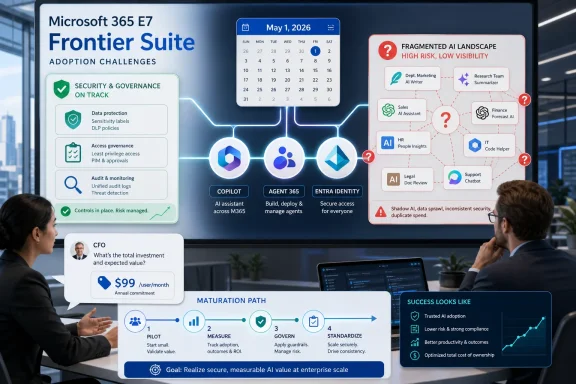
Microsoft’s new Microsoft 365 E7 “Frontier Suite” became generally available on May 1, 2026, at $99 per user per month, bundling Microsoft 365 E5, Microsoft 365 Copilot, Agent 365, and Entra Suite into one annual enterprise license. Three months later, the early channel read is not that customers reject AI, but that they reject Microsoft’s assumption that AI is ready to be bought like email, identity, or endpoint security. As Channel Dive reported through interviews with managed service provider Tusker, the bundle’s biggest obstacle may be its youth: the product is priced like a mature platform, while many buyers still experience enterprise AI as a departmental experiment.
That distinction matters because E7 is not merely another SKU in Microsoft’s ever-thickening licensing catalog. It is Microsoft’s attempt to turn Copilot from an add-on into the default enterprise AI layer, and to make Agent 365 the governance plane for the next wave of workplace automation. The question is not whether Microsoft’s AI software bundle is “too new” in the abstract. It is whether Microsoft has moved faster than customers’ ability to prove value, govern risk, and standardize on one AI vendor across the business.
Microsoft’s pitch for E7 is coherent, even elegant, by the standards of enterprise software packaging. Take the familiar high-end Microsoft 365 E5 foundation, add Microsoft 365 Copilot, fold in Agent 365 for managing AI agents, include Entra Suite for identity and access controls, and sell the result as a single enterprise AI-and-security tier. Microsoft described the package in March as the first “Frontier Suite,” built around “intelligence and trust,” and followed through with general availability on May 1.
The economic argument is equally straightforward. Microsoft says E7 costs less than buying the included pieces à la carte, and partners have been repeating a roughly 15 percent savings figure for organizations that would otherwise buy the full stack separately. For a CIO already committed to E5, Copilot, Entra Suite, and agent governance, $99 per user per month is not irrational. It is a bundled discount with simpler procurement and a tidier story for the board.
The problem is that this ideal customer is still rare. Tusker chief innovation officer Kush Patel told Channel Dive that he has not seen a whole organization standardize on one AI platform. Finance may like Copilot because Excel and PowerPoint remain its native habitat; developers may prefer Claude for coding; marketing teams may reach for Gemini or other tools for image and campaign work. That is not a temporary nuisance. It is the actual state of AI adoption inside many enterprises.
Microsoft’s bundle assumes that AI standardization will look like Office standardization: one vendor, one tenant, one license, one governance model. But generative AI has not behaved like the productivity-suite market. It behaves more like a portfolio of specialized tools whose strengths shift quickly, whose costs are hard to forecast, and whose value depends heavily on job role, data quality, and workflow design.
That makes E7 less like the obvious successor to E5 and more like a bet that the market will consolidate around Microsoft before customers have finished experimenting.
The invisible cost is commitment. Patel’s comment to Channel Dive that customers can upgrade but cannot easily downgrade gets to the heart of Microsoft licensing psychology. An annual enterprise commitment turns an AI experiment into a budget line before the organization has necessarily answered the operational questions that matter most.
Does every user need Copilot? Which roles produce measurable savings? Which workflows are safe to automate? Which departments need agent governance now, rather than in some aspirational future? Which existing security and identity investments overlap with the E7 stack? These are not academic questions; they determine whether the discounted bundle is actually cheaper or simply broader.
That is why some companies are staying on E5 and adding Copilot month to month where it is useful. The approach is messier, but it preserves optionality. In the current AI market, optionality has real value because the tools are improving, pricing models are changing, and vendor capabilities are uneven across use cases.
Microsoft’s counterargument is that fragmented AI adoption creates security and governance problems. That is true. Shadow AI, uncontrolled agents, unmanaged data access, and inconsistent retention policies are real enterprise risks. But the existence of those risks does not automatically prove that every employee should be licensed into the full Microsoft AI bundle.
For many administrators, the sensible path is staged adoption: pilot Copilot, measure usage, test Agent 365, validate Entra Suite needs, and only then decide whether E7 belongs in the renewal negotiation. That is not anti-Microsoft behavior. It is procurement discipline.
For knowledge workers who build decks, summarize meetings, draft emails, analyze spreadsheets, search internal documents, and coordinate projects, Copilot has a natural advantage. It can sit close to the Microsoft Graph, inherit existing permissions, and appear inside familiar applications rather than demanding a new destination. That matters because enterprise software adoption is often less about theoretical capability than about friction.
But Microsoft’s strength is also its constraint. Copilot is most compelling when the work is already Microsoft-shaped. Developers who spend their day in code repositories, terminal windows, issue trackers, and model-assisted programming environments may care less about Copilot in Word and more about whichever coding assistant performs best that month. Designers, marketers, analysts, and data scientists may also have tool preferences that do not map cleanly to a Microsoft 365 seat.
That is the adoption pattern Patel described to Channel Dive, and it tracks with what many IT teams see on the ground. AI is not one thing. It is summarization, search, drafting, coding, image generation, workflow automation, data extraction, meeting intelligence, customer support, compliance review, and more. A single bundle can govern some of that activity, but it cannot magically make one model or one interface best for every task.
This is where Microsoft’s historical muscle memory may be misleading. Office won because documents, spreadsheets, presentations, and email became standardized work artifacts. AI tools are not yet standardized artifacts; they are competing forms of cognition-as-a-service. The winning package may not be the one with the most familiar logo. It may be the one that proves itself in each job category.
In that sense, Agent 365 is Microsoft at its most Microsoft. The company understands that enterprises do not only buy capability; they buy control planes. Active Directory, Group Policy, Intune, Defender, Purview, and Entra all reflect the same pattern: Microsoft turns messy technology adoption into something administrators can provision, monitor, restrict, and report on.
The trouble is timing. Agentic AI is still new enough that many companies have not yet moved beyond pilots, demos, and cautious internal experiments. The management layer is important, but buyers may not yet know how many agents they will run, what those agents will do, or which vendor ecosystems they will inhabit. Selling the control plane before the controlled objects are broadly deployed is strategically rational for Microsoft but financially awkward for customers.
That awkwardness becomes sharper when Agent 365 is included in a suite purchased for every user. Some organizations may need agent governance for developers, operations teams, service desks, analysts, or process-heavy departments. That does not mean every employee needs to be part of the same licensed bundle on day one.
Microsoft is betting that agent governance will become as central as endpoint management or identity governance. It may be right. But the customers hesitating today are not necessarily shortsighted. They are being asked to pay now for a management problem that is emerging unevenly across the enterprise.
A one-year license term makes sense for Microsoft. It stabilizes revenue, encourages standardization, and gives partners a clean renewal motion. It also helps Microsoft shift AI from experimental spending into recurring platform spend, which is exactly what Wall Street wants to see from a company pouring billions into AI infrastructure.
For customers, though, the market is still moving too quickly for premature standardization to feel safe. Model quality changes. Token costs change. Regulatory pressure changes. Internal acceptable-use policies change. New features appear in one product and then are matched elsewhere weeks later. A tool that looks best for coding in July may not look best in November; an image model that marketing loves today may be displaced before next year’s planning cycle.
That is why consumption-based services such as AWS Bedrock and OpenAI’s API-led offerings have a different appeal. They let organizations scale usage with demand, at least in theory, rather than licensing broad populations before usage patterns are clear. Consumption pricing has its own hazards, especially runaway token bills and unpredictable departmental sprawl, but it matches the experimental phase more naturally than a universal per-seat commitment.
Microsoft is trying to move customers from experimentation to platformization. Customers are responding by saying: prove the platform first. That is not a contradiction. It is a negotiation over who absorbs uncertainty.
AI adoption without governance is a real problem. Employees paste sensitive content into consumer tools. Departments buy point solutions without security review. Agents may be granted too much access. Internal permissions that were tolerable when humans clicked through folders become dangerous when a machine can summarize, correlate, and expose information at scale. The old SharePoint sprawl problem becomes much more serious when an assistant can read across it.
Microsoft knows this terrain. By bundling Copilot with Entra, Defender, Purview, Intune, and Agent 365, it is telling customers that AI safety is not a separate feature but a platform property. For regulated industries, large enterprises, and organizations already struggling with identity governance, that argument has weight.
It also puts pressure on competitors. A best-in-class model is attractive, but the buyer in a large enterprise is rarely just the employee who likes the output. Security teams want conditional access, audit trails, data-loss controls, retention policies, eDiscovery hooks, and admin visibility. Microsoft’s advantage is that it can tie AI procurement to those existing control surfaces.
Still, governance is not the same as value. A well-governed tool that employees do not use is just shelfware with a compliance story. The E7 challenge is that Microsoft must win both halves of the argument at once: Copilot must be useful enough to justify broad deployment, and the governance bundle must be necessary enough to justify the premium.
That is a high bar for a product suite that only reached general availability in May.
Patel’s comments to Channel Dive show how the better partners are likely to handle E7 in the near term: not as a default upgrade, but as a staged maturity path. Add specific tools first. Test Agent 365 or Entra Suite. Expand Copilot where usage is visible. Build return-on-investment cases around time saved, processes improved, risks reduced, or software consolidated. Then revisit the bundle when the renewal clock forces the conversation.
This is healthier than the old enterprise software habit of buying the suite and hoping adoption follows. AI does not reward that laziness. A Copilot license assigned to an employee who never changes a workflow is not transformation; it is a tax on optimism.
The partner role is also becoming more consultative because AI ROI is difficult to measure honestly. Time saved is not automatically money saved. A faster meeting summary does not matter if the organization simply schedules more meetings. A coding assistant may increase developer throughput, but it may also require new review practices. An agent may automate a process, but only after expensive integration and governance work.
The E7 sales motion therefore depends on evidence that many customers do not yet have. Microsoft can provide case studies, and Ignite will no doubt produce more. But each organization still has to translate those examples into its own data estate, workflows, risk tolerance, and employee behavior.
Enterprise agreements create natural decision points. As E5 renewals come up, customers will be asked to compare the cost of staying put plus selected add-ons against the cost of moving to E7. If an organization already has meaningful Copilot adoption, wants Entra Suite, and is preparing for agent governance, the bundle will look increasingly rational. If it has only scattered AI use, it will look premature.
That means adoption may rise not because the product suddenly becomes less new, but because customers accumulate enough partial commitments that the bundle math flips. A few Copilot-heavy departments, a security push toward Entra Suite, an internal agent initiative, and a looming renewal can turn E7 from “too much too soon” into “the least messy option.”
Patel’s forecast to Channel Dive that adoption could rise into Q3 and Q4 around Microsoft Ignite fits that pattern. Ignite is where Microsoft can flood the zone with demos, partner materials, customer stories, and roadmap signals. It is also where IT leaders will look for proof that Agent 365 is more than a licensing line item and that Copilot’s enterprise value is maturing beyond novelty.
But the renewal calendar cuts both ways. If customers feel pushed into annual AI commitments before value is proven, E7 could become a symbol of Microsoft overreach. That would be especially risky in a market where many users already complain about Copilot branding sprawl, uneven feature quality, and the sense that AI is being inserted into products faster than organizations can absorb it.
Microsoft’s best move is not to pressure customers into universal deployment. It is to make phased adoption feel like a path toward E7 rather than a rejection of it.
This is not unusual in technology cycles. Early cloud adoption was fragmented before platform strategies hardened. Security tooling sprawled before consolidation platforms gained power. Collaboration tools proliferated before enterprises tried to rationalize them. The pattern is familiar: experimentation first, sprawl second, governance panic third, consolidation fourth.
Microsoft is trying to skip ahead to consolidation. That ambition is understandable because it owns the productivity estate, the identity estate, and much of the endpoint and security estate. If any vendor can argue that AI should be governed inside the Microsoft tenant, Microsoft can.
But AI may resist consolidation longer than Microsoft would like because user preference is stronger and more visible. Employees can compare outputs instantly. Developers can feel whether code suggestions are useful. Marketers can judge image quality. Analysts can test reasoning. Unlike many back-office platforms, AI tools advertise their strengths and weaknesses directly in the work product.
That makes forced standardization risky. If IT mandates one AI assistant that key teams consider inferior for their work, employees will route around it. The result is not governance; it is shadow adoption with better excuses.
For WindowsForum readers, the lesson should feel familiar. The Microsoft stack is powerful when it is the default substrate of work, but default status does not eliminate the need for trust. Users and administrators accept platform decisions when they see stability, value, and control. They resist when a strategic bundle arrives before the daily experience proves itself.
Copilot and agents are only as safe and useful as the data and permissions beneath them. If SharePoint sites are over-permissioned, if Teams channels contain sensitive files with loose access, if retention policies are inconsistent, if labels are poorly applied, and if identity governance is messy, enterprise AI does not solve the problem. It accelerates discovery of the problem.
This is where Microsoft’s bundle creates a useful but uncomfortable mirror. E7 includes tools that can help govern identity, security, compliance, and agents, but buying the suite does not automatically clean up the tenant. Administrators still need to review access, classify data, tune policies, train users, and monitor behavior. The license is not the implementation.
That matters for ROI. A company that buys E7 before doing governance groundwork may blame Copilot for weak results when the real issue is poor data readiness. Conversely, a company that invests in data hygiene, role-based deployment, and workflow redesign may extract value from Copilot without needing an immediate enterprise-wide E7 rollout.
This is why the “too new” label applies not only to Microsoft’s product, but to the customer operating model around it. The software is new. The governance practices are new. The ROI models are new. The cultural norms around AI-assisted work are new. A bundle can simplify procurement, but it cannot mature an organization overnight.
That future is plausible. In fact, some version of it is likely. The question is whether Microsoft has packaged it at the right moment and with the right flexibility.
For the most advanced Microsoft-centric enterprises, E7 may already make sense. If a company has broad E5 adoption, a serious Copilot rollout, a security mandate around Entra Suite, and a roadmap for agentic automation, the suite can reduce licensing complexity and align governance. Those customers are Microsoft’s showcase accounts.
For everyone else, E7 is a roadmap disguised as a license. It tells customers where Microsoft wants them to go, but it does not prove they are ready to get there this quarter. That is why the smarter buyers are testing the pieces before buying the bundle. They are not rejecting AI; they are refusing to confuse procurement momentum with business transformation.
Microsoft should not fear that caution. If Copilot usage deepens, if Agent 365 becomes necessary, if Ignite delivers credible enterprise examples, and if token economics keep pushing CIOs toward governed platforms, E7 adoption will rise naturally. But if Microsoft leans too hard on bundle economics before customers see operational proof, it risks turning “Frontier Suite” into another phrase admins associate with licensing fatigue.
That distinction matters because E7 is not merely another SKU in Microsoft’s ever-thickening licensing catalog. It is Microsoft’s attempt to turn Copilot from an add-on into the default enterprise AI layer, and to make Agent 365 the governance plane for the next wave of workplace automation. The question is not whether Microsoft’s AI software bundle is “too new” in the abstract. It is whether Microsoft has moved faster than customers’ ability to prove value, govern risk, and standardize on one AI vendor across the business.
 Microsoft Has Built a Suite for a Customer That Barely Exists Yet
Microsoft’s pitch for E7 is coherent, even elegant, by the standards of enterprise software packaging. Take the familiar high-end Microsoft 365 E5 foundation, add Microsoft 365 Copilot, fold in Agent 365 for managing AI agents, include Entra Suite for identity and access controls, and sell the result as a single enterprise AI-and-security tier. Microsoft described the package in March as the first “Frontier Suite,” built around “intelligence and trust,” and followed through with general availability on May 1.The economic argument is equally straightforward. Microsoft says E7 costs less than buying the included pieces à la carte, and partners have been repeating a roughly 15 percent savings figure for organizations that would otherwise buy the full stack separately. For a CIO already committed to E5, Copilot, Entra Suite, and agent governance, $99 per user per month is not irrational. It is a bundled discount with simpler procurement and a tidier story for the board.
The problem is that this ideal customer is still rare. Tusker chief innovation officer Kush Patel told Channel Dive that he has not seen a whole organization standardize on one AI platform. Finance may like Copilot because Excel and PowerPoint remain its native habitat; developers may prefer Claude for coding; marketing teams may reach for Gemini or other tools for image and campaign work. That is not a temporary nuisance. It is the actual state of AI adoption inside many enterprises.
Microsoft’s bundle assumes that AI standardization will look like Office standardization: one vendor, one tenant, one license, one governance model. But generative AI has not behaved like the productivity-suite market. It behaves more like a portfolio of specialized tools whose strengths shift quickly, whose costs are hard to forecast, and whose value depends heavily on job role, data quality, and workflow design.
That makes E7 less like the obvious successor to E5 and more like a bet that the market will consolidate around Microsoft before customers have finished experimenting.
The Price Is Not the Only Price
At $99 per user per month on an annual term, E7 is expensive enough to force a CFO conversation but not so expensive that Microsoft cannot defend it. If a company truly needs the included components, the bundle math can work. The issue is that the list price captures only the visible part of the cost.The invisible cost is commitment. Patel’s comment to Channel Dive that customers can upgrade but cannot easily downgrade gets to the heart of Microsoft licensing psychology. An annual enterprise commitment turns an AI experiment into a budget line before the organization has necessarily answered the operational questions that matter most.
Does every user need Copilot? Which roles produce measurable savings? Which workflows are safe to automate? Which departments need agent governance now, rather than in some aspirational future? Which existing security and identity investments overlap with the E7 stack? These are not academic questions; they determine whether the discounted bundle is actually cheaper or simply broader.
That is why some companies are staying on E5 and adding Copilot month to month where it is useful. The approach is messier, but it preserves optionality. In the current AI market, optionality has real value because the tools are improving, pricing models are changing, and vendor capabilities are uneven across use cases.
Microsoft’s counterargument is that fragmented AI adoption creates security and governance problems. That is true. Shadow AI, uncontrolled agents, unmanaged data access, and inconsistent retention policies are real enterprise risks. But the existence of those risks does not automatically prove that every employee should be licensed into the full Microsoft AI bundle.
For many administrators, the sensible path is staged adoption: pilot Copilot, measure usage, test Agent 365, validate Entra Suite needs, and only then decide whether E7 belongs in the renewal negotiation. That is not anti-Microsoft behavior. It is procurement discipline.
Copilot Is Strongest Where Microsoft Already Owns the Workflow
The reason Microsoft has a credible shot at this market is obvious to anyone who lives inside Windows, Office, Teams, Outlook, SharePoint, and Entra ID. Microsoft does not need to win enterprise AI from the outside. It is embedding AI into the work surfaces where millions of employees already spend their day.For knowledge workers who build decks, summarize meetings, draft emails, analyze spreadsheets, search internal documents, and coordinate projects, Copilot has a natural advantage. It can sit close to the Microsoft Graph, inherit existing permissions, and appear inside familiar applications rather than demanding a new destination. That matters because enterprise software adoption is often less about theoretical capability than about friction.
But Microsoft’s strength is also its constraint. Copilot is most compelling when the work is already Microsoft-shaped. Developers who spend their day in code repositories, terminal windows, issue trackers, and model-assisted programming environments may care less about Copilot in Word and more about whichever coding assistant performs best that month. Designers, marketers, analysts, and data scientists may also have tool preferences that do not map cleanly to a Microsoft 365 seat.
That is the adoption pattern Patel described to Channel Dive, and it tracks with what many IT teams see on the ground. AI is not one thing. It is summarization, search, drafting, coding, image generation, workflow automation, data extraction, meeting intelligence, customer support, compliance review, and more. A single bundle can govern some of that activity, but it cannot magically make one model or one interface best for every task.
This is where Microsoft’s historical muscle memory may be misleading. Office won because documents, spreadsheets, presentations, and email became standardized work artifacts. AI tools are not yet standardized artifacts; they are competing forms of cognition-as-a-service. The winning package may not be the one with the most familiar logo. It may be the one that proves itself in each job category.
Agent 365 Is the Most Strategic Part of the Bundle, and Also the Least Proven
If Copilot is the familiar hook, Agent 365 is the future-facing wager. Microsoft is not just selling chat inside Office. It is preparing for an enterprise environment in which AI agents perform multi-step tasks, call tools, access business data, and operate with varying degrees of autonomy. That world will need management, identity, policy, auditability, and security controls.In that sense, Agent 365 is Microsoft at its most Microsoft. The company understands that enterprises do not only buy capability; they buy control planes. Active Directory, Group Policy, Intune, Defender, Purview, and Entra all reflect the same pattern: Microsoft turns messy technology adoption into something administrators can provision, monitor, restrict, and report on.
The trouble is timing. Agentic AI is still new enough that many companies have not yet moved beyond pilots, demos, and cautious internal experiments. The management layer is important, but buyers may not yet know how many agents they will run, what those agents will do, or which vendor ecosystems they will inhabit. Selling the control plane before the controlled objects are broadly deployed is strategically rational for Microsoft but financially awkward for customers.
That awkwardness becomes sharper when Agent 365 is included in a suite purchased for every user. Some organizations may need agent governance for developers, operations teams, service desks, analysts, or process-heavy departments. That does not mean every employee needs to be part of the same licensed bundle on day one.
Microsoft is betting that agent governance will become as central as endpoint management or identity governance. It may be right. But the customers hesitating today are not necessarily shortsighted. They are being asked to pay now for a management problem that is emerging unevenly across the enterprise.
The Annual Term Collides With a Monthly-Moving Market
Enterprise licensing likes predictability. Generative AI does not. That tension is written all over the E7 debate.A one-year license term makes sense for Microsoft. It stabilizes revenue, encourages standardization, and gives partners a clean renewal motion. It also helps Microsoft shift AI from experimental spending into recurring platform spend, which is exactly what Wall Street wants to see from a company pouring billions into AI infrastructure.
For customers, though, the market is still moving too quickly for premature standardization to feel safe. Model quality changes. Token costs change. Regulatory pressure changes. Internal acceptable-use policies change. New features appear in one product and then are matched elsewhere weeks later. A tool that looks best for coding in July may not look best in November; an image model that marketing loves today may be displaced before next year’s planning cycle.
That is why consumption-based services such as AWS Bedrock and OpenAI’s API-led offerings have a different appeal. They let organizations scale usage with demand, at least in theory, rather than licensing broad populations before usage patterns are clear. Consumption pricing has its own hazards, especially runaway token bills and unpredictable departmental sprawl, but it matches the experimental phase more naturally than a universal per-seat commitment.
Microsoft is trying to move customers from experimentation to platformization. Customers are responding by saying: prove the platform first. That is not a contradiction. It is a negotiation over who absorbs uncertainty.
Security Gives Microsoft Its Best Argument
The strongest case for E7 is not that Copilot will be the best AI for every worker. It is that Microsoft may offer the most coherent enterprise governance story for organizations already invested in its stack.AI adoption without governance is a real problem. Employees paste sensitive content into consumer tools. Departments buy point solutions without security review. Agents may be granted too much access. Internal permissions that were tolerable when humans clicked through folders become dangerous when a machine can summarize, correlate, and expose information at scale. The old SharePoint sprawl problem becomes much more serious when an assistant can read across it.
Microsoft knows this terrain. By bundling Copilot with Entra, Defender, Purview, Intune, and Agent 365, it is telling customers that AI safety is not a separate feature but a platform property. For regulated industries, large enterprises, and organizations already struggling with identity governance, that argument has weight.
It also puts pressure on competitors. A best-in-class model is attractive, but the buyer in a large enterprise is rarely just the employee who likes the output. Security teams want conditional access, audit trails, data-loss controls, retention policies, eDiscovery hooks, and admin visibility. Microsoft’s advantage is that it can tie AI procurement to those existing control surfaces.
Still, governance is not the same as value. A well-governed tool that employees do not use is just shelfware with a compliance story. The E7 challenge is that Microsoft must win both halves of the argument at once: Copilot must be useful enough to justify broad deployment, and the governance bundle must be necessary enough to justify the premium.
That is a high bar for a product suite that only reached general availability in May.
Partners Are Being Asked to Sell Outcomes, Not SKUs
Channel partners sit in the uncomfortable middle of this transition. Microsoft wants partners to drive customers from AI pilots to organization-wide adoption. Customers want partners to explain whether the licenses will actually pay back. Those are not the same sales motion.Patel’s comments to Channel Dive show how the better partners are likely to handle E7 in the near term: not as a default upgrade, but as a staged maturity path. Add specific tools first. Test Agent 365 or Entra Suite. Expand Copilot where usage is visible. Build return-on-investment cases around time saved, processes improved, risks reduced, or software consolidated. Then revisit the bundle when the renewal clock forces the conversation.
This is healthier than the old enterprise software habit of buying the suite and hoping adoption follows. AI does not reward that laziness. A Copilot license assigned to an employee who never changes a workflow is not transformation; it is a tax on optimism.
The partner role is also becoming more consultative because AI ROI is difficult to measure honestly. Time saved is not automatically money saved. A faster meeting summary does not matter if the organization simply schedules more meetings. A coding assistant may increase developer throughput, but it may also require new review practices. An agent may automate a process, but only after expensive integration and governance work.
The E7 sales motion therefore depends on evidence that many customers do not yet have. Microsoft can provide case studies, and Ignite will no doubt produce more. But each organization still has to translate those examples into its own data estate, workflows, risk tolerance, and employee behavior.
The Renewal Calendar Is Microsoft’s Quiet Weapon
Microsoft does not need every customer to adopt E7 immediately. It needs E7 to become unavoidable in renewal discussions. That is a subtler and more powerful strategy.Enterprise agreements create natural decision points. As E5 renewals come up, customers will be asked to compare the cost of staying put plus selected add-ons against the cost of moving to E7. If an organization already has meaningful Copilot adoption, wants Entra Suite, and is preparing for agent governance, the bundle will look increasingly rational. If it has only scattered AI use, it will look premature.
That means adoption may rise not because the product suddenly becomes less new, but because customers accumulate enough partial commitments that the bundle math flips. A few Copilot-heavy departments, a security push toward Entra Suite, an internal agent initiative, and a looming renewal can turn E7 from “too much too soon” into “the least messy option.”
Patel’s forecast to Channel Dive that adoption could rise into Q3 and Q4 around Microsoft Ignite fits that pattern. Ignite is where Microsoft can flood the zone with demos, partner materials, customer stories, and roadmap signals. It is also where IT leaders will look for proof that Agent 365 is more than a licensing line item and that Copilot’s enterprise value is maturing beyond novelty.
But the renewal calendar cuts both ways. If customers feel pushed into annual AI commitments before value is proven, E7 could become a symbol of Microsoft overreach. That would be especially risky in a market where many users already complain about Copilot branding sprawl, uneven feature quality, and the sense that AI is being inserted into products faster than organizations can absorb it.
Microsoft’s best move is not to pressure customers into universal deployment. It is to make phased adoption feel like a path toward E7 rather than a rejection of it.
The Real Fight Is Over Standardization
The “too new” critique is really a critique of standardization. Microsoft is asking enterprises to believe that workplace AI is ready to be standardized around Microsoft 365. Many customers are answering that the market has not earned that conclusion yet.This is not unusual in technology cycles. Early cloud adoption was fragmented before platform strategies hardened. Security tooling sprawled before consolidation platforms gained power. Collaboration tools proliferated before enterprises tried to rationalize them. The pattern is familiar: experimentation first, sprawl second, governance panic third, consolidation fourth.
Microsoft is trying to skip ahead to consolidation. That ambition is understandable because it owns the productivity estate, the identity estate, and much of the endpoint and security estate. If any vendor can argue that AI should be governed inside the Microsoft tenant, Microsoft can.
But AI may resist consolidation longer than Microsoft would like because user preference is stronger and more visible. Employees can compare outputs instantly. Developers can feel whether code suggestions are useful. Marketers can judge image quality. Analysts can test reasoning. Unlike many back-office platforms, AI tools advertise their strengths and weaknesses directly in the work product.
That makes forced standardization risky. If IT mandates one AI assistant that key teams consider inferior for their work, employees will route around it. The result is not governance; it is shadow adoption with better excuses.
For WindowsForum readers, the lesson should feel familiar. The Microsoft stack is powerful when it is the default substrate of work, but default status does not eliminate the need for trust. Users and administrators accept platform decisions when they see stability, value, and control. They resist when a strategic bundle arrives before the daily experience proves itself.
The E7 Decision Belongs in the Same Room as Data Hygiene
There is another reason broad E7 adoption may be slower than Microsoft hoped: many organizations are not ready for AI because their information architecture is not ready for AI.Copilot and agents are only as safe and useful as the data and permissions beneath them. If SharePoint sites are over-permissioned, if Teams channels contain sensitive files with loose access, if retention policies are inconsistent, if labels are poorly applied, and if identity governance is messy, enterprise AI does not solve the problem. It accelerates discovery of the problem.
This is where Microsoft’s bundle creates a useful but uncomfortable mirror. E7 includes tools that can help govern identity, security, compliance, and agents, but buying the suite does not automatically clean up the tenant. Administrators still need to review access, classify data, tune policies, train users, and monitor behavior. The license is not the implementation.
That matters for ROI. A company that buys E7 before doing governance groundwork may blame Copilot for weak results when the real issue is poor data readiness. Conversely, a company that invests in data hygiene, role-based deployment, and workflow redesign may extract value from Copilot without needing an immediate enterprise-wide E7 rollout.
This is why the “too new” label applies not only to Microsoft’s product, but to the customer operating model around it. The software is new. The governance practices are new. The ROI models are new. The cultural norms around AI-assisted work are new. A bundle can simplify procurement, but it cannot mature an organization overnight.
Microsoft’s Bundle Is Early, Not Wrong
It would be easy to dismiss E7 as another expensive Microsoft licensing maneuver. That would be too glib. The bundle reflects a serious view of where enterprise software is going: AI assistants embedded in productivity tools, agents acting on business processes, and identity/security controls stretched over human and non-human actors alike.That future is plausible. In fact, some version of it is likely. The question is whether Microsoft has packaged it at the right moment and with the right flexibility.
For the most advanced Microsoft-centric enterprises, E7 may already make sense. If a company has broad E5 adoption, a serious Copilot rollout, a security mandate around Entra Suite, and a roadmap for agentic automation, the suite can reduce licensing complexity and align governance. Those customers are Microsoft’s showcase accounts.
For everyone else, E7 is a roadmap disguised as a license. It tells customers where Microsoft wants them to go, but it does not prove they are ready to get there this quarter. That is why the smarter buyers are testing the pieces before buying the bundle. They are not rejecting AI; they are refusing to confuse procurement momentum with business transformation.
Microsoft should not fear that caution. If Copilot usage deepens, if Agent 365 becomes necessary, if Ignite delivers credible enterprise examples, and if token economics keep pushing CIOs toward governed platforms, E7 adoption will rise naturally. But if Microsoft leans too hard on bundle economics before customers see operational proof, it risks turning “Frontier Suite” into another phrase admins associate with licensing fatigue.
The Frontier Suite Has to Earn Its Name One Department at a Time
The practical read for Windows shops is neither “buy E7” nor “avoid E7.” It is to treat E7 as a maturity decision, not a novelty purchase. Microsoft has made the bundle available; that does not mean every tenant is ready for it.- Organizations already paying for E5, Copilot, Agent 365, and Entra Suite should run the bundle math at renewal because E7 may reduce total licensing cost.
- Organizations with uneven Copilot adoption should keep measuring usage by role and department before committing to enterprise-wide AI seats.
- Administrators should fix permissions, data classification, retention, and identity governance before assuming Copilot or agents will deliver safe results.
- Developers, finance teams, marketing groups, and analysts may legitimately prefer different AI tools, so standardization should follow evidence rather than vendor preference.
- Microsoft partners will need to sell measurable workflow outcomes, not simply the idea that a larger Microsoft SKU is the natural next step.
- Ignite could improve the case for E7, but demos and roadmap announcements should still be tested against local business processes and real usage data.
References
- Primary source: Channel Dive
Published: 2026-07-07T21:50:12.149654
Is Microsoft’s AI software bundle too new? | Channel Dive
Adoption of the Copilot-infused 365 E7 suite has been sluggish, according to Kush Patel, chief innovation officer at Tusker.www.channeldive.com
- Official source: blogs.microsoft.com
Introducing the First Frontier Suite built on Intelligence + Trust - The Official Microsoft Blog
Today Microsoft is announcing: Wave 3 of Microsoft 365 Copilot Expanded model diversity with Claude and next-gen OpenAI models available today General availability of Agent 365 on May 1 for $15 per user General availability of the new Microsoft 365 E7: The Frontier Suite on May 1 for $99 per...blogs.microsoft.com - Related coverage: windowscentral.com
Microsoft 365 premium E7 tier is "the First Frontier Suite" | Windows Central
Microsoft’s latest subscription tier promises AI power at $99/month, but analysts are skeptical about its benefits compared to existing plans.www.windowscentral.com - Official source: microsoftnegotiations.com
Microsoft 365 E7 Frontier Suite: The Complete Guide (2026) | Microsoft Negotiations
Microsoft 365 E7 Frontier Suite launched 1 May 2026 at $99/user, bundling E5 + Copilot + Agent 365 + Entra Suite. The complete enterprise analysis. microsoftnegotiations.com
- Official source: news.microsoft.com
Microsoft presenta la primera suite pionera, construida sobre Inteligencia y Confianza - Source EMEA
La compañía presenta Microsoft 365 E7, una suite que unifica Microsoft 365 E5, Microsoft 365 Copilot y Agent 365 en una única soluciónnews.microsoft.com - Official source: techcommunity.microsoft.com
- Official source: microsoftpartners.microsoft.com
- Related coverage: winbuzzer.com
Microsoft Bundles Copilot Into New $99 Microsoft 365 E7 Suite
Microsoft has launched a new $99 Office 365 bundle with Copilot AI included for enterprise users, marking a major shift in its AI monetization strategy. winbuzzer.com
- Related coverage: office-watch.com
Microsoft 365 E7: a $99 "Frontier Suite", the Future or an Expensive Bundle?
Microsoft has announced its most expensive Microsoft 365 plan ever. Called Microsoft 365 E7, it goes on sale May 1, 2026, at $99 per user per month. That’s $1office-watch.com
- Related coverage: windowsreport.com
Microsoft launches $99/month Microsoft 365 “E7” Frontier Suite for enterprise customers
Microsoft launches Microsoft 365 E7 Frontier Suite at $99/month per user, bundling Copilot, Agent 365, security, and AI tools for enterprises. windowsreport.com
- Related coverage: agentmodeai.com
Microsoft 365 E7: the $99 Frontier Suite, decoded
Microsoft 365 E7 went GA 1 May 2026 at $99/user/mo, bundling E5, Copilot and Agent 365. With E3 and E5 base prices rising 1 Jul 2026, the AI add-on is now a tier decision.agentmodeai.com - Official source: partner.microsoft.com
Lead Frontier Transformation with Microsoft 365 E7, now generally available
Guide customers through Frontier Transformation—moving them from AI pilots to secure, governed scale with Microsoft 365 E7 and Microsoft Agent 365.partner.microsoft.com
- Related coverage: techradar.com
Microsoft 365 confirms new premium tier focused on AI and productivity | TechRadar
Microsoft adds new E7 plan to cope with AI usagewww.techradar.com - Related coverage: itpro.com
Everything you need to know about the new E7 Microsoft 365 tier, including features, pricing, and release date | IT Pro
The new premium bundle for Microsoft 365 adds AI capabilities to traditional tierswww.itpro.com - Related coverage: troutman.com
When E5 and Copilot Aren’t Enough, Microsoft’s Latest E7 SKU Is on the AI ‘Frontier’
PDF documentwww.troutman.com
- Related coverage: softwareone.com
- Official source: adoption.microsoft.com
